
Table of Contents
Some links on The Justifiable are affiliate links, meaning we may earn a small commission at no extra cost to you. Read full disclaimer.
If you’re researching doba dropshipping amazon because you want to use Doba suppliers to sell on Amazon without getting your account suspended, you’re in the right place.
This is for sellers who are considering Doba for Amazon dropshipping or already using it and want to know if it’s allowed, what the real risks are, and how Amazon actually treats this model.
The core question answered here is simple: is Doba dropshipping on Amazon compliant, or does it put your seller account at risk?
Is Doba Dropshipping On Amazon Actually Allowed In 2026
The short answer is yes, but only if you follow Amazon’s dropshipping rules exactly.
From what I’ve seen, most issues don’t come from Doba itself, but from how sellers use it on Amazon without fully understanding what Amazon expects from you as the seller.
Amazon’s Dropshipping Policy And How It Applies To Doba
Amazon allows dropshipping, but it does not allow marketplace-to-marketplace fulfillment. Doba is a supplier network, not a retailer, which puts it in a gray-but-usable zone.
Here’s the key distinction Amazon cares about:
- You must be the seller of record at all times
- The customer should never know Doba exists
- All branding, invoices, and communication must show your business
If a Doba supplier ships an order with their logo, website, or contact details, Amazon considers that a policy violation. I’ve seen accounts flagged over a single packing slip.
Amazon updated enforcement in late 2023 and again in 2024, and reviews are now more automated. That means mistakes surface faster than they used to.
Why Being The Seller Of Record Matters With Doba
Being the seller of record means Amazon and the buyer see you as the actual retailer, not Doba or the upstream supplier.
In practice, this requires:
- Neutral packing slips or custom invoices
- Your brand name on return labels
- Customer service handled directly by you
Doba itself doesn’t guarantee this. Each supplier sets their own fulfillment standards. Some support blank packaging. Others don’t.
In my experience, sellers get comfortable after a few smooth orders and stop auditing shipments. That’s usually when problems start.
How Amazon Defines Policy-Compliant Dropshipping
Amazon’s definition is stricter than most people expect. Policy-compliant dropshipping means:
- No third-party branding visible to customers
- No invoices listing another seller
- You control refunds, returns, and support
A common misunderstanding is thinking that “automated fulfillment” equals compliance. It doesn’t. Automation helps speed, not policy safety.
Amazon’s system cross-checks tracking data, buyer complaints, and invoice requests. When those don’t align, manual reviews follow.
Where Most Doba Sellers Accidentally Break The Rules
These mistakes happen quietly, which is why they’re dangerous:
- Using default supplier packing slips
- Allowing Doba suppliers to email customers
- Uploading listings that don’t match supplier SKUs
- Ignoring return address mismatches
One seller I spoke with had 400+ successful orders before a single buyer uploaded a packing slip photo in a return request. That image triggered a full account review.
The Biggest Risks Of Using Doba For Amazon Dropshipping
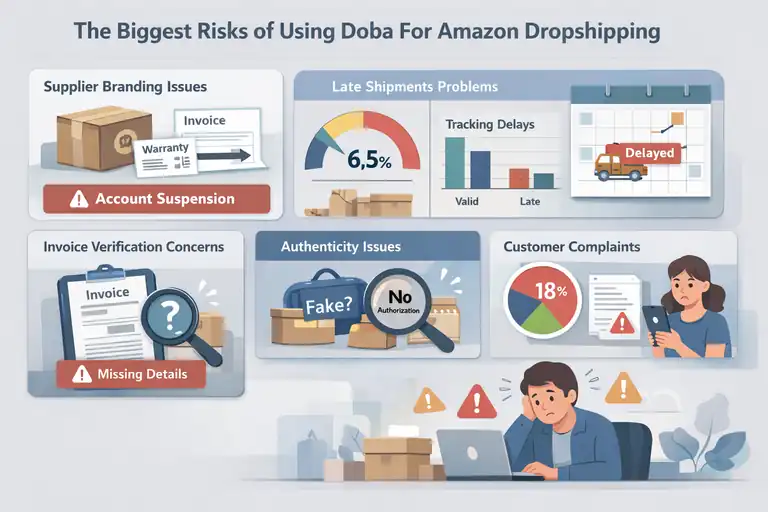
Doba can work, but it carries specific risks that don’t exist with private label or direct wholesale. These risks aren’t theoretical. They show up in suspension notices every week.
Account Suspension Risks From Supplier Branding Issues
This is the number one reason Doba-based Amazon accounts get suspended.
Common triggers include:
- Supplier logos on boxes
- Invoices showing another company
- Warranty cards pointing elsewhere
Amazon calls this “dropshipping policy abuse.” Even one verified instance can lead to a suspension without warning.
Appeals are difficult because Amazon usually asks for proof that you control fulfillment. With Doba, you often don’t have that documentation.
Late Shipping And Tracking Problems With Doba Suppliers
Amazon expects fast, reliable shipping. Many Doba suppliers ship in 3–7 business days, not including processing.
That creates problems with:
- Late shipment rate
- Valid tracking rate
- On-time delivery score
Amazon’s benchmarks are strict. A late shipment rate above 4% can trigger account health warnings.
I’ve seen sellers lose Buy Box eligibility simply because their Doba supplier updated tracking numbers late.
Product Authenticity And Invoice Verification Concerns
When Amazon requests invoices, Doba sellers often struggle.
Why?
- Doba invoices don’t always show brand authorization
- Some suppliers are distributors, not manufacturers
- Invoices may lack required business details
Amazon wants invoices dated within 365 days, showing quantity, brand, and supplier contact info. Not all Doba suppliers provide this cleanly.
Without valid invoices, authenticity claims are almost impossible to fight.
Customer Experience Metrics That Trigger Amazon Reviews
Amazon watches customer experience metrics closely, including:
- Order defect rate
- A-to-z claims
- Negative feedback related to shipping or product quality
Doba sellers are vulnerable here because you don’t control inventory. If a supplier ships the wrong item or runs out of stock, your account takes the hit.
One or two A-to-z claims won’t kill an account, but patterns absolutely will. Amazon’s systems are designed to spot patterns fast.
Common Policy Violations When Using Doba On Amazon
Most Doba-related Amazon suspensions don’t happen because sellers are reckless. They happen because Amazon’s rules are very literal, and Doba’s setup makes it easy to cross lines without realizing it.
Supplier Packing Slips That Violate Amazon Requirements
This is the most common and most preventable violation I see.
Amazon requires that every order looks like it came directly from you. When a Doba supplier includes their own packing slip, Amazon treats that as evidence of unauthorized dropshipping.
Typical red flags Amazon looks for:
- Supplier name or logo on the packing slip
- Supplier website or phone number
- Invoices that list Doba or a third party as the seller
What makes this tricky is that some Doba suppliers claim they ship “blind,” but still include subtle identifiers. I’ve seen slips with tiny footer URLs that were enough to trigger a suspension.
My rule of thumb: always place a test order to yourself first. If the box contains anything you wouldn’t want Amazon to see, that supplier is unusable for Amazon.
Using Doba As A Marketplace Instead Of A Supplier
Amazon is very clear about this, even if sellers aren’t.
You can dropship from a supplier. You cannot fulfill Amazon orders by buying from another marketplace.
If Amazon determines you’re using Doba as an intermediary marketplace rather than a backend supplier, that’s a violation.
Signals Amazon uses to infer this include:
- Retail-style invoices instead of wholesale invoices
- Pricing that matches public supplier listings
- No brand authorization or reseller documentation
This is where doba dropshipping amazon becomes risky. Doba sits in between a marketplace and a supplier network, and Amazon doesn’t care how Doba markets itself. They care how the transaction looks on paper.
Mismatched Product Listings And Brand Registry Issues
This one sneaks up on sellers who scale quickly.
If your Amazon listing doesn’t exactly match what the Doba supplier ships, you’re exposed.
That includes:
- Different brand names
- Different packaging
- Different model numbers or variations
Brand Registry complaints often start when a brand owner notices their product being sold under incorrect details. Once that happens, Amazon may ask for invoices and authorization letters you don’t have.
I’ve seen sellers lose entire ASIN portfolios over a single mismatched brand field.
Pricing Conflicts And MAP Violations With Doba Vendors
MAP pricing stands for Minimum Advertised Price. Many Doba suppliers enforce it quietly.
When you list below MAP on Amazon:
- Suppliers may cut you off
- Brands may file IP complaints
- Amazon may flag price volatility
Because Doba suppliers change pricing without notice, your margins can disappear overnight. Worse, automated repricing tools can unknowingly push you into MAP violations.
This isn’t just a profit issue. It’s a compliance risk that compounds fast.
How To Use Doba With Amazon The Right Way
If you’re going to use Doba with Amazon, you need systems, not hope. This section is about reducing exposure, not eliminating risk completely.
Structuring Orders So You Remain The Seller Of Record
Everything flows from this principle.
To remain the seller of record, you must control how orders are placed, branded, and supported.
That means:
- Manual or semi-automated order routing
- Custom invoice instructions on every order
- Your business name on all customer-facing documents
I strongly suggest avoiding full auto-ordering at the beginning. Automation hides problems until they become account-level issues.
Yes, it’s slower. It’s also safer.
Choosing Doba Suppliers That Support Amazon Compliance
Not all Doba suppliers are Amazon-friendly, even if they say they are.
Before listing anything, verify:
- Neutral or custom packing slips
- Consistent processing times
- Wholesale-style invoices with full business details
Suppliers that ship from U.S. warehouses tend to perform better on Amazon metrics. Overseas fulfillment adds tracking delays that Amazon rarely forgives.
In my experience, it’s better to work with 2–3 reliable Doba suppliers than 50 risky ones.
Managing Shipping Times To Meet Amazon Performance Metrics
Amazon’s key metrics don’t care about your supplier problems.
You need to manage:
- Handling time
- Estimated delivery dates
- Valid tracking upload speed
A practical workaround is padding handling time slightly and choosing suppliers with predictable fulfillment windows. Fast isn’t always better if it’s inconsistent.
Amazon prioritizes reliability over speed.
Handling Returns And Customer Support Without Doba Exposure
Returns are where many Doba sellers get exposed.
Best practices include:
- Using your own return address when possible
- Issuing refunds proactively
- Never directing customers to contact the supplier
If a customer mentions a third-party company in a message to Amazon support, that conversation is logged. Enough of those logs create patterns Amazon investigates.
I know it feels inefficient to act as the middle layer, but that’s exactly what Amazon expects you to do.
When Doba Dropshipping On Amazon Is Not Worth The Risk
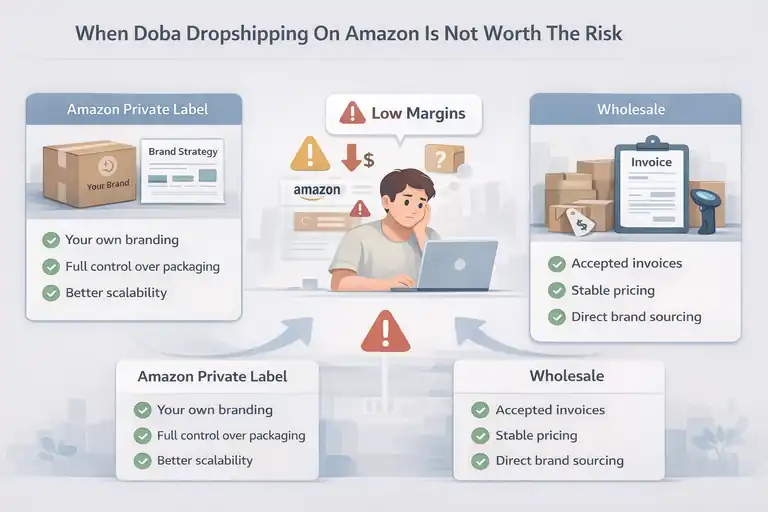
This is the part most people skip, but honestly, it’s the most important.
There are very real situations where continuing with doba dropshipping amazon simply doesn’t make business sense anymore, no matter how carefully you follow the rules.
Scenarios Where Amazon Private Label Is A Better Option
Private label means selling a product under your own brand, even if a manufacturer makes it for you. It sounds intimidating, but in many cases it’s actually safer than Doba.
Private label is usually the better option when:
- You want full control over packaging and branding
- You’re tired of supplier surprises
- You plan to scale past a few hundred orders per month
Amazon tends to trust private label sellers more because there’s no ambiguity about who the seller of record is. You are the brand. You are the supplier. There’s no third party for Amazon to question.
From what I’ve seen, sellers who switch from Doba to private label often reduce account health issues dramatically within 60–90 days.
Why Wholesale Accounts Often Outperform Doba On Amazon
Wholesale means buying inventory directly from an authorized brand or distributor and shipping it yourself or via FBA.
Compared to Doba, wholesale wins on:
- Invoice quality that Amazon actually accepts
- Stable pricing
- Clear brand authorization
Yes, wholesale requires upfront capital. But it also removes most of the policy gray areas that come with Doba. When Amazon asks where your products come from, you can answer in one sentence and back it up with clean paperwork.
In practice, wholesale sellers also win more Buy Boxes because Amazon trusts their fulfillment consistency.
Margin Limitations That Hurt Long-Term Amazon Sellers
This part hurts, but it’s real.
Doba margins are usually thin. After Amazon fees, refunds, and occasional supplier price increases, many sellers are left with 5–10% net margins.
That’s dangerous because:
- One A-to-z claim can wipe out profits
- Ad spend becomes hard to justify
- You have no buffer for mistakes
Amazon is not forgiving when things go wrong. Thin margins mean you’re always one issue away from selling at a loss.
Red Flags That Signal It’s Time To Stop Using Doba
Here are signs I personally treat as exit signals:
- Repeated late shipments you can’t control
- Suppliers refusing neutral packaging
- Amazon asking for invoices more than once
- Customer messages mentioning another company
If two or more of these are happening, I’d seriously consider moving on. Doba can be a stepping stone, but it’s rarely a long-term foundation.
Doba Versus Other Amazon Dropshipping Alternatives
Doba isn’t the only option, and it’s not always the best one. The right choice depends on your goals, risk tolerance, and how serious you are about building a real Amazon asset.
Doba Compared To Wholesale Supplier Relationships
Here’s a simple comparison that reflects real-world experience, not marketing claims:
- Control
- Doba: Low to medium
- Wholesale: High
- Compliance Risk
- Doba: Medium to high
- Wholesale: Low
- Startup Cost
- Doba: Low
- Wholesale: Medium to high
Wholesale requires more effort upfront, but it pays off in stability. Doba is easier to start, but harder to defend when Amazon asks questions.
Doba Versus Private Label For Amazon Sellers
Private label is the highest control option, but also the highest responsibility.
A quick reality check:
- Doba
- Faster to launch
- Easier to test products
- Higher account risk
- Private Label
- Slower setup
- Better margins
- Stronger Amazon trust signals
If your goal is building a sellable brand or long-term income stream, private label almost always wins.
When Doba Makes Sense For Testing Products Only
This is where Doba actually shines.
I believe Doba works best as a testing tool, not a scaling tool.
Smart use cases include:
- Validating demand before bulk buying
- Testing categories you don’t know yet
- Learning Amazon operations with low upfront risk
Used this way, Doba can save you thousands in bad inventory decisions. Just don’t confuse testing with building.
Long-Term Scalability Compared To Direct Supplier Deals
Direct supplier deals, meaning relationships outside of platforms like Doba, are where serious Amazon sellers end up.
Why?
- Custom terms
- Predictable fulfillment
- Negotiated pricing
- Clear compliance documentation
Doba doesn’t scale relationships. It standardizes them. That’s convenient early on, but limiting later.
If your goal is stability, defensibility, and fewer sleepless nights worrying about policy emails, Doba should be a phase, not a destination.
Final Verdict: Is Doba Dropshipping On Amazon Worth It?
Here’s my honest, no-fluff take.
Doba dropshipping on Amazon is allowed, but it lives in a narrow lane with very little room for error. It works best as a short-term tool, not a long-term business model. If you treat it like a way to test products, learn Amazon’s systems, or get started with minimal capital, it can be useful. If you treat it like a scalable, hands-off operation, it becomes risky fast.
Amazon’s enforcement has grown stricter, more automated, and far less forgiving. The platform clearly favors sellers who control inventory, branding, and fulfillment. Doba doesn’t give you that control by default. You have to fight for it, monitor it, and constantly double-check it.
So the real question isn’t “Can you do doba dropshipping amazon?” It’s “How long can you do it safely?”
For most sellers I’ve worked with or observed, the answer is: not forever.
A Simple Decision Framework You Can Use Right Now
Use this as a quick self-check. Be honest with yourself. Amazon always finds the weak spots eventually.
Doba Makes Sense If All Of These Are True
- You are testing products, not building a brand yet
- Your order volume is low to moderate
- You personally audit suppliers and shipments
- You can handle customer support yourself
- You are prepared to exit quickly if Amazon flags issues
In this scenario, Doba is a learning tool. A stepping stone. Nothing more.
Doba Is Risky If Any Of These Are True
- You rely on full automation
- You’ve never tested shipments to yourself
- Your supplier controls packaging or returns
- Amazon has already requested invoices
- Your margins are under 10% after fees
If this sounds like your setup, you’re not running a business. You’re borrowing time from Amazon’s enforcement systems.
Best Practice Tip To Leave You With
If you choose to use Doba, set an exit plan before you place your first listing. Decide in advance what success looks like, what warning signs trigger a stop, and what model you’ll graduate into next.
Amazon rewards clarity and control. Doba offers convenience. Those two don’t always align.
FAQ
Is doba dropshipping amazon allowed?
Yes. Doba dropshipping on Amazon is allowed if you follow Amazon’s dropshipping policy. You must be the seller of record, remove all third-party branding, control customer service, and ensure packing slips and invoices show only your business.
Why is doba dropshipping amazon considered risky?
It’s risky because many Doba suppliers don’t fully support Amazon compliance. Common issues include supplier-branded packing slips, slow shipping, weak invoices, and inconsistent fulfillment, all of which can trigger account reviews or suspensions.
Is Doba good for long-term Amazon selling?
No. Doba works best for short-term product testing or learning Amazon operations. For long-term stability, higher margins, and lower account risk, wholesale or private label models perform better than doba dropshipping amazon.

I’m Juxhin, the voice behind The Justifiable.
I’ve spent 6+ years building blogs, managing affiliate campaigns, and testing the messy world of online business. Here, I cut the fluff and share the strategies that actually move the needle — so you can build income that’s sustainable, not speculative.
Related posts:
 Viral Launch Amazon Success: Boost Rankings & Revenue!
 Is Doba Shopify Worth Using for Dropshipping Stores?
 How to Make Money Dropshipping: 7 Secrets to a $10K/Month
 How To Start A Dropshipping Business With No Money
 Dropshipping Business Model Success: Tips for Long-Term Growth
 Viral Launch Chrome Extension: The Ultimate Tool for Sellers