
Table of Contents
Some links on The Justifiable are affiliate links, meaning we may earn a small commission at no extra cost to you. Read full disclaimer.
This doba review is for anyone considering Doba as a dropshipping supplier and wants a clear, no-nonsense breakdown before committing.
If you’re wondering whether Doba is actually worth the cost, what the real pros and cons are, and how much you’ll truly pay beyond the advertised plans, this answers that exact question.
I’m walking you through what Doba does well, where it falls short, and what most reviews gloss over so you can decide if it fits your business goals.
What Doba Is And How The Dropshipping Platform Works
Doba is a subscription-based dropshipping platform that sits between you and a network of pre-vetted suppliers.
Instead of sourcing products one supplier at a time, Doba acts as a centralized hub where product discovery, order routing, and supplier coordination happen in one dashboard.
If you’re new to dropshipping, this structure can feel reassuring. If you’re more experienced, it may feel restrictive.
How Doba Connects Retailers With Dropshipping Suppliers
Doba doesn’t manufacture or warehouse products itself. It aggregates suppliers and gives you access through a single interface. Think of it as a supplier directory plus order management software rolled into one.
Here’s how that connection works in practice:
- Doba signs agreements with suppliers and lists their catalogs inside the platform
- You browse and select products from those suppliers
- When a customer places an order, Doba passes that order to the correct supplier
From what I’ve seen, this setup lowers the barrier to entry. You don’t need to negotiate with suppliers or vet them individually. That said, you’re also one step removed from the supplier relationship, which limits flexibility later.
A key thing many beginners miss is that you’re not choosing Doba as your supplier. You’re choosing Doba as the middle layer. That distinction matters when pricing, branding, or shipping issues come up.
How Product Importing And Inventory Syncing Functions
Doba supports direct product importing into platforms like Shopify. Product importing simply means pushing product titles, descriptions, images, and prices into your store without manual copy-paste.
Inventory syncing works like this:
- Doba checks supplier stock levels on a schedule
- Your store inventory updates based on that data
- Out-of-stock products are flagged or paused
In theory, this reduces overselling. In reality, inventory updates aren’t always real-time. If a supplier sells out quickly, there can be short delays before your store reflects it.
My personal take: Doba’s syncing is fine for low-volume testing stores. Once you scale or run promotions, the lag becomes more noticeable, especially during high-demand periods.
How Order Routing And Fulfillment Are Handled
Order routing is where Doba leans heavily into automation.
When a customer checks out:
- The order appears inside your Doba dashboard
- Doba routes the order to the correct supplier
- The supplier ships directly to your customer
- Tracking is sent back to Doba and pushed to your store
You don’t manually email suppliers or forward invoices. That’s the convenience you’re paying for.
However, you also lose control. You can’t choose faster shipping methods per order, bundle products across suppliers, or intervene easily when something goes wrong. If fulfillment speed is critical to your brand, this can feel limiting.
What Makes Doba Different From Marketplaces Like AliExpress
Doba and AliExpress often get compared, but they solve different problems.
AliExpress is an open marketplace. Anyone can sell, prices are lower, and supplier quality varies wildly. Doba is curated. You pay for access, but suppliers are pre-approved.
Key differences that matter in real use:
- Doba suppliers are mostly US-based or have US warehouses
- Shipping times are generally shorter than AliExpress
- Product prices are higher due to middleman margins
- Branding and customization options are more limited
If you value speed and simplicity over margins, Doba can feel safer. If you care about cost control and supplier relationships, AliExpress or private sourcing wins long-term.
Doba Pricing Plans, Fees, And Real Monthly Costs
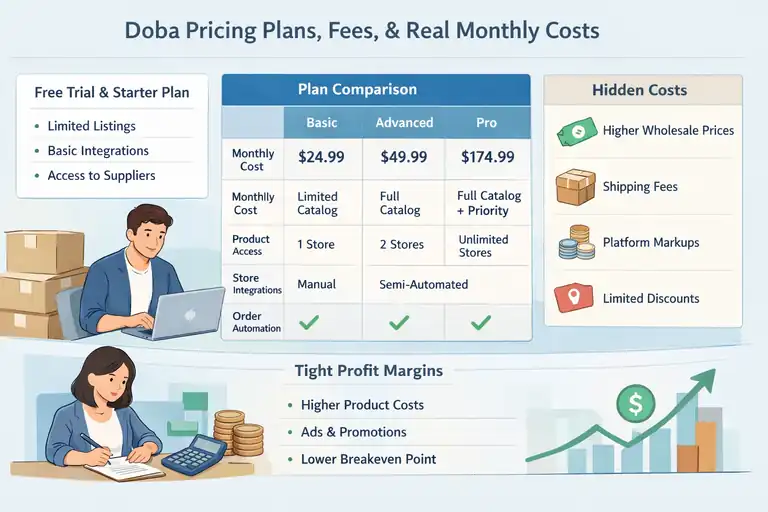
This is where most doba review searches really focus, and for good reason.
Doba’s pricing structure looks simple on the surface, but the real cost only becomes clear when you factor in supplier pricing and margins.
Breakdown Of Doba Free Trial And Entry-Level Plan
Doba offers a free trial that lets you browse products and test the interface. You can’t actually sell products without upgrading, which makes the trial more of a preview than a test drive.
The entry-level paid plan is designed for beginners.
It includes:
- Limited number of product listings
- Basic integrations
- Access to the supplier network
From what I’ve seen, this tier works best for validating whether the platform feels intuitive to you. It’s not ideal for running ads or scaling traffic because listing limits can slow experimentation.
What You Get With Doba Basic, Advanced, And Pro Plans
This is where things get practical. Below is a clear comparison so you can see how the plans differ without marketing fluff.
| Plan Name | Monthly Cost (Approx.) | Product Access | Store Integrations | Order Automation | Best For |
| Basic | $24.99 | Limited catalog | 1 store | Manual approval | New sellers testing ideas |
| Advanced | $49.99 | Full catalog | 2 stores | Semi-automated | Growing stores with traction |
| Pro | $174.99 | Full catalog + priority | Unlimited | Fully automated | High-volume sellers |
What this table doesn’t show
- Higher plans don’t lower product costs
- You’re paying for speed, scale, and automation
- Supplier pricing stays the same across plans
In my experience, most people jump to Advanced faster than expected because manual order approval gets old quickly.
Hidden Costs Beyond The Monthly Subscription Fee
This is the part many Doba reviews gloss over. The subscription is only one piece of the cost puzzle.
Other costs include:
- Higher wholesale prices compared to direct suppliers
- Shipping fees that vary by supplier
- Limited ability to negotiate bulk discounts
- Platform fees baked into product pricing
For example, a product that costs $12 on AliExpress might cost $18–$22 on Doba before shipping. That difference adds up fast if you’re running paid ads.
How Supplier Pricing Impacts Your Actual Profit Margins
Doba suppliers set their own prices, and those prices already include Doba’s margin. You don’t see that breakdown, but you feel it in your profit math.
Let me break it down simply:
- Higher product cost means higher breakeven point
- Ads become harder to optimize profitably
- Discounts and promotions eat margin faster
In my experience, Doba works best for stores focused on organic traffic, content, or marketplaces where speed matters more than price. If your business model depends on aggressive paid advertising, margins can feel tight very quickly.
Key Pros Of Using Doba For Dropshipping Businesses
Doba’s biggest strengths show up when you value simplicity, speed, and reduced operational friction.
It’s not the cheapest platform, but it removes several headaches that commonly trip up beginners and early-stage sellers.
Access To US-Based And International Suppliers
One of Doba’s strongest selling points is access to suppliers with US-based warehouses, alongside international options. In simple terms, that means faster shipping for many products without you having to negotiate logistics yourself.
Here’s why that matters in real-world use:
- US-based suppliers typically deliver in 3–7 business days
- Faster delivery reduces chargebacks and customer complaints
- Shipping times are more predictable than AliExpress
From what I’ve seen, stores using US-based Doba suppliers tend to get fewer “Where is my order?” emails. That alone can save hours each week.
That said, not every product ships from the US. You still need to check supplier location per item. I suggest filtering by warehouse location before adding products, especially if you’re selling to US customers.
Centralized Product Catalog And Supplier Management
Doba’s centralized catalog means you’re browsing products from many suppliers in one place, instead of jumping between websites, emails, and spreadsheets.
Practically, this gives you:
- One dashboard for product discovery
- Unified pricing and inventory views
- No need to manage multiple supplier logins
For beginners, this is huge. I remember how overwhelming supplier outreach felt early on. Doba removes that friction.
The downside is choice overload. Many products are identical across suppliers, often with similar pricing. My workaround is to sort by shipping location first, then compare margins manually. It’s slower, but it prevents listing overpriced products that won’t convert.
Automated Order Processing And Tracking Updates
Automation is where Doba earns its subscription fee. Once your store is connected, orders flow without manual forwarding.
Here’s the simplified order flow:
- Customer places an order in your store
- Order appears in Doba automatically
- Supplier receives fulfillment request
- Tracking is pushed back to your store
This reduces human error and saves time, especially once you’re handling multiple daily orders.
In my experience, automation works best when you’re selling single-SKU products. Multi-supplier carts can still get messy, and Doba doesn’t handle split shipments gracefully.
Platform Stability And Ease Of Use For Beginners
Doba’s interface is clean, predictable, and relatively bug-free. That may sound boring, but boring is good when money is involved.
Why beginners tend to stick with it:
- Clear navigation and product filters
- Minimal technical setup
- Low learning curve compared to custom sourcing
I’ve seen many new sellers quit dropshipping not because it failed, but because the tools felt overwhelming. Doba lowers that barrier. It won’t make you profitable on its own, but it won’t trip you up technically either.
Biggest Cons And Limitations Found In This Doba Review
This is where honesty matters. Doba solves convenience problems, but it introduces trade-offs that directly affect margins, branding, and long-term scalability.
Limited Product Customization And Branding Options
If branding matters to you, Doba will feel restrictive.
Most suppliers on Doba:
- Use generic packaging
- Don’t support custom inserts
- Don’t offer private labeling
In plain terms, your customer won’t remember your brand. They’ll remember the product.
This makes Doba a poor fit for long-term brand building. I see it more as a testing platform. Once a product proves demand, moving to a private supplier usually makes more sense.
Higher Wholesale Prices Compared To Alternatives
This is the most common complaint in any doba review, and it’s valid.
Because Doba sits between you and the supplier:
- Wholesale prices include platform margins
- You have little room to negotiate
- Competitors sourcing directly often undercut you
A realistic example I’ve seen:
- Product cost on Doba: $24
- Same product via private supplier: $15–$17
- That $7 difference can wipe out ad profitability
If you rely heavily on paid ads, these margins can make scaling frustrating.
Supplier Transparency And Product Quality Concerns
Doba doesn’t always disclose full supplier details upfront. You often won’t know who the supplier is until after deeper inspection.
Why this matters:
- You can’t research supplier reputation externally
- Quality varies more than expected
- Product images don’t always match reality
My personal rule is to order samples for any product I care about. It adds upfront cost, but it’s cheaper than dealing with refunds later.
Customer Support Speed And Resolution Challenges
Doba offers support, but response times aren’t always fast, especially on lower-tier plans.
Common support frustrations include:
- Delayed responses during high-volume periods
- Limited power to resolve supplier-side issues
- Generic replies for complex problems
Because Doba isn’t the supplier, they’re often stuck relaying messages back and forth. That extra layer can slow resolution when something goes wrong.
Product Selection Quality And Supplier Vetting Process
Product quality and supplier reliability are where many dropshipping platforms quietly succeed or fail.
Doba positions itself as a curated network, but the real experience depends on how well you understand what’s actually inside the catalog.
Types Of Products Most Commonly Found On Doba
Doba’s catalog leans heavily toward practical, evergreen product categories rather than trending or viral items. You’ll notice patterns quickly once you browse for a while.
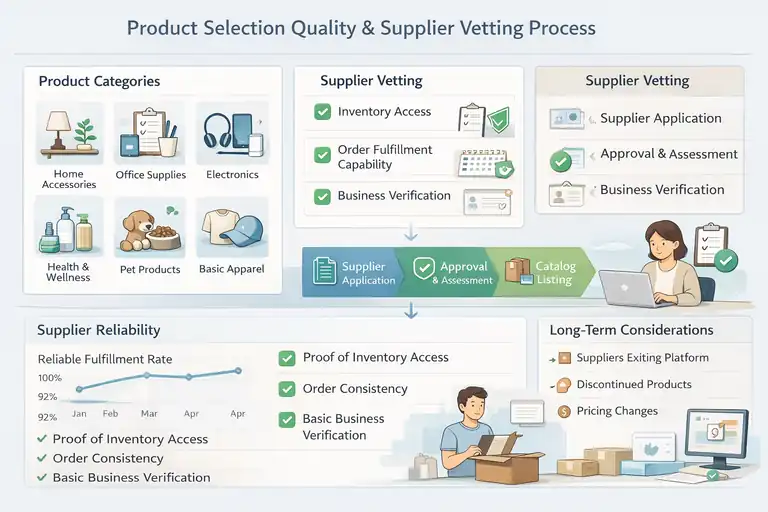
Most common product categories include:
- Home and kitchen accessories
- Office and business supplies
- Electronics accessories, not high-end electronics
- Health, wellness, and personal care items
- Pet products and basic apparel
These are not impulse-buy TikTok products. They’re everyday items with steady demand and lower refund risk.
From what I’ve seen, Doba works best when you’re building a niche store around utility rather than hype. For example, an office supplies store targeting remote workers performs more naturally here than a flashy gadget brand.
The trade-off is excitement. You won’t be first to market on trends. You’ll be competing on convenience, trust, and delivery speed instead.
How Doba Vetts And Approves Its Suppliers
Doba states that suppliers go through an approval process before being added to the platform. In simple terms, that means suppliers must meet baseline requirements for fulfillment capability, product availability, and operational reliability.
What this vetting usually covers:
- Proof of inventory access
- Ability to fulfill orders consistently
- Basic business verification
What it doesn’t guarantee:
- Premium product quality
- Competitive pricing
- Exceptional customer service
In my experience, Doba’s vetting reduces outright scams, not mediocre suppliers. You’re less likely to get burned completely, but you’re still responsible for quality control.
That’s why I always recommend ordering samples for top products. A $40 test order can save you hundreds in refunds and chargebacks later.
Risks Of Product Overlap And Market Saturation
Because Doba is a shared catalog, product overlap is unavoidable. You’re often selling the same item as dozens of other stores using the same supplier.
Real risks this creates:
- Price undercutting between sellers
- Identical product images across stores
- Reduced brand differentiation
If you list products straight out of the catalog without modification, you’re competing on price alone. That’s rarely sustainable.
My workaround is simple but effective:
- Rewrite product descriptions in your own voice
- Bundle complementary products when possible
- Focus on niche positioning instead of general appeal
Even small tweaks can help you stand out in a crowded catalog.
Long-Term Reliability Of Doba Supplier Relationships
Doba suppliers can come and go. This is something many sellers only notice after months of operation.
What can happen over time:
- Suppliers leave the platform
- Product SKUs get discontinued
- Pricing changes without much notice
This isn’t unique to Doba, but the lack of direct supplier relationships makes it harder to adapt quickly.
For long-term stores, I see Doba as a stepping stone. It’s reliable enough to validate demand, but once a product proves consistent sales, transitioning to a direct supplier usually improves margins and stability.
Doba Integrations With Shopify, WooCommerce, And More
Integrations are where Doba feels genuinely polished. The platform focuses on reducing technical friction so you can spend more time on marketing and less on backend tasks.
How Doba Integrates With Shopify Stores
Shopify is Doba’s strongest integration by far. Setup is straightforward, even if you’re not technical.
Here’s how it typically works:
- Connect your Shopify store to Doba
- Import products directly into your store
- Sync orders and tracking automatically
Product importing includes images, descriptions, and pricing, which saves hours of manual work.
One thing I appreciate is how Doba handles order status updates. Customers receive tracking info without you needing to intervene, which helps maintain trust.
That said, always review imported descriptions. They’re functional, not persuasive. Conversion optimization is still on you.
WooCommerce And Other Ecommerce Platform Compatibility
WooCommerce integration exists, but it’s less seamless than Shopify.
You can expect:
- Basic product importing
- Manual checks for inventory accuracy
- Occasional sync delays
Other platforms are supported in more limited ways, often requiring CSV uploads or manual steps.
If you’re running WooCommerce, Doba is usable, just not elegant. I’d budget extra time for spot-checking inventory and pricing to avoid surprises.
Limitations Of Doba API And Automation Tools
Doba does offer API access, but it’s not designed for heavy customization. In plain English, you can automate basics, but you can’t deeply customize workflows.
Limitations include:
- Limited control over order logic
- Minimal customization for fulfillment rules
- No advanced automation triggers
For most beginners, this won’t matter. For advanced sellers, it can feel restrictive quickly.
If you’re the type who loves building custom flows or syncing multiple systems, Doba may feel boxed-in.
Sync Accuracy For Pricing, Inventory, And Orders
Sync accuracy is generally solid, but not perfect.
What works well:
- Order syncing is reliable
- Tracking updates usually push correctly
- Price changes are reflected eventually
Where issues arise:
- Inventory updates can lag during high demand
- Supplier stock changes aren’t always instant
My personal habit is to avoid running flash sales on Doba products. The sync delay risk isn’t worth the potential overselling headaches.
Who Doba Is Best For And Who Should Avoid It
Not every dropshipping platform is meant to scale forever, and Doba is a good example of that. It shines in specific scenarios and becomes frustrating in others. Knowing where you fall saves time and money.
Best Fit For Beginners Testing Dropshipping Models
Doba is genuinely beginner-friendly, especially if you’re still figuring out whether dropshipping even fits your lifestyle or skills.
It works well if you:
- Want to launch quickly without supplier outreach
- Prefer a guided, structured platform
- Are testing niches before committing long-term
In early-stage testing, speed matters more than margins. Doba lets you validate ideas without getting stuck in technical weeds.
I’ve seen beginners burn out trying to “do it the right way” too early. Doba removes complexity so you can focus on basics like product-market fit and customer behavior.
If this is your first store, that simplicity can be worth the premium.
Why Advanced Sellers May Outgrow Doba Quickly
Once you know what you’re doing, Doba’s guardrails start to feel like walls.
Advanced sellers usually want:
- Direct supplier relationships
- Custom pricing negotiations
- Branding control and packaging options
- Flexible fulfillment workflows
Doba limits all of that.
In my experience, sellers who rely on paid ads outgrow Doba the fastest. Margins get squeezed, and optimization becomes harder. At that point, convenience stops justifying the cost.
Doba isn’t broken for advanced sellers. It’s just not built for them.
Use Cases Where Doba Makes Financial Sense
There are scenarios where Doba’s pricing actually works in your favor.
It makes sense when:
- You sell high perceived-value products
- Traffic comes from SEO or email, not ads
- Shipping speed increases conversion rates
- Customer support time needs to stay minimal
For example, a niche store targeting corporate buyers or institutions often benefits from reliability more than rock-bottom pricing.
In those cases, Doba’s higher costs can be absorbed without killing profitability.
Situations Where Doba Can Hurt Profitability
Doba becomes risky when margins are already thin.
Watch out if:
- You rely heavily on Facebook or Google Ads
- Your products compete directly on price
- You need frequent discounts or promos
In those situations, every extra dollar in product cost matters. I’ve seen stores with solid conversion rates still lose money because margins couldn’t support ad spend.
That’s usually the point where switching platforms becomes unavoidable.
Doba Compared To Top Dropshipping Alternatives
No doba review is complete without context. The platform only makes sense when you compare it to realistic alternatives and understand what you’re trading off.
Doba Vs Spocket For US-Based Product Sourcing
Both platforms emphasize faster shipping, but they approach it differently.
Quick comparison:
- Doba focuses on centralized access and automation
- Spocket focuses on curated, higher-quality suppliers
- Spocket often offers better branding options
- Doba usually has a larger raw catalog
Spocket tends to win if you care about brand feel and premium positioning. Doba wins if you want volume and simplicity.
If I had to choose for a brand-focused store, I’d lean Spocket. For quick testing, Doba still has an edge.
Doba Vs SaleHoo For Supplier Research And Costs
SaleHoo isn’t a fulfillment platform. It’s a supplier directory.
Key difference:
- Doba handles fulfillment for you
- SaleHoo helps you find suppliers, then you deal directly
SaleHoo requires more effort, but costs less long-term. Doba costs more but saves time.
If you’re comfortable emailing suppliers and negotiating, SaleHoo usually leads to better margins. If that sounds exhausting, Doba feels easier.
Doba Vs AliExpress And Private Supplier Models
AliExpress remains the cheapest option for many products, but it comes with trade-offs.
AliExpress pros:
- Lower product costs
- Massive product variety
AliExpress cons:
- Longer shipping times
- Quality inconsistency
- Supplier reliability issues
Private suppliers combine the best of both worlds but require volume and experience.
My honest take: Doba sits between AliExpress and private sourcing. It’s safer than AliExpress, easier than private suppliers, and more expensive than both.
When Switching From Doba Becomes The Smart Move
Switching makes sense when:
- A product shows consistent monthly sales
- You need better margins to scale ads
- Branding starts to matter more
At that stage, Doba has done its job. Holding onto it too long can slow growth instead of supporting it.
Final Verdict: Is Doba Worth The Cost In 2025
So after everything, is Doba actually worth paying for this year? The answer depends less on the platform and more on where you are in your journey.
When Doba Is A Smart Starting Platform
Doba is worth it if you value:
- Speed over optimization
- Structure over flexibility
- Lower operational stress
For beginners and testers, it’s a safe place to learn without breaking too much.
When Doba’s Pricing Outweighs Its Convenience
Doba stops making sense when:
- Ad costs rise
- Competition increases
- Brand differentiation becomes essential
At that point, the monthly fee isn’t the problem. The opportunity cost is.
What I’d Personally Consider Before Subscribing
Before subscribing, I’d ask myself:
- Am I testing or scaling?
- Do I need speed or margins right now?
- Will this platform still fit me in six months?
Answering those honestly saves regret later.
One Practical Tip To Test Doba Without Risk
Here’s my favorite low-risk approach:
- Use Doba to test 1–3 products only
- Avoid paid ads initially
- Track conversion rates and customer feedback
- Switch suppliers once demand is proven
That way, Doba becomes a tool, not a trap.
FAQ
Is Doba Worth It For Beginners In 2025?
Yes, for beginners who want to test dropshipping without dealing with suppliers directly. This doba review shows Doba works best for learning the model, validating products, and launching fast, but it’s not ideal for long-term scaling due to higher costs.
How Much Does Doba Really Cost Per Month?
Doba’s real cost is more than the subscription fee. Beyond the monthly plan, you pay higher wholesale prices, supplier shipping fees, and reduced margins compared to direct sourcing. In practice, many sellers see product costs 20–40% higher than alternatives like AliExpress or private suppliers.
What Is The Biggest Downside Of Doba?
The biggest downside is profit margin limitation. Doba’s convenience comes at the cost of higher product prices, limited branding control, and little room for negotiation. This makes paid advertising and aggressive scaling harder compared to other dropshipping options.

I’m Juxhin, the voice behind The Justifiable.
I’ve spent 6+ years building blogs, managing affiliate campaigns, and testing the messy world of online business. Here, I cut the fluff and share the strategies that actually move the needle — so you can build income that’s sustainable, not speculative.
Related posts:
 SaleHoo Review: Is It Legit or a Scam? My Honest Take
 How to Find Trending Products for Dropshipping That Sell Fast
 The Best SaleHoo Shopify Suppliers for Dropshipping
 Dropshipping Marketing Strategies That Actually Drive Sales
 Why the Salehoo Wholesale Directory Helps You Scale
 Dropshipping Platforms Ranked: Speed, Fees, and Control