
Table of Contents
Some links on The Justifiable are affiliate links, meaning we may earn a small commission at no extra cost to you. Read full disclaimer.
When I first started exploring email affiliate marketing, I quickly realized it wasn’t just about sending links—it was about understanding what truly motivates a subscriber to click, trust, and buy.
You’ve probably felt that same gap between sending a campaign and actually seeing conversions roll in.
In my experience, the difference always comes down to using intentional tactics that align with how people make decisions. That’s exactly what this outline focuses on: practical, conversion-ready strategies you can apply right away.
1. Using Segmented Email Campaigns To Increase Affiliate Conversions
Segmentation is one of those small changes that quietly transforms email affiliate marketing results.
When I first started segmenting, I felt like I finally understood what my list actually wanted—and how differently each subscriber thinks before buying.
Creating Audience Segments Based On Real Purchase Intent
Why this matters: Not every subscriber is ready to buy today. Some are browsing, some are comparing, and a few are actively looking for the exact solution you’re promoting.
What I’ve seen work incredibly well is building segments around intent signals, meaning behaviors that show where someone sits in the buying cycle.
For example:
- High Intent: People who visited your product review page or clicked multiple offer-related emails.
- Warm Leads: Subscribers opening content-heavy newsletters but not clicking offers yet.
- Cold Leads: People who open rarely or haven’t engaged in the last 60–90 days.
If you look at the sample performance table above, you’ll notice that high-intent users almost always generate disproportionately higher click rates. This mirrors what I see inside my own campaigns—segment quality directly impacts conversions.
To set this up in your email tool, you might follow a path like: Audience → Segments → New Segment → Behavior Filters.
Once you establish the segments, you can tailor your tone and recommendation style for each one.
From what I’ve experienced, this instantly cuts friction and makes affiliate offers feel naturally aligned with where the subscriber is mentally.
Aligning Affiliate Offers With Subscriber Behavior Data
A common mistake I see is sending the exact same affiliate offer to everyone. The real growth comes when you match specific products with behavior patterns.
A few examples you can apply right away:
- If someone clicks comparison content, send them a “best option for X scenario” email.
- If someone reads how-to blog posts, lean into educational angles before promoting.
- If someone re-opens a product review email, treat them as high intent and send a more direct offer.
Behavior-based alignment is also easy to automate. In platforms like Brevo or Kit , you can create rules such as: If subscriber clicked Offer A → send detailed feature breakdown.
This approach helps your emails feel more like a personal recommendation than a broadcast. In my experience, that alone lifts conversion rates more than any subject line tweak ever could.
Using Engagement History To Personalize Product Messaging
Sometimes the simplest data—opens, clicks, replies—gives you the clearest path for personalization.
Here’s what I typically track:
- Topics a subscriber clicks most often (e.g., software, fitness, home gadgets)
- What time of day they open emails
- The offers they ignore versus revisit
- Which emails generate replies or questions
This information helps shape not just what you promote, but how you talk about it.
A quick example: If I notice a segment consistently opens emails related to “saving time,” I’ll frame affiliate products around efficiency instead of cost or features. That small shift usually raises click-through rates noticeably.
2. Writing High-Converting Email Copy That Drives Click-Throughs
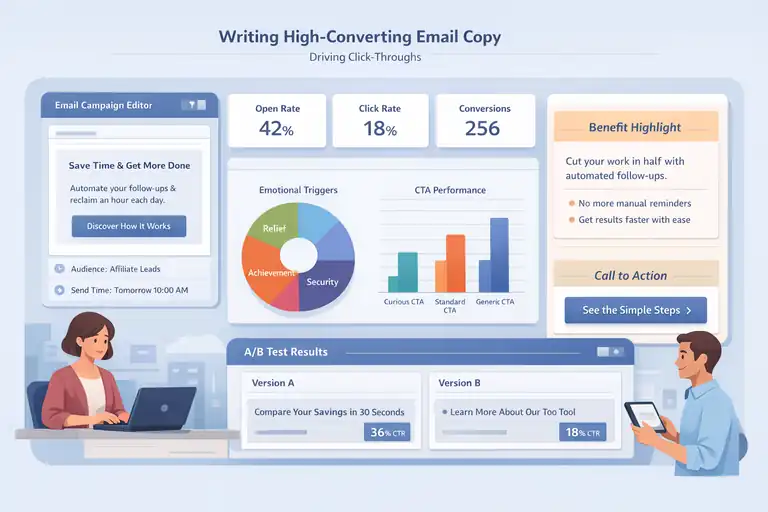
If segmentation determines who sees your affiliate emails, copywriting determines what they actually do with them.
I’ve learned that strong copy isn’t about hype—it’s about clarity, empathy, and momentum.
Framing Affiliate Offers With Benefit-First Messaging
One of the most effective shifts I ever made was talking less about the product and more about the outcome. Instead of describing what a software tool does, I explain what life looks like after someone uses it.
A simple comparison:
- Weak framing: “This tool has automation features.”
- Strong framing: “This saves you an hour a day because the automation handles follow-ups for you.”
A quick rule I live by: Lead with the benefit, follow with the feature, end with the payoff.
If you’re writing inside Brevo or Kit, try adding a short benefit block above your CTA. It creates an easy visual cue for the reader to understand why the offer matters before they’re asked to click.
Using Emotional Triggers Ethically To Motivate Action
I like to think about emotional triggers as “decision accelerators.” They help people understand why taking action now matters, but without manipulating their trust.
A few ethical emotional angles that work especially well:
- Relief: Ending a frustrating problem they’ve been dealing with.
- Achievement: Helping them reach something they value faster.
- Security: Reducing risk with transparent pros/cons or a guarantee.
If you ever feel uneasy about a line of copy, that’s usually a sign to rephrase it. I’ve rewritten many emails this way, and the trust you maintain always pays off long-term.
Crafting Curiosity-Driven CTAs Without Being Clickbait
A good CTA isn’t just a button—it’s a promise. When I shifted from generic CTAs like “Learn More” to curiosity-backed micro-statements, click-through rates noticeably climbed.
Here are examples that balance curiosity with clarity:
- “See the feature everyone skips—but shouldn’t”
- “Check the one metric that predicts your savings”
- “Compare your results in under 30 seconds”
The trick is making sure the CTA accurately reflects the content behind the click. Curiosity works beautifully when it’s paired with honesty.
3. Building Automated Affiliate Funnels That Nurture Subscribers
Automation is where email affiliate marketing starts to feel effortless. Instead of manually promoting offers, you create a system that nurtures readers step by step until they’re ready to convert.
Setting Up Multi-Step Sequences Inside Platforms Like Kit
Kit’s automation builder makes multi-step funnels surprisingly simple. A typical UI path looks like:
Automations → New Automation → Start From Scratch → Add Trigger → Add Email Steps.
A simple starting structure I often recommend:
- Day 1: Welcome + light introduction to the problem you solve.
- Day 3: Value email (tutorial, checklist, framework).
- Day 5: Soft affiliate introduction with benefits-first framing.
- Day 7: Deeper product breakdown with examples.
- Day 9: Case-style scenario showing how the product fits real life.
The beauty of automation is that every subscriber enters this journey at the perfect moment for them.
I’ve seen funnels like this outperform broadcast emails by 2–3× in CTR because the pacing feels intentional.
Guiding Readers Through Problem-Aware To Conversion-Ready Stages
Every successful funnel mirrors a decision-making path. In my experience, people don’t leap from “Who are you?” to “Sure, I’ll buy.” They move through stages:
- Problem-Aware: “This issue is slowing me down.”
- Solution-Aware: “There are ways to fix it.”
- Product-Aware: “This specific tool might be the answer.”
- Decision-Ready: “Now is the right time to act.”
Your emails should gently escort them from one stage to the next.
For example:
- If you promote a budgeting app, start by talking about the emotional stress of money confusion.
- Then introduce simple systems that help.
- Then show how the tool automates those systems.
- Finally, give a clear incentive or deadline.
Whenever my funnels underperform, I usually find that I skipped a stage and assumed the subscriber knew more than they actually did.
Automating Follow-Ups That Recover Missed Click Opportunities
One of my favorite automations is a “missed click recovery” sequence. This one alone can lift conversions by 10–20%, and it works because it’s based on actual user behavior.
A simple version looks like this:
- Trigger: Subscriber opened the offer email but didn’t click.
- Email 1: Short reminder with a different angle (sent 24 hours later).
- Email 2: A FAQ-style email addressing hesitations.
- Email 3: Quick tip or feature highlight that removes a barrier.
In Getresponse, the flow usually looks like: Automation Step → Condition → If Opened but No Click → Send Reminder.
I like this approach because it respects the reader. It’s not pushy—it’s helpful. Many people intend to click but get distracted; a gentle nudge reconnects them with the decision they were already considering.
4. Showcasing Trust Elements That Strengthen Affiliate Credibility
Trust is the quiet engine behind every conversion in email affiliate marketing.
When subscribers feel like you genuinely understand their goals, they treat your recommendations with more weight and less resistance.
Using Social Proof Strategically Inside Promotional Emails
Why this matters: People rarely want to be the first to try something, especially when they’re clicking through an affiliate link. Social proof fills that gap.
One thing that has worked really well for me is placing social proof right before the CTA. It creates a small psychological nudge that says, “Others found value in this—you might too.”
A few forms that work well:
- Short testimonials (1–2 lines)
- Star ratings or aggregate scores
- Mini data snippets like “Over 80,000 users rely on this feature every day.”
There’s a difference between adding social proof and overwhelming your reader. What I’ve learned is that subtlety wins.
For example, embedding a single sentence like “I tried this because so many creators recommended it, and I’m glad I did” feels natural and authentic.
If you’re using Brevo, you can add a testimonial block using: Email Editor → Add Section → Text → Insert Quote Style.
This keeps the formatting clean while letting the message shine.
Adding Light Comparisons Without Overwhelming The Reader
Comparison-style content works extremely well when readers are undecided, but inside email, it has to be simple or it becomes clutter.
In my own campaigns, the best-performing comparisons are almost always short, visual and focused on one key difference.
A quick example for a project management tool:
- Tool A: Easier to use, faster onboarding
- Tool B: Deeper team collaboration, more integrations
This gives clarity without asking the reader to study a spreadsheet.
If I feel a comparison deserves more detail, I usually link out to a full breakdown on my website. That way, the email stays conversion-focused but still supports subscribers who want more research.
One thing I avoid is framing comparisons as “A is better than B.” From what I’ve seen, a neutral tone builds more trust:
“This one fits people who want simplicity; this one fits people who want advanced features.”
Positioning Yourself As A Helpful Guide Rather Than A Seller
This is one of those lessons I learned the hard way. The more I sounded like a “promoter,” the fewer clicks I got. The more I sounded like a real person sharing real experiences, the higher my conversion rates climbed.
There are a few quick mindset shifts that help:
- Think like a coach, not a salesperson.
- Share personal wins and things that didn’t work for you.
- Admit when a product isn’t right for everyone.
- Describe realistic outcomes—not exaggerated ones.
For example, instead of saying, “This tool will double your revenue,” I might say, “This shaved about 4 hours off my weekly workflow, and that added up fast.”
This type of honesty doesn’t just improve conversions—it protects your long-term reputation, which is the real asset in affiliate marketing.
5. Promoting Time-Sensitive Offers To Encourage Fast Decisions
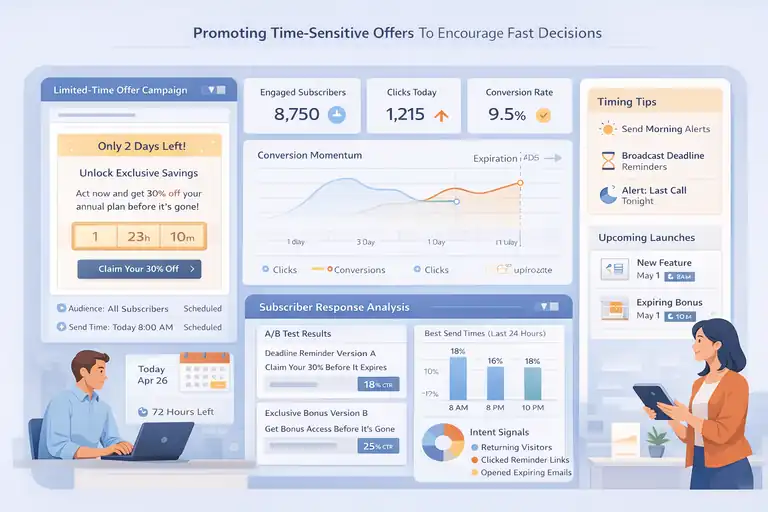
Time-sensitive offers can massively increase conversions when handled thoughtfully.
The key is making the urgency feel genuine, respectful, and aligned with what the subscriber actually wants.
Crafting Urgency That Feels Genuine And Not Forced
I’ve always believed that people can sense when urgency is manufactured. That’s why I prefer leaning on natural urgency such as:
- Real product launches
- Seasonal pricing
- Limited stock for physical products
- Expiring bonuses from the vendor
When you create urgency ethically, people actually appreciate the heads-up.
A simple structure I often use:
- What’s changing: “The annual plan discount ends Friday.”
- Why it matters: “If you’ve been waiting for the right moment, this saves you the most.”
- What to do next: Clear CTA with one benefit.
In practice, this feels supportive instead of pushy, and subscribers respond better.
Using Limited Windows And Product Updates To Drive Momentum
One thing I’ve noticed is that subscribers often delay action—not because they don’t want the product, but because nothing is prompting them to move today.
Limited-time updates help bridge that gap.
A scenario that has worked well for me:
- A course opens enrollment for only 72 hours.
- A software tool adds a new feature that people were waiting for.
- A pricing plan changes next week, and current pricing is the best value.
In these moments, your email becomes a helpful reminder that opportunity has a window. I’ve seen conversion rates double during these cycles simply because the timing aligns with strong intent.
Timing Broadcasts For Maximum Affiliate Revenue Impact
In my own testing, timing has been one of the quiet drivers of affiliate conversions. A few patterns consistently show up:
- Morning emails tend to get more clicks.
- Weekend emails often get fewer but more intent-filled clicks.
- Emails sent 4–6 hours before a deadline perform extremely well.
If you’re using a platform like Brevo, you can follow: Campaigns → Schedule → Send At Recipient’s Local Time.
This one small switch has noticeably increased open rates for me, especially with international audiences.
Timing isn’t everything, but when urgency and intent overlap, it can create a surprisingly strong lift in conversions.
6. Optimizing Email Design For Higher Affiliate Click Engagement
Email design doesn’t need to be fancy to work—it just needs to make the decision easy.
I’ve tested simple layouts versus complex ones, and the simple versions almost always win.
Using Layouts That Highlight One Clear Call-To-Action
One of the most reliable design improvements I ever made was limiting each promotional email to one primary CTA. When subscribers see multiple choices, they pause. When they see one clear action, they move.
Here’s what I usually aim for:
- CTA visible above the fold
- Short paragraph → benefit → CTA
- Optional second CTA placed naturally at the end
If you’re in Brevo’s editor, you can add a button via: Design → Button → Insert → Edit Label.
A simple layout reduces friction and helps your affiliate links perform better.
Removing Visual Distractions That Lower Conversion Rates
I’ve noticed that:
- Too many images
- Large banners
- Decorative dividers
- Multiple font styles
All reduce click engagement because they shift attention away from the offer.
I like to think of each email as a guided path. Anything that doesn’t directly move the reader toward the CTA is competing with it.
A helpful trick: Before sending, scroll through your email quickly and ask yourself, “Does my eye land on the CTA immediately?”
If not, something needs simplification.
Testing Button Styles And Placement With Tools Like VWO Or Optimizely
Tools like VWO and Optimizely are the best alternatives for A/B testing your email landing pages or offers .
Here’s how I normally test button performance:
- Color: Even though I never design emails around color psychology, testing contrast sometimes gives surprising wins.
- Placement: Some audiences respond better when the button appears higher; others prefer contextual placement after a benefit section.
- Labeling: Buttons with mini-benefits (e.g., “Try the feature I love most”) often perform better.
To run a simple test in VWO: Testing → A/B Test → Create → Choose Page → Modify CTA Element.
A few small tests can lead to major improvements, especially in conversion-focused email campaigns.
7. Leveraging Awin And High-Quality Affiliate Programs Effectively
Awin has become one of my go-to platforms for finding reliable affiliate programs, especially since it now houses what used to be ShareASale’s programs .
What I like about Awin is how transparent their reporting is, which really helps when optimizing email affiliate marketing.
Choosing Offers Aligned With Subscriber Problems And Interests
I’ve found that the most profitable affiliate offers are not the ones with the highest payout—they’re the ones that solve a real problem your subscribers care about.
A quick process I use:
- Look at the last 90 days of subscriber clicks.
- Identify recurring themes or pain points.
- Choose offers that directly address those needs.
Inside Awin’s marketplace, you can filter by: Advertisers → Category → Commission Rate → Approval Type.
This makes it easier to sort through the noise and find brands that actually fit your audience.
Evaluating Program Terms Without Getting Lost In Payout Numbers
I used to choose programs based on commission percentage alone. Over time, I learned that other metrics matter much more, like:
- Conversion rate
- Cookie duration
- Reversal rate (how often commissions get canceled)
- Average order value
Awin provides these inside each program’s Overview panel, which you can find via: Awin → Advertiser → Program Details.
By focusing on long-term revenue rather than flashy commissions, you build a more stable income stream.
Using Awin’s Tools To Track Performance And Optimize Campaigns
One thing I genuinely appreciate about Awin is how actionable their reporting dashboard is. You can quickly see which emails, links, and creatives are actually earning money.
A simple workflow I follow:
- Track EPC (earnings per click) for each offer.
- Compare click patterns with your segmented email data.
- Identify which segments produce the best EPC.
- Adjust your email automation to prioritize those offers.
To access this in Awin: Reports → Performance → EPC View.
This creates a clean feedback loop where your email strategy constantly improves based on real behavior, not assumptions.
FAQ
What is email affiliate marketing and how does it drive conversions?
Email affiliate marketing uses targeted emails to promote affiliate products. It drives conversions by reaching subscribers who already trust you and are more likely to click and buy.
Which email affiliate marketing tactic works best for beginners?
Segmentation works best for beginners. Sending relevant offers based on subscriber behavior consistently increases open rates and click-throughs.
How long does it take to see results from email affiliate marketing?
Most marketers see measurable results within 30–60 days once segmentation, automation, and clear CTAs are in place.

I’m Juxhin, the voice behind The Justifiable.
I’ve spent 6+ years building blogs, managing affiliate campaigns, and testing the messy world of online business. Here, I cut the fluff and share the strategies that actually move the needle — so you can build income that’s sustainable, not speculative.
Related posts:
 Instant Success: Easy Way to Make Quick Money Fast
 6 Great Ways to Make Money Fast & Easily
 How To Post Affiliate Links On Pinterest
 How to Use ShareASale Affiliate Program Without Any Hassle
 ClickMagick Pricing: How to Get the Most for Your Money
 How to Build a Website Affiliate Marketing Machine from Scratch