
Table of Contents
Some links on The Justifiable are affiliate links, meaning we may earn a small commission at no extra cost to you. Read full disclaimer.
If you’ve been exploring ways to launch or scale your online store, chances are you’ve stumbled upon SaleHoo Wholesale and Alibaba as two leading platforms for sourcing products.
I remember the first time I compared them—it felt like choosing between two different worlds: one built for ease and verified suppliers, the other a massive open marketplace full of opportunity (and risk).
In this guide, we’ll break down SaleHoo Wholesale vs. Alibaba in a clear, practical way—so you can decide which platform truly fits your business goals, budget, and experience level.
Understanding How SaleHoo Wholesale and Alibaba Work
Before deciding which platform fits your business, it helps to understand how SaleHoo Wholesale and Alibaba operate behind the scenes.
While both connect buyers with suppliers, their structures and goals are very different—one focuses on reliability and simplicity, the other on massive scale and flexibility.
How SaleHoo Wholesale Operates as a Curated Directory
SaleHoo Wholesale isn’t a marketplace in the traditional sense—it’s a curated supplier directory. That means every supplier listed on SaleHoo has been pre-vetted by their internal team before being approved.
You pay a small annual membership fee (around $67) for access to a network of over 8,000 verified suppliers offering both wholesale and dropshipping options.
Here’s how it works in practice:
- You browse the SaleHoo directory for products you want to sell.
- You contact suppliers directly through the platform.
- You can choose between wholesale bulk buying or dropshipping models.
What makes SaleHoo stand out is its low barrier to entry and its focus on verified suppliers. For beginners, that’s a big deal—it minimizes scams and saves you time vetting factories yourself.
How Alibaba Functions as a Global B2B Marketplace
Alibaba is the world’s largest B2B (business-to-business) marketplace, hosting millions of suppliers—mostly from China, India, and other manufacturing regions. It’s free to use, and you can find virtually any product you can imagine.
But with that massive scale comes complexity. Alibaba doesn’t curate or approve every supplier manually. Instead, sellers create listings directly, and buyers must do their own due diligence.
Here’s a quick example: If you’re sourcing custom water bottles, Alibaba might show you hundreds of factories offering them. You’d then have to check certifications, negotiate prices, and arrange shipping yourself.
It’s ideal for experienced sellers who want custom products at the lowest cost, but it can feel overwhelming for newcomers.
Key Differences in Business Models and Target Users
While both platforms connect you with suppliers, their goals couldn’t be more different.
- SaleHoo Wholesale focuses on quality control and simplicity. It’s made for dropshippers, small retailers, and entrepreneurs who want a straightforward, scam-free sourcing experience.
- Alibaba focuses on scale and variety. It’s made for larger businesses or private-label sellers looking for factories that can customize and mass-produce goods.
In short, SaleHoo is like a trusted sourcing assistant, while Alibaba is a vast manufacturing bazaar.
If you’re new to eCommerce or prefer verified suppliers, SaleHoo Wholesale is easier to navigate. But if you’re ready to handle negotiations, logistics, and customization, Alibaba gives you more freedom (and potential profit margins).
Comparing Supplier Verification and Trust Levels
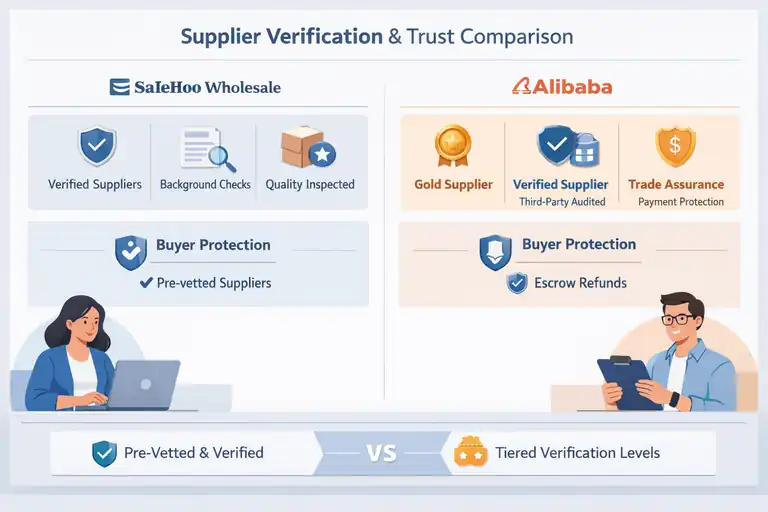
Trust is everything when sourcing products online.
Let’s take a close look at how each platform handles supplier verification, what Alibaba’s “tiers” really mean, and which platform gives you stronger buyer protection overall.
How SaleHoo Wholesale Screens and Verifies Suppliers
One of SaleHoo’s strongest selling points is its rigorous supplier screening process. Every supplier must pass a background check before being added to the directory.
SaleHoo’s vetting process includes:
- Verification of business registration documents
- Checks for trade references and performance history
- Evaluation of product quality, communication speed, and reliability
SaleHoo even removes suppliers that receive repeated negative feedback. This creates a curated environment where you can trust that every company listed is legitimate and active.
From my experience, this saves an enormous amount of time—no more worrying whether a supplier is real or if your payment will vanish into thin air.
Alibaba’s Verification Tiers and What They Really Mean
Alibaba doesn’t pre-vet suppliers the same way SaleHoo does. Instead, it uses a tier-based verification system that signals credibility levels:
- Gold Supplier: A paid membership badge. Suppliers pay Alibaba for visibility—so while it’s a sign of professionalism, it’s not proof of product quality.
- Verified Supplier: This means a third-party inspection company (like TÜV Rheinland) has audited the supplier’s factory. It’s a stronger indicator of trustworthiness.
- Trade Assurance: Alibaba’s escrow-like service that holds funds until you confirm delivery. This adds protection for buyers but doesn’t guarantee product quality.
In other words, you need to do your own homework. Look for verified suppliers, check reviews, and communicate clearly about specifications before placing any order.
Which Platform Offers Better Buyer Protection
SaleHoo takes the win here for beginners. Its built-in verification and smaller supplier network mean fewer scams and smoother transactions.
However, Alibaba does have the advantage of Trade Assurance, which refunds you if a supplier fails to ship or delivers something vastly different from what was promised.
Here’s a quick comparison:
- SaleHoo Wholesale: Prevents scams through pre-vetted suppliers.
- Alibaba: Protects buyers after issues occur through refund mechanisms.
If you want proactive protection, SaleHoo is safer. If you’re comfortable managing risks and want access to millions of suppliers, Alibaba can work—just with more vigilance.
Product Variety and Sourcing Opportunities
Both SaleHoo Wholesale and Alibaba give you access to thousands of products, but the scale, customization, and niche depth differ dramatically.
Range of Products Available on SaleHoo Wholesale
SaleHoo Wholesale features over 2.5 million products across popular categories like fashion, electronics, beauty, and home goods. These products come from trusted suppliers based mainly in the US, UK, and Australia.
One great advantage is market alignment. SaleHoo focuses on trending and high-demand products for online sellers—especially dropshippers. Their team even curates a “trending products” list, updated regularly to reflect real-time eCommerce data.
It’s a goldmine for sellers who want to quickly find profitable items without endless research.
However, customization is limited. SaleHoo is more about ready-to-sell inventory, not private label manufacturing.
Exploring Alibaba’s Massive Product Categories
Alibaba’s scale is simply unmatched—over 200 million products across 40+ industries. Whether you need pet accessories, solar panels, or custom yoga mats, you’ll find multiple factories ready to produce them.
The big advantage? You can request OEM (original equipment manufacturer) or ODM (original design manufacturer) services. That means you can put your logo on products, change packaging, and build your own brand.
But there’s a catch: most suppliers have MOQs (minimum order quantities). You might need to buy 200–500 units to get started, which isn’t ideal for beginners.
Which Platform Offers Better Options for Niche Sellers
It depends on your goals.
- If you’re testing new products or running a small dropshipping store, SaleHoo Wholesale is your best friend—low risk, easy access, and verified suppliers.
- If you’re scaling or building a brand that needs custom packaging or unique product designs, Alibaba gives you full control.
In essence, SaleHoo Wholesale is better for entry-level eCommerce and low-capital startups, while Alibaba is ideal for scaling brands and experienced importers.
Pro Tip: Some sellers actually use both—testing products through SaleHoo, then moving to Alibaba once they’ve proven demand. It’s a smart, low-risk strategy that blends the best of both worlds.
Pricing Structure and Minimum Order Requirements
Before you dive in, it’s important to understand how SaleHoo Wholesale and Alibaba handle pricing.
While one charges a membership fee for supplier access, the other operates on large order quantities and factory pricing.
Both models work—but the right one depends on your budget, experience, and order volume.
Understanding SaleHoo Wholesale’s Membership Fee Model
Unlike Alibaba, SaleHoo uses a membership-based pricing model. You pay a yearly fee (around $67 at the time of writing) for access to its curated directory of pre-vetted suppliers.
Here’s what you actually get for that fee:
- Unlimited supplier access: Over 8,000 verified wholesale and dropshipping suppliers.
- Real-time product data: Insights into trending products, profit margins, and market competition.
- Lifetime support and training: Tutorials for beginners who need guidance on selling and sourcing.
What I personally like about this model is how predictable it is. You know your exact cost upfront—no hidden transaction fees, no per-order commissions. Once you’ve paid for the year, you can reach out to as many suppliers as you want.
This makes SaleHoo especially beginner-friendly. Even if you only test a few products, the cost stays manageable and the risk stays low.
Alibaba’s MOQ (Minimum Order Quantity) System Explained
Alibaba doesn’t charge a membership fee to buyers. Instead, suppliers set minimum order quantities (MOQs) for each product. MOQ means the smallest number of units you must buy in one order to get the factory price.
Here’s how it typically looks:
- A phone case supplier might set an MOQ of 200 units.
- A clothing manufacturer might require 100 pieces per design or color.
- Some suppliers offer lower MOQs if you agree to pay a slightly higher price per unit.
The advantage? You can negotiate bulk discounts directly with manufacturers, often saving up to 50% compared to Western wholesalers.
The downside? You need upfront capital and storage. Buying 300 yoga mats at once can be a great deal—but not if you’re just testing the market.
Quick tip: When you find a product on Alibaba, message suppliers directly to ask, “Can you offer a lower MOQ for a sample order?” Many will agree, especially if they sense long-term business potential.
Which Platform Is More Cost-Effective for Small Businesses
It really depends on your stage of growth.
- If you’re just starting out, SaleHoo Wholesale is more affordable overall. A $67 membership gives you access to low-cost products without committing to large inventory orders.
- If you’re scaling up or have a proven product, Alibaba offers unbeatable per-unit pricing once you can handle MOQs.
To put it simply: SaleHoo is low-risk, Alibaba is high-reward. I often recommend starting with SaleHoo to validate your niche, then moving to Alibaba for manufacturing once you know your products sell consistently.
Shipping, Delivery Times, and Logistics
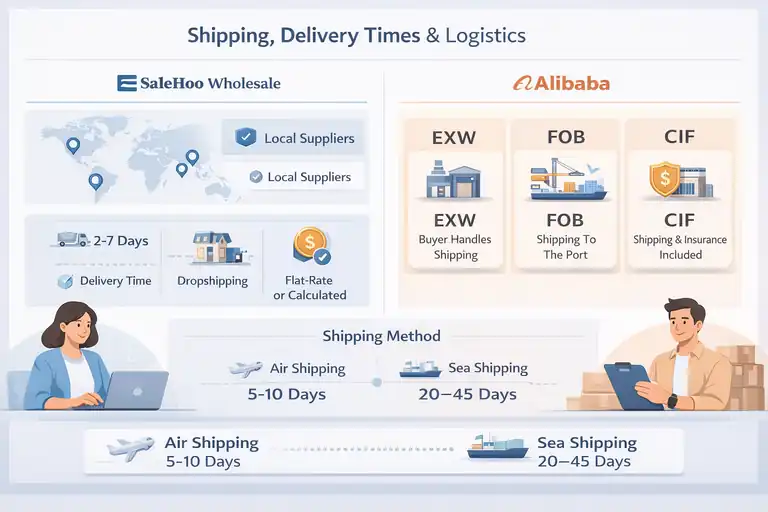
Shipping can make or break your eCommerce experience.
Let’s break down how both SaleHoo Wholesale and Alibaba handle shipping so you know what to expect in terms of costs, timelines, and logistics.
How SaleHoo Wholesale Handles Dropshipping and Shipping Options
Because SaleHoo connects you with suppliers that often offer dropshipping services, you don’t have to deal with shipping directly. Dropshipping means your supplier stores and ships the product directly to your customer—no inventory, no packaging hassles.
Here’s what makes it appealing:
- Fast fulfillment: Many SaleHoo suppliers ship from the US, UK, or AU, so domestic delivery is fast—often 2–7 days.
- Flat-rate or real-time shipping: Depending on the supplier, shipping costs are either included in product pricing or calculated dynamically at checkout.
- No large storage costs: Since products are shipped per order, you avoid warehouse fees altogether.
From what I’ve seen, this is a big advantage for small stores or anyone running a lean operation. You can scale gradually without worrying about shipping logistics or customs clearance.
Alibaba’s Shipping Models: EXW, FOB, and Beyond
Alibaba operates differently—it’s built around international trade terms (known as Incoterms). These define who’s responsible for shipping, customs, and insurance.
The three you’ll see most often are:
- EXW (Ex Works): You handle everything—pickup, shipping, customs, insurance. Cheapest option, but most work.
- FOB (Free On Board): The supplier delivers goods to the port; you handle shipping and customs after that point.
- CIF (Cost, Insurance, Freight): The supplier covers shipping and insurance to your country’s port. You handle local import duties and delivery.
Shipping from Asia to the US or Europe typically takes 20–45 days by sea or 5–10 days by air.
It’s worth noting that Alibaba’s logistics can be overwhelming at first, especially if you’ve never imported goods before. But once you learn how to read quotes and shipping terms, it becomes much easier—and the cost savings are significant.
Which Platform Offers Faster and More Reliable Delivery
If speed is your top priority, SaleHoo Wholesale clearly wins. Most of its suppliers operate within the same region as your target market, offering short delivery times and simplified returns.
Alibaba, while powerful for scaling, involves international logistics—longer shipping times, customs fees, and more risk of delays.
So here’s the rule of thumb:
- Choose SaleHoo if you want consistent, quick delivery for dropshipping or small-scale retail.
- Choose Alibaba if you’re okay with longer lead times in exchange for better manufacturing control and profit margins.
Pro Tip: Many sellers eventually mix both. They start with SaleHoo suppliers for faster fulfillment, then move production to Alibaba once sales stabilize. That hybrid model often brings the best of both worlds.
User Experience and Platform Ease of Use
Your sourcing platform should make life easier—not harder.
In this section, we’ll explore how user-friendly each platform is, from dashboards to supplier communication, and which one feels smoother for beginners.
Navigating SaleHoo Wholesale’s Dashboard and Tools
SaleHoo keeps things intentionally simple. Once you log in, you’ll find a clean dashboard with intuitive filters for product type, price range, and supplier location.
Some of the most helpful features include:
- Market Research Lab: A data tool showing trending products, average profit margins, and competition levels.
- Supplier Filters: Sort by location, shipping region, or product category.
- Training Resources: Step-by-step guides for new sellers—perfect if you’re starting from scratch.
From my own experience, SaleHoo feels like a guided marketplace—it doesn’t just connect you with suppliers; it teaches you how to source safely and sell strategically.
How Easy It Is to Communicate with Alibaba Suppliers
Alibaba’s interface is more complex but also more powerful. The Alibaba Message Center lets you chat with suppliers directly, share product photos, negotiate pricing, and request samples—all within the platform.
However, expect a few quirks:
- Language barriers: Many suppliers are based in China, so communication can be slower or require clarification.
- Time zone gaps: Negotiations can stretch across multiple days if you’re in the US or Europe.
- Template replies: Some suppliers use automated responses at first; persistence helps build real communication.
Despite this, once you find a reliable supplier, relationships on Alibaba can become incredibly valuable. Many factories even assign you a personal sales rep for smoother future orders.
Which Platform Offers a Better Experience for New Sellers
If you’re new to eCommerce or just testing product ideas, SaleHoo Wholesale is easier to start with—hands down. It offers a cleaner interface, verified suppliers, and no need to manage logistics.
Alibaba, on the other hand, is more suitable once you understand global trade basics. It’s a powerhouse, but it takes time to master.
In short:
If I could give one piece of advice—it would be this: Start where you’ll learn faster, not just save money. SaleHoo teaches you the ropes; Alibaba rewards you once you’ve learned them.
Customer Support and Seller Assistance
Customer support can make a world of difference, especially when you’re dealing with international suppliers or setting up your first online store.
Let’s take a look at how SaleHoo Wholesale and Alibaba handle guidance, problem resolution, and learning resources.
SaleHoo Wholesale’s Dedicated Support and Learning Hub
SaleHoo Wholesale shines when it comes to support. From day one, you’re not left to figure things out alone—they’ve built a community-first approach around customer help and education.
Here’s what makes SaleHoo’s support genuinely helpful:
- Live chat and email assistance: Their team responds quickly and actually understands eCommerce—not just generic “ticket” answers.
- Learning Hub: A full library of step-by-step guides, beginner tutorials, and sourcing tips. Think of it as a built-in business school for online sellers.
- Active community forum: Thousands of members share product ideas, supplier experiences, and success stories.
What I personally like is the human tone in their responses. You’re talking to people who’ve sold products online themselves, not just customer service reps reading from scripts.
For a new seller, this kind of guidance is invaluable. It saves you from common beginner mistakes and helps you build confidence early.
Alibaba’s Buyer Support and Trade Assurance System
Alibaba takes a more transactional approach to support—it’s less about personal guidance and more about protecting your money and managing trade disputes.
Here’s what that looks like:
- Trade Assurance: Alibaba holds your payment in escrow until you confirm that goods are received and as described. If not, you can file a claim for a refund.
- Help Center: A self-service portal with documentation on payments, logistics, and supplier communication.
- Buyer disputes and mediation: If something goes wrong (like damaged goods or delays), Alibaba can step in to mediate between you and the supplier.
It’s effective for large-scale transactions but not exactly beginner-friendly. You’ll need to navigate the system on your own, and response times can vary depending on the complexity of your issue.
That said, once you understand how Trade Assurance works, it’s a strong safety net for international sourcing.
Which Platform Offers More Guidance for Beginners
If you’re just getting started, SaleHoo Wholesale is hands down the better choice for support and education. Their customer service team and Learning Hub make the entire experience approachable—even if you’ve never sourced a product before.
Alibaba’s system is powerful, but it’s designed for experienced importers who already understand terms like “CIF,” “MOQ,” or “lead time.”
To put it simply: SaleHoo teaches you how to succeed, while Alibaba assumes you already know how.
Ideal Use Cases: Who Should Use Which Platform
Both SaleHoo Wholesale and Alibaba can be great tools—it all depends on your business model, risk tolerance, and goals.
When SaleHoo Wholesale Is the Better Choice
SaleHoo Wholesale is ideal if you’re starting out and want a simple, trustworthy sourcing process.
It’s a perfect fit for:
- Dropshippers: Many SaleHoo suppliers handle inventory and shipping for you.
- Small retailers: You can order in small quantities or even one-off units.
- Low-budget startups: A one-time membership fee lets you test products before committing to bulk orders.
If you value peace of mind and want verified suppliers without spending weeks vetting them, SaleHoo is the smarter option.
For example, I once helped a beginner start a pet accessories store through SaleHoo. Within two weeks, she had found a reliable US-based dropshipper—no import taxes, no long shipping delays. That kind of simplicity can’t be overstated.
When Alibaba Fits Your Business Model Best
Alibaba is built for sellers who want scale and control. If you’re ready to invest in bulk orders or create your own private-label brand, Alibaba opens up opportunities that SaleHoo simply can’t match.
You should consider Alibaba if you:
- Have a tested product that already sells well.
- Want to customize packaging or design (OEM/ODM manufacturing).
- Are comfortable negotiating prices and handling logistics.
It’s the go-to choice for established eCommerce brands that want to build long-term supplier relationships and scale profit margins through direct factory sourcing.
How to Transition Between the Two as Your Store Grows
Here’s a smart approach I often suggest:
- Start with SaleHoo Wholesale to find and test winning products with minimal risk.
- Use performance data from your store (sales volume, reviews, repeat purchases) to identify which products deserve long-term investment.
- Shift to Alibaba once you’re confident in demand—use it to create branded or customized versions of your bestsellers.
This way, you use SaleHoo as your testing ground and Alibaba as your scaling engine. It’s a practical, low-risk path that many successful eCommerce sellers follow.
Realistic Pros and Cons of Each Platform
No platform is perfect. Let’s look at what SaleHoo Wholesale and Alibaba really do well—and where each might fall short.
Pros and Cons of SaleHoo Wholesale for Online Retailers
Pros:
- Verified suppliers reduce risk of scams.
- Excellent support and beginner-friendly tools.
- Low upfront cost and no large order minimums.
- Access to both dropshipping and wholesale suppliers.
Cons:
- Smaller product selection compared to Alibaba.
- Less room for product customization or branding.
- Requires annual membership fee.
SaleHoo’s biggest advantage is peace of mind—you’re buying reliability. But if you want full control over manufacturing or product design, you’ll eventually outgrow its limitations.
Pros and Cons of Alibaba for Global Product Sourcing
Pros:
- Massive variety—millions of products and suppliers.
- Direct access to manufacturers for custom branding.
- Potential for high margins with bulk pricing.
- Trade Assurance adds transactional protection.
Cons:
- Risk of unverified or low-quality suppliers.
- Long shipping times and complex logistics.
- Requires experience with import/export processes.
Alibaba’s greatest strength—its sheer scale—can also be overwhelming. The key is to vet suppliers carefully, request samples, and never rush a deal.
How to Avoid Common Pitfalls with Either Platform
Here are a few lessons learned from experience:
- Always order samples before committing to bulk orders.
- Communicate clearly and confirm details in writing—especially product specs and delivery dates.
- Use secure payment methods like PayPal or Trade Assurance.
- Start small to test reliability before scaling up.
A small test order can save you from a costly mistake later. I’ve seen sellers lose thousands because they skipped this one simple step.
Final Verdict: Which Platform Is Better for You
Choosing between SaleHoo Wholesale and Alibaba really comes down to where you are in your business journey and how much risk you’re willing to take.
Deciding Based on Your Budget, Risk Tolerance, and Experience
If you’re new to eCommerce or prefer a lower-risk approach, SaleHoo is the clear winner. It’s affordable, safe, and packed with educational tools.
If you already have experience with sourcing, logistics, and want to control every part of your product line, Alibaba gives you far more room to grow and innovate.
My Personal Recommendation After Comparing Both Platforms
I’d say: Start with SaleHoo Wholesale, scale with Alibaba.
SaleHoo gives you a safe place to learn and test without big investments. Once you’ve built momentum and know your products sell, Alibaba becomes a natural next step for expansion and brand building.
That balance—safety first, scale second—is how many successful online stores evolve today.
Pro Tip: Combining SaleHoo Wholesale and Alibaba for Maximum Reach
Here’s a strategy I’ve personally seen work wonders:
- Use SaleHoo suppliers for quick-turn, low-risk dropshipping.
- Use Alibaba for customized or bulk inventory once products prove profitable.
- Keep both networks active—SaleHoo for convenience, Alibaba for growth.
It’s the best of both worlds: the trust and simplicity of SaleHoo Wholesale, paired with the scale and flexibility of Alibaba.
That’s how smart eCommerce entrepreneurs grow sustainably—testing, learning, and scaling with purpose.
FAQ
Is SaleHoo Wholesale better than Alibaba for beginners?
Yes. SaleHoo Wholesale is generally better for beginners because it offers pre-verified suppliers, smaller order requirements, and guided support, reducing risk when starting out.
What is the main difference between SaleHoo Wholesale and Alibaba?
SaleHoo Wholesale is a curated directory focused on trusted suppliers and ease of use, while Alibaba is a massive global marketplace built for bulk sourcing and custom manufacturing.
Can I use SaleHoo Wholesale and Alibaba together?
Absolutely. Many sellers use SaleHoo Wholesale to test products with low risk, then switch to Alibaba for bulk orders and custom branding once demand is proven.

I’m Juxhin, the voice behind The Justifiable.
I’ve spent 6+ years building blogs, managing affiliate campaigns, and testing the messy world of online business. Here, I cut the fluff and share the strategies that actually move the needle — so you can build income that’s sustainable, not speculative.
Related posts:
 Advantages of a Dropshipping Company: Genuine Business Knowledge
 Salehoo Dropshipping Reviews: Is It Worth Your Money Today?
 Is SaleHoo Worth Joining? Real Buyers Share Results
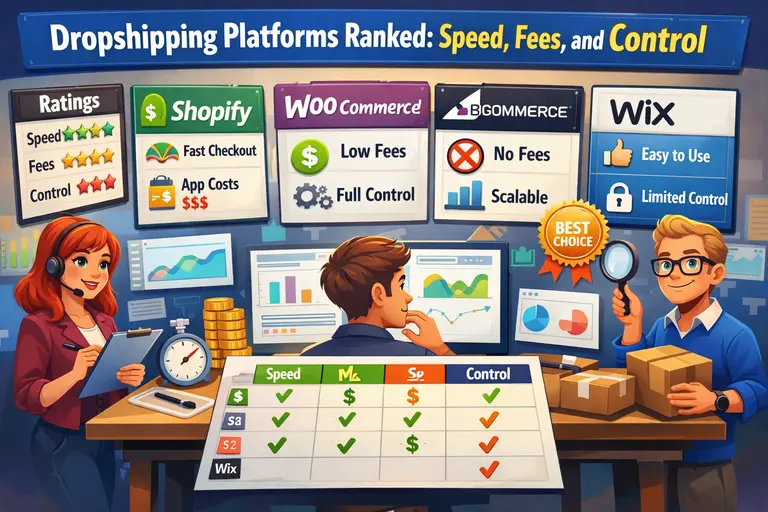 Dropshipping Platforms Ranked: Speed, Fees, and Control
 Headless Ecommerce Platform: Is It the Faster Way to Scale?
 Ecommerce CRM Tools That Turn Customers Into Repeat Buyers