Table of Contents
Some links on The Justifiable are affiliate links, meaning we may earn a small commission at no extra cost to you. Read full disclaimer.
When I first started setting up a blog website, I had no idea that it could actually start earning from day one. Most people assume you need months of traffic or tons of content before seeing any income—but that’s not true if you build it strategically.
In this guide, I’ll walk you through how to launch your blog the right way—from niche selection and monetization setup to content planning—so it’s ready to make money from the moment you hit publish.
Choosing a Profitable Niche From the Start
Finding the right niche is the most critical step in setting up a blog website that earns from day one.
This isn’t just about choosing what you love—it’s about matching passion with profit potential.
Identify Evergreen Niches With Proven Earning Potential
I’ve learned that the best niches aren’t always the trendiest—they’re the evergreen ones. These are topics people consistently search for, no matter the season or year. Think personal finance, health, relationships, career growth, and lifestyle improvement.
Here’s how you can spot a profitable evergreen niche:
- Look for consistent demand: Use tools like Google Trends to see if interest has been stable for at least 3–5 years.
- Check monetization avenues: Are there affiliate programs, digital products, or services people buy in this niche?
- Identify audience pain points: The stronger the pain or desire, the more likely people will pay for solutions.
Example: A blog about “budgeting for beginners” has endless potential because new audiences age into that need every year.
Evaluate Competition and Monetization Opportunities Early
Competition isn’t bad—it means there’s money to be made. The trick is finding gaps in that competition.
Here’s what I do before committing to a niche:
- Analyze top-ranking blogs: What kind of content are they creating? What products or ads are they using?
- Find content gaps: Look for outdated posts, unanswered questions, or underserved audience segments.
- Test early monetization ideas: Research affiliate networks like Awin, Flexoffers, or Aweber’s referral program to confirm earning options exist.
If big players dominate but lack depth in a certain subtopic (for instance, “eco-friendly budgeting tips”), you’ve found your entry point.
Validate Your Blog Idea With Keyword and Audience Research
Before buying a domain, validate your idea with real data. Start by creating a list of 20–30 keywords related to your niche. Then, run them through tools like Ahrefs, Ubersuggest, or even Google’s autocomplete feature.
What you’re looking for is a mix of:
- Low-competition, high-intent keywords: These bring targeted readers who are ready to buy or subscribe.
- Search volume with transactional potential: Terms like “best,” “review,” or “how to” often indicate commercial intent.
- Audience overlap: Check Reddit, Quora, or Facebook groups to confirm active conversations about your niche.
When you validate both the keywords and audience behavior, you’re no longer guessing—you’re making a data-backed decision.
Building a Strategic Blog Foundation
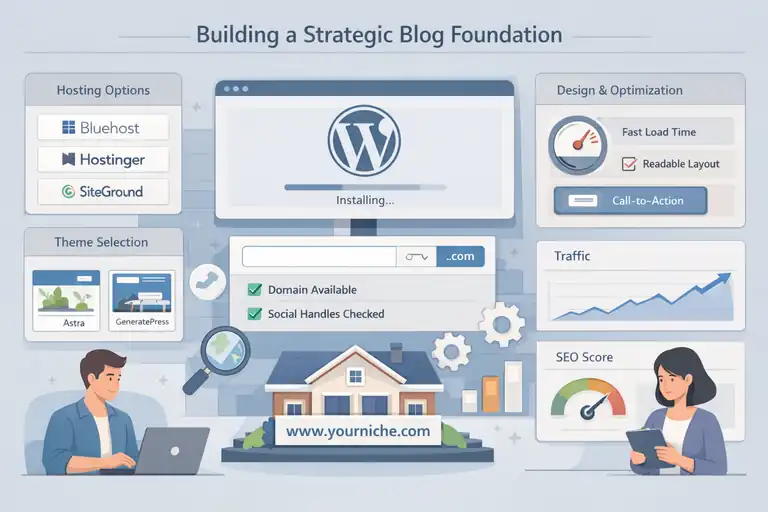
Once you’ve nailed your niche, the next step is building your foundation. Think of this as laying down the bricks of your online house—the structure that supports your traffic, SEO, and income.
Select the Right Blogging Platform and Hosting Setup
Choosing the wrong platform is like building a house on sand. I always recommend WordPress.org, not the free WordPress.com version—it gives you full control over design, SEO, and monetization.
Here’s a quick setup roadmap:
- Choose a reliable host: Go for speed and uptime. Bluehost, Hostinger, and Hostgator are beginner-friendly options.
- Install WordPress with one click: Most hosts have this feature built in.
- Pick a lightweight theme: Themes like Astra or GeneratePress are great for performance and flexibility.
Why this matters: A slow or limited site will hurt your SEO and frustrate visitors before you ever earn a cent.
Choose a Domain Name That Reflects Brand and SEO Intent
Your domain name is your brand’s first impression. Ideally, it should be short, easy to spell, and hint at your niche or value.
Some quick naming principles I use:
- Avoid complex words: Simplicity builds trust and memorability.
- Include a relevant keyword: For instance, “BudgetNest.com” signals a personal finance focus.
- Check availability: Always confirm social media handles and trademarks before finalizing.
Pro tip: A clear, keyword-aligned domain gives you a head start in search visibility and helps readers instantly understand your focus.
Optimize Your Blog Design for User Experience and Conversion
Design directly affects how long people stay—and whether they click or buy. Keep your design clean, scannable, and focused on the reader journey.
Key design principles I rely on:
- Readable fonts and spacing: Your words are your product—make them comfortable to consume.
- Visible CTAs (calls to action): Guide readers toward subscribing or buying without being pushy.
- Fast load times: Use image compressors like TinyPNG and caching plugins like WP Rocket to reduce lag.
Remember, every design choice should serve one goal: helping visitors take meaningful action.
Setting Up Essential Pages That Build Trust
You can’t earn from day one without building trust. The right pages do more than fill a menu—they make readers feel safe investing time and money in you.
Create an About Page That Connects and Converts
Your About page is one of the most visited on any blog. It’s where readers decide if they can trust you.
Here’s how to write one that works:
- Start with your story: Why did you start this blog? What personal connection do you have to the topic?
- Speak to the reader’s problem: Make it about them, not just you.
- Include a call-to-action: Encourage readers to join your email list or explore specific posts.
Example: Instead of saying, “I love writing about fitness,” say, “I know what it’s like to feel stuck trying every new workout—so I created this space to simplify getting healthy again.”
Write a Disclosure and Privacy Policy to Build Credibility
Transparency is more than compliance—it’s professionalism. If you’re using affiliate links, ad networks, or email lists, you must disclose it.
What to include:
- Disclosure Statement: Clearly say when you earn from links or recommendations.
- Privacy Policy: Explain how user data (like emails or cookies) is collected and used.
- Cookie Notice (if applicable): Especially important for European traffic (GDPR compliance).
You can use free generators like Termly to create these pages quickly.
This small step instantly separates your blog from amateurs—and reassures readers you run a legitimate business.
Design a Contact Page That Encourages Reader Interaction
A well-crafted Contact page helps you connect with readers, brands, and collaborators. It’s not just a form—it’s an invitation.
Best practices I’ve learned:
- Keep it simple: Include a short greeting and a form with 2–3 fields (name, email, message).
- Add alternative contact options: A dedicated email or social links give users flexibility.
- Set expectations: Let readers know when they can expect a reply.
Example: “I usually respond within 48 hours—thanks for reaching out!” This simple line makes you feel approachable and professional at once.
Crafting Content Designed to Monetize Early
When it comes to setting up a blog website that earns from day one, your content isn’t just about sharing ideas—it’s your sales engine.
The earlier you learn to create posts that attract, educate, and convert, the faster you’ll see income rolling in.
Plan Content Around Low-Competition, High-Intent Keywords
I’ve learned that keyword strategy isn’t about chasing huge traffic—it’s about targeting intent. You want visitors who are ready to act, whether that means subscribing, buying, or signing up.
Here’s a step-by-step way to find those sweet-spot keywords:
- Use simple research tools: Start with free options like Ubersuggest or Google Keyword Planner. They’ll help you find terms with low competition but clear buying intent.
- Look for “money phrases”: Words like best, review, how to, vs., and for beginners tend to attract readers ready to take action.
- Prioritize low volume, high conversion: A keyword that gets 300 searches a month but converts well beats one with 5,000 visitors who never buy.
Example: Instead of writing “How to start a blog,” go for “How to start a blog on WordPress for beginners.” It’s narrower, but those readers are much more likely to take your affiliate link or hosting recommendation.
Write Pillar Posts That Establish Authority and Attract Traffic
Think of pillar posts as the “anchors” of your blog—comprehensive, evergreen guides that answer big questions in your niche. These become your long-term traffic and income drivers.
Here’s what makes a great pillar post:
- Length and depth: Aim for 2,000+ words that genuinely solve a reader’s problem.
- Structure for skimmability: Use short paragraphs, subheadings, and bullet points so readers stay engaged.
- Include monetization naturally: Add affiliate recommendations, lead magnets, or internal links to related posts.
From my experience, one solid pillar post can attract thousands of monthly visitors and hundreds of affiliate clicks if optimized properly.
For instance, a detailed “How to Meal Prep for Weight Loss” post could feature affiliate links to containers, meal plans, or nutrition too.
Use Internal Linking Strategically to Boost Engagement and Earnings
Internal links aren’t just for SEO—they’re a subtle way to lead readers down a conversion path.
Here’s how I approach it:
- Guide the reader’s journey: Link beginner posts to advanced tutorials or monetized content.
- Boost authority pages: Link frequently to your best-earning posts (like your top affiliate reviews).
- Avoid overlinking: Two to four contextual links per post are usually enough.
Quick example: In a post about “Starting a Budget,” you could link to another post titled “10 Best Budgeting Apps for Beginners.” It keeps readers on your site longer and moves them closer to a monetized page.
Implementing Multiple Income Streams From Day One
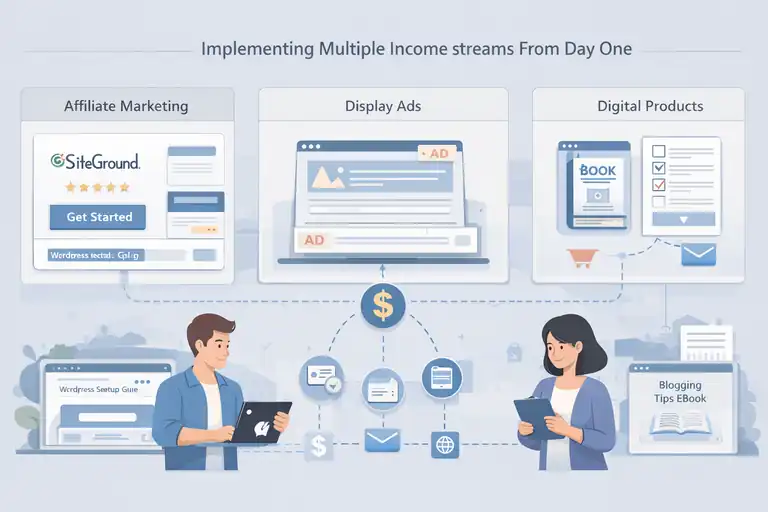
If your blog is set up well, you don’t need to wait months to start earning. The trick is layering different income streams early—so you’re not dependent on one source.
Add Affiliate Links Naturally Within Foundational Content
Affiliate marketing is one of the easiest ways to earn from day one. The key word here is naturally. Readers can smell forced links a mile away.
Here’s how I make affiliate content feel genuine:
- Focus on personal experience: Share what you actually use and why it works.
- Embed links contextually: Don’t dump affiliate banners everywhere. Add them where they fit the reader’s journey.
- Use clear disclosures: Transparency builds trust and prevents reader skepticism.
For instance, if you’re reviewing a hosting provider like SiteGround, show a simple setup example or screenshot. That proof makes your link recommendation feel authentic and helpful, not salesy.
Integrate Display Ads and Sponsored Placements Strategically
Display ads can bring passive income, but timing matters. I suggest waiting until you have at least 1,000 monthly visits before applying to ad networks like Google AdSense or Ezoic.
Once approved, here’s how to maximize earnings without hurting user experience:
- Avoid clutter: Place ads between sections, not in the middle of sentences.
- Test ad positions: Use heatmaps (like Microsoft Clarity) to see where people actually scroll.
- Balance monetization with readability: Always prioritize user experience—ads shouldn’t feel intrusive.
As your blog grows, consider sponsored posts. Even one paid partnership can bring $100–$300 for smaller blogs if the niche is valuable enough.
Offer a Simple Digital Product or Lead Magnet for Early Sales
Selling your own product sounds intimidating, but it doesn’t have to be. I started by offering a simple ebook—just 10 pages summarizing my best blogging tips.
You can do the same with:
- Printable planners or templates (created using Canva)
- Mini email courses (delivered through platforms like Mailerlite)
- Checklists or toolkits that solve one small problem
Even if you give these away for free, they’re powerful lead magnets. You build your list and can later promote higher-value products or affiliate offers.
Example: A “30-Day Fitness Challenge PDF” could collect 500+ subscribers in your first month—each a potential customer later.
Optimizing for SEO Before You Publish
SEO isn’t just a post-launch task—it starts before you hit publish. When you optimize upfront, you set your blog up for steady, compounding growth.
Conduct On-Page Optimization for Each Blog Post
On-page SEO is about helping search engines (and readers) understand your content better. It’s not technical—it’s strategic writing.
My go-to checklist before publishing:
- Include your main keyword in the title, first paragraph, and at least one subheading.
- Use semantic variations: Sprinkle in related terms naturally (for example, “start a blog,” “launch a website,” “create a blog site”).
- Add meta tags: Write a clear meta title (under 60 characters) and description (under 160 characters).
- Use header tags properly: Keep a clean structure—H2s for sections, H3s for supporting details.
Even one missing meta description can hurt click-through rates. So I always take an extra five minutes to write a compelling one—it’s worth it.
Build SEO-Friendly URLs, Meta Titles, and Descriptions
Your URL and meta info are what people see first in search results. Make them clean, descriptive, and aligned with your keyword.
Quick tips I always follow:
- Keep URLs short: For example, “/start-a-fitness-blog” instead of “/how-to-start-a-fitness-blog-in-2025-step-by-step-guide.”
- Use dashes, not underscores: Search engines read dashes better.
- Write persuasive meta titles: Combine clarity with curiosity, like “How to Start a Blog That Earns in 30 Days.”
Meta descriptions should feel like mini invitations—explain the benefit, not just the topic.
Submit Sitemap and Set Up Google Search Console for Indexing
This final step ensures your content is visible to search engines from day one.
Here’s the simple setup process:
- Install an SEO plugin: Tools like Rank Math or Yoast SEO automatically generate your sitemap.
- Verify your site in Google Search Console: You’ll need to add your domain and confirm ownership (usually by adding a small DNS record or HTML tag).
- Submit your sitemap: Usually found at yourdomain.com/sitemap.xml.
- Check coverage reports: This shows which pages are indexed and if any have errors.
Once that’s done, your blog is officially ready to grow—and earn.
Pro tip: Don’t obsess over SEO perfection early on. Consistency beats complexity. Publish well-researched, helpful content weekly, and your traffic—and income—will naturally follow.
Building an Email List From Launch Day
If there’s one thing I wish I’d done sooner when setting up a blog website, it’s building an email list from day one.
Social media algorithms change, SEO takes time, but your email list? That’s your direct line to readers who want to hear from you.
Create a Lead Magnet That Solves a Real Problem
A lead magnet is something valuable you offer for free—usually in exchange for an email address. The goal is simple: give readers a reason to trust you and stay connected.
When choosing a lead magnet, focus on one real problem your audience wants to solve fast. The best ones are small, actionable, and results-driven.
Some examples that have worked well for me and others:
- Checklists and templates: A “Blog Launch Checklist” or “Content Calendar Template.”
- Mini email courses: A 5-day “Start Your Blog Challenge” with daily steps.
- Printable guides or toolkits: A “10 Tools Every New Blogger Needs” PDF.
Pro tip: Use a platform like Kit (formerly ConvertKit) or Brevo to deliver your lead magnet automatically after signup. That way, you’re building trust right from the start without any manual work.
Use Signup Forms and Popups That Convert Visitors to Subscribers
I used to think popups were annoying until I realized they could increase signups by 200% when used smartly. The key is timing and placement.
Here’s what I’ve found works best:
- Embed forms naturally: Place one after every blog post and on your About page.
- Use exit-intent popups: These trigger when someone’s about to leave your site—catching them before they go.
- Offer specific value: Instead of “Join my newsletter,” say “Get my free 7-day guide to launching your blog.”
Keep your forms short—first name and email only. People don’t want to fill out long forms; they want quick access to what they came for.
Nurture Subscribers With Automated Welcome Sequences
Once someone joins your list, don’t leave them hanging. Your welcome sequence is where relationships begin—and where early income can start, too.
Here’s a simple 3–email sequence that works wonders:
- Email 1 – Welcome and Deliver the Freebie: Thank them genuinely, introduce yourself briefly, and deliver the lead magnet link.
- Email 2 – Build Trust: Share your story or a valuable tip that ties into your niche. Be personal and conversational.
- Email 3 – Soft Sell or Next Step: Gently introduce an affiliate recommendation, a resource, or your best-performing post.
You can set this up in Kit or Brevo in minutes using their automation features. It’s like having a 24/7 assistant growing your audience while you sleep.
Promoting Your Blog to Get Immediate Traffic
Creating great content is only half the game. The other half is getting eyeballs on it. I like to think of promotion as “fuel” for your blog—it’s what gets you momentum early on.
Leverage Pinterest and Social Media for Quick Visibility
If you’re just starting, Pinterest is hands-down one of the fastest ways to drive free traffic. It’s not really a “social media” site—it’s a visual search engine.
Here’s how to make it work for you:
- Create 3–5 pins per blog post: Use Canva to design vertical pins (1000x1500px works best).
- Optimize pin titles and descriptions: Include keywords naturally and keep them clear.
- Stay consistent: Pin daily for the first month using a scheduler like Tailwind to save time.
Outside Pinterest, pick one other platform to focus on—whether it’s Instagram, LinkedIn, or TikTok—and post valuable snippets from your content. Don’t try to be everywhere at once. It’s better to do one platform well than five poorly.
Join Niche Forums and Communities to Build Early Engagement
Online communities are gold mines for traffic when used authentically. Instead of spamming links, focus on being helpful first.
Places to try:
- Reddit: Subreddits like r/Blogging or r/Entrepreneur are great for building authority.
- Facebook Groups: Find groups related to your niche and engage in discussions before sharing your content.
- Quora: Answer questions in-depth, then link to your blog post for deeper info (only if it genuinely adds value).
Example: If you’re blogging about minimalism, spend 15 minutes daily answering “how to declutter” questions. Within weeks, you’ll start seeing organic traffic and backlinks to your posts.
Use Guest Posts and Collaborations for Rapid Authority Growth
One of the smartest shortcuts I’ve used is guest posting—writing for other blogs in your niche. It builds backlinks (which help SEO), brings referral traffic, and positions you as an expert.
Here’s a simple plan:
- Find blogs that accept guest posts: Search Google for “your niche + write for us.”
- Pitch original, helpful topics: Keep it focused on their readers’ interests.
- Include one link back to your site: Ideally to a pillar post or lead magnet page.
Beyond guest posts, collaborate with other creators. You can co-host a live Q&A, trade newsletters, or share each other’s posts. Real partnerships compound your reach faster than any ad spend.
Tracking and Analyzing Blog Performance
Once your blog is live and getting some traction, it’s time to measure what’s working. Tracking helps you double down on what earns and fix what doesn’t.
Set Up Google Analytics and Understand Key Metrics
If you haven’t already, connect your blog to Google Analytics 4 (GA4). It’s free, and it gives you a clear view of who’s visiting, how they found you, and what they’re doing on your site.
Here are a few key metrics to focus on early:
- Users: The number of people visiting your site.
- Session duration: How long they stay (aim for 1–3 minutes minimum).
- Bounce rate: If it’s high, your content or page design may need tweaking.
- Traffic sources: Know whether people are coming from Pinterest, Google, or social media.
Spend 10 minutes each week checking these numbers. Over time, patterns will emerge—and you’ll know where to focus your energy.
Track Conversions to See What’s Earning From Day One
Traffic means little if it’s not turning into income. That’s why conversion tracking is essential.
To do this, I use a mix of tools:
- Affiliate dashboards: Check your clicks, sales, and commissions weekly.
- Email software stats: See which opt-ins are performing best.
- Analytics goals: In GA4, set up goals for sign-ups or link clicks so you can see what content leads to results.
If a particular blog post drives the most affiliate clicks, consider writing a follow-up or turning it into a video. Let your audience’s behavior guide your next move.
Adjust Content and Monetization Strategies Based on Data
Here’s the truth: your first strategy won’t be perfect. Mine wasn’t either. But your data will tell you what’s worth refining.
Here’s how I use analytics insights to grow smarter:
- If traffic is good but earnings are low: Review your monetization placements—maybe affiliate links aren’t visible enough.
- If visitors drop off quickly: Improve your introduction or add more visuals.
- If a post performs well: Update it every few months with fresh data and stronger CTAs.
Think of your blog as a living project that evolves. Every tweak makes it better. Over time, these small optimizations add up to real, sustainable income.
Pro tip: Treat data like feedback, not judgment. It’s there to guide you, not criticize your effort. Keep refining, stay consistent, and your blog will steadily grow into a source of income and freedom you built from the ground up.
Scaling Your Blog Income Beyond the First Month
Once you’ve set up your blog and started earning, the real fun begins—scaling. This is where you move from “making a little” to building reliable, growing income.
Think of it like turning a spark into a steady flame.
Update and Repurpose High-Performing Content for More Revenue
One of the fastest ways to grow your blog income is by improving what’s already working. I call this “content compounding”—because small updates can bring big returns.
Here’s how to do it:
- Check analytics regularly: Look for posts bringing the most traffic or conversions.
- Add new affiliate products: Refresh older posts with current recommendations or updated links.
- Improve SEO freshness: Update statistics, fix broken links, and re-upload images with better alt text.
- Repurpose top posts: Turn a blog post into a YouTube video, Pinterest pin, or free mini-guide to expand reach.
Example: I once had a post about “How to Start a Blog on a Budget” that was ranking well but not earning much. I added a section comparing hosting providers with affiliate links—and my earnings doubled within a month. Small changes, big impact.
Build Backlinks to Strengthen Domain Authority Over Time
Backlinks are like votes of confidence from other websites. The more high-quality sites that link to you, the more Google trusts your blog—and the higher you rank.
Here’s a simple backlink strategy that actually works:
- Guest posting: Write for blogs in your niche and include a link back to your own content.
- Resource link outreach: Contact bloggers who have “helpful resources” pages and suggest adding your post.
- Create shareable assets: Infographics, statistics, or data-rich guides tend to attract natural backlinks.
You don’t need hundreds of backlinks to see results. Even 5–10 good ones from trusted sources can move the needle significantly in competitive niches.
Create a Long-Term Content and Monetization Growth Plan
Scaling isn’t about working harder—it’s about being strategic. After your first month, start planning 3–6 months ahead.
Here’s what I focus on:
- Content calendar: Schedule one new post per week targeting strategic keywords.
- Monetization diversity: Layer affiliate income, digital products, and ad revenue together.
- Email funnel growth: Expand your automated email sequences to promote more offers naturally.
I also recommend setting quarterly goals. For instance, “Increase traffic by 25%” or “Grow my email list to 1,000 subscribers.” When you have a clear direction, your growth becomes intentional, not accidental.
Avoiding Common Mistakes That Delay Blog Earnings
Many new bloggers unknowingly sabotage their early success. The truth is, most mistakes aren’t fatal—they just slow your progress.
But if you avoid them from the start, your path to profit becomes much smoother.
Don’t Overcomplicate Design or Delay Publishing
I’ve seen so many new bloggers spend weeks obsessing over colors, logos, and fonts. The reality? Your first visitors don’t care about design nearly as much as you do.
Focus instead on what actually drives growth:
- Clean layout: Choose a simple, mobile-friendly theme (like Neve or Kadence).
- Readable text: Prioritize clarity and spacing over fancy visuals.
- Speed: A slow site kills conversions—use a caching plugin like LiteSpeed.
Perfection is the enemy of progress. Get your site live, then refine it as you go. The longer you wait to publish, the longer it’ll take to earn.
Avoid Choosing Niches With No Clear Monetization Path
One of the biggest mistakes I made early on was blogging about things I liked but no one would pay for. A blog can’t make money if its audience doesn’t spend money.
Before finalizing your niche, ask yourself:
- Are there affiliate programs or products available in this niche?
- Do people actively search for paid solutions in this space?
- Can I create my own product here eventually?
If you’re unsure, run a quick Google search for “[your topic] + affiliate program.” If nothing shows up, it’s probably not a profitable niche. Passion matters—but profit matters too if you want sustainability.
Stay Consistent With Content and Promotion Strategy
Even the best blog setup won’t make money if you post once and disappear. Consistency is what separates hobby blogs from income-generating ones.
Here’s what’s worked for me:
- Create a realistic schedule: One post a week is better than five in a burst and then silence.
- Promote every post: Share on Pinterest, in Facebook groups, and via email.
- Track your progress: Use Google Analytics to see what’s gaining traction and do more of it.
Momentum builds over time. The first few months are about planting seeds—then, suddenly, one day, you realize they’ve started to grow.
Expert Tips to Keep Your Blog Earning Consistently
Sustaining income is often harder than making it. The key is to treat your blog like a business—because that’s exactly what it becomes once it starts paying you.
Focus on Solving Reader Problems, Not Just Writing Posts
Every piece of content should answer a specific question or solve a problem your reader is struggling with. If you keep their needs front and center, the money follows naturally.
Here’s how I keep that focus:
- Start with empathy: What is your reader frustrated about right now?
- Offer clear steps or solutions: Avoid fluff—help them achieve something quickly.
- Invite engagement: Ask for comments, feedback, or emails to learn what else they need.
When readers trust you as a problem-solver, they’ll click your links, buy your products, and keep coming back. That’s how long-term income is built.
Reinvest Early Profits Into Better Tools and SEO Services
When you start earning, it’s tempting to pocket everything—but reinvesting is how you scale faster.
Smart reinvestments include:
- Upgrading hosting: A faster host like Cloudways or WPengine improves SEO and user experience.
- Investing in SEO tools: Tools like Ahrefs or Keysearch help uncover more profitable keywords.
- Hiring freelancers: Outsource design, editing, or Pinterest graphics to save time.
I still follow a simple rule: reinvest at least 30% of my earnings for the first year. It’s like planting seeds for future growth.
Keep Testing and Tweaking Monetization for Maximum ROI
What works in month one might not work in month six—and that’s okay. The best bloggers treat monetization like an experiment.
Here’s what I test regularly:
- Affiliate link placement: Try moving links higher in the post or adding comparison tables.
- Ad layout: Test sidebar vs. in-content ads to see what converts better.
- Email promotions: Alternate between different products or offers to learn what resonates most.
The key is curiosity. When you test often and track results, your blog evolves with your audience’s needs—and your earnings grow naturally over time.
Pro tip: Think of your blog like a long-term investment. It may start small, but with patience, consistency, and smart reinvestment, it can become a steady source of income that keeps growing—month after month, year after year.
FAQ
How long does it take to make money when setting up a blog website?
You can earn from day one if you set up monetization early through affiliate links, lead magnets, or digital products, even before organic traffic grows.
What is the fastest way to monetize a new blog?
The fastest approach is affiliate marketing paired with high-intent content, such as reviews, comparisons, and problem-solving guides tied to buyer keywords.
Do you need traffic before monetizing a blog?
No. You should monetize from the start. Even low traffic can generate income if visitors are targeted and the offers match their intent.

I’m Juxhin, the voice behind The Justifiable.
I’ve spent 6+ years building blogs, managing affiliate campaigns, and testing the messy world of online business. Here, I cut the fluff and share the strategies that actually move the needle — so you can build income that’s sustainable, not speculative.