
Table of Contents
Some links on The Justifiable are affiliate links, meaning we may earn a small commission at no extra cost to you. Read full disclaimer.
Switching from Semrush to Ahrefs worth it is not a simple yes-or-no question, and I think that is exactly why so many SEO teams get stuck.
On paper, both platforms cover keyword research, backlink analysis, rank tracking, and technical audits. But once you actually use them every week, the differences start to matter.
Ahrefs has leaned hard into link intelligence, organic search research, and a broader marketing platform story, while Semrush still shines as a wider digital visibility suite that stretches into PPC, content, social, and AI visibility.
What “Switching From Semrush To Ahrefs Worth It” Really Means
This question is really about fit, not hype. Most people are not choosing a “better” tool in the abstract.
They are choosing the tool that helps them make better SEO decisions faster, with less friction and less wasted spend.
Define The Real Decision Before You Cancel Anything
When people ask whether moving from Semrush to Ahrefs is worth it, they often focus on surface-level stuff like dashboard layout or which tool “feels” more accurate. I think that misses the point. The real decision is whether your current stack matches the way you do SEO today.
What you are really evaluating: research depth, backlink workflow, reporting needs, content planning, competitor analysis, team collaboration, and total cost.
Imagine you run a lean content site with two writers and one SEO lead. In that situation, you may care most about finding low-competition topics, spotting link gaps, and monitoring rankings.
Ahrefs can feel more natural for that kind of workflow because its product identity is still strongly tied to search intelligence, site research, and backlinks. Its Site Explorer highlights organic and backlink shifts well, and its Keywords Explorer emphasizes topic discovery and clustering.
Now imagine you manage SEO inside a broader marketing team. Suddenly SEO is not living alone. You also care about PPC overlaps, social workflows, reporting across multiple channels, and AI visibility dashboards.
That is where Semrush often keeps its seat at the table because it positions itself as a cross-channel visibility platform rather than a narrower SEO-only environment.
So before you switch, write down one sentence: “We are moving because we need better ______.” If you cannot fill that blank clearly, you probably are not ready to switch yet.
Separate Feature Parity From Workflow Advantage
One of the biggest traps in software decisions is assuming that similar feature lists mean similar outcomes. Both tools offer keyword research, site audits, backlink analysis, rank tracking, and competitor discovery. That part is true. But parity on paper does not mean parity in actual use.
Here is the practical difference. In many SEO teams, Ahrefs tends to become the tool people open first when they want to answer a search question fast: What pages drive a competitor’s traffic? Which backlinks were won or lost? Which topic clusters look realistic? Which pages are slipping?
Its interface often supports investigative work well, especially for organic search and link analysis. That matters more than an extra feature you rarely touch.
Semrush, by contrast, often wins when the workflow spans multiple channels or departments. If your CMO wants one platform that touches SEO, PPC, competitor ad research, reporting, content tools, and broader visibility measurement, Semrush’s breadth can save real time. That breadth is part of why many agencies and in-house teams tolerate the extra complexity.
I suggest thinking in terms of “workflow advantage” instead of “feature availability.” Ask: Which tool reduces the number of clicks, exports, and second guesses required to finish the work that actually makes us money?
How Ahrefs And Semrush Differ In Day-To-Day SEO Work
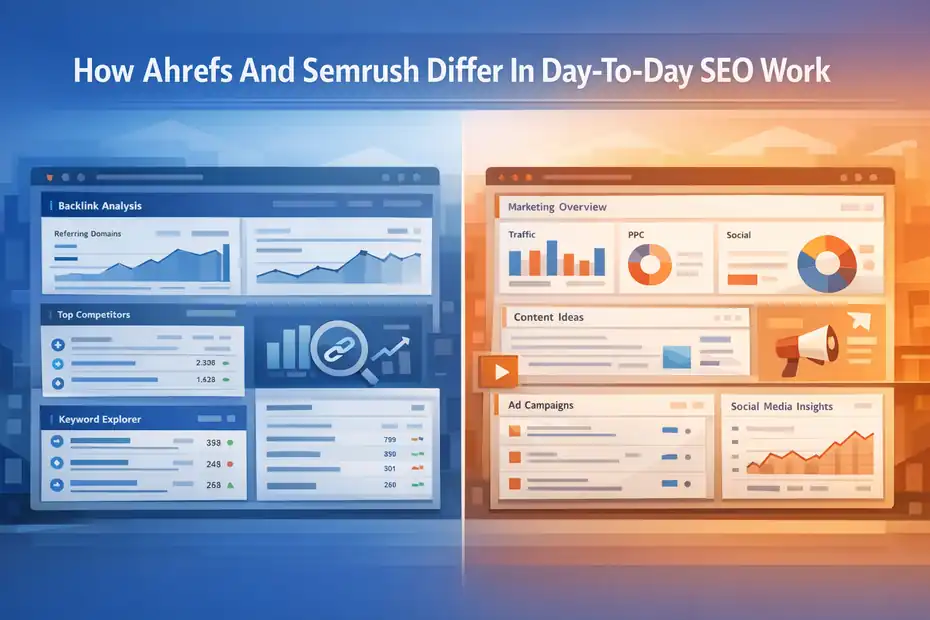
At a high level, both platforms are mature and powerful. The difference is in what each one is built to prioritize and how that shapes your daily process.
Ahrefs Often Feels Stronger For Search-Led Research
Ahrefs has built much of its reputation around backlink data and organic competitor analysis, and its public positioning still reinforces that. It highlights massive backlink infrastructure, frequent data updates, and deep research into pages, domains, keywords, and traffic patterns.
Its Site Explorer also now emphasizes organic, paid, and AI-related competitor intelligence, which makes it more than a classic backlink tool.
That matters because SEO research is often messy. You are jumping from one competitor to another, checking top pages, validating keyword intent, and tracing why a ranking change happened.
Ahrefs is often praised because it supports this style of investigative work without making you feel like you are navigating five separate product layers.
Where Ahrefs tends to feel especially useful:
- Competitor teardown: top pages, traffic shifts, linking domains, content gaps.
- Link analysis: lost links, referring domains, anchor review, historical profile patterns.
- Topic discovery: keyword ideas, parent topic logic, cluster-style exploration.
- Technical triage: issue prioritization inside Site Audit.
In my experience, Ahrefs tends to reward SEO specialists who live in search all day. It feels built for people asking, “Why is this page winning?” rather than “How do I coordinate five marketing functions in one dashboard?”
Semrush Usually Wins On Breadth And Marketing Coverage
Semrush is not just an SEO platform anymore. Its own positioning is about brand visibility across SEO, PPC, social, content, and AI search, which is a meaningful clue about who it serves best. It is trying to be a broader marketing operating system, not just a search research tool.
For many businesses, that broader scope is incredibly useful. Say you are a mid-sized SaaS company. The SEO team needs keyword research, yes, but leadership also wants market insights, paid search overlaps, monthly reporting, content support, and some view into how AI search is changing brand visibility.
In that environment, Semrush can justify its place even if one individual SEO prefers Ahrefs for pure organic research.
Semrush also keeps leaning into integrated reporting and recommendation layers. Its SEO toolkit messaging includes keyword research, backlink analytics, rank tracking, technical SEO, custom reporting, and AI-driven recommendations through Semrush Copilot. That can be attractive if your team values guided insights and executive-ready reporting.
I believe this is the cleanest way to think about it: Ahrefs often feels sharper for search specialists, while Semrush often feels more useful for mixed marketing teams.
The Data Story Is Closer Than Many People Think
A lot of migration decisions get driven by old brand narratives. Someone says, “Ahrefs has better backlinks,” or “Semrush has more marketing data,” and the conversation stops there. But the reality in 2026 is more nuanced.
Semrush states that its database includes 27.9 billion keywords, 142 geographic databases, 808 million domains, and 43 trillion backlinks. Ahrefs states 28.7 billion topics in Keywords Explorer, and its big-data pages emphasize trillions of backlink records, 35 trillion live backlink records, hundreds of billions of pages in index, and frequent data refreshes.
Those are massive numbers on both sides. For most users, the practical issue is not which platform has the bigger sounding figure. It is which one gives you trustworthy enough directional data to make a decision. SEO tools estimate. They do not produce gospel.
That is why I advise treating tool metrics as decision support, not absolute truth. If Ahrefs estimates a competitor page gets 18,000 monthly visits and Semrush says 12,000, the useful conclusion is usually not “one tool is wrong.” The useful conclusion is, “This page matters enough to investigate.” Then you validate with Search Console, Analytics, or live SERP inspection.
When Switching To Ahrefs Makes Sense
There are absolutely cases where moving to Ahrefs is the right call. The switch becomes worth it when the product fits your core SEO job better than Semrush does.
You Care More About Organic SEO Than Cross-Channel Marketing
If your business is primarily trying to grow through organic search, Ahrefs often becomes easier to justify. You are not paying for a broad stack you barely use. You are paying for a platform centered on search research, organic competition, backlinks, and site improvement.
This is especially true for niche publishers, affiliate sites, editorial teams, SaaS content engines, and consultants who live mostly inside SEO deliverables. In those cases, Semrush’s wider toolkit can start to feel like a nice-but-expensive bundle rather than a true necessity.
A realistic example: let’s say your current workflow each week is keyword discovery, brief creation, ranking review, competitor page analysis, and backlink prospecting. You are not actively using ad research, social features, or broad market dashboards.
If that sounds familiar, Ahrefs may tighten your workflow because the bulk of what you need lives in the parts of the platform most people buy it for in the first place.
I have seen this matter more than price alone. Even if monthly costs look fairly close, saving analyst time every week can easily outweigh a small subscription difference.
You Want Stronger Link-Centric SEO Workflows
If links still play a big role in your SEO program, Ahrefs remains a serious contender because its identity and infrastructure are heavily tied to backlink intelligence.
Ahrefs publicly emphasizes the scale of its live backlink index and frequent updates, and that matters when you are tracing link velocity, competitor referring domains, and historical link changes.
That does not mean Semrush is weak here. Semrush has robust backlink analytics and a dedicated Backlink Audit workflow with toxic link management and outreach-style features. It is a real product, not a token add-on.
But the user experience question is different. If your day involves saying things like:
- Which links did this competitor gain in the last month?
- Which high-authority referring domains link to them but not us?
- Which pages attract links naturally?
- Which broken pages still have live backlinks we can reclaim?
Then Ahrefs often feels like home. In my opinion, that is where the switch is easiest to defend.
You Want A Cleaner SEO-First Team Environment
Sometimes a migration is not about missing features. It is about cognitive load. Teams get tired of paying for platform complexity they do not need. Ahrefs can be appealing because it often feels more SEO-first in how users navigate research questions, especially when compared with a platform intentionally stretching across many digital channels.
This is a quietly important reason to switch. Software friction compounds. If your strategist hesitates every time they need to build a report or dig into a competitor, that friction becomes hidden cost.
Picture a freelance consultant handling 15 client sites. That person may value a tool that helps them move from keyword idea to competitor inspection to top pages to link gap analysis quickly. In that context, a streamlined environment beats extra modules that never influence deliverables.
So yes, switching from Semrush to Ahrefs worth it can be a very real answer when your team is asking for simpler search-focused execution, not more breadth.
When Staying With Semrush Is The Smarter Move
A lot of SEO teams switch tools because the industry conversation makes them feel like they should. I do not think that is a good enough reason.
Stay With Semrush If You Need More Than SEO
Semrush’s biggest advantage is still its broader marketing footprint. If your organization relies on one platform for SEO, paid search insights, content workflows, reporting, market views, and growing AI search visibility measurement, leaving it may create more workflow gaps than benefits.
This is common in agencies and in-house growth teams. SEO does not exist alone. A monthly performance review may involve search rankings, ad overlaps, branded visibility, traffic movements, and executive dashboards. Semrush’s wider positioning is meant for exactly this kind of environment.
I suggest staying put if replacing Semrush means you immediately need three extra tools just to regain what you lost. Software consolidation is valuable when budgets are tight and team time is limited.
A good reality check is this: List every Semrush feature your team touched in the last 60 days. Now circle the ones that directly affect reporting, paid search, or non-SEO stakeholders. If that circle is big, leaving Semrush may be more disruptive than it first appears.
Stay If Your Reporting And Stakeholder Buy-In Depend On It
Some tools are not chosen because they are a specialist’s favorite. They are chosen because leadership understands the outputs. That may sound boring, but it is real.
Semrush leans into custom dashboards, PDF reporting, integrations, and AI-guided recommendations. If your internal clients already trust those outputs, moving platforms has a cost that is easy to underestimate.
Here is a scenario I see often. The SEO lead wants Ahrefs because it feels sharper for research. But the director of marketing loves Semrush because monthly reports are already standardized and the paid media team references the same platform.
That kind of alignment matters. Tools do not succeed in isolation; they succeed inside organizational habits.
In my experience, switching platforms without a reporting transition plan creates more pain than the migration itself. If Semrush is already embedded in leadership dashboards, client deliverables, or recurring planning meetings, staying with it may be the more profitable choice even if Ahrefs is personally more enjoyable to use.
Stay If Pricing Structure And Seats Work Better For Your Team
Pricing changes, so you should always verify current plan details before signing a contract. But as of the current official pricing pages, Semrush lists Pro at $139 monthly or $117.33 monthly when billed annually, with higher tiers above that.
Ahrefs lists multiple paid tiers and notes annual savings, plus a free Ahrefs Webmaster Tools fallback after cancellation. Ahrefs also recently published a 2026 pricing guide to help users choose among its plans.
I would not reduce the decision to sticker price alone, though. The real pricing question is this: Which platform gives your team the right combination of limits, users, tracked keywords, audits, and research volume without constant overages or workarounds?
That answer varies a lot. A solo consultant may find one platform clearly better value. A five-person agency may reach the opposite conclusion once seats, projects, and reporting workflows enter the picture.
So before switching, calculate your actual cost per useful workflow, not just cost per month.
How To Migrate Without Breaking Your Workflow
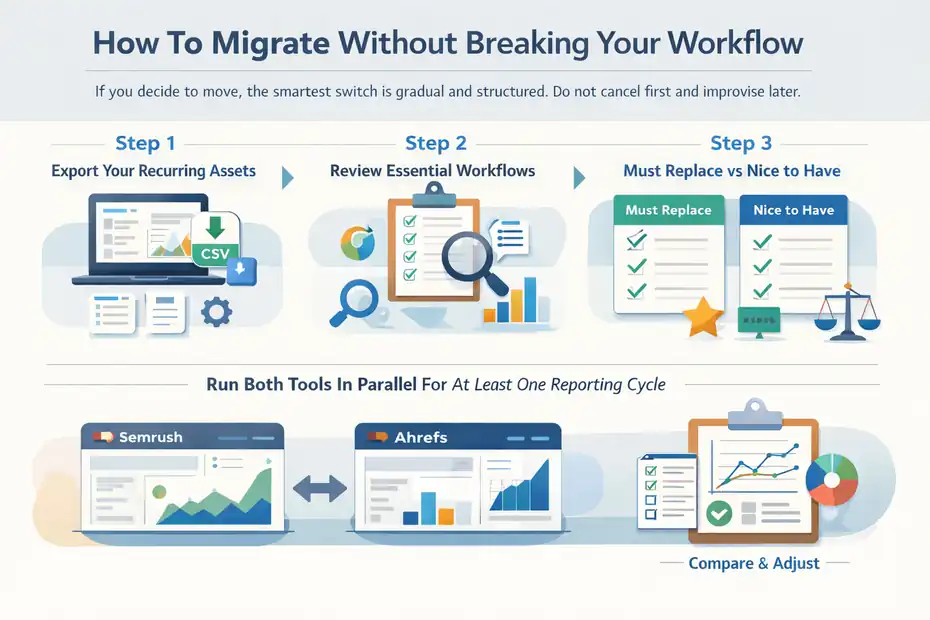
If you decide to move, the smartest switch is gradual and structured. Do not cancel first and improvise later.
Audit What You Use Inside Semrush Before Leaving
Start with a usage audit. This sounds obvious, but many migrations fail because teams do not know what they are actually replacing.
- Step 1: Export your recurring assets. Pull out tracked keyword lists, saved reports, project settings, audit baselines, and any recurring competitor sets.
- Step 2: Review essential workflows. Note exactly how your team uses the platform each week. Keyword research? Site audits? Brand mentions? Client reports? PPC overlap checks?
- Step 3: Mark “must replace” vs “nice to have.” Not every feature deserves a one-to-one substitute.
This process matters because migrations are rarely feature-for-feature. For example, if you mainly used Semrush for keyword research, backlink review, and audits, the handoff to Ahrefs is usually manageable. If you used it for social, advertising, and cross-channel reporting, the move gets more complicated very quickly.
I recommend doing this in a spreadsheet with four columns: current task, current Semrush feature, business importance, Ahrefs replacement. It sounds simple because it is simple, and simple wins.
Run Both Tools In Parallel For At Least One Reporting Cycle
This is the step people skip because they want to save money fast. I think that is a mistake.
Use a temporary overlap period, even if it is just one month. During that window, rebuild your core SEO workflows in Ahrefs while keeping Semrush live. Compare:
- ranking coverage,
- competitor discovery,
- backlink views,
- site audit priorities,
- keyword opportunity research,
- reporting outputs.
This is not about proving one tool “wins.” It is about identifying what will feel different so your team is not surprised later.
A practical example: maybe Ahrefs becomes your preferred source for topic discovery and competitor top pages, but you notice that leadership still expects a style of report you previously built in Semrush. Better to discover that during overlap than after cancellation.
Parallel testing also helps recalibrate expectations around metrics. Search estimates, keyword numbers, and traffic projections will not match perfectly across platforms. That is normal. Your job is to decide whether the new tool supports better decisions, not identical ones.
Rebuild Your Core Operating System Inside Ahrefs
Once you commit, recreate the workflows that drive actual results first. Do not waste your first week customizing everything.
- Priority 1: Site setup. Add verified properties where needed and configure your audit targets.
- Priority 2: Keyword tracking. Import the keyword sets that matter for revenue, not every phrase you ever tracked.
- Priority 3: Competitor benchmarks. Save your main competitors and document baseline traffic, ranking, and backlink snapshots.
- Priority 4: Research templates. Create a repeatable process for keyword discovery, content refreshes, and link analysis.
Ahrefs’ own platform pages highlight Site Explorer, Keywords Explorer, Rank Tracker, and Site Audit as core pillars, so that is usually the smartest migration order too.
I suggest keeping your rebuilt process boring at first. Fancy dashboards can wait. What matters is that your team can answer the same business-critical questions on day one.
Mistakes To Avoid During The Switch
A tool migration can improve your SEO operations, but it can also create confusion if you handle it carelessly.
Mistake 1: Expecting The Metrics To Match Perfectly
This is probably the most common and most frustrating error. You switch tools, compare five keywords, notice different numbers, and panic.
Do not do that. Semrush and Ahrefs collect, model, and present data differently. Their databases are huge, but they are still estimates built on distinct systems.
Semrush states 27.9 billion keywords and 43 trillion backlinks in 2026, while Ahrefs states 28.7 billion topics and emphasizes a massive, frequently updated backlink index. Those inputs alone tell you the measurement systems are substantial but not identical.
The better question is: Are the differences decision-breaking or directionally acceptable?
For instance, if both tools flag the same competitor subfolder as a major traffic driver, you already have enough signal to investigate. Chasing perfect parity wastes time.
Mistake 2: Moving For Novelty Instead Of Strategy
I have seen teams switch just because the other platform feels fresher. That is not a strategy. That is software FOMO.
A move is worth making when it solves a real business issue: lower wasted spend, faster SEO research, stronger backlink analysis, cleaner collaboration, or better prioritization. If the switch is mainly emotional, you may end up recreating the same frustrations in a new interface.
A simple test helps here. Finish this sentence with something measurable: “By moving to Ahrefs, we expect to improve ______ within 90 days.” It might be content production speed, link prospecting efficiency, audit response time, or research quality. If you cannot name a measurable win, hold off.
Mistake 3: Ignoring What Semrush Was Quietly Doing Well
People tend to remember the pain points that pushed them toward a switch. They forget the features that worked.
Semrush’s broader visibility approach, reporting options, and toolkit ecosystem are easy to undervalue until they are gone. The same goes for any cross-functional use cases tied to paid search, social, or AI visibility tracking.
Before you leave, ask each stakeholder one blunt question: “What will you miss if Semrush disappears tomorrow?” You may get answers that materially change your migration plan.
Advanced Ways To Get More Value From Ahrefs After Migrating
A lot of teams switch tools and then use only 60% of what they pay for. That is fixable.
Build Content Decisions Around Topic Depth, Not Just Keyword Volume
One of the easiest ways to waste Ahrefs is to use it like a basic keyword lookup tool. That misses the bigger opportunity.
Ahrefs’ keyword and site research flows are most useful when you combine them. Start with a topic, inspect the SERP, review who owns traffic in that space, study their top pages, and map the subtopics that support the main intent. That is how you move from random keyword hunting to full content strategy.
A mini scenario: Say you run a cybersecurity SaaS company and want to rank for “password manager for teams.” Instead of writing one page and hoping for the best, use competitor top pages and related topics to map supporting content like onboarding security, credential sharing, access policies, and admin controls. That is more likely to build topical authority than chasing one term in isolation.
I believe this is where Ahrefs can become genuinely valuable after the switch. It helps you see the content ecosystem around a keyword, not just the keyword itself.
Use Link Intelligence For Content Refreshes, Not Just Outreach
Most teams think backlink tools are for link building alone. That leaves value on the table.
Ahrefs can also help you decide which older pages deserve updates first. Look for pages that still attract referring domains but have lost rankings or traffic momentum. Those pages already have authority signals. Refreshing them can be a smarter move than publishing something new from scratch.
This is one of my favorite practical shortcuts because it connects links, rankings, and content ROI in one workflow. You are not just asking, “Where can we get links?” You are asking, “Where do we already have enough authority to recover growth?”
For many of us, that shift is where SEO becomes more efficient.
Pair Ahrefs With First-Party Data So You Do Not Over-Rely On Estimates
No SEO platform should become your only source of truth. Ahrefs is powerful, but it still works best when paired with first-party data like Google Search Console and analytics.
Use Ahrefs to spot opportunities, competitor movements, ranking gaps, and content priorities. Then use first-party data to validate impressions, clicks, conversions, and page-level outcomes. This reduces the risk of acting on attractive but low-value opportunities.
I recommend a simple workflow:
- use Ahrefs for discovery,
- use Search Console for validation,
- use analytics for business impact,
- use your CRM or revenue data for final prioritization.
That four-step habit keeps your strategy grounded in outcomes instead of tool fascination.
Final Verdict: Is The Switch Worth It?
For most people, switching from Semrush to Ahrefs worth it only when your SEO program is genuinely search-first and you want a platform that feels more centered on organic research, backlinks, competitor analysis, and practical SEO investigation.
Ahrefs is especially compelling if your team spends most of its time inside content strategy, link intelligence, and organic growth workflows. Its public positioning, keyword research depth, Site Explorer focus, and backlink infrastructure all support that use case well.
But if your organization relies on Semrush for broader marketing visibility, integrated reporting, PPC context, content operations, and cross-functional stakeholder alignment, staying with Semrush may be the smarter decision. Semrush is not just an SEO tool anymore, and that wider scope is exactly why many teams keep it.
So here is my honest answer.
Switch if you want:
- a more SEO-first workflow,
- stronger day-to-day organic and backlink research,
- less platform sprawl around features you rarely use.
Stay if you need:
- broader marketing coverage,
- executive-friendly reporting continuity,
- a platform shared across SEO, PPC, content, and visibility teams.
If I were advising you one-on-one, I would not ask which brand is “better.” I would ask which platform makes your next 12 months of SEO easier, faster, and more profitable. That is the only version of this decision that really matters.
FAQ
What is the main difference between Semrush and Ahrefs?
The main difference is focus. Ahrefs is more centered on organic search, backlinks, and SEO research workflows, while Semrush offers a broader marketing toolkit including PPC, content, and reporting. Your choice depends on whether you need deep SEO analysis or a multi-channel marketing platform.
Is switching from Semrush to Ahrefs worth it for SEO?
Switching from Semrush to Ahrefs is worth it if your strategy is heavily focused on organic search, backlink analysis, and competitor research. If your workflow depends more on cross-channel marketing and reporting, Semrush may still be the better fit for your needs.
Will I lose data if I switch from Semrush to Ahrefs?
You won’t lose your website’s SEO data, but you will lose access to saved reports, keyword tracking history, and project settings inside Semrush. It’s important to export critical data and rebuild your tracking and workflows inside Ahrefs before fully switching platforms.
Is Ahrefs more accurate than Semrush?
Neither tool is universally more accurate because both rely on estimated data from different sources and algorithms. In most cases, the differences are directional rather than critical. The better approach is to use either tool for insights and validate decisions with your own analytics and Search Console data.
Can I use both Semrush and Ahrefs together?
Yes, many SEO professionals use both tools together to combine strengths. Ahrefs is often used for backlink and competitor research, while Semrush supports broader marketing insights and reporting. This approach can be powerful but increases costs, so it depends on your budget and workflow needs.

I’m Juxhin, the voice behind The Justifiable.
I’ve spent 6+ years building blogs, managing affiliate campaigns, and testing the messy world of online business. Here, I cut the fluff and share the strategies that actually move the needle — so you can build income that’s sustainable, not speculative.
Related posts:
 Top SEO Keyword Selection Techniques
 How to Choose a Good SEO Company: Best Way to Start
 A Guide to AIOSEO: What it is and How it Can Help You Improve Your SEO Strategy
 7 Most Important SEO Factors for Skyrocketing Traffic
 Semrush Vs Ahrefs Which Is Better For SEO Today?
 How to Increase Your SEO Ranking