
Table of Contents
Some links on The Justifiable are affiliate links, meaning we may earn a small commission at no extra cost to you. Read full disclaimer.
A real wp engine vs siteground comparison usually starts with speed and uptime, but that is not where it should end.
I’ve looked at both hosts from the perspective of someone who cares about real-world WordPress performance, not just homepage promises.
If you are trying to choose between a premium managed WordPress platform and a more budget-friendly host with strong performance tools, this guide will help you sort it out clearly.
We’ll break down how each host handles speed, uptime, support, pricing, scaling, and everyday site management so you can pick the one that actually fits your website.
What This Comparison Really Comes Down To
Speed and uptime matter, but they only tell part of the story.
The bigger question is this: do you need a premium WordPress-specific platform, or do you need the best balance of cost and performance?
What WP Engine Is Best Known For
WP Engine is built as a managed WordPress hosting platform, and that focus shapes almost everything about the service. Its official plans emphasize performance, expert WordPress support, daily backups, staging, CDN delivery, and a 99.99% uptime SLA on qualifying plans.
WP Engine also positions itself as a premium option for businesses that care about reliability and operational support, not just raw hosting space.
In practical terms, that usually means you are paying more to reduce risk. You get a tighter WordPress environment, more guardrails, and a platform that feels built for agencies, serious business sites, publishers, and stores that cannot afford sloppy hosting performance.
From what I’ve seen, WP Engine tends to appeal to people who do not want to babysit server behavior. They want cleaner workflows, predictable backups, staging, and support that understands WordPress deeply.
That is a different value proposition from “cheap hosting that happens to support WordPress.”
What SiteGround Is Best Known For
SiteGround is a broader hosting company, but its managed WordPress hosting is still very strong. The official WordPress hosting pages highlight auto-updates, caching, CDN, backups, staging on higher tiers, and in-house speed technology.
SiteGround also says it serves more than 3 million domains, which gives it a larger mass-market footprint than many boutique WordPress hosts.
What makes SiteGround attractive is the value gap. You can start much cheaper than WP Engine, and you still get a well-optimized WordPress setup. For many blogs, portfolio sites, service businesses, and early-stage stores, that is a very compelling middle ground.
I believe this is why the comparison feels tricky. SiteGround is not a weak budget host. It is a genuinely capable platform that punches above its price point. WP Engine, though, is still playing a different game.
Speed: Which Host Feels Faster In Real Use?
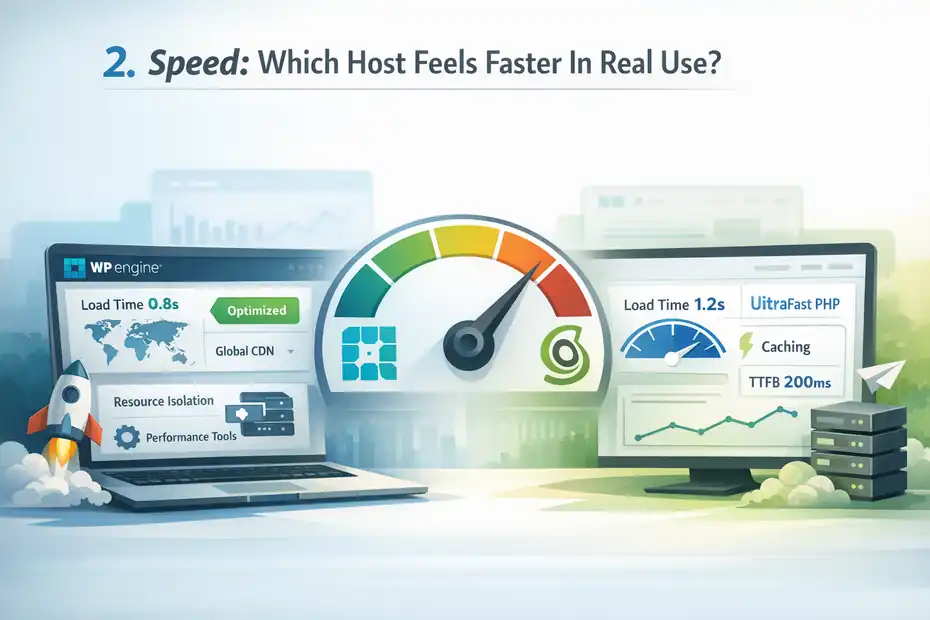
This is where most people begin, and honestly, they should.
Slow sites lose conversions, hurt SEO, and make every marketing dollar work harder than it should.
How WP Engine Approaches Speed
WP Engine puts speed front and center in its hosting pitch. Its hosting pages promote managed WordPress performance, global CDN delivery, isolated resources on higher plans, and performance-focused tooling.
WP Engine also claims some customers have seen site speed improvements of up to 200% after migrating, though that kind of result will obviously depend on what they moved from and how well the site was built before.
The important detail is not the marketing number. It is the architecture. WP Engine is built to remove common WordPress bottlenecks: bad caching setups, sloppy update practices, low-quality shared environments, and plugin chaos.
If your site is moderately complex, that cleaner environment can absolutely show up as faster load times and more stable performance under traffic spikes.
In my experience, WP Engine usually wins on consistency more than peak speed. A cheap host can sometimes look fast on a tiny test site. But when the site has real plugins, real traffic, and real business stakes, consistency matters more than a one-time GTmetrix screenshot.
How SiteGround Approaches Speed
SiteGround’s performance story is built around smart infrastructure decisions and in-house optimizations. Its official materials highlight CDN, caching, and a custom “Ultrafast PHP” setup that it says can make websites load up to 30% faster than standard PHP environments.
SiteGround also says this setup reduces Time to First Byte, which is the delay before the server starts sending page data to a visitor’s browser.
That matters because TTFB is one of those quiet metrics that often shapes how fast a site feels. Even before the full page renders, a faster server response creates a smoother user experience.
For many WordPress sites, SiteGround is more than fast enough. A local business site, a blog, an agency brochure site, or a medium-sized content site can run very well there.
The catch is that performance headroom is usually not as premium as WP Engine’s more specialized environment, especially once your site gets heavier or traffic becomes less predictable.
Which One Wins On Speed?
Here is my honest answer: WP Engine usually has the edge for serious WordPress performance, while SiteGround offers better value for the speed you get.
That is not a cop-out. It is the real distinction.
If your site is a revenue asset, a lead-generation machine, or a WooCommerce build with meaningful traffic, WP Engine is generally the safer speed pick because its whole platform is designed around controlled WordPress performance.
Its premium plans also include isolated resources and stronger performance tooling.
If your goal is to get very good speed without jumping into premium hosting costs, SiteGround is often the better buy. You still get well-optimized WordPress hosting and speed-focused infrastructure, just at a lower entry price.
Uptime: Which Host Is More Reliable?
Uptime is where marketing gets slippery, because almost every host says it is reliable.
What you really want to look for is whether the company publicly states an uptime commitment and how seriously it treats availability.
WP Engine’s Uptime Position
WP Engine publicly advertises a 99.99% uptime SLA on its plans and in enterprise-related materials. Its legal SLA page confirms that uptime guarantees are contractually addressed through a service level agreement.
WP Engine also frames availability as part of its broader managed platform strategy.
A 99.99% target is stronger than the common 99.9% benchmark you see in mainstream hosting. That difference sounds tiny, but over time it can matter. Roughly speaking, 99.9% uptime allows materially more downtime than 99.99%.
That does not mean your site will magically never go down. Plugins break things. DNS problems happen. third-party services fail. But in a host-vs-host comparison, WP Engine is signaling a more premium uptime standard.
SiteGround’s Uptime Position
SiteGround’s educational content and hosting guidance repeatedly frame strong uptime as a core hosting requirement, and its materials commonly refer to 99.9% uptime as the standard benchmark for reliable hosting. Its platform messaging also emphasizes stability and performance.
The difference here is subtle but important. SiteGround clearly cares about uptime and reliability, but WP Engine is more explicit in putting a 99.99% SLA into its premium hosting messaging. That gives WP Engine a stronger paper advantage in this category.
If your site going down for even a short stretch would mean lost leads, missed orders, or support headaches, I would lean toward the provider making the stronger formal uptime commitment.
Which One Wins On Uptime?
On paper, WP Engine wins because it publicly emphasizes a 99.99% uptime SLA, while SiteGround more commonly references the industry-standard 99.9% level in its content.
In daily use, though, both hosts have a reputation for being far more dependable than bargain-basement shared hosting. So I would frame it like this:
- WP Engine: Better choice when uptime is a business-critical requirement.
- SiteGround: Still reliable for most small and mid-sized WordPress sites.
Pricing And Value: Premium Platform Vs Smarter Budget
This is where most decisions get made. Not because people are cheap, but because hosting has to make financial sense.
WP Engine Pricing Reality
WP Engine’s official pricing starts at $30 per month for Startup, then moves to $55 for Professional, $109 for Growth, and $276 for Scale on its small business plan lineup. The plans include things like SSL, daily backups, staging, CDN, and expert support.
That entry point already tells you what kind of company this is. WP Engine is not trying to win on affordability. It is trying to win on platform quality and support depth.
I suggest thinking about WP Engine as an operations cost, not just a hosting bill. If it saves you even one messy outage, one broken update, or a few hours a month in troubleshooting, the math can work out surprisingly fast for businesses.
SiteGround Pricing Reality
SiteGround’s official WordPress hosting page shows promotional entry pricing that starts much lower, with standard pricing that later renews higher.
Its WordPress plans include StartUp, GrowBig, and GoGeek, and the company’s published rate information shows regular pricing levels such as $17.99, $29.99, and $44.99 per month on 12-month terms depending on plan.
This is where SiteGround shines. The entry cost is dramatically easier for small sites to justify. Even after renewal, it often remains below WP Engine’s pricing floor.
The trap, of course, is comparing promo pricing to premium managed hosting pricing as if they are the same category. They are not. SiteGround gives you better affordability. WP Engine gives you a more specialized WordPress environment.
Value Depends On Your Site Type
Imagine you run a personal blog making a little affiliate income. SiteGround probably makes more sense. You would likely feel the price difference more than the performance difference.
Now imagine you run a law firm site worth several qualified leads a month, or an online store doing consistent sales. That changes the equation. In that case, even a modest improvement in uptime, workflow, and support quality can justify WP Engine quickly.
That is why the best value is not universal. It depends on how expensive hosting mistakes would be for you.
Features That Affect Speed And Stability

Not every feature matters equally. Some are nice extras. Others directly affect whether your site stays fast and stable.
Backups, Staging, And Recovery Tools
WP Engine includes daily backups and staging in its managed hosting pitch, which is part of why developers and agencies like it.
SiteGround also includes backups and offers staging on higher plans, while backup restores are free on its shared hosting plans.
It also notes that on-demand backups are free on GrowBig and GoGeek, while StartUp charges separately for that feature.
This matters more than many beginners realize. A “fast host” is not really helping you if one plugin update crashes your site and recovery is annoying.
I recommend paying close attention to how easy it is to create a staging copy, test changes, and roll back safely. That workflow reduces downtime risk more than another tiny speed tweak ever will.
CDN, Caching, And Resource Handling
Both hosts emphasize CDN and caching as core performance features. WP Engine includes edge delivery and CDN in plan materials, while SiteGround bakes performance tools into its managed WordPress experience.
SiteGround also points to its custom technology stack, including Brotli support and its Ultrafast PHP setup.
The deeper difference is resource isolation and platform intent. WP Engine explicitly highlights isolated resources on premium plans.
That is useful when you need more predictable performance under load. SiteGround is strong, but it is still more value-oriented in how it packages hosting.
For many of us, that means SiteGround is excellent until the site becomes demanding enough that “excellent value” is no longer the main priority.
Security And Maintenance Support
WP Engine emphasizes proactive WordPress security, expert support, and managed updates in premium materials. SiteGround promotes auto-updates, a smart WAF, and managed WordPress conveniences.
Security ties directly into uptime because compromised sites often become unavailable, slow, or unstable. This is why I never look at security as a separate category. Good hosting security is part of performance insurance.
Which Host Is Easier To Use Day To Day?
A host can look great in a spec sheet and still be annoying to live with. This section matters if you are the person who actually has to manage the site.
WP Engine For Workflow And Control
WP Engine’s appeal is how organized the experience feels for WordPress work. The company clearly leans into staging, managed backups, migration support, and expert assistance.
It is designed for people who want a cleaner operational setup, especially if they run multiple stakeholders, clients, or production workflows.
In my opinion, WP Engine feels less like generic hosting and more like a managed WordPress operations layer. That is especially useful for agencies and growing businesses where a careless change can become expensive fast.
The downside is simple: cost. You pay for that smoother experience.
SiteGround For Simplicity And Affordability
SiteGround has become very approachable for non-technical users. Its managed WordPress pages emphasize easy setup, automated migration, updates, backups, and a custom control environment designed for usability.
That makes SiteGround a strong choice if you want solid WordPress hosting without jumping into a more premium ecosystem. It is usually easier to justify for freelancers, bloggers, and small business owners who want good tools without premium overhead.
I think this is one of SiteGround’s most underrated strengths. It does not just compete on low price. It competes on “easy enough for real people, strong enough for serious websites.”
Best Use Cases: Who Should Choose Which Host?
This is where the decision gets easy. Once you match the host to the site type, the noise drops away.
Choose WP Engine If You Need Premium WordPress Hosting
WP Engine is usually the better fit when your site has meaningful business value and downtime or slowness would genuinely hurt. That includes:
- Agencies managing client sites
- Growing WooCommerce stores
- Publishers with regular traffic spikes
- Lead-generation sites where each conversion matters
- Teams that need safer development workflows
Its higher pricing, stronger uptime promise, and performance-oriented managed environment all point in the same direction: reliability for serious WordPress use.
I would also add one more group here: people who are tired of patching together performance fixes manually. WP Engine is often attractive because it reduces the number of moving parts you need to manage yourself.
Choose SiteGround If You Want Strong Performance For Less
SiteGround is usually the better choice when you want a fast, reliable WordPress host without paying premium managed-hosting prices. That includes:
- Personal blogs
- Small business websites
- Portfolio sites
- Affiliate or niche content sites
- Early-stage online stores
- Freelancers building and managing a few websites
Its lower starting price, solid WordPress tooling, staging on higher plans, and speed-focused stack make it one of the better value choices in the market.
If your site is important but not yet mission-critical, SiteGround often hits the sweet spot.
Common Mistakes People Make In This Comparison
A lot of bad hosting decisions come from comparing the wrong things.
Mistake 1: Looking Only At Promotional Pricing
This is probably the biggest one. SiteGround’s promo rates look dramatically lower, but regular renewal pricing is much higher than the headline discount. WP Engine’s pricing is more obviously premium from day one.
You should compare year-one cost and renewal cost separately. Otherwise, the comparison is not honest.
Mistake 2: Assuming “Fast” Means The Same Thing Everywhere
A tiny blog with a lightweight theme can look fast almost anywhere. That does not mean the host will perform equally well once you add page builders, forms, scripts, analytics, WooCommerce, image-heavy pages, and real traffic.
This is why I think consistency matters more than isolated speed claims. WP Engine tends to win more clearly once the WordPress setup gets heavier. SiteGround often wins when the site is simpler and budget matters more.
Mistake 3: Ignoring Support And Recovery Workflows
Speed and uptime are not just about infrastructure. They are also about how quickly you can recover from mistakes. Backups, staging, knowledgeable support, and rollback options all affect real uptime.
That is one reason premium hosting can be worth it. Not because the server is magically perfect, but because the workflow around the server is safer.
My Verdict On WP Engine Vs SiteGround Comparison
This section is the one most readers actually want, so let me be direct.
Best For Speed And Uptime Overall: WP Engine
If your top priority is the strongest combination of premium WordPress performance, formal uptime commitment, and safer site management, WP Engine is the better overall choice.
Its 99.99% uptime SLA, managed WordPress focus, staging, backups, CDN delivery, and premium support positioning give it the edge for business-critical sites.
I would pick WP Engine for sites where reliability has a direct revenue impact.
Best Value Alternative: SiteGround
If you want very good speed, strong WordPress features, and a much lower starting cost, SiteGround is the better value option.
Its managed WordPress setup, caching and CDN features, in-house performance stack, and lower entry pricing make it a smart fit for many smaller sites.
I would pick SiteGround when the site matters, but not enough to justify premium managed-hosting costs yet.
The Simplest Way To Decide
Use this filter:
- Pick WP Engine if your site is a business asset you cannot afford to have slow down, break, or go offline.
- Pick SiteGround if you want strong WordPress hosting at a more accessible price and your site is not yet at premium-platform scale.
That is the cleanest conclusion I can give you. In a true wp engine vs siteground comparison, WP Engine wins on premium speed-and-uptime confidence, while SiteGround wins on affordability and practical value.
Final Recommendation Before You Buy
Before choosing either host, I suggest asking yourself three questions:
How Expensive Is Downtime For You?
If one hour offline would cost you leads, sales, or client trust, lean toward WP Engine. A stronger uptime commitment and more premium environment are easier to justify when downtime has a real price tag.
How Complex Is Your WordPress Site?
If your site is plugin-heavy, custom-built, WooCommerce-based, or growing quickly, WP Engine’s managed environment will probably age better. If your site is leaner and more straightforward, SiteGround may be all you need.
Are You Buying For Today Or For The Next 12 Months?
This is the question people skip. A host that fits today may not fit six months from now. If you expect traffic growth, more content, or more site complexity, buying slightly ahead of your current needs can save you a migration later.
My honest take is this: SiteGround is the smarter buy for many smaller websites, but WP Engine is the better long-term fit when performance and uptime are central to the business.
That is the difference in plain English.
FAQ
What is the main difference between WP Engine and SiteGround?
The main difference is that WP Engine is a premium managed WordPress host focused on performance and reliability, while SiteGround offers more affordable hosting with strong performance features. WP Engine prioritizes advanced tools and uptime guarantees, whereas SiteGround balances speed with cost-effectiveness for smaller websites.
Which is faster, WP Engine or SiteGround?
WP Engine is generally faster for complex or high-traffic WordPress sites due to its optimized infrastructure and resource isolation. SiteGround is still very fast for most websites, but WP Engine tends to deliver more consistent speed under heavier workloads and traffic spikes.
Does WP Engine have better uptime than SiteGround?
WP Engine typically offers a stronger uptime guarantee with a 99.99% SLA, compared to SiteGround’s industry-standard 99.9%. This means WP Engine is often the better choice for mission-critical websites where even small amounts of downtime can impact revenue or user experience.
Is SiteGround good enough for beginners?
Yes, SiteGround is an excellent option for beginners because it offers an easy setup, affordable pricing, and strong performance features. It provides a user-friendly environment that works well for blogs, small business websites, and users who don’t need premium managed hosting.
Is WP Engine worth the higher price?
WP Engine is worth the price if your website generates revenue or requires high reliability and performance. Its managed environment, advanced tools, and stronger uptime focus can save time and prevent costly issues, making it a smart investment for growing or business-critical sites.

I’m Juxhin, the voice behind The Justifiable.
I’ve spent 6+ years building blogs, managing affiliate campaigns, and testing the messy world of online business. Here, I cut the fluff and share the strategies that actually move the needle — so you can build income that’s sustainable, not speculative.
Related posts:
 WP Engine Vs Hostinger WordPress Hosting Comparison: Value
 Kinsta Web Hosting vs Competitors: Who Comes Out on Top?
 SiteGround Hosting Reviews: Why Users Love (or Hate) It
 Bluehost WordPress Hosting vs Competitors: Who Wins?
 Namecheap WordPress Hosting vs Bluehost: Who Wins?
 WP Engine WordPress Hosting Review: Speed, Security, and Value