
Table of Contents
Some links on The Justifiable are affiliate links, meaning we may earn a small commission at no extra cost to you. Read full disclaimer.
Upwork Inc has become a household name for freelancers and businesses alike, but what exactly is Upwork Inc, and how does it make money from connecting professionals online?
If you’ve ever wondered how this global freelance platform operates behind the scenes—or how it turned gig work into a billion-dollar business—this article will break it all down for you.
We’ll explore its business model, revenue streams, and the clever ways Upwork sustains its global marketplace for talent and clients.
Understanding What Upwork Inc Really Is
Upwork Inc. is essentially the bridge between freelance professionals and businesses that need flexible, on-demand talent.
Think of it as a digital marketplace where work meets opportunity—developers, writers, designers, and marketers find clients who need their skills.
I like to describe it as the “LinkedIn that actually pays you.” But to understand how Upwork Inc. became a powerhouse in the freelance economy, let’s rewind a bit.
The Origin and Evolution of Upwork
Upwork’s story began as two separate platforms: Elance and oDesk. Both launched in the early 2000s with the same mission—to make remote work easier. Elance started in 1999, targeting professionals and small businesses who wanted to hire online without the old-school HR hassle.
Meanwhile, oDesk, founded in 2003, took a more technical route, building real-time work tracking tools for remote collaboration.
In 2015, these two pioneers merged, forming what we now know as Upwork Global Inc The goal was to combine Elance’s polished client marketplace with oDesk’s robust work management technology.
I still remember how, post-merger, the platform felt like a “super app” for freelancers—smoother project handling, built-in time tracking, and a unified profile system.
Since then, Upwork has evolved rapidly: expanding from a simple job board to a comprehensive work ecosystem offering project catalogs, specialized talent badges, and even AI-based talent matching.
How Upwork Became the Largest Freelance Marketplace
Upwork’s scale didn’t happen by chance—it came from smart positioning and relentless user trust-building.
Today, over 18 million freelancers and nearly 900,000 clients use the platform. What fueled this growth was accessibility: anyone with skills and internet access could join, bid on projects, and build a career.
But Upwork also built tools that keep clients returning. Features like “Talent Scout”, which lets businesses hire pre-vetted experts, and “Project Catalog”, which allows freelancers to sell predefined services (like “Logo Design for $250”), have reshaped the freelance workflow.
Its payment protection system also set it apart. When I first used Upwork, what impressed me most was its Escrow system—clients fund the project upfront, so freelancers know they’ll get paid once milestones are met. That trust factor turned casual users into long-term partners.
The Vision and Mission Driving Upwork’s Growth
Upwork’s mission is surprisingly human: “to create economic opportunities so people have better lives.” It’s not just about connecting buyers and sellers—it’s about empowering independence.
Upwork envisions a world where skilled professionals can work from anywhere, not just where jobs exist. This mission is visible in the company’s investments in AI-driven matching, remote work compliance, and skills certification programs.
From what I’ve seen, Upwork’s leadership leans heavily on data to improve transparency and fairness. Every tweak to the rating system or search algorithm aims to make good freelancers easier to find and reward reliability over low pricing.
Upwork’s Role in the Future of Remote Work
The pandemic didn’t just accelerate remote work—it validated Upwork’s long-term bet on flexibility. According to Upwork’s own Future Workforce Report, 58% of hiring managers plan to use more remote freelancers over the next five years.
Upwork isn’t just reacting to this trend; it’s shaping it. The company is building AI-assisted hiring tools that can analyze job descriptions and auto-match ideal candidates.
Imagine posting a job for a mobile app, and within seconds, getting a shortlist of verified developers with matching past projects. That’s where Upwork is headed.
I believe Upwork’s future will focus on hybrid workforce models, where companies mix full-time employees with global freelance experts. In that sense, Upwork isn’t just a platform—it’s becoming part of the infrastructure of the modern workforce.
How Upwork Inc Connects Freelancers and Clients

Upwork’s genius lies in its matchmaking process. It’s not just about listing jobs and waiting for bids; it’s a complex, trust-based ecosystem that quietly handles millions of transactions and collaborations every month.
Let’s break down how this system works behind the scenes.
The Platform Ecosystem: Freelancers, Clients, and Agencies
The Upwork ecosystem revolves around three main roles:
- Freelancers: Independent professionals offering their skills—writers, designers, coders, marketers, and more.
- Clients: Individuals or companies hiring talent for projects.
- Agencies: Groups of freelancers working together under a shared brand or business account.
Once you create an account, the UI path is pretty simple: From your dashboard, click Find Work > Search Jobs if you’re a freelancer, or Post a Job > Get Proposals if you’re a client.
Agencies add another layer—teams can share earnings, distribute tasks, and scale operations without leaving the platform. This flexibility makes Upwork not just a job board but a functioning remote business environment.
How the Matching Algorithm Works Behind the Scenes
Upwork’s matching system isn’t just keyword-based; it’s an AI-driven recommendation engine. It looks at your profile’s:
- Skills and certifications
- Job success rate
- Past client feedback
- Proposal relevance
When a client posts a job, the algorithm ranks freelancers based on these signals. That’s why keeping your profile niche-specific is crucial. I often tell new freelancers: “Don’t try to be a jack-of-all-trades—Upwork rewards specialists.”
The platform also uses behavioral data. For example, if you consistently decline low-paying jobs, Upwork learns to show you more premium listings. That’s personalization in action.
Project Types: Hourly, Fixed-Price, and Long-Term Contracts
Upwork offers three main project structures, each suited to different needs:
- Hourly Contracts – Best for ongoing work. Upwork’s Work Diary automatically tracks time and takes random screenshots. Clients are billed weekly.
- Fixed-Price Contracts – Ideal for defined deliverables (e.g., logo design). Funds go into escrow and release upon milestone completion.
- Long-Term Contracts – Used by larger businesses for steady collaboration. These often transitin from fixed-price or hourly gigs after trust is built.
From my experience, beginners thrive with fixed-price projects—they’re easier to manage and require less ongoing communication.
How Upwork Ensures Trust and Transparency Between Users
Trust is the currency of freelancing, and Upwork knows it. The platform invests heavily in systems that prevent fraud and misunderstandings:
- Escrow Protection: Ensures freelancers get paid and clients only release funds when satisfied.
- Dispute Resolution Center: Helps mediate issues between parties fairly.
- Verified Badges and ID Checks: Adds authenticity to profiles.
- Job Success Score (JSS): A dynamic metric that tracks a freelancer’s reliability based on feedback and project outcomes.
One underrated feature is Upwork Messages, the built-in chat where you can share files, video call, and track all communications. It’s what keeps collaboration smooth and professional.
When both sides play by the rules—communicate clearly, fund milestones, and deliver on time—Upwork becomes an incredibly efficient system of mutual trust.
Pro Tip: If you’re a freelancer on Upwork, focus on creating a niche-specific, complete profile and maintaining a high Job Success Score. The algorithm loves consistent reliability—and so do clients.
The Core Revenue Streams of Upwork Inc
If you’ve ever used Upwork Inc., you’ve probably wondered—how exactly does the company make money from all these projects flying around the platform?
The truth is, Upwork’s business model is smart, layered, and built on mutual value. They earn primarily through service fees, Connects, subscription plans, and transaction processing.
Let’s look at how each stream fuels the platform’s growth.
Service Fees Charged to Freelancers and Clients
This is Upwork’s bread and butter. Every time money changes hands on the platform, Upwork takes a cut.
For freelancers: Upwork charges a sliding service fee based on your lifetime billings with each client:
10% for all new contracts (previously it was tiered, but this changed in 2023).
Let’s say you complete a $1,000 logo design project. You’ll keep $900, and Upwork earns $100. This might seem steep at first, but it funds the systems that make the platform trustworthy—payment protection, client mediation, and marketing visibility.
For clients: Clients are charged a 5% client marketplace fee on every payment made to freelancers. So if a client pays you $1,000, they’ll actually pay $1,050. Large companies using enterprise accounts, however, often negotiate custom fee structures.
I always tell freelancers to see this as the cost of convenience. The peace of mind that Upwork’s escrow and dispute systems offer is well worth it—especially when compared to the risk of working directly with new clients off-platform.
How Connects Generate Revenue for Upwork
Connects are Upwork’s internal bidding currency—the tokens freelancers use to apply for jobs. You can think of them as your digital “application tickets.”
- Each job proposal typically costs 2–8 Connects, depending on the project’s size and competition.
- Connects cost about $0.15 each, though freelancers receive a few free ones monthly.
Here’s how it looks in practice:
From your dashboard, click Find Work > Proposals, and you’ll see how many Connects you have left. If you’re short, just click Buy Connects, choose the quantity, and pay directly via card or Upwork balance.
It’s a clever revenue stream because it encourages serious applications. It filters out spammy bids while giving Upwork steady micro-revenue from active freelancers.
In 2024, Connects revenue alone accounted for an estimated 10–15% of Upwork’s total earnings.
I suggest using Connects strategically—apply only to jobs that truly match your expertise and where you can offer clear value.
Upwork’s Subscription Plans and Premium Tiers
Beyond Connects and service fees, Upwork also makes money through subscription plans. These are designed to give power users more visibility and functionality.
For Freelancers:
- Basic (Free) – Limited to 10 free Connects per month.
- Freelancer Plus ($14.99/month) – Includes 80 Connects/month, profile insights showing who viewed your profile, and the ability to keep your profile visible even when inactive.
For Clients:
- Client Marketplace (Free) – Basic hiring and payment tools.
- Client Plus ($49.99/month) – Enhanced search filters, faster customer support, and easier multi-hire management.
Freelancer Plus, in particular, is worth the investment for active users. I use it myself—it’s basically a visibility boost. When you can see who’s viewing your profile, you can tweak your portfolio to appeal to specific types of clients.
The Role of Payment Processing and Transaction Fees
Every transaction on Upwork flows through its payment infrastructure. The company earns additional revenue through payment processing fees, currency conversions, and withdrawal charges.
Here’s how it works:
- Clients pay through Upwork’s escrow system using cards, PayPal, or direct bank transfer.
- Upwork takes its commission, holds funds securely, and releases payment once milestones are approved.
- Freelancers can withdraw funds via bank transfer (free for U.S. users) or PayPal (which incurs small fees).
Currency conversion is another subtle but profitable channel. When a U.S. client pays in USD and a freelancer in India withdraws in INR, Upwork applies a small exchange rate margin—typically around 2–3%.
From my experience, it’s smart to link your Payoneer or direct bank account for better rates and lower withdrawal costs.
All of these combined—service fees, Connects, subscriptions, and transaction margins—make Upwork Inc. a self-sustaining marketplace where every click, bid, and payment keeps the engine running.
Upwork’s Enterprise Solutions and B2B Offerings
Now here’s where Upwork truly steps beyond just freelancing—it’s not only for individuals.
Upwork Inc. has become a major player in enterprise talent acquisition, helping Fortune 500 companies manage large-scale, remote workforces through Upwork Enterprise.
What Upwork Enterprise Offers to Large Companies
Upwork Enterprise is tailored for corporations that need vetted, flexible, and compliant freelance teams. Unlike the regular marketplace, this tier provides custom onboarding, compliance management, and dedicated support.
For example, if a tech company needs 50 developers for a six-month sprint, Upwork Enterprise helps them:
- Source pre-vetted talent.
- Manage contracts and NDAs.
- Handle payroll and tax compliance globally.
The workflow looks like this:
From the enterprise dashboard, an HR manager can click Talent Cloud > Request Talent, filter by skill and experience, and get a shortlist of approved freelancers—often within hours.
It’s basically a plug-and-play global workforce solution.
Custom Talent Pools and Managed Services Explained
This is where things get impressive. Enterprise clients can create custom talent pools, meaning they can keep a private list of their favorite freelancers for future projects.
I’ve seen how this helps businesses avoid the hiring scramble every time they start a new project. They just go to Talent Pool > Invite to Job, and instantly re-engage proven contractors.
Upwork also offers Managed Services, where Upwork itself oversees entire projects—from hiring to delivery. Think of it as a done-for-you freelance operation. The client defines the goal, and Upwork handles everything else, including managing subcontractors and quality assurance.
How Upwork Partners with Corporations for Large-Scale Hiring
Upwork collaborates directly with companies like Microsoft, Airbnb, and Nasdaq to fill specialized roles efficiently. These aren’t one-off hires—they’re ongoing talent pipelines.
For instance, Microsoft uses Upwork to source digital marketing specialists, developers, and designers for its internal campaigns. Upwork’s AI tools analyze role descriptions and past hiring data to recommend top candidates automatically.
What makes this model powerful is scalability. Upwork can onboard hundreds of freelancers across regions while maintaining compliance with local labor laws—a headache for many corporations if handled independently.
The Pricing and Value Proposition of Enterprise Solutions
Upwork Enterprise uses a custom pricing model, depending on company size, project volume, and services needed. Typically, businesses pay a platform fee plus a management fee for handled projects.
The true value here is time saved and risk minimized. Instead of manually managing contracts and payments across multiple freelancers, everything sits under one umbrella—secure, tracked, and globally compliant.
Here’s what companies get for that investment:
- Vetted professionals and talent verification.
- Centralized invoicing and reporting.
- Streamlined compliance with country-specific labor laws.
- Dedicated Upwork support teams for project success.
From what I’ve observed, this model positions Upwork not just as a gig platform but as a strategic talent partner for enterprises navigating the remote work era.
Advertising and Promotion as a Revenue Channel

Advertising is one of the quieter—but increasingly powerful—revenue channels for Upwork Inc Unlike traditional job boards that rely mainly on listing fees, Upwork has built an internal economy where visibility itself becomes a service.
The company monetizes not just transactions but also attention.
How Promoted Proposals Work for Freelancers
If you’ve ever seen certain job listings on Upwork where a few proposals appear at the very top, those are Promoted Proposals. Think of it like “sponsored posts” on social media, except they directly impact who clients see first.
Here’s how it works:
- When submitting a proposal, freelancers can choose to bid extra Connects to “promote” their proposal.
- These bids compete in an internal auction system—the more you bid, the higher your proposal may appear in search or client views.
- Clients see a small “Promoted” tag beside your name, giving you a visibility boost.
From the freelancer dashboard, you’ll see this option right after writing your proposal under “Boost your visibility.”
In simple terms: it’s paying for a front-row seat. I’ve tried it on smaller projects, and it genuinely helps when entering competitive categories like web development or copywriting, where hundreds of proposals pour in.
But I always advise freelancers to boost selectively—it’s worth it when your profile strongly matches the client’s needs. Otherwise, you’re just burning Connects.
The Economics Behind Visibility and Bidding
From Upwork’s perspective, promoted proposals turn competition into revenue. Every Connect bid adds up, and since freelancers buy Connects with real money, the model scales effortlessly.
Let’s take a hypothetical scenario:
- 100 freelancers apply for a job.
- 10 decide to boost their proposals.
- Each spends around 10–20 Connects ($1.50–$3.00).
That single job post might generate $30–$50 in additional micro-revenue—without Upwork lifting a finger. Multiply that across tens of thousands of jobs daily, and you can see why this system is so profitable.
It’s a win-win: freelancers get exposure, clients get higher-quality applicants faster, and Upwork monetizes the race for visibility.
The Impact of Advertising on Freelancer Competition
Advertising reshaped the competitive landscape on Upwork. Before promoted bids, proposal order was mostly organic—based on experience, client history, and timing.
Now, it’s part skill, part strategy, and part budget.
This model rewards freelancers who:
- Understand when to boost strategically.
- Maintain high Job Success Scores to convert visibility into contracts.
- Treat Connects as an investment, not a cost.
However, I’ll be honest—this has created a mild “pay-to-play” environment. New freelancers sometimes feel pressured to spend on visibility just to get noticed.
That’s why I suggest balancing both: optimize your profile first, then use boosts sparingly for high-value contracts.
Why Upwork Invests Heavily in Platform Ads
Upwork doesn’t just sell ad space internally—it also advertises externally to attract clients and freelancers.
They run multi-channel campaigns across Google, YouTube, and LinkedIn promoting messages like “Hire the best talent, anywhere.” In 2024 alone, Upwork reportedly spent over $100 million on marketing to strengthen its global presence.
The idea is simple: more traffic means more freelancers and clients, which increases overall transaction volume. In effect, every advertising dollar Upwork spends outside brings in multiple dollars in transaction and service fees inside.
It’s a loop: external ads fuel growth, while internal ad tools (like promoted proposals) monetize user engagement.
Upwork’s Strategic Partnerships and Integrations
Upwork Inc. doesn’t operate in isolation—it thrives because it’s woven into a global web of payment systems, HR tools, and compliance platforms.
These partnerships make it possible for freelancers and businesses in over 180 countries to work together seamlessly.
Collaborations with Payment and Software Platforms
Upwork partners with major payment providers like Payoneer, PayPal, and Deel to process international transactions securely.
When you go to Settings > Get Paid in your Upwork dashboard, you’ll see multiple payout options—these integrations make that possible. Each partnership ensures faster withdrawals, better currency conversion rates, and compliance with local financial laws.
On the business side, Upwork integrates with tools like QuickBooks and Xero to simplify accounting. Clients can export invoices directly into their systems, cutting hours of manual work.
I always recommend freelancers connect their Payoneer accounts for lower withdrawal fees and faster turnaround, especially if they work internationally.
How API Integrations Help Businesses Hire Efficiently
Upwork’s API integrations allow larger businesses to plug the platform directly into their internal workflows.
For example, a company can use Upwork’s API to:
- Auto-post jobs from its internal HR system.
- Track spending per department.
- Manage freelancer contracts without leaving their HR dashboard.
This kind of automation is gold for corporations handling hundreds of contracts at once. Instead of manually onboarding freelancers, they can sync everything through a single API connection.
It’s a quiet but critical feature—one that’s turned Upwork from a gig platform into a global hiring infrastructure.
Partnerships with Global Compliance and Payroll Providers
Remote hiring brings legal complexity. Who pays taxes? Which laws apply? Upwork solves this through partnerships with global compliance providers like Deel, Remote, and Papaya Global.
These collaborations handle country-specific regulations—employment classification, tax documentation (like W-8BEN forms), and data privacy.
For instance, when an Upwork Enterprise client hires freelancers from different countries, these partnerships ensure the contracts align with local labor laws. It’s part of why major corporations trust Upwork over smaller freelance marketplaces.
The Financial Impact of These Strategic Collaborations
These integrations may not be as flashy as ad campaigns, but they’re hugely profitable. By partnering with trusted third parties, Upwork reduces operational costs, expands its reach, and earns small margins on every integrated transaction.
More importantly, these collaborations lower churn—freelancers and clients are less likely to leave when payments, contracts, and compliance are all handled smoothly.
In short, partnerships make Upwork scalable without heavy infrastructure spending. It’s efficiency and trust bundled into a business advantage.
How Upwork Inc. Balances Growth and Profitability
Running a massive global marketplace is tricky. Upwork has to balance user acquisition (growth) with sustainability (profit).
The challenge? Keeping both freelancers and clients happy while still turning a profit in a highly competitive market.
The Challenge of Scaling a Marketplace Business
Marketplaces live and die by balance. If there are too many freelancers, competition gets fierce and rates drop. Too few, and clients can’t find talent.
Upwork constantly adjusts its marketing and pricing models to maintain this equilibrium. For instance, by increasing Connect costs and tightening verification, they ensure only serious professionals stay active.
It’s not just user scaling, though—it’s system scaling. Upwork manages millions of job posts, proposals, and payments daily. Their infrastructure relies heavily on automation and machine learning to keep operations smooth and efficient.
Revenue Growth Versus Profit Margins: The Trade-Off
In its early years, Upwork focused almost entirely on growth. But now, as a publicly traded company (NASDAQ: UPWK), it’s under pressure to show profitability.
The trade-off looks like this:
- Growth requires heavy spending on marketing and R&D.
- Profitability demands higher efficiency and reduced user incentives.
Upwork’s 2024 financial reports showed $700+ million in annual revenue, but slim profit margins. Still, that’s improving each year as automation replaces manual moderation and customer service tasks.
I believe the company’s next big challenge will be maintaining user satisfaction while tightening margins—a delicate balancing act for any two-sided marketplace.
How Upwork Invests in AI and Automation to Cut Costs
AI is Upwork’s secret weapon for scaling profitably. The company is using machine learning models to:
- Detect fraud faster.
- Auto-match freelancers to jobs.
- Automate dispute resolution and proposal ranking.
For example, the AI Talent Match tool, launched in 2024, can suggest the top five candidates for a client’s project within seconds—cutting hiring time dramatically.
Freelancers benefit too. When you log in and see “Best Matches for You,” that’s Upwork’s AI quietly learning from your past behavior, improving accuracy over time.
Automation reduces overhead, allowing Upwork to grow without hiring thousands more employees. It’s efficiency that feeds profit.
Key Financial Metrics That Drive Long-Term Success
To understand Upwork’s health, investors and analysts watch four key metrics:
- Gross Services Volume (GSV): Total value of all transactions on the platform.
- Take Rate: The percentage of GSV Upwork keeps (around 15%).
- Active Clients and Freelancers: Measures engagement and platform vibrancy.
- Revenue Retention: How much repeat business comes from existing clients.
When GSV rises and the take rate stays stable, it signals strong platform efficiency. Upwork’s challenge is to grow these numbers while keeping operational costs low—a balance it’s managing more efficiently every year.
Upwork’s Global Reach and Market Expansion
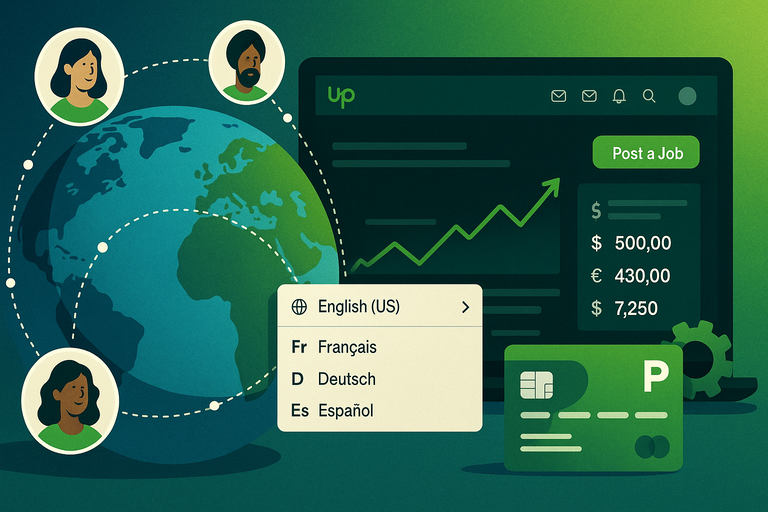
Upwork Inc. isn’t just a freelancing platform—it’s a global economy in motion. With freelancers and clients spanning more than 180 countries, Upwork has built an ecosystem that thrives across languages, currencies, and work cultures.
Let’s unpack how the company sustains and expands this worldwide network.
How Upwork Attracts Freelancers from 180+ Countries
Upwork’s growth hinges on accessibility. Anyone with skills and an internet connection can join—no gatekeeping, no physical borders. That openness is why Upwork now has millions of active freelancers across continents.
Here’s how it works in practice:
- Localized onboarding: New freelancers can select their region and preferred currency right from sign-up.
- Global payment options: Integration with Payoneer, PayPal, and direct bank transfers allows workers from countries like India, the Philippines, Nigeria, and Ukraine to withdraw earnings easily.
- Skill diversity: From U.S.-based marketing experts to Eastern European developers and Asian designers, Upwork leverages the diversity of talent to attract more clients seeking global reach.
What I find interesting is that freelancers aren’t drawn just by opportunity—they’re drawn by stability. Upwork’s escrow system and dispute resolution tools give international freelancers a sense of security rarely found elsewhere.
Regional Market Strategies in Asia, Europe, and the U.S.
Upwork doesn’t apply a one-size-fits-all approach. Each region gets its own strategy.
- Asia: Focused on talent growth. Upwork heavily invests in education and workshops in markets like India and the Philippines, where remote work adoption is high. They also run local partnerships to teach freelancers how to price and market their services better.
- Europe: The emphasis here is on compliance and data protection. European freelancers benefit from GDPR-compliant systems and region-specific payment integrations. Upwork also partners with European tech companies for enterprise hiring.
- United States: This remains Upwork’s most mature and high-spending market. The company positions itself as a talent-on-demand partner for startups and Fortune 500s, emphasizing quality, verified talent, and enterprise-scale solutions.
Each region fuels a different part of Upwork’s ecosystem—Asia supplies talent, the U.S. supplies demand, and Europe provides innovation in compliance and project governance.
How Localization and Currency Support Boost Engagement
Localization goes beyond translation. Upwork understands that freelancers prefer to work in familiar settings—currency, language, and culture all matter.
Localized features include:
- Currency display: Freelancers can set their dashboard to show earnings in local currency, avoiding conversion confusion.
- Language options: The platform supports multiple languages for smoother communication.
- Regional support: Customer service centers in different time zones mean faster help.
When I switched my account to show prices in my native currency, it genuinely made budgeting and comparing jobs easier. This might sound minor, but small comfort improvements like that drive long-term user engagement.
Upwork’s Growth Opportunities in Emerging Markets
Emerging markets are Upwork’s next frontier. Countries in Africa, Latin America, and Southeast Asia have rising digital literacy and youth populations eager to work online.
For example:
- In Nigeria, Upwork’s growth rate reportedly doubled between 2022 and 2024.
- In Brazil, the demand for bilingual support roles and creative freelancers has skyrocketed.
- In Vietnam and Indonesia, small business owners increasingly use Upwork to find affordable tech talent.
I believe the next few years will see Upwork expand its infrastructure—localized payment gateways, more regional partnerships, and language support—to capture these fast-growing markets.
Competition and Market Positioning
The freelance economy is getting crowded. Platforms like Fiverr, Freelancer.com, and Toptal all compete for attention. Yet, Upwork Inc. continues to lead in scale, trust, and enterprise integration.
Comparing Upwork to Fiverr, Freelancer, and Toptal
Here’s a quick comparison to show where Upwork stands:
| Platform | Focus | Strengths | Weaknesses |
| Upwork | Broad marketplace for all skill levels | Secure payment protection, enterprise services, global reach | Higher fees for freelancers |
| Fiverr | Predefined “gig” services | Quick turnaround, lower entry barrier | Limited flexibility for long-term projects |
| Freelancer.com | Bidding-based projects | Large project variety | Outdated interface, lower trust scores |
| Toptal | Exclusive high-end freelancers | Top-tier vetting, premium clients | Limited access (only 3% accepted) |
Upwork’s sweet spot lies in being versatile—it appeals to both freelancers seeking flexibility and corporations needing scale.
How Upwork Differentiates Through Quality and Scale
Upwork’s Job Success Score (JSS) system, skill certifications, and client verification processes create a trust-based environment. It’s not about being the cheapest; it’s about being the most reliable.
Quality control is automated through data. Freelancers with poor ratings gradually lose visibility, while consistent performers rise. I suggest treating your JSS like your credit score—it affects everything from search ranking to client interest.
Upwork also scales better than competitors. Its AI-powered talent matching and enterprise tools make it adaptable for small gigs and major corporate projects—a flexibility few platforms can match.
Pricing, Policy, and User Experience Advantages
Upwork balances premium service with flexibility. Its 10% freelancer fee might seem steep, but it covers services that Fiverr or Freelancer charge extra for—like escrow protection, dispute resolution, and 24/7 global support.
Policy-wise, Upwork’s transparency is a major plus. Clients and freelancers can view full contract terms, milestones, and payment status in real-time from the dashboard (My Jobs > Contracts > View Details).
User experience is also improving fast. In 2025, Upwork rolled out a cleaner, mobile-optimized UI and simplified onboarding for both freelancers and clients, reducing friction for new users.
The Future of Competition in the Freelance Economy
The future freelance market will be shaped by AI integration, verified skills, and hybrid work models.
Fiverr and Toptal will likely continue specializing—one for quick gigs, the other for elite contracts—while Upwork strengthens its position as the all-in-one platform for global, long-term collaboration.
From what I’ve seen, Upwork’s success comes from balance—it serves everyone without diluting quality. It’s the difference between being a “gig site” and being the infrastructure of remote work.
Future Outlook: How Upwork Plans to Grow Revenue
Upwork Inc. isn’t standing still. The next chapter of its growth centers around AI, subscriptions, and hybrid workforce solutions that blend freelancers with full-time teams.
The Role of AI in the Future of Talent Matching
AI is becoming Upwork’s invisible engine. The company’s Talent Match system already uses machine learning to suggest the best freelancers for every project.
Soon, it will handle:
- Smart project scoping: AI will draft job descriptions based on client needs.
- Instant proposals: Freelancers may get AI-assisted proposal suggestions.
- Skill validation: Machine learning could verify portfolios and performance history faster.
Imagine posting a job for “Web App Development,” and within seconds, Upwork recommends five verified experts with pricing, delivery time, and portfolio examples—all powered by AI. That’s the future we’re heading toward.
How Subscription-Based Models Could Evolve
Subscription revenue is one of Upwork’s most scalable opportunities.
Currently, Freelancer Plus and Client Plus plans drive consistent income. In the future, Upwork may introduce new tiers with:
- AI insights (e.g., proposal success predictions).
- Premium analytics dashboards for clients.
- Private talent communities for verified professionals.
I believe this shift will gradually turn Upwork into a SaaS-like model, where recurring subscriptions supplement transactional fees.
The Push Toward Hybrid Workforce Solutions
Upwork is actively bridging the gap between freelancers and traditional employment. Through its Enterprise division, it’s helping corporations blend permanent staff with on-demand experts.
This hybrid approach helps companies:
- Cut hiring costs by up to 40%.
- Scale teams instantly for projects.
- Access niche skills globally without full-time commitments.
From my perspective, this hybrid model isn’t just a business strategy—it’s the future of how work gets done.
What Investors Can Expect from Upwork’s Long-Term Vision
Upwork’s long-term strategy revolves around sustainable profitability and market leadership.
Key investor expectations include:
- Steady revenue growth driven by enterprise accounts.
- Margin expansion through AI automation and subscription income.
- Global penetration into emerging markets with rising digital workforces.
By 2030, Upwork aims to be more than a platform—it’s positioning itself as the backbone of the global freelance economy, where every project, payment, and collaboration runs through its ecosystem.
Pro Tip: If you’re a freelancer or business using Upwork, pay attention to its AI-driven updates and new subscription tiers. Early adopters usually benefit most when the platform introduces new tools—especially those that boost visibility or streamline project management.

I’m Juxhin, the voice behind The Justifiable.
I’ve spent 6+ years building blogs, managing affiliate campaigns, and testing the messy world of online business. Here, I cut the fluff and share the strategies that actually move the needle — so you can build income that’s sustainable, not speculative.
Related posts:
 Freelancer Website: How to Stay Competitive in the Gig Economy
 Freelancing Websites: Top 10 Platforms to Kickstart Your Career
 12 Best Sites Like Upwork for Freelancers Today
 Toptal Freelance Review: Is It Worth the Hype?
 Best Sites to Hire Freelancers Online for Any Skill
 Which Freelance Work Websites Give Beginners Real Jobs?