
Table of Contents
Some links on The Justifiable are affiliate links, meaning we may earn a small commission at no extra cost to you. Read full disclaimer.
If you’re researching doba dropshipping eBay because you’re wondering whether it’s still worth your time, you’re not alone—I’ve asked the same question myself.
This is for sellers who are considering starting with Doba on eBay or those already using it and questioning if the margins, competition, and platform rules still make sense today.
We’re answering one clear question here: Is Doba dropshipping on eBay still profitable right now, or has the opportunity passed?
Current Profitability Of Doba Dropshipping On eBay Today
Doba dropshipping on eBay can still be profitable, but only under very specific conditions. From what I’ve seen, the biggest mistake sellers make is assuming Doba works the same way it did five or ten years ago.
The math has changed, competition has intensified, and eBay fees are far less forgiving than they used to be.
How Doba’s Supplier Pricing Impacts Real eBay Margins
Doba works as a supplier marketplace, meaning you’re buying products from pre-vetted wholesalers rather than negotiating directly with a factory or brand. That convenience comes at a cost.
Most Doba suppliers already price products close to retail. When you layer eBay fees on top, margins shrink fast.
Here’s what typically happens:
- You find a product on Doba for $22
- Shipping from the supplier is $8–$12
- Your total cost lands around $32–$34 before eBay fees
On eBay, that same product often sells for $38–$45. After eBay’s final value fee (roughly 13–15%), your profit can drop to single digits.
In my experience, anything under a 20% margin is fragile. One return, late shipment, or price undercut wipes it out completely. Doba pricing doesn’t make bad products unprofitable—it makes average products risky.
Average Product Costs Versus eBay Selling Price Reality
The reality is that eBay is a price-driven marketplace. Buyers compare listings aggressively, especially for non-branded items.
With doba dropshipping eBay listings, you’re often competing against:
- Other Doba sellers listing the exact same SKU
- Sellers sourcing the same product cheaper from direct suppliers
- Liquidators or wholesalers with bulk pricing advantages
A common scenario I see:
- Doba cost: $28 landed
- Competitive eBay price: $34.99
- After fees: ~$29.75 back to you
That’s not a business. That’s borrowed time.
The only Doba products that still work are:
- Large or awkward items with fewer sellers
- Niche products with poor Amazon coverage
- SKUs where shipping speed matters more than price
If the product is easy to find on Amazon, it’s usually too competitive on eBay.
Where Profit Gets Eaten By Fees, Shipping, And Returns
Most sellers underestimate how many hands touch their revenue before it reaches them.
Here’s where profits disappear:
- eBay final value fees: ~13–15%
- Payment processing fees baked into eBay Managed Payments
- Doba membership costs (monthly or annual)
- Supplier shipping costs you don’t control
- Return shipping, which you usually pay
Returns hurt more with Doba because you’re not the fulfillment source. If a buyer opens an “item not as described” case, eBay often sides with them—even if the supplier made the mistake.
One return can erase the profit from five successful orders. That’s not theory; I’ve watched it happen.
Profit Scenarios For New Sellers Versus Established Stores
New sellers face a tougher climb.
Without sales history or feedback:
- You’ll need lower prices to convert buyers
- Promoted listings become almost mandatory
- Margins shrink even further
Established sellers have advantages:
- Higher conversion rates at the same price
- More flexibility to absorb returns
- Better visibility in search results
That said, even established stores struggle to scale Doba long-term. Most use it as a testing phase, then transition to direct suppliers once a product proves demand.
If you’re new, treat Doba as a learning platform, not a forever model.
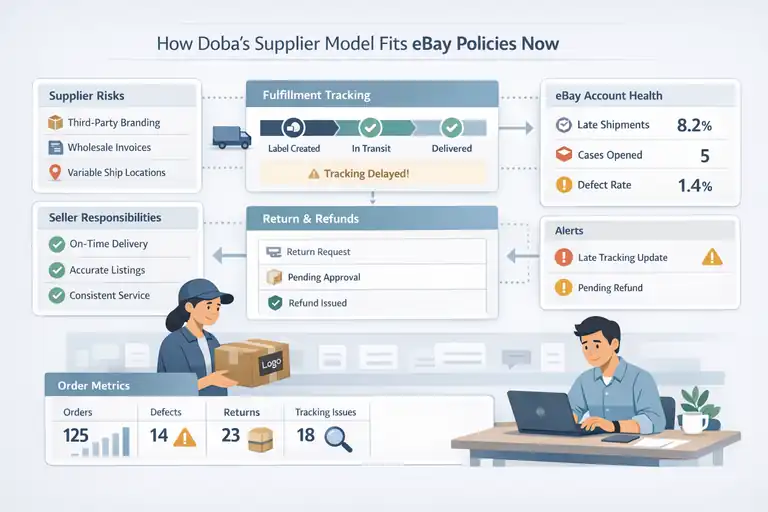
How Doba’s Supplier Model Fits eBay Policies Now
This is where things get uncomfortable for a lot of sellers.
eBay’s dropshipping policy hasn’t banned Doba outright, but it has tightened expectations around control, transparency, and fulfillment quality.
eBay Dropshipping Policy Compliance With Doba Suppliers
eBay allows dropshipping only if you’re sourcing from legitimate wholesale suppliers. Doba qualifies—but only technically.
The risk comes from how suppliers fulfill orders:
- Packaging may include third-party branding
- Invoices can expose wholesale pricing
- Ship-from locations may change unexpectedly
eBay’s policy focuses on seller responsibility. Even if Doba is the source, you’re accountable for:
- On-time delivery
- Accurate item descriptions
- Consistent buyer experience
If a supplier fails, eBay doesn’t care why. The defect hits your account.
Order Fulfillment Control And Tracking Upload Challenges
One of the biggest friction points with doba dropshipping eBay setups is tracking reliability.
Issues I see repeatedly:
- Tracking numbers uploaded late
- Carriers not recognized by eBay
- Tracking showing “label created” for days
That’s dangerous on eBay.
Late tracking uploads increase:
- Late shipment defects
- Item not received cases
- Seller performance warnings
Some Doba suppliers are solid. Others are painfully slow. The problem is you don’t control which one drops the ball until after the damage is done.
Handling Returns And Refunds When Using Doba On eBay
Returns are where Doba becomes emotionally exhausting.
Here’s the usual process:
- Buyer opens a return on eBay
- You request return authorization from the supplier
- Supplier provides an address or denies responsibility
- Time passes while eBay watches the clock
If the supplier delays, you’re still liable. Many sellers end up refunding buyers before receiving the item back just to protect their metrics.
That’s fine once. It’s brutal at scale.
Account Risk Factors eBay Sellers Should Understand
Individually, these issues seem manageable. Together, they compound.
Key risks include:
- Rising defect rates from supplier errors
- Below-standard tracking performance
- Buyer complaints you can’t directly fix
- Reduced Top Rated Seller eligibility
I always tell people this: eBay rewards control. The less control you have over fulfillment, the more fragile your account becomes.
Doba can still work—but only if you actively monitor suppliers, limit SKUs, and accept that it’s not a passive system.
Expert tip: If you’re serious about testing doba dropshipping eBay, start with 5–10 products max, track every order manually for 30 days, and review defects weekly. If one supplier causes repeated issues, cut them immediately—no exceptions.
Product Competition Levels Using Doba On eBay
This is where doba dropshipping eBay either clicks for you—or quietly fails. Competition isn’t just about how many sellers exist, but how identical their listings are.
With Doba, that similarity is often the real problem.
Product Saturation From Shared Doba Supplier Catalogs
Doba’s biggest strength is also its biggest weakness: everyone sees the same catalog.
When hundreds of sellers pull from the same supplier feed, a few things happen fast:
- Identical product titles appear across eBay
- Stock images get reused everywhere
- Pricing converges within a very tight range
Here’s what I’ve personally noticed after auditing multiple Doba-based eBay stores:
- 60–70% of sellers list the product without changing images
- Most copy-paste supplier descriptions word for word
- Only price becomes the differentiator
That creates instant saturation—even if the product itself isn’t popular.
If you search eBay and see more than 10 near-identical listings on page one, that product is already in trouble. Doba doesn’t stop you from listing saturated products, so you have to self-filter aggressively.
Price Undercutting And Race-To-The-Bottom Risks
This is the part nobody enjoys talking about.
Because Doba pricing is fixed, sellers compete almost entirely on price. That leads to:
- Sellers shaving margins just to win the Buy Box equivalent
- New sellers undercutting without understanding fees
- A downward spiral where nobody really wins
I’ve seen sellers make sales while losing money—because they didn’t calculate true net profit.
A typical race-to-the-bottom looks like this:
- Seller A lists at $49.99
- Seller B lists at $47.99
- Seller C lists at $44.99
- Everyone’s cost is $41–$43 after shipping and fees
At that point, you’re working for eBay, not yourself.
If a product can’t sustain at least a 20–25% margin buffer, price competition will kill it.
Identifying Lower-Competition Doba Product Categories
Not all Doba categories behave the same.
From what I’ve tested and reviewed, lower-competition products usually share these traits:
- Bulky or oversized items with higher shipping friction
- Replacement parts or accessories with specific compatibility
- Products buyers search by problem, not brand name
Examples that tend to perform better:
- Industrial or workshop accessories
- Niche home improvement parts
- Specialty pet or farm-related supplies
Quick test I use:
- Search the product name on eBay
- Scroll the first page
- If listings look visually identical, skip it
If sellers took time to customize images or descriptions, competition is usually thinner.
Using Product Differentiation To Compete On eBay
Differentiation is your only real lever with Doba.
You can’t change supplier cost, but you can change perception.
Ways to stand out without breaking eBay rules:
- Write your own titles focused on buyer problems, not product specs
- Use lifestyle images where allowed instead of raw supplier photos
- Add clear size guides, compatibility notes, or use-case examples
One small change I’ve seen work:
- Including a “Who This Is For” and “Who This Is Not For” section in descriptions
That reduces returns and builds buyer trust—two things eBay’s algorithm quietly rewards.
Fee Structure Impact On Doba Dropshipping eBay Profits
If you don’t understand the fee stack, doba dropshipping eBay will feel profitable right up until your payout hits.
Fees don’t kill businesses overnight—they bleed them slowly.
Doba Membership Costs Versus Free Supplier Alternatives
Doba isn’t free. That matters.
Depending on your plan, you’re paying:
- Monthly or annual membership fees
- Per-order processing costs in some cases
Free supplier alternatives may look attractive, but they often lack:
- Centralized order management
- Consistent supplier vetting
- Integrated inventory tools
The real question isn’t “Is Doba expensive?”
It’s “Does Doba help me make enough to justify the fixed cost?”
If you’re only running a handful of products, the membership fee alone can erase profits.
eBay Final Value Fees And Their Effect On Margins
eBay’s final value fee is the silent killer.
Most categories land between:
- 13% to 15% of the total sale price
- Including shipping charged to the buyer
That means:
- A $50 sale can cost you $7–$8 instantly
- Promoted listings reduce margins even further
Many sellers price products without adding fees back into the equation. That’s how “profitable” products quietly turn negative.
PayPal And Managed Payments Cost Breakdown
While PayPal used to be separate, eBay Managed Payments now bundles processing.
That simplifies payouts—but not costs.
What’s baked in:
- Payment processing fees
- Currency conversion (if applicable)
- Refund processing losses you don’t recover
You don’t see a line item for everything, which makes it easier to underestimate the total hit.
My advice: Always assume 15–17% total platform cost before Doba or shipping.
Calculating True Net Profit Per Doba Product
This is the formula I actually use:
- Sale price
- Minus Doba product cost
- Minus supplier shipping
- Minus eBay fees (15–17%)
- Minus return buffer (at least 3–5%)
What’s left is your real profit.
If that number isn’t worth your time per order, the product isn’t viable—no matter how many sales it gets.
I’d rather sell fewer products with clean margins than chase volume that creates stress, defects, and burnout.
Best practice: Build a simple spreadsheet before listing anything. If a product can’t survive a return, a fee increase, and one undercut competitor, it’s not strong enough for doba dropshipping eBay long term.
Automation, Scaling, And Workflow With Doba And eBay
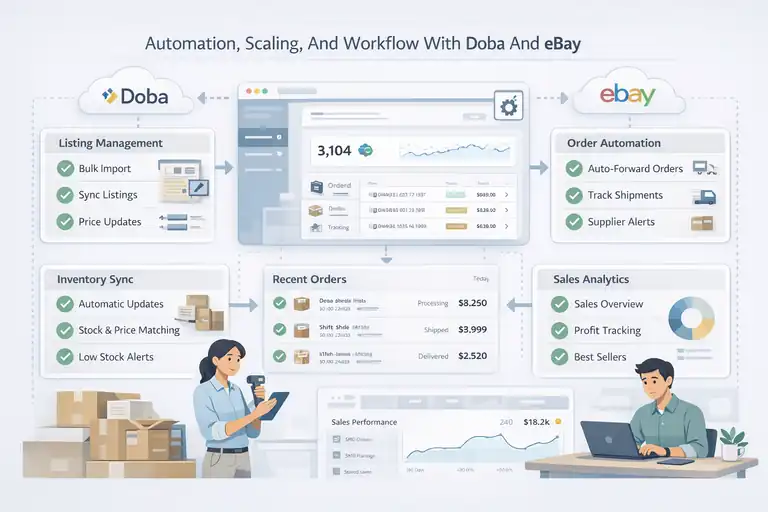
Automation is often why people choose Doba in the first place. The promise is simple: fewer manual steps, less chaos.
The reality is more nuanced, especially once you try to scale beyond a small test store.
Listing Management Limitations When Scaling Doba Products
Doba makes it easy to create listings quickly, but scaling exposes cracks fast.
When you list more products, you’ll notice:
- Limited flexibility in bulk-editing titles and descriptions
- Supplier data that doesn’t always align with eBay SEO best practices
- Difficulty customizing variations at scale
Here’s a real-world scenario I’ve seen repeatedly:
- You list 50 Doba products quickly
- 15 perform decently
- You want to optimize only those 15
- You end up editing them manually anyway
At that point, the “automation advantage” starts to fade. Doba is efficient for launching, but clunky for refining. If you enjoy deep optimization and testing, the system can feel restrictive.
Order Automation Strengths And Weaknesses Inside Doba
Order automation is where Doba genuinely helps—up to a limit.
Strengths include:
- Orders auto-forwarded to suppliers
- Central dashboard for order tracking
- Reduced risk of forgetting to place orders
Weaknesses show up when things go wrong:
- Limited visibility into supplier delays
- Manual intervention required for address changes
- Slow response cycles if a supplier makes a mistake
Automation works best when everything goes right. eBay, unfortunately, punishes sellers hardest when things go wrong—and that’s where automation stops protecting you.
Inventory Sync Risks And Stock Mismatch Issues
Inventory sync sounds boring until it costs you your account health.
Doba relies on supplier inventory feeds. If those feeds lag:
- You sell out-of-stock items
- Orders get delayed or canceled
- Defects hit your eBay metrics
This usually happens during:
- Seasonal spikes
- Supplier backorders
- Holiday demand surges
My rule of thumb: If inventory accuracy is critical, don’t list deep quantities. Limit stock levels manually, even if Doba shows more available.
Scaling Constraints Compared To Other eBay Dropshipping Models
Compared to other models, doba dropshipping eBay scales more vertically than horizontally.
You can:
- Add more SKUs
- Test more categories
But you can’t easily:
- Negotiate pricing
- Speed up fulfillment
- Customize packaging or branding
Direct supplier relationships scale better. Doba scales faster at the start—but hits a ceiling sooner.
Doba Versus Alternative eBay Dropshipping Options Today
Choosing Doba isn’t about whether it’s “good” or “bad.” It’s about where it fits compared to other sourcing methods available right now.
Doba Compared To Direct Supplier Sourcing For eBay
Direct supplier sourcing means you contact suppliers yourself and negotiate terms.
Compared to Doba:
- Lower product costs over time
- More control over shipping and handling
- Higher upfront effort and communication
Doba wins on speed and simplicity. Direct sourcing wins on margins and control.
If you’re validating ideas, Doba is easier. If you’re scaling winners, direct suppliers almost always outperform.
Doba Versus Wholesale And US-Based Distributors
US-based distributors offer:
- Faster shipping
- More consistent tracking
- Better alignment with eBay buyer expectations
The downside:
- Minimum order requirements
- Approval processes
- Smaller catalogs
Doba sits in the middle. It’s easier than wholesale, but less reliable long-term. Many sellers start with Doba, then graduate to US distributors once they find traction.
When Doba Makes Sense Compared To Private Suppliers
Private suppliers shine when:
- You sell consistent volume
- You want exclusivity
- You care about long-term brand value
Doba makes sense when:
- You’re testing demand
- You don’t want supplier conversations yet
- You value speed over optimization
I see Doba as a bridge, not a destination.
Situations Where Doba Is No Longer The Best Choice
Doba stops making sense when:
- You’re constantly fighting thin margins
- Returns eat weekly profits
- Supplier errors affect your seller level
- You already know what sells
At that stage, staying with Doba feels safe—but it quietly limits growth.
Who Doba Dropshipping On eBay Is Still Worth It For
Despite all the caveats, doba dropshipping eBay isn’t dead. It’s just misunderstood.
Beginner Sellers Testing eBay With Low Operational Effort
If you’re new and overwhelmed, Doba lowers the barrier.
It’s useful if:
- You want to learn eBay’s system
- You’re testing basic product-market fit
- You don’t want logistics headaches yet
Think of it as training wheels.
Sellers Prioritizing Simplicity Over Maximum Margins
Some sellers value:
- Predictability
- Fewer moving parts
- Less daily management
If that’s you, smaller profits might be acceptable. Just be honest about the tradeoff.
Niches Where Doba Still Offers Competitive Advantage
Doba still works in niches where:
- Speed matters more than branding
- Products are bulky or specialized
- Competition isn’t driven purely by price
These niches are smaller—but more forgiving.
Clear Signs It’s Time To Move Beyond Doba
You should consider moving on if:
- Your spreadsheet shows shrinking margins
- You avoid listing more products out of fear
- You feel boxed in by supplier limitations
- You’ve proven demand already
That’s not failure. That’s progress.
Expert tip: Use Doba as a controlled testing engine. Once a product proves itself, graduate it to a better supplier model. That’s how doba dropshipping eBay stays useful—without becoming the thing that holds you back.
FAQ
Is doba dropshipping eBay still profitable in 2026?
Yes, but only in limited situations. Doba dropshipping eBay can still be profitable for testing products or running small, controlled stores. Thin margins, high competition, and eBay fees make it difficult to scale long term without switching to better suppliers.
Can beginners make money with doba dropshipping on eBay?
Beginners can make some profit, but expectations should be realistic. Doba is best for learning how eBay works, understanding fees, and validating demand—not for building a high-margin business right away.
What is the biggest risk with doba dropshipping eBay?
The biggest risk is lack of control. Supplier delays, inventory mismatches, and returns can hurt eBay account metrics. One supplier issue can erase multiple profitable orders if margins are already thin.

I’m Juxhin, the voice behind The Justifiable.
I’ve spent 6+ years building blogs, managing affiliate campaigns, and testing the messy world of online business. Here, I cut the fluff and share the strategies that actually move the needle — so you can build income that’s sustainable, not speculative.
Related posts:
 Is SaleHoo Worth Joining? Real Buyers Share Results
 Doba Pricing Explained: Plans, Fees, and Hidden Costs
 How Doba Inventory Works and What’s Worth Listing
 Is Doba Shopify Worth Using for Dropshipping Stores?
 Doba Supplier Network Explained: Quality and Reliability
 Appscenic Vs Spocket Comparison Which Wins?