
Table of Contents
Some links on The Justifiable are affiliate links, meaning we may earn a small commission at no extra cost to you. Read full disclaimer.
If you’ve been researching suppliers, doba online probably came up as a potential all-in-one dropshipping solution, and I’ve seen many sellers wonder if it’s actually worth committing to.
This article is for beginners, side hustlers, and store owners who want an honest breakdown before paying for a platform.
The core question I’m answering is simple: Is Doba Online worth using for dropshipping in today’s ecommerce landscape?
What Doba Online Actually Offers Dropshippers Today
Doba online positions itself as a centralized dropshipping hub, not just a product directory.
Instead of hunting suppliers across multiple platforms, Doba tries to bundle sourcing, automation, and supplier access into one controlled ecosystem.
How Doba Online Works As A Supplier Marketplace
At its core, doba online acts as a middle layer between you and verified suppliers. You don’t contact suppliers directly like you would on Alibaba. Instead, Doba aggregates them into its own marketplace and manages the relationship.
Here’s what that looks like in practice:
- Supplier aggregation: Doba works with hundreds of manufacturers and wholesalers, mostly US-based.
- Unified catalog: Products live inside one dashboard, searchable by category, margin, or demand signals.
- Centralized checkout: Orders flow through Doba, not the supplier’s website.
From my experience, this setup removes a lot of early-stage friction. You’re not negotiating MOQs or messaging suppliers at 2 a.m. That said, it also means you give up some control. You’re trusting Doba’s supplier vetting rather than doing your own.
This model works best if you value simplicity over flexibility. If you like being hands-on with suppliers, Doba can feel restrictive.
Product Sourcing Model Compared To AliExpress
The biggest difference between Doba online and AliExpress is who controls the supply chain.
With AliExpress:
- You choose sellers individually
- Quality varies wildly
- Shipping timelines are inconsistent
With Doba:
- Suppliers are pre-vetted
- Products are curated into a single system
- Pricing is more stable but often higher
One important reality check: margins on Doba products tend to be thinner. You’re paying for reliability and US-based fulfillment, not rock-bottom pricing.
I’ve noticed that Doba products work better for stores targeting:
- Faster shipping expectations
- Higher trust audiences
- Repeat customers
AliExpress still wins for experimental, trend-based stores. Doba wins when consistency matters more than hype.
Order Automation And Inventory Sync Capabilities
Automation is where Doba online tries to justify its monthly cost.
Key automation features include:
- One-click product listing to connected stores
- Automatic order routing to suppliers
- Inventory syncing to reduce overselling
In simple terms, when a customer places an order on your store, Doba pushes it to the supplier without you touching anything.
This matters because inventory mismatches are one of the fastest ways to burn customer trust. Doba’s sync isn’t perfect, but it’s noticeably more reliable than manual AliExpress workflows.
That said, automation limits are tied directly to your pricing tier. On lower plans, you’ll hit caps faster than expected.
Shipping Speed And Fulfillment Transparency
Shipping is one of Doba’s strongest selling points.
Most suppliers ship from:
- The United States
- Canada
- Occasionally Europe
Typical delivery ranges fall between 3–7 business days, which is dramatically faster than standard AliExpress shipping.
Where Doba falls short is transparency:
- Tracking updates can lag
- Supplier-specific handling times aren’t always obvious
- You don’t always see fulfillment delays until after ordering
In my opinion, Doba shipping is good, not perfect. It’s fast enough to compete with Amazon expectations, but not polished enough to forget about customer service entirely.
Supported Ecommerce Platforms And Integrations
Doba online integrates with most mainstream ecommerce platforms, including:
- Shopify
- WooCommerce
- BigCommerce
- Amazon and eBay (with limitations)
Store integration limits are tied to pricing tiers, which matters more than people realize.
For example:
- Limited plan: 1 store
- Basic: 2 stores
- Standard: 5 stores
- Enterprise: 15 stores
If you plan to run multiple storefronts or test niches, this becomes a real constraint quickly.
Doba Online Pricing Plans And True Cost Breakdown
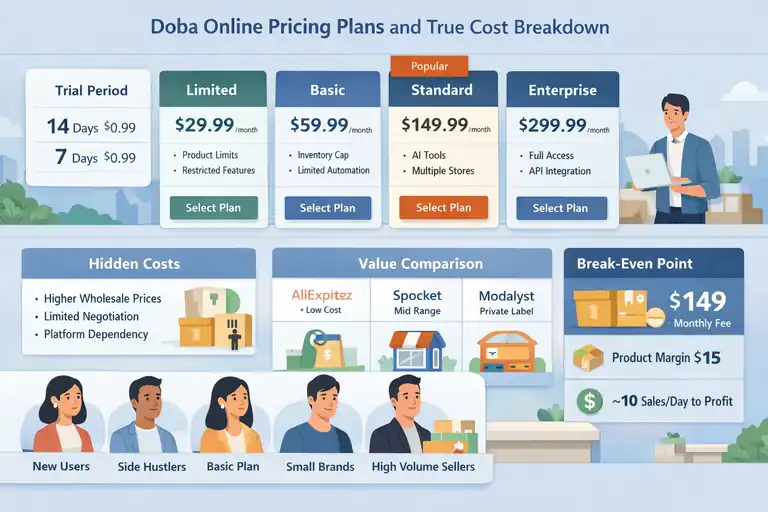
Pricing is where most people pause—and honestly, where many decide Doba online isn’t for them. It’s not cheap, and understanding what you actually get at each tier is critical before committing.
Free Trial Limitations And Access Restrictions
Doba technically offers trials, but they’re not free in the traditional sense.
Current trial structure:
- Limited plan: 14-day trial for $0.99
- Basic plan: 7-day trial for $0.99
During trials, you’ll notice:
- Product limits are very tight
- Automation features are capped
- You won’t get a realistic sense of scaling
The trial is best used to test the interface, not profitability. If you expect to validate a business idea in a week, you’ll likely be disappointed.
Monthly Subscription Tiers Explained Clearly
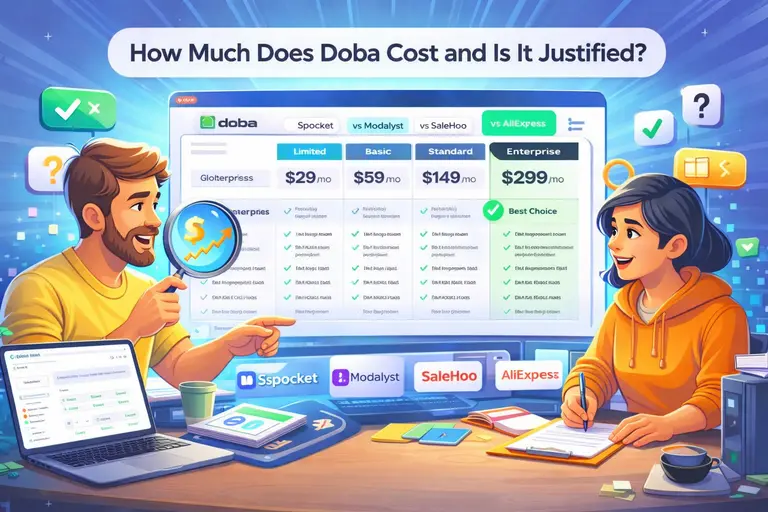
Based on the current pricing shown:
- Limited: $29.99/month
- Basic: $59.99/month
- Standard: $149.99/month
- Enterprise: $299.99/month
Annual billing drops prices slightly, but Standard stays at $149.99 regardless, which I find interesting. That suggests Doba sees Standard as the “serious seller” tier.
Key differences across tiers:
- Product listing limits
- Inventory capacity
- AI tools usage
- Number of connected stores
- API access
If you’re being honest with yourself, most functional automation starts at the Standard plan.
Hidden Costs That Affect Dropshipping Margins
The subscription fee is only part of the real cost.
Other margin killers include:
- Higher wholesale pricing compared to AliExpress
- Limited ability to negotiate supplier rates
- Platform dependency if you scale heavily on Doba
For example, if your product margin is $15 and you’re paying $149/month, you need roughly 10 sales per day just to cover software costs.
That math surprises a lot of beginners.
Value Comparison Against Competing Platforms
Compared to alternatives:
- AliExpress + DSers: Low cost, high effort
- Spocket: Mid-range pricing, better branding
- Modalyst: Strong private-label options
Doba online sits at the higher end of cost without offering branding control. You’re paying for infrastructure, not uniqueness.
In my view, Doba makes sense if you:
- Value speed over customization
- Want fewer moving parts
- Are okay trading margin for simplicity
Who Benefits Most From Each Pricing Tier
Here’s the honest breakdown:
- Limited: Testing the dashboard only
- Basic: Side hustlers with one store
- Standard: Small brands focused on US shipping
- Enterprise: High-volume sellers with multiple stores
If you’re just starting out, Standard can feel expensive—but it’s also the first tier where Doba actually performs the way it’s marketed.
From what I’ve seen, most people quit Doba not because it’s bad, but because they choose the wrong plan for their stage.
Product Quality And Supplier Reliability On Doba
Product quality is one of the biggest reasons people even consider doba online in the first place.
The promise is simple: fewer bad suppliers, fewer surprises, and fewer angry customers. The reality is more nuanced, and it depends heavily on category and expectations.
How Doba Vetts And Manages Its Suppliers
Doba doesn’t let just anyone list products. Suppliers go through an internal approval process before appearing on the platform.
Here’s how that vetting typically works in practice:
- Suppliers must be registered businesses, not individual resellers
- Most suppliers are US-based wholesalers or manufacturers
- Doba acts as the intermediary for onboarding and compliance
This structure filters out a lot of the chaos you see on open marketplaces. In my experience, you’re far less likely to run into outright scams or fake tracking numbers.
That said, vetting doesn’t mean perfection. Doba manages access, not day-to-day supplier performance. If a supplier starts slipping on fulfillment speed or quality, Doba may not catch it immediately. You still need to monitor customer feedback closely.
Think of Doba as reducing risk, not eliminating it.
Product Category Strengths And Weak Spots
Not all categories perform equally well on doba online.
Categories that tend to perform better:
- Home and kitchen
- Office supplies
- Pet accessories
- Sports and outdoor gear
These categories usually benefit from:
- Standardized manufacturing
- Fewer sizing or fit issues
- Lower return rates
Weaker categories include:
- Fashion and apparel
- Electronics with complex specs
- Trend-based novelty products
If you’re used to testing viral products quickly, Doba can feel slow and limited. Where it shines is stable, evergreen products that customers reorder or recommend.
Quality Control Issues Reported By Sellers
Even with supplier vetting, quality issues still come up.
Common complaints sellers report:
- Minor product variations between batches
- Packaging that feels generic or unbranded
- Occasional damaged items during transit
From what I’ve seen, these issues are less frequent than AliExpress horror stories, but they still matter. A single bad shipment can wipe out five-star reviews fast.
A practical strategy I recommend:
- Order samples from at least two suppliers when possible
- Focus on products with consistent materials, not complex parts
- Avoid white-label items unless branding is irrelevant
Doba reduces guesswork, but it doesn’t replace due diligence.
Branding And Private Label Limitations
If branding is your long-term goal, this is where doba online shows its limits.
Most products:
- Ship in generic packaging
- Do not support custom inserts
- Do not offer logo placement
Private labeling exists in very limited cases, usually at the Enterprise level or through direct supplier negotiation.
If your goal is building a recognizable brand, Doba works better as a stepping stone than a permanent solution. It’s great for validating products and learning operations, but not ideal for brand-first businesses.
Refunds, Returns, And Dispute Resolution Process
Returns on Doba are handled supplier by supplier, which means policies vary.
What’s consistent:
- You submit disputes through the Doba dashboard
- Doba mediates communication
- Refund timelines depend on supplier response
What’s not consistent:
- Return shipping responsibility
- Restocking fees
- Refund approval speed
In my experience, disputes usually resolve, but slowly. This is not Amazon-level customer service, and you’ll need to set realistic expectations with customers.
Ease Of Use And Learning Curve For Beginners
One of the biggest selling points of doba online is that it’s built for beginners who don’t want to juggle multiple tools. Ease of use is mostly a win here, with a few important caveats.
Dashboard Usability And Product Search Experience
The dashboard is clean and beginner-friendly.
Product discovery includes:
- Category filters
- Price and margin indicators
- Demand signals from Doba’s internal data
Searching feels more structured than AliExpress, but also more constrained. You won’t find thousands of near-identical listings. That’s good for clarity, but limiting for aggressive testing.
Personally, I like this balance. It forces you to think like a store owner, not a product gambler.
Store Setup And Initial Configuration Process
Getting started is straightforward:
- Connect your store
- Set default pricing rules
- Configure shipping and tax preferences
Most users can complete setup in under an hour.
The biggest learning curve comes from understanding Doba-specific terms like:
- Inventory list capacity, meaning how many products you can actively manage
- One-click listings, meaning instant product imports
Once you understand those limits, setup feels logical.
Bulk Product Import And Listing Management
Bulk importing is one of Doba’s strongest features.
You can:
- Import multiple products at once
- Edit pricing rules globally
- Sync inventory automatically
However, limits apply based on your plan. On lower tiers, you’ll hit caps fast, which can feel frustrating if you didn’t plan for it.
A smart workaround is starting with fewer, higher-quality products instead of flooding your store.
Common Technical Friction Points New Users Face
Most issues I see beginners struggle with include:
- Hitting listing or inventory limits unexpectedly
- Confusion around supplier shipping zones
- Delays in inventory sync updates
None of these are dealbreakers, but they require patience. Doba works best when you slow down and build deliberately.
Support Resources And Onboarding Materials
Doba offers:
- Live chat support
- Help center articles
- Video tutorials
- Access to Doba Elite Academy on higher plans
Support quality is solid, not magical. You’ll get answers, but not instant hand-holding.
If you’re brand new to dropshipping, these resources genuinely help. If you’re advanced, they’ll feel basic.
Overall, doba online is easier than most platforms, but it still expects you to think like a business owner.
Profitability Potential Using Doba Online Products
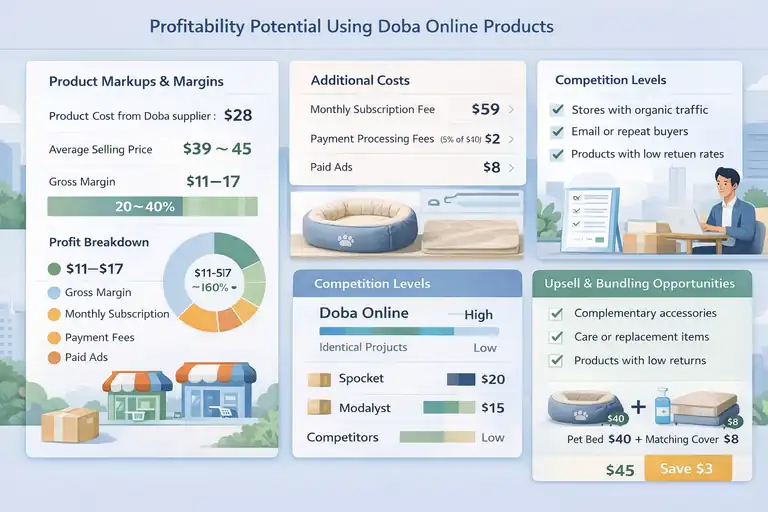
Profitability is where expectations and reality tend to collide with doba online. It can absolutely make money, but not in the “throw up a store and print cash” way some people expect.
This section is about what margins actually look like and where the platform helps or hurts.
Typical Product Markups And Margin Reality
Most products on doba online support markups in the 20–40% range, depending on category and shipping costs.
Here’s a realistic example I’ve seen play out:
- Product cost from Doba supplier: $28
- Average selling price: $39–45
- Gross margin before ads and software: $11–17
Now subtract:
- Monthly Doba subscription
- Payment processing fees
- Paid traffic or influencer costs
That margin shrinks fast.
Doba works better for:
- Stores with organic traffic
- Email or repeat buyers
- Products with low return rates
If you rely heavily on paid ads, the margin pressure can feel tight unless you’re very disciplined with product selection.
Competition Levels On Shared Doba Products
One thing many sellers underestimate is shared catalogs.
Because everyone accesses the same supplier pool:
- Multiple stores often sell identical products
- Price competition becomes inevitable
- Differentiation has to come from marketing, not the product
This doesn’t mean it’s impossible. It just means you can’t win on price alone.
In my experience, the sellers who succeed:
- Build content around the product
- Use bundles or bonuses
- Focus on customer experience
If your strategy is “find a product no one else has,” Doba will feel limiting.
Upsell And Bundling Opportunities
This is where profitability can improve if you’re intentional.
Good upsell strategies on Doba include:
- Complementary accessories
- Care or replacement items
- Simple add-ons that ship together
For example:
- Selling a pet bed with a matching cover
- Bundling office organizers instead of single units
Because Doba supports bulk importing and pricing rules, you can test bundles without heavy manual work. This is one of the few ways I’ve seen sellers push margins past the 40% ceiling.
Scalability Limits For Growing Stores
Doba scales operationally, but not creatively.
You can handle more orders, more SKUs, and more stores as you upgrade plans. That part works.
Where scaling gets tricky:
- Limited branding options
- Shared supplier dependencies
- Rising subscription costs as volume grows
At a certain point, you may realize you’re paying more to maintain convenience than you’re earning from it.
When Doba Online Becomes A Bottleneck
Doba online usually becomes a bottleneck when:
- You want custom packaging
- You need supplier exclusivity
- You’re ready to negotiate costs directly
This is often a sign of growth, not failure. Many sellers outgrow Doba after using it as a foundation.
Doba Online Vs Popular Dropshipping Alternatives
No platform is “best” in isolation. The real question is how doba online compares depending on what you’re trying to build.
Doba Online Vs AliExpress And DSers
AliExpress with DSers wins on flexibility and cost.
Key differences:
- AliExpress offers lower product costs
- Doba offers faster and more predictable shipping
- DSers requires more manual supplier vetting
If you’re testing trends or running ads aggressively, AliExpress often wins. If you care about fewer headaches and fewer refunds, Doba feels calmer.
Personally, I see Doba as lower stress but lower upside.
Doba Online Vs Spocket For US-Based Shipping
Both platforms emphasize US-based suppliers, but Spocket leans more toward branding.
Comparison highlights:
- Spocket supports branded invoicing on some plans
- Doba has deeper automation limits tied to pricing
- Spocket product prices are often higher
If branding matters even a little, Spocket usually edges out Doba. If automation and supplier volume matter more, Doba holds its ground.
Doba Online Vs Modalyst For Branded Products
Modalyst is stronger for private-label and brand-forward stores.
Differences that matter:
- Modalyst supports custom branding options
- Doba focuses on operational simplicity
- Modalyst product catalogs are more curated
If your long-term vision includes building a recognizable brand, Modalyst is usually the better fit. Doba is more utilitarian.
Doba Online Vs Wholesale2B Pricing Models
Wholesale2B is often cheaper upfront.
Key contrasts:
- Wholesale2B has lower monthly fees
- Doba offers a more polished interface
- Automation on Wholesale2B feels dated
I’d say Wholesale2B works for budget-focused sellers. Doba feels more modern, but you pay for it.
Which Platform Fits Different Seller Goals
Here’s the simplest way I frame it:
- Testing fast and cheap: AliExpress + DSers
- Building a brand: Modalyst or Spocket
- Reducing complexity: Doba online
- Running multiple low-cost stores: Wholesale2B
Doba isn’t the most profitable or the cheapest option. It’s the most controlled and predictable. For some sellers, that tradeoff is worth everything.
Real Pros And Cons Of Using Doba Online
By the time someone seriously considers doba online, they usually want clarity, not hype.
This section is about stripping the platform down to what it genuinely does well, where it frustrates people, and why reactions to it are so polarized.
Advantages That Make Doba Online Appealing
The biggest strength of doba online is control. Not total control, but enough structure to reduce chaos.
What consistently works in Doba’s favor:
- Centralized supplier access without direct negotiations
- Faster US-based shipping compared to overseas marketplaces
- Built-in automation for listings, orders, and inventory
- Cleaner interface than most legacy dropshipping tools
From my experience, Doba feels calming. You’re not chasing suppliers, tracking spreadsheets, or worrying if a seller disappears overnight. For people who value predictability over experimentation, that peace of mind is real.
It also lowers the technical barrier. You don’t need to duct-tape five tools together to get basic operations running.
Drawbacks That Turn Sellers Away
The same structure that helps beginners often frustrates experienced sellers.
Common reasons people leave:
- Monthly fees eat into already thin margins
- Limited product differentiation
- Restricted branding and packaging options
- Shared catalogs that increase competition
Doba isn’t flexible by design. If you like testing aggressively, negotiating costs, or building supplier relationships, the platform can feel boxed in.
I’ve seen many sellers blame Doba when the real issue was mismatch, not quality.
Dealbreakers For Advanced Dropshippers
For advanced dropshippers, some limitations are hard stops.
Typical dealbreakers include:
- No supplier exclusivity
- Minimal private-label support
- Pricing you can’t negotiate directly
- Dependency on platform rules and limits
Once you’re optimizing at scale, these constraints matter. At that stage, you’re better served owning more of your supply chain.
Doba isn’t built for power users. It’s built for stability.
Situations Where Doba Online Still Makes Sense
Even with its flaws, doba online still has a place.
It makes sense if you:
- Want fast, domestic shipping
- Sell evergreen, low-return products
- Prefer operations over experimentation
- Value simplicity more than margins
I see Doba as a “training wheels” platform that still works well for certain long-term models, especially informational or content-driven stores.
Who Should Use Doba Online And Who Should Avoid It
Choosing Doba isn’t about skill level. It’s about mindset and goals.
Best Fit For First-Time Dropshipping Sellers
If you’re brand new, Doba can be a safer starting point.
It helps beginners:
- Avoid scam suppliers
- Learn order flow without chaos
- Focus on store setup and marketing
The tradeoff is cost, but that cost often buys clarity. For some people, that’s worth it.
Store Types That Benefit From Centralized Suppliers
Certain store models align naturally with Doba:
- Niche stores with practical products
- Office, home, or pet-focused stores
- Content-driven stores that don’t rely on trends
These stores benefit from reliability more than novelty.
Sellers Who Will Struggle With Doba Online
Doba is not friendly to:
- Trend chasers
- Ad-heavy arbitrage models
- Brand-first businesses
- Sellers obsessed with maximum margins
If you’re constantly optimizing for pennies, Doba will feel expensive.
Long-Term Business Models That Outgrow Doba
Many successful sellers outgrow Doba naturally.
Signs it’s time to move on:
- You want custom packaging
- You’re negotiating bulk pricing
- You need supplier exclusivity
Outgrowing Doba isn’t failure. It’s progress.
Final Verdict: Is Doba Online Worth Using For Dropshipping?
This is where I stop being neutral.
Doba online is not the best dropshipping platform. It’s also not a bad one. It’s specific.
When Doba Online Is A Smart Choice
Doba makes sense when:
- You want fewer moving parts
- You value fast shipping over cheap sourcing
- You’re learning ecommerce fundamentals
- You prefer predictability over experimentation
In those cases, Doba can save you time, stress, and early mistakes.
When You’re Better Off Choosing Alternatives
You should look elsewhere if:
- Branding is your top priority
- You need exclusive products
- You want maximum margin control
- You enjoy supplier negotiations
Platforms like Modalyst, Spocket, or direct sourcing will serve you better.
Key Questions To Ask Before Signing Up
Before paying for Doba, ask yourself:
- Am I paying for convenience or results?
- Can my margins support a monthly fee?
- Do I need flexibility or structure right now?
If your answers lean toward structure, doba online is worth trying. If not, you’ll likely outgrow it faster than you expect.
FAQ
Is Doba online good for beginners in dropshipping?
Yes. Doba online is beginner-friendly because it offers vetted suppliers, built-in automation, and faster US-based shipping, which reduces common early mistakes like supplier scams and inventory issues.
Can you make a profit using Doba online?
You can, but margins are usually moderate. Most sellers see 20–40% markups, so profitability works best with organic traffic, repeat customers, or bundled products rather than heavy paid ads.
What are the main downsides of Doba online?
The biggest drawbacks are monthly subscription costs, limited branding options, and shared product catalogs, which can increase competition and cap long-term scalability for advanced sellers.

I’m Juxhin, the voice behind The Justifiable.
I’ve spent 6+ years building blogs, managing affiliate campaigns, and testing the messy world of online business. Here, I cut the fluff and share the strategies that actually move the needle — so you can build income that’s sustainable, not speculative.
Related posts:
 Salehoo Dropshipping Reviews: Is It Worth Your Money Today?
 How the Salehoo App Works and Why It Speeds Up Product Research
 Salehoo Pricing Explained: What You Actually Get for Your Money
 Is SaleHoo Legit? What Real Sellers Actually Discover
 Doba Wholesale Pricing, Access, and Product Quality Breakdown
 How Much Does Doba Cost and Is It Justified?