
Table of Contents
Some links on The Justifiable are affiliate links, meaning we may earn a small commission at no extra cost to you. Read full disclaimer.
When I first started exploring affiliate marketing how to strategies, I remember feeling overwhelmed by all the moving parts—choosing a niche, finding the right affiliate networks, and actually making that first sale.
The truth is, success in affiliate marketing doesn’t have to take months. With the right approach and a few smart tools, you can build momentum quickly and start earning commissions faster than most beginners expect.
Let me show you how to make your first sale fast, step by step.
Choose a Profitable Niche With Buyer Intent
Finding a profitable niche is the first and most critical step in affiliate marketing how to. The right niche determines whether your efforts bring in consistent commissions or just random traffic that never converts.
Identify High-Demand Niches That Solve Real Problems
If you want to make your first affiliate sale fast, focus on problems people are actively trying to solve. Buyers don’t just browse—they search with intent.
For example, someone typing best protein powder for muscle gain is ready to buy, not just read.
Here’s how you can spot high-demand, problem-solving niches:
- Use Google Autocomplete and “People Also Ask”: Type broad ideas like fitness or budget travel and note the phrases Google suggests. Those are real buyer queries.
- Check Amazon’s Best Sellers: Look at what’s trending in categories related to your interests. If products are ranking high and have strong reviews, it means people are buying consistently.
- Look for Evergreen Needs: Think about areas where spending never stops—health, relationships, money, and lifestyle upgrades.
In my experience, it’s best to choose something you actually care about. You’ll create better content and connect more authentically when you genuinely enjoy the topic.
Use Market Research Tools To Validate Profitability
Before committing, validate your niche with data. Don’t guess—confirm that people are both searching and buying.
Try these quick tools:
- Serpstat: Search for keyword volume and difficulty. A good target range for beginners is 1K–10K searches per month with moderate competition.
- Google Trends: See whether interest in your topic is stable or seasonal. A steady upward curve usually means long-term demand.
- Awin and FlexOffers: Browse their affiliate marketplaces to check how many advertisers exist in your niche. More offers usually mean more potential earnings.
A small but growing niche is often more profitable than a crowded one.
For example, instead of “fitness,” go for “home workouts for busy parents.” It’s easier to rank and connect with a defined audience.
Avoid Broad Niches and Focus on Sub-Niche Clarity
Going too broad is one of the fastest ways to stall your affiliate progress. When your niche is vague, your content becomes too general to attract real buyers.
Here’s a quick test: if you can’t describe your audience in one sentence, your niche is too wide.
For example:
- Too broad: “Fitness.”
- Focused: “Bodyweight fitness for beginners working from home.”
When you narrow your focus, you can:
- Speak directly to your audience’s pain points.
- Build topical authority faster.
- Rank for long-tail keywords with clear buying intent.
It’s like being the go-to guide for one specific problem rather than another faceless voice in a massive crowd.
Select The Right Affiliate Programs To Join
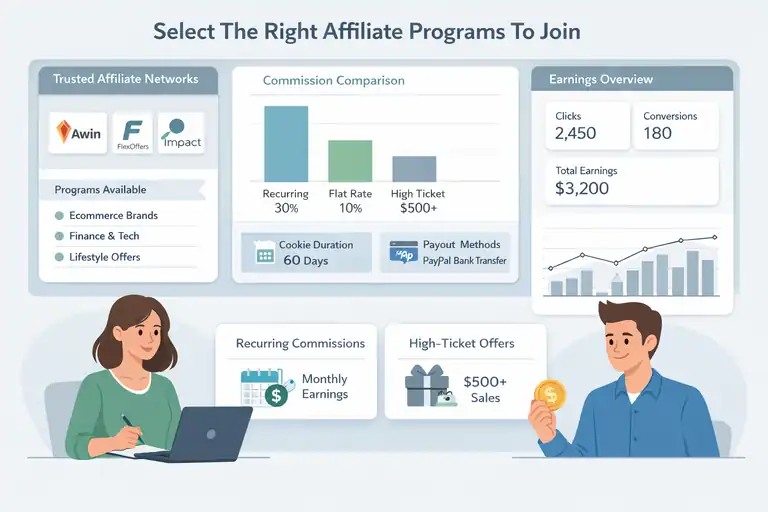
Once your niche is clear, your next step in affiliate marketing how to is choosing programs that actually pay well and fit your audience’s needs.
Join Trusted Networks Like Awin, FlexOffers, or Impact
Start with reliable affiliate networks—they make finding quality programs easier and protect you from scams.
Some trusted options include:
- Awin: A global affiliate network that replaced ShareASale, offering programs from brands like Etsy and Fiverr.
- FlexOffers: Great for lifestyle, finance, and technology niches with thousands of partner brands.
- Impact: Ideal for creators working with big names in software and eCommerce.
When I first joined Awin, the setup was simple: Sign up → Choose niche → Apply for brand programs → Get approved links.
Within a few hours, I had my first set of links ready to embed in my blog posts.
These networks also provide detailed reporting dashboards, so you can track clicks, commissions, and conversion rates in one place.
Evaluate Commission Rates and Cookie Durations Before Joining
Not all affiliate programs pay equally. Some might offer 3% per sale, while others go as high as 50%. But don’t just chase the highest percentage—evaluate the total earning potential.
Here’s what to compare:
- Commission structure: Flat rate vs. recurring commissions. Recurring programs are gold if you’re promoting subscriptions or SaaS products.
- Cookie duration: This determines how long you’ll get credit for a buyer’s purchase after they click your link. A 60–90 day cookie is far better than a 24-hour one.
- Payment thresholds: Choose networks that pay regularly and offer PayPal or direct deposit options.
For instance, Impact has flexible payout methods and detailed performance analytics, making it perfect for scaling over time.
Partner With Brands Offering Recurring or High-Ticket Commissions
Recurring commissions are the secret to building passive income in affiliate marketing. These are programs that pay you monthly as long as your referral stays subscribed.
Examples:
- Aweber – email marketing for creators with monthly payouts.
- Getresponse – automation platform offering steady commissions per active user.
If you prefer faster results, you can also focus on high-ticket offers—products priced over $500 with strong brand credibility. Even one or two conversions can bring in a substantial profit.
My advice: Combine both. Promote recurring offers for stability and sprinkle in high-ticket products for faster income spikes.
Build a Simple Yet Conversion-Focused Website
Your website is your affiliate business headquarters. It doesn’t need to be fancy—it needs to load fast, look trustworthy, and guide visitors toward taking action.
Use WordPress With Fast Hosting Like Hostinger or WP Engine
WordPress is still the best platform for beginners in affiliate marketing because it’s flexible, affordable, and easy to scale.
Here’s a quick path to get started:
- Get hosting with Hostinger (affordable and beginner-friendly) or WP Engine (optimized for performance).
- Install WordPress with a single click—most hosts handle this automatically.
- Add SSL and caching (WP Rocket or LiteSpeed Cache are great options) to improve speed and trust.
A slow website kills conversions. Studies show that even a one-second delay in page load time can reduce conversions by up to 7%. Fast hosting fixes that before it starts.
Choose a Clean Theme Optimized for Speed and Mobile Users
Your website’s theme should guide attention rather than distract it. Go for minimalist layouts with plenty of white space and strong typography.
Try lightweight options like:
- Astra – fast, customizable, and SEO-friendly.
- GeneratePress – clean design with excellent speed performance.
Test your site on Google’s PageSpeed Insights or GTmetrix. If it takes longer than three seconds to load, tweak it until it does better.
I’ve found that removing unnecessary plugins and compressing images (with Optimole or Imagify) can easily cut loading time in half.
Install SEO Tools Like Rank Math or AIOSEO for Search Visibility
No affiliate site succeeds without SEO. Tools like Rank Math and AIOSEO simplify optimization by giving step-by-step suggestions right inside your WordPress dashboard.
For example:
- Add your target keyword (like “best budget laptops for students”) in the Focus Keyword box.
- Use their on-page checklist to improve title tags, meta descriptions, and readability.
- Enable Schema markup (through the plugin) to make your listings stand out in Google’s results.
Rank Math even lets you connect to Google Search Console directly, so you can track performance without switching tabs.
Once SEO is set up properly, your site works for you—attracting organic visitors day and night without ongoing ad spend.
Create Content That Drives Buyer Clicks
Once your website is set up, the real engine of your affiliate marketing how to strategy begins—content.
Your words, videos, and visuals must do one simple thing: help readers make confident buying decisions. The more trust you build, the faster that first sale happens.
Write Product Reviews and Comparisons That Build Trust
Honest reviews convert far better than generic product lists. People can spot fluff from a mile away, so think like a real user, not a salesperson.
When I write a review, I imagine explaining the product to a friend over coffee—what I liked, what I didn’t, and whether I’d buy it again.
Here’s how to structure high-converting content:
- Start with your experience: Share how you discovered the product or why you tested it. For example, “I first tried Awin’s dashboard because I wanted an easier way to track my affiliate sales.”
- Break down pros and cons: Use short, honest bullets. Readers love seeing transparency—it builds credibility fast.
- Include screenshots or UI examples: If you’re reviewing a tool like Rank Math, show where to access keyword suggestions (Dashboard → SEO Analysis → Keyword Recommendations).
- End with a clear takeaway: Help readers decide if it’s right for them.
For comparisons, use a simple table showing key features, pricing, and your verdict.
Example: Awin vs. FlexOffers—who offers better beginner programs? Tables boost engagement and help users skim quickly, which Google also favors for snippets.
Use Long-Tail Keywords To Attract Ready-To-Buy Visitors
One mistake many beginners make is targeting short, competitive keywords like “best laptop.”
Instead, go for long-tail variations that show buyer intent—phrases like best laptop under $800 for students or Rank Math vs AIOSEO for beginners.
Why long-tail keywords work:
- They’re easier to rank for.
- They attract users ready to buy.
- They bring in steady traffic over time.
You can find them by:
- Typing your main idea into Google and checking autocomplete suggestions.
- Using keyword tools like Semrush or Surfer SEO to filter phrases with lower competition.
- Exploring “People Also Ask” and “Related Searches” at the bottom of Google’s results.
I’ve noticed that even one blog post targeting a long-tail keyword can bring more conversions than ten articles chasing broad ones. It’s less traffic, but better quality traffic—people with wallets open.
Add Affiliate Links Naturally Using ThirstyAffiliates or PrettyLinks
Affiliate links should blend naturally into your content, not stick out like ads. Tools like ThirstyAffiliates and PrettyLinks make this easy by cloaking long, messy URLs into short, branded links.
For example, a raw link might look like: https://awin.com/c/1234/affiliateproduct?ref=abxYZ
But with PrettyLinks, it becomes: yourdomain.com/go/awinproduct
This looks cleaner, builds trust, and lets you track clicks directly inside WordPress.
Here’s how I recommend using links:
- Link only when relevant: Add them to helpful contexts like tutorials or real examples.
- Use call-to-action anchors: Instead of “click here,” write “try Awin’s beginner-friendly affiliate dashboard.”
- Avoid overlinking: One or two links per section are enough.
By keeping your links reader-first, you’ll convert more without coming across as salesy.
Drive Targeted Traffic To Your Offers
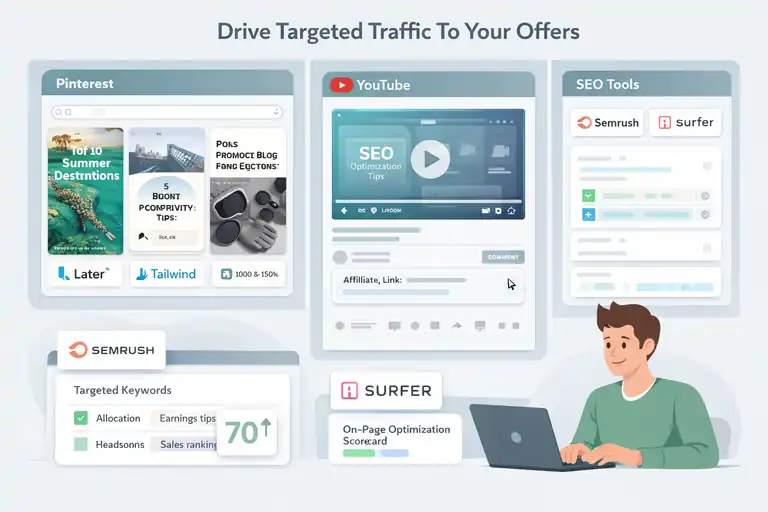
Once your content is live, it’s time to get eyes on it. Without targeted traffic, even the best content won’t bring your first sale.
The goal isn’t more visitors—it’s the right visitors: people looking to take action.
Use Pinterest and YouTube for Fast Organic Reach
If SEO feels slow, platforms like Pinterest and YouTube can give you faster visibility.
Pinterest: It’s not just for recipes or décor—it’s a visual search engine. You can create eye-catching pins linking directly to your blog posts or affiliate content.
- Create vertical pins using Canva (1000×1500 px).
- Add your keyword in the pin title and description.
- Schedule posts with tools like Later or Tailwind.
YouTube: Video builds instant trust. Review products on camera or screen-share how a tool works. Even a simple “how to use Rank Math to improve SEO” video can bring evergreen views.
Tip: Always include your affiliate link in the description and mention it naturally in the video (“You’ll find my affiliate link below if you want to try this tool yourself”).
Both platforms reward consistency, so aim for one new upload or pin batch per week to build momentum.
Leverage SEO Tools Like Surfer SEO or Semrush To Optimize Posts
If you’re focusing on long-term growth, SEO tools are your best friends. Surfer SEO and Semrush show you exactly what’s ranking and how to match that intent.
With Surfer SEO, you can:
- Enter your target keyword and analyze the top 10 results.
- Adjust your word count, headings, and keyword density based on data.
- Get real-time optimization scores while writing.
With Semrush, use the Keyword Magic Tool to uncover related queries and content gaps your competitors missed.
Example workflow:
- Write your article draft.
- Run it through Surfer SEO to fine-tune for on-page optimization.
- Use Semrush to find backlinks or guest posting opportunities to boost authority.
From what I’ve seen, optimizing even small details like meta descriptions and internal links can double organic clicks within a few weeks.
Run Paid Ads Cautiously With Clear ROI Tracking Through Voluum
If you want to speed things up, paid traffic can work—but only if you track every click. That’s where Voluum comes in. It’s an advanced tracking platform that lets you monitor ad performance across Google, Facebook, or native ad networks.
Why tracking matters:
- You’ll see exactly which ads convert.
- You can pause underperforming campaigns instantly.
- You’ll avoid wasting money on random clicks.
Example path: Create a simple funnel (ad → review page → affiliate link). Then set up Voluum to track how many clicks lead to conversions. Start small—maybe $5 to $10 a day—and scale what works.
The goal isn’t to spend more, but to learn faster. Paid ads are like a microscope—they reveal what truly resonates with your audience.
Build an Email List To Capture and Nurture Leads
Traffic is great, but your biggest long-term asset in affiliate marketing is your email list.
It’s your personal channel to follow up with interested visitors—people who already trust you enough to share their inbox.
Offer Free Resources Using OptinMonster or WPForms
People rarely join email lists just to “get updates.” They need an incentive. Offer a free resource that solves a small but valuable problem—like a checklist, guide, or mini-template.
Use OptinMonster or WPForms to build signup forms quickly:
- Create a popup or inline form.
- Write a short headline like “Get My 5-Step Affiliate Starter Checklist.”
- Connect it to your email platform.
OptinMonster also allows exit-intent popups, which appear right before someone leaves your site—perfect for capturing hesitant visitors.
In my own setup, switching from sidebar forms to exit popups boosted signups by nearly 40%.
Send Automated Sequences Through Email Tools Like Kit or Brevo
Once someone joins, don’t just send random newsletters. Use Kit (formerly ConvertKit) or Brevo (formerly Sendinblue) to set up automated sequences that nurture relationships.
Example sequence:
- Day 1: Welcome email with your best beginner guide.
- Day 3: Share your favorite affiliate tool (with your link).
- Day 5: Offer a helpful resource or comparison post.
Automation keeps you top-of-mind without extra effort. Inside Kit, you can use the visual “Automation Map” to drag and connect emails based on actions (like opening or clicking).
These small touches make your emails feel personal, not robotic.
Segment Subscribers Based on Interests To Increase Conversions
Segmentation means grouping subscribers by what they care about most. It’s one of the fastest ways to boost conversions.
Here’s how to do it:
- Add a quick survey question on signup like, “What’s your main goal right now?”
- In Kit or Brevo, tag people based on their response (e.g., “SEO beginner,” “Email marketing learner”).
- Send content tailored to each group’s needs.
This approach ensures every email feels relevant. When readers feel understood, they click more often—and buy more confidently.
From what I’ve seen, segmented campaigns often perform 30–50% better than generic blasts. It’s personalization at scale, and it works beautifully for affiliate marketing.
Analyze, Optimize, and Scale What Works
Once you start getting traffic and clicks, your next step in affiliate marketing how to is analyzing what’s actually working.
Without tracking data, it’s like driving with your eyes closed—you’re moving, but you don’t know where. The key is to test, refine, and scale based on facts, not feelings.
Use Analytics Tools Like MonsterInsights or Sitechecker To Track Growth
You can’t improve what you don’t measure. Tools like MonsterInsights and Sitechecker help you see exactly which posts or links drive the most traffic and conversions.
MonsterInsights connects directly to Google Analytics but makes it visual and easy to read inside WordPress.
You’ll see metrics like:
- Top-performing pages
- Average session duration (how long people stay)
- Click-through rates on affiliate links
For example, in MonsterInsights, go to Insights → Reports → Publishers to view which links get the most clicks. This shows you where people are actually engaging—and where to place more calls-to-action.
Sitechecker, on the other hand, focuses on SEO performance. It tracks keyword rankings, site health, and backlinks. I like using its “Site Audit” report to catch technical issues before they affect rankings.
Once you start tracking weekly, patterns emerge. You’ll see which content brings real results and which posts need updating or new CTAs.
A/B Test Headlines and CTAs Using Tools Like VWO or Optimizely
A/B testing sounds complex, but it’s simply comparing two versions of a page to see which performs better. You can test headlines, call-to-action buttons, or even product placements.
Tools like VWO (Visual Website Optimizer) or Optimizely make this process intuitive. You can create a variation directly on your page and split your visitors 50/50 to measure which one gets more clicks or conversions.
Here’s an example:
- Version A: “Start Your Affiliate Journey Today”
- Version B: “Earn Your First Commission This Week”
After a few hundred visitors, the tool will show which one drives more clicks. I’ve had headlines where a simple word change boosted conversions by 20%.
In the VWO dashboard, you can find this under Dashboard → Test Campaigns → A/B Tests → Results. Always test one element at a time so you know exactly what caused the improvement.
Scale Profitable Campaigns Using Data-Driven Decisions
Once you know what’s working, it’s time to scale. The secret is to focus resources where you’re already succeeding instead of constantly chasing new ideas.
Here’s how to scale effectively:
- Identify your top 3 converting articles in MonsterInsights.
- Add more internal links to those posts from related articles.
- Promote those pages on Pinterest, YouTube, or email campaigns.
- Double down on similar keywords using tools like Surfer SEO or Semrush.
If you’re running ads, increase your budget slowly—about 10–15% per week—and monitor ROI through tools like Voluum.
Scaling is not about doing more; it’s about doing more of what works.
Avoid Common Mistakes That Slow Down First Sales
Affiliate marketing is simple, but not easy. Many beginners unknowingly sabotage their progress. Avoiding these common pitfalls can save you months of wasted effort.
Don’t Promote Too Many Unrelated Products at Once
It’s tempting to sign up for every affiliate program out there, but promoting too many unrelated products confuses your audience and dilutes trust.
Stick to products that fit your niche and genuinely help your readers. For example, if your blog is about online business, it makes sense to recommend Awin for affiliate programs and Kit for email automation—but not fitness supplements or travel gear.
Keep a list of approved tools you personally use and stand behind. This consistency builds authority over time.
Avoid Ignoring SEO and Content Consistency
SEO is the long game that makes affiliate marketing how to sustainable. Without it, your content remains invisible. I’ve seen creators focus entirely on social media, only to realize their reach dies the moment they stop posting.
Keep your site optimized with SEO tools like Rank Math or AIOSEO. Maintain a posting schedule—one high-quality article per week is better than ten rushed ones.
Tip: Use Surfer SEO’s content editor to keep posts consistently optimized. It gives you live feedback as you write, like suggesting missing keywords or paragraph structure improvements.
When you publish regularly and focus on SEO, traffic—and sales—start compounding naturally.
Refrain From Copying Competitors—Focus on Building Trust
It’s okay to draw inspiration from others, but copying their strategy word-for-word doesn’t work. Your readers can sense authenticity, and Google rewards original value.
Instead, use your voice. If you’re explaining how to use Awin, share your personal setup experience, the first program you joined, or what surprised you most about their dashboard.
Think of yourself as a guide, not a salesperson. You’re showing what worked for you so readers can decide confidently for themselves. That mindset shift alone builds long-term loyalty and conversions.
Use Proven Tools To Simplify Affiliate Workflows
Affiliate marketing becomes much easier when your systems work for you. Automate, track, and simplify wherever you can so you can focus on strategy instead of manual tasks.
Manage Links With AffiliateWP or Tapfiliate for Accurate Tracking
Tracking affiliate links manually is time-consuming and error-prone. Tools like AffiliateWP and Tapfiliate help manage everything in one place.
AffiliateWP integrates directly with WordPress, letting you manage affiliate programs, track referrals, and even pay commissions from your dashboard.
You can view stats under AffiliateWP → Reports → Referrals to check conversions by day or campaign.
Tapfiliate works great for multi-channel tracking. If you’re promoting across blogs, YouTube, and email, it consolidates all analytics into one clean interface.
Both tools prevent broken links and missing commissions—issues that quietly eat profits if you’re not paying attention.
Research Product Demand Using NicheScraper or Sell The Trend
Before promoting a new product, it’s smart to verify whether it’s trending or losing momentum. Tools like NicheScraper and Sell The Trend make that easy.
In NicheScraper, head to Product Scraper → Trending to see what’s performing well across platforms. You can also check engagement data like Facebook ad performance.
Sell The Trend takes this further with predictive analytics—it forecasts which products are gaining traction based on real-time sales data.
By checking product demand before you commit, you avoid wasting time on offers that no one’s buying anymore.
Monitor Competitors Using SpyFu or BigSpy for Campaign Insights
Competitor analysis isn’t about copying—it’s about understanding what’s working in your niche.
SpyFu helps you uncover which keywords your competitors rank for and how they structure their ads. Just enter a competitor’s domain, and you’ll see their top-performing content and backlinks.
BigSpy, on the other hand, focuses on ad intelligence. It lets you see creatives and campaigns currently running on Facebook, Instagram, and Google Ads.
Here’s how I use them together:
- Use SpyFu to find your competitor’s top keywords.
- Use BigSpy to analyze their ad creatives.
- Create better, more helpful content targeting the same audience.
This approach ensures your marketing stays competitive without resorting to imitation.
Pro Tips To Make Your First Sale Faster
Once you have the basics in place, these final tips can help accelerate your first affiliate sale—and set the foundation for consistent future income.
Focus on Solving Problems, Not Just Selling Products
People don’t want to be sold to; they want their problems solved. Instead of writing “buy this,” explain why it helps.
For example, instead of promoting a hosting plan by listing features, say, “I switched to Hostinger because my old host made my site load in 6 seconds. Now it loads in under 2.” That’s a relatable result, not a sales pitch.
Remember: When readers feel you’re helping, not pushing, they buy naturally.
Build Genuine Relationships With Your Audience
Affiliate marketing is built on trust. Reply to comments, answer emails, and be honest when something isn’t perfect. Transparency creates connection.
If you’re running an email list, occasionally send messages that don’t sell anything—just share helpful advice or personal insights.
I’ve found that those emails actually boost conversions later because people see you as a real human, not a marketer.
Engagement turns casual readers into loyal fans—and loyal fans click your links.
Reinforce Every Piece of Content With One Clear Call-To-Action
Every article, video, or email should have one goal. If you give too many choices, people freeze and do nothing.
Whether it’s “Try Awin today,” “Join Kit to start your email list,” or “Get this free SEO checklist,” make sure your CTA is clear and repeated naturally near the end.
Here’s a simple layout I use:
- Introduce the problem.
- Share the solution (your affiliate product).
- Reinforce with proof or experience.
- End with one clear action step.
It’s a small change that can dramatically boost conversions—and it keeps your message focused.
Final Thought: Making your first affiliate sale fast isn’t about luck—it’s about clarity, focus, and consistency. Follow the data, use the right tools, and always prioritize helping over selling. Do that, and your first sale won’t just be fast—it’ll be the first of many.
FAQ
How do I start affiliate marketing and make my first sale fast?
Start by choosing a profitable niche, joining trusted networks like Awin or FlexOffers, and creating helpful content that targets buyer intent keywords. Focus on solving real problems to convert faster.
What tools help beginners in affiliate marketing how to succeed quickly?
How long does it take to make your first affiliate sale?
With consistent effort and optimized content, most beginners see their first sale within 30 to 90 days, especially when combining SEO and targeted traffic sources like Pinterest or YouTube.

I’m Juxhin, the voice behind The Justifiable.
I’ve spent 6+ years building blogs, managing affiliate campaigns, and testing the messy world of online business. Here, I cut the fluff and share the strategies that actually move the needle — so you can build income that’s sustainable, not speculative.
Related posts:
 Proven Ways to Make Money Online Through Affiliate Marketing
 How I Made My First $500 With MyLead Network
 How To Post Affiliate Links On Pinterest
 How to Use ShareASale Affiliate Program Without Any Hassle
 How to Get Into Affiliate Online Marketing in 5 Easy Steps!
 How the Aweber Affiliate Program Pays: Fast Profits Guide