
Table of Contents
Some links on The Justifiable are affiliate links, meaning we may earn a small commission at no extra cost to you. Read full disclaimer.
If you’re searching for spocket alternatives for dropshipping beginners, you’re probably trying to solve a very practical problem: finding a platform that feels easier, cheaper, or simply better matched to the kind of store you want to build. I get it.
Spocket is still positioned around US and EU supplier access and starts at $39.99 per month on its Starter plan, so it is not always the most forgiving option when you are testing your first products or learning the basics.
Why Beginners Start Looking Beyond Spocket
Before you compare tools, it helps to understand what usually pushes new sellers to look elsewhere.
In my experience, beginners rarely leave because one platform is “bad.” They leave because their business model and their first tool stop matching.
What Spocket Does Well And Where It Can Feel Limiting
Spocket’s core appeal is pretty clear: it focuses heavily on supplier discovery, especially US and EU suppliers, and packages that into a clean beginner-friendly experience. That matters if your biggest concern is faster domestic-style shipping and a more curated catalog instead of the endless AliExpress rabbit hole.
The catch is that curated convenience often comes with tradeoffs. The Starter plan begins at $39.99 per month and limits you to 25 unique products, even though it includes a very large catalog and zero transaction fees.
For a beginner who is still testing offers, angles, and ad creatives, that pricing can feel a little aggressive compared with tools that offer a true free plan or pay-as-you-go model.
I think this is the real tension. If you already know you want branded-feeling products with a simpler interface, Spocket makes sense. But if you are still figuring out your niche, or you want more room to test messy first ideas, some alternatives feel less financially stressful. That matters more than people admit.
The Four Things Beginners Actually Need In An Alternative
Most new sellers think they need “the best dropshipping app.” Usually, they actually need four simpler things. First, they need low risk. A free plan, free account, or very cheap trial buys you time to make beginner mistakes without panicking over fixed monthly costs.
DSers offers a free plan, CJdropshipping is free to use at the platform level, Trendsi has a free option for listing products, and Zendrop also has a free plan.
Second, they need easy product testing. That means quick imports, simple order syncing, basic automation, and enough supplier variety to test more than one angle. Third, they need realistic shipping expectations.
Faster shipping is nice, but transparent shipping is often more important in the beginning. Finally, they need a sourcing model that matches the store they want to build: general products, fashion, print-on-demand, or a more branded custom route.
That is why “best alternative” is the wrong question. The better question is: which tool makes your first 20 to 50 orders less chaotic?
How To Choose The Right Spocket Alternative As A Beginner
The safest way to choose a platform is to match it to the type of beginner you are, not to the loudest YouTube recommendation. That sounds obvious, but it saves money fast.
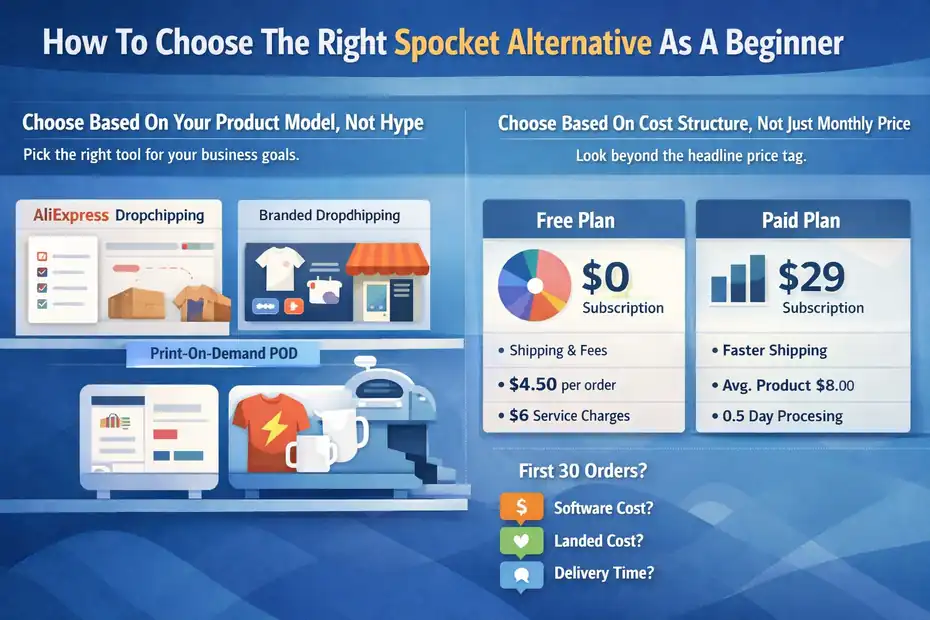
Choose Based On Your Product Model, Not Hype
A lot of beginners pick a tool because somebody calls it “the best.” I suggest flipping that around. Start with the product model you want to run. If you want low-cost catalog testing with lots of product variety, an AliExpress-centered workflow like DSers or AliDrop makes more sense than paying extra for a curated marketplace.
DSers is positioned as an official AliExpress dropshipping solution, while AliDrop centers on AliExpress, Alibaba, Temu, and US/EU suppliers.
If you want better branding support and more guided beginner onboarding, Zendrop is more relevant. Its plans emphasize unlimited orders, custom branding on higher tiers, coaching resources, and a free plan with limited access. That is a very different experience from a bare-bones importer.
If you want print-on-demand instead of classic reselling, Printful is really playing a different game. You are not just importing generic items. You are creating custom products, paying base product plus fulfillment and shipping costs, and building your margins around design and brand positioning.
This is the shortcut I wish more beginners used: don’t compare everything to everything. Compare marketplace tools to marketplace tools, AliExpress tools to AliExpress tools, and POD tools to POD tools.
Choose Based On Cost Structure, Not Just Monthly Price
Monthly pricing can fool you. A platform with a $0 plan can still become expensive if shipping is inconsistent, service fees stack up, or you need upgrades too early. A platform with a paid plan can still be cheaper if it reduces errors, speeds up fulfillment, or helps you test more products profitably.
For example, CJdropshipping markets itself as free to use, with no monthly subscription for core access, but you still pay product, shipping, and service-related costs depending on what you use. Modalyst has a free Hobby tier, but supplier-side information also shows service-fee language in its ecosystem, so your total economics matter more than the headline plan name.
A simple beginner test helps here. Estimate your first 30 orders and ask three questions: what is my software cost, what is my average landed product cost, and what will customer expectations be around delivery? That gives you a much clearer answer than browsing feature checklists for two hours.
Top Spocket Alternatives For Dropshipping Beginners
This is the section most people came for, so let me be direct. These are not random picks. Each one fits a different beginner situation.
DSers: Best For Cheap Product Testing And AliExpress Workflows
DSers is one of the strongest spocket alternatives for dropshipping beginners if your main goal is learning fast without committing to a large monthly bill. Its free plan is still a big advantage. Recent DSers materials describe the free tier as supporting up to 3 stores and basic automation, with paid tiers expanding product limits, pricing rules, and branding features.
What makes DSers especially beginner-friendly is the workflow. It is built around importing products, syncing inventory, managing orders in bulk, and comparing suppliers more efficiently than doing everything manually. If you are testing multiple low-ticket products, those operational basics matter a lot more than fancy dashboards.
I would choose DSers if you are the kind of beginner who wants reps. You want to test product pages, learn pricing, understand supplier ratings, and get comfortable with order handling before you worry about private labeling or premium-feeling catalogs. The downside is obvious too: you are closer to the AliExpress model, so you need to be more disciplined about supplier vetting, shipping communication, and product quality control.
A realistic scenario: If you are launching a general store and want to test five to ten products with organic TikTok content before spending much, DSers is usually a more forgiving starting point than Spocket.
CJdropshipping: Best For Beginners Who Want More Sourcing Flexibility
CJdropshipping sits in a nice middle ground. It positions itself as free to use for core platform access, and it combines product sourcing, warehousing, shipping options, and fulfillment support in one ecosystem. That makes it appealing for beginners who are already thinking a step beyond basic product import tools.
What I like about CJ for beginners is that it can grow with you. Early on, you can use it as a simple source-and-ship solution. Later, if you care more about warehousing, packaging, or custom sourcing, the same ecosystem gives you more room to evolve. That is helpful because a lot of beginners outgrow their first tool the second they hit consistent sales.
The main caution is that “free” does not mean simple. CJ can feel more operationally involved than Spocket or Zendrop. You may need to pay more attention to shipping routes, warehouse choices, and service-specific fees. For some beginners, that is empowering. For others, it is just more moving parts than they want on week one.
I recommend CJdropshipping when you want better sourcing control without jumping straight into complex fulfillment setups on your own. It is especially useful if you care about product sourcing flexibility more than polished beginner coaching.
Zendrop: Best For Beginners Who Want Guidance And A Cleaner Experience
Zendrop is one of the easiest Spocket alternatives to recommend when a beginner wants a platform that feels guided, not just functional. It offers a free plan, advertises access to a large product catalog, and puts a lot of emphasis on support, education, coaching, and features like custom branding and product requests on higher tiers. Its Plus plan is currently listed at $79 per month, while the free plan has limited access.
That positioning matters. Some beginners do not just need products. They need handrails. They want help spotting winning products, understanding fulfillment, and avoiding early confusion. Zendrop clearly markets itself toward that audience.
Would I say Zendrop is cheaper than every alternative? No. But that is not really the point. For some sellers, paying more for a smoother beginner experience is worth it if it reduces decision fatigue and setup friction. I have seen plenty of beginners waste more money on bad product choices than they ever would on software.
Zendrop is a strong fit if you want a more curated all-in-one feel, especially if Spocket appealed to you but did not feel flexible enough. It is weaker if your only goal is ultra-low-cost testing.
AutoDS: Best For Sellers Who Care About Automation Early
AutoDS is a better fit for the beginner who already knows they want automation to be central from the start. Its public pricing pages emphasize automation, price and stock monitoring, automated fulfillment, and a low-cost trial entry point such as “start now for $1,” though the exact package pricing is modular and less transparent at a glance than simpler free-plan tools.
This matters because AutoDS is not really trying to be the cheapest sandbox. It is trying to be the operational engine. If you expect to test across multiple suppliers or want tighter automation around stock and pricing, it can make sense. AutoDS also supports a wide supplier ecosystem compared with more narrowly positioned tools.
The downside for true beginners is complexity and cost stacking. DSers’ own comparison content frames AutoDS as having modular pricing, where functions can be sold more separately than DSers’ bundled tiers. That does not automatically make it a bad choice, but it does mean you should map your expected needs before committing.
I would put AutoDS slightly behind DSers and Zendrop for the average first-time seller, but ahead of them for the beginner who is unusually operations-focused and wants to automate aggressively from day one.
Modalyst, Trendsi, And Printful: Best Niche Picks Depending On Your Store Type
Not every beginner should use the same kind of alternative. Modalyst is useful if you want marketplace-style sourcing with free entry, broad product access, and a mix of US suppliers, AliExpress vendors, and ecommerce integrations. Its pricing page shows a free Hobby tier, which lowers entry friction for early experiments.
Trendsi is more specific. It is especially relevant for fashion-focused beginners, and its pricing page says the platform is free to use up to 500 listed products, with optional Pro features. That is very attractive if you want to test apparel without paying software fees up front.
Printful belongs in this conversation for one reason: many beginners should not be doing classic generic-product dropshipping at all. If you have a design angle, niche audience, or creator brand, print-on-demand can be a smarter path. Printful is free to start, but your economics are built on base product price, fulfillment, shipping, and your ability to charge for originality.
My honest take: Niche fit beats broad popularity. A fashion beginner may do better with Trendsi than with a general platform. A creator with a meme page may do better with Printful than with any classic dropshipping app.
Quick Comparison: Which Alternative Fits Which Beginner?
You do not need a giant spreadsheet to choose. You need a simple decision filter.
| Platform | Best For | Entry Pricing Signal | Main Strength | Main Watchout |
|---|---|---|---|---|
| DSers | Cheap testing with AliExpress | Free plan | Bulk order workflow, supplier comparison, low-cost learning | More manual supplier vetting needed |
| CJdropshipping | Flexible sourcing and fulfillment | Free core access | Sourcing, warehousing, shipping flexibility | More moving parts for beginners |
| Zendrop | Guided beginner experience | Free plan, Plus at $79/mo | Coaching, smoother onboarding, branding options | Paid tiers rise quickly |
| AutoDS | Automation-first sellers | Trial-based entry | Price/stock monitoring and automation | Modular pricing can add complexity |
| Modalyst | Marketplace sourcing with free entry | Free Hobby plan | US suppliers plus broad integrations | Total economics still need review |
| Trendsi | Fashion beginners | Free use up to 500 products | Fashion-focused catalog and low upfront risk | Niche-specific rather than general |
| Printful | Print-on-demand brands | Free to start | Custom products and brand differentiation | Margins depend on creative execution |
The table above reflects current platform positioning and public pricing or access models from official pages.
The Simplest Way To Narrow It Down
Here is the no-fluff version I would use myself.
- Choose DSers if your budget is tight and you want to test lots of products cheaply.
- Choose CJdropshipping if you want more control over sourcing and fulfillment earlier.
- Choose Zendrop if you want beginner support, cleaner onboarding, and a more curated feel.
- Choose AutoDS if automation matters more to you than minimal cost.
- Choose Trendsi if you are selling fashion.
- Choose Printful if you are building a design-led or creator-led brand.
That is honestly enough for most beginners. The biggest mistake is over-comparing instead of launching.
How To Set Up Your First Store With A Spocket Alternative
This is where theory turns into actual progress. The right platform helps, but your first setup decisions matter even more.
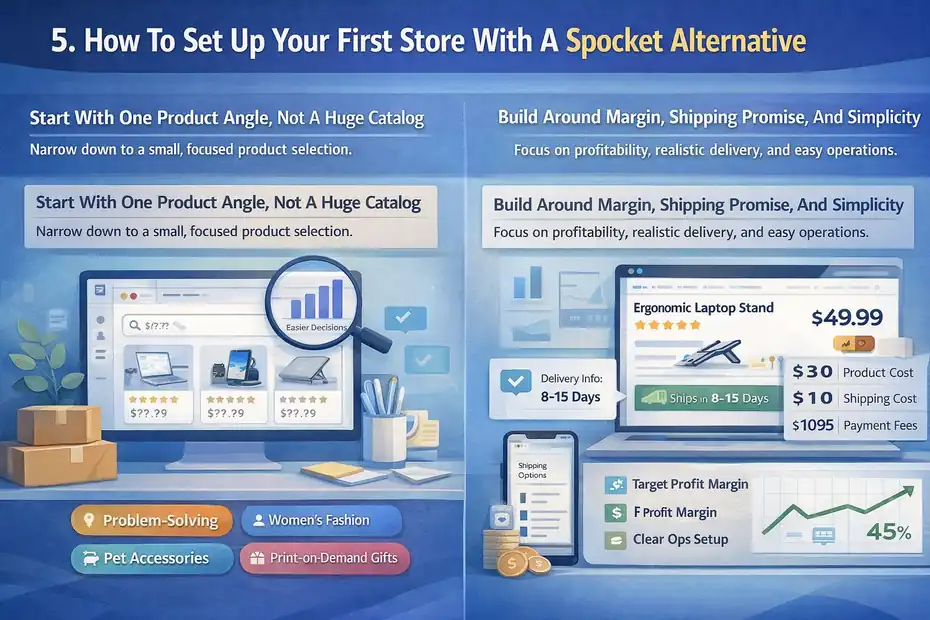
Start With One Product Angle, Not A Huge Catalog
Beginners love catalog size. I understand the temptation. But a bigger catalog usually creates slower decisions, weaker product pages, and random testing. I suggest starting with one niche or one product angle.
That can be problem-solving home products, women’s fashion, pet accessories, or custom print-on-demand gifts. The platform you choose should support that angle clearly.
For example, if you use DSers, your first task is not importing 50 products. It is narrowing down to three to five products with decent supplier ratings, understandable shipping methods, and room for margin after ad costs or content creation.
If you use Trendsi, the same principle applies, but with apparel selection and size consistency in mind. If you use Printful, it becomes design-market fit instead of supplier hunting.
A small scenario: Imagine you are selling ergonomic desk accessories. Five carefully selected products with a shared audience will usually outperform a random 40-product store. It feels less exciting, but it converts better because the store makes sense.
Build Around Margin, Shipping Promise, And Simplicity
Three things should shape your first setup: product margin, believable shipping communication, and operational simplicity. I believe beginners often obsess over “winning product” research while ignoring whether the numbers and logistics actually work.
Start by calculating your landed cost: product cost, shipping, software cost, payment fees, and expected refund leakage. Then write a shipping promise you can actually keep.
If your supplier usually lands in 7 to 20 days, do not market it like 3-day domestic fulfillment. CJ shipping pages and Printful shipping resources both make it clear that route, destination, and product type affect delivery timing and cost.
Simplicity matters too. Your first store does not need ten apps, five bundles, and a hyper-complex upsell funnel. It needs clean product pages, clear shipping information, a basic offer, and one acquisition strategy. A platform that helps you do that consistently is a better beginner choice than one with fifty advanced features you will not touch.
Common Mistakes Beginners Make When Switching From Spocket
A lot of people move to an alternative and accidentally recreate the same frustrations they were trying to escape. The problem is not always the platform.
Mistake 1: Picking The Cheapest Option And Ignoring Fit
This is the classic trap. A free plan feels safe, so the beginner grabs it immediately. Sometimes that is smart. Sometimes it is just delayed pain. A free AliExpress-focused setup can be perfect for low-budget testing, but it can also create support issues if you choose weak suppliers or set unrealistic delivery expectations.
On the other side, a paid tool like Zendrop or even Spocket can feel expensive, but if it gives you a cleaner catalog, easier onboarding, or features that reduce confusion, it may help you get to your first sale faster. This is why I do not like blanket advice. “Cheapest” and “best for beginners” are not the same thing.
A better question is this: will this platform help me launch and learn with fewer mistakes? That is the beginner metric that matters.
Mistake 2: Confusing Supplier Access With Brand Advantage
Access to millions of products sounds impressive. But product access is not a moat. Lots of platforms advertise huge catalogs. Zendrop highlights 1M+ products, Spocket highlights 100 million+ catalog access, and Modalyst promotes millions of products too. Those numbers are useful, but they do not automatically create a stronger store.
What creates advantage is curation, positioning, offer structure, and trust. If ten stores sell the same product with the same weak product description, the platform did not fail. The store positioning failed. I think beginners need to hear that early because it prevents “tool hopping,” where every new app feels like a rescue plan.
The better move is to choose one platform, commit to a realistic product angle, improve your offer, and gather real customer behavior data before switching again.
How To Optimize Results Once Your Store Is Live
Once you launch, the platform matters less than your feedback loop. This is where beginners either grow or drift.
Track The Few Metrics That Actually Matter Early
You do not need enterprise analytics in month one. You need a short list of numbers that tell you whether your store deserves more effort. Track click-through rate from your traffic source, add-to-cart rate, checkout initiation, conversion rate, average order value, refund rate, and delivery-related complaints.
Those tell you much more than vanity metrics like page views alone. Shopify’s beginner dropshipping guides also keep the focus on practical launch and growth steps rather than drowning beginners in advanced reporting too early.
Here is a simple interpretation framework I recommend:
- Low clicks: Your creative or hook is weak.
- High clicks, low add-to-cart: Your offer or product page is weak.
- High add-to-cart, low checkout completion: Trust, shipping, or price resistance is likely the issue.
- High refunds or support tickets: Supplier quality or expectation-setting is failing.
That framework works no matter which Spocket alternative you use. The tool supports the store, but the metrics tell the truth.
Improve Product Selection Before You Add More Products
Many beginners respond to weak results by adding more products. Usually that just multiplies confusion. I believe it is smarter to improve selection quality first.
Use reviews, shipping routes, supplier reliability signals, and customer questions to refine what you already listed. Platforms like DSers, CJdropshipping, and Zendrop all position themselves around simplifying sourcing and fulfillment, but the seller still has to choose well.
A mini example: let’s say your first store sells desk products. One cable organizer gets clicks but poor conversion. Instead of adding 12 random new products, test one stronger bundle, rewrite the problem-solution copy, improve the main image, and compare shipping options. That is how stores improve. Not by turning into a flea market.
Advanced Tips For Scaling Beyond The Beginner Stage
Once you start getting traction, your best alternative may change. That is normal. Tools are not identities.
Move From Product Testing To Process Control
In the first stage, you care about learning and product testing. In the second stage, you care about consistency. That often means better supplier relationships, clearer shipping logic, branding upgrades, or moving into warehousing and custom packaging where available.
CJdropshipping’s broader fulfillment ecosystem becomes more attractive here, while platforms with branding options like Zendrop can also make more sense as you mature.
This is where I think a lot of beginners finally understand why they were frustrated earlier. Early-stage tools are great for speed. Growth-stage tools need to reduce volatility. If you are doing 10 orders a week, rough edges are annoying. If you are doing 40 orders a day, rough edges become expensive.
So as you scale, ask a new question: which platform gives me better operational control, not just easier sourcing?
Build A Store Customers Can Remember
The longer you stay in dropshipping, the less the generic marketplace game helps you. You need differentiation. That can come from custom bundles, better education, niche specialization, branded packaging, original photography, or a creator-style content angle.
Printful is a great example of how some sellers skip generic reselling entirely and build brand memory through design. Trendsi can help fashion sellers create a more coherent catalog.
My honest opinion is that the best long-term “Spocket alternative” is not always another app. Sometimes it is a better business model inside the store you are already building. The app gets you started. The brand gets you paid repeatedly.
Final Verdict: The Best Spocket Alternative For Most Beginners
There is no universal winner, but there is a practical winner for each beginner type. For most people starting from zero, DSers is the easiest recommendation because the free plan reduces pressure and the workflow teaches the core mechanics of product testing, supplier comparison, and order handling.
If you want more sourcing flexibility and room to grow into warehousing or more advanced fulfillment, CJdropshipping is a strong second choice. If you want cleaner onboarding and more beginner support, Zendrop is probably the better fit. If fashion is your lane, Trendsi deserves serious attention. If you are building around custom design, Printful may be the smartest route of all.
So when people ask me about spocket alternatives for dropshipping beginners, I do not answer with one platform.
I answer with one rule: choose the tool that matches the kind of beginner you are right now, not the seller you hope to become six months from now. That usually leads to better decisions, lower stress, and a faster path to your first real sales.
FAQ
What are the best spocket alternatives for dropshipping beginners?
The best spocket alternatives for dropshipping beginners include DSers, CJdropshipping, Zendrop, and AutoDS. Each offers different benefits depending on your goals, such as lower startup costs, better automation, or more flexible supplier sourcing, making them suitable for testing and scaling a new store.
Is there a free alternative to Spocket for beginners?
Yes, several spocket alternatives for dropshipping beginners offer free plans, including DSers, Zendrop, and CJdropshipping. These platforms allow you to start without monthly fees, making them ideal for testing products and learning the basics before committing to paid tools.
Which dropshipping platform is easiest for beginners to use?
Zendrop is often considered one of the easiest spocket alternatives for dropshipping beginners due to its simple interface, guided onboarding, and built-in support. It helps reduce confusion and allows new sellers to focus more on product testing and store setup.
Can I make money using Spocket alternatives as a beginner?
Yes, many beginners successfully make money using spocket alternatives for dropshipping beginners. The key is choosing the right platform, testing products strategically, setting realistic shipping expectations, and improving your product pages based on customer behavior and feedback.
How do I choose the right Spocket alternative for my store?
To choose the right spocket alternative for dropshipping beginners, consider your budget, product type, and experience level. If you want low-cost testing, choose DSers. If you want branding and support, choose Zendrop. Match the platform to your business model for better results.

I’m Juxhin, the voice behind The Justifiable.
I’ve spent 6+ years building blogs, managing affiliate campaigns, and testing the messy world of online business. Here, I cut the fluff and share the strategies that actually move the needle — so you can build income that’s sustainable, not speculative.
Related posts:
 How to Make Money Dropshipping: 7 Secrets to a $10K/Month
 Discover 5 Best Dropshipping Sites: Boost Your Sales Now!
 Dropshipping Step by Step: A Beginner’s Roadmap
 15 Trending Dropshipping Products That Sell Right Now
 Online Dropshipping Explained: How It Really Works
 How to Start SaleHoo Dropshipping & Make Money Fast