
Table of Contents
Some links on The Justifiable are affiliate links, meaning we may earn a small commission at no extra cost to you. Read full disclaimer.
AppScenic product sourcing strategy works best when you stop treating product research like a treasure hunt and start treating it like a filtering system.
If you want to find winning products faster, you need a repeatable way to judge supplier quality, shipping reality, margins, catalog depth, and product-market fit before you import anything into your store.
In my experience, that is where most beginners lose time.
They browse too much, test too little, and confuse “interesting” with “sellable.” This guide will help you build a sourcing process that is faster, cleaner, and much more profitable.
What An AppScenic Product Sourcing Strategy Really Means
A strong sourcing strategy is not just “find products on AppScenic and import them.”
It means choosing products through a set of rules that protect your margins, your brand, and your customer experience.
Start With The Right Goal, Not Just A Product List
Most people open a sourcing platform and immediately search for products. I think that is backwards. Your first job is to decide what kind of store you are building, what customer problem you want to solve, and what operational limits you can handle.
AppScenic positions itself as a dropshipping and automation platform with access to 1 million+ products, 100+ categories, supplier locations across the USA, UK, EU, and Canada, plus automation for product, order, and tracking sync. It also highlights 2–5 day shipping on parts of its offer, white label orders, and instant stock and price syncing.
That matters because your strategy should match the platform’s strengths. If a marketplace is built around faster domestic sourcing and automated sync, then your edge is usually not “cheapest product possible.” Your edge is usually better delivery expectations, fewer stock surprises, cleaner operations, and higher trust.
A practical goal sounds like this: “I want 20 products in one niche, sourced from suppliers that support reliable fulfillment, with enough margin to absorb ads and refunds.” That is a sourcing strategy. “I want trending products” is not.
Understand What AppScenic Is Best Used For
AppScenic is best used when you want curated sourcing plus operational automation, not just endless catalog scraping. The platform emphasizes vetted suppliers, automated ordering, store integrations, tracking imports, smart pricing formulas, and a wallet-based payment system with auto-funding.
In plain English, that means it is built to reduce the messy parts of dropshipping: overselling, wrong pricing, slow manual order routing, and disconnected tracking updates.
For many stores, that changes the sourcing decision itself. You should prefer products that benefit from dependable sync and reasonable shipping speed over products that only look attractive in a spreadsheet. A product with slightly lower margin but smoother fulfillment often outperforms a “high-margin winner” that creates support tickets every week.
That is the mindset I recommend throughout this guide: source for repeatability, not just excitement.
Build Your Sourcing Criteria Before You Search
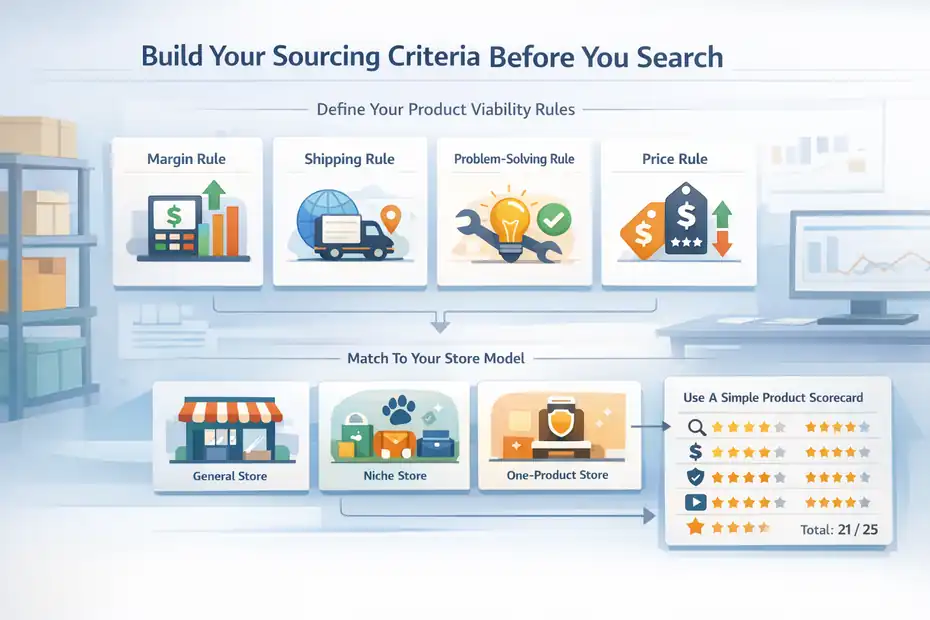
This is the step that makes everything faster. When your filters are clear, you stop wasting hours browsing products you should never test.
Define Your Product Viability Rules
Before you open a catalog, write down the minimum standards a product must meet to earn a place in your shortlist.
Here is a simple framework I suggest:
- Margin Rule: Aim for enough gross margin to cover ads, transaction fees, returns, and still leave room for profit.
- Shipping Rule: Prefer supplier locations and delivery expectations that match your store promise.
- Problem-Solving Rule: Choose products that fix a clear annoyance, save time, improve comfort, or create a visible outcome.
- Price Rule: Avoid products priced so low they cannot support customer acquisition costs, and avoid products so expensive that trust becomes a major barrier.
- Competition Rule: Skip products everyone sells with the exact same photos and titles.
AppScenic’s built-in price formulas are useful here because the platform lets you create rules to increase or decrease prices across products and even set a default pricing formula.
I like this because you can think in ranges instead of one-off prices. For example, if a sourced item lands at $14 cost, you can already know whether it fits your store’s pricing logic before you import it. That is much more efficient than importing first and doing margin math later.
Match Products To A Store Model
Not every product fits every store model. This is where many sourcing strategies quietly break.
If you run a general store, you need products with broad appeal, impulse-friendly pricing, and strong creatives. If you run a niche store, you need thematic fit, repeat buyer potential, and products that build perceived authority. If you run a branded one-product or hero-product store, you need a product that can carry the whole message.
Imagine you are building a pet accessories store. A random kitchen gadget might have good margins, but it weakens your brand. A slow feeder bowl, pet grooming tool, car seat protector, and odor-control accessory make more sense because they can be bundled, cross-sold, and explained to the same audience.
That is why the best AppScenic product sourcing strategy is not “search what is trending.” It is “search what fits my store structure, customer pain point, and operational model.”
Use A Simple Product Scorecard
A scorecard saves you from emotional decisions. I recommend rating each product from 1 to 5 on five factors:
- Demand Clarity: Can a customer understand the benefit in five seconds?
- Margin Strength: Is there enough room after fulfillment and marketing?
- Supplier Confidence: Does the sourcing setup reduce fulfillment risk?
- Creative Potential: Can this be demonstrated well in images or video?
- Brand Fit: Does it strengthen your store’s position?
A product scoring 21/25 is worth a test. A product scoring 14/25 is usually not.
This sounds basic, but it works because it forces consistency. In my experience, a boring scoring sheet beats “gut feeling” almost every time.
Use AppScenic Filters To Narrow Down Products Faster
Once your rules are set, the platform becomes much easier to use. Now you are filtering for fit, not browsing for inspiration.
Prioritize Supplier Geography And Shipping Reality
One of AppScenic’s main selling points is supplier access in regions like the USA, UK, EU, and Canada, alongside faster shipping claims on key parts of the catalog.
That is important because geography affects almost everything: delivery speed, refund pressure, customer satisfaction, and even conversion rate. If your audience is in the US, products sourced closer to that market often create a smoother experience than items shipping internationally with vague timelines.
I suggest starting your product search with shipping expectations in mind. Ask yourself, “Can I honestly market this delivery promise on my site without creating headaches later?” If the answer is no, keep moving.
A lot of store owners underestimate how much faster shipping can raise conversion. Even when the exact product is not unique, a more credible delivery window can become your differentiator.
Filter For Catalog Quality, Not Just Category
AppScenic offers 100+ product categories and a catalog of more than 1 million products. That scale is useful, but scale can also distract you.
When I evaluate catalog quality, I look for three things:
- Listing clarity: Titles, images, and descriptions should make sense quickly.
- Perceived value: The product should look like something a real brand would sell.
- Angle potential: The item should support a distinct benefit or audience angle.
For example, a generic desk organizer may be hard to sell unless it has a clear design, compact feature, cable management angle, or premium aesthetic. A product does not need to be brand new. It needs to be sellable with a believable promise.
This is where you need discipline. A huge catalog is only helpful if you can reject products quickly.
Use Import Limits And Plan Constraints Strategically
AppScenic’s pricing and plan presentation varies by channel, but current public listings show a free option and paid tiers with different pushed product limits, AI request caps, premium product access, and automation support.
The Shopify App Store listing, for example, shows paid plans at $39, $79, and $99 per month with different product limits and premium access, while AppScenic’s own pricing materials also highlight automation, smart pricing, and premium product features.
That means your sourcing strategy should not begin with importing hundreds of products. It should begin with a tight shortlist.
I usually recommend this:
- Phase 1: Shortlist 30 products.
- Phase 2: Import 10–15 serious candidates.
- Phase 3: Launch 3–5 initial tests.
- Phase 4: Expand only after clear traction.
This protects your time and your subscription value. More imported products do not automatically create more revenue. Often they just create more clutter.
Evaluate Winning Products The Smart Way
This is where your strategy becomes profitable. You are no longer asking, “Is this product cool?” You are asking, “Can this product survive real customer acquisition and operations?”
Look For Clear Pain Points And Easy Demonstration
Winning products usually do one of three things well: they remove friction, increase comfort, or create a visible before-and-after.
That is why problem-solving products tend to outperform “random nice-to-have” items. A posture corrector, pet hair remover, drawer organizer, leak-proof travel accessory, or ergonomic desk item can all be explained through a simple emotional hook: “Here is the annoying thing. Here is how this product fixes it.”
When a product can be demonstrated visually, your marketing becomes easier. That matters more than many people realize. If you need a paragraph to explain the value, your ad costs will usually be higher.
I recommend testing products that a stranger can understand in one scroll. The best products do not ask the customer to work hard.
Check Margin With A Realistic Ad Cost Buffer
A product is not winning because the cost-to-sell spread looks big on paper. It is winning when margin survives advertising, returns, payment fees, and promotional discounts.
Here is a simple example. Suppose a product costs $18 landed, and you sell it for $44. That sounds fine at first glance. But after payment fees, shipping-related issues, customer support, an introductory discount, and paid traffic, that margin can shrink fast.
This is where AppScenic’s pricing formulas help operationally. Since the platform supports formula-based price adjustments, you can standardize your pricing instead of manually editing each product one by one.
I suggest thinking in “net opportunity,” not just markup. If your likely customer acquisition cost is high, the product needs enough perceived value to justify a stronger price point or bundle.
Favor Products That Can Be Bundled Or Upsold
In many cases, the first product you source is not the real profit driver. The real profit comes from the second item added to the cart.
That is why I love products with natural accessory logic. A car cleaning gel pairs with detailing brushes. A pet seat cover pairs with a travel water bottle. A kitchen container set pairs with labels or measuring tools.
Bundling does three things:
- It raises average order value.
- It gives you more pricing flexibility.
- It makes your store feel more intentional.
This is especially useful if you are building a niche store with AppScenic rather than a one-product offer. A sourcing strategy that includes add-ons is usually stronger than a strategy built around isolated items.
Set Up AppScenic For Faster And Safer Product Testing
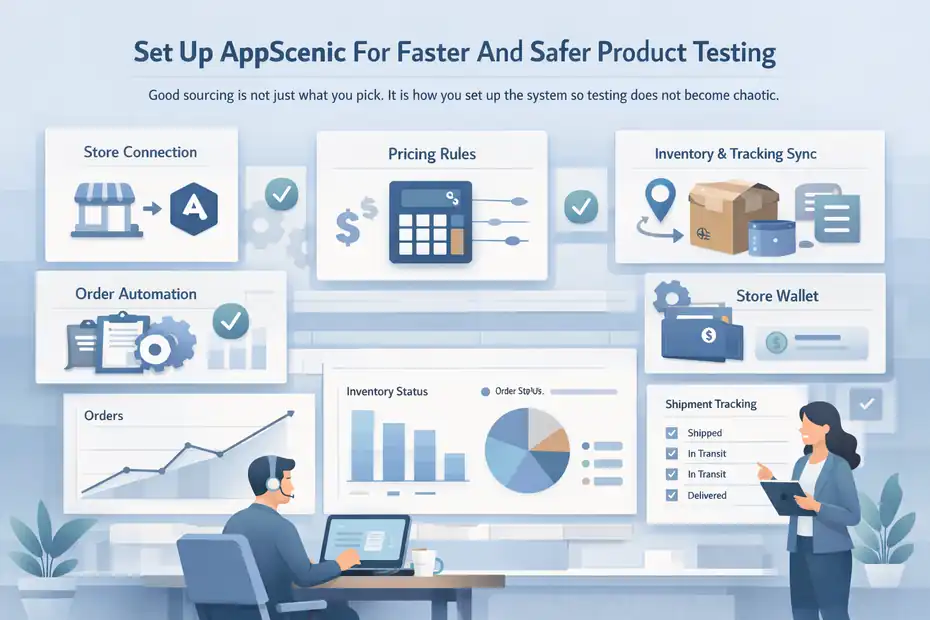
Good sourcing is not just what you pick. It is how you set up the system so testing does not become chaotic.
Connect Your Store And Configure Core Automation
AppScenic says retailers can connect stores, import products, sync orders, and auto-import tracking data through built-in integrations. Its automation pages mention store connection, one-click or bulk product imports, and 24/7 syncing for products, orders, and tracking.
The practical takeaway is simple: set up your operations before you import your first serious batch.
Your first setup priorities should be:
- Store connection: Make sure product data can flow properly.
- Order automation: Reduce manual forwarding mistakes.
- Tracking sync: Keep customer updates consistent.
- Inventory sync: Protect yourself from selling unavailable stock.
This matters because your sourcing decisions become much better when you know the backend is stable. A product might look great, but if your process is manual and messy, you will hesitate to test aggressively.
I believe beginners should spend one focused session on backend setup before they spend hours on product discovery. It feels slower, but it saves time almost immediately.
Configure Pricing Formulas Before Importing At Scale
AppScenic’s help materials explain that you can set a default pricing formula and create rules that raise or lower prices for one or more products.
That is a bigger advantage than it sounds.
Without pricing rules, you end up importing products and then cleaning up every listing manually. With formulas, you can control price logic from the start. For example, lower-cost items might need a higher multiplier, while higher-cost items may need a flatter markup so you stay competitive.
A simple rule structure might look like this:
- Under $10 cost: Higher markup to protect ad spend.
- $10–$30 cost: Balanced markup plus shipping cushion.
- Over $30 cost: Lower multiplier, stronger perceived value angle, possible bundle strategy.
You will still review products individually, but formulas create a stable baseline. In real stores, that kind of consistency matters more than people expect.
Set Up The Store Wallet So Orders Do Not Stall
AppScenic uses a Store Wallet system for supplier payments, and its help center explains that the wallet can be auto-funded once a threshold is reached using a preferred payment method.
This is one of those details many people ignore until it causes a problem.
If a product test starts getting orders and your payment flow is not ready, fulfillment can slow down at exactly the wrong moment. I recommend setting this up early and choosing sensible thresholds so you do not create avoidable delays.
Operational friction kills momentum. When a test is working, you want the system to support the volume, not interrupt it.
Create Product Pages That Support The Sourcing Strategy
A sourced product is only half the job. You still need to present it in a way that matches the reason you picked it.
Rewrite Titles And Descriptions Around Benefits
Even if a supplier listing is technically usable, I rarely recommend publishing it as-is. Supplier copy is often too generic, too feature-heavy, or too awkward for conversion.
AppScenic promotes AI tools for product enhancement, SEO assistance, image upscaling, and marketing support, and Shopify App Store reviewers have specifically mentioned the platform’s AI tools as a time saver.
That can help with workflow, but the strategy still matters more than the tool. The product page should answer:
- What problem does this solve?
- Who is it for?
- Why is this better than the annoying alternative?
- What outcome should the buyer expect?
I suggest rewriting every serious test product in human language. Lead with the customer’s frustration, then show the fix, then support it with features. Features alone rarely sell. Outcomes do.
Adjust Images And Merchandising For Trust
A product can be solid and still fail because it looks untrustworthy. This is especially true in dropshipping, where shoppers are already cautious.
When I review sourced items, I look for visual consistency first. Do the images feel like they belong in the same store? Do they make the product feel premium enough for the asking price? Can the shopper quickly understand scale, use case, and result?
AppScenic also highlights white label orders, which can support a more brand-safe experience than obviously third-party fulfillment.
That does not automatically create a strong brand, but it does make it easier to sell a cleaner experience if your site design, copy, and merchandising are aligned.
Build Collections That Make Cross-Sells Natural
Collections are part of sourcing strategy, not just site organization.
If you source products into disconnected categories, you lose cross-sell momentum. But if you organize products around use cases, you increase both relevance and average order value.
For example, instead of using vague collections like “Accessories” and “New Arrivals,” you could use:
- Home Organization Essentials
- Pet Travel Must-Haves
- Work-From-Home Comfort
- Quick Kitchen Fixes
That makes your store easier to shop and makes every sourced product work harder.
Avoid The Most Common Sourcing Mistakes
A lot of sourcing problems are not technical. They come from bad judgment repeated consistently.
Mistake 1: Importing Too Many Products Too Early
The biggest mistake I see is catalog overload. A seller imports dozens or hundreds of products, then cannot write good pages, cannot prioritize ads, and cannot tell which products deserve focus.
This is especially tempting on large catalogs. Since AppScenic offers access to 1M+ products and broad category coverage, it is easy to mistake availability for opportunity.
I recommend staying narrow at the beginning. A small, intentional catalog almost always outperforms a messy big one.
Depth beats quantity. Ten products with strong positioning will teach you more than 200 random imports.
Mistake 2: Chasing “Winning” Products Without A Brand Angle
A product is not truly winning if your store has no reason to sell it better than anyone else.
This is where beginners often get trapped by social media trends. They see a product performing in someone else’s ad account and assume the product itself is the entire advantage.
Usually it is not. The advantage is often the angle, audience matching, offer structure, creative quality, or shipping promise.
Your AppScenic product sourcing strategy should answer: “Why would this product win in my store, for my audience, with my positioning?” If you cannot answer that, keep looking.
Mistake 3: Ignoring Fulfillment And Support Friction
Trustpilot and Shopify App Store feedback for AppScenic includes many positive comments about automation, product selection, speed, and support, but there are also complaints tied to integration friction, navigation, and marketplace-specific issues.
That is actually useful. It is a reminder that sourcing strategy must include operational realism.
Even a good platform cannot save a weak process. If you source products with confusing variants, fragile shipping expectations, or unclear customer communication, support requests will rise.
I believe every product should pass one final question before import: “Will this create avoidable customer confusion?” If yes, it is probably not worth it.
Optimize Your Sourcing Process After The First Tests
Your first round of products is not the final answer. It is data collection.
Track The Metrics That Actually Matter
After launch, do not just watch sales. Watch the full product story.
The most useful metrics usually include:
- Click-through rate: Tells you if the product angle is attractive.
- Landing page conversion rate: Tells you if the page and offer are convincing.
- Add-to-cart rate: Tells you if interest is real.
- Average order value: Tells you if your bundle logic is working.
- Refund or complaint rate: Tells you if the sourced product creates friction.
A product with moderate sales but high complaints is not a winner. A product with average conversion but excellent upsell behavior might be more valuable than it first appears.
This is where many stores get sharper. They stop judging products emotionally and start judging them operationally.
Double Down On Product Families, Not Just Single Winners
Once you find traction, do not immediately jump to a brand-new niche. Expand around the proof.
If one ergonomic desk product sells, look for adjacent items that fit the same customer. If one pet travel product works, source more travel-related pet items. This is the fastest way to turn product research into store depth.
AppScenic’s large catalog and category spread make this kind of family expansion easier once you know what theme is working.
In my experience, this is how small stores start feeling like brands. They stop behaving like product hunters and start behaving like category curators.
Refresh Offers Faster With AI, But Keep Human Judgment
AppScenic now promotes AI-assisted product enhancement, SEO help, image upscaling, and marketing support. These tools can speed up iteration, especially when you are testing multiple offers.
But I would not outsource your judgment to AI.
Use AI to speed up drafts, product copy variants, angle ideas, and cleanup. Then apply your own filter. Does the page sound believable? Does it match your customer? Does it make a strong promise without sounding generic?
Tools accelerate. Strategy decides.
Advanced AppScenic Product Sourcing Strategy For Scaling
Once you have a few validated products, the job changes. Now you are building an engine.
Build A Repeatable Weekly Sourcing Routine
Scaling gets easier when sourcing becomes a habit, not a random binge.
A strong weekly routine might look like this:
- Monday: Review product performance and kill weak listings.
- Tuesday: Shortlist 10–15 new candidates.
- Wednesday: Score products using your framework.
- Thursday: Import 3–5 high-confidence tests.
- Friday: Update collections, bundles, and copy.
This routine works because it keeps discovery tied to data. You are not sourcing in a vacuum. You are sourcing based on what your store is teaching you.
I suggest keeping a simple spreadsheet with columns for niche, supplier region, cost, sell price, score, launch date, conversion notes, and support notes. It is not glamorous, but it makes decision-making much cleaner.
Segment Products By Testing Intent
Not every sourced product has the same role.
I like to sort products into three groups:
| Product Type | Purpose | What You Look For |
|---|---|---|
| Hero Products | Main acquisition drivers | Strong demo, strong angle, broad appeal |
| Support Products | Raise AOV and improve collections | Easy bundles, logical add-ons |
| Trust Products | Make the store feel complete | Useful basics, lower-risk essentials |
This approach stops you from expecting every item to be a viral winner. Some products are there to convert cold traffic. Some are there to improve cart size. Some are there to make the catalog feel credible.
That is a much smarter way to scale.
Know When To Stop Sourcing And Start Brand Building
At some point, better sourcing is no longer the biggest lever. Better branding is.
If you already have products with sales, decent fulfillment, and healthy feedback, constantly hunting for the “next winner” can actually slow you down. That is when you should invest more in creative testing, email flows, bundles, offer design, customer education, and retention.
A mature AppScenic product sourcing strategy does not mean importing forever. It means sourcing enough high-fit products to support a brand direction, then improving how you sell them.
That shift is where stores stop looking temporary and start becoming real businesses.
Final Thoughts
The best AppScenic product sourcing strategy is not complicated, but it does require discipline. You need clear criteria, realistic margin math, supplier and shipping awareness, smart product scoring, and a backend setup that supports testing without chaos.
If I were starting from scratch, I would not try to find 100 products fast. I would try to find five products that fit one audience, one store promise, and one operational standard. Then I would improve from there.
That is how you find winning products faster on AppScenic: not by browsing harder, but by sourcing smarter.
FAQ
What is an AppScenic product sourcing strategy?
An AppScenic product sourcing strategy is a structured approach to selecting profitable products using filters like supplier location, shipping speed, pricing rules, and product-market fit. Instead of random browsing, it focuses on consistent criteria to identify products that are easier to sell, fulfill, and scale.
How do I find winning products on AppScenic fast?
To find winning products quickly on AppScenic, apply strict filters like clear problem-solving value, reliable shipping regions, and strong margins. Shortlist products using a scoring system, then test only a few high-potential items instead of importing large catalogs that slow down decision-making.
Is AppScenic good for beginners in dropshipping?
AppScenic can be beginner-friendly because it combines product sourcing with automation features like order syncing and pricing rules. This reduces manual work and common mistakes, making it easier for new sellers to manage products, track orders, and maintain consistent pricing without complex setups.
What makes a product profitable on AppScenic?
A profitable product on AppScenic typically solves a clear problem, has enough margin after ad costs and fees, and comes from a reliable supplier with reasonable shipping times. Products that can be bundled or upsold often perform better because they increase total order value.
How many products should I test with AppScenic?
It’s best to start by testing 3 to 5 products instead of importing dozens at once. This allows you to focus on quality product pages, track performance accurately, and optimize faster without overwhelming your store with low-performing or untested items.

I’m Juxhin, the voice behind The Justifiable.
I’ve spent 6+ years building blogs, managing affiliate campaigns, and testing the messy world of online business. Here, I cut the fluff and share the strategies that actually move the needle — so you can build income that’s sustainable, not speculative.
Related posts:
 Ecommerce Agency Services That Grow Your Store Fast
 How to Make Money Dropshipping: 7 Secrets to a $10K/Month
 Dropshipping Marketing Strategies That Actually Drive Sales
 Ecommerce Automation That Saves Time Without Breaking Sales
 Salehoo WooCommerce Integration That Boosts Growth
 Dropshipping Platforms Ranked: Speed, Fees, and Control