
Table of Contents
Some links on The Justifiable are affiliate links, meaning we may earn a small commission at no extra cost to you. Read full disclaimer.
Here’s something I’ve noticed over the years: when people talk about growth, they often focus on tactics, but the real breakthroughs usually come from studying how successful e commerce companies think, decide, and execute as they scale.
That’s exactly what this guide is about—learning from proven operators so you can apply the same principles to your own online growth journey.
Product-Led E Commerce Companies That Scale With Focus
The fastest-scaling e commerce companies I’ve worked with didn’t grow by adding more products. They grew by getting obsessively good at selling fewer products better.
Product-led growth in eCommerce isn’t a buzzword—it’s a discipline built around focus, clarity, and ruthless prioritization.
Building Hero Products That Drive Repeat Purchases
Most breakout e commerce companies rely on one or two hero products that do most of the revenue heavy lifting.
A hero product isn’t just your bestseller—it’s the item customers remember, talk about, and come back for.
What I’ve seen work consistently:
- Clear problem dominance: The product solves one painful, specific problem better than alternatives.
- Repeat-use logic: Consumable, refillable, or habit-forming by design.
- Merchandising priority: Homepage, ads, emails, and bundles all orbit this product.
For example, many DTC brands generate 60–80% of revenue from fewer than 20% of their SKUs. That concentration makes marketing sharper and operations simpler. When customers know exactly what you’re known for, trust builds faster.
If you’re scaling, ask yourself: If I removed every product but one, which would survive? That answer usually reveals your hero.
Using Customer Feedback Loops To Refine Core Offers
Product-led e commerce companies treat feedback like a live dashboard, not a quarterly report. Reviews, returns, support tickets, and post-purchase surveys are product roadmap inputs.
Here’s a simple loop I recommend:
- Collect: Reviews, NPS surveys, customer support tags
- Cluster: Group feedback into recurring themes
- Act: Update copy, formulation, sizing, or bundles
- Close the loop: Tell customers what changed
Brands that actively respond to reviews see conversion lifts of up to 15%, according to multiple CRO studies. Even small changes—like clarifying sizing or improving instructions—reduce friction at scale.
Limiting SKU Expansion To Protect Margins And Clarity
Adding SKUs feels like progress, but it often hides indecision. Every new SKU adds:
- Inventory risk
- Marketing complexity
- Operational overhead
I’ve watched profitable stores lose margin simply by expanding too fast. Focused e commerce companies set strict rules, such as:
- New SKUs must increase AOV or LTV
- New variants must share packaging or components
- Every SKU must justify its warehouse footprint
Less choice often converts better. Choice overload is real, especially on mobile.
Aligning Product Development With Brand Positioning
Your product roadmap should reinforce what you want to be known for. If your brand stands for simplicity, don’t release complex add-ons. If it stands for performance, don’t dilute with entry-level products.
A quick gut check:
- Does this product make our brand clearer or noisier?
- Would our best customer be excited—or confused?
Strong e commerce companies say “no” far more often than they say “yes.”
Tools that help with product focus and feedback
- Explore customer feedback platforms like Hotjar or Yotpo
- Compare inventory planning tools such as StockIQ or Inventory Planner
- Test product messaging with on-site analytics tools like VWO
E Commerce Companies Winning Through Brand Experience
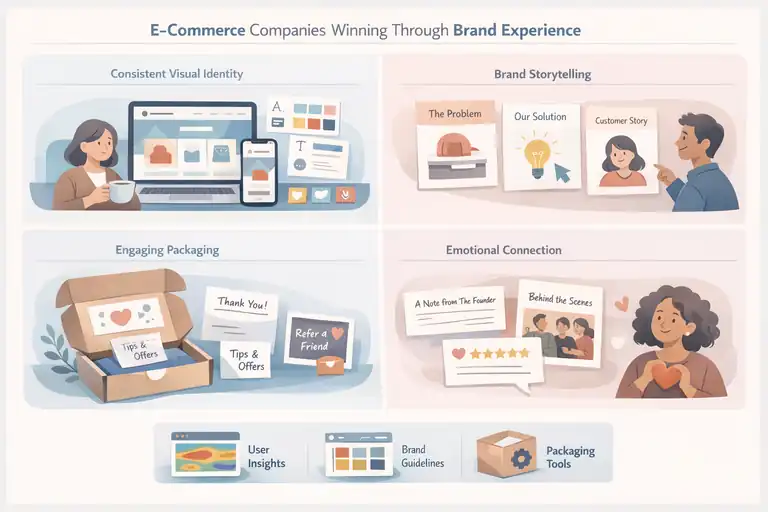
At scale, products get copied. Experience doesn’t. The e commerce companies that win long-term treat brand experience as a conversion system, not a design exercise.
Creating Consistent Visual Identity Across All Touchpoints
Consistency builds trust faster than cleverness. Your site, ads, emails, packaging, and social feeds should feel unmistakably connected.
Key elements to lock down:
- Color and typography discipline
- Photography style guidelines
- Tone of voice rules
I’ve seen conversion rates drop simply because ad creatives didn’t match landing pages. Familiarity reduces cognitive load, which matters when you’re asking for a credit card.
Turning Brand Storytelling Into Conversion Leverage
Good brand stories don’t live on the About page—they show up everywhere. Product pages, ads, and emails should reinforce why the product exists.
Effective storytelling often includes:
- The problem you noticed first
- Why existing solutions weren’t enough
- What you changed differently
This isn’t fluff. Brands that clearly communicate their “why” often see higher AOV and stronger retention because customers feel aligned, not just sold to.
Designing Packaging As A Retention And Referral Tool
Packaging is your only guaranteed physical touchpoint. Smart e commerce companies use it to:
- Reinforce brand values
- Educate customers post-purchase
- Encourage referrals or reorders
Simple inserts explaining usage or offering reorder incentives routinely lift second-purchase rates by 10–20%. That’s meaningful at scale.
Building Emotional Connection Beyond Product Features
Features win clicks. Emotion wins loyalty.
Ways brands build connection:
- Relatable language instead of corporate copy
- Founder notes or behind-the-scenes moments
- Customer stories framed as shared wins
When customers feel understood, price becomes less fragile.
Tools that strengthen brand experience
- Improve on-site experience with tools like Hotjar or Contentsquare
- Manage visual consistency using brand systems in Frontify
- Optimize packaging workflows with services like Packlane
E Commerce Companies Mastering Customer Acquisition Systems
The most resilient e commerce companies don’t rely on one channel. They build acquisition systems that survive algorithm changes and cost fluctuations.
Diversifying Traffic Sources To Reduce Platform Risk
If 70% of revenue comes from one platform, you don’t have a strategy—you have exposure.
Balanced acquisition usually includes:
- Paid media
- Organic search
- Email and SMS
- Partnerships or referrals
Brands with diversified traffic typically recover faster from CPM spikes and platform policy changes.
Scaling Paid Media With Clear Unit Economics
Paid ads only scale when math—not hope—drives decisions.
You need clarity on:
- Customer acquisition cost (CAC)
- Contribution margin
- Payback period
I suggest pausing spend anytime you can’t answer: How much can I afford to pay for this customer and still win?
Using Content And SEO To Lower Long-Term CAC
SEO isn’t fast, but it compounds. Content-led e commerce companies build libraries that answer buying questions, comparisons, and use cases.
Well-ranking content can:
- Reduce paid spend dependence
- Educate customers before they hit product pages
- Improve conversion quality
Over time, organic traffic often becomes the highest-margin channel.
Leveraging Influencers And Partnerships Strategically
The best partnerships aren’t about reach—they’re about relevance.
Look for:
- Creators who already use similar products
- Partners with overlapping audiences
- Long-term relationships over one-off posts
Micro-influencers frequently outperform large creators on ROAS because trust is higher.
Tools that support scalable acquisition
- Analyze channel performance with GA4 and attribution tools like Triple Whale
- Build SEO workflows using platforms like Ahrefs
- Manage influencer partnerships with tools like Modash
Pro tip: If you’re scaling, don’t ask “What should we add next?” Ask “What should we double down on?” That question alone has saved more e commerce companies than any growth hack ever will.
E Commerce Companies Optimizing Operations For Growth
Operational efficiency is where many e commerce companies quietly win or lose as they scale. Growth exposes every crack in fulfillment, inventory, and team workflows.
The brands that scale smoothly are rarely the flashiest—they’re the most disciplined behind the scenes.
Streamlining Fulfillment Without Sacrificing Speed
Fast shipping is no longer a differentiator. It’s table stakes. But speed without control kills margins.
What I’ve seen work in practice:
- Standardize pick-and-pack processes before volume spikes
- Use shipping zones strategically instead of defaulting to “fastest”
- Split inventory across locations only when data proves it’s needed
For example, moving from same-day to next-day fulfillment can cut labor costs by 10–15% with minimal impact on conversion, especially if expectations are clearly set. Customers care more about reliability than raw speed.
The key mindset shift is this: fulfillment is a system, not a promise. Once you treat it that way, optimization becomes measurable instead of emotional.
Inventory Planning That Supports Predictable Scaling
Inventory mistakes are expensive lessons. Too much stock locks cash. Too little kills momentum.
Strong e commerce companies plan inventory around:
- Sell-through rate, not gut feeling
- Lead times by supplier, not averages
- Seasonal demand patterns, not last month’s sales
A simple rule I often suggest is planning inventory in “weeks of cover” instead of units. When you know how many weeks your current stock supports at projected demand, decisions become calmer and more rational.
Brands that forecast inventory weekly instead of monthly tend to reduce stockouts by double-digit percentages.
Automating Internal Processes To Reduce Human Error
Manual processes don’t fail because people are careless. They fail because scale multiplies small mistakes.
Common automation wins:
- Auto-routing orders based on location
- Syncing inventory across sales channels
- Triggering internal alerts for anomalies
Even basic automation can reduce fulfillment errors by 30–40%. Less rework means fewer refunds, fewer support tickets, and happier teams.
Balancing In-House Teams And External Partners
Not everything should be outsourced. Not everything should be internal.
Healthy balance usually looks like:
- Core knowledge stays in-house
- Execution-heavy tasks get external support
- Clear ownership, regardless of who executes
If accountability is unclear, performance always slips. This is less about cost and more about clarity.
Operations optimization toolbox
- Fulfillment and logistics platforms: ShipBob, ShipHero
- Inventory planning software: Inventory Planner, Netstock
- Workflow automation tools: Zapier, Make
- Order and ops analytics: Daasity
E Commerce Companies Using Data To Guide Decisions
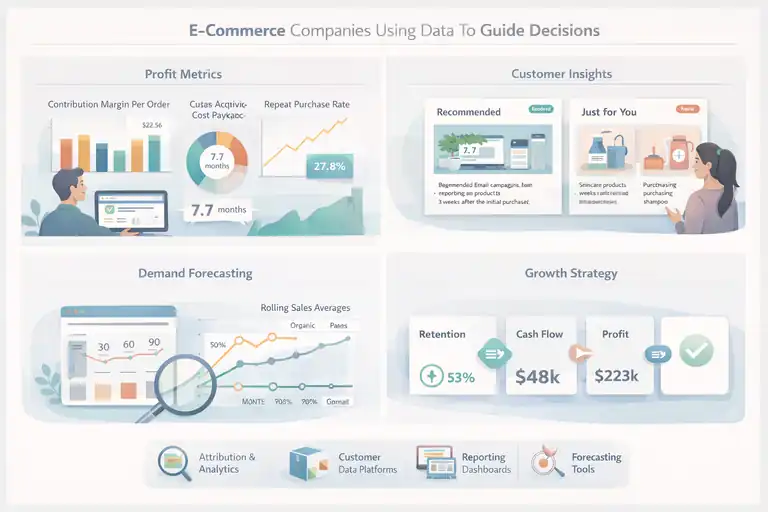
Data doesn’t make decisions for you. It simply removes excuses. The most effective e commerce companies don’t track more metrics—they track better ones.
Defining Metrics That Actually Reflect Business Health
Revenue hides problems. Profit exposes them.
Metrics that consistently matter:
- Contribution margin per order
- Customer acquisition cost payback
- Repeat purchase rate
I’ve seen brands growing 30% year over year while quietly bleeding cash because they never modeled unit economics properly. If a metric doesn’t change how you act, it’s noise.
Turning Customer Data Into Personalization Opportunities
Personalization sounds complex, but it often starts simple.
Practical examples:
- Segment emails by first product purchased
- Recommend replenishment based on usage cycles
- Adjust messaging based on entry channel
Even basic personalization can lift email revenue by 10–20%. You don’t need AI hype—just clean data and clear intent.
Forecasting Demand Using Historical Performance Signals
Demand forecasting isn’t about predicting the future perfectly. It’s about reducing surprises.
Effective signals include:
- Rolling 30/60/90-day sales averages
- Promo-driven demand spikes
- Channel-specific seasonality
Brands that forecast weekly catch issues early, while monthly forecasting often reacts too late.
Avoiding Vanity Metrics That Distort Growth Strategy
Likes, impressions, and traffic feel good. They rarely pay the bills.
If a metric doesn’t connect to:
- Profit
- Retention
- Cash flow
…it shouldn’t drive strategy. I’ve learned to ask one blunt question: What decision would I make differently if this number changed?
Data and analytics toolbox
- Attribution and analytics: GA4, Triple Whale
- Customer data platforms: Segment
- Reporting dashboards: Looker Studio
- Forecasting tools: Forecastly
E Commerce Companies Scaling Retention And Lifetime Value
Retention is where growth gets easier. The best e commerce companies don’t just acquire customers—they keep them coming back without friction.
Building Post-Purchase Journeys That Increase Loyalty
The sale isn’t the finish line. It’s the starting point.
High-impact post-purchase journeys include:
- Order education emails
- Usage tips timed to delivery
- Follow-ups that feel helpful, not salesy
Brands with structured post-purchase flows often see repeat purchase rates increase by 15–25%. That’s growth without increasing ad spend.
Subscription And Reorder Models That Stabilize Revenue
Subscriptions only work when they’re customer-first.
Successful models:
- Solve a real replenishment problem
- Offer flexible frequency controls
- Make skipping or pausing easy
Forced subscriptions create churn. Thoughtful ones create predictability for both sides.
Customer Support As A Revenue Protection Channel
Support isn’t a cost center. It’s insurance.
Strong support teams:
- Resolve issues fast
- Educate customers proactively
- Identify product or process gaps
Reducing friction here directly protects lifetime value. One saved customer is often worth more than a new one acquired through ads.
Community Building To Extend Customer Lifetime
Community doesn’t mean forums for everyone. Sometimes it’s as simple as:
- Exclusive email content
- Private social groups
- Early access to launches
When customers feel included, not targeted, loyalty deepens. That’s hard to copy and powerful at scale.
Retention and LTV toolbox
- Email and lifecycle platforms: Aweber, Mailerlite
- Subscription management: Recharge
- Customer support systems: Gorgias
- Community platforms: Circle
Best practice to leave you with: When growth feels heavy, look downstream. Improving retention, operations, or data clarity is often easier—and more profitable—than chasing the next acquisition channel.

I’m Juxhin, the voice behind The Justifiable.
I’ve spent 6+ years building blogs, managing affiliate campaigns, and testing the messy world of online business. Here, I cut the fluff and share the strategies that actually move the needle — so you can build income that’s sustainable, not speculative.
Related posts:
 Ecommerce Strategy Boost: 8 Simple Steps to Increase Profits
 Connective Ecommerce Explained: Build Without Inventory
 Social Commerce Strategies to Turn Engagement Into Sales
 Adobe Ecommerce vs Shopify: Which Platform Wins?
 Ecommerce Platform Comparison: Which One Fits Your Brand?
 Starting an Ecommerce Business: A Realistic Step-By-Step Guide