
Table of Contents
Some links on The Justifiable are affiliate links, meaning we may earn a small commission at no extra cost to you. Read full disclaimer.
Ecommerce SEO is one of those things that sounds straightforward until you realize rankings alone don’t pay the bills—buyers do.
I’m writing this for ecommerce founders, marketers, and store owners who are tired of seeing traffic without sales and want SEO that actually moves revenue.
The big question this answers is simple: how do you build an ecommerce SEO strategy that attracts people ready to buy, not just browse?
Buyer-First Ecommerce SEO Strategy Built To Drive Sales
Most ecommerce SEO strategies fail because they chase rankings instead of revenue. A buyer-first approach flips that mindset. Instead of asking “What can I rank for?”, I focus on “What would someone search right before pulling out a credit card?”
That shift alone changes which pages you optimize, which keywords you pursue, and how you measure success.
Mapping Ecommerce SEO To Real Buyer Intent Stages
Not every searcher is ready to buy, and pretending otherwise is where a lot of wasted effort comes from. I break ecommerce SEO into intent stages, not funnel buzzwords, just practical behavior patterns.
How I map intent in practice:
- Awareness: “what is,” “how to use,” “benefits of” searches
- Consideration: “best,” “reviews,” “alternatives,” “vs” searches
- Purchase-ready: product names, SKUs, “buy,” “price,” “free shipping”
Here’s the key insight: ecommerce SEO should heavily favor consideration and purchase-ready stages. Awareness content can help, but only if it supports those money pages.
From what I’ve seen, stores that shift even 20–30% of effort from top-of-funnel blog posts to buyer-intent pages often see faster revenue growth without more traffic.
Differentiating Informational Traffic From Revenue Traffic
Traffic feels good. Sales feel better. The two are not the same.
Informational traffic usually:
- Has low conversion rates (often under 0.5%)
- Bounces quickly
- Rarely visits product pages
Revenue traffic:
- Clicks through categories and products
- Uses filters and search
- Converts at 2–5% or higher in healthy stores
I suggest tagging keywords in your tracking tool (Ahrefs, Semrush, or even a spreadsheet) as either informational or commercial.
Then compare revenue per session in Google Analytics (GA4). This simple exercise often reveals that 70% of revenue comes from 30% of keywords.
That’s where ecommerce SEO should double down.
Prioritizing Product, Category, And Money Pages
If your product and category pages aren’t ranking, blog content won’t save you.
My priority order looks like this:
- Category pages targeting broad commercial terms
- High-margin product pages
- Supporting content that feeds internal links to those pages
Category pages are especially powerful because they match how buyers search. Someone typing “men’s running shoes” doesn’t want a blog post. They want options.
I’ve seen category pages optimized with 300–500 words of useful copy, clean internal links, and proper filters outperform dozens of blog posts combined.
Aligning Ecommerce SEO With Conversion Rate Optimization
SEO gets people in the door. Conversion rate optimization closes the sale. They should never be separate.
When I optimize a page, I look at:
- Page speed (every 1-second delay can drop conversions by ~7%)
- Mobile usability
- Clear value props above the fold
- Trust signals like reviews, shipping info, and returns
One small but effective tactic: answer buyer objections directly on SEO pages. Add sizing help, comparison charts, or “who this is for” sections. These don’t just help conversions, they often improve dwell time, which indirectly supports rankings.
High-Intent Keyword Research For Ecommerce SEO Growth
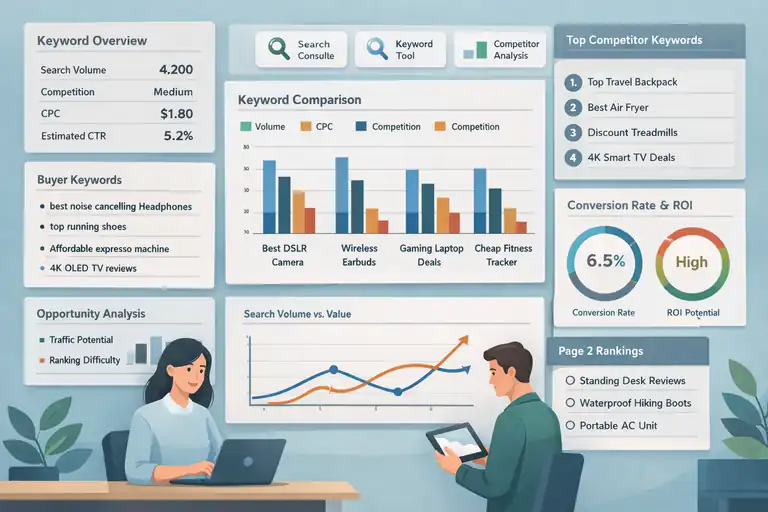
Keyword research is where ecommerce SEO either becomes a growth engine or a time sink.
The goal isn’t more keywords, it’s better ones. I’d rather rank for 50 terms that sell than 5,000 that don’t.
Finding Buyer Keywords With Clear Purchase Signals
Buyer keywords are easy to spot once you know what to look for.
Strong purchase signals include:
- Specific product names or models
- Category-level searches with intent (“wireless noise cancelling headphones”)
- Queries that imply comparison before buying
I usually start with Google Search Console to see what already drives impressions, then expand using keyword tools. Often, the fastest wins come from optimizing pages that are already ranking on page two.
In my experience, these keywords convert 3–10x higher than generic informational terms.
Using Commercial Modifiers That Indicate Readiness To Buy
Commercial modifiers are small words with big impact. They tell you exactly where the searcher’s head is.
Examples that consistently perform:
- “best”
- “top”
- “reviews”
- “price”
- “deal”
- “near me”
I like layering modifiers onto existing category keywords. For example, instead of just “standing desk,” test “best standing desk for home office.” These terms usually have lower volume but far higher revenue per visit.
That trade-off is almost always worth it.
Analyzing Competitor Keywords That Generate Sales
Competitors are your best keyword research shortcut.
Here’s how I do it:
- Identify 3–5 direct competitors ranking for products you sell
- Export their top organic pages, not just keywords
- Look for category and product URLs driving traffic
Pay attention to patterns. If multiple competitors rank for similar category structures or naming conventions, that’s usually demand proving itself.
I’ve uncovered entire revenue-driving categories this way that clients never thought to target.
Balancing Search Volume With Revenue Potential
High volume doesn’t equal high value. This is where ecommerce SEO requires judgment, not just tools.
I evaluate keywords using:
- Estimated conversion rate
- Average order value
- Product margin
- Ranking difficulty
A keyword with 500 monthly searches that converts at 4% can easily outperform one with 10,000 searches converting at 0.2%.
If I had to give one rule: always choose the keyword that would hurt more to lose if rankings dropped. That’s usually the one tied closest to revenue.
Product Page Ecommerce SEO That Converts Searchers
Product pages are where ecommerce SEO either proves its value or completely falls apart. This is the point where intent is highest, patience is lowest, and small details directly affect revenue.
Writing Product Titles That Win Clicks And Buyers
Product titles do far more than help rankings. They decide whether someone clicks, trusts you, and feels confident enough to keep scrolling.
I usually see two common mistakes here. The first is titles written only for search engines. The second is titles written only for branding. Ecommerce SEO works best when those meet in the middle.
A strong product title does three things clearly:
- States exactly what the product is
- Includes the primary buyer keyword naturally
- Adds one clarity or trust element
For example, instead of stuffing a title like “Ergonomic Office Chair Adjustable Lumbar Mesh Black,” I’d aim for something closer to how a real buyer thinks: “Ergonomic Office Chair With Adjustable Lumbar Support.”
You’ll notice the keyword is there, but it’s readable. Google has repeatedly said it rewrites titles when they feel spammy, and I’ve seen that happen often on ecommerce sites.
One practical shortcut I use is scanning top-ranking competitors and noting patterns. If five of them include size, material, or use-case in the title, that’s not a coincidence. It’s buyer intent showing up in SERPs.
Optimizing Product Descriptions For Humans And Search Engines
Product descriptions are where most ecommerce SEO efforts quietly fail. Not because people ignore them, but because they’re written like manufacturer spec sheets.
When I write or optimize descriptions, I focus on explanation before persuasion. A buyer needs to understand the product before they care how great it is.
Here’s how I structure descriptions that convert:
- A short opening explaining who the product is for
- A plain-language explanation of what problem it solves
- Scannable sections covering features, use cases, and FAQs
Search engines reward this because it creates depth. Buyers reward it because it reduces uncertainty.
From what I’ve seen, adding just 200–300 words of genuinely helpful content to a thin product page can lift organic conversions by 10–30%, especially for mid-priced items where buyers hesitate.
If you sell technical products, explain the terms immediately. Saying “IPX7 waterproof” is fine, but add a simple line like “meaning it can survive full water immersion.” That’s good ecommerce SEO and good sales copy at the same time.
Using Structured Data To Enhance Ecommerce SERP Visibility
Structured data sounds technical, but it’s one of the highest leverage ecommerce SEO tactics available.
In simple terms, structured data is code that helps Google understand what’s on your page. For product pages, this usually includes:
- Price
- Availability
- Reviews and ratings
When implemented correctly, this can trigger rich results, like star ratings, directly in search. Those stars matter. Studies consistently show rich results can increase click-through rates by 15–30% without changing rankings.
If you’re on Shopify or WooCommerce, most modern themes include basic structured data. I still recommend testing it using Google’s Rich Results Test to catch missing fields.
One thing I watch closely is accuracy. If your structured data shows “in stock” but the product isn’t, trust erodes fast. Ecommerce SEO isn’t just about visibility, it’s about consistency.
Avoiding Thin Content That Kills Ecommerce SEO Performance
Thin content doesn’t just underperform, it can drag your entire site down.
Product pages with:
- One sentence descriptions
- Duplicate manufacturer copy
- No unique value
tend to struggle long-term, especially after core updates.
I’ve worked on stores with thousands of products where rewriting everything wasn’t realistic. In those cases, I prioritize:
- Best sellers
- High-margin items
- Pages already ranking on page two
Improving even 50 key product pages can have an outsized impact. Thin content isn’t always about word count. It’s about usefulness. If your page answers the buyer’s real questions, ecommerce SEO usually follows.
Category Page Ecommerce SEO For Scalable Revenue
Category pages are the backbone of scalable ecommerce SEO. They capture broad buyer intent and funnel users toward multiple products without forcing a decision too early.
Structuring Category Pages For Search And Usability
A well-structured category page feels intuitive to users and readable to search engines. When either side struggles, performance drops.
I aim for three clear layers:
- A concise headline targeting the core keyword
- A short intro that sets expectations
- Product listings supported by filters
From an ecommerce SEO perspective, the headline and intro are critical. They tell Google what the page is about without overwhelming the shopper.
One small but effective trick is matching category naming to how people actually search. “Home Office Chairs” often outperforms “Office Seating Solutions” because it matches real language.
Clean URLs, logical breadcrumbs, and consistent hierarchy also make a difference. These elements help search engines understand how authority flows through your site.
Optimizing Category Content Without Hurting UX
This is where many store owners get nervous, and I get it. Nobody wants a wall of text above products.
The solution is balance.
I usually place 150–300 words of category content:
- Above products for highly competitive categories
- Below products for conversion-sensitive categories
The content should explain selection criteria, not pitch products. Think “how to choose” instead of “why we’re the best.”
In practice, this helps ecommerce SEO while quietly guiding buyers toward the right filters and products. When done right, bounce rates often drop because users feel oriented instead of overwhelmed.
Internal Linking Strategies That Boost Ecommerce SEO Authority
Internal linking is one of the most underrated ecommerce SEO levers.
Category pages should act as hubs. They pass authority to products and receive it from supporting content like buying guides.
A simple framework I use:
- Blog and guide content links into category pages
- Category pages link down to key products
- Products link back to their parent categories
This creates a loop that reinforces relevance. I’ve seen category pages jump from page two to page one without new backlinks, purely from better internal linking.
Anchor text matters too. Use descriptive phrases, not “click here.” This helps both users and search engines understand context.
Handling Faceted Navigation Without Indexing Problems
Faceted navigation helps users filter by size, color, price, or brand. It also creates SEO nightmares if unmanaged.
Every filter combination can generate a new URL. Left unchecked, this wastes crawl budget and creates duplicate content.
The approach I trust most is:
- Allow indexing for high-value filtered pages
- Block or noindex low-value combinations
- Keep internal links pointing to core categories
For example, “black running shoes” might deserve indexation. “Size 9 black running shoes under $120” probably doesn’t.
This balance protects ecommerce SEO performance while preserving a smooth shopping experience. It’s not glamorous work, but it prevents long-term damage that’s hard to undo.
Content-Led Ecommerce SEO That Attracts Ready Buyers
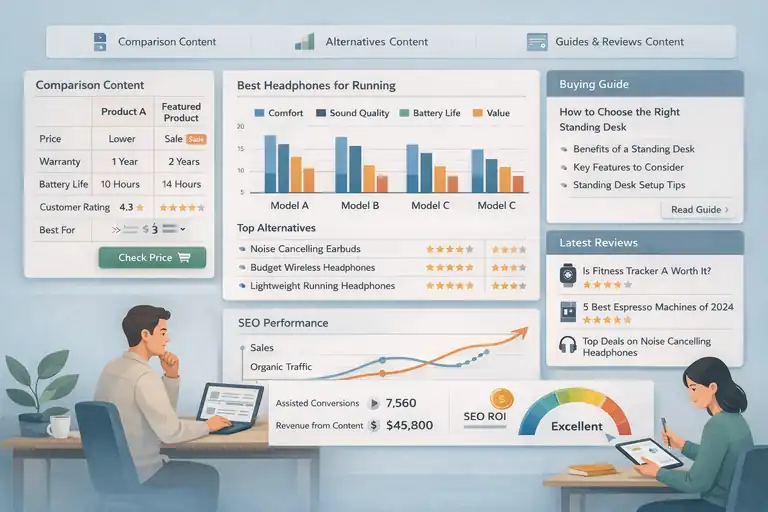
Content-led ecommerce SEO works when content stops acting like a traffic magnet and starts acting like a sales assistant. The goal here isn’t volume. It’s relevance, timing, and intent.
Creating Comparison And Alternatives Content For Purchase Intent
Comparison and alternatives pages are some of the highest-converting assets I’ve ever worked on. They catch buyers right before a decision, usually when trust and reassurance matter most.
These pages work because the intent is obvious. Someone searching “Brand A vs Brand B” or “Best alternatives to X” is already in buying mode. They’re just trying to avoid regret.
What I’ve seen work consistently:
- Be honest about weaknesses, including your own products
- Compare real features buyers care about, not marketing fluff
- Link directly to relevant product and category pages
A simple comparison table goes a long way here. For example:
| Feature | Product A | Your Product |
| Price | Lower upfront | Slightly higher |
| Warranty | 1 year | 3 years |
| Best for | Casual use | Daily, long-term use |
This type of content often converts at 2–4x the rate of standard blog posts. It also naturally supports ecommerce SEO because it attracts backlinks without chasing them.
Building Buying Guides That Support Product Pages
Buying guides should exist to make product pages convert better, not to live in isolation.
I like to think of them as pre-sales education. They answer questions product pages shouldn’t have to repeat in full.
Strong buying guides usually:
- Explain key features in plain language
- Help readers self-qualify (“Who this is for”)
- Link out to relevant categories and products
For example, a “How To Choose The Right Standing Desk” guide can internally link to size-specific or budget-based categories. That internal linking quietly boosts ecommerce SEO while guiding buyers forward.
From what I’ve seen, stores that connect guides tightly to categories often see assisted conversion rates jump by 15–25%. Even when the guide isn’t the final click, it plays a real role in the sale.
Targeting Bottom-Funnel Blog Topics That Convert
Not all blog content is top of funnel. Bottom-funnel topics exist, and they’re gold when done right.
Examples include:
- “Best X for Y use case”
- “Is X worth it?”
- “X reviews and buyer tips”
These topics work best when written by someone who clearly understands the product. Thin opinions won’t cut it here.
I usually include:
- Real usage scenarios
- Clear pros and cons
- Direct links to product pages
This kind of content often ranks slower but converts stronger. I’ve seen individual bottom-funnel posts drive consistent monthly revenue that beats entire content clusters built only for traffic.
Avoiding Traffic-Only Content That Never Drives Sales
Here’s a hard truth I’ve learned the long way: some content just isn’t worth publishing for ecommerce SEO.
Traffic-only content usually:
- Has vague informational intent
- Rarely leads to product views
- Looks good in reports but not in revenue
If a topic can’t logically link to a product or category, I question why it exists. That doesn’t mean educational content is bad. It just means it needs a clear path forward.
A simple test I use is asking: “What would I want to buy after reading this?” If there’s no clear answer, the content probably won’t support sales.
Technical Ecommerce SEO Foundations That Protect Revenue
Technical ecommerce SEO isn’t exciting, but it’s what keeps everything else from falling apart. When technical issues creep in, rankings slip quietly and revenue follows.
Managing Crawl Budget On Large Ecommerce Websites
Crawl budget is how much attention search engines give your site. On large ecommerce websites, wasting it is easy.
Common crawl budget drains include:
- Endless filter combinations
- Duplicate URLs
- Low-value search result pages
I usually start by checking crawl stats in Google Search Console. If Google is spending time crawling pages that will never rank or convert, that’s a problem.
One practical fix is tightening internal links so they point to priority categories and products. Another is blocking useless URLs via robots.txt or noindex tags. This helps search engines focus on pages that actually make money.
Fixing Indexation Issues That Block Product Visibility
Indexation issues are silent revenue killers.
I’ve seen cases where:
- Products weren’t indexed due to accidental noindex tags
- Canonical tags pointed to the wrong pages
- Pagination confused search engines
The fix starts with auditing. Tools like Screaming Frog or Sitebulb help surface problems fast, but the real work is deciding what deserves to be indexed.
My rule is simple: if a page targets buyer intent and offers unique value, it should be indexable. Everything else should get out of the way.
Improving Site Speed For Ecommerce SEO And Conversions
Site speed affects both rankings and sales. Google has confirmed this, and buyers feel it instantly.
Some benchmarks I aim for:
- Largest Contentful Paint under 2.5 seconds
- Mobile load times under 3 seconds
Easy wins often include:
- Compressing images
- Removing unused apps or scripts
- Using a lightweight theme
I once saw a store increase mobile conversions by 18% after cutting load time by just over a second. Ecommerce SEO brought the traffic. Speed made it profitable.
Preventing Duplicate Content Across Ecommerce Pages
Duplicate content is everywhere in ecommerce, usually by accident.
Common causes:
- Similar products with minor variations
- Filtered URLs indexed as separate pages
- Manufacturer descriptions reused everywhere
The solution isn’t deleting pages. It’s clarifying intent.
I rely on:
- Canonical tags to signal the main version
- Unique descriptions for priority products
- Noindex for low-value duplicates
Duplicate content rarely causes penalties, but it does dilute ranking signals. Cleaning it up helps search engines understand which pages deserve to rank and sell.
Measuring Ecommerce SEO Success Beyond Rankings
If ecommerce SEO is doing its job, rankings are just the side effect. What really matters is whether organic search is contributing to revenue in a predictable, scalable way.
Tracking Revenue And Assisted Conversions From SEO
This is where a lot of ecommerce teams get misled. They look only at last-click revenue and miss how SEO actually supports buying decisions.
In GA4 or similar analytics tools, I always look at assisted conversions. These show when organic search played a role earlier in the journey, even if it wasn’t the final touchpoint.
Here’s how I approach it in real life:
- Track organic revenue as both direct and assisted
- Compare conversion paths that include organic vs those that don’t
- Watch time-to-purchase for SEO users versus paid traffic
On several stores I’ve worked with, organic search influenced 40–60% of purchases even when it only “closed” 20–30%. That insight completely changes how much SEO is valued internally.
If you only measure last-click, you’ll almost always underfund ecommerce SEO.
Identifying Keywords That Drive Actual Sales
Not all ranking keywords deserve equal attention. Some look impressive in tools and quietly do nothing for the business.
What I care about instead:
- Keywords that lead to product views
- Keywords that appear in converting sessions
- Keywords tied to higher average order value
A practical shortcut is exporting landing pages from analytics, then mapping revenue back to the keywords those pages target. This often reveals that a handful of category and product terms drive most organic sales.
Once you know those keywords, you protect them fiercely. Those pages get priority for updates, internal links, and technical fixes. In ecommerce SEO, defense is just as important as growth.
Using Ecommerce Analytics To Refine SEO Strategy
Analytics should guide decisions, not just report results.
I regularly use data to answer questions like:
- Which SEO pages attract browsers vs buyers?
- Where do organic users drop off before purchasing?
- Which content assists conversions but doesn’t rank yet?
For example, if a buying guide has high engagement but low revenue, I’ll improve internal links to categories or add clearer next steps. If a category page ranks well but converts poorly, that’s a signal to adjust layout, filters, or trust signals.
Ecommerce SEO improves fastest when analytics and optimization talk to each other, not when they live in separate dashboards.
Knowing When Ecommerce SEO Is Hurting Profitability
This one’s uncomfortable, but important.
SEO can hurt profitability when:
- It attracts low-intent traffic that overloads support
- It ranks for keywords that don’t match your pricing or positioning
- It drives sales of low-margin products while ignoring high-margin ones
I’ve seen stores scale organic traffic aggressively, only to realize margins dropped because SEO skewed demand in the wrong direction.
If that happens, it’s not a failure. It’s feedback. Refine keyword targets, rebalance content, and refocus ecommerce SEO around profit per visit, not visits alone.
Scaling Ecommerce SEO Without Sacrificing Buyer Intent
Scaling ecommerce SEO is where many strategies break. Traffic grows, but quality drops. The challenge is expanding reach without inviting the wrong audience.
Expanding SEO While Maintaining Keyword Quality
When scaling, I don’t chase new keywords blindly. I extend proven patterns.
That usually means:
- Expanding winning categories into subcategories
- Creating variations around high-converting buyer terms
- Targeting adjacent use cases with similar intent
For example, if “standing desk for home office” converts well, expanding into “standing desk for small spaces” or “standing desk for programmers” often works without diluting intent.
This approach keeps ecommerce SEO grounded in buyer behavior instead of guesswork.
Automating Ecommerce SEO Tasks Without Losing Control
Automation can help, but it’s easy to overdo it.
I’m careful with:
- Auto-generated product descriptions
- Programmatic category pages
- Bulk internal linking tools
Automation works best for structure, not persuasion. I’ll automate things like metadata templates or internal link logic, then manually refine top pages that drive revenue.
If a page matters to sales, a human should review it. No exceptions. Ecommerce SEO scales best when automation supports humans, not replaces them.
Updating Existing Pages For Higher Conversion Potential
One of the highest ROI moves in ecommerce SEO is updating pages you already have.
I prioritize updates based on:
- Pages ranking positions 5–15
- Pages with traffic but low conversion rates
- Pages tied to seasonal demand
Often, small changes like clearer headlines, better internal links, or updated product info unlock growth faster than publishing something new.
From what I’ve seen, refreshing existing pages can outperform new content creation by 2–3x in terms of revenue impact.
Avoiding Growth Tactics That Attract The Wrong Audience
Some SEO tactics look scalable but quietly damage intent.
I’m cautious of:
- Broad “what is” content unrelated to products
- Viral-style posts with no buying path
- Over-optimizing for volume instead of fit
If growth tactics bring people who would never buy from you, that traffic becomes noise. Ecommerce SEO should feel like helpful guidance, not a crowd you have to manage.
When in doubt, I ask one simple question: “Would I want this person on my product page?” If the answer is no, I rethink the strategy.

I’m Juxhin, the voice behind The Justifiable.
I’ve spent 6+ years building blogs, managing affiliate campaigns, and testing the messy world of online business. Here, I cut the fluff and share the strategies that actually move the needle — so you can build income that’s sustainable, not speculative.
Related posts:
 Ecommerce Marketing Solutions That Multiply Your Sales
 Ecommerce Marketing Guide: Turn Traffic Into Sales
 SEO Checker: The Secret Weapon of Top 5% Webmasters
 Dropshipping Business Model Success: Tips for Long-Term Growth
 Ecommerce CRM Tools That Turn Customers Into Repeat Buyers
 Salehoo Products List That Helps You Find Winning Items Fast