
Table of Contents
Some links on The Justifiable are affiliate links, meaning we may earn a small commission at no extra cost to you. Read full disclaimer.
When I first got into the affiliate marketing world, no one really told me what it actually takes to make it work.
Everyone talks about “passive income” and “earning while you sleep,” but few mention the messy middle—the part where you test, fail, tweak, and slowly figure out what converts.
In this guide, I want to pull back the curtain and share the practical, overlooked truths about affiliate marketing that most people skip over.
Let’s get into the stuff that actually matters.
The Real Meaning Of Affiliate Marketing Success
Affiliate marketing often gets sold as a dream—make money while you sleep, set up a few links, and wait for the magic to happen. But let’s be honest—it’s not magic, it’s method.
Success in the affiliate marketing world depends more on understanding people than on chasing commissions.
Why Passive Income Isn’t Really Passive
There’s a huge misconception that once you post a few affiliate links, the money just rolls in. The truth? Passive income starts as active work. You’ll spend hours researching products, writing reviews, optimizing pages, and learning what actually converts.
Here’s how it really works:
- Setup phase: You build your website, choose your niche, and publish optimized content.
- Momentum phase: You start attracting organic traffic through SEO and social sharing.
- Maintenance phase: You monitor analytics, update old content, and test new offers.
So yes, income can become more passive later—but only after you’ve built systems that run without you constantly pushing. Think of it like planting a garden—you work hard upfront so it grows on its own later.
The Difference Between Promoting and Persuading
Many beginners in affiliate marketing promote products without really persuading anyone to buy them. They share links, but not stories. Persuasion is emotional; it’s about connecting your audience’s needs to the solution a product provides.
Here’s a simple example: Instead of saying “This hosting platform is great,” say “I switched to this hosting after my old one crashed twice in a week—it cut my page load time in half.” That’s persuasion because it’s personal, relatable, and proof-based.
Real persuasion doesn’t push; it invites people to trust your recommendation.
How Real Affiliates Build Trust Before Selling
Trust is the quiet foundation of affiliate success. Without it, no link will convert—no matter how clever your copy is.
Here’s what authentic affiliates do differently:
- Transparency: They disclose affiliate links clearly and explain why.
- Experience sharing: They test tools before recommending them.
- Consistency: They keep showing up with value-driven content, not just sales posts.
In my experience, readers are far more likely to click your affiliate link after they’ve learned from you multiple times. Trust isn’t built with a single post—it’s earned through consistent honesty and useful advice.
How To Choose Affiliate Programs That Actually Pay
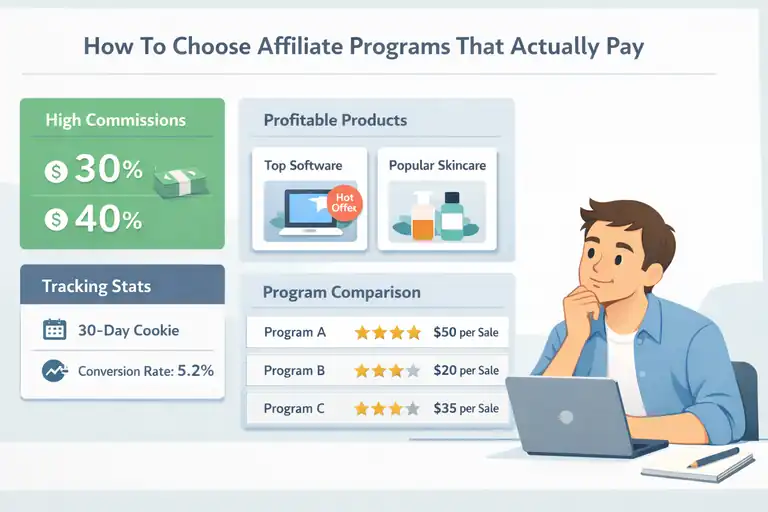
Not all affiliate programs are created equal. Some pay generously and support you with good tracking tools, while others underdeliver or disappear overnight.
Choosing the right partners is what separates hobby affiliates from full-time earners.
What Makes a Good Affiliate Program Profitable
A profitable affiliate program typically has three things:
- High commission structure: Anything between 20–50% is strong, especially for digital products.
- Reliable tracking: Look for programs offering 30+ day cookies and transparent dashboards.
- Strong product-market fit: If your audience loves what the product solves, sales come naturally.
It’s also smart to test multiple programs before committing to one. For instance, a SaaS affiliate program might outperform a physical product even if commissions look smaller upfront because renewals stack over time.
Why Awin Is the Top Network for Beginners and Experts
Awin is one of the most trusted affiliate networks today. It’s beginner-friendly yet powerful enough for experienced marketers.
Here’s why Awin works:
- Variety: Thousands of brands across niches like finance, fashion, and SaaS.
- Ease of use: You can manage all your affiliate programs from one dashboard.
- Reliable payouts: Awin is known for consistent, timely payments and detailed analytics.
From my experience, Awin simplifies the discovery process. You can easily compare programs, check EPC (earnings per click), and apply directly from one place—saving hours of manual searching.
Avoiding Low-Commission or Unreliable Programs
A major pitfall for new affiliates is chasing “quick-win” programs that look easy but pay pennies. If a product gives you a 3% commission and requires tons of traffic to make $100, it’s not worth your time.
Here’s how to avoid bad fits:
- Check brand reputation: Google “program name + reviews.”
- Confirm cookie duration: Anything less than 7 days is too short.
- Watch for payout thresholds: Some require $100+ before releasing earnings.
If it sounds too good to be true—like 90% commissions—it probably is. Reliable programs focus on long-term partnerships, not gimmicks.
Building A Website That Converts Without Feeling Salesy
Your website is your affiliate hub, but that doesn’t mean it has to scream “Buy now!” The best affiliate sites feel like genuine resources, not sales funnels.
Crafting Content That Sells Without “Selling”
Selling without sounding like a salesperson is an art—and it starts with empathy. Instead of pushing products, solve problems first. Every piece of content should aim to help your audience make an informed decision.
Try this content mix:
- How-to guides: Explain how to do something with the product.
- Comparisons: Offer objective pros and cons of different tools.
- Personal reviews: Share your honest experiences, including what didn’t work.
By being real, you automatically become more persuasive—and your links convert better.
Using Storytelling To Naturally Recommend Products
Storytelling is the heart of authentic affiliate marketing. People remember stories, not specs. A short anecdote can do more for conversion than a dozen feature lists.
Example: “I used to spend hours manually scheduling posts. Then I found Brevo’s automation tools—now it takes me 10 minutes.”
That’s not a pitch. It’s a relatable moment showing transformation. When readers see themselves in your story, the sale becomes effortless.
Optimizing Pages For Higher Click-Through and Conversions
Small tweaks can make a big difference. Focus on:
- Clear CTAs: Use buttons that say “Try It Here” or “See How It Works.”
- Readable layouts: Break text into short paragraphs.
- Strategic link placement: Insert affiliate links where intent is highest (after solving a pain point).
Use analytics tools to test what works—adjust button colors, placements, or link frequency until conversions climb.
The Secret To Creating Content That Converts
Even the best affiliate programs won’t perform if your content doesn’t pull readers in.
Great affiliate content feels educational, not promotional—it makes the buying decision feel like the reader’s idea.
How To Choose the Right Keywords for Affiliate Posts
Your keywords should match buyer intent. Phrases like “best,” “review,” or “vs.” show people are close to purchasing.
Try using tools like Ahrefs or Google Keyword Planner to find:
- “Best [product] for [use case]”
- “[Product] alternatives”
- “[Product] review”
Always create content that directly answers what people are searching for—and align it naturally with your affiliate offers.
Why Product Comparisons and Tutorials Convert Better
When readers compare two or more options, they’re at the final decision stage. That’s why comparison posts often convert better than generic blogs.
A good comparison includes:
- Side-by-side data: Pricing, features, trial options.
- Visuals: Screenshots or charts make choices clearer.
- Verdict section: Summarize who each product is best for.
Tutorials also perform well because they show, not tell. Walk users through the exact steps—like setting up a Kit automation or connecting Aweber to your landing page.
Balancing SEO Optimization With Authenticity
SEO helps people find your content, but authenticity makes them trust it. Never force keywords; let them flow naturally.
Here’s my rule of thumb:
- Write for humans first, then refine for Google.
- Use focus keywords in the intro, one H2, and a few subheads.
- Prioritize clarity over keyword count.
Google’s algorithm rewards helpful content—and so do readers.
Building and Growing an Audience That Trusts You
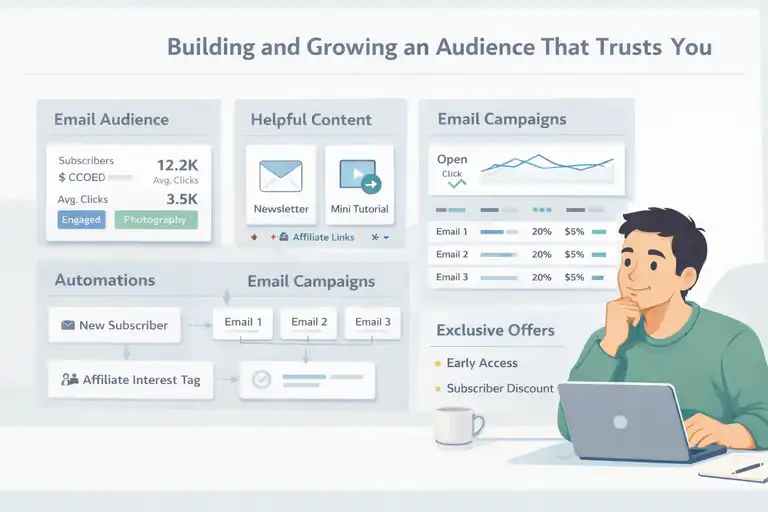
Affiliate marketing works best when you have a loyal audience that believes your recommendations.
That means engaging beyond one-time clicks—it’s about nurturing real relationships.
Why Email Marketing Is Still the Strongest Affiliate Channel
Despite social media trends, email still drives some of the highest affiliate conversions. Why? Because it’s personal and direct.
Here’s how you can use it:
- Send helpful newsletters, not just promo blasts.
- Share mini tutorials with affiliate links naturally embedded.
- Segment your list based on interests to increase relevance.
Email is where you can deepen trust, share behind-the-scenes insights, and offer exclusive deals your audience actually wants.
How To Use Kit for Automated Campaigns and Nurturing
Kit (previously ConvertKit) is built for creators and affiliate marketers. It helps you automate email sequences, manage subscribers, and track link clicks—all in one place.
Here’s a simple setup path: Dashboard → Automations → New Sequence → Add Tag for “Affiliate Interest.”
Once it’s live, Kit automatically sends personalized emails to subscribers who clicked your affiliate links—saving you hours each week while keeping your engagement authentic.
Engaging with Your Audience Through Brevo CRM
Brevo (formerly Sendinblue) is a CRM tool designed for communication and nurturing. You can send email campaigns, automate follow-ups, and track every customer interaction in one dashboard.
Practical use case:
- Tag users based on the affiliate product they clicked.
- Send follow-ups like “Did this tool help solve your problem?”
- Offer bonuses or tips related to the product to increase conversions.
It’s not just about pushing a link—it’s about staying connected after the click. That’s where long-term affiliate growth happens.
How To Track and Improve Your Affiliate Performance
Affiliate marketing isn’t just about creating content—it’s about knowing what works and what doesn’t. If you don’t track performance, you’re basically throwing darts in the dark.
Let’s talk about how to measure your progress and make smart adjustments that move the needle.
Essential Metrics That Tell You What’s Working
You can’t improve what you don’t measure. Here are a few numbers every affiliate marketer should monitor closely:
- Click-through rate (CTR): Shows how often people click your affiliate links. A low CTR might mean your call-to-action isn’t strong enough.
- Conversion rate: The percentage of people who buy after clicking your link. This reveals whether your content actually persuades.
- Earnings per click (EPC): Combines the two above and helps you compare which products perform best.
- Refund rate: High refund rates can signal a low-quality product or poor audience fit.
I suggest checking these metrics at least twice a month. It keeps you focused on what’s working instead of what feels exciting.
Tools Like VWO and Optimizely for A/B Testing Campaigns
If you want to know what truly converts, testing is your best friend. Platforms like VWO and Optimizely are made for that.
Here’s how I use them in practice:
- In VWO, I create a simple A/B test by going to Dashboard → Create → A/B Test.
- I test two versions of a call-to-action button—say “Get Started” versus “Try It Now.”
- After a week, I check which version gets more clicks.
Optimizely works similarly but gives you deeper analytics if you’re running larger campaigns. These small experiments can reveal massive insights—sometimes a simple headline tweak can double conversions.
If you’re just starting, even testing through your CMS (like WordPress plugins) can help. The goal isn’t perfection—it’s continuous improvement.
Using Analytics To Refine Your Strategy Over Time
Your analytics dashboard is basically a roadmap to better performance. Use it to understand where your audience is coming from and what they do once they land on your site.
Here’s how I approach it:
- Track top-performing pages: Which posts bring the most affiliate clicks?
- Identify drop-off points: Where do readers leave before clicking a link?
- Adjust content strategy: Double down on high-performing topics and optimize underperforming ones.
For instance, if Google Analytics shows your “best hosting providers” article gets steady traffic but low conversions, try adding a comparison table or a stronger CTA. Over time, these data-driven refinements compound your results.
The Mindset Shifts No One Talks About
Affiliate marketing success isn’t just about strategies—it’s about mindset.
You’ll face rejection, plateaus, and algorithm changes. How you think determines whether you last long enough to win.
Learning To Think Like a Problem Solver, Not a Seller
The best affiliates aren’t pushing products—they’re solving problems. When someone searches “best budgeting app,” they’re not looking for an app—they’re looking for control over their money.
That’s where problem-solving comes in. Start with empathy. Ask yourself:
- What’s my audience struggling with?
- How can this product make their life easier?
When you focus on solving instead of selling, your recommendations feel natural, not forced. The shift seems small, but it changes everything—from your tone to your conversions.
Why Patience and Consistency Matter More Than Talent
I’ve seen people give up three months in because they didn’t see results. The truth is, affiliate marketing is like planting seeds—you water them for a while before anything grows.
Data shows that most affiliates don’t earn significant income until after 6–12 months of consistent effort. So if you’re early in the journey, remind yourself: this is normal.
Consistency compounds. Publishing one solid piece a week for a year will outperform someone who posts 10 pieces in a month and burns out.
How To Overcome Affiliate Burnout and Stay Motivated
It’s easy to lose motivation when results are slow. What’s helped me most is reconnecting with why I started—freedom, flexibility, and creating something on my own terms.
Try these quick resets:
- Take one weekend off content entirely—no metrics, no writing.
- Revisit your early wins to remind yourself of progress.
- Join a small creator or affiliate community. Shared struggles feel lighter when others get it.
Burnout usually means you’re pushing too hard without seeing the big picture. Step back, breathe, and come back with fresh energy.
Pro Tips To Scale Your Affiliate Income
Once your foundation is solid, scaling your affiliate marketing becomes about working smarter—not just harder. Here’s how to expand your income streams without losing your authenticity.
Diversifying Your Affiliate Revenue Streams
Putting all your eggs in one program is risky. A single platform change could cut your income in half overnight. Instead, aim to diversify:
- Promote products across different niches (e.g., SaaS, finance, and lifestyle).
- Mix one-time commissions with recurring ones (like SaaS subscriptions).
- Add affiliate links to your email sequences, YouTube descriptions, and social bios.
Diversification creates income stability—and it opens you up to surprising new audiences.
Leveraging YouTube, TikTok, and Social Content
Short-form content is one of the fastest ways to build trust and drive affiliate sales. Platforms like YouTube Shorts and TikTok reward authenticity, not polish.
Example: Create quick 30-second clips explaining how a tool helped you. For instance, “Here’s how I use Brevo to automate client follow-ups.” Then drop your affiliate link in the video description or pinned comment.
It’s casual, it’s personal, and it converts because it feels human. You’re not selling—you’re sharing.
Collaborating With Brands For Exclusive Deals
Once you’ve built some traction, brands may start reaching out—or you can pitch them directly. Ask for exclusive bonuses or higher commission rates for your audience.
I’ve done this by simply emailing affiliate managers and saying, “Hey, I’ve been promoting your tool for six months. Would you be open to a custom coupon for my readers?”
Brands love affiliates who bring consistent traffic. Sometimes, even a small negotiation can raise your commission by 5–10%, which adds up quickly.
Common Affiliate Marketing Mistakes To Avoid
Affiliate marketing has its share of traps—some harmless, others costly. Knowing what to avoid will save you frustration and wasted time.
Promoting Too Many Products at Once
It’s tempting to join every program that looks good. But promoting too many products dilutes your message. Your audience can’t tell what’s genuinely worth their attention.
Pick a handful of core products that align perfectly with your niche. Once those perform, add others gradually. It’s better to be known for five trustworthy recommendations than fifty random ones.
Ignoring Compliance and FTC Disclosure Rules
This is a big one. The Federal Trade Commission (FTC) requires affiliates to disclose that they earn commissions. Hiding that fact can get you flagged—or worse, fined.
A simple line like “I may earn a commission if you buy through my link, at no extra cost to you” keeps you compliant and builds transparency. Readers appreciate honesty—it strengthens trust, not weakens it.
Copying Content Instead of Creating Value
Copying someone else’s review or rewriting popular posts might seem like a shortcut, but it backfires. Google’s algorithm detects duplicate content easily, and audiences sense it too.
Instead, bring your own experience into every post. Talk about how you used the product, what worked, and what didn’t. That’s what makes your content irreplaceable—and truly valuable.
Turning Affiliate Marketing Into a Long-Term Business
The real win in affiliate marketing isn’t a few commissions—it’s creating a system that keeps earning for years.
Let’s explore how to make that happen.
Building Brand Authority That Outlasts Trends
Authority is what keeps your site relevant even when trends fade. You build it by showing expertise, consistency, and care for your readers.
For example: Create in-depth tutorials, publish original data, and engage in your niche community. Over time, Google and your audience both start seeing you as a reliable voice—which makes every new post rank faster and convert better.
Creating Evergreen Content That Continues To Earn
Evergreen content keeps performing long after you hit publish. Think of timeless topics like “How To Start Affiliate Marketing for Beginners” or “Best Tools To Automate Affiliate Links.”
To keep content fresh:
- Update old posts every few months.
- Replace outdated screenshots or product details.
- Add internal links to newer guides.
Evergreen posts become your income backbone—they’re steady, reliable, and require less maintenance over time.
Reinvesting Profits Into Growth and Automation
When money starts coming in, resist the urge to cash it all out. Instead, reinvest strategically.
Here’s where I recommend putting your profits:
- Email tools like Kit for automation and segmentation.
- Analytics or SEO software for deeper insights.
- Freelancers or content writers to help you scale faster.
Automation frees up your time so you can focus on strategy, not daily grunt work. That’s how affiliate marketing evolves from a side hustle into a real business.
Pro Tip: The affiliates who win long-term aren’t the ones who chase quick profits—they’re the ones who build trust, stay consistent, and play the long game with care and purpose.
FAQ
What is the affiliate marketing and how does it work?
The affiliate marketing is a performance-based strategy where you earn commissions by promoting other companies’ products or services. You share special links, and when someone buys through your link, you get paid.
How do beginners start with the affiliate marketing?
Beginners can start by choosing a niche, joining reputable affiliate programs like Awin, and creating helpful content that naturally includes affiliate links. Consistency and trust-building are key.
What makes the affiliate marketing profitable long-term?
Affiliate marketing becomes profitable when you focus on quality content, audience trust, and promoting high-commission, recurring products. Tracking results and refining your strategy ensures steady growth.

I’m Juxhin, the voice behind The Justifiable.
I’ve spent 6+ years building blogs, managing affiliate campaigns, and testing the messy world of online business. Here, I cut the fluff and share the strategies that actually move the needle — so you can build income that’s sustainable, not speculative.
Related posts:
 How to Become a Better Affiliate Marketer
 What No One Tells You About Affiliate Marketing
 10 Digital Marketing Affiliate Marketing Hacks That Work
 How to Find Affiliate Marketing Offers That Actually Convert
 15 Best Affiliate Programs to Make Money Fast
 How to Become an Affiliate Marketer and Earn Online