
Table of Contents
Some links on The Justifiable are affiliate links, meaning we may earn a small commission at no extra cost to you. Read full disclaimer.
Finding winning products dropshipping stores love isn’t about luck—it’s about data, timing, and smart observation.
Every top-performing store has that one product that drives sales and makes their brand stand out. But how do you uncover those hidden gems before everyone else jumps on the trend?
In this guide, you’ll learn how to spot, analyze, and validate winning dropshipping products that actually sell, using proven strategies and real tools trusted by successful store owners.
Understanding What Makes a Product a “Winner”
Before you can find winning products dropshipping stores love, you need to understand what makes a product win in the first place.
A winning product isn’t random—it’s a balance of demand, emotional appeal, and profit margin.
Identifying Key Traits of High-Converting Products
High-converting products share a few repeatable characteristics that make them irresistible.
- Solves a specific problem: Winning products often make life easier or fix an annoyance. Think of a posture corrector or a cable organizer—simple, useful, and easy to explain in one sentence.
- Has a clear “wow” factor: This is that instant visual or emotional reaction when someone first sees the ad. If you’ve ever stopped scrolling because a gadget looked too cool not to click, that’s the wow factor in action.
- Lightweight and easy to ship: Avoid bulky items that raise shipping costs. Products under 2 lbs usually perform best.
- High perceived value: I usually look for products that feel premium but cost little to source. For example, LED skincare masks can retail for $50+ but cost around $10 to import.
I suggest testing each potential product with a simple checklist: Is it useful, visually engaging, and easy to advertise? If the answer is yes to at least two, it’s worth exploring further.
Why Emotional Triggers Drive Buying Decisions
Winning dropshipping products connect emotionally before they convince logically. People buy based on how something makes them feel.
Let me give you an example: A self-cleaning water bottle doesn’t just sell because it’s convenient—it sells because it makes buyers feel clean, smart, and health-conscious. That’s emotional alignment.
Here’s how emotional triggers work in dropshipping:
- Fear of missing out (FOMO): “Limited stock available!” creates urgency.
- Desire for comfort or status: Products that promise luxury, convenience, or social validation tend to outperform practical ones.
- Curiosity and novelty: New, unique products (like magnetic charging cables or reusable lint rollers) perform well because they surprise people.
When crafting ad copy or selecting images, focus less on what the product does and more on how it makes the buyer feel.
The Role of Market Demand and Product Uniqueness
Even the best-looking product can flop if there’s no market demand. I usually start by checking product demand through:
- Google Trends: Type in the product keyword and track interest over the past 12 months. Look for steady growth, not random spikes.
- TikTok and Instagram: Search hashtags like #TikTokMadeMeBuyIt to find trending items.
Uniqueness also matters. You don’t have to reinvent the wheel—but your offer needs a fresh spin. Try bundling (e.g., a dog grooming brush plus a free pet shampoo sample) or changing the color, packaging, or marketing angle to stand out.
Evaluating Price Points for Profit and Perceived Value
A winning product must balance profit margin and customer psychology. I recommend using the 3x rule: price your product at three times your sourcing cost.
Here’s how it breaks down:
- Product cost: $10
- Selling price: $29.99
- Profit after shipping/ads: roughly $8–10
Also, test different price points. For example, I once tested a $24.99 LED desk light and found that at $27.99, the conversion rate stayed the same—but profit increased by 12%. Small pricing tweaks can lead to meaningful results.
Analyzing Competitor Dropshipping Stores for Product Ideas
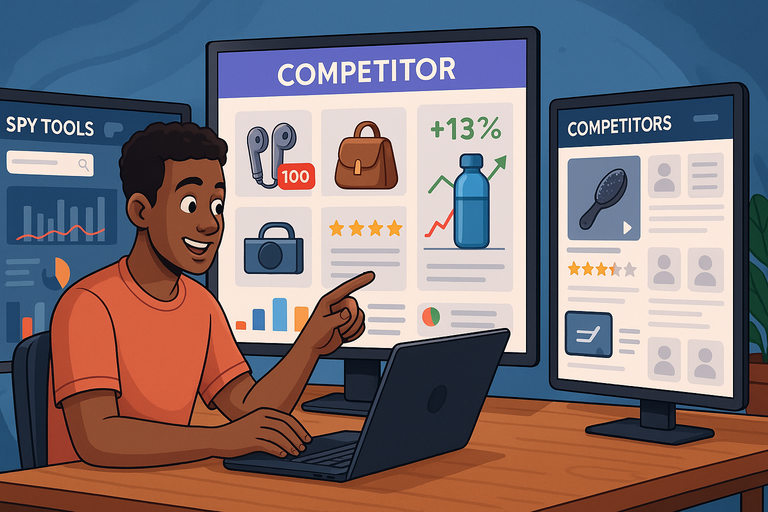
Once you understand what makes a product a winner, the next step is to study your competition.
Most successful dropshippers didn’t invent their products—they found them by observing what already works.
Using Spy Tools to Track Bestselling Items
Spy tools are your digital binoculars into what’s selling right now. Tools like Minea, AdSpy, and Dropship.io show which ads and products are performing well across multiple stores.
For instance:
- On Minea, you can filter ads by engagement level or country to spot trending products.
- Dropship.io lets you view estimated monthly revenue for Shopify stores—perfect for identifying proven winners.
The trick is to look for patterns. If several stores are pushing the same type of product with growing engagement, that’s a strong signal of profitability.
How to Reverse Engineer Store Catalogs for Insights
Reverse engineering means breaking down a successful store to understand what’s working behind the scenes.
Here’s a quick path:
- Visit the store’s homepage and add “/collections/all” to the URL (e.g., store-name.com/collections/all).
- Sort products by bestselling if possible.
- Check recurring themes—product types, niches, ad copy styles, and bundle offers.
I often use the Chrome extension Koala Inspector to reveal hidden data, like top-selling products or installed apps. This helps uncover marketing strategies like upsells or social proof plugins.
Spotting Gaps in Competitor Product Offerings
Finding gaps is about seeing what others aren’t selling. For instance, if multiple pet stores sell grooming brushes, but none sell matching nail clippers, you’ve found an opening.
Ask yourself:
- Can I offer better shipping or packaging?
- Is there a related accessory that competitors missed?
- Could I create a unique bundle or variant (e.g., new color or size)?
Often, small tweaks like these lead to differentiation without reinventing the product.
Evaluating Competitor Product Presentation and Marketing
Competitors give away more than they realize through their visuals and ads.
Pay attention to:
- Product photos: Are they lifestyle-based or plain? Lifestyle photos generally convert better.
- Ad angles: Do they focus on convenience, appearance, or results?
- Reviews: What are buyers complaining about? Every negative review is a product improvement idea.
I suggest keeping a competitor swipe file—a simple Google Sheet where you list product ideas, ad links, and notes about what’s working. It’ll become your personal idea goldmine over time.
Leveraging Product Research Tools to Find Winners
Product research tools can save hours of guessing. They analyze real data from stores, social media, and suppliers to pinpoint what’s trending now.
How to Use Ecomhunt for Trending Product Insights
Ecomhunt curates and updates trending dropshipping products daily, showing estimated profits and engagement.
To get started:
- Log into Ecomhunt and sort products by Most Popular or Newest.
- Click any product to view analytics like selling price, cost, profit margin, and competitor store links.
- Use the “Facebook Ad” tab to study live ad examples and engagement.
I like using Ecomhunt for validation—it’s great for confirming whether a product idea already has traction.
Discovering New Niches Through Niche Scraper
Niche Scraper combines data from Shopify and AliExpress to uncover new niche opportunities.
Here’s my favorite workflow:
- Use the Handpicked section to see curated winning products.
- Check the Shopify Scraper to spy on trending stores and extract product data.
- Use the AliExpress Scraper to track rising products with low order counts (early trends).
For example, I once spotted a baby head protection pillow there before it went viral—weeks before other platforms picked it up.
Using Dropship Spy for Real-Time Product Data
Dropship Spy gives product data like engagement trends, supplier links, and influencer marketing examples.
Why it stands out:
- Provides a “Winning Score” based on ad reach, reviews, and competition.
- Shows real engagement charts from Facebook and Instagram.
- Includes influencer contact data for direct outreach.
I recommend using Dropship Spy for fast decision-making—it helps cut through guesswork when shortlisting products.
Exploring AliShark and PPSpy for Data-Driven Product Discovery
AliShark tracks millions of AliExpress orders in real time, showing which products are spiking in sales.
To use it effectively:
- Filter by Order Growth Rate or Last 7 Days to spot surging items.
- Check Country Distribution to see where demand is strongest.
PPSpy works similarly but focuses on analyzing Shopify store performance. It helps uncover which stores are selling certain products—and how much they’re making.
Together, these two tools give a 360° view of what’s actually selling versus what’s just trending.
Expert Tip: Combine these tools rather than relying on one. Use Ecomhunt for trend discovery, Niche Scraper for early opportunities, and AliShark for data confirmation. That three-step combo is one of the fastest ways to identify genuine winning products dropshipping stores love.
Validating Winning Products Before Launch
Once you’ve found potential winning products for dropshipping, it’s time to validate them before investing in ads or inventory. Validation ensures your product has real demand, trustworthy suppliers, and strong profit margins.
I always treat this stage like a filter — the goal is to confirm your product can sell repeatedly, not just once.
Testing Market Demand with Search Trends and Social Proof
The first step in validation is checking if people are already looking for your product. I usually rely on Google Trends, TikTok, and AliExpress order data to measure interest.
Here’s how to test demand quickly:
- Use Google Trends: Type your product keyword (e.g., “wireless LED lamp”) and select the last 12 months. A consistent upward or steady line shows stable demand. Spikes followed by sharp drops often mean short-lived fads.
- Check TikTok and Instagram: Search hashtags like #tiktokmademebuyit or #productreview. If you find organic videos with high engagement, that’s strong social proof.
- Look at AliExpress orders: Filter by Orders (descending) to see if your product consistently sells across multiple suppliers — not just one viral listing.
I suggest avoiding products that have zero trend data or sudden one-week spikes. A sustainable product usually grows gradually across several platforms.
Using Facebook Ads Library to Check Product Performance
The Facebook Ads Library is a goldmine for verifying real-world product performance. It shows live ads, creative strategies, and how long a campaign has been running.
To use it effectively:
- Visit Facebook Ads Library and enter keywords related to your product.
- Look for ads that have been active for 30 days or longer — longevity means the advertiser is likely making money.
- Observe patterns: Are multiple stores running ads for similar products? What ad angles (problem-solving, emotional, or novelty) do they use?
For example, when I validated a portable blender, I found dozens of ads running for over two months. That confirmed strong demand, so I moved forward with testing.
A quick rule: If you can’t find at least three ongoing ads for a similar product, it might not have proven market traction yet.
Assessing Supplier Reliability and Shipping Speed
Many dropshippers lose customers because of poor supplier choices, not product quality. Before launch, I recommend running a mini quality audit of your top 3 suppliers.
Check the following:
- Ratings and reviews: Stick with suppliers rated 4.7 stars or higher.
- Order volume: A supplier with at least 1,000 fulfilled orders signals consistency.
- Communication: Message the supplier directly. Ask specific questions about shipping time, replacement policy, and packaging. Reliable ones reply fast and clearly.
- Test order: Always order one unit yourself. Track how long it takes to arrive and inspect packaging and quality.
Platforms like AliExpress, CJ Dropshipping, or Zendrop now display estimated delivery times and fulfillment centers — use these metrics to minimize delays.
Estimating Profit Margins and Hidden Costs
Before committing, calculate your true profit — not just the difference between price and cost. Hidden costs often erode what looks like a “winning” product.
Here’s a quick margin checklist:
- Product Cost: What you pay your supplier per unit.
- Shipping Fees: Often $2–$8 depending on region.
- Ad Spend per Sale: Average cost to acquire a customer (typically 25–35% of price).
- Platform Fees: Shopify, PayPal, and transaction fees (~3–5%).
For example, if your LED lamp costs $10, shipping is $3, and you sell it for $29.99, your gross profit is $16.99. After ads and fees, your net profit might be $6–8.
I recommend using the 3x markup rule: Price your product at least three times your sourcing cost. It creates enough buffer for ad testing and seasonal discounts.
Finding Winning Products Through Social Media Trends

Social media platforms, especially TikTok and Instagram, have become the fastest ways to identify trending dropshipping products.
I’ve seen products go from unknown to viral overnight because of one well-timed post. The trick is to spot trends before they explode.
Spotting Viral Products on TikTok and Instagram Reels
Viral products usually follow a simple pattern: visual appeal, short demonstration, and a clear emotional reaction.
Here’s how I find them:
- Go to TikTok and type “Amazon finds,” “TikTok made me buy it,” or a niche keyword like “pet gadgets.”
- Filter by Most Liked or Most Shared.
- Watch for products repeatedly appearing across different creators — that repetition signals momentum.
For instance, the mini portable printer trend started with a few TikTok videos showing students using it for journaling. Within weeks, it became a top seller on AliExpress.
Use the “Save” feature on TikTok to bookmark viral clips and track recurring products weekly.
Using Hashtags to Identify Emerging Product Categories
Hashtags act like trend beacons. I recommend following 5–10 niche hashtags that align with your store. Examples:
- #tiktokmademebuyit
- #coolgadgets
- #homehacks
- #beautytools
- #petlovers
Once you see the same item appear under multiple hashtags, that’s an early signal of potential. I suggest checking engagement — at least 10k+ likes on multiple posts usually points to growing interest.
To validate, cross-check the product’s search data on Google Trends. If both social and search activity are rising, you’ve likely spotted a winner.
Tracking Influencer Collaborations to Predict Product Success
Influencers often act as unofficial product testers for what’s about to go viral. By watching who they partner with, you can anticipate the next big dropshipping trend.
Here’s a simple system I use:
- Follow mid-tier influencers (10k–100k followers) in your target niche.
- Watch their sponsored posts and tagged products.
- Use a free tool like Collabstr or HypeAuditor to see engagement rates.
If you notice multiple influencers promoting a similar item within weeks, it’s usually part of a coordinated brand push — meaning strong ad budgets and expected returns. That’s when I jump in early.
Evaluating Social Engagement Metrics for Proof of Demand
Numbers never lie. If people are watching, liking, and sharing, demand exists. Focus on engagement-to-view ratios:
- A 10%+ engagement rate (likes/comments vs. views) suggests strong audience interest.
- High comment sections with phrases like “Where can I buy this?” or “I need this!” are prime indicators of buying intent.
I believe this qualitative data often predicts success better than spreadsheets. Social platforms reveal emotional energy — the heartbeat of every winning product.
Discovering Untapped Products on Marketplaces
While social media shows what’s trending, marketplaces like AliExpress, Amazon, and Etsy reveal what’s converting.
I use them to find evergreen and rising-star products with proven transaction data.
Mining AliExpress for Rising Star Products
AliExpress remains the go-to for early-stage product discovery. You can spot upcoming winners before competitors notice.
Here’s my approach:
- Filter products by Orders but focus on those with 500–5,000 orders — they’re trending but not saturated.
- Sort by Newest Arrivals and look for fast-rising order counts within weeks.
- Check customer reviews and photos to verify real satisfaction.
A quick example: The magnetic charging cable was visible on AliExpress months before it became a mainstream item. By monitoring order velocity, I caught it early.
Using Amazon Best Sellers to Predict Future Dropshipping Trends
Amazon is a live reflection of what consumers are buying daily. Visit Amazon Best Sellers and browse categories like Home & Kitchen, Health & Personal Care, and Toys & Games.
Look for:
- Products ranked between #50–#200 — popular but not dominated by big brands.
- Items with consistent 4.5+ star ratings and high review counts.
- Features or angles that could translate well to social ads.
For instance, when “LED strip lights” entered the top 100 in 2020, dropshippers who acted early made thousands before saturation hit.
Exploring Etsy for Unique, High-Perceived Value Items
Etsy is full of handcrafted, aesthetic products that appeal to emotional buyers. I often browse Etsy for inspiration when I want to find premium-feeling dropshipping ideas.
Look for:
- Personalized items (engraved jewelry, custom mugs, etc.).
- Home décor or fashion accessories with strong visual appeal.
- Products with fewer than 5,000 reviews — unique but proven.
These types of products are perfect for dropshippers who want to escape price wars. You can often find similar items from suppliers on Alibaba or 1688 and position them as artisanal-inspired.
Identifying Seasonal and Evergreen Product Opportunities
Timing can make or break a product. Seasonal products (like Halloween lights or Christmas sweaters) can bring fast profits, while evergreen products (like posture correctors or pet beds) sustain your store year-round.
Here’s how I classify them:
- Seasonal: Strong demand spikes around holidays. Great for quick cash flow.
- Evergreen: Stable search volume throughout the year. Ideal for long-term growth.
I recommend mixing both in your catalog. For example, one of my stores sold evergreen LED lamps but switched to holiday-themed variants each quarter. That approach maintained revenue consistency while keeping the product line fresh.
Pro Insight: Combine marketplace data with social trend signals. If you spot an AliExpress product that’s also starting to trend on TikTok, that overlap is your green light to test immediately. Most of my winning products came from that exact intersection — data meets culture.
Using Data Analytics to Refine Your Product Selection
Once you’ve tested a few products, the next step is to use data analytics to refine your winning product choices.
I like to think of this stage as the “truth check.” Instead of guessing what’s working, you let numbers guide your next move.
How to Analyze Product Performance Metrics
When analyzing product performance, focus on key actionable metrics — the numbers that tell you whether to scale, tweak, or cut a product.
Here are the main ones I rely on:
- CTR (Click-Through Rate): Measures how many people click your ad or product listing. A rate above 2% usually means your creative is catching attention.
- CPC (Cost Per Click): The amount you pay for each click. If your CTR is good but CPC is high, try adjusting your targeting or ad creative.
- ROAS (Return on Ad Spend): This shows how much revenue you earn per dollar spent on ads. A ROAS above 2.5x is a good early sign.
- Add-to-Cart vs. Purchase Ratio: If lots of people add your product to cart but don’t check out, your pricing, shipping, or trust elements may need improvement.
I usually track these inside the Meta Ads Manager or Shopify Analytics dashboard. The data never lies — it highlights whether your audience truly wants what you’re selling.
Tracking Conversion Rates and Customer Behavior
Understanding how users behave on your site is just as important as knowing how many buy.
Tools like Hotjar and Microsoft Clarity record visitor sessions, showing exactly where people click, scroll, or drop off. I remember one client whose sales jumped 18% after we saw users leaving on the shipping page — we simply added clearer delivery time info, and it fixed the issue.
Here’s what I suggest tracking:
- Conversion rate (target at least 2–3%)
- Average session duration (above 1 minute is healthy)
- Cart abandonment rate (should stay below 70%)
By connecting behavior to outcomes, you’ll know which parts of your funnel need refinement — no more blind optimization.
Using Google Trends and Keyword Tools to Forecast Demand
Data forecasting helps you anticipate what customers will want next.
Start with Google Trends:
- Type your niche keyword (for example, “wireless home gadgets”).
- Filter by the past 12 months and specific regions.
- Look for consistent growth or seasonal spikes.
Then, use keyword tools like Ubersuggest, Ahrefs, or Google Keyword Planner to check monthly search volume and competition.
If searches for your product keyword are increasing but competition remains moderate, that’s your cue to move early. I’ve caught several rising winners — like the “automatic hair curler” — by spotting search growth 4–6 weeks before they went viral.
Building a Product Testing Funnel for Ongoing Optimization
A structured testing funnel helps you continuously validate and refine products.
I use a simple three-phase system:
- Test Phase (Validation): Run low-budget ads ($20–$50 daily) for 3–5 days to gauge CTR, engagement, and interest.
- Optimize Phase (Conversion): If results look promising, tweak ad creatives, landing pages, and price points.
- Scale Phase (Growth): Gradually increase ad spend once you achieve profitable ROAS.
Use analytics tools like Triple Whale or Shopify’s Reports Dashboard to track profitability and performance trends. Over time, your funnel becomes smarter, saving money and spotting winners faster.
Common Mistakes to Avoid When Choosing Winning Products
Even experienced dropshippers fall into predictable traps when selecting products. I’ve made a few of these mistakes myself, and they’re worth avoiding early on.
Ignoring Shipping Times and Supplier Reliability
Many first-time sellers chase viral products without checking supplier quality. That’s risky. Slow shipping and unreliable communication can destroy customer trust.
Always test your supplier before launch:
- Place one sample order to measure delivery speed.
- Ask for real packaging photos.
- Check refund policies carefully.
If a supplier takes longer than 20 days to deliver, look for alternatives on Salehoo or Appscenic, both known for faster fulfillment options.
Misjudging Market Saturation and Copycat Competition
When you see hundreds of stores selling the same product, it’s a red flag. Saturation doesn’t just mean more competition — it also drives ad costs up.
Here’s how to assess it:
- Search your product name in Facebook Ads Library. If you find dozens of identical ads, it’s probably too late.
- Check AliExpress order data — 50,000+ orders often means the trend is mature.
- Look for smaller niches or unique angles to reposition (e.g., “ergonomic baby carrier” instead of just “baby carrier”).
I suggest entering markets early or targeting specific segments — that’s where the real profit hides.
Overvaluing Viral Products Without Data Validation
Just because something is viral doesn’t mean it’s profitable. Many products go viral for entertainment, not conversion.
Always validate first:
- Check ad longevity — if a viral product’s ads last less than two weeks, it might have poor repeat sales.
- Calculate margins — products under $20 are rarely worth scaling unless you can bundle or upsell.
- Run small test campaigns before committing large budgets.
Think of virality as a signal, not a guarantee.
Neglecting Product Quality and Customer Experience
Low-quality products lead to refunds, bad reviews, and account suspensions. Before scaling, I recommend ordering samples and personally inspecting them.
Pay attention to:
- Material durability
- Product consistency
- Packaging quality
Also, read competitor reviews on Amazon or AliExpress to identify common complaints and address them in your product listing. For instance, if customers often mention “poor battery life,” you can proactively highlight your improved version.
Long-term stores aren’t built on viral hits — they’re built on customer trust.
Expert Tips to Scale and Sustain Winning Products
Scaling is where dropshipping shifts from side hustle to serious business. Once a product starts selling, your focus should move from discovery to optimization and longevity.
How to Bundle Products for Higher AOV (Average Order Value)
Bundling increases order size and profit without extra ad costs. I usually recommend testing complementary bundles, where one product naturally pairs with another.
Examples:
- Pet grooming brush + nail clipper set
- LED desk lamp + cable organizer
- Skincare roller + serum
On Shopify, you can use apps like Bundler to set up one-click bundles. Start by offering a 10–15% discount for customers who buy two or more items — it’s simple, effective, and boosts margins.
Using Email Marketing to Maximize Product Lifespan
Email is your secret weapon for repeat sales. Once a customer buys, nurture them with helpful content and exclusive offers.
I recommend a basic 3-part sequence:
- Welcome Email: Thank the buyer and introduce your brand story.
- Usage Tips: Send 2–3 days later with helpful product advice.
- Upsell/Discount: Offer a related product or bundle with a special deal.
Platforms like Klaviyo or Omnisend integrate directly with Shopify and make automation easy. Consistent email follow-ups can increase your average customer value by 20–30%.
Leveraging Customer Reviews to Build Trust and Social Proof
Positive reviews act as digital word-of-mouth. Encourage customers to leave feedback through post-purchase emails.
I suggest using Loox or Judge.me for automated review collection. Display reviews with customer photos on your product pages — visuals drastically improve credibility.
Also, repurpose the best testimonials in your ads or website banners. People believe people, not ads.
Knowing When to Pivot or Retire a Product
Every product has a lifecycle. Some stay evergreen, others fade fast.
Here’s when I consider pivoting or retiring:
- ROAS drops below 1.5x for 3 weeks straight.
- Rising ad costs outpace profit margins.
- Newer products in your niche outperform yours.
Instead of abandoning a niche, pivot the offer — change angles, update packaging, or add bundles. I once revived a slow-moving posture corrector by marketing it as a “work-from-home back support” during remote work trends. Context changes everything.
Pro Tip: Build Systems for Continuous Product Discovery
Relying on luck or occasional research is risky. The best dropshippers build systems that continually surface new opportunities.
Creating a Repeatable Product Research Routine
Consistency beats randomness. I recommend dedicating 1–2 hours weekly solely to product discovery.
A sample routine could look like this:
- Mondays – Check TikTok and Instagram trends.
- Wednesdays – Browse AliExpress and Amazon for new arrivals.
- Fridays – Validate 3–5 promising products using Google Trends or AdSpy.
Keeping this schedule ensures you’re always one step ahead of competitors.
Automating Product Tracking with AI-Powered Tools
Tools like Thieve.co, PipiAds, and Minea now use AI to analyze millions of listings and ad creatives. You can automate alerts for products gaining traction in real-time.
For example, I use Minea’s Trending Alerts feature to get notified when engagement spikes for new dropshipping ads. It’s like having a virtual research assistant doing the work for you.
Building a Data Dashboard for Decision-Making
Instead of juggling spreadsheets, set up a central dashboard using Notion.
Track:
- Product name
- CPC, CTR, and ROAS
- Daily spend and net profit
- Supplier lead time
This helps you see which products deserve scaling and which to phase out — at a glance.
Adapting to Market Changes with Rapid Testing and Feedback
Markets evolve quickly. What worked last month might underperform today. That’s why I believe in rapid testing — short, structured experiments with fast feedback.
Run A/B tests on your ad creatives, landing pages, and price points. Even a 0.5% conversion boost can compound into big profit gains over time.
Also, keep close contact with your customers. Their feedback often reveals product improvements or new opportunities you might overlook.

I’m Juxhin, the voice behind The Justifiable.
I’ve spent 6+ years building blogs, managing affiliate campaigns, and testing the messy world of online business. Here, I cut the fluff and share the strategies that actually move the needle — so you can build income that’s sustainable, not speculative.
Related posts:
 Top Dropshipping Products That Are Crushing It Online
 15 Trending Dropshipping Products That Sell Right Now
 20 Best Products to Dropship for Maximum Profit
 What Is Headless Commerce and Why Does It Matter?
 Dropshipping Guide: Build a Store That Actually Sells
 Best Online Store Platforms to Launch Your Brand Today