
Table of Contents
Some links on The Justifiable are affiliate links, meaning we may earn a small commission at no extra cost to you. Read full disclaimer.
If you’ve ever wondered how can I grow my business online without spending a dime on ads, you’re not alone. Many entrepreneurs, freelancers, and small business owners face the same challenge—wanting growth but working with tight budgets.
The good news? You don’t need paid ads to build traction, generate leads, or increase sales. There are proven, organic strategies that can help you attract customers naturally, build brand authority, and scale sustainably.
So, what are those strategies that actually work in the real world? Let’s break them down step by step.
Build A Strong Online Presence That Converts
A strong online presence isn’t just about having a website—it’s about building a digital ecosystem that feels credible, clear, and customer-focused.
Think of it as creating a place where people want to stay, engage, and take action.
Optimize Your Website For Search And User Experience
Your website is the first impression of your business online. If it’s slow, cluttered, or confusing, visitors leave within seconds.
I suggest using a clean layout, intuitive navigation, and SEO fundamentals to make it both discoverable and enjoyable.
Start with on-page SEO: include your main keyword naturally in the page title, meta description, and headers. Use tools like Yoast SEO (for WordPress) or Rank Math to identify keyword placement opportunities.
For user experience, focus on:
- Fast loading speed: Use Google PageSpeed Insights to find and fix performance issues.
- Clear structure: Keep menus simple and categories logical.
- Accessibility: Make sure text is readable and buttons are tappable on all devices.
A good example is Shopify’s homepage—it’s sleek, quick, and guides you clearly toward trying their product.
Create A Compelling Brand Story That Builds Trust
People don’t just buy from businesses—they buy from stories. A brand story connects logic (your offer) with emotion (why you do it). I recommend sharing your origin story, mission, and customer wins to humanize your brand.
Here’s how to build one effectively:
- Start with your “why.” Why does your business exist beyond profit?
- Show transformation. Explain how you help your customers achieve a better outcome.
- Use relatable language. Drop the corporate jargon; speak like a person.
For example, Patagonia tells its story around environmental responsibility, not just outdoor gear—and that’s what makes it unforgettable.
Use Clear Calls-To-Action To Guide Visitors Toward Conversion
A call-to-action (CTA) is the bridge between curiosity and commitment. If your website has vague buttons like “Learn more,” you’re losing conversions. Replace them with clear, action-driven language such as “Start my free trial” or “Get your custom quote.”
Effective CTAs:
- Stand out visually (contrasting color).
- Appear multiple times across your page.
- Match the visitor’s stage in the buying journey.
For instance, if someone’s reading a beginner guide, the CTA could be “Download the checklist.” If they’re on a pricing page, “Start your plan today.”
Ensure Mobile-Friendliness And Fast Page Speed
More than 60% of users now browse on mobile. If your site isn’t responsive, it’s invisible. Test your design using Bing’s Mobile-Friendly Test. Avoid heavy scripts or oversized images that slow things down.
For better speed and mobile UX:
- Compress images using TinyPNG.
- Use a caching plugin like WP Rocket.
- Stick with a clean, responsive theme.
A well-optimized site doesn’t just look good—it performs like a silent salesperson working 24/7.
Master Organic SEO To Drive Consistent Traffic
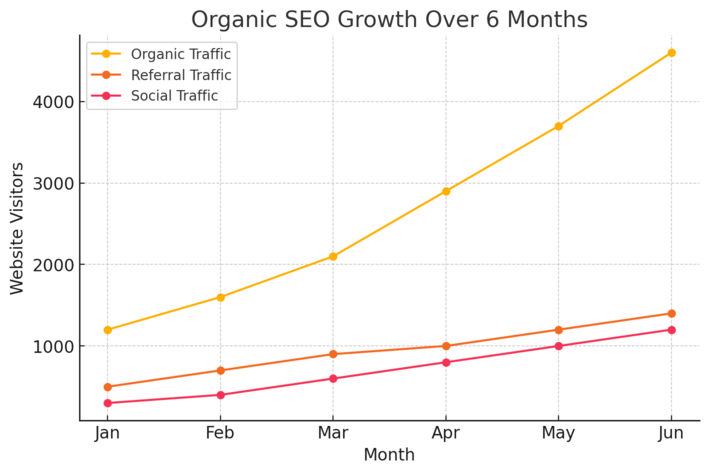
Organic SEO is your long-term growth engine. Unlike ads, it compounds over time—meaning the content you publish today can still drive traffic months or years later.
Research And Target Long-Tail Keywords With Buyer Intent
Long-tail keywords are specific phrases people use when they’re ready to act, like “best budget email marketing tool for beginners.” Use Ahrefs, Ubersuggest, or Google Keyword Planner to find low-competition terms.
Focus on:
- Search intent: Is the user looking to buy, learn, or compare?
- Volume vs. difficulty: Go for keywords with steady search volume and low competition.
- Semantic variations: Use related terms naturally to build topic depth.
I often recommend targeting problem-based keywords—questions your audience is already asking. They convert faster and build trust early.
Optimize On-Page Elements Like Titles, Meta Descriptions, And URLs
Small tweaks here make a big difference. Each page should have a clear, keyword-rich title and an inviting meta description. For URLs, shorter is better—use hyphens, and avoid filler words.
Example:
- Weak URL: yoursite.com/how-you-can-grow-your-business-online-fast
- Better URL: yoursite.com/grow-business-online
Tools like SEMrush or SurferSEO can audit your site and show where optimization opportunities lie.
Create Topic Clusters Around Core Industry Themes
Search engines love depth and organization. A topic cluster is a set of related articles linked to a main “pillar” page. This signals authority on that subject.
For example, if your pillar topic is “Email Marketing,” you could have supporting posts like:
- “How To Build Your First Email List”
- “Best Email Automation Tools”
- “Email Marketing Mistakes To Avoid”
Internally link all of these to your main page and back—it creates a web of relevance that Google rewards.
Use Internal Linking To Improve Crawlability And Session Time
Internal linking guides both readers and search engines through your content. I suggest linking to 2–4 relevant pages from every post using descriptive anchor text (not “click here”).
This helps:
- Spread authority across pages.
- Reduce bounce rate.
- Keep users exploring your site longer.
Think of it as creating a guided tour for your visitors—each click deepens their trust and improves your SEO signals.
Create Content That Attracts And Converts Naturally
High-quality content is your most powerful marketing asset.
When done right, it builds authority, attracts organic traffic, and drives conversions—all without paying for ads.
Focus On Value-Driven Blog Posts That Solve Real Problems
Forget writing for algorithms. Write for humans first, search engines second. Every post should answer a question your audience genuinely cares about.
To make your blog posts more valuable:
- Start with audience pain points.
- Use examples, visuals, or data to back up points.
- End each post with a clear next step (e.g., download, subscribe, share).
A practical example: A small coaching business could write “How To Set Better Goals In 15 Minutes,” including a free goal-tracking template. That’s both useful and lead-generating.
Repurpose Content Into Multiple Formats (Video, Email, Social)
Don’t let your content live and die on your blog. Repurpose it across platforms. Turn a blog post into a YouTube video, an infographic, or a series of short LinkedIn posts.
Here’s how I usually do it:
- Extract 3–4 key ideas from the blog.
- Turn each into a bite-sized post or video.
- Link back to the original piece for more depth.
Repurposing amplifies your reach and helps you stay consistent without reinventing the wheel.
Publish Guest Posts On High-Authority Sites For Backlinks
Guest posting is still one of the best ways to build backlinks and reach new audiences. Target websites within your niche that have real engagement, not just high domain authority.
To make it effective:
- Personalize your outreach email.
- Pitch unique, value-packed topics.
- Link naturally to your site (avoid spammy self-promotion).
Think of it as trading value for visibility—you help their readers, and in return, your brand gains exposure and credibility.
Leverage Case Studies And Tutorials To Build Expertise
People trust what they can see. Case studies and tutorials prove you know what you’re talking about. Share detailed stories about how you solved real problems, including data and screenshots.
For instance, instead of saying “We improved conversions,” show how:
- “We redesigned a landing page, reduced form fields from 6 to 3, and saw a 42% increase in sign-ups.”
That kind of specificity turns content into authority—and authority into trust.
Pro tip: The key to growing your business online without ads is consistency. Every small SEO tweak, story, and piece of content builds momentum. Over time, your organic presence becomes your strongest marketing channel—steady, authentic, and scalable.
Grow With Email Marketing And Lead Nurturing
Email marketing remains one of the most reliable ways to grow your business online without spending on ads.
Done right, it helps you build genuine relationships, nurture trust, and turn casual visitors into loyal customers.
Offer A Lead Magnet That Speaks To Your Ideal Audience
Your email list begins with one simple exchange: value for contact information.
A lead magnet is the freebie you offer—like a checklist, template, or short guide—in exchange for an email. But the real key is alignment. The magnet must solve a specific, immediate problem for your target audience.
For example, if you run an online fitness coaching business, a good lead magnet might be “7 Quick Home Workouts That Burn Fat Without Equipment.” It’s relevant, actionable, and instantly valuable.
How to create an effective lead magnet:
- Identify your audience’s biggest frustration or desire.
- Keep it short and focused (1–3 pages is plenty).
- Deliver it immediately through an automated email sequence.
I suggest using tools like Aweber or MailerLite—they make it easy to create landing pages, set up automations, and tag new subscribers based on which lead magnet they downloaded.
Use Segmented Email Lists For Personalized Campaigns
One mistake I often see is sending the same email to everyone. People unsubscribe quickly when content feels irrelevant.
Segmentation solves this by dividing your audience based on interests, behavior, or stage in the customer journey.
Here’s a practical example:
- New subscribers get a welcome series.
- Existing customers receive product updates or loyalty offers.
- Inactive users receive re-engagement emails.
You can set this up easily inside ActiveCampaign using “if/then” rules. When you send messages that feel tailored, engagement skyrockets—and unsubscribes drop.
Automate Follow-Ups To Keep Subscribers Engaged
Automation ensures your audience never goes cold. Once someone opts in, they should receive a series of follow-up emails that provide value before asking for a sale.
A simple 4-step sequence could look like this:
- Welcome email: Deliver the lead magnet and thank them for joining.
- Value email: Share a quick win or tip.
- Story email: Tell a relatable story that builds connection.
- Offer email: Introduce your product or service as the next logical step.
You can easily create this flow in Kit (formerly ConvertKit) or HubSpot. I like to test small variations—like subject lines or CTA placements—to find what resonates best.
Share Useful Tips And Stories Instead Of Just Promotions
Your subscribers don’t want constant sales pitches. They joined your list because they trust your insight—so nurture that.
I recommend using a 3:1 value-to-promotion ratio. That means three emails that teach, inspire, or entertain for every one that sells.
Ideas that work well:
- Share a personal story about a business lesson learned.
- Send quick tips or tools that make your reader’s life easier.
- Include links to new blog posts, tutorials, or podcast episodes.
When readers feel your emails genuinely help them, they’ll look forward to every message you send.
Leverage Social Media To Build Community And Trust
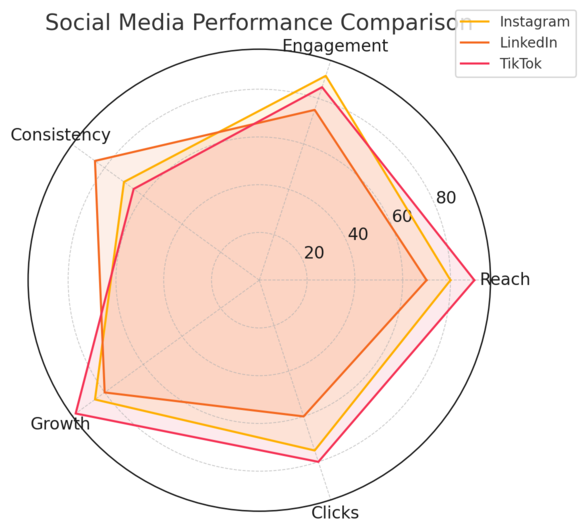
Social media isn’t just for visibility—it’s where your brand’s personality shines.
The goal isn’t to shout louder; it’s to connect deeper. When you use social platforms intentionally, they become powerful engines for organic growth.
Pick The Right Platforms Based On Your Audience
You don’t need to be everywhere—just where your audience is. For example, LinkedIn works best for B2B services, Instagram for lifestyle or product brands, and TikTok for creative or educational short-form content.
Ask yourself:
- Where do my customers spend time?
- What type of content do they enjoy—videos, infographics, or stories?
- Which platform gives me the best chance to show expertise?
I always suggest mastering one or two platforms first before expanding. It’s better to post consistently in one place than sporadically across five.
Post Consistently With Authentic, Story-Driven Content
The algorithms may change, but authenticity always wins. People connect with stories, not slogans. Share behind-the-scenes moments, lessons learned, or the journey behind your product or service.
A useful posting rhythm could be:
- 3 educational or helpful posts per week.
- 1 personal story post.
- 1 community or testimonial feature.
Use scheduling tools like Later or Buffer to stay consistent without burning out. And if you’re ever unsure what to post, just share what you’re learning—that kind of honesty resonates deeply.
Engage Directly With Followers To Build Relationships
Engagement is a two-way street. Reply to comments, ask questions, and show appreciation for feedback. Even short, genuine replies make a big difference in building community.
Try setting aside 15–20 minutes daily to:
- Respond to comments and DMs.
- Comment on followers’ posts.
- Join conversations in relevant hashtags or groups.
The more you interact, the more the algorithm favors your content—and the more your audience sees you as approachable, not just promotional.
Collaborate With Micro-Influencers For Credibility
Micro-influencers (creators with 5k–50k followers) often have higher engagement and more loyal audiences than big influencers. I believe partnering with them is one of the most effective low-cost growth strategies.
What works best:
- Offer free products or affiliate commissions.
- Co-create short videos or tutorials.
- Ask for honest reviews, not scripted endorsements.
Use tools like Collabstr or Upfluence to find verified micro-influencers in your niche. Authentic partnerships like these build trust and expand reach faster than most paid ads.
Build Partnerships And Collaborations That Multiply Reach
Partnerships can help your business grow faster than going solo. They let you tap into someone else’s audience while offering equal value in return.
I’ve seen this work wonders for service providers, coaches, and even small eCommerce brands.
Partner With Complementary Businesses For Cross-Promotion
Find businesses that serve the same audience but offer different products. For example, a wedding photographer could partner with a florist or event planner.
Ways to cross-promote include:
- Featuring each other’s products on your websites.
- Running joint social campaigns or giveaways.
- Offering exclusive bundle deals.
Partnerships like these expand your visibility while keeping acquisition costs at zero.
Co-Host Webinars Or Events To Share Audiences
Webinars are fantastic for showcasing expertise and attracting warm leads. When you co-host one, both brands benefit from doubled exposure and credibility.
To make it work smoothly:
- Choose a topic relevant to both audiences.
- Split responsibilities—one handles the presentation, the other Q&A.
- Record the session and repurpose it into social clips or blog posts.
I once co-hosted a live session between an SEO tool and a copywriting agency—it generated over 1,000 leads without any ad spend.
Create Joint Content Like Ebooks Or Challenges
Joint content is a long-term asset that keeps bringing in leads. You can co-create ebooks, templates, or even free challenges with another expert in your field.
Ideas to try:
- “30-Day Business Growth Challenge” with a marketing partner.
- “Ultimate Industry Guide” combining insights from multiple brands.
- “Resource Bundle” where each partner contributes one tool or guide.
You can host it using Canva for simplicity, then share it via your email lists or social channels.
Exchange Email Mentions Or Guest Newsletters
If you already have a newsletter, one of the easiest collaboration wins is mentioning each other’s content. You promote their resource one week; they promote yours the next.
Why it works:
- You reach a warm, pre-qualified audience.
- It costs nothing but helps both lists grow.
- It builds genuine relationships between brands.
This kind of reciprocity strengthens your network and accelerates visibility organically.
Pro tip: Growth without ads isn’t about doing everything—it’s about doing the right things consistently. Focus on relationships, value, and authenticity. When people trust you, they’ll follow, subscribe, and buy—without ever needing to be sold to.
Harness The Power Of Online Reviews And Testimonials
Online reviews are one of the most powerful forms of organic marketing you can leverage to grow your business online.
They build credibility, influence decisions, and create social proof that encourages trust—without you needing to spend on ads.
Encourage Happy Customers To Leave Public Reviews
Most satisfied customers won’t leave a review unless you ask. I recommend making this part of your post-purchase process.
A short follow-up email that says, “Your feedback helps others find us—would you mind leaving a quick review?” works better than any generic message.
How to collect more reviews effectively:
- Ask at the right time—right after a positive experience or delivery.
- Include direct links to your Google, Yelp, or Trustpilot pages.
- Incentivize gently, like offering a small thank-you coupon for future use.
If you use Google My Business (now Google Business Profile), reviews appear directly in search results. That alone can increase your click-through rate by up to 35%.
Showcase Testimonials Prominently On Your Website
Don’t hide your social proof deep in your site. Display testimonials on key pages where visitors are making buying decisions—like your homepage, landing pages, or pricing section.
Best practices for showcasing testimonials:
- Use real names and photos (with permission).
- Include specific details about what the customer loved.
- Pair them with measurable results, if possible.
For example, instead of a generic quote like “Great service!”, a stronger one is “After working with this team, our website traffic grew by 60% in three months.”
Tools like Trustindex.io or EmbedSocial make it easy to pull and display real Google or Facebook reviews dynamically.
Respond Professionally To Both Positive And Negative Feedback
Your response to reviews says as much about your brand as the reviews themselves. Thank happy customers publicly—it reinforces their loyalty and shows authenticity.
But don’t ignore negative ones; they’re opportunities to improve and demonstrate accountability.
How I suggest handling reviews:
- For positive ones: thank them and personalize your reply.
- For negative ones: acknowledge the issue, apologize if valid, and move the discussion offline.
Example response to a complaint: “I’m sorry your experience didn’t meet expectations. I’d love to make it right—please reach out at [email].” This approach can actually convert critics into loyal fans.
Use Social Proof In Landing Pages And Emails
Social proof boosts conversions dramatically. I’ve seen landing page conversion rates jump by 20–40% simply by adding testimonials, star ratings, or “as featured in” logos.
Where to use it:
- Add snippets of customer quotes near CTAs.
- Include review screenshots in email campaigns.
- Highlight real data like “Over 5,000 happy customers served.”
People trust people. The more proof you provide, the easier it becomes for visitors to believe in your brand.
Use Free Tools And Platforms To Simplify Growth
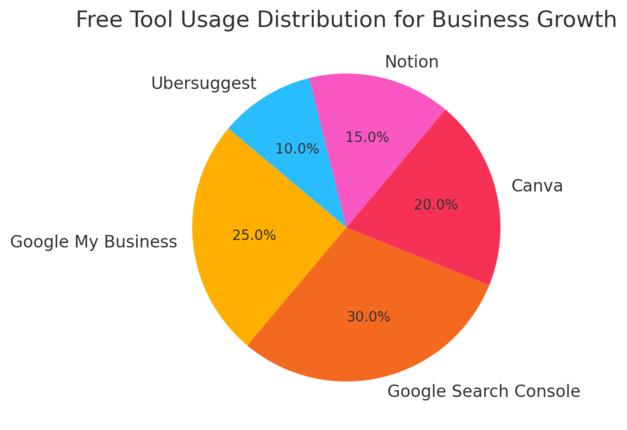
You don’t always need premium software to grow. There are plenty of free, high-value tools that can automate, analyze, and optimize your efforts so you can focus on strategy, not stress.
Use Google My Business For Local Visibility
If your business has any local presence, this is a must. Google My Business (GMB) lets you appear in Google Maps, local search results, and “near me” queries.
Quick setup path:
- Go to business.google.com and claim your listing.
- Fill in every section—address, hours, photos, and service area.
- Post weekly updates, just like a social media feed.
I suggest adding customer photos or event updates regularly. Businesses that post on GMB see up to 2x higher engagement compared to those that don’t.
Explore Free SEO Tools Like Google Search Console And Ubersuggest
Search Console helps you understand how Google sees your website. It shows which keywords bring traffic, what pages get clicks, and any indexing issues.
Ubersuggest, created by Neil Patel, gives free keyword insights and competitor data. Together, they form a simple but effective SEO toolkit.
Use them to:
- Identify pages with declining clicks (in Search Console).
- Find content gaps by checking what competitors rank for (in Ubersuggest).
- Track improvements after SEO updates.
I check Search Console weekly—it’s like having a direct line to what Google thinks of your site.
Use Canva Or Notion For Content Creation And Planning
Canva makes it ridiculously easy to design professional-looking graphics for social media, blogs, and ads. You can use free templates, drag and drop images, and export in multiple formats.
Notion, on the other hand, is a productivity and content management powerhouse.
I use it to:
- Plan content calendars.
- Track topic ideas and drafts.
- Collaborate with clients or team members.
Both tools have free versions that can easily handle the needs of solopreneurs or small teams.
Track Performance With Google Analytics To Guide Strategy
Data tells the truth about what’s working and what’s not. Google Analytics (GA4) helps you see traffic trends, audience behavior, and conversion paths.
Key metrics to track:
- Average session duration (shows engagement).
- Bounce rate (indicates relevance).
- Conversion rate (tells you if visitors are taking action).
If you’re not sure where to start, connect Google Analytics with Google Search Console for a fuller picture of traffic and search performance in one dashboard.
Develop A Consistent Content And Engagement Schedule
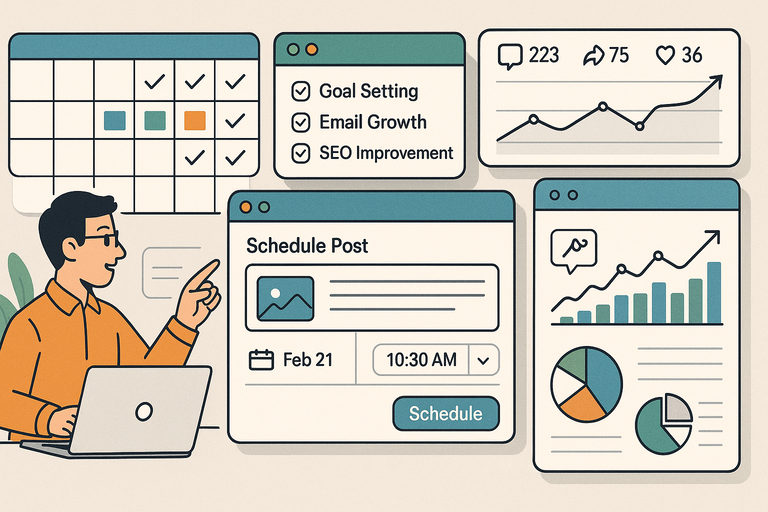
Consistency builds momentum online. Whether you’re publishing blogs, social posts, or emails, having a schedule ensures you show up regularly—something algorithms and audiences both love.
Plan Monthly Themes To Maintain Focus
Monthly themes help you organize ideas and maintain message clarity.
For example, January could be about goal setting, February about email growth, and March about SEO improvement.
I like to start each month by asking, “What’s my audience struggling with right now?” Then, I build content that directly solves those issues. It keeps your marketing relevant and structured.
Schedule Posts Using Free Tools Like Buffer Or Later
Manually posting every day can eat up your time. Buffer and Later let you schedule weeks of posts in advance.
How to streamline scheduling:
- Batch-create posts once a week.
- Schedule them at high-engagement times (each platform shows these).
- Use analytics inside the tool to refine timing.
Once you automate posting, you free up energy for community engagement—which matters even more.
Analyze Engagement To Learn What Resonates
Don’t just post and move on. Check analytics weekly to see what content performs best. Look for:
- Topics that get the most shares or saves.
- Posts with strong comments (shows emotional connection).
- Content formats that attract longer watch time or clicks.
I’ve found that short personal stories often outperform “perfect” how-tos—people crave connection as much as information.
Continuously Adjust Based On Performance Data
The best marketers treat data like feedback, not failure. If something underperforms, ask why. Maybe timing was off, or the headline didn’t spark curiosity.
Use insights to:
- Double down on what’s working.
- Experiment with new formats.
- Drop what doesn’t deliver results.
This constant iteration makes your marketing smarter over time—no ad spend required.
Build An Evergreen System That Grows Over Time
Evergreen systems are your secret weapon for sustainable online growth. They keep working long after you’ve built them—like assets that never sleep.
Turn High-Performing Content Into Evergreen Assets
Look at your analytics and find your top-performing blog posts, videos, or emails. Then, update and optimize them so they stay relevant year-round.
Ways to repurpose evergreen content:
- Turn a blog post into a downloadable guide.
- Create an infographic or video from the same topic.
- Add updated examples or data every few months.
For instance, if your “Email Marketing Tips” post still drives traffic a year later, polish it and link it to new resources or lead magnets.
Automate Lead Nurturing And Onboarding Processes
Once you’ve built trust through content, automation helps you turn that interest into long-term relationships. Tools Kit or HubSpot let you send pre-set email sequences that educate and onboard leads.
Example workflow:
- Lead downloads your free guide.
- They get a 5-day email series that teaches and builds trust.
- On day six, they receive an offer tailored to their needs.
That’s how you grow passively—every subscriber moves through a system you’ve already built.
Create A Resource Library Or Knowledge Hub
A resource hub turns your expertise into an always-available learning center. It could include guides, templates, checklists, or video tutorials.
Not only does it help your audience, but it also builds backlinks and keeps visitors returning. You can build one easily using Notion or WordPress categories, organized by topic.
Keep Updating Content To Maintain Rankings And Relevance
Search engines love fresh content. Review and refresh your key pages every 3–6 months—update stats, links, and visuals.
I like to keep a simple spreadsheet with columns for URL, last updated, and next review date. This small habit keeps your site sharp, relevant, and competitive.
Final thought: Building a business online without ads is completely doable. It just requires patience, structure, and a clear system. Focus on relationships, optimize for consistency, and build assets that grow over time. The result? Sustainable, organic growth that compounds while you sleep.

I’m Juxhin, the voice behind The Justifiable.
I’ve spent 6+ years building blogs, managing affiliate campaigns, and testing the messy world of online business. Here, I cut the fluff and share the strategies that actually move the needle — so you can build income that’s sustainable, not speculative.
Related posts:
 How to Grow Your Business Online for Free — Step-by-Step Plan
 How to Grow Online Business Through Social Media Step by Step
 Increase Landing Page Conversion Rate
 How to Grow Your Online Business Fast and Scale to 6 Figures
 10 Cute Ideas to Grow Online Business and Attract Loyal Fans
 10 Proven Strategies to Grow Online Business in Any Niche