
Table of Contents
Some links on The Justifiable are affiliate links, meaning we may earn a small commission at no extra cost to you. Read full disclaimer.
Building a dropshipping store that actually converts isn’t about flashy designs or throwing random products online—it’s about strategy, psychology, and precision.
Have you ever wondered why some dropshipping stores generate thousands in sales while others barely get a click? The truth is, successful stores are engineered for conversion from day one.
In this guide, we’ll break down every step of building a dropshipping store that turns browsers into loyal buyers, using real-world strategies that actually work.
Choosing the Right Niche for Your Dropshipping Store
Finding the right niche is where your entire dropshipping journey begins. I like to think of it as choosing the terrain before building your empire—you want solid ground, not shifting sand.
The goal is to find a market that has real demand, manageable competition, and room to grow.
Understanding Market Demand and Competition
Before you even think about product ideas, you need to understand who’s buying what and why. Dropshipping success is often tied to customer intent—the difference between casual interest and purchase-ready demand.
Here’s how I approach it:
- Use Google Trends: Type in your niche idea (e.g., “pet grooming tools”) and look at the long-term trend. A steady upward curve is a good sign; a spiky one might suggest a fad.
- Check search volume: Tools like Ubersuggest show how many people search for keywords like “wireless car vacuum.” High search volume combined with medium competition is ideal.
- Study competitors: Search your niche on Shopify. If you see many stores selling similar products with thousands of reviews, that’s both good (validation) and bad (saturation).
I usually look for niches that have clear demand but where big brands haven’t dominated the space yet—like eco-friendly kitchen products or portable health gadgets.
Identifying Profitable Micro-Niches
A micro-niche is a smaller, more specific segment within a larger category. Instead of “fitness,” think “home pilates gear for busy moms.”
Micro-niches let you serve a tighter audience, which often means lower ad costs and stronger brand loyalty.
A few real-world examples:
- Instead of “home décor,” try “Scandinavian wall art for minimalist apartments.”
- Instead of “pet products,” go for “anxiety-relief toys for small dogs.”
I suggest you start by imagining a very specific type of customer—their problems, hobbies, and online habits. This person becomes your niche compass. Every decision—product, design, and ad—should appeal directly to them.
Using Data Tools to Validate Niche Ideas
You don’t have to guess. There are plenty of tools that can help you confirm whether a niche has potential.
- Minea: Lets you track trending ads across Facebook, TikTok, and Pinterest. I like to filter for “recently trending” campaigns that have over 1,000 likes in under a week. That tells me the audience is responding.
- Google Keyword Planner: Type your niche term, and check average monthly searches and competition level.
- Ecomhunt or Niche Scraper: These platforms surface winning products and show engagement data. If you notice multiple “winning” products from the same niche, that’s a signal worth paying attention to.
The key is convergence. When multiple data sources point to the same market trend, that’s when I take action.
Avoiding Oversaturated and Low-Margin Niches
It’s tempting to jump into “hot” markets like phone accessories or beauty tools. But those are often flooded with sellers offering razor-thin profit margins.
A few ways to spot danger zones:
- Products with hundreds of identical listings on AliExpress.
- Keywords with very high competition on Google or Amazon.
- Ad fatigue—if you’ve seen the same TikTok ad ten times this month, skip that niche.
Instead, look for moderately competitive spaces where you can differentiate—through better branding, storytelling, or unique bundles.
I believe long-term success in dropshipping comes from being strategic, not reactive. It’s better to own a small pond than fight in an ocean full of sharks.
Selecting Winning Products That Actually Sell
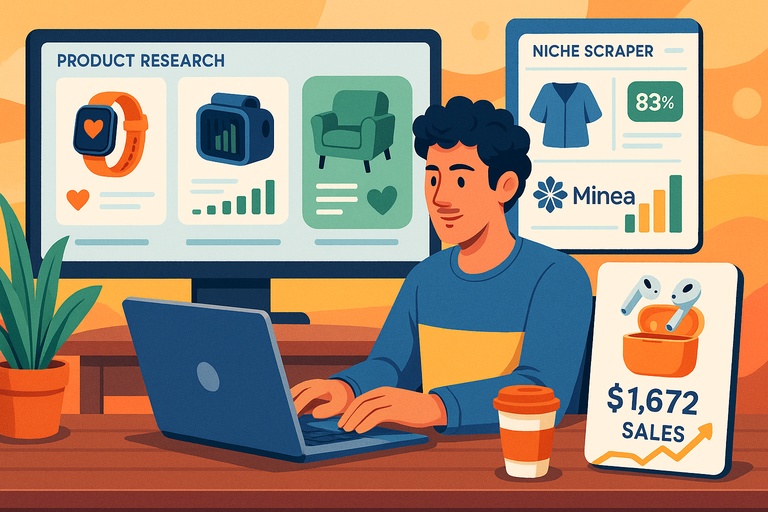
Once your niche is locked in, the next step is choosing products that attract clicks and convert visitors.
In dropshipping, the right product can make or break your store—so this step deserves patience and testing.
How to Spot High-Converting Products Early
Winning products share a few consistent traits. I like to call them the “3 E’s”: Emotion, Ease, and Evidence.
- Emotion: The product should trigger an emotional reaction—surprise, relief, curiosity, or joy. Example: a self-stirring mug.
- Ease: It should solve a small but annoying problem quickly. People love simple wins.
- Evidence: There should be visible proof it’s already selling—like reviews, viral TikTok videos, or high engagement on ads.
If you’re on TikTok or Facebook, pay attention to ads with lots of comments asking “Where can I buy this?” That’s often your cue.
Evaluating Product Quality and Supplier Reliability
A great product isn’t just trendy—it’s also well-made and shipped reliably. I’ve seen stores lose all credibility because their supplier messed up orders.
Here’s what I always do:
- Order a sample first. It’s the simplest way to check quality, packaging, and delivery time.
- Choose AliExpress suppliers with ratings above 4.8 and over 500 orders.
- Use CJ Dropshipping or Zendrop for faster shipping options to the U.S. and EU.
I also email suppliers directly before listing their products. The way they respond—fast, professional, or vague—tells me a lot about how they’ll handle future issues.
Testing Product Market Fit Before Launch
You don’t need a full website to test a product. I often run small validation campaigns using a single-page landing setup.
Try this:
- Build a quick landing page with tools like Shopify’s Debutify theme or Carrd.
- Run a small ad budget ($20–$50) on TikTok or Meta Ads.
- Track link clicks, add-to-carts, and engagement rate.
If your click-through rate (CTR) is above 2% and cost per click (CPC) is under $1.50, the product likely has potential. If not—pivot fast.
Testing early saves you from wasting money on duds later.
Using Product Research Tools Like Minea and Niche Scraper
These tools make finding winning dropshipping products much easier, especially when you know how to read the data.
- Minea: Filters trending ads by engagement. I focus on ads with consistent growth, not one-time viral hits.
- Niche Scraper: Rates products with a “Store Analysis” score, which helps spot profitable categories.
- Thieve.co: Curates high-quality AliExpress products already doing well on social media.
For example, if I notice three similar products gaining traction across Minea and Niche Scraper, that’s usually my green light. I’ll then test variations (color, size, bundle) to see which version gets traction.
Building a Conversion-Focused Store Design
Your dropshipping store design should do one thing exceptionally well: guide visitors smoothly toward checkout.
Think of it as setting up a digital shop window where every element—colors, layout, buttons—nudges people to take action.
I’ve learned over the years that beautiful doesn’t always mean effective; the best designs are simple, fast, and built for trust.
Structuring Your Homepage for Maximum Engagement
Your homepage isn’t just decoration—it’s your first impression. Within three seconds, visitors should know what you sell and why they should stay.
Start with a clear hero section—a large banner image with a short headline that communicates value fast. For example, “Smart Kitchen Tools That Save You Time.”
Include one call-to-action (CTA) button like “Shop Now” or “Discover More.”
Next, add these key sections:
- Featured Products: Highlight your best-sellers, not every product.
- Why Choose Us: A short, visual section listing benefits—free shipping, easy returns, fast delivery.
- Social Proof: Logos of trusted payment systems or customer reviews help reduce hesitation.
I recommend keeping your homepage minimal. The goal isn’t to show everything—it’s to create enough curiosity to explore deeper.
Designing Product Pages That Drive Purchases
A strong product page feels like a personal pitch. You want it to answer every possible question before the customer even asks.
Focus on three core elements:
- High-quality visuals: Use multiple angles, lifestyle photos, and a short demo video if possible. A 2023 Shopify study showed that videos increase conversion rates by up to 80%.
- Clear headline: Instead of “Wireless Vacuum,” use “Portable Car Vacuum – Clean Every Corner Effortlessly.”
- Urgency elements: Add low-stock alerts or limited-time offers to encourage faster decisions.
I suggest using a layout like this: product image on the left, short bullet-point benefits on the right, and a large “Add to Cart” button just below the price. Keep it clean and mobile-friendly.
Optimizing Navigation and Mobile Responsiveness
Your navigation should make shopping frictionless. If users can’t find what they want in a few seconds, they leave.
Here’s what works well:
- Keep your main menu simple—Home, Shop, About, Contact.
- Use filters (price, category, color) for stores with many products.
- Make the search bar visible at the top right—it’s your conversion shortcut.
More than 70% of dropshipping traffic now comes from smartphones. That means your site needs to load in under three seconds.
I recommend using themes like Impulse (Shopify) or Astra (WooCommerce) because they’re lightweight and automatically adjust layouts for smaller screens.
Creating Trust Elements Like Reviews and Guarantees
Trust is the invisible engine of conversion. Without it, even the best design fails.
Here’s what I always include:
- Customer Reviews: Display real ones with names or photos. Tools like Loox or Judge.me integrate easily.
- Guarantee Badges: A simple “30-Day Money-Back Guarantee” builds immediate confidence.
- Security Seals: SSL, PayPal, or Stripe logos reassure buyers their payments are safe.
A quick pro tip: include a small trust line below your “Add to Cart” button—something like “Secure checkout powered by Shopify.” It subtly boosts reassurance without breaking the flow.
Writing Product Descriptions That Convert Browsers Into Buyers
A great description transforms a casual scroller into a paying customer. It’s not about fancy language—it’s about making the reader feel the benefit.
I always write as if explaining the product to a friend over coffee: honest, enthusiastic, and helpful.
Using Emotional Triggers in Copywriting
Buying decisions are emotional first, logical second. The right words make people imagine how the product will improve their life.
Focus on triggers like:
- Relief: “Say goodbye to messy spills.”
- Desire: “Enjoy café-quality coffee at home.”
- Belonging: “Join thousands of smart shoppers who already upgraded.”
I suggest combining emotion with storytelling—describe a small everyday problem, then show how your product solves it. That narrative makes your copy memorable.
Highlighting Benefits Over Features
Features tell, benefits sell. Instead of listing “stainless steel blades,” say “Cuts vegetables twice as fast without dulling.”
To make it easier, use this quick structure:
- Feature: The factual aspect.
- Benefit: What it does for the user.
- Emotional payoff: How it makes them feel.
Example: “Rechargeable battery (feature) means you can use it anywhere (benefit), so you’ll never be stuck mid-clean again (emotional payoff).”
This simple shift in language often doubles engagement.
Structuring Copy for Readability and Impact
People skim online, so structure matters. Use short paragraphs, bullet points, and clear spacing.
Here’s an effective layout:
- Headline with key benefit.
- 2–3 short sentences introducing the problem and solution.
- Bullet points for main features.
- Call to action (CTA): “Order today for fast delivery.”
Keep sentences punchy and visual. Replace vague words like “amazing” with concrete ones like “lightweight,” “durable,” or “precision-cut.”
A/B Testing Different Description Formats
Even seasoned marketers guess wrong sometimes. That’s why I suggest A/B testing—comparing two versions of a product page to see which performs better.
For example:
- Version A: Short, emotional copy.
- Version B: Detailed, feature-heavy copy.
Run both for a week using tools like VWO or Shopify’s built-in “Theme Preview.” Track conversion rate and average order value (AOV).
From what I’ve seen, emotional storytelling formats usually win for impulse-buy products, while detailed specs perform better for tech or higher-ticket items.
Pricing Strategies to Boost Conversion and Profit Margins
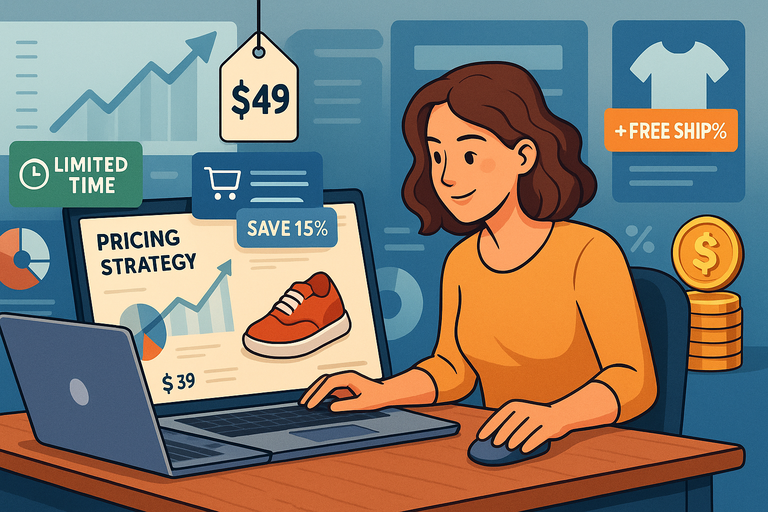
Your pricing strategy doesn’t just determine profit—it shapes perception.
I’ve seen stores fail because they priced too low, signaling “cheap,” or too high, scaring off casual buyers. The right pricing balances trust, value, and profitability.
Understanding Psychological Pricing Techniques
Psychological pricing taps into how the human brain perceives value. Small changes can make big differences.
Some proven tactics:
- Charm pricing: Use “.99” endings (e.g., $19.99 instead of $20). Studies show it increases conversions by up to 10%.
- Anchor pricing: Display the original price crossed out beside the discounted price—it makes the deal feel bigger.
- Tiered pricing: Offer three versions (Basic, Plus, Premium). Most buyers pick the middle option.
I use this in my stores by setting clear visual contrast—like showing “Was $39.99, Now $24.99 – Limited Offer.” It’s subtle psychology that works.
Setting Competitive Yet Profitable Prices
Always start by understanding your total costs—product price, shipping, platform fees, and ad spend. Then, aim for at least a 2.5x to 3x markup for healthy profit.
Use sites like AliExpress and Amazon to compare competitor prices. If your competitors are selling a similar gadget for $30, consider pricing yours at $28.99 with a stronger value hook like “Free 2-Day Shipping.”
I suggest testing prices with small ad campaigns to find the sweet spot where conversions and profit balance out.
Offering Limited-Time Discounts and Bundles
Scarcity drives action. When customers feel time pressure, they buy faster.
You can try:
- Countdown timers during flash sales.
- “Buy 2, Get 1 Free” bundles for everyday items.
- Email-exclusive offers to re-engage hesitant visitors.
From my experience, bundling often boosts average order value (AOV) by 20–30%. It’s also easier to promote—customers love “more for less.”
Using Free Shipping to Increase Average Order Value
Free shipping isn’t really “free,” but it feels that way to buyers—and that perception increases conversions.
Here’s how to make it work:
- Set a minimum threshold, like “Free shipping on orders over $50.”
- Increase product prices slightly to cover shipping cost.
- Promote it in banners and checkout reminders.
In one of my stores, just adding a free shipping bar (“You’re only $12 away from free shipping!”) lifted my AOV by 18%.
Setting Up a Seamless Checkout Experience
Checkout is where excitement turns into hesitation. You can have the most beautiful dropshipping store in the world, but if the checkout feels clunky or confusing, your sales will vanish.
I’ve seen stores lose over 60% of potential revenue simply because their checkout flow wasn’t optimized. The goal is to make it so easy that buying feels effortless.
Minimizing Friction and Reducing Abandonment
Every extra click, form field, or delay increases cart abandonment. I always think of checkout like a water slide—you want zero bumps along the way.
Here’s how to streamline it:
- Enable guest checkout: Don’t force account creation before purchase. Offer sign-up after checkout instead.
- Use autofill and smart forms: Let browsers auto-complete address or payment details.
- Show progress indicators: A simple “Step 1 of 2” reduces uncertainty and keeps buyers moving.
- Preload shipping info: If possible, auto-detect country and currency using IP lookup.
One client of mine saw a 22% drop in abandonment simply by removing the “Confirm Password” field and making phone number optional. Small tweaks often bring big wins.
Offering Multiple Payment Options and Currencies
When people reach checkout, they’ve already made an emotional commitment. Losing them because of missing payment options feels painful—and avoidable.
I recommend including:
- Credit/debit cards (Visa, MasterCard, AmEx)
- PayPal or Shop Pay for one-click checkout
- Apple Pay and Google Pay for mobile users
- Local methods (Klarna, Afterpay, or iDEAL) depending on target countries
For international stores, set currency auto-conversion.
On Shopify, go to Settings → Markets → Currencies to enable it. This tiny feature increases conversion rates in non-U.S. regions by up to 15%, especially for European shoppers.
Adding Urgency and Social Proof at Checkout
Even at checkout, customers hesitate. That’s why gentle reminders can help close the sale without feeling pushy.
Try adding:
- Countdown timers: “Order within 2 hours for same-day dispatch.”
- Stock alerts: “Only 4 left in stock!”
- Micro social proof: “12 people purchased this in the last 24 hours.”
These signals build momentum. I’ve found that the best approach is subtle—not screaming urgency, but softly reinforcing that the product is in demand.
Using One-Page Checkout Plugins for Shopify or WooCommerce
The faster the checkout, the higher the conversion. One-page checkouts are a proven way to simplify everything into a single, focused screen.
On Shopify, apps like Fast Checkout In One Click reduce the checkout steps dramatically.
For WooCommerce, try CartFlows or CheckoutWC—both optimize flow and allow design customization.
I once migrated a client’s three-step checkout to a single page using CartFlows. Their conversion rate jumped from 1.8% to 3.4% in less than two weeks—no ad changes, just flow optimization.
Leveraging High-Impact Store Branding
Branding is what makes your dropshipping store memorable. It’s not just a logo or color scheme—it’s the emotional impression your store leaves.
When done right, branding builds trust, loyalty, and perceived value, often letting you charge more for the same product.
Crafting a Memorable Brand Identity and Story
Every successful brand has a story. I suggest building yours around why you started, not just what you sell.
For example, if your store sells eco-friendly kitchenware, your story might be about reducing plastic waste after noticing how much packaging accumulates from daily cooking. That kind of narrative connects emotionally.
Elements of strong brand identity include:
- A clear mission and purpose
- A unique brand voice (friendly, minimalist, or bold)
- A memorable logo and color palette
- Consistent product packaging and visuals
A cohesive story gives your products meaning beyond price—it turns buyers into supporters.
Using Consistent Visuals and Tone Across Pages
Consistency creates familiarity, and familiarity builds trust. Whether a customer lands on your homepage, blog, or checkout page, everything should feel part of one ecosystem.
Here’s what to align:
- Font choices and button styles
- Product photo lighting and backgrounds
- Tone of writing—if your homepage sounds warm and conversational, keep that tone in emails too
Shopify makes this easy with “theme settings,” where you can define fonts, colors, and button styles globally. I usually stick to two main colors—one for CTAs and one neutral—to maintain focus.
Building Trust Through Transparency and Authenticity
People buy from brands they trust. And in dropshipping, where customers may wait a little longer for products, honesty goes a long way.
Be upfront about:
- Shipping times and return policies
- Product sourcing (e.g., “We partner with small manufacturers in China and the U.S.”)
- Real customer feedback, not fake testimonials
When you share real behind-the-scenes details—like testing products yourself or improving packaging—it humanizes your store. I’ve found customers are surprisingly forgiving if they feel respected.
How Branding Influences Perceived Product Value
Branding directly impacts how much people are willing to pay. Two stores can sell the same product, but the one with stronger branding often earns double the revenue.
For instance, minimalist stores like LARQ or The Ridge Wallet use clean design, strong typography, and lifestyle imagery to elevate simple products. Their branding makes “premium” feel natural, not forced.
If you position your store as thoughtful, reliable, and visually polished, your prices feel justified—and conversions increase even without discounts.
Driving Targeted Traffic to Your Dropshipping Store
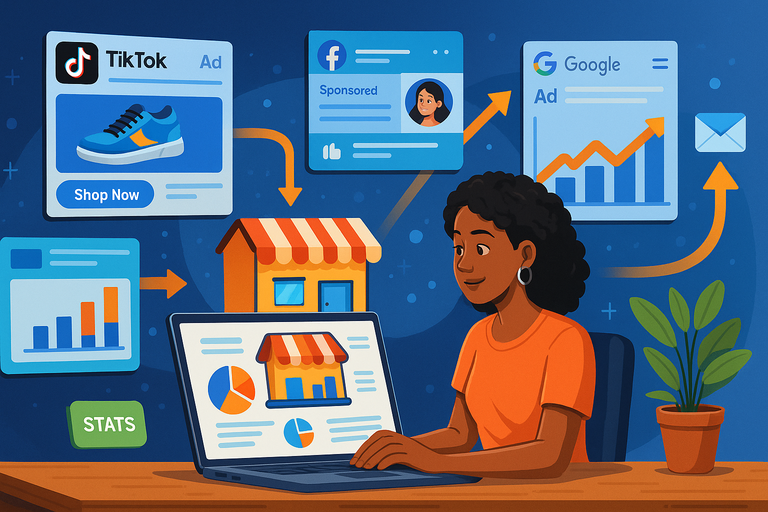
Once your store looks amazing and functions perfectly, it’s time to get people in the door.
Traffic is the oxygen of your dropshipping store—but not all traffic is equal. You want visitors who are ready (or nearly ready) to buy.
Mastering Paid Ads: Facebook, TikTok, and Google
Paid ads are still the fastest way to scale. Each platform serves a different purpose, so I suggest using them strategically:
- Facebook Ads: Great for testing multiple audiences quickly. Start with conversion campaigns and use “Advantage+ Shopping Campaigns” for automation.
- TikTok Ads: Ideal for impulse-buy products. Keep videos short (under 20 seconds) with strong hooks like “You didn’t know you needed this!”
- Google Ads: Perfect for products with existing search demand. Run Shopping Ads using product feeds from Shopify’s Google & YouTube Channel app.
A quick tip: monitor click-through rates (CTR) closely. On TikTok, aim for 1.5% or higher; on Facebook, above 2% usually means your creative is resonating.
Using SEO and Blog Content to Build Organic Reach
SEO takes longer but delivers compounding results. When your dropshipping store ranks for long-tail keywords, you get steady, free traffic that keeps growing.
Start with blog topics related to your niche. For example, if you sell ergonomic desks, create articles like:
- “5 Ways to Improve Posture While Working from Home”
- “Best Desk Accessories for Small Spaces”
Use keywords naturally in headings and first paragraphs. Tools like Ubersuggest or Ahrefs help find easy-to-rank terms.
I usually aim for articles around 1,000 words, optimized for one main keyword and two related terms.
Building an Email List for Long-Term Conversions
Email marketing remains one of the most profitable tools in eCommerce. It’s your direct line to people who’ve already shown interest.
Use pop-ups or lead magnets like:
- 10% off for first-time signups
- Free shipping for newsletter subscribers
- A mini product quiz (“Find your perfect item”)
Then, automate three essential flows:
- Welcome series: Introduce your brand and top products.
- Abandoned cart series: Remind users of what they left behind.
- Post-purchase series: Request reviews or offer related items.
Klaviyo and Omnisend are excellent for this—they integrate smoothly with Shopify and WooCommerce.
Partnering With Micro-Influencers for Affordable Promotion
Micro-influencers (those with 5,000–50,000 followers) are incredibly effective for dropshipping stores on a budget. They feel authentic, and their audiences trust their recommendations.
Here’s how I suggest approaching it:
- Use tools like Modash or Collabstr to find influencers in your niche.
- Offer free products plus commission rather than flat fees.
- Ask for both content usage rights and tagging in posts.
A small example: I partnered with a fitness micro-influencer who had only 8,000 followers. Her Instagram reel generated over 600 store visits and 45 orders in a week. The key wasn’t follower count—it was relevance and trust.
Using Analytics to Optimize Store Performance
You can’t improve what you don’t measure. Data turns guesswork into strategy—and for a dropshipping store, that’s the difference between scraping by and scaling profitably.
I often tell new store owners: analytics aren’t just numbers; they’re your store’s heartbeat.
The key is learning to interpret those signals correctly and act on them quickly.
Tracking Key Metrics Like Conversion Rate and CAC
Two metrics I check almost daily are conversion rate (CR) and customer acquisition cost (CAC). They reveal how efficiently your store turns traffic into profit.
- Conversion Rate (CR): This shows what percentage of visitors make a purchase. A healthy benchmark for most dropshipping stores is between 2–4%. If it’s lower, your product pages or checkout process might be causing friction.
- Customer Acquisition Cost (CAC): This tells you how much you spend on ads per customer. If your average order value (AOV) is $45 and your CAC is $30, you’re barely breaking even. The goal is to keep CAC under 30–40% of AOV.
To track these metrics easily, set up your Shopify analytics dashboard or Google Analytics (GA4).
On Shopify, go to Analytics → Reports → Behavior → Conversion Overview. For ad data, integrate your Facebook Pixel and TikTok Pixel so all events (Add to Cart, Purchase, etc.) flow directly into your reports.
When you start monitoring daily trends instead of monthly summaries, you’ll notice subtle shifts—like weekend traffic outperforming weekdays—and can adjust ads accordingly.
Identifying Drop-Off Points With Heatmaps
Numbers tell you what’s happening, but heatmaps show you why. Tools like Hotjar visualize where users click, scroll, or drop off on your pages.
A few patterns I often find:
- Users hover around the “Add to Cart” button but don’t click—it’s often too low on mobile view.
- Visitors scroll halfway down the product description and exit—maybe it’s too long or cluttered.
- A sudden drop between “Add to Cart” and “Checkout”—indicates friction in the cart or shipping cost surprise.
I recommend running heatmaps for 500–1,000 visitors to get statistically useful data. Combine this with session recordings—you’ll literally watch where customers hesitate or get confused. It’s a humbling but powerful experience.
Testing and Iterating With Data-Driven Decisions
Testing is how you turn insights into profit. Instead of guessing which design, ad, or product variation works, let the data decide.
Here’s my process:
- Form a hypothesis: “Shorter product descriptions will increase conversion.”
- Run an A/B test: Use tools like VWO to split traffic evenly.
- Measure for at least 7 days or 1,000 visitors per version for reliable results.
- Act fast: Implement winners, archive losers, and move on to the next test.
Most successful dropshippers constantly test—headlines, button colors, product photos, even shipping copy. From my experience, just improving your “Add to Cart” button visibility can lift sales by 10–20%.
Using Tools Like Google Analytics and Hotjar
You don’t need a full-time data analyst. A few free tools go a long way:
- Google Analytics 4: Tracks user flow, engagement time, and conversion sources. Focus on Traffic acquisition → Sessions by source/medium to see which platforms bring buyers.
- Hotjar: Excellent for heatmaps, scroll maps, and session recordings.
- Lucky Orange: Adds live chat with session replays, great for spotting user frustration in real-time.
- Triple Whale or BeProfit: Ideal for advanced profit tracking when you scale across multiple ad platforms.
A balanced combination of GA4 for macro data and Hotjar for micro behavior gives you both the forest and the trees—big-picture trends and fine details.
Scaling Your Dropshipping Store Sustainably
Scaling a dropshipping store isn’t just about selling more—it’s about growing without breaking your systems or profit margins.
I believe sustainable scaling means building efficiency into every part of your business before chasing bigger numbers.
Automating Fulfillment and Customer Support
When orders start rolling in, manual fulfillment becomes impossible. Automation frees your time so you can focus on strategy instead of spreadsheets.
For fulfillment, I recommend tools like AutoDS, DSers, or CJ Dropshipping. They automatically process orders, sync tracking numbers, and update order statuses in Shopify.
For support, tools like Tidio or ManyChat let you handle emails, chats, and social DMs in one dashboard. You can even automate replies for common questions like “Where’s my order?” using pre-set macros.
I once worked with a store that cut support time by 40% just by setting up smart replies for FAQs. Customers got answers faster, and the team had more time for revenue-generating tasks.
Expanding Product Lines Without Losing Focus
Adding new products feels exciting—but do it strategically. Expansion should deepen your niche, not dilute it.
Let’s say your store sells portable blenders. Instead of adding random gadgets, you could add accessories like smoothie cups, travel bags, or flavored powder mixes. This keeps your brand consistent and increases average order value (AOV) naturally.
A quick rule I use: for every new product, ensure it either:
- Solves a related problem for your existing audience, or
- Enhances the use of your current best-seller.
Avoid adding too many SKUs (stock keeping units) too soon—it can confuse customers and hurt inventory flow.
Retargeting and Upselling to Existing Customers
The easiest sale you’ll ever make is to someone who already bought from you. Retargeting and upselling build profit without new ad spend.
Here’s how to do it:
- Retargeting ads: Use Facebook or TikTok Custom Audiences to show ads to people who visited but didn’t buy.
- Upsell offers: Use one-click upsell apps like Zipify OCU or ReConvert to offer add-ons right after checkout.
- Email upsells: Send post-purchase emails featuring complementary products (“You might also love…”).
In one of my stores, a simple “Add this for 20% off” pop-up after checkout increased revenue per customer by 17%. Retargeting isn’t about pressure—it’s about gentle reminders and added value.
Maintaining Profitability During Growth
Scaling fast can hide problems like thin margins or overspending on ads. Keep profit your north star.
I recommend reviewing your metrics weekly:
- Gross margin: Stay above 30–40% minimum.
- Ad ROAS (Return on Ad Spend): Aim for 2x or higher.
- Refund rate: Keep under 5%—high returns kill growth.
Tools like BeProfit make this simple by pulling your ad spend, revenue, and shipping costs into one clear dashboard.
Sustainable scaling is less about explosive growth and more about steady, predictable profit. Think of it as running a marathon, not a sprint.
Expert Tips to Increase Conversion Rates Fast
Even small tweaks can move the needle fast. After optimizing dozens of dropshipping stores, I’ve noticed certain tactics consistently lift conversion rates—often without needing more traffic.
Adding Exit-Intent Popups and Time-Sensitive Offers
Exit-intent popups trigger when a user moves their mouse toward the browser’s close button. Done right, they save abandoned sales without annoying shoppers.
Try offering:
- A 10% discount code (“Wait! Here’s a little something before you go.”)
- Free shipping if they complete the order now
- A reminder of limited stock availability
Apps like Privy or OptiMonk handle this easily for Shopify. I’ve seen exit popups recover 8–12% of lost carts on average.
Using Video Testimonials and Social Proof
Video testimonials build emotional trust faster than text reviews ever could. Even simple 10-second clips of real customers unboxing or using your product add authenticity.
Encourage customers to record short clips in exchange for discounts or loyalty points. Then embed them on product pages and ads.
A small example: a store selling posture correctors added one customer video (“I’ve been wearing this for 2 weeks and my back feels amazing”) and saw conversion jump 22% overnight.
Personalizing the Shopping Experience With AI Tools
Personalization used to sound complex—but now, tools make it easy. I suggest using AI-driven product recommendation apps like LimeSpot.
These tools analyze browsing behavior to suggest relevant products in real-time. For example, someone viewing yoga mats might see “Recommended: Non-slip straps” below. This subtly increases cart size without feeling salesy.
On average, personalization can boost revenue by 15–20%—and shoppers appreciate when your store “gets” them.
Continuously Updating Your Store Based on Trends
Trends change fast, especially in dropshipping. What sold in summer might flop by winter. Stay ahead by tracking data and adjusting every few weeks.
Use tools like Google Trends or Minea to spot rising products early. Update banners, hero images, and ad creatives to stay fresh.
I usually do a “store refresh” every 60 days—updating visuals, adding trending colors, or testing new bundles. This keeps returning customers interested and signals that your store is active and trustworthy.

I’m Juxhin, the voice behind The Justifiable.
I’ve spent 6+ years building blogs, managing affiliate campaigns, and testing the messy world of online business. Here, I cut the fluff and share the strategies that actually move the needle — so you can build income that’s sustainable, not speculative.
Related posts:
 Discover 5 Best Dropshipping Sites: Boost Your Sales Now!
 10 Proven Dropshipping Marketing Tactics to Boost Sales
 Online Dropshipping Explained: How It Really Works
 Dropshipping for Beginners: The Complete No-Fluff Guide
 How to Build an Ecommerce Store That Actually Converts
 How to Dropship With SaleHoo: What Makes It Easier