
Table of Contents
Some links on The Justifiable are affiliate links, meaning we may earn a small commission at no extra cost to you. Read full disclaimer.
Doba dropshipping is one of those platforms people keep asking me about when they’re trying to decide if starting a dropshipping business today still makes sense.
If you’re a beginner exploring supplier platforms or an existing seller wondering whether Doba is worth your time and money, this article is for you.
I’ll answer the core question most people have before signing up: is Doba dropshipping actually worth starting today, or are there better options available now?
What Doba Dropshipping Is And How The Platform Works
At its core, doba dropshipping is designed to act as a middle layer between you and wholesale suppliers. Instead of chasing individual vendors, negotiating terms, and managing spreadsheets, Doba bundles everything into one system.
That convenience is the real promise, but how it actually works matters more than the marketing.
How Doba Connects Retailers With Verified Suppliers
Doba operates as a supplier network, not a marketplace like Amazon or AliExpress. That distinction is important. You are not buying from Doba itself. You are buying from suppliers that Doba has already vetted and onboarded.
Here’s how this usually plays out in real life. When you create a Doba account, you immediately gain access to thousands of products from suppliers that already agreed to dropshipping terms.
No cold emails. No MOQ negotiations. No back-and-forth approvals.
What “verified suppliers” actually means in practice:
- Suppliers are pre-approved for dropshipping compatibility
- Products already include wholesale pricing and shipping rules
- Suppliers agree to fulfill single-item orders
That said, verification does not mean perfection. In my experience, some suppliers are excellent and responsive, while others feel slow or outdated.
Doba removes the finding problem, not the quality control responsibility. You still need to test products and suppliers like you would anywhere else.
How Product Sourcing And Inventory Access Works
Product sourcing inside Doba feels more like using a catalog than browsing a marketplace. You search by category, keyword, brand, or supplier, then review product pages that include cost, MSRP, and shipping origin.
One thing Doba does well is inventory syncing. Inventory levels are updated automatically based on supplier feeds, which reduces the risk of selling out-of-stock products. That’s a big deal if you’ve ever dealt with manual CSV uploads or surprise stockouts.
The tradeoff is flexibility. You usually cannot customize products, bundle items creatively, or request variations. You’re choosing from what already exists.
This sourcing model works best if:
- You want speed over customization
- You are testing demand before committing to a niche
- You prefer wholesale-style catalogs over trend hunting
If your strategy depends on viral products or rapid pivots, Doba can feel restrictive.
How Order Fulfillment And Shipping Are Handled
Once an order comes in, Doba automatically sends it to the supplier for fulfillment. You don’t manually place orders unless you want to review them first, which is helpful if you’re cautious early on.
Shipping timelines depend entirely on the supplier, not Doba. Many suppliers are US-based, which often means 3–7 business day delivery. Others ship internationally, which can stretch longer.
Key fulfillment realities to understand:
- You don’t control packaging or inserts
- Branding is usually generic or supplier-branded
- Tracking numbers are provided automatically
From what I’ve seen, fulfillment reliability is solid but not exceptional. It’s better than AliExpress in consistency, but it’s not Amazon-level fast or polished.
How Doba Integrates With Ecommerce Platforms
Doba integrates directly with platforms like Shopify, BigCommerce, and WooCommerce. Setup is fairly straightforward, even if you’re new.
Once connected, you can:
- Import products with one click
- Sync pricing and inventory automatically
- Push orders to suppliers without manual steps
The biggest advantage here is reduced operational friction. You spend less time managing backend tasks and more time on traffic, ads, and optimization. If you value simplicity, this is one of Doba’s strongest points.
Doba Dropshipping Pricing Plans And Cost Breakdown
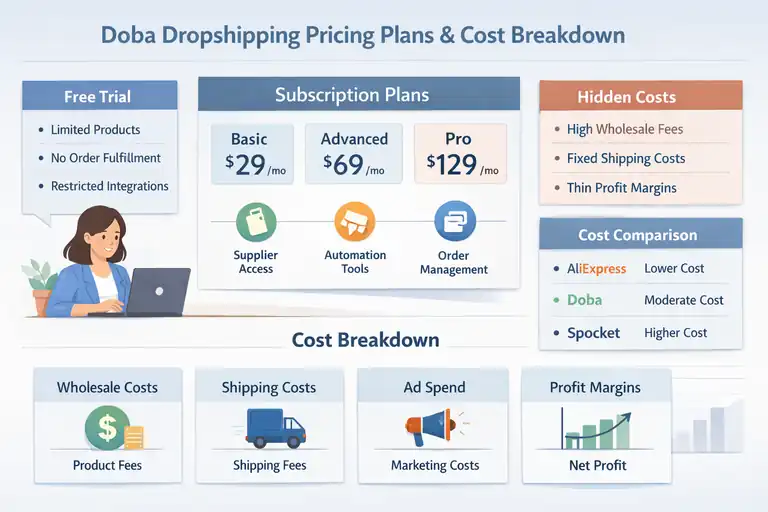
Pricing is where most people pause. Doba dropshipping is not free, and the subscription cost changes the math of your business quickly.
Understanding the full cost structure upfront can save you frustration later.
Free Trial Limitations And Access Restrictions
Doba offers a limited free trial, but it’s more of a preview than a usable plan. You can browse products and explore the dashboard, but you cannot fully operate a store long-term without upgrading.
During the trial, you’ll notice restrictions like:
- Limited product access
- No live order fulfillment
- Reduced export and integration capabilities
This trial is best used to evaluate usability, supplier quality, and niche fit. It’s not designed to validate profitability.
Monthly Subscription Plans And Feature Differences
Doba uses tiered monthly plans, typically starting around $24–$29 per month and scaling upward based on features. Higher plans unlock more integrations, automation, and reporting tools.
In simple terms, you’re paying for:
- Access to suppliers
- Automation and syncing tools
- Centralized order management
For beginners, the entry-level plan is usually enough. Advanced sellers may need higher tiers, but at that point, the cost-to-value ratio deserves scrutiny.
Hidden Costs That Affect Doba Profit Margins
The subscription fee is just the visible cost. The bigger issue is product pricing. Many Doba products have thinner margins than alternatives like AliExpress or direct suppliers.
Common margin pressure points include:
- Higher wholesale costs
- Fixed shipping fees that eat into profit
- Limited pricing flexibility
If you’re running paid ads, these costs add up fast. I’ve seen sellers struggle to maintain even 15–20% margins unless they price aggressively or upsell.
How Doba Pricing Compares To Other Supplier Tools
Compared to other dropshipping tools, Doba sits in the middle. It’s more expensive than AliExpress-based tools but cheaper than some premium US supplier platforms.
Quick comparison perspective:
- AliExpress + DSers: Lower cost, higher effort
- Spocket: Higher cost, faster shipping
- Doba: Moderate cost, centralized convenience
If your priority is simplicity and supplier access, Doba can justify its price. If your priority is maximum margin, it’s harder to defend long-term.
My honest take: Doba is priced for convenience, not optimization. Whether that’s worth it depends entirely on your goals and tolerance for tradeoffs.
Pros Of Using Doba Dropshipping For Online Stores
Doba dropshipping shines when convenience and structure matter more than squeezing every last dollar of margin.
If you value a cleaner workflow and fewer moving parts, these advantages can feel genuinely helpful, especially early on.
Access To A Large Supplier And Product Network
One of the biggest reasons people choose doba dropshipping is instant access to a wide supplier network. You’re not stuck with one vendor or one region. You can browse thousands of products across multiple niches from a single dashboard.
What this looks like in practice is speed. Instead of spending weeks hunting for suppliers, you can validate ideas quickly.
Helpful realities here:
- You can test multiple niches without opening new accounts
- Many suppliers are US-based, which appeals to domestic buyers
- Products already include dropshipping-friendly terms
In my experience, this is especially useful if you’re still figuring out what you want to sell. You’re trading higher product costs for faster decision-making, which can be a fair exchange early on.
Centralized Dashboard For Products And Orders
The Doba dashboard is one of its strongest features. Everything lives in one place: products, orders, suppliers, and inventory updates.
If you’ve ever managed orders manually, you’ll appreciate how much mental space this saves. You don’t bounce between emails, spreadsheets, and supplier portals.
What the dashboard simplifies:
- Product imports and pricing updates
- Order routing to suppliers
- Tracking number synchronization
I’ve seen beginners avoid costly mistakes simply because the system prevents them. It’s not flashy, but it’s stable, and stability matters more than people admit.
No Need To Contact Suppliers Individually
This is an underrated benefit. With Doba, you don’t negotiate terms, request catalogs, or explain your business model to every supplier.
That alone removes a major friction point for beginners who feel intimidated by supplier outreach.
Why this matters emotionally as well as practically:
- You avoid rejection or silence from suppliers
- You skip long approval processes
- You focus on building the store, not chasing emails
If outreach drains your energy, Doba acts like training wheels. Not forever, but helpful while you’re learning balance.
Built-In Tools That Simplify Early-Stage Stores
Doba includes tools that quietly support early-stage stores, like automated inventory syncing and basic analytics.
These aren’t advanced growth tools, but they prevent beginner errors.
Examples that matter more than they sound:
- Inventory updates reduce overselling
- Order automation cuts fulfillment delays
- Supplier data helps compare options faster
For someone launching their first store, these tools reduce overwhelm. And honestly, less overwhelm usually means better follow-through.
Cons And Limitations Of Doba Dropshipping Today
Doba dropshipping is not a perfect solution, and pretending otherwise would be misleading. These limitations don’t affect everyone equally, but they’re important to understand before committing.
Higher Product Costs Compared To Alternatives
The most common complaint I hear is pricing. Doba products often cost more than similar items on AliExpress or through direct suppliers.
That affects margins immediately.
Why this happens:
- Suppliers bake convenience into pricing
- Shipping costs are often fixed and non-negotiable
- You’re paying for access, not exclusivity
If you rely on paid ads, this can hurt fast. I’ve seen stores struggle to stay profitable unless they raise prices, which then impacts conversion rates.
Limited Control Over Branding And Packaging
If branding matters to you, Doba will feel restrictive. Most suppliers ship products in generic packaging with little customization.
What you usually can’t control:
- Custom boxes or inserts
- Branded labels
- Unboxing experience
For commodity products, this may not matter. But if your long-term plan includes brand equity, this limitation becomes a ceiling you eventually hit.
Supplier Location And Shipping Speed Issues
While many Doba suppliers are US-based, not all are. Shipping speed varies more than the platform suggests.
What I’ve noticed:
- Delivery times can range from 3 to 14+ days
- Tracking updates aren’t always real-time
- Customer expectations still lean Amazon-fast
If your audience expects quick delivery, you’ll need to vet suppliers carefully or accept higher support volume.
Subscription Fees That Impact Small Sellers
Finally, the monthly subscription is a psychological and financial weight for small sellers.
Even $29 a month matters when:
- You’re testing ideas
- You haven’t made consistent sales yet
- Every tool adds to overhead
For some, that pressure motivates action. For others, it adds stress. I always suggest being honest with yourself here. If the fee makes you rush decisions, it might not be the right fit yet.
Sometimes the smartest move is waiting until your foundation is stronger, even if the tool itself is solid.
Doba Dropshipping Compared To Other Supplier Platforms
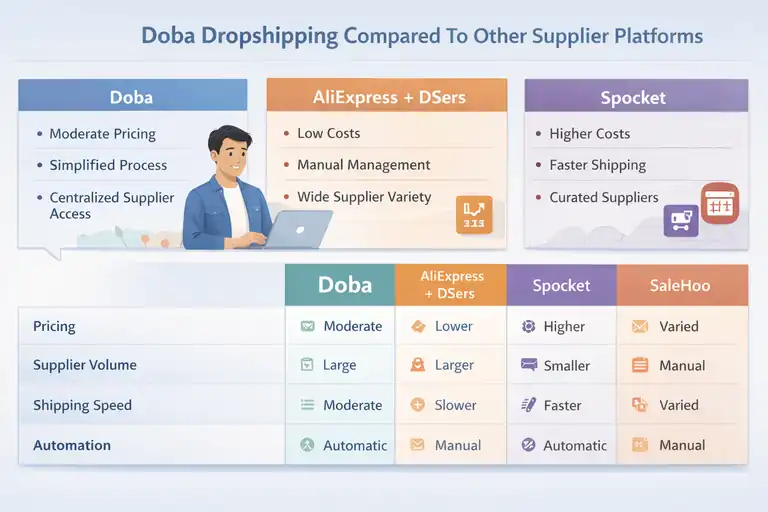
When people ask me whether doba dropshipping is “better” than other platforms, my honest answer is always: it depends on what kind of friction you’re willing to tolerate.
Each option solves a different problem, and comparing them side by side makes the tradeoffs much clearer.
Doba Dropshipping Vs AliExpress And DSers
AliExpress paired with DSers is still the most common entry point into dropshipping. It’s cheap, flexible, and chaotic.
Doba flips that experience on its head.
Here’s how the difference feels in practice:
- AliExpress + DSers gives you lower product costs and more variety
- Doba gives you structure, fewer suppliers, and cleaner workflows
With AliExpress, you manually vet suppliers, deal with inconsistent shipping, and handle frequent product changes. In return, your margins are usually better. With Doba, you pay more per product but spend far less time managing chaos.
If you’re running paid ads and need every dollar of margin, AliExpress often wins. If you’re overwhelmed by moving parts, Doba can feel like relief.
Doba Dropshipping Vs Spocket And US Suppliers
Spocket is often compared to Doba because both emphasize US and EU suppliers.
The key difference is curation versus volume.
Spocket focuses on fewer suppliers with faster shipping and more branding-friendly options. Doba focuses on a larger supplier catalog with standardized processes.
Quick comparison snapshot:
| Feature | Doba | Spocket |
| Supplier volume | Large | Smaller, curated |
| Shipping speed | Moderate | Faster on average |
| Branding options | Limited | Slightly better |
| Pricing | Moderate | Higher |
If your brand promise is fast shipping, Spocket usually wins. If you want more product choice without supplier outreach, Doba is often easier.
Doba Dropshipping Vs SaleHoo Directory Model
SaleHoo works very differently. It’s a directory, not an automation platform.
That means SaleHoo helps you find suppliers, but you still manage relationships, orders, and integrations yourself.
In real terms:
- Doba is “plug-and-play”
- SaleHoo is “find-and-build”
If you enjoy control and don’t mind emailing suppliers, SaleHoo can lead to better long-term margins. If you want to avoid outreach entirely, Doba feels far more approachable.
Doba Dropshipping Vs Wholesale Marketplaces
Wholesale marketplaces like Faire or direct B2B portals require upfront inventory purchases. That alone puts them in a different category.
Doba’s advantage is obvious here: no inventory risk.
Wholesale marketplaces win when:
- You already have demand
- You want exclusive pricing
- You’re building a brand
Doba wins when you’re still validating. It’s not about which is “better,” but which matches where you are right now.
Who Doba Dropshipping Is Best For Right Now
Doba dropshipping isn’t for everyone, but it fits certain situations surprisingly well. If you see yourself in any of these scenarios, it might actually make sense.
Beginners Who Want A Structured Supplier System
If this is your first store, structure matters more than optimization.
Doba gives you guardrails. Fewer decisions. Fewer mistakes.
Instead of juggling tools, suppliers, and spreadsheets, you get one system that works “well enough” across the board. That stability often keeps beginners from quitting too early.
Sellers Focused On US-Based Wholesale Products
If your audience is primarily in the US and expects reasonable shipping times, Doba’s supplier base can help.
You won’t get overnight delivery, but you’re far less likely to face 30-day shipping complaints.
This works especially well for:
- Practical home products
- Office supplies
- Non-trendy evergreen items
These categories value reliability over hype.
Store Owners Avoiding Direct Supplier Outreach
Some people love negotiating. Others hate it.
If supplier outreach feels draining or intimidating, Doba removes that barrier completely. You trade margin for peace of mind.
I’ve seen sellers move faster simply because they weren’t stuck waiting on supplier replies.
Businesses Testing Dropshipping Before Scaling
Doba works well as a testing environment.
You can:
- Validate product demand
- Learn order flow
- Understand customer expectations
Then, once you find traction, you can graduate to direct suppliers or private arrangements. In that sense, Doba isn’t always the final destination. Sometimes it’s the training ground, and that’s perfectly fine.
When Doba Dropshipping Is Not Worth Starting
Doba dropshipping can be useful, but there are very real scenarios where it works against your goals. If you’re in one of these positions, starting with Doba may slow you down rather than help.
Sellers Focused On High-Margin Private Label Brands
If your goal is to build a recognizable brand with strong margins, Doba is usually the wrong tool.
Private label means selling products under your own brand name, with custom packaging and a distinct customer experience. Doba’s supplier model doesn’t support that well.
Here’s where things break down:
- Products are generic and sold by many retailers
- Packaging and inserts are controlled by suppliers
- You cannot differentiate easily beyond price
In my experience, private label sellers need margin control and supplier relationships. Doba trades both for convenience. That’s fine for testing, but it becomes a bottleneck once branding matters.
Dropshippers Needing Fast International Shipping
If you sell to customers outside the US, shipping speed becomes a deal-breaker fast.
Doba has international suppliers, but delivery times are inconsistent. You may see 7–10 day shipping on paper, then deal with delays in reality.
This creates problems like:
- Higher refund requests
- Lower repeat purchase rates
- More support tickets
If your audience expects near-Amazon speed globally, you’ll likely struggle to meet expectations through Doba alone.
Ecommerce Stores Scaling Past Starter Volumes
Doba works best at low to moderate order volume. Once you start scaling, cracks appear.
Common scaling pain points include:
- Limited pricing negotiation
- Supplier capacity constraints
- Thinner margins under ad pressure
When you’re spending thousands per month on ads, even small cost inefficiencies matter. At that stage, most serious sellers move toward direct supplier relationships or bulk purchasing.
Entrepreneurs With Tight Monthly Budgets
Even a modest subscription fee can hurt when cash flow is tight.
If you’re choosing between:
- Paying for ads
- Paying for your store platform
- Paying for supplier access
Doba often loses that comparison. Free or pay-as-you-go tools reduce pressure while you learn.
Sometimes the smartest decision is not starting yet.
Best Alternatives To Doba Dropshipping In 2025
If Doba dropshipping doesn’t fully align with your goals, there are solid alternatives depending on what you value most. Each option below solves a different problem.
Spocket For Faster US And EU Fulfillment
Spocket focuses heavily on US and EU suppliers with faster shipping times.
It’s especially useful if your store promises quick delivery and higher perceived quality.
Where Spocket stands out:
- Faster average shipping
- More curated supplier list
- Better fit for premium positioning
The downside is higher product costs and fewer total products. If speed is your selling point, that tradeoff can be worth it.
AliExpress With DSers For Low-Cost Scaling
AliExpress combined with DSers remains the cheapest way to scale dropshipping.
DSers is an order automation tool that helps manage AliExpress suppliers. In simple terms, it reduces manual work while keeping costs low.
Why sellers still use this setup:
- Extremely low product costs
- Massive product variety
- High margin potential
The tradeoff is operational chaos if you don’t vet suppliers carefully. This setup rewards effort and punishes shortcuts.
SaleHoo For Supplier Vetting And Research
SaleHoo is not a dropshipping platform. It’s a supplier directory.
That means you use it to find vetted suppliers, then build relationships yourself.
This works well if:
- You want long-term supplier control
- You’re comfortable with outreach
- You care about margin optimization
It’s slower upfront, but often stronger long-term.
Direct Supplier Partnerships Outside Marketplaces
This is the endgame for many sellers.
Once you have sales data, you can contact manufacturers or distributors directly. No middle platforms. No subscriptions.
Benefits include:
- Better pricing
- Custom terms
- Real business relationships
It takes effort, but the payoff compounds.
Final Verdict On Doba Dropshipping In Today’s Market
Doba dropshipping still has a place in today’s ecommerce landscape, but it’s no longer a universal recommendation. The value depends entirely on what you’re optimizing for right now.
Key Tradeoffs Between Convenience And Profit
Doba’s biggest strength is convenience. Its biggest weakness is margin.
You’re essentially paying to reduce friction:
- Less supplier outreach
- Fewer tools to manage
- Cleaner workflows
If you’re early-stage, that tradeoff can make sense. If you’re growth-focused, it becomes expensive.
What I’d Consider Before Paying For A Subscription
Before subscribing, I’d ask myself a few honest questions:
- Do I value speed over control right now?
- Can I afford thinner margins while learning?
- Am I testing, or am I scaling?
If your answers lean toward testing and learning, Doba can be a reasonable step.
How To Decide If Doba Fits Your Business Goals
Doba fits builders who want structure, not optimization.
If you want:
- A guided entry into dropshipping
- Fewer technical headaches
- Predictable workflows
It can help. If you want maximum profit and brand control, it won’t.
Smarter Ways To Test Doba Without Overcommitting
If you’re curious but cautious, here’s a safer approach:
- Use the trial to analyze suppliers
- Build a small test store
- Validate one or two products only
Think of Doba as a learning platform, not a forever solution. Used intentionally, it can teach you how dropshipping works without overwhelming you. Used blindly, it can become an unnecessary expense.
The difference is clarity, not the tool itself.
FAQ
Is doba dropshipping legit and safe to use today?
Yes, doba dropshipping is a legitimate platform that connects retailers with pre-vetted suppliers. It’s safe to use, but legitimacy doesn’t guarantee profitability, which depends on pricing, margins, and how you run your store.
Is doba dropshipping worth it for beginners in 2026?
Doba dropshipping can be worth it for beginners who want a structured system with minimal supplier outreach. It’s best for learning order flow and product testing, not for maximizing profits long-term.
Can you make money with doba dropshipping today?
You can make money with doba dropshipping, but margins are often thinner than alternatives. It works best for testing products or selling higher-priced items where convenience matters more than cost.

I’m Juxhin, the voice behind The Justifiable.
I’ve spent 6+ years building blogs, managing affiliate campaigns, and testing the messy world of online business. Here, I cut the fluff and share the strategies that actually move the needle — so you can build income that’s sustainable, not speculative.
Related posts:
 Lightspeed Ecommerce vs Others: Which Helps You Earn Faster?
 Dropshipping Platforms Ranked: Speed, Fees, and Control
 How To Start A Dropshipping Business With No Money
 Dropshipping Guide: Build a Store That Actually Sells
 Start Dropshipping Today: A Simple Guide for Complete Beginners
 Is Doba Shopify Worth Using for Dropshipping Stores?