
Table of Contents
Some links on The Justifiable are affiliate links, meaning we may earn a small commission at no extra cost to you. Read full disclaimer.
When I first started to promote affiliate links, I made one big mistake—I sounded like a walking advertisement. If you’ve ever dropped a link and felt a little “spammy,” you’re not alone.
The truth is, promoting affiliate products without turning off your audience is an art. It’s about trust, storytelling, and subtle strategy.
In this guide, I’ll walk you through the most effective ways to share affiliate links authentically, so you can earn commissions while keeping your audience engaged and respected.
Understand Why Affiliate Links Feel Spammy
Before you can promote affiliate links effectively, it helps to understand why they sometimes come across as spammy.
It’s not about the link itself—it’s about how and when it’s shared.
Recognize Common Mistakes in Affiliate Promotion
One of the most common mistakes I see is treating affiliate marketing like traditional advertising. If every other line in your post or email screams “buy this now,” readers start tuning out.
Some quick examples of what makes affiliate content feel pushy:
- Linking too often in a single paragraph.
- Promoting unrelated products that don’t fit the audience’s intent.
- Using aggressive calls-to-action like “You must buy this today!”
- Copying manufacturer descriptions instead of adding personal context.
In my experience, the fix is simple: earn the click by offering value first. Instead of saying “Go buy this,” show why it helped you, or how it solves a real problem.
How Overselling Damages Audience Trust
Every time you overpromise or sound too salesy, you chip away at the trust you’ve built. Readers don’t mind links—they mind manipulation. If you recommend products that don’t match their needs, they’ll feel deceived.
A better approach is honesty in moderation. You can still be enthusiastic, but be transparent: share both pros and cons.
For example, if you’re promoting a plugin, say, “This one’s fast but has a slightly steep learning curve.” That kind of honesty builds credibility, not suspicion.
The Psychology Behind Spam Perception
From what I’ve seen, people don’t hate affiliate links—they hate feeling like they’re being sold to. Our brains detect insincerity fast. If your tone feels desperate or overly polished, readers subconsciously back away.
The solution? Keep your voice conversational and grounded. Imagine you’re recommending a product to a friend, not pitching it to a stranger.
A simple mindset shift—“I’m helping, not selling”—turns spam into service.
Build Trust Before You Promote Affiliate Links
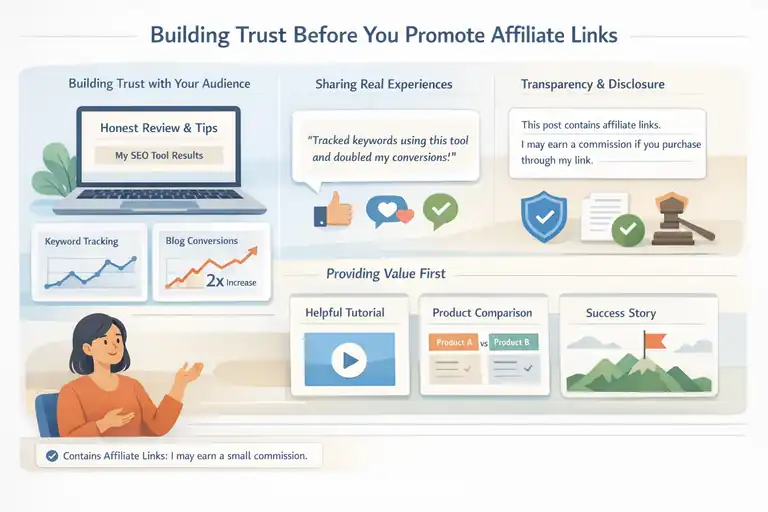
Before asking for a click, you need to earn belief. Trust transforms affiliate links from potential spam into helpful resources.
How Authenticity Shapes Buying Decisions
Authenticity isn’t just a buzzword—it’s currency. People buy from creators they believe. That’s why I always advise sharing real stories and outcomes.
For example, instead of saying “This SEO tool boosted my rankings,” describe how you used it: “After tracking my keywords in Awin’s affiliate dashboard, I spotted which posts converted best—and doubled down.”
That kind of transparency connects emotionally and proves your experience is genuine.
Why Transparency About Affiliates Matters
Let me be clear: always disclose your affiliate partnerships. Phrases like “This post contains affiliate links, which means I may earn a small commission if you buy through my link” actually increase reader trust.
Transparency signals confidence. It tells your audience you stand behind what you’re recommending. And in most countries, like the U.S., the FTC requires disclosure—so it’s also legally smart.
Creating Value-First Content That Naturally Converts
A value-first mindset means you lead with education, not persuasion. Instead of a product push, create tutorials, comparisons, or stories that teach something useful.
Here’s what works:
- Share actionable tips or frameworks first.
- Weave affiliate mentions into real examples.
- Let your results speak louder than your links.
If your content helps solve a problem, readers will want to click—not feel pressured to.
Choose The Right Affiliate Products For Your Audience
Not every affiliate product is a fit. Choosing the right ones is what separates genuine recommendations from spammy promotions.
How To Match Affiliate Products To Reader Intent
Start by understanding your audience’s real goals.
For example, if you teach creators how to grow their audience, promote tools that make that process easier—like Kit for email automation or Awin’s discovery tools for affiliate partnerships.
Ask yourself: Would I personally use this product if I weren’t getting paid? If the answer’s no, it’s not worth recommending.
Evaluating Product Credibility Before Promotion
Before you share any affiliate link, test the product yourself—or at least research verified reviews.
Look for:
- Clear product value and features.
- Positive user experiences (not just testimonials).
- Active support and long-term stability.
I once promoted a promising new SaaS, only to have it vanish six months later. Now I only partner with brands that have consistent track records and responsive support.
Using Awin To Find Trusted, High-Converting Programs
Awin is my go-to platform for discovering reliable affiliate programs. It replaced the now-closed ShareASale network, and it’s known for vetting brands carefully.
Here’s how I use it:
- Log in to Awin.
- Browse categories related to your niche (e.g., finance, software, or lifestyle).
- Check program stats—commission rates, EPC (earnings per click), and approval rates.
By focusing on brands with solid reputations and good conversion data, your promotions feel more trustworthy and perform better.
Create Content That Promotes Affiliate Links Naturally
Affiliate content should feel like part of the story—not an interruption. When done right, links blend seamlessly into helpful content.
Crafting Educational Blog Posts That Subtly Sell
Start with value. Write posts that solve a reader’s problem and only mention affiliate links where they make sense.
For instance, if you’re writing “How to Build a Landing Page That Converts,” mention your favorite builder (with an affiliate link) when you naturally discuss the tools needed.
Pro tip: Don’t overload your post with links. One to three well-placed mentions per article usually outperforms ten scattered ones.
Using Storytelling To Integrate Product Recommendations
Storytelling is one of the most effective ways to promote affiliate links without sounding salesy. When you tell a personal or client-based story that includes the product, it feels authentic.
For example: “I used to spend hours manually tagging email subscribers until I discovered Kit’s automation feature. Now, I just set rules once, and it sorts my audience for me.”
This approach works because it’s conversational, relatable, and rooted in personal experience.
How-To Guides And Tutorials That Drive Organic Conversions
How-to content converts because it shows readers how a product solves their problem in real time. Step-by-step tutorials, mini video demos, or screen captures are great for this.
Example: “Here’s how to create your first affiliate campaign in Awin: Dashboard → Programs → Apply → Copy Tracking Link.”
When you walk readers through tangible results, they trust you—and they buy.
Promote Affiliate Links Through Email The Right Way
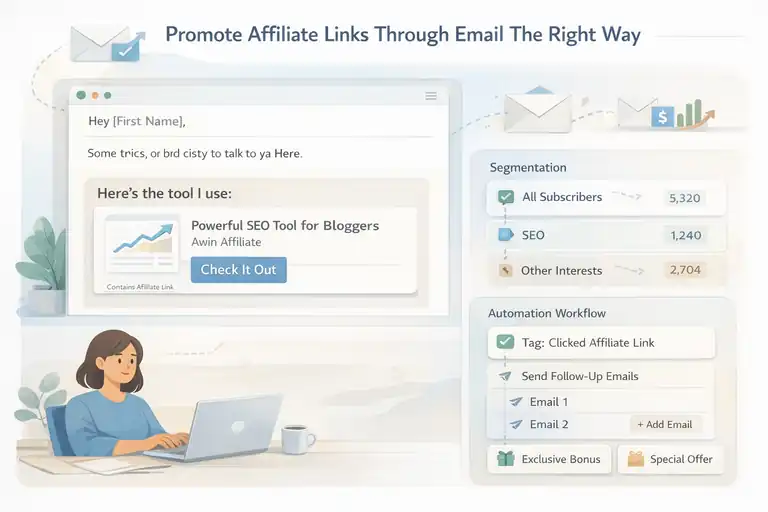
Email marketing remains one of the most powerful (and underused) ways to share affiliate content authentically.
How To Write Value-Driven Affiliate Emails
The golden rule: educate first, sell second. Every email should offer something useful, whether that’s a mini tip, story, or insight.
Here’s an easy structure I use:
- Start with a relatable story or pain point.
- Share a quick solution or lesson learned.
- Mention the affiliate product that helped.
- Add a soft call-to-action (e.g., “Here’s the tool I use”).
This keeps your tone conversational, not transactional.
Segmenting Audiences For Better Conversions
Not every subscriber cares about every product. Segmenting means grouping your audience by interest or behavior—so they only see what’s relevant.
For example, in Kit, you can tag subscribers who clicked your previous “SEO tools” email. Then, when you promote another related product, you send it only to that segment.
This simple strategy boosts engagement and reduces unsubscribes.
Using Kit To Automate Email Campaigns Effectively
Kit (formerly ConvertKit) is a creator-friendly email platform that simplifies automation.
A quick workflow example:
- Go to Automations → New Sequence.
- Set a trigger like “Clicked affiliate link.”
- Add follow-up emails sharing value (like setup tips or bonuses).
This way, your promotions feel personal and purposeful, not spammy. You’re continuing the conversation, not pushing another sale.
Use Social Media To Promote Affiliate Links Authentically
Promoting affiliate links on social media can either feel natural or painfully forced—it all depends on your approach.
The goal is to blend your recommendations into meaningful content that feels like a genuine part of your daily story.
Leveraging Instagram And TikTok Without Sounding Salesy
If you’ve ever scrolled through Instagram or TikTok, you’ve seen both extremes: the “in-your-face” product pusher and the quiet creator whose recommendations feel effortless. You want to be the latter.
Here’s what works well:
- Show before you tell. Instead of saying “Buy this,” demonstrate it. For example, film a short clip of you using a product that improved your workflow, then share what changed for you.
- Use captions wisely. Write naturally, as if talking to a friend. “I’ve been trying this planner for two weeks—it’s made my mornings less chaotic.”
- Limit links in bios. Keep your bio link simple, ideally a single link with multiple destinations using tools like Linktree or Awin’s smart link feature.
Remember, social media followers want stories and authenticity, not constant sales pitches.
The Art Of Soft Selling Through Stories And Reels
Soft selling is about creating curiosity without direct pressure. When using Instagram Stories or TikTok Reels, make your content feel like a behind-the-scenes share, not a promo.
For example, if you’re promoting an email automation tool like Kit, you could record a short clip showing how it organizes your subscribers automatically. Then add a subtle overlay like: “This feature saved me hours—link’s in my bio if you want to try it.”
The power of this approach is emotional relatability. People connect with you, not the product first.
Building A Loyal Community That Trusts Your Recommendations
Consistency and honesty are what build a real community. Engage genuinely—reply to comments, ask questions, and show gratitude when people support your links.
A small but loyal audience that trusts your advice will always outperform a large but disconnected one. From what I’ve seen, it’s those deeper relationships that turn affiliate clicks into repeat conversions.
Optimize Your Affiliate Promotions With Data
You can’t improve what you don’t measure. Tracking your affiliate links and testing how people respond helps you make smarter, more ethical promotion decisions.
Tracking Performance With Tools Like VWO And Optimizely
VWO and Optimizely are both excellent tools for understanding what works in your affiliate campaigns. They help you experiment with things like button placement, copy variations, and call-to-action styles.
A simple path to start in VWO:
- Log in to your dashboard.
- Choose Create Test → A/B Test.
- Set variations, such as two different affiliate button designs.
Even small improvements in click-through rates—say 2% to 3%—can compound significantly over time.
How To A/B Test Affiliate Content Without Being Pushy
Testing doesn’t mean spamming your audience with multiple versions of the same message. Instead, make subtle, thoughtful changes.
Try this:
- Test different types of intros—educational vs. storytelling.
- Swap call-to-action phrases like “Check it out” versus “See how it works.”
- Monitor which version performs better through your affiliate dashboard (Awin offers built-in link tracking metrics).
A/B testing helps you refine your tone, not just your design. The result is content that feels even more natural and effective.
Using Analytics To Refine Your Promotion Strategy
Analytics reveal patterns that aren’t always obvious. For instance, you might notice certain posts convert better when you share a personal story, or that emails perform best on Tuesdays.
Awin provides detailed EPC (earnings per click) reports, while tools like Google Analytics show which content drives traffic to your links. Use these insights to focus on what actually works instead of guessing.
Over time, this data-driven refinement makes your promotions smoother, more ethical, and more profitable.
Diversify Your Affiliate Link Placement
One of the best ways to promote affiliate links without being spammy is to spread them out across different formats.
When links appear naturally in multiple content types, they feel more like resources and less like advertisements.
Smart Ways To Integrate Links Into Blogs, Videos, And Podcasts
Different audiences prefer different mediums. Some love reading, others watching, others listening. Repurpose your affiliate strategy accordingly.
For example:
- Blogs: Embed links naturally in tutorials or comparison posts.
- Videos: Mention the product once, then show it in action.
- Podcasts: Use short mentions like, “By the way, I use Kit for my email sequences—it’s in the show notes if you’re curious.”
This approach builds familiarity across platforms without overwhelming any single channel.
When (And Where) To Include Links For Maximum Impact
Timing matters. The most effective affiliate link placements happen after value has been delivered.
If you’re writing a blog post, place the first link after explaining a key benefit. In videos, add the link near the end when trust has been earned. In podcasts, use your intro or outro for a short mention.
Think of it like seasoning—use it strategically, not excessively.
Why Less Frequent But Strategic Linking Converts Better
It might sound counterintuitive, but the fewer links you include, the higher your click rates often go. That’s because scarcity increases curiosity and focus.
By limiting your links to only the most relevant spots, you create a sense of trust. Readers feel you’re recommending something because it matters, not because you’re chasing clicks.
Maintain Ethical Standards In Affiliate Marketing
Ethical affiliate marketing builds long-term success. Cutting corners or misleading readers might bring quick gains, but it always backfires in the end.
Understanding FTC Disclosure Requirements
The FTC (Federal Trade Commission) requires affiliate marketers to disclose partnerships clearly. That means you need to tell readers when you earn commissions.
A simple, effective disclosure: “This post contains affiliate links, which means I may earn a small commission if you purchase through my link—at no extra cost to you.”
Place it at the top of your content, not buried at the bottom. Transparency isn’t just compliance—it’s respect for your reader.
How Honest Reviews Strengthen Long-Term Credibility
Honesty turns casual readers into loyal fans. Share both the strengths and weaknesses of any product you recommend.
For example: “Kit is incredibly easy to use for automating email sequences, but its analytics dashboard could be more detailed.”
Readers appreciate balanced reviews. They show you care more about their success than a commission.
Balancing Revenue Goals With Audience Integrity
It’s natural to want to earn from your work—but not at the cost of trust. Always ask yourself, Would I still recommend this product if there was no affiliate program?
When your integrity leads your income, the results compound naturally. People can feel sincerity, and that’s what keeps them coming back.
Pro Tips To Promote Affiliate Links Without Being Spammy
After years of trial, error, and countless experiments, I’ve learned a few reliable techniques that help you grow your affiliate income without sacrificing authenticity.
The “Friend Recommendation” Approach That Always Works
Imagine recommending something to a close friend. You’d explain why you liked it, how it helped, and leave them free to decide. That’s exactly how to talk about affiliate products online.
Use phrases like “Here’s what worked for me” instead of “You need this.” It feels lighter, and readers appreciate being treated as equals.
How To Build Passive Income Through Evergreen Content
Evergreen content—like tutorials, comparisons, or resource guides—can generate affiliate income long after you publish it.
For instance, a post titled “Best Email Tools for Creators” can drive consistent traffic and commissions if you update it regularly. Make sure links remain active (especially if tools rebrand, like Sendinblue becoming Brevo).
Evergreen articles quietly do the heavy lifting while you focus on new ideas.
My Go-To Checklist Before Publishing Affiliate Content
Before hitting publish, I always run through a quick checklist:
- Does this content genuinely help my audience?
- Are my disclosures clear and visible?
- Did I test or personally verify the product?
- Are affiliate links placed naturally, not forced?
- Does the tone feel conversational and honest?
If every answer is “yes,” your affiliate content is ready.
Pro Tip: Think of promoting affiliate links as building relationships, not just income. The more your audience feels understood and respected, the more naturally your recommendations will convert—without ever feeling spammy.
FAQ
How can I promote affiliate links without being spammy?
You can promote affiliate links naturally by focusing on value-driven content, being transparent about affiliations, and sharing personal experiences instead of hard-selling.
What’s the best way to promote affiliate links on social media?
Use storytelling and demonstrations to show real benefits, limit links in captions, and guide followers to one main link in your bio for a seamless experience.
How do I build trust while promoting affiliate links?
Disclose partnerships clearly, recommend only products you truly use or believe in, and balance promotional content with educational or entertaining posts.

I’m Juxhin, the voice behind The Justifiable.
I’ve spent 6+ years building blogs, managing affiliate campaigns, and testing the messy world of online business. Here, I cut the fluff and share the strategies that actually move the needle — so you can build income that’s sustainable, not speculative.
Related posts:
 Start Making Money with MyLead Affiliate Program: The Best Way
 Methods for Marketing Affiliate Websites – Simple Ways
 What Methods Do Successful Affiliate Marketers Use
 How to Make Money with Affiliate Marketing
 How to Become a Better Affiliate Marketer
 10 Proven Strategies for Creating Passive Income Streams