
Table of Contents
Some links on The Justifiable are affiliate links, meaning we may earn a small commission at no extra cost to you. Read full disclaimer.
If you’ve been wondering how to use SaleHoo for dropshipping without wasting hours on the wrong suppliers or slow-moving products, you’re in the right place.
I’ve seen too many beginners jump into dropshipping, pick random items, and burn ad spend because they didn’t validate demand or supplier reliability first.
This guide is for aspiring dropshippers, side hustlers, ecommerce beginners, and even small store owners who want to source fast-selling products with less risk.
We’re answering one clear question: How do you actually use SaleHoo for dropshipping—and how do you choose products that sell quickly instead of sitting in your store?
How To Set Up SaleHoo For Dropshipping The Right Way
If you want to master how to use SaleHoo for dropshipping, setup is where most people either gain clarity—or get overwhelmed. The platform is simple, but using it strategically is what separates random browsing from finding real suppliers.
Let me walk you through it step by step.
Create And Verify Your SaleHoo Account
First, sign up at SaleHoo.com and choose a plan. SaleHoo typically offers:
| Plan | Billing | Best For |
| Annual Membership | Lower yearly rate | Beginners testing product ideas |
| Lifetime Access | One-time payment | Long-term dropshippers building brands |
After payment, you’ll get access to:
- Supplier Directory
- Market Research Lab
- Community Forum
Verify your email immediately. That sounds basic—but verification unlocks direct supplier messaging inside the dashboard.
Pro tip: Use a professional email address tied to your domain (e.g., hello@yourstore.com). Suppliers take you more seriously than if you message them from a Gmail account.
This small detail increases response rates. In my experience, supplier reply speed improves significantly when you look like a business—not a hobbyist.
Navigate The SaleHoo Directory And Dashboard
Once inside, head to the Supplier Directory. This is where most of your time will be spent.
You’ll see filters for:
- Product category
- Supplier type (Wholesaler or Dropshipper)
- Location
- Shipping regions
The dashboard can feel broad at first. Don’t browse randomly.
Instead, start with:
- Your niche (e.g., Home Fitness, Pet Accessories, Kitchen Tools)
- A target country (e.g., United States if you want fast shipping)
- Supplier type set to “Dropshipper”
SaleHoo lists over 8,000 vetted suppliers. But here’s the reality: Not all will fit your business model.
Your goal isn’t to find many suppliers.
Your goal is to find 2–3 high-quality suppliers per product category.
Filter Suppliers By Dropship-Friendly Criteria
When learning how to use SaleHoo for dropshipping, filtering is everything.
Here’s what I look for immediately:
- Ships to your target market
- No high minimum order quantity (MOQ)
- Accepts small retailers
- Provides tracking numbers
- Offers reasonable shipping times (under 10 days preferred for US market)
If a supplier requires bulk purchases, they’re not true dropshipping partners.
Reality check: Some suppliers say “dropshipping available” but quietly charge handling fees per order. Always read the profile carefully.
You want suppliers that:
- Allow single-item fulfillment
- Provide blind shipping (No supplier branding in the package)
- Offer returns process clarity
That last one matters more than you think. Returns destroy margins if not managed correctly.
Shortlist Suppliers Based On Real Performance Signals
SaleHoo pre-screens suppliers, but you still need to evaluate.
Here’s how I shortlist properly:
- Years In Business: Established suppliers (5+ years) are generally more stable.
- Contact Transparency: Legitimate suppliers list phone numbers, addresses, and business details.
- Response Speed: Message them with a simple inquiry. If they reply within 24–48 hours, that’s a strong sign.
- Pricing Spread: Compare supplier price vs Amazon or competitor retail price.
Example:
- Supplier cost: $14
- Average Amazon retail: $39
- Estimated shipping: $5
- Gross margin: ~$20 before ads
That’s workable.
If the margin is under 30%, scaling with paid ads becomes difficult.
How To Find Dropshipping Suppliers Inside SaleHoo
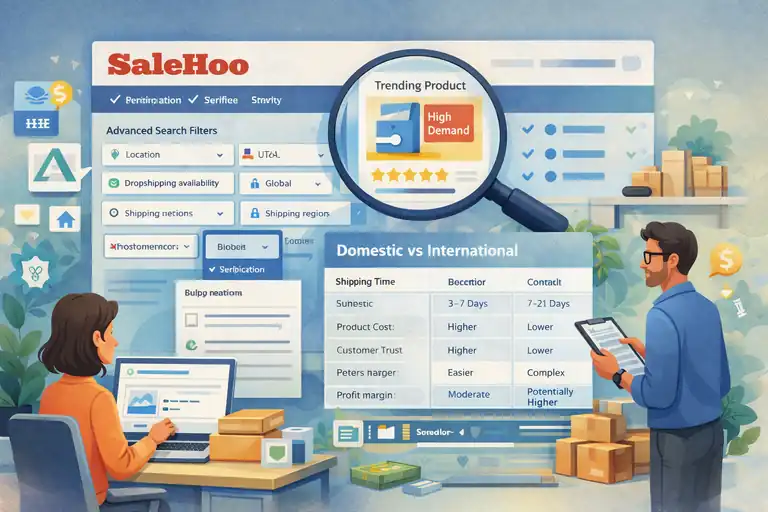
Now that your account is set up, this is where the real work begins. Finding suppliers inside SaleHoo isn’t about scrolling—it’s about structured research.
Let me break it down properly.
Use Advanced Search Filters To Narrow Results
SaleHoo’s filtering system is underrated.
Instead of searching “fitness,” try:
- “Resistance Bands Dropshipper USA”
- “Adjustable Dumbbells Supplier”
- “Pet Grooming Tools Dropship”
The more specific you are, the better your results.
Then refine by:
- Location
- Dropshipping available
- Shipping regions
This eliminates suppliers who can’t serve your market efficiently.
Shortcut strategy: Start with “United States” suppliers first if your store targets US customers. Faster shipping = higher conversion rates.
According to Baymard Institute, 22% of shoppers abandon carts due to slow delivery times. Shipping speed directly impacts sales.
Identify Verified And Pre-Screened Suppliers
One reason people use SaleHoo instead of random Google searches is verification.
SaleHoo checks:
- Business registration
- Supplier legitimacy
- Contact information
- Trade history
But don’t stop there.
Go further:
- Check their website professionalism
- Search their brand name on Google
- Look for reviews outside SaleHoo
If they look outdated or inactive, move on.
You’re building a real ecommerce business—not gambling.
Compare Domestic Vs International Suppliers
This decision affects everything: delivery speed, refunds, customer satisfaction, and even ad strategy.
Here’s a simple comparison:
| Factor | Domestic Supplier | International Supplier |
| Shipping Time | 3–7 Days | 7–21 Days |
| Product Cost | Higher | Lower |
| Customer Trust | Higher | Lower |
| Returns Process | Easier | Complex |
| Profit Margin | Moderate | Potentially Higher |
If you’re testing with paid ads, I strongly recommend starting domestic.
Yes, margins may be slightly lower.
But faster delivery reduces refund rates and chargebacks. That protects your ad account and payment processor.
Long-term, you can switch or negotiate bulk pricing.
Check Minimum Order Requirements And Fees
This is where beginners lose money.
Some suppliers:
- Require account setup fees
- Charge per-order dropshipping fees
- Set monthly minimum sales requirements
Let me break this down:
If a supplier charges:
- $3 handling fee per order
- $8 shipping
- $15 product cost
Your total cost becomes $26 before ads.
If your selling price is $39, that margin shrinks quickly.
Always calculate: True landed cost = Product + Shipping + Handling + Transaction Fees
Only then evaluate profitability.
Contact Suppliers With A Conversion-Focused Script
This is the part most guides skip.
When you message suppliers, don’t say:
“Hi, do you do dropshipping?”
That screams beginner.
Instead, try something like this:
Example Outreach Script
Subject: Retail Partnership Inquiry
Hello [Supplier Name],
My name is [Your Name], and I operate an online ecommerce store in the [niche] market targeting customers in [country].
I’m interested in featuring several of your products and would like to confirm:
- Dropshipping availability
- Average processing time
- Return policy
- Wholesale pricing tiers
If possible, I’d also appreciate a product catalog or data feed.
Looking forward to your response.
Best regards,
[Your Name]
Professional. Clear. Focused.
Suppliers are more responsive when you:
- Sound like a retailer
- Ask specific operational questions
- Show intent to scale
In my experience, strong supplier relationships are one of the most overlooked competitive advantages in dropshipping.
How To Research Fast-Selling Products With SaleHoo
Once you understand how to use SaleHoo for dropshipping, product research becomes your unfair advantage.
The difference between a slow store and a scaling store usually comes down to one thing: picking items people are already buying.
Let’s get practical.
Use SaleHoo Market Research Lab Effectively
Inside your dashboard, the SaleHoo Market Research Lab is where you evaluate product demand and competition data.
Here’s how I use it:
- Search for a product keyword (e.g., “massage gun”).
- Check:
- Average selling price
- Competition level
- Sell-through rate (How often items sell once listed)
- Trend direction
If the average price is $70 and the competition level is low-to-medium, that’s interesting.
But here’s the nuance most people miss:
Don’t just look at price. Look at consistency.
A product that sells steadily at $35 all year is often better than a viral product that spikes for 3 weeks and dies.
From what I’ve seen, sustainable “problem-solving” products outperform flashy trends. Think posture correctors, pet grooming kits, kitchen organizers — not TikTok fads.
Analyze Product Demand Trends And Seasonality
Seasonality can either make you look like a genius or burn your ad budget.
Inside the Research Lab, check the historical trend graph. Then cross-check it with Google Trends (We’ll cover that deeper later).
Examples:
- Heated blankets spike in winter.
- Resistance bands spike in January (New Year fitness goals).
- Outdoor camping gear spikes in summer.
Timing matters.
If you launch a winter product in April, your conversion rate drops and you’ll assume the product is bad. It’s not. The timing is.
Statista reports that ecommerce sales during Q4 (October–December) consistently outperform other quarters due to holiday buying behavior. Plan product timing around buying cycles, not just trends.
Check Competition Levels Before Listing
Competition inside SaleHoo shows how crowded a niche might be.
But here’s the thing:
Low competition doesn’t automatically mean good.
High competition doesn’t automatically mean bad.
Instead, ask:
- Are competitors generic?
- Are they using poor product images?
- Are reviews weak or inconsistent?
If you see sloppy listings, that’s opportunity.
For example: If competitors sell a “dog nail grinder” with blurry photos and no demo video, you can differentiate by:
- Adding a short explainer video
- Improving SEO in product descriptions
- Highlighting safety features clearly
Competition is only scary when everyone is doing it well.
Evaluate Average Resale Price And Profit Margins
This is where beginners get emotional instead of mathematical.
You must calculate real margins.
Here’s a simple example:
| Item | Amount |
| Supplier Cost | $18 |
| Shipping | $7 |
| Payment Fees | $2 |
| Total Cost | $27 |
| Selling Price | $59 |
| Gross Profit | $32 |
That looks great — until ads come in.
If your cost per acquisition (CPA) is $18, your net profit becomes $14.
Still profitable.
If your CPA is $28? You lose money.
I personally look for products with:
- At least 40–50% gross margin
- Retail price above $35 (Easier to absorb ad costs)
Low-ticket items under $20 are harder to scale unless bundled.
Avoid Oversaturated And Declining Niches
Oversaturation isn’t about popularity — it’s about price wars.
Red flags:
- Identical product photos everywhere
- Extremely low retail prices
- Suppliers offering the exact same stock images
If Amazon is selling the same item for $12 with Prime shipping, competing at $29 becomes difficult.
Instead, look for:
- Slightly differentiated versions
- Bundled options
- Custom-branded potential
In my experience, boring niches win. Household improvement, pet care, organization tools — they’re steady, not flashy.
How To Validate Fast-Selling Items Before Listing
Finding a product inside SaleHoo is step one. Validating it externally is what protects your money.
This is where smart dropshippers separate themselves.
Cross-Check Product Demand On Google Trends
Go to Google Trends and enter your product name.
You’re looking for:
- Stable upward trend
- Seasonal predictability
- No sharp long-term decline
If interest has dropped 60% in the last year, that’s a warning.
Also compare similar terms.
Example:
- “Adjustable dumbbells”
- “Home gym weights”
- “Compact workout equipment”
Sometimes the broader keyword has stronger consistent demand.
Google Trends doesn’t show sales volume. It shows interest momentum. That momentum often predicts buying behavior.
Verify Sales Volume Using Amazon And eBay Data
This step adds real-world validation.
On Amazon:
- Check Best Seller Rank (BSR)
- Read reviews (Are people actively buying?)
- Look at review frequency (New reviews weekly = active sales)
Tools like:
- Jungle Scout
- Helium 10
- eBay Terapeak
Help estimate sales volume.
If multiple sellers move 500+ units per month, that’s proof of demand.
You’re not guessing anymore.
You’re confirming.
Analyze Competitor Store Listings For Gaps
Visit Shopify stores or ecommerce sites selling the same product.
Look for weaknesses:
- Poor copy
- No benefit-driven messaging
- No FAQ section
- No trust badges
Ask yourself:
“What would make this more convincing?”
Example: If competitors list “Waterproof Pet Blanket,” you could position it as:
“Furniture Protection Blanket For Dogs That Shed”
Same product. Better pain-focused positioning.
This is where real profit lives.
Calculate Real Profit After Ads And Fees
Let’s be honest: Ads are usually the biggest cost.
If you plan to use:
Estimate realistic CPA (Cost Per Acquisition).
Beginner stores often see $15–$35 CPA depending on niche.
Your math must work even on bad days.
Formula: Total Cost = Product + Shipping + Fees + Estimated CPA
If profit is under $10 per sale, scaling becomes stressful.
Aim for breathing room.
Test With Low-Risk Product Variations First
Instead of listing 50 products, test 3–5 variations of one strong idea.
Example:
Instead of:
- 30 random fitness tools
Try:
- 3 variations of posture correctors
- 2 resistance band bundles
This helps:
- Narrow targeting
- Simplify ads
- Analyze clearer data
From what I’ve seen, focused testing beats scattered catalog building every time.
How To Contact Suppliers And Negotiate Terms
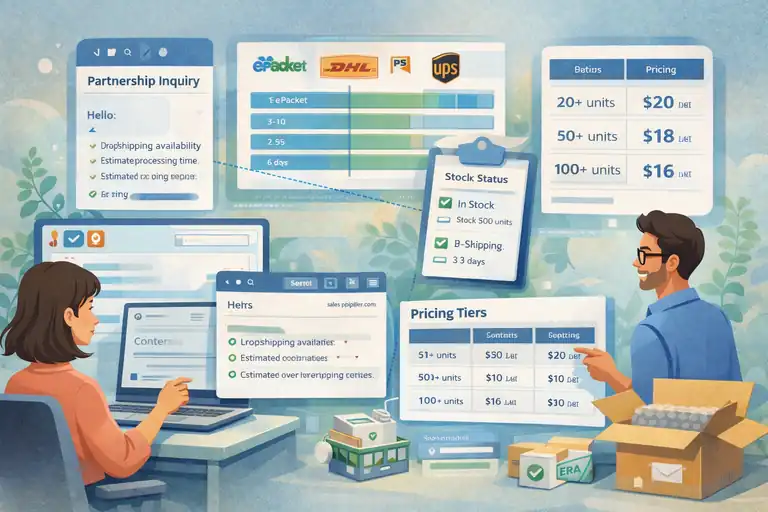
Once you’ve validated demand, it’s time to strengthen supplier relationships. This is an underrated part of how to use SaleHoo for dropshipping effectively.
Good suppliers can make or break scaling.
Craft A Professional First Outreach Message
Your first message sets the tone.
Keep it structured and business-focused.
Include:
- Your store niche
- Target market
- Estimated order volume
- Questions about dropshipping process
Suppliers respond better when they sense growth potential.
Even if you’re new, position yourself as building long-term.
Ask About Shipping Times And Tracking Options
Shipping time impacts:
- Conversion rate
- Refund rate
- Customer satisfaction
Ask:
- Average processing time
- Average delivery time
- Tracking integration
If they use ePacket, USPS, DHL, or UPS — clarify expected delivery windows.
Customers today expect under 7–10 days for domestic orders.
Slow shipping leads to PayPal disputes. Trust me, you want to avoid that.
Confirm Stock Availability And Restocking Speed
Stockouts can destroy momentum.
Ask:
- How many units are available?
- How often is inventory updated?
- What happens if stock runs out mid-campaign?
If you plan to scale ads, supplier inventory must keep up.
Running ads while supplier stock is low is one of the fastest ways to create chaos.
Negotiate Pricing For Long-Term Scaling
Many beginners assume listed price is final.
It’s not.
Once you start generating consistent orders (even 30–50 per month), revisit pricing.
Ask:
“If I reach 100 units per month, is there tiered pricing available?”
Even a $2 reduction per unit:
- On 500 orders = $1,000 additional profit
That’s real money.
Suppliers are open to negotiation when you bring volume.
Request Product Samples For Quality Control
Before scaling heavily, order samples.
Yes, it costs money.
But it protects your brand.
Test:
- Packaging quality
- Product durability
- Shipping time
- Tracking accuracy
Take your own product photos while you’re at it.
Original images increase conversion rates compared to generic supplier photos.
In my opinion, this single step separates hobby dropshippers from real ecommerce operators.
How To Import SaleHoo Products To Your Store
Once you truly understand how to use SaleHoo for dropshipping, the next step is execution. Research means nothing if the product never makes it to your store in a way that actually converts.
This part is where beginners either copy-paste lazily… or build a real ecommerce asset.
Let’s do it properly.
Connect SaleHoo With Shopify Or WooCommerce
SaleHoo itself is primarily a supplier directory and research tool. To actually import and sell products, you’ll need an ecommerce platform.
Most people use:
| Platform | Best For | Monthly Cost | Ease Of Use |
| Shopify | Beginners & Fast Launch | From $39/month | Very Easy |
| WooCommerce | WordPress Users | Hosting + Plugins | Moderate |
If you’re using Shopify, SaleHoo offers SaleHoo Dropship (their integrated product import tool). It allows:
- Direct product imports
- Inventory syncing
- Order forwarding automation
That means when someone buys, the order is automatically sent to the supplier.
If you’re on WooCommerce, you’ll often manually coordinate with suppliers or use a dropshipping automation plugin.
My honest opinion: If you’re just starting, Shopify simplifies everything. Fewer technical headaches = more focus on sales.
Manually List Products For Better SEO Control
Even if you use an automation tool, I strongly recommend manually editing every product listing.
Why?
Because supplier listings are written for wholesalers — not your customers.
Here’s what you should customize:
- Product title
- Description
- Images
- Meta description (This is what appears on Google search results)
Example:
Supplier Title: “Portable 12V Heated Blanket Car Camping Blue”
Improved Store Title: “Portable Heated Travel Blanket For Car And Camping”
See the difference?
The second one focuses on benefit and use-case. That improves SEO and conversions.
Google rewards original content. Copying supplier descriptions hurts rankings.
Optimize Product Titles And Descriptions
When learning how to use SaleHoo for dropshipping, product optimization is where profit is made.
Structure your description like this:
- Problem
- Solution
- Benefits
- Technical specs
- FAQ
Example:
Problem: Cold car rides during winter.
Solution: A 12V plug-in heated travel blanket.
Benefits: Heats quickly, lightweight, energy efficient.
Keep it conversational. Talk like you’re explaining it to a friend.
Also include:
- Bullet points for readability
- Clear dimensions
- Shipping timeframe
Conversion tip: Add a simple FAQ like:
- How long does it take to heat up?
- Is it machine washable?
This reduces hesitation.
Set Strategic Pricing For Competitive Advantage
Pricing is not random. It’s math and psychology.
Here’s a quick breakdown:
| Factor | What To Consider |
| Supplier Cost | Base price |
| Shipping | Domestic vs international |
| Payment Fees | Shopify + Stripe/PayPal |
| Advertising | Estimated CPA |
| Target Margin | 30–50% minimum |
If your total cost is $28, pricing at $59 gives room for ads and discounts.
Psychology works too:
- $59 sounds better than $60
- Offer “Free Shipping” instead of adding $7 at checkout
In my experience, free shipping increases conversion rate more than slightly lowering price.
Add Trust Signals To Improve Conversions
This is where many new dropshippers lose sales.
You must add:
- Secure checkout badges
- Clear return policy
- Shipping timeline page
- Customer support email
If possible, add:
- Product demo video
- Real lifestyle photos
- Customer reviews
According to Baymard Institute, nearly 18% of shoppers abandon carts due to lack of trust in the site.
Trust signals reduce doubt.
And doubt kills conversions.
How To Avoid Common SaleHoo Dropshipping Mistakes
Even when you know how to use SaleHoo for dropshipping, small mistakes can quietly eat your profit.
Let me be direct here.
Choosing Suppliers Based On Price Alone
Cheapest doesn’t mean best.
Low-cost suppliers often come with:
- Slow processing times
- Poor packaging
- Weak communication
If refunds increase, your savings disappear.
Example:
Saving $2 per unit sounds great.
But if refund rate jumps 5%, your profit vanishes.
Reliable suppliers are long-term partners.
Not just cost centers.
Ignoring Shipping Times And Customer Experience
Fast-selling items only stay fast-selling if customers are happy.
Ask yourself:
Would you wait 25 days for this product?
If not, your customers won’t either.
Shipping under 7–10 days for domestic markets dramatically improves:
- Reviews
- Repeat purchases
- Chargeback rates
Customer experience is not optional. It’s your retention strategy.
Listing Too Many Products Without Testing
This is the “hope strategy.”
Uploading 100 random products does not increase your chances.
It increases confusion.
Better approach:
- Pick 3–5 validated products
- Test with ads
- Analyze results
- Scale winners
Focused effort beats scattered effort every time.
Skipping Product Validation Outside SaleHoo
SaleHoo gives data.
But it’s not the entire internet.
Always validate on:
- Google Trends
- Amazon
- eBay
- Competitor stores
If external demand is weak, internal directory data won’t save you.
Cross-validation reduces risk.
Underestimating Customer Support Expectations
Dropshipping is not passive.
You will get:
- Shipping questions
- Tracking issues
- Refund requests
Prepare:
- Pre-written email templates
- Clear refund policy
- FAQ page
Fast responses increase trust.
Slow replies increase disputes.
How To Scale After Finding A Fast-Selling Product
This is the exciting part.
You’ve validated demand.
You’ve made sales.
Now what?
Scaling is where how to use SaleHoo for dropshipping turns into building a real business.
Double Down On Winning Products With Paid Ads
Once you see consistent sales, increase ad budget gradually.
Platforms to consider:
| Platform | Best For | Strength |
| Facebook Ads | Broad targeting | Scalable |
| TikTok Ads | Trend-driven products | Viral potential |
| Google Shopping | Buyer-intent traffic | High conversion |
If your product converts at 3% and CPA is stable, increase budget by 20–30% increments.
Do not jump from $20/day to $300/day overnight.
Scaling is controlled, not emotional.
Negotiate Better Supplier Margins At Scale
Volume gives leverage.
If you’re ordering 200+ units monthly, approach your supplier:
“Can we discuss tiered pricing?”
Even $1.50 discount per unit:
- 500 units = $750 extra profit
Scaling without negotiating is leaving money on the table.
Bundle Complementary Products To Increase AOV
AOV = Average Order Value.
Higher AOV = More revenue per customer.
Example: If you sell a posture corrector, bundle:
- Resistance bands
- Stretch guide PDF
- Foam roller
Bundle pricing increases perceived value.
Instead of $39 single item, sell a $79 bundle.
Your ad cost stays similar.
Profit increases.
Build Email Flows To Retarget Past Visitors
Most visitors don’t buy immediately.
Use email marketing tools like:
Set up:
- Abandoned cart emails
- Post-purchase upsell
- Educational sequences
Email marketing often generates $36–$40 for every $1 spent, according to industry benchmarks (Litmus).
It’s one of the highest ROI channels in ecommerce.
Transition From Testing To Brand Positioning
Testing phase:
- Generic store
- Broad products
- Basic branding
Scaling phase:
- Niche authority positioning
- Custom packaging (Eventually)
- Branded social media presence
At this stage, you’re not just dropshipping.
You’re building an ecommerce brand.
That shift increases:
- Customer loyalty
- Repeat purchases
- Long-term value
By now, you don’t just know how to use SaleHoo for dropshipping.
You understand:
- How to research products properly
- How to validate them intelligently
- How to import and optimize listings
- How to avoid common mistakes
- How to scale strategically
And that’s the difference between experimenting… and building something that actually grows.
FAQ
How To Use SaleHoo For Dropshipping Step By Step?
To understand how to use SaleHoo for dropshipping, follow these core steps:
Create a SaleHoo account and access the Supplier Directory.
Filter for verified dropshipping suppliers in your target country.
Use the Market Research Lab to analyze demand, competition, and pricing.
Contact suppliers to confirm shipping times, fees, and stock levels.
Import validated products into Shopify or WooCommerce and optimize listings.
The key is validating demand before listing products.How Do You Find Fast-Selling Items On SaleHoo?
Use the SaleHoo Market Research Lab to check:
Average selling price
Competition level
Historical demand trends
Profit margin potential
Then cross-check with Google Trends and Amazon Best Seller Rank to confirm real-world demand. Fast-selling items usually solve a specific problem and have steady year-round interest.Is SaleHoo Good For Beginners In Dropshipping?
Yes, SaleHoo is beginner-friendly because it provides:
Pre-screened suppliers
Built-in product research tools
Access to verified wholesale partners
It reduces the risk of scams and unreliable suppliers, which is one of the biggest fears for new dropshippers.

I’m Juxhin, the voice behind The Justifiable.
I’ve spent 6+ years building blogs, managing affiliate campaigns, and testing the messy world of online business. Here, I cut the fluff and share the strategies that actually move the needle — so you can build income that’s sustainable, not speculative.
Related posts:
 Salehoo Products List That Helps You Find Winning Items Fast
 Dropshipping Business Model Success: Tips for Long-Term Growth
 Dropshipping How to Start: Your Complete Beginner’s Guide
 Ecommerce Marketing Guide: Turn Traffic Into Sales
 Salehoo Directory Free: What You Can Access Without Paying
 Why the Salehoo Wholesale Directory Helps You Scale