
Table of Contents
Some links on The Justifiable are affiliate links, meaning we may earn a small commission at no extra cost to you. Read full disclaimer.
If you’re searching for Appscenic alternatives for EU dropshipping, you’re probably running into the same issue I see again and again: limited EU supplier coverage, pricing constraints, or scaling friction once your store starts growing.
This guide is for EU-focused dropshippers, Shopify store owners, and ecommerce founders who want faster shipping, reliable suppliers, and better margins without relying on Appscenic alone.
The core question this article answers is simple: which platforms can realistically replace or outperform Appscenic for EU dropshipping growth—and why?
1. Spocket as a Premium Appscenic Alternative for EU Sellers
If you’re serious about EU dropshipping and want more control over branding and supplier quality, Spocket is often the first Appscenic alternative I point people to.
It’s not the cheapest option, but it’s built for sellers who care about reliability, speed, and not looking like every other dropshipping store.
EU And US Supplier Network Coverage Comparison
Spocket’s biggest strength is its strong EU and US supplier base, especially for products that ship within 2–5 business days inside Europe.
From what I’ve seen, this immediately solves one of the most common Appscenic complaints: limited variety in certain EU categories.
Key differences I’ve noticed in practice:
- Spocket leans heavily toward EU and US manufacturers, not marketplaces
- Appscenic focuses more on print-on-demand and select EU suppliers
- Spocket’s catalog feels more “retail-ready” out of the box
If you’re selling to Germany, France, the Netherlands, or the Nordics, Spocket’s delivery speed alone can noticeably improve conversion rates. Faster shipping builds trust, especially with EU customers who are already skeptical of long delivery windows.
Private Label And Branded Invoicing Capabilities
This is where Spocket really separates itself as a premium Appscenic alternative for EU dropshipping.
Spocket allows:
- Branded invoices with your store name and logo
- No supplier branding on packages
- Optional thank-you cards with certain suppliers
In simple terms: your customer never sees Spocket or the supplier. That matters more than people think.
I’ve worked with stores where switching to branded invoicing alone reduced refund requests because customers perceived the brand as more legitimate. It’s a subtle trust signal, but in EU ecommerce, trust equals sales.
Shopify And WooCommerce Integration Strengths
Spocket’s integrations are clean, fast, and stable—especially on Shopify.
What makes it stand out:
- One-click product imports
- Automatic order forwarding to suppliers
- Real-time inventory syncing to prevent overselling
For WooCommerce users, the setup takes slightly longer, but once configured, it’s reliable. Compared to Appscenic, Spocket feels more polished and less technical for beginners.
If you’re scaling beyond a single store, this smoother backend experience saves real time every week.
Product Pricing Control And Margin Flexibility
Spocket isn’t cheap, but it gives you more predictable margins.
Here’s why:
- Wholesale pricing is usually fixed and transparent
- No bidding or supplier negotiations needed
- Easier to calculate landed costs upfront
A realistic example: If a product costs €18 on Spocket and sells for €39.99, you know exactly what you’re working with. With Appscenic, pricing can fluctuate depending on supplier availability, which makes forecasting harder as you scale.
For brand-focused stores, that consistency is often worth the higher monthly fee.
Spocket Limitations Compared To Appscenic
Spocket isn’t perfect, and it’s not always the best Appscenic replacement.
Limitations worth knowing upfront:
- Smaller catalog compared to Appscenic’s POD-focused options
- Monthly subscription required to unlock most suppliers
- Not ideal for hyper-niche or custom-manufactured products
My honest take: Spocket works best if you want fewer products, better branding, and faster EU shipping. If your strategy depends on massive product testing or print-on-demand, Appscenic may still have an edge.
2. Syncee for Multi-Supplier EU Dropshipping Expansion
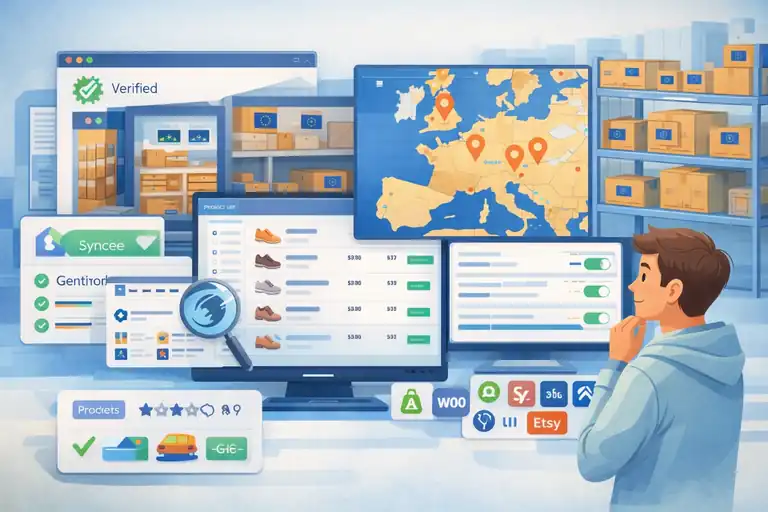
Syncee plays a very different role than Spocket. While Spocket is about premium curation, Syncee is about scale, variety, and supplier diversity—which makes it one of the most flexible Appscenic alternatives for EU dropshipping.
Access To Verified EU-Based Wholesale Suppliers
Syncee connects you to thousands of EU-based wholesalers and manufacturers, not just dropshipping-only suppliers.
What that means in practice:
- More B2B-style suppliers
- Larger catalogs per supplier
- Often better bulk pricing as you grow
Countries like Germany, Italy, Spain, and Poland are particularly well represented. If your goal is to expand across multiple EU markets with localized suppliers, Syncee gives you more options than Appscenic.
Supplier Approval And Product Quality Control
One thing I appreciate about Syncee is that suppliers are reviewed and vetted, but you still have control over who you work with.
Smart ways to use this:
- Start with 1–2 suppliers per category
- Order samples before scaling ads
- Remove underperforming suppliers quickly
Syncee doesn’t pretend every supplier is perfect—and that honesty is refreshing. It’s a marketplace, not a magic button.
Automated Product Sync And Inventory Updates
Syncee’s automation is built for sellers managing large catalogs.
Core automation features include:
- Real-time stock updates
- Automatic price changes when suppliers adjust costs
- Bulk product imports and edits
This matters if you’re running 200+ SKUs. Manual updates at that scale are a silent profit killer. Compared to Appscenic, Syncee feels more enterprise-ready when volume increases.
Marketplace And Platform Compatibility Range
Syncee integrates with more platforms than most Appscenic alternatives.
Supported platforms include:
- Shopify
- WooCommerce
- BigCommerce
- Wix
- Squarespace
- Etsy (via workflows)
If you’re selling across multiple channels—or plan to—Syncee gives you room to grow without rebuilding your stack later.
When Syncee Outperforms Appscenic For Scale
In my experience, Syncee outperforms Appscenic when:
- You want many suppliers, not just one
- You’re expanding into multiple EU countries
- You need bulk product management and automation
A real-world scenario: A general store with 500 SKUs will struggle to scale on Appscenic alone. Syncee’s supplier diversity and automation make that kind of growth realistic instead of chaotic.
That said, Syncee requires more decision-making. If you prefer simplicity over flexibility, Spocket may feel easier.
3. BigBuy as a Full-Service EU Dropshipping Solution
If Appscenic feels limiting and you’re looking for something closer to a true EU logistics partner, BigBuy is one of the most serious Appscenic alternatives for EU dropshipping.
This isn’t a lightweight app—it’s an infrastructure-heavy platform built for sellers who want speed, scale, and fewer moving parts.
EU Warehousing And 24–48 Hour Shipping Advantage
BigBuy operates multiple warehouses across Europe, with Spain as its central hub.
In practical terms, this means most EU orders are delivered in 24–48 hours, sometimes faster than local competitors.
Why this matters more than people admit:
- EU customers expect Amazon-like delivery standards
- Faster shipping reduces PayPal disputes and chargebacks
- Ads convert better when delivery times are clearly short
From what I’ve seen, stores that switch to BigBuy often highlight shipping speed directly on product pages—and that alone can lift conversion rates by a noticeable margin.
Catalog Depth Across Multiple Product Categories
BigBuy’s catalog is huge—we’re talking 100,000+ products across categories like home, electronics, kitchen, toys, fitness, and seasonal goods.
What makes it different from Appscenic:
- Products are stocked by BigBuy, not third-party sellers
- Inventory data is reliable and updated constantly
- Fewer “out of stock” surprises after ads start running
This makes BigBuy ideal if you’re building a general store or niche store with depth, not just testing random products.
Native Integrations With Shopify And Marketplaces
BigBuy shines when it comes to multi-channel selling.
Native integrations include:
- Shopify and WooCommerce
- Amazon, eBay, and Kaufland
- PrestaShop and other EU-focused platforms
Orders, tracking numbers, and inventory sync automatically.
Compared to Appscenic, BigBuy feels more like an ERP system—a central brain that handles everything once you’re set up.
Branding, Packaging, And Fulfillment Control
This is where BigBuy quietly outperforms many Appscenic alternatives.
BigBuy offers:
- Neutral packaging (no supplier branding)
- Optional branded inserts
- Centralized returns handling within the EU
You’re not getting full private labeling like a manufacturer, but you are getting consistency. Customers receive clean, professional packages that don’t scream “dropshipping.”
In EU ecommerce, that professionalism matters.
Cost Structure Compared To Appscenic
BigBuy’s pricing can surprise beginners—but it makes sense at scale.
Cost components typically include:
- Monthly subscription
- Product cost (slightly higher than Asian suppliers)
- Shipping fees based on destination
Here’s my honest take: BigBuy isn’t built for micro-budgets. It’s built for sellers who value operational stability over razor-thin margins. Compared to Appscenic, it’s more predictable—but less flexible for experimental product testing.
4. BrandsGateway for Fashion-Focused EU Dropshipping
If your store sells clothing, accessories, or luxury fashion, BrandsGateway is a completely different kind of Appscenic alternative for EU dropshipping.
It’s not general-purpose—and that’s exactly the point.
Luxury And Premium Fashion Brand Access
BrandsGateway specializes in authentic designer and premium fashion brands—think recognizable labels your customers already trust.
Key advantages:
- Genuine branded products (not replicas)
- Certificates of authenticity
- Strong perceived value from day one
This removes a huge friction point in fashion dropshipping: trust.
Customers are far more willing to pay €120 for a known brand than €39 for a generic hoodie.
EU Fulfillment Centers And Delivery Speed
BrandsGateway fulfills orders from EU-based warehouses, ensuring fast delivery and no surprise customs fees.
Typical delivery times:
- 2–5 business days within the EU
- Tracking provided automatically
- Returns handled inside Europe
Compared to Appscenic, this is a premium experience. It’s designed for customers who expect smooth logistics and are willing to pay for it.
Pricing Model And Profit Margin Realities
Let’s be real—BrandsGateway is not a high-margin playground.
What you should expect:
- Wholesale prices are higher
- Margins are tighter (often 20–40%)
- Average order value is significantly higher
In my experience, BrandsGateway works best when:
- You focus on brand positioning, not discounts
- You upsell or bundle accessories
- You rely on organic traffic, email, or influencers—not cheap ads
It’s a different game than Appscenic, but a powerful one if played correctly.
Platform Integrations And Order Automation
BrandsGateway integrates smoothly with:
- Shopify
- WooCommerce
- API access for custom setups
Once connected, orders flow automatically from your store to their fulfillment centers. Tracking updates sync back without manual work. Compared to Appscenic, the automation feels more enterprise-grade and less experimental.
Ideal Store Types Compared To Appscenic Users
BrandsGateway is ideal if:
- You run a fashion-only store
- Your audience values brand names and quality
- You’re building long-term brand trust, not quick wins
If you’re running a general dropshipping store or testing dozens of products weekly, Appscenic may still fit better. But for fashion-focused EU dropshipping, BrandsGateway plays in a league Appscenic doesn’t even try to enter.
5. Modalyst for Branded And Sustainable EU Products
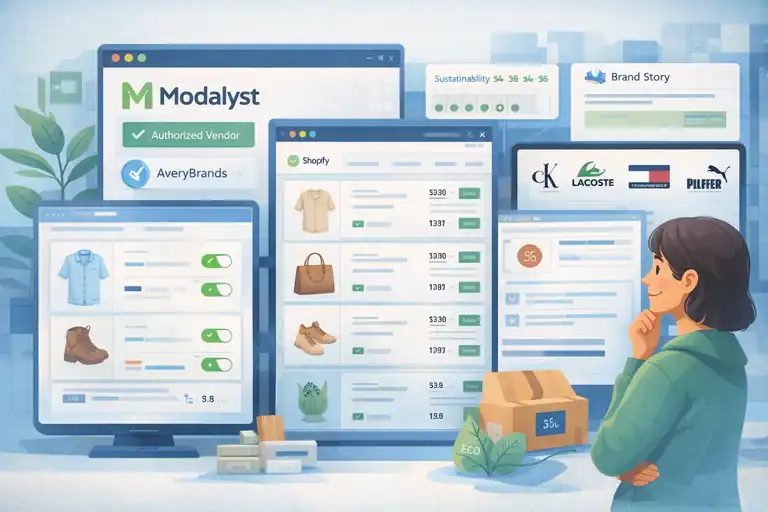
If you care about brand perception and sustainability—and your customers do too—Modalyst is one of the more thoughtful Appscenic alternatives for EU dropshipping.
It’s not about flooding your store with products. It’s about selling fewer items that feel intentional and trustworthy.
Curated EU And US Supplier Marketplace
Modalyst doesn’t operate like an open marketplace. Instead, it curates suppliers, many of which are based in the EU and US.
What that means in plain language:
- Fewer low-quality, mass-produced products
- More boutique-style and eco-conscious items
- Better alignment with EU consumer values
I’ve seen Modalyst work especially well for stores targeting Germany, Scandinavia, and the Netherlands—markets where sustainability messaging actually influences buying decisions.
Brand Partnerships And Authorized Resellers
One underappreciated advantage of Modalyst is access to authorized brand partnerships.
Why this matters:
- You’re legally reselling real brands
- No gray-area sourcing risks
- Higher trust and fewer customer objections
Compared to Appscenic, which focuses more on supplier logistics, Modalyst leans into brand legitimacy. That shift alone can justify higher pricing on your storefront.
Automation Features For Shopify Stores
Modalyst integrates tightly with Shopify, and the automation is smooth.
Key automation highlights:
- One-click product imports
- Automatic order routing to suppliers
- Real-time inventory and price syncing
From a workflow perspective, Modalyst feels lighter than Appscenic. You spend less time managing suppliers and more time refining product pages and messaging.
Product Differentiation Versus Appscenic
This is where Modalyst shines.
Instead of competing on price, you compete on:
- Brand story
- Sustainability claims
- Product uniqueness
In practice, that means fewer price wars and less dependency on paid ads. I’ve seen stores using Modalyst rely more on content, email, and influencer traffic—which compounds better long-term.
Limitations EU Sellers Should Know
Modalyst isn’t for everyone.
Honest limitations:
- Smaller catalog compared to Appscenic
- Less flexibility for rapid product testing
- Higher product costs on average
My take: If your strategy is “test 50 products a month,” Modalyst will frustrate you. If your strategy is “build a brand people trust,” it fits beautifully.
6. CJdropshipping With EU Warehouses as an Alternative
CJdropshipping is often underestimated—but with its EU warehouses, it becomes one of the more flexible Appscenic alternatives for EU dropshipping. It’s not elegant, but it’s powerful.
EU Warehouse Availability And Shipping Times
CJdropshipping operates multiple EU warehouses, mainly in Germany, France, and Poland.
What you can realistically expect:
- 5–10 business day delivery within the EU
- Faster fulfillment than China-based shipping
- Lower customs risk for EU customers
It’s not Amazon-fast like BigBuy, but it’s good enough for price-sensitive markets.
Custom Sourcing And Product Requests
This is where CJdropshipping quietly dominates.
You can:
- Request custom product sourcing
- Ask for alternatives to trending products
- Negotiate pricing at scale
In simple terms, CJ acts like a personal sourcing agent. Appscenic doesn’t offer this level of flexibility, especially for custom or trending items.
Branding, POD, And Packaging Options
CJdropshipping supports:
- Branded packaging
- Print-on-demand (POD) products
- Custom inserts and labels
This makes CJ ideal for sellers who want mid-level branding without dealing directly with manufacturers. It’s not luxury branding—but it’s far better than generic packaging.
Cost Efficiency Versus Appscenic
CJdropshipping is generally more cost-efficient than Appscenic.
Why:
- No mandatory monthly subscription
- Competitive product pricing
- Flexible shipping options
If you’re operating on thinner margins or testing aggressively, CJ often wins on cost alone.
Operational Trade-Offs For EU-Based Stores
There are trade-offs—always.
Things to be aware of:
- Dashboard can feel overwhelming
- Supplier communication sometimes requires follow-ups
- EU warehouse stock isn’t available for every product
My honest advice: CJdropshipping works best when you’re hands-on and proactive. If you want a “set it and forget it” platform, this isn’t it.
7. VidaXL Dropshipping for Home And Garden Niches
VidaXL is one of the most overlooked Appscenic alternatives for EU dropshipping—and that’s a mistake if you sell home, furniture, or garden products.
EU Manufacturer-Backed Product Supply
VidaXL designs and manufactures many of its own products, which means:
- Consistent quality
- Stable pricing
- Fewer supplier disruptions
You’re not dealing with random third-party sellers. You’re working directly with a European brand.
Localized Warehousing Across Europe
VidaXL operates warehouses across:
- Germany
- Netherlands
- France
- Italy
- Spain
This allows for fast, predictable shipping within the EU—often 2–5 business days. Compared to Appscenic, logistics feel more controlled and less variable.
Catalog Specialization And Niche Suitability
VidaXL focuses on:
- Furniture
- Outdoor and garden products
- Storage and home improvement items
This specialization matters. Instead of being “everything for everyone,” VidaXL is perfect for niche authority stores in home and living categories.
Platform Integration And Order Processing
VidaXL integrates with:
- Shopify
- WooCommerce
- API-based custom systems
Order processing is straightforward, and tracking is automatically pushed back to your store. It’s not flashy—but it’s reliable.
When VidaXL Beats Appscenic For EU Markets
VidaXL clearly wins when:
- You target bulky or high-ticket items
- You want EU-based returns and support
- You’re building a long-term home niche brand
Appscenic still works for trend-based or POD-focused stores, but for home and garden, VidaXL plays a completely different—and often stronger—game.
Appscenic Alternatives Comparison Table (EU Dropshipping Focus)
| Platform | Best For | EU Warehouses | Shipping Speed (EU) | Branding Options | Product Range | Pricing Model | Ease of Use | How It Compares to Appscenic |
| Spocket | Branded niche stores | Yes | 2–5 days | Branded invoices, inserts | Medium | Monthly subscription | Very Easy | Better branding, smaller catalog |
| Syncee | Multi-supplier scale | Yes | 3–7 days | Supplier-dependent | Very Large | Tiered plans | Moderate | More suppliers, more control |
| BigBuy | Fast EU fulfillment at scale | Yes (Multiple) | 24–48 hours | Neutral + inserts | Massive | Subscription + fees | Moderate | Faster shipping, less flexibility |
| BrandsGateway | Fashion & luxury stores | Yes | 2–5 days | Full brand authenticity | Focused (Fashion) | Monthly subscription | Easy | Premium niche vs general Appscenic |
| Modalyst | Branded & sustainable products | Yes (Some) | 3–7 days | Brand-authorized | Curated | Subscription | Very Easy | Better brand trust, fewer SKUs |
| CJdropshipping | Cost-efficient testing & scaling | Yes | 5–10 days | Custom packaging, POD | Very Large | No mandatory fee | Harder | Cheaper, more manual |
| VidaXL | Home & garden niche | Yes (EU-wide) | 2–5 days | Neutral branding | Focused (Home) | Wholesale pricing | Easy | Strong niche dominance |
Quick takeaway: There is no single “best” Appscenic alternative. The right choice depends entirely on how you want to build your store—not just what you sell.
FAQ
What are the best Appscenic alternatives for EU dropshipping?
The best Appscenic alternatives for EU dropshipping include Spocket, Syncee, BigBuy, BrandsGateway, Modalyst, CJdropshipping (EU warehouses), and VidaXL. These platforms offer faster EU shipping, stronger supplier reliability, and better scalability depending on your store model.
Which Appscenic alternative offers the fastest EU shipping?
BigBuy offers the fastest EU shipping, with many orders delivered in 24–48 hours from European warehouses. VidaXL and Spocket also provide consistently fast EU fulfillment, typically within 2–5 business days.
Are Appscenic alternatives better for scaling EU dropshipping stores?
Yes, many appscenic alternatives for eu dropshipping scale better than Appscenic. Syncee excels for multi-supplier growth, BigBuy for logistics-heavy scaling, and CJdropshipping for cost-efficient product testing and expansion across EU markets.

I’m Juxhin, the voice behind The Justifiable.
I’ve spent 6+ years building blogs, managing affiliate campaigns, and testing the messy world of online business. Here, I cut the fluff and share the strategies that actually move the needle — so you can build income that’s sustainable, not speculative.
Related posts:
 Discover 5 Best Dropshipping Sites: Boost Your Sales Now!
 How to Use Dsers Shopify for Seamless Dropshipping
 Shopify DSers Review: Is It Really Worth Your Time?
 20 Best Products to Dropship for Maximum Profit
 Best Online Store Platforms to Launch Your Brand Today
 Dropshipping Platforms Ranked: Speed, Fees, and Control