
Table of Contents
Some links on The Justifiable are affiliate links, meaning we may earn a small commission at no extra cost to you. Read full disclaimer.
If you want to build an omnisend ecommerce lifecycle marketing strategy that actually converts, you need more than a few welcome emails and a discount popup.
You need a system that speaks to people differently depending on where they are in the buying journey. That is where Omnisend can be incredibly effective.
In my experience, stores get the best results when they stop treating email and SMS like separate channels and start using them as one connected customer journey.
Let me walk you through how to build that strategy from the ground up so it brings in more sales without feeling pushy.
What Ecommerce Lifecycle Marketing Really Means
Lifecycle marketing is the process of sending the right message to the right shopper at the right stage of their relationship with your store. In ecommerce, that means you are not blasting the same campaign to everyone.
You are guiding people from first visit to first purchase, then from repeat customer to loyal buyer.
Why Lifecycle Marketing Converts Better Than Generic Campaigns
Most stores start with campaigns because they are simple. You create a promotion, send it to your list, and hope enough people buy. The problem is that campaigns are broad by nature. They are useful, but they rarely match the exact moment a shopper is in.
Lifecycle marketing converts better because it responds to behavior. A first-time subscriber needs trust. A cart abandoner needs reassurance or urgency. A repeat customer might need a cross-sell, replenishment reminder, or VIP reward. Those are three very different conversations.
Here is the real shift: lifecycle marketing is less about “sending more” and more about “sending with context.” That context is what makes Omnisend powerful when used properly. It tracks subscriber actions, purchase history, browsing behavior, and channel engagement so you can automate messages around what people actually do.
I believe this is why lifecycle systems usually outperform random promotional sending. They reduce friction. They answer objections earlier. They also make revenue more predictable because you are not relying only on big sale days to drive results.
A simple example: imagine two stores selling skincare. One sends a weekend discount to everyone. The other sends a welcome series to new subscribers, cart recovery emails to non-buyers, replenishment reminders after 45 days, and a win-back sequence after inactivity. The second store is building revenue every week, not just during promotions.
The Core Stages Of The Ecommerce Customer Lifecycle
To build a real omnisend ecommerce lifecycle marketing strategy, you need to think in stages. This keeps your automations clean and prevents messy overlap.
The core lifecycle usually looks like this:
- Awareness: The shopper discovers your brand through ads, social content, search, referrals, or direct visits.
- Consideration: They browse products, join your email list, compare options, or read reviews.
- Conversion: They add products to cart, start checkout, and make their first purchase.
- Retention: They buy again, engage with your emails, and begin trusting your store.
- Loyalty: They become repeat customers, high-value buyers, or advocates.
- Reactivation: They stop engaging or buying, and you try to bring them back.
What matters here is not the labels. What matters is the messaging logic. Each stage has a different job. Awareness builds attention. Consideration removes doubt. Conversion reduces hesitation. Retention increases frequency. Loyalty increases customer lifetime value. Reactivation rescues fading revenue.
When I audit ecommerce accounts, I usually find that the biggest gap is not email design or copy. It is stage confusion. Stores send retention offers to first-time subscribers. They send win-back messages to recent buyers.
They treat all customers like they are at the same point. That creates friction fast.
Why Omnisend Fits Lifecycle Marketing So Well
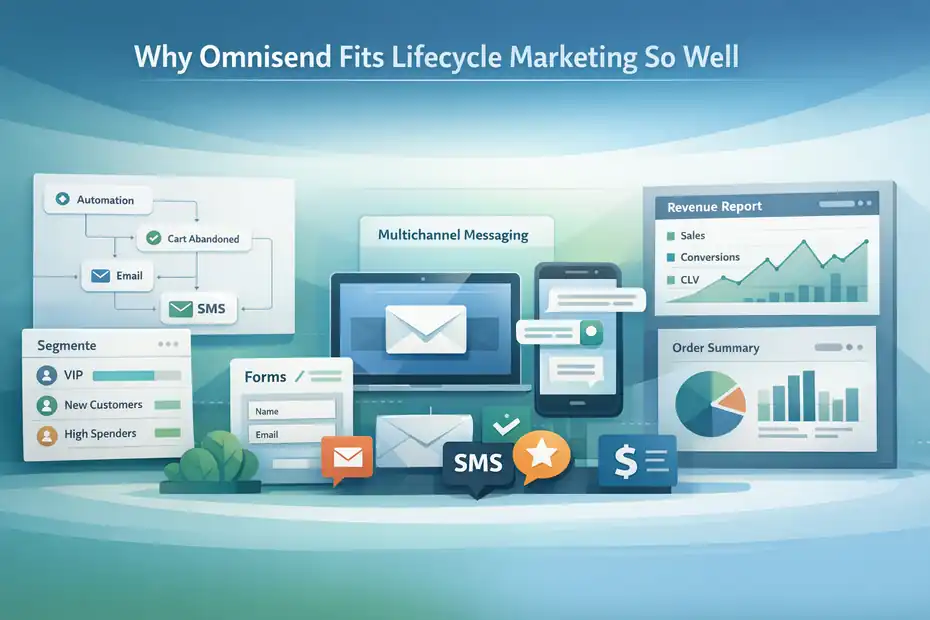
Omnisend works best when you use it as a customer journey tool, not just an email sender. It gives you automation, segmentation, email, SMS, forms, reporting, and ecommerce event tracking in one place.
That setup is important because lifecycle marketing depends on behavior-based triggers.
The Omnisend Features That Matter Most For Lifecycle Strategy
You do not need every feature on day one. You need the ones that support lifecycle movement. In practice, a few features matter more than the rest.
First is automation. This is the engine of the whole system. Omnisend lets you trigger messages based on signup, browsing, cart actions, checkout activity, orders, and customer inactivity. That means your messages can respond to real behavior instead of fixed dates alone.
Second is segmentation. You need to split people by customer type, purchase count, average order value, engagement level, and product interest. A healthy lifecycle strategy depends on smaller, sharper groups.
Third is multichannel messaging. Email alone works, but email plus SMS can be stronger when used carefully. For example, an email may handle education and trust-building, while SMS handles urgency, reminders, or time-sensitive offers.
Fourth is forms. Signup forms are not just list-growth tools. They are the entry point into your lifecycle. If your form promise is weak, the rest of the funnel suffers. If the form captures intent well, your welcome flow becomes much stronger.
Fifth is reporting. Omnisend helps you track revenue by automation, campaign results, and subscriber behavior. This matters because lifecycle marketing is not “set and forget.” You need to see which flows drive assisted revenue, first-order conversion, and repeat purchase rate.
In my view, Omnisend becomes most valuable when these features work together rather than separately.
Common Mistakes When Using Omnisend For Lifecycle Marketing
A lot of stores buy Omnisend, install a few default automations, and assume they now have a lifecycle strategy. They do not. They have tools, but not a system.
One common mistake is turning on every default workflow without adjusting timing, messaging, or offers. The templates are a good starting point, but they should not be your final strategy. A generic abandoned cart email is rarely enough if your products are expensive, technical, or highly competitive.
Another mistake is overusing discounts. If every automation offers 10% or 15% off, you train shoppers to wait. Discounts should solve a specific conversion problem, not cover weak messaging everywhere.
I also see poor audience suppression all the time. This means people keep receiving signup offers after they already purchased, or they stay in win-back sequences while actively browsing again. Those errors make a brand feel disconnected.
Message overlap is another issue. A shopper should not receive a campaign, a browse abandonment flow, and a cart flow all within a few hours unless that sequence is intentional. You need clear rules for priority.
Finally, many brands forget the retention side. They build acquisition and cart recovery flows but ignore post-purchase, replenishment, cross-sell, review requests, and reactivation. That leaves a huge amount of customer lifetime value untouched.
How To Build Your Lifecycle Strategy Before You Open Automation Workflows
Before you start creating flows, map your customer journey. This step sounds basic, but it saves a lot of cleanup later. A strong strategy starts on paper before it starts inside software.
Map Your Customer Journey From Signup To Repeat Purchase
Start by identifying the major moments a customer can have with your store. Do not think like a marketer first. Think like a shopper.
A simple map often includes these moments:
- Visitor lands on site for the first time.
- Visitor joins email or SMS.
- Subscriber browses products.
- Subscriber adds a product to cart.
- Shopper starts checkout.
- Shopper buys for the first time.
- Customer receives product.
- Customer considers buying again.
- Customer becomes inactive.
Now assign a question or emotional state to each step. For example, a new visitor may wonder, “Can I trust this store?” A cart abandoner may think, “Do I really need this right now?” A recent buyer may be asking, “Did I make the right choice?” That emotional layer is where great lifecycle messaging comes from.
I suggest writing one main goal for each stage. Example: the welcome flow builds trust and drives the first purchase. The post-purchase flow reduces buyer’s remorse and sets up the second purchase. The win-back flow reopens attention.
This mapping process also helps you spot missing stages. If you have strong acquisition but nothing after purchase, your revenue will feel more expensive than it needs to be.
Define The Triggers, Delays, And Exit Rules
Once you know the lifecycle stages, you need logic. This is where many automations either become effective or become annoying.
Each flow should have three technical elements: trigger, delay, and exit rule. The trigger tells Omnisend when a shopper enters the flow. The delay controls timing between messages. The exit rule removes people when the flow is no longer relevant.
For example, a welcome flow trigger might be “joins list.” The delay between email one and email two might be one day. The exit rule might be “placed order.” That way, once a new subscriber buys, they stop receiving beginner-focused incentives and move into post-purchase messaging.
Timing matters more than many people realize. Send too slowly and you lose momentum. Send too fast and you create fatigue. For most stores, the highest urgency flows are browse abandonment, cart abandonment, and checkout recovery. Those should move quickly. Educational or brand-story messages can breathe more.
Exit logic is just as important. If someone becomes a customer, they should leave prospect-focused flows. If someone re-engages with the brand, they may no longer belong in a win-back flow. This kind of clean flow management keeps the customer experience sharp.
In my experience, smart suppression and exit rules often improve results faster than rewriting subject lines.
The Essential Omnisend Flows Every Ecommerce Store Should Build
You do not need twenty automations to start. You need the right ones. These are the flows that usually create the strongest lifecycle foundation.
Welcome Flow: Turn New Subscribers Into First-Time Buyers
Your welcome flow is one of the highest-leverage parts of an omnisend ecommerce lifecycle marketing strategy because it shapes the first real relationship with a subscriber. This is not just where you deliver a signup incentive. It is where you explain why your store is worth paying attention to.
A strong welcome series usually includes three to five messages. The first message should arrive quickly and deliver whatever was promised in the signup form. It should also reinforce your brand value in plain language. Why buy from you instead of another store selling similar products?
The next messages should reduce friction. You might explain product benefits, show bestsellers, answer common objections, highlight reviews, or introduce your guarantee. This is especially important if your products need education. A technical product, supplement, skincare item, or premium product nearly always needs more than one email to convert well.
Here is a practical structure:
- Email 1: Deliver incentive and explain brand promise.
- Email 2: Show bestsellers or starter picks.
- Email 3: Share reviews, FAQs, or product education.
- Email 4: Add urgency before the offer expires.
I recommend keeping the tone warm and direct. New subscribers do not need a corporate brand lecture. They need a reason to trust you and an easy next step.
Browse Abandonment Flow: Re-Engage Interested Shoppers
Browse abandonment often gets ignored, but it is incredibly useful because it targets people who showed intent before they were ready to add to cart. These shoppers are warmer than general subscribers but cooler than cart abandoners. Your job is to bring them back without sounding desperate.
The best browse abandonment messages remind people what they viewed and help them continue the buying decision. This usually works better than pushing an immediate discount. At this stage, people often need clarity more than a coupon.
A strong browse email can include the viewed product, related items, key benefits, shipping information, and a simple call to action. If your category involves fit, compatibility, ingredients, or setup, this is the place to answer those concerns.
I have seen browse flows work especially well for products with more consideration involved, such as furniture, wellness products, apparel, beauty, and gear. Someone may love the product but need more time, more trust, or a reminder.
Keep this flow short. One or two messages are often enough. Send the first within a few hours while interest is still fresh. A second message the next day can reinforce value, provide social proof, or suggest similar options.
Think of browse abandonment as gentle momentum. You are not chasing the sale aggressively. You are reopening the tab in the shopper’s mind.
Cart And Checkout Recovery Flow: Rescue Revenue Without Sounding Pushy
Cart and checkout recovery are where many stores expect easy revenue, but results depend heavily on execution. A cart flow should do more than say, “You left something behind.” It should address why the shopper paused.
Start with a simple first reminder within one to four hours. Keep it clean. Show the item, provide a clear return path to cart, and reduce friction. Make shipping, returns, or checkout ease visible. If your store has trust signals like reviews or guarantees, include them.
The second message can handle objections. This might include product benefits, customer feedback, or answers to common concerns. For example, if you sell premium bedding, reassure shoppers about softness, durability, and trial policy. If you sell supplements, talk about use case and expected outcomes in realistic terms.
A third message can introduce urgency. That could mean limited stock, offer expiration, or a gentle reminder that the cart may not be saved forever. I would be careful with fake urgency. People notice.
Checkout recovery is slightly lower funnel than cart recovery because the buyer already entered checkout. That audience may justify faster timing or stronger reassurance. Sometimes a short SMS reminder works well here if the user opted in.
A compact sequence often performs best:
- Message 1: Reminder and easy path back.
- Message 2: Objection handling and trust.
- Message 3: Urgency or incentive if needed.
The goal is not pressure. The goal is to remove hesitation.
How To Build Post-Purchase And Retention Flows That Increase Lifetime Value
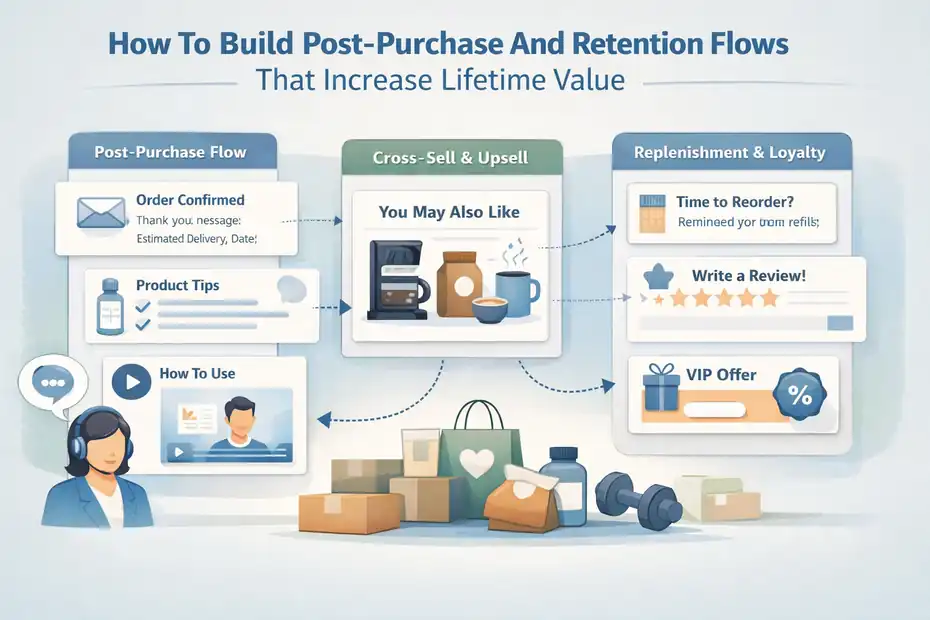
A lot of brands stop working after the first sale. That is a costly mistake.
The post-purchase phase is where trust deepens and margins usually improve because you are marketing to someone who already knows you.
Post-Purchase Flow: Reduce Buyer’s Remorse And Build Confidence
The moment after purchase is emotionally important. Even excited customers can feel uncertainty. They may wonder whether they chose the right product, when it will arrive, or how to use it properly. Your post-purchase flow should calm that uncertainty.
The first message should confirm the purchase and set expectations. This is not just transactional. It is a chance to reinforce confidence. Thank them, explain what happens next, and make support feel easy to access.
The second and third messages should help the customer succeed with the product. If it is apparel, give care tips or styling ideas. If it is skincare, explain how and when to use it. If it is a fitness accessory, explain setup and usage. Education here reduces returns and increases satisfaction.
You can also use this stage to plant the seed for the next purchase. Do this subtly. Recommend complementary products only after you have helped the customer feel good about the order they already placed. Timing matters.
I suggest separating customer service from marketing in tone, even when both live in the same automation ecosystem. Right after purchase, usefulness beats promotion. When customers feel supported, they are much more open to future offers.
A good post-purchase flow often improves more than repeat sales. It can improve reviews, lower refund pressure, and increase long-term trust.
Cross-Sell, Upsell, And Replenishment Flows
Once customers have had time to use the product, you can start driving additional revenue more intelligently. This is where retention flows become extremely valuable.
Cross-sell flows recommend related products that naturally fit what the customer already bought. Upsell flows move them toward a higher-tier product, bundle, or refill size next time. Replenishment flows remind customers to buy again before they run out.
These should be based on product logic, not guesswork. If someone buys a coffee machine, a good follow-up might be filters, beans, or cleaning supplies. If someone buys protein powder, a replenishment reminder may make sense in 25 to 40 days depending on average consumption.
This is where product catalog knowledge matters. I recommend looking at your order patterns to identify natural pairings. Do not just push random products because they have high margin. Relevance drives conversion here.
A simple retention setup could look like this:
- Cross-sell email 10 days after delivery.
- Usage education 14 days after delivery.
- Replenishment reminder 30 days after purchase.
- VIP or bundle offer after the second purchase.
You do not need complicated psychology here. You need timing, product relevance, and clear utility. Customers are more likely to buy again when the message feels helpful rather than opportunistic.
Review Request And Loyalty-Building Flows
Reviews do more than boost social proof. They also strengthen the customer’s identity with your brand. When people leave a positive review, they are reinforcing their own satisfaction. That can support future purchases.
A review request should be timed around when the customer has actually used the product. Too early and the request feels rushed. Too late and the enthusiasm may be gone. The right timing depends on the product. A candle may need a week. A skincare product may need a few weeks. A mattress may need longer.
Keep the request simple. Ask one clear question and make the response path easy. If you want more detailed feedback, start with a quick rating and then collect more if they are willing.
Loyalty-building flows can also reward milestones. For example, after a second or third order, you might send a thank-you email with early access, a bundle suggestion, or a loyalty perk. This is where brands start turning repeat buyers into genuine fans.
In my experience, many stores wait too long to acknowledge good customers. You do not need a huge rewards program to create loyalty. Sometimes a well-timed appreciation message works surprisingly well.
Segmentation Strategies That Make Omnisend More Powerful
Segmentation is what turns lifecycle marketing from “automated sending” into “relevant communication.”
The more your segments reflect real customer behavior, the more your messaging feels personal without being creepy.
Segment By Intent, Purchase Behavior, And Engagement
The most useful segments are the ones that change how you speak to people. That is the test. If a segment does not change the message, it may not be worth building yet.
Intent-based segments include subscribers who viewed a category, clicked a product collection, started checkout, or joined from a specific form. These tell you what people are interested in right now.
Purchase behavior segments are even more valuable. You can separate first-time buyers, repeat buyers, high average order value customers, discount-sensitive buyers, and category-specific buyers. These groups often respond differently to offers, urgency, and product recommendations.
Engagement segments help with deliverability and smart sending. Active subscribers can receive more frequent campaigns. Less engaged contacts may need slower pacing or a re-engagement sequence before you keep pushing promotions.
A few strong examples include:
- New subscribers with no purchase.
- Customers with one order in the last 60 days.
- Repeat customers with high spend.
- Subscribers who clicked but did not buy.
- Inactive contacts with no opens or clicks in 90 days.
I suggest starting with five to eight core segments and improving them over time. Too many segments early on usually creates maintenance problems. Focus on the groups that change revenue decisions.
Use Dynamic Content Without Making Emails Feel Overbuilt
Dynamic content means parts of an email change based on subscriber data or behavior. This can be helpful, but it should stay readable and useful. Too much personalization can make emails feel mechanical.
A smart use of dynamic content is product recommendation blocks based on purchase history or category interest. Another is showing different CTAs depending on whether someone is a customer or prospect. Even simple changes like swapping hero products by gender, category, or season can improve relevance.
What I would avoid is trying to personalize every sentence. That usually adds complexity without real lift. Most of the time, better segmentation beats excessive personalization.
Think of dynamic content as a precision tool. Use it where it improves decision-making. For example, if someone bought running shoes, showing socks, insoles, and recovery gear is useful. Showing a random homepage bestseller is less useful.
When done well, dynamic content makes your emails feel timely. When overdone, it feels like software showing off.
Omnisend Email And SMS Timing Strategy
Timing is part of the message. The same email can feel helpful or annoying depending on when it lands.
Omnisend gives you the flexibility to time things well, but strategy still matters more than software settings.
When To Use Email Versus SMS In The Lifecycle
Email and SMS should not compete with each other. They should do different jobs. Email is better for storytelling, product education, social proof, and richer visual selling. SMS is better for urgency, reminders, and fast action.
For most stores, I recommend using email as the primary lifecycle channel and SMS as the reinforcement channel. That keeps SMS valuable instead of overused.
A few examples of good SMS use include welcome offer reminders, cart recovery nudges, limited-time sale alerts, and back-in-stock notifications. These are moments where speed matters. A long educational message does not belong in SMS.
Email is more flexible. You can explain product value, answer objections, show reviews, compare options, and guide the next step. This makes it ideal for welcome flows, browse recovery, post-purchase education, and cross-sell sequences.
The key is coordination. If you send both channels at once, make sure they play different roles. For example, an email could explain why a product is worth buying, while the SMS simply reminds the shopper that their offer expires tonight.
In my experience, brands get into trouble when they treat SMS like “more email, but shorter.” It should feel more immediate and more selective.
Frequency, Send Windows, And Fatigue Control
A strong lifecycle strategy is not about sending as many messages as possible. It is about protecting attention while still creating momentum. That is why frequency control matters.
High-intent flows can move fast because the shopper is actively deciding. Cart recovery may justify messages over 24 to 48 hours. Welcome flows may be concentrated over the first week. Post-purchase education depends on shipping and product use timing.
Campaign frequency should then sit around those flows, not collide with them. I recommend setting clear suppression logic so recent flow recipients are not flooded with unrelated promotions. This becomes especially important during big sale periods.
Fatigue control also means watching engagement signals. If people stop opening, clicking, or purchasing, sending more usually makes it worse. Reduce pressure, change angle, or move them into re-engagement logic.
A practical approach is to review three things regularly: Open patterns, click patterns, and conversion by send frequency tier. If heavier frequency does not create more revenue per recipient, it is probably not worth the added fatigue.
This part is easy to overlook, but it protects deliverability and brand trust over time.
How To Measure Whether Your Lifecycle Strategy Is Actually Working
You cannot optimize what you do not measure clearly. One of the biggest mistakes I see is judging lifecycle success by opens alone.
Opens can be directional, but revenue and movement through the lifecycle matter far more.
The Metrics That Matter Most
The best metrics depend on the stage you are measuring. Welcome flows should be judged on first-purchase conversion and revenue per recipient. Cart recovery should be judged on recovery rate, recovered revenue, and click-to-purchase speed.
Post-purchase flows should be judged on second purchase rate and time to repeat purchase.
Here are the metrics I think matter most:
- Signup conversion rate from forms.
- Welcome flow first-order conversion rate.
- Browse and cart flow recovery revenue.
- Repeat purchase rate.
- Average order value by segment.
- Customer lifetime value over time.
- Unsubscribe rate and spam complaint signals.
- Revenue per recipient for key flows.
It is also useful to compare first-time customer acquisition performance against repeat customer performance. If repeat revenue is weak, you may have a retention problem rather than a traffic problem.
One tip I strongly recommend is measuring by automation, not just channel. “Email revenue” is too broad. You want to know whether your welcome flow, cart flow, replenishment flow, and win-back flow are each pulling their weight.
When metrics are reviewed at the flow level, it becomes much easier to improve weak spots.
Use Attribution Carefully And Look For Directional Wins
Attribution in ecommerce is never perfect. One customer may see an email, then come back through search, then buy on direct traffic. So while platform-reported revenue is helpful, treat it as part of the picture, not the full truth.
I suggest looking for directional wins. If you improve the welcome flow and first-purchase conversion rises, that is meaningful. If you launch replenishment reminders and repeat order timing tightens, that matters. If unsubscribe rates climb after increasing message frequency, that also tells you something important.
A mini case-style example: imagine your store sends a three-email welcome flow with a 10% discount. It converts okay, but most first purchases happen only in the first email.You test a revised sequence where email two explains the product benefits and email three answers objections with reviews.
Over the next month, total welcome flow revenue rises because more people convert after the first email instead of dropping off. That is the kind of improvement that compounds.
Do not wait for “perfect attribution truth” before making smart decisions. Ecommerce optimization often works through patterns, not certainty.
Advanced Optimization Tips For Scaling Your Omnisend Strategy
Once your core lifecycle system is working, the next goal is refinement.
This is where you move from functional automations to a stronger revenue engine.
Test Offers, Angles, And Message Sequencing
Most brands test subject lines first because they are easy. That is fine, but bigger gains often come from testing offer logic, message angle, and sequence structure.
For example, you can test whether your welcome flow works better with a discount up front or with value-first education before the incentive. You can test whether cart recovery performs better with social proof before urgency or vice versa.
You can test whether post-purchase cross-sells convert better after delivery rather than immediately after order confirmation.
A few worthwhile tests include:
- Discount versus no-discount welcome series.
- Single-product feature versus bestseller collection.
- Education-first versus urgency-first cart messaging.
- SMS reminder included versus email-only recovery.
- Product-based cross-sell versus bundle recommendation.
I would keep one thing in mind: do not run random tests. Test the part of the flow most likely to change buying behavior. That usually means offer timing, trust-building content, and product relevance.
Small lifts inside automated flows matter because they apply continuously. A modest improvement in a welcome or cart sequence can create outsized annual revenue gains.
Create A Win-Back System That Feels Relevant
Win-back automations are often too generic. A customer who has been inactive for 90 days does not just need a discount. They need a reason to care again.
A better win-back system starts by asking why the customer likely went cold. Did they only buy once? Did they buy a consumable product and then stop? Were they heavily discount-driven? Did they once engage with a certain category? Your message should reflect that history.
For example, a one-time buyer may respond to a “still looking for the right fit?” angle with curated recommendations. A lapsed repeat buyer may respond better to a loyalty-based message that acknowledges the relationship. A consumable buyer may need a replenishment-focused re-entry point.
I believe win-back works best when it feels like re-relevance, not desperation. A generic “we miss you” email is easy to ignore. A message that says, in effect, “Here is what is new, useful, or worth another look based on what you bought before,” is much stronger.
You can also use a tiered approach: reminder first, value second, incentive third. That protects margin while still giving yourself room to recover the customer.
Common Problems And How To Fix Them
Even well-built lifecycle systems can underperform. Usually the issue is not the idea of lifecycle marketing itself.
It is a specific breakdown in relevance, timing, or message-to-stage fit.
Low Conversion From Flows
If your flows are getting opens and clicks but not purchases, the first place to look is message-stage alignment. Are you asking for the sale before enough trust exists? Are you sending educational content too late? Are you using the same CTA regardless of buyer intent?
You should also review the landing experience. A strong email cannot save a weak product page. If people click but do not buy, the problem may involve price clarity, social proof, shipping expectations, or mobile friction.
Another common issue is weak creative hierarchy. Too many blocks, too many links, and unclear focus can reduce action. Many high-converting lifecycle emails are actually pretty simple.
I recommend checking these three areas first: Audience fit, offer fit, and page fit. Most low-conversion problems live there.
Too Many Messages Or Overlapping Automations
When people complain about receiving too many emails, or when unsubscribe rates rise, overlap is often the culprit. You may have several flows and campaigns firing around the same time with no suppression priorities.
Start by identifying which messages deserve priority. Usually cart and checkout recovery should outrank general campaigns. Post-purchase messages should suppress broad promotional pushes for a short period. Win-back messages should pause if the customer re-engages.
This is one of those behind-the-scenes improvements that customers never notice directly, but they absolutely feel it. The brand starts to feel smarter and less noisy.
A clean message hierarchy can improve both customer experience and performance. Fewer, more relevant touches often beat more volume.
Final Thoughts: Build A System, Not Just A Few Automations
An omnisend ecommerce lifecycle marketing strategy works best when it is treated like a connected customer journey, not a pile of separate emails and texts. That is the real difference between brands that send messages and brands that build compounding revenue.
If I were setting this up from scratch, I would start with the essentials: welcome, browse, cart, post-purchase, cross-sell, replenishment, and win-back. Then I would tighten segmentation, control overlap, and improve timing before adding more complexity. That order matters.
You do not need a huge list to make lifecycle marketing work. You need relevance, consistency, and a real understanding of what your customers need at each stage. When those pieces come together, Omnisend becomes much more than an automation platform. It becomes a revenue system that keeps working even when you are not launching a sale every week.
And honestly, that is the goal. Not more noise. More timely, useful communication that helps the right customer buy at the right moment.
Omnisend Ecommerce Lifecycle Marketing Strategy That Converts
What is an Omnisend ecommerce lifecycle marketing strategy?
An omnisend ecommerce lifecycle marketing strategy is a system that sends targeted messages based on where a customer is in their buying journey. It uses automation, segmentation, and behavior tracking to guide shoppers from first visit to repeat purchase, increasing conversions and long-term customer value.
How does lifecycle marketing increase ecommerce sales?
Lifecycle marketing increases sales by delivering relevant messages at the right time. Instead of generic campaigns, it responds to actions like browsing or purchasing. This reduces friction, builds trust, and encourages repeat purchases, which leads to higher conversion rates and improved customer lifetime value.
What are the most important Omnisend automation flows?
The most important Omnisend automation flows include welcome emails, browse abandonment, cart recovery, post-purchase follow-ups, and win-back campaigns. These flows cover the full customer journey and ensure consistent engagement, helping convert new visitors and retain existing customers effectively.
When should I use email vs SMS in Omnisend?
Email should be used for detailed content like product education, storytelling, and offers, while SMS works best for urgency-driven messages such as reminders or limited-time deals. Combining both channels strategically improves engagement without overwhelming the customer.
How do I optimize my lifecycle marketing strategy in Omnisend?
You can optimize your strategy by testing timing, messaging, and offers across different lifecycle stages. Focus on segmentation, monitor flow performance, and adjust based on customer behavior. Small improvements in key automations like welcome or cart recovery can significantly increase overall revenue.

I’m Juxhin, the voice behind The Justifiable.
I’ve spent 6+ years building blogs, managing affiliate campaigns, and testing the messy world of online business. Here, I cut the fluff and share the strategies that actually move the needle — so you can build income that’s sustainable, not speculative.
Related posts:
 Omnisend Ecommerce Marketing Automation That Boosts Revenue
 Omnisend Automation: How to Scale Your Store on Autopilot
 Boost Sales with Automated Email Marketing: 10 Proven Strategies
 How To Design An Email Marketing Campaign
 Aweber Email Automation Examples: Templates & Pro Insights
 How To Build Product Launch Email Sequences In GetResponse