
Table of Contents
Some links on The Justifiable are affiliate links, meaning we may earn a small commission at no extra cost to you. Read full disclaimer.
If you’re searching for a real squirrly seo score not improving fix, you’re probably dealing with one of the most frustrating SEO problems in WordPress: you’re making edits, following suggestions, and still watching the score stay stuck.
I’ve seen this happen when the issue is not the content itself, but the way Squirrly reads the page, the keyword, or the audit signals behind it.
The good news is that this is usually fixable.
Once you isolate the right bottleneck, the score often starts moving again, and more importantly, your actual rankings usually improve with it.
Understand Why The Squirrly SEO Score Gets Stuck
Before you start editing random sentences, it helps to understand what Squirrly is actually measuring and what it is not.
What The Score Actually Measures
A lot of site owners treat the score like a final grade on the page. That is usually the first mistake. Squirrly’s own documentation makes it clear that the SEO Live Assistant score is only one ranking factor among many, while Focus Pages looks at a much larger set of ranking signals and tasks.
Squirrly says Focus Pages can surface more than 113 ranking factors you can influence, and the Live Assistant score is just one part of that bigger picture.
That matters because a page can feel “better” to you while the score stays flat.
For example, you may improve readability, add examples, and tighten the call to action, but the score may not rise if the main keyword placement, page focus, or audit status did not change in the way the plugin expects.
Here is the practical way to think about it:
- Live Assistant Score: Measures on-page optimization signals while you write.
- Focus Pages Score: Evaluates a broader ranking picture for one target keyword.
- Ranking Reality: Google does not rank pages because a plugin score turned green.
I believe this mindset shift is the real starting point. Your goal is not to “game the score.” Your goal is to make the plugin correctly recognize a well-optimized page.
Why “Not Improving” Usually Has A Simple Cause
In my experience, when the score will not move, the problem usually falls into one of five buckets.
- Keyword mismatch: You are optimizing for one phrase, but the page is really about another.
- Content recognition issue: Squirrly is not reading key text because of page builders, tabs, accordions, or hidden modules.
- Main keyword confusion: The Focus Page is tied to the wrong main keyword.
- Audit lag: You made changes, but you have not refreshed the audit data.
- Section saturation: You already fixed the obvious on-page items, and the remaining blockers are off-page, structural, or competitive.
Imagine you run a local roofing page and keep forcing “best roofing services near me” into a page that is really about “emergency roof leak repair.” Even if the page is useful, the score may stall because the keyword target and the page intent do not match tightly enough.
That is why the right fix is rarely “add the keyword more times.” Most of the time, it is about alignment.
Check Whether You Chose The Right Main Keyword
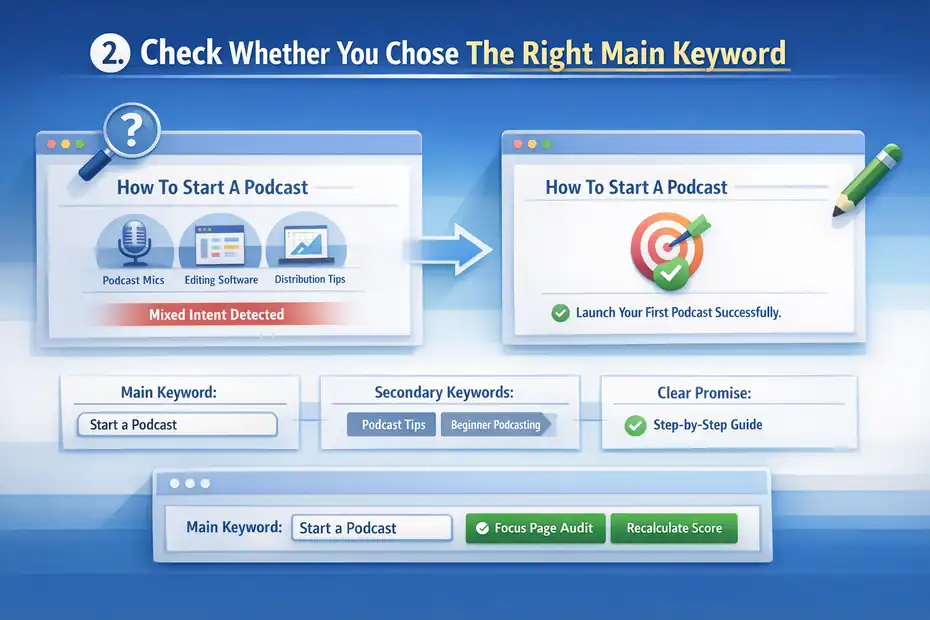
This is the first technical check I would do, because a wrong target keyword can make every other edit feel useless.
Confirm The Page Is Built Around One Primary Intent
One page should usually chase one main intent. That sounds basic, but it is where many stuck scores begin.
Let me break it down for you. If your article is titled something like “How To Start A Podcast,” but half the page is really about podcast microphones, editing software, and distribution tools, then the plugin may struggle to identify one clear optimization target.
You might be trying to rank for “start a podcast,” “best podcast software,” and “podcast mic setup” on the same page.
That creates mixed signals.
A healthier setup looks like this:
- One main keyword: The clearest search phrase that matches the page purpose.
- Two to five secondary variations: Closely related phrases that support the same intent.
- One promise to the reader: A single outcome the page helps them achieve.
I suggest reading your page and asking one blunt question: “If someone lands here from Google, what exact problem are they expecting solved?” Your answer should match the keyword in Squirrly.
If it does not, the score may stay low because the page is trying to be too many things at once.
Make Sure The Main Keyword In Focus Pages Is Correct
Squirrly’s documentation notes that the main keyword used by Focus Pages is the one that influences the page’s ranking calculations and related tasks. It also explains that if you change the main keyword, you need to request a new audit so the report updates with the new target.
That gives you a very practical fix path:
- Step 1: Open the page in Squirrly and check which keyword has been set as the main one.
- Step 2: Ask whether that keyword truly matches the page’s primary intent.
- Step 3: If not, change it to the best-fit phrase.
- Step 4: Request a new audit so the score recalculates correctly.
I have seen pages stay stuck simply because the content was optimized for a secondary phrase while the Focus Page still used an old keyword from a previous draft. Once the keyword was corrected and a new audit ran, the score finally started reflecting the actual changes.
That kind of issue feels mysterious until you find it. Then it feels obvious.
Fix Content Alignment Instead Of Forcing More Keywords
This is where real ranking recovery starts. Not with stuffing, but with alignment.
Rewrite Key Sections So The Topic Is Obvious
Squirrly tends to reward clarity. If the plugin cannot quickly tell what the page is about, your score can plateau even if the content is decent.
I recommend checking these areas first:
- Title: Does it say exactly what the page solves?
- Introduction: Does the main keyword appear naturally and early?
- First subheading: Does it reinforce the same search intent?
- Conclusion or CTA: Does the page finish the same topic it started?
Here is a simple example.
Weak setup: “Marketing Tips For Small Business Owners”
Better setup: “Email Marketing Automation For Small Business: Setup, Mistakes, And ROI”
The second version is narrower and easier for both users and SEO tools to understand.
A practical rewrite method:
- Step 1: Put the main keyword in the title naturally.
- Step 2: Use a close variation in the first 100 words.
- Step 3: Add related phrases in H2s and H3s without repeating the exact same wording.
- Step 4: Remove paragraphs that drift into unrelated subtopics.
In my experience, cutting 300 weak words often helps more than adding 1,000 generic ones. A page with clean topical focus usually scores better and converts better too.
Use Semantic Coverage, Not Repetition
One reason people search for a squirrly seo score not improving fix is that they assume a low score means “not enough keywords.” Usually it means “not enough topic coverage in the right places.”
Semantic coverage means supporting your main topic with naturally related terms, questions, and entities.
For example, if your page targets “WordPress image SEO,” useful supporting terms might include:
- Alt text
- File names
- Compression
- Lazy loading
- WebP
- Captions
- Core Web Vitals
- Image sitemap
You are not repeating one phrase over and over. You are building a complete context around it.
This tends to help in two ways. First, Squirrly has more signals to recognize page relevance. Second, your content better matches what a real reader expects.
I believe this is where many SEO scores get rescued. Instead of trying to hit the same keyword harder, you make the page more complete. That is a much more sustainable fix.
Make Sure Squirrly Can Actually Read The Content
This part is overlooked all the time, especially on sites using page builders or custom layouts.
Watch For Hidden Content, Tabs, And Builder Blocks
If text exists visually on the page but is loaded in a way the plugin does not properly process, your score can look artificially weak.
This often happens with:
- Accordion sections
- Tabs that hide content until clicked
- Sliders and carousels
- Text inserted through shortcodes
- Builder templates pulling content dynamically
- Product descriptions split across custom fields
The result is frustrating. You see the keyword in the design, but Squirrly may not count it the way you expect.
A quick test I like is this: copy the visible page text into a plain document and see whether the core topic is still obvious without the design. If the answer is no, you may be relying too heavily on modules instead of indexable, readable page content.
A realistic scenario: An agency landing page uses Elementor tabs for services, testimonials in sliders, and custom widgets for FAQs. It looks polished, but only a thin amount of actual body text is clearly readable in the main editor. The score stays weak because the plugin is seeing less than the visitor sees.
The fix is usually to add a stronger plain-text structure around the design elements.
Check Whether Another Plugin Or Setup Is Causing Conflicts
Squirrly says its plugin can be used alongside other SEO plugins, which is helpful, but mixed setups can still create confusion in real-world WordPress environments if multiple tools influence metadata, indexing settings, or page analysis workflows.
I would look for these conflict patterns:
- Two SEO plugins active: One controls title tags, another controls audits.
- Caching delays: Changes are saved, but stale cache keeps older output visible.
- Builder preview mismatch: You edit in one interface while another controls published content.
- JavaScript-heavy rendering: Important text appears late or conditionally.
This does not always mean you must remove tools. It means you should simplify the path between content, plugin analysis, and published output.
My rule is simple: One page, one primary keyword, one clear content source, one check for how the final rendered page actually appears.
That alone solves more “score not improving” issues than people expect.
Refresh The Audit And Recalculate The Right Signals
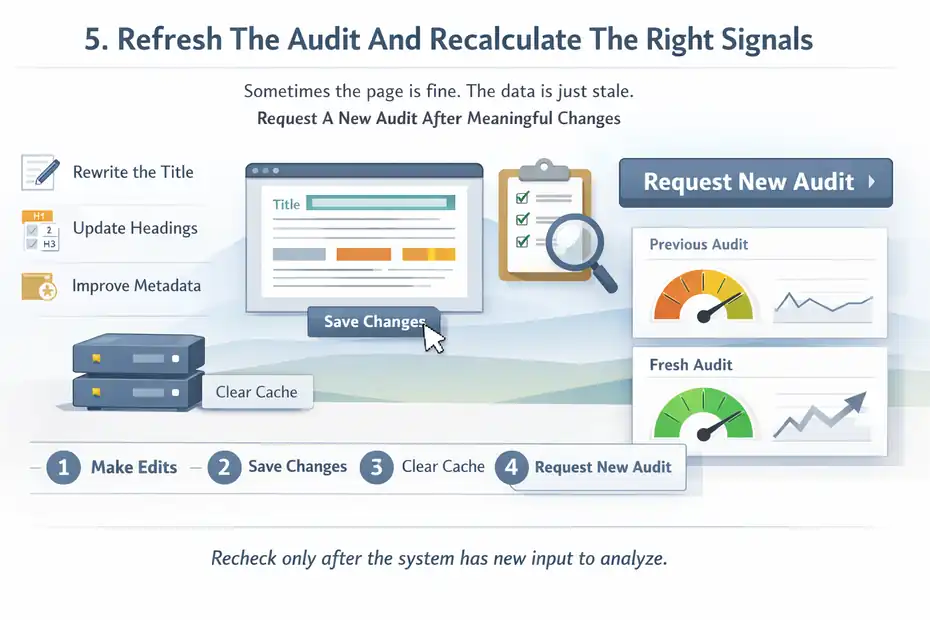
Sometimes the page is fine. The data is just stale.
Request A New Audit After Meaningful Changes
Squirrly’s documentation specifically says that after changing the main keyword for a Focus Page, you should request a new audit to update the report with fresh information.
I would extend that logic to any meaningful change, including:
- Rewriting the title
- Expanding the intro
- Changing headings
- Tightening keyword intent
- Removing unrelated sections
- Improving metadata
A lot of users edit the page, reload once, and expect the score to catch up immediately everywhere. That is not always how these systems work.
A better workflow is:
- Step 1: Make all major content edits first.
- Step 2: Save and confirm they appear on the live page.
- Step 3: Clear cache if you use caching.
- Step 4: Request a fresh audit.
- Step 5: Recheck only after the system has new input to analyze.
This sounds simple, but it matters. You do not want to judge the plugin based on yesterday’s version of the page.
Separate On-Page Feedback From Ranking Progress
This is the emotional trap. You improve the page, the score only moves a little, and you assume nothing worked.
But the plugin score and Google results do not move in lockstep.
Squirrly itself positions the Live Assistant as real-time guidance for on-page optimization, not as a direct promise that a score increase instantly equals higher rankings. Its broader Focus Pages system is built around a larger set of ranking factors.
That means your recovery process should track two things:
| Metric | What It Tells You | What To Do With It |
|---|---|---|
| Squirrly Score | Whether the page better matches plugin recommendations | Use it for optimization feedback |
| Search Console Impressions | Whether Google is testing the page more often | Watch trend direction |
| Click-Through Rate | Whether your title and meta are competitive | Improve hooks and promise |
| Average Position | Whether the page is climbing or slipping | Reassess intent and competition |
| Conversions | Whether the traffic is useful | Keep business goals first |
I suggest using Squirrly to fix page structure and Search Console to judge actual recovery. That combination is much healthier than obsessing over a single score.
Improve The Signals That Usually Unlock The Score
Once the basics are fixed, you can work through the highest-impact items that tend to move both optimization scores and ranking potential.
Tighten Titles, Meta Descriptions, And Heading Logic
This is not glamorous work, but it moves the needle.
Your title should include the target keyword naturally, but it also needs a strong promise. A meta description should reinforce relevance and improve click-through, even if Google rewrites it sometimes. Headings should help both structure and search intent.
A useful formula I often recommend:
- Title: Main topic + clear outcome
- Meta description: Reader problem + solution + reason to click
- H2s: Major stages of the process
- H3s: Specific actions, mistakes, or examples
Here is a mini scenario. Let’s say your page title is “SEO Tips For Beginners.” That is broad and weak. A better title might be “SEO Tips For Beginners: 12 Fixes That Help New Sites Rank Faster.” That gives the page sharper intent and stronger click appeal.
I have noticed that pages stuck in the middle often do not need more content. They need cleaner packaging. Better headings and metadata make the page easier for tools, search engines, and humans to understand at a glance.
Strengthen Topical Depth Where The Page Feels Thin
If your score still will not improve after basic fixes, I would look for thin sections.
Thin does not mean short. It means incomplete.
A section usually feels thin when it:
- Names a problem but does not explain why it happens
- Recommends a fix but gives no steps
- Mentions a term but does not define it
- Gives advice without examples
- Covers beginner basics but skips optimization
For many of us, this is the real content upgrade point. You stop writing broad summaries and start answering the next question the reader would naturally ask.
For example, instead of saying “optimize your images,” explain:
- What file naming should look like
- How alt text should describe content
- Why oversized images affect speed
- How image optimization helps usability and SEO together
That kind of expansion tends to improve content quality and plugin interpretation at the same time.
Fix Common Mistakes That Keep The Score Frozen
You can do a lot of work and still stay stuck if one of these mistakes is quietly undermining the page.
Targeting A Keyword That Is Too Broad Or Too Competitive
This is a classic trap. You pick a main keyword that sounds good, but the SERP is dominated by giant brands, huge guides, or a different content format than yours.
Then you keep editing the page, expecting the score to carry you through.
I suggest checking the top results manually. Ask:
- Are they blog posts, category pages, videos, or service pages?
- Are they from huge authority domains?
- Do they solve a more specific intent than your page does?
- Is your page realistically the best match?
Imagine you target “SEO tools” with a 1,500-word blog post on a small site. That is probably not a page-optimization problem. It is a keyword selection problem.
A smarter move is often to narrow the target, such as:
- SEO tools for small businesses
- SEO tools for bloggers
- Free SEO audit tools for WordPress
- Technical SEO tools for agencies
I believe this is one of the biggest ranking recovery moves available. Better keyword fit can improve the page score, rankings, and conversion quality all at once.
Over-Optimizing The Page Until It Sounds Robotic
The opposite problem also happens. You get so focused on improving the score that you make the content worse.
Warning signs include:
- Repeating the exact phrase too often
- Writing awkward headings just to fit keywords
- Adding unnatural lists of variations
- Turning helpful content into a checklist for a plugin
This usually harms trust. Readers notice when a page starts sounding mechanical, and Google is getting better at spotting thin, over-optimized patterns too.
A better approach is to write for clarity first and optimization second. Use the keyword where it fits. Then support it with related language, examples, and a clear structure.
In my experience, the best-performing SEO content does not feel “optimized” when you read it. It feels useful, direct, and complete.
Use A Real Recovery Workflow Instead Of Random Edits
This is the system I would follow if I needed a dependable squirrly seo score not improving fix on a live site.
A 30-Minute Recovery Checklist
Here is a compact workflow you can actually use.
- Step 1: Confirm the page has one clear primary intent.
- Step 2: Check that the main keyword in Squirrly matches that intent.
- Step 3: Rewrite the title and first 100 words for clarity.
- Step 4: Remove or trim unrelated sections.
- Step 5: Add semantic subtopics the reader genuinely expects.
- Step 6: Check whether visible content is plain-text readable and not hidden inside odd modules.
- Step 7: Save changes, clear cache, and request a new audit.
- Step 8: Compare Squirrly feedback with Search Console performance over time.
This workflow works because it attacks the root causes in the right order. It does not waste time polishing details before you fix targeting and structure.
If you only do one thing today, I would start with the keyword-page match. That is the fastest way to tell whether you have a score problem or a strategy problem.
What To Do If The Score Still Barely Moves
Sometimes the page improves, but the score barely changes. That does not always mean failure.
At that point, I would ask these tougher questions:
- Is the page type wrong for the keyword?
- Does the SERP expect fresher content?
- Are stronger competitors covering the topic more deeply?
- Is internal linking too weak?
- Does the page need backlinks or stronger domain trust?
This is where many site owners realize the plugin was not the real bottleneck. The page may be reasonably optimized, but it still lacks authority, link equity, or a stronger content angle.
That is actually useful insight. It tells you to stop tweaking sentence-level details and start working on broader SEO leverage.
Move From Score Improvement To Real Ranking Recovery
Once you get the score moving, the next job is turning that into traffic, clicks, and results.
Support The Page With Internal Links And Better Context
One isolated page rarely performs as well as a page supported by a small content cluster.
For example, if your main page is about “email automation setup,” related supporting articles could cover:
- Welcome email examples
- Cart abandonment flows
- Email segmentation basics
- Email automation mistakes
- Deliverability troubleshooting
Internal links help search engines understand topic relationships. They also help users keep learning, which improves engagement and page value.
A practical approach:
- Add 3 to 5 relevant internal links from older posts to the target page.
- Use descriptive anchor text that reflects the topic naturally.
- Link out from the target page to closely related support content.
- Keep the cluster focused instead of linking randomly across unrelated posts.
This is one of those boring but powerful moves. It may not create instant score fireworks, but it often helps rankings settle upward over time.
Measure Recovery With Business Metrics, Not Just Plugin Scores
I’ll be honest: it is easy to become emotionally attached to plugin numbers.
But the real recovery question is not “Did the score hit 100?” It is “Did the page become more visible, more clickable, and more useful?”
The metrics I care about most are:
- Impressions: Is Google surfacing the page more often?
- Clicks: Is the title and intent match strong enough to win traffic?
- Position trend: Is the page climbing gradually?
- Leads or sales: Is the traffic actually helping your business?
- Engagement: Are users staying and finding what they need?
A page can sit at a “good enough” optimization score and still outperform a “perfect” page because it matches intent better and earns more trust.
That is why I think the best squirrly seo score not improving fix is not really about chasing a prettier number. It is about using the score as a diagnostic tool while building a page that deserves to rank.
Advanced Tips When Basic Fixes Are Not Enough
This final stage is for pages that are almost there but still underperform compared with their potential.
Match The Search Results Format More Closely
Sometimes your content is good, but it is shaped the wrong way.
If the top search results use templates like:
- Step-by-step tutorials
- Comparison pages
- Pricing breakdowns
- Local service pages
- Definition-plus-how-to guides
then your page should probably lean into that dominant format too.
A quick example: if the SERP for your keyword is filled with “how to” guides and your page is mostly a thought piece, the plugin score might improve with edits, but rankings may still lag because the format mismatch remains.
I suggest studying the first page for structure clues:
- How long are the leading pages?
- Do they use FAQs?
- Are they beginner-focused or expert-focused?
- Do they include examples, screenshots, or templates?
- Is the search intent informational, transactional, or mixed?
This kind of adjustment often does more for rankings than another round of keyword polishing.
Build Authority Around The Topic Over Time
Some pages do not need one fix. They need a stronger site context.
If your website has only one article on a topic, Google may not see you as especially authoritative there yet. But if you build a tight cluster around that subject, the main page often gets stronger by association.
A simple scaling path looks like this:
- Core page: The main keyword target
- Support article 1: Beginner setup
- Support article 2: Common mistakes
- Support article 3: Tool comparison
- Support article 4: Advanced optimization
- Support article 5: Troubleshooting or FAQs
This is how you move from isolated page optimization to topical authority.
Squirrly can help you spot page-level opportunities, but long-term ranking recovery usually comes from better content systems, stronger internal linking, and clearer authority signals across the site.
Final Thoughts
If your Squirrly score is not improving, the fix is usually less dramatic than it feels in the moment. Most of the time, the page is dealing with one hidden issue: the wrong main keyword, weak intent alignment, unreadable content structure, stale audit data, or a page that is trying to rank for a query it was never built to win.
My advice is to stop chasing the score emotionally and start diagnosing the page logically. Clean up the keyword target. Make the topic clearer. Ensure Squirrly can read the content. Refresh the audit. Then measure recovery in Search Console, not just inside the plugin.
That is the real path to ranking recovery. Not a green badge for its own sake, but a page that is clearer, more useful, and much more likely to earn visibility over time.
FAQ
What causes the Squirrly SEO score not to improve?
The Squirrly SEO score often stays stuck due to keyword mismatch, unclear page intent, or content the plugin cannot properly read. In many cases, the issue is not the quality of the content but how well it aligns with the selected focus keyword and audit signals.
How do I fix a Squirrly SEO score that is not changing?
To fix a Squirrly SEO score that is not improving, update the main keyword to match the page intent, rewrite key sections for clarity, ensure content is readable in plain text, and request a new audit so Squirrly recalculates the page using updated signals.
Does a higher Squirrly SEO score guarantee better rankings?
A higher Squirrly SEO score does not guarantee better rankings because it only measures on-page optimization. Google rankings depend on multiple factors such as competition, backlinks, user engagement, and content relevance, so the score should be used as guidance, not a final result.
Why is my content optimized but the Squirrly score is still low?
Your content may feel optimized, but the score can remain low if the keyword targeting is unclear or the plugin cannot detect important content sections. Hidden elements, mixed topics, or weak keyword placement can prevent Squirrly from recognizing your improvements accurately.
How often should I refresh the Squirrly audit after changes?
You should refresh the Squirrly audit after making meaningful updates like changing keywords, rewriting headings, or improving structure. This ensures the system analyzes the latest version of your page and reflects accurate optimization feedback based on current content.

I’m Juxhin, the voice behind The Justifiable.
I’ve spent 6+ years building blogs, managing affiliate campaigns, and testing the messy world of online business. Here, I cut the fluff and share the strategies that actually move the needle — so you can build income that’s sustainable, not speculative.
Related posts:
 How to Increase Your SEO Ranking
 Internal Links: 7 Tips for a Stronger SEO Foundation
 Schema Pro Review: The Ultimate SEO Optimization Plugin
 Is the Squirrly SEO WordPress Plugin Enough to Rank?
 Squirrly SEO Pricing: What You Pay vs What You Get
 Squirrly Content Optimization Strategy For Higher Rankings