Table of Contents
Some links on The Justifiable are affiliate links, meaning we may earn a small commission at no extra cost to you. Read full disclaimer.
If you’re searching for an honest adsterra vs monetag comparison, the real question is not just which platform looks better on a sales page. It is which one can turn your traffic into more revenue without wrecking user experience or slowing down growth.
I have looked at both from the perspective that matters most to publishers: payout speed, minimum thresholds, ad formats, optimization options, and where each one tends to win.
The short answer is that both can pay well, but they usually pay more in different situations depending on your traffic source, GEO mix, and tolerance for aggressive formats.
What This Comparison Really Comes Down To
Before you compare dashboards, payout screenshots, or marketing claims, it helps to define what “pays more” actually means.
For most publishers, it is a mix of eCPM, fill rate, payout threshold, payment timing, and how much revenue survives after you balance ads against SEO and user experience.
Why “Pays More” Is Bigger Than Raw CPM
A lot of publishers make the same mistake here. They compare one network’s headline CPM with another network’s headline CPM and assume the higher number wins.
In practice, that is too shallow. What matters is your final revenue per thousand visitors after ad fill, ad quality, user drop-off, and conversion behavior all play out on your site or traffic source.
Adsterra explicitly positions its publisher monetization around high CPM rates, 100% fill rate, and broad global coverage, while Monetag leans heavily into automated optimization through MultiTag and AI-based ad selection to increase yield.
Let me put that into plain English. A network can look amazing on paper and still underperform for you if the format does not match your audience.
A mobile-heavy entertainment site with Tier 2 or Tier 3 traffic might do better with one set of ad formats, while a cleaner content site with search traffic may need something less disruptive to avoid hurting engagement.
That is why experienced publishers often compare eCPM, session value, bounce rate, and pages per session together instead of obsessing over a single RPM screenshot. The pricing models behind these platforms also vary across CPM, CPC, and CPA logic, which changes how earnings behave for different traffic types.
My advice is simple: Treat “which pays more” as a traffic-fit question, not a brand question. In most cases, the winner is the platform whose ad mix matches your audience’s behavior best.
The Core Business Models Behind Both Networks
Adsterra and Monetag both sit in the broad traffic monetization space, but they present slightly different strengths.
Adsterra positions itself as a monetization platform for websites and social media traffic, with publisher-focused formats including Popunder, Social Bar, banners, native placements, interstitials, and Smartlinks.
It also highlights 45,000+ publishers, 200,000+ new ad campaigns per year, and approval as fast as 10 minutes.
Monetag, on the other hand, frames its value around automation and yield optimization. Its main pitch is MultiTag, a single integration that can automatically use several ad formats and optimize which format performs best.
On its official site, Monetag says MultiTag can generate yield gains of up to 53%, and it supports web, mobile, and Telegram Mini App traffic. That positioning matters because it tells you Monetag is trying to reduce manual testing friction for publishers who want a simpler setup with automatic format selection.
In practical terms, Adsterra often appeals to publishers who want more manual control, specific format choices, and access to its proprietary Social Bar format.
Monetag often appeals to publishers who want a lower-friction setup, quick monetization, and automatic optimization from a single tag. Neither approach is universally better.
I believe the real edge depends on whether you are the kind of publisher who likes to tune placements yourself or wants the platform to do more of the heavy lifting.
Ad Formats And Monetization Options
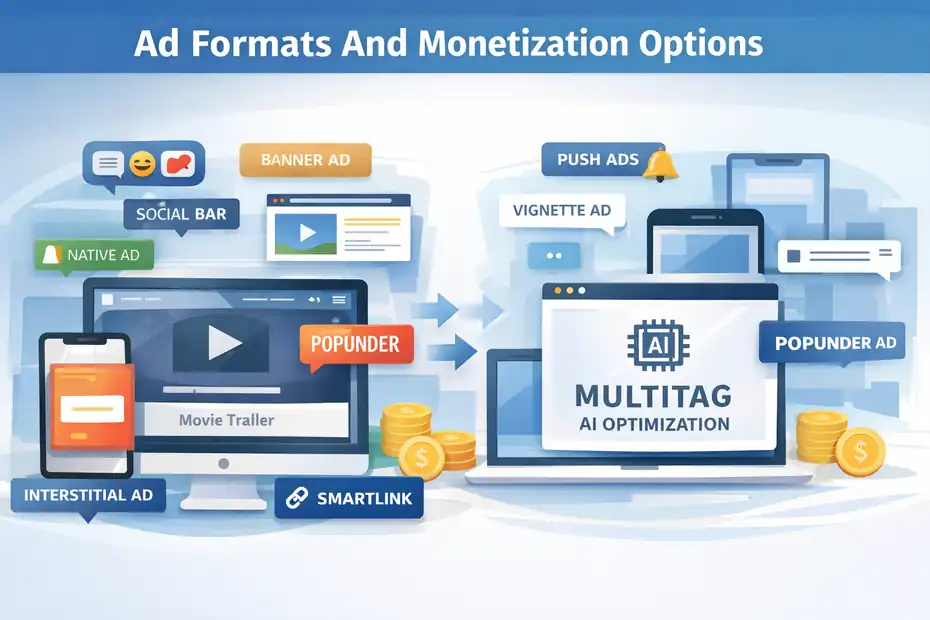
The second major factor in any adsterra vs monetag comparison is ad format depth.
A platform can only pay more when it has formats that fit your audience, your layout, and the kind of traffic you actually have.
Adsterra’s Main Formats And Where They Tend To Win
Adsterra gives publishers several monetization routes: Popunder, Social Bar, banners, native ads, interstitials, and Smartlinks, also called Direct Links in some of its content. The platform repeatedly emphasizes Social Bar as a proprietary format and positions it as a higher-engagement alternative to traditional push-style units.
In its own materials, Adsterra says Social Bar is designed to deliver stronger CTRs, and one 2026 article claims up to 35 times higher CTR than web push ads in some use cases.
This matters because Adsterra is not just selling standard display. It is leaning on formats that can monetize visitors who may ignore normal banners. Smartlink is another important piece of the puzzle.
Adsterra describes Smartlink as a single URL containing multiple offers and notes that revenue can come from both CPM and CPA dynamics, which means it can work well for traffic that converts beyond a simple page impression.
The company also says Smartlink can be used on blogs, apps, and social media traffic, which makes it attractive for publishers without a classic content website.
Where does Adsterra usually have an advantage? From what I have seen, it looks strongest when you want more format variety and you are willing to test combinations manually.
For example, a movie trailer site case study published by Adsterra reported monthly revenue in the $7,000 to $9,000 range using Popunder, Social Bar, and Smartlink across traffic from Asia and the US.
That is a case study, not a guarantee, but it does show the platform’s intended strength: stacking multiple formats on entertainment-style traffic.
Monetag’s Main Formats And Where They Tend To Win
Monetag’s official format lineup centers on Popunder, Push, Vignette Banner, In-Page Push, and SmartLink, with MultiTag bundling several of them into one automated implementation.
The company’s homepage describes these as AI-enhanced formats built to cover web, mobile, and Telegram Mini App traffic, and its social traffic page specifically recommends Popunder, Vignette Banner, Interstitial, Push Notifications, and In-Page Push as monetization options.
The biggest differentiator is not the individual formats alone. It is the way Monetag packages them. MultiTag is designed to choose the most suitable and profitable format for a given site, and Monetag has published case-study content around that idea for years.
One official case study says MultiTag automatically chooses the most suitable and profitable ad format for a specific website, which is exactly the kind of promise that attracts smaller publishers who do not want to micromanage placements.
Monetag also makes a strong play for ease of entry. Its own blog says there are no traffic minimums, approvals are usually under 24 hours, and automated optimization helps smaller sites monetize sooner.
That is a meaningful difference for beginner publishers who do not yet have the volume to negotiate, test endlessly, or wait for premium approval.
If I had to summarize the format battle simply, I would say this: Adsterra gives you more of a “choose your monetization stack” feel, while Monetag gives you more of a “plug in one system and let it optimize” feel. The one that pays more is often the one that matches your workflow tolerance.
Payout Thresholds, Payment Speed, And Cash Flow
This is where many comparisons get surprisingly real.
A network can have decent eCPMs and still be frustrating if your cash flow is slow or the minimum payout is too high for your current traffic level.
Minimum Payouts: Monetag Is Usually Easier For Small Publishers
On official help pages, Monetag states that its minimum payout starts at $5 for PayPal, Skrill, and WebMoney; $20 or $30 for Payoneer depending on country; $100 for crypto; and $500 for wire, online banking, and Revolut, with an added bank fee for transfers below $1,000. It also says the minimum withdrawal starts at $5 depending on the method used.
Adsterra also supports low entry thresholds, but they depend on payment method. Its own publisher content says payouts are automated once you complete your profile and reach the minimum required by your chosen payment system.
In more recent Adsterra materials, the company says the minimum payout can be as low as $5 for Paxum, and its local bank transfer option starts at $25 instead of the classic $1,000 wire minimum.
So who wins this round? For many small publishers, Monetag has the cleaner and more transparent low-threshold story because its help documentation spells out method-specific minimums very clearly, and the $5 floor for common digital payout methods is easy to understand.
Adsterra can also be beginner-friendly on payout minimums, but the exact threshold is more tied to payment method selection and what options are available in your account.
If you are starting with a small site doing a few dollars per day, lower payout friction matters more than many people admit. Fast access to early revenue is motivating. It also helps you recycle cash into content, hosting, or paid traffic tests without waiting forever.
Payment Cycles: Faster Access Can Matter More Than Slightly Higher RPM
Monetag updated its payouts in late 2025 and says the first payout can be available in just two weeks after earnings accrue, down from the older 30-day wait.
The company also says publishers can use monthly, bi-weekly, or weekly payment cycles depending on eligibility, with weekly payments available to Silver+ publishers in its Priority program.
One help page notes weekly payouts are every Thursday with a 4-day hold period for eligible accounts.
Adsterra, by contrast, repeatedly highlights automated NET-15 payouts for publishers. Its local currency payout article also states that local bank transfer users get paid twice a month on payment dates, and multiple Adsterra blog pages cite NET-15 as the standard publisher payment frequency.
This creates an interesting split. Adsterra’s NET-15 schedule is solid and predictable. Monetag’s newer payout structure can be more flexible, especially for publishers who qualify for more frequent cycles.
If you are a growth-stage publisher, that flexibility is a big deal. I have seen plenty of people choose a platform with slightly lower earnings simply because the cash arrives sooner and more consistently.
So from a pure cash-flow perspective, Monetag has the edge for many smaller or mid-tier publishers because the floor is lower and the payout options are more flexible on paper. Adsterra still looks strong for publishers comfortable with NET-15 and method-based thresholds.
Setup, Approval, And Ease Of Use
The best-paying network in theory is not much use if setup is clunky or approval slows down your launch. This part matters more than many comparison articles admit.
Which Platform Is Faster To Launch?
Adsterra says publisher approval can take around 10 minutes and emphasizes a fast self-serve setup flow for website and social media monetization. The platform also outlines a simple three-step process: register, place the code, and start earning.
Monetag takes a similar simplicity-first approach. Its own site says you can monetize traffic today, while its blog says approvals are usually under 24 hours and there are no traffic minimums. For a beginner, that “no traffic minimums” line is important. It signals that you do not need a giant site before you can start testing and learning.
Here is how I see it in real terms:
- Adsterra: Likely feels faster if you already know which format you want and you want direct control over integration.
- Monetag: Likely feels easier if you want one simpler starting point and less manual configuration through MultiTag.
For many of us, ease of launch is not just convenience. It affects testing speed. A publisher who can test three placements this week will usually beat the publisher who spends a month waiting for the “perfect setup.”
Dashboard Philosophy: Manual Control Vs Automated Optimization
This is one of the most useful ways to frame the adsterra vs monetag comparison. Adsterra often feels built for publishers who want to choose formats and shape the monetization stack intentionally. Its format-specific materials, traffic estimators, and format education all point in that direction.
Monetag pushes the opposite value proposition: reduced complexity. MultiTag is explicitly sold as a single tag that automates ad selection to improve CPM and yield. The company says this approach helps monetize all inventory and boosts CPM rates by using AI-based delivery logic.
Neither philosophy is wrong. But your personality as a publisher matters here. If you love testing, split placements, and using different ad stacks by device or page type, Adsterra may give you more room to work. If you want the platform to handle more decisions so you can focus on traffic growth, Monetag may feel lighter and faster.
In my experience, the network that “pays more” often ends up being the one you actually optimize consistently. A platform with slightly lower upside but better execution discipline can beat a more flexible platform you never fully tune.
Which Pays More By Traffic Type?
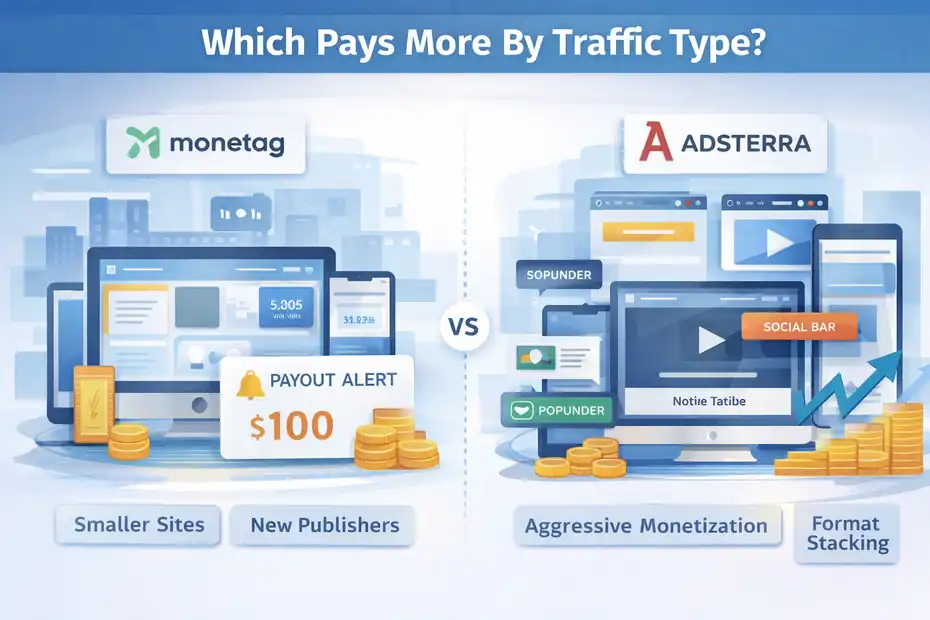
Now we get to the part most people actually care about. Not generic claims. Not vague marketing copy.
Just the practical question: which one is more likely to pay more for your kind of traffic?
For Small Sites And New Publishers, Monetag Often Has The Easier Path To Early Earnings
If your site is new, your daily traffic is modest, or you are testing monetization for the first time, Monetag has a pretty strong case. The lower entry threshold, the stated lack of traffic minimums, and the automated MultiTag model make it easier to start earning without overthinking every placement.
The company has also made its faster first-payout messaging a big part of its publisher pitch since late 2025.
Imagine you run a small streaming blog with 8,000 to 15,000 monthly visits, mostly mobile users from mixed GEOs. You probably do not have enough clean data to know whether Popunder, Push, or In-Page Push will produce the best yield.
In that situation, a one-tag optimization system can save time and help you discover revenue faster. That does not guarantee the highest long-term RPM, but it often improves your odds of getting to usable results quickly.
Monetag also looks especially friendly for publishers monetizing nontraditional or social-heavy traffic. Its official material includes social traffic and Telegram Mini Apps in its positioning, which tells you the company is actively thinking beyond classic content sites.
So if you force me to choose one platform for a brand-new publisher who mainly wants easier onboarding, lower payout friction, and less manual testing, I would lean Monetag first.
For Aggressive Monetization And Format Stacking, Adsterra Can Win Bigger
Adsterra becomes very compelling when you have enough traffic to test multiple formats and enough confidence to optimize them deliberately.
The platform’s combination of Popunder, Social Bar, Smartlink, native, interstitials, and display opens the door to stacking monetization in ways that can push session value higher on entertainment, download, utility, or viral traffic.
The proprietary Social Bar angle matters here. Adsterra presents it as a high-engagement format and has repeatedly framed it as a revenue driver beyond ordinary push-style ads.
If your audience tolerates stronger monetization well, a format like that can outperform safer, lower-intensity setups. Its Smartlink model also blends CPM and CPA behavior, which can improve revenue when traffic not only views offers but converts on them.
A realistic example: let’s say you run a movie, memes, or downloads site with high page depth, returning users, and a lot of non-premium GEO traffic. In that case, Adsterra’s broader format toolkit may give you more upside because you can test combinations rather than relying on one automated decision layer.
Adsterra’s own publisher case study around a movie trailer site shows the platform wants to be judged in exactly this kind of environment.
That does not mean Adsterra always pays more. It means Adsterra often has a higher ceiling when your traffic profile supports more aggressive monetization and you know how to optimize around it.
For Search Traffic, UX-Sensitive Sites, And SEO Projects, The Winner Depends On Restraint
This is the nuance a lot of comparison articles skip. If your traffic is heavily organic from Google, the highest-paying ad format is not automatically the best business decision.
Aggressive monetization can increase bounce rates, reduce session depth, and hurt the overall site experience. Both networks publish materials that acknowledge the need to balance earnings with user experience and page performance.
Monetag explicitly warns against overloading pages and recommends monitoring page speed and Core Web Vitals. Adsterra’s WordPress and Discover-focused materials also point publishers toward testing placements without damaging UX or visibility.
If you run a content site built on search traffic, I suggest evaluating both networks by page group. Test monetization on lower-risk pages first, watch bounce rate and revenue per session, and do not judge success by RPM alone
A network that earns 20% more but cuts your return visits or time on site is not truly paying more over the long run.
For SEO publishers, this is often the best practical rule:
- Use the network that gives you acceptable revenue with the lowest UX damage.
- Judge results by session value, not just page-level RPM.
- Scale only after you confirm user metrics stay healthy.
That is where “which pays more” stops being a simple platform debate and becomes a publishing strategy decision.
Optimization Strategies That Actually Change Revenue
Choosing the better network is only step one. The bigger gains usually come from how you set it up, what you test, and how quickly you cut underperforming placements.
Start With One Variable At A Time
One of the easiest ways to get bad data is to change everything at once. If you switch networks, add two new placements, change page speed plugins, and alter traffic sources in the same week, you will have no idea what caused the result.
Here is the cleaner way to do it:
- Step 1: Keep your traffic source stable for the test period.
- Step 2: Test one main format or one main tag first.
- Step 3: Measure eCPM, revenue per session, bounce rate, and pages per visit together.
- Step 4: Only then add another format or another placement.
This matters because both Adsterra and Monetag can behave very differently depending on GEO and device. Adsterra itself notes that minimum bids and pricing behavior depend on GEO, format, and device type.
Monetag, meanwhile, keeps emphasizing automatic format optimization, which means placement context still matters even when the system is choosing formats for you.
I recommend running comparisons over enough volume to smooth out weird days. Weekend traffic, social spikes, or one viral article can distort your judgment fast.
Match Formats To Intent, Not Just Device Type
A lot of publishers only segment by desktop versus mobile. That is useful, but it is not enough. Intent matters more.
For example:
- Low-intent, entertainment-style traffic: Usually tolerates stronger monetization better.
- Utility traffic: Can monetize well if the user expects a quick transaction or tool-based experience.
- Informational search traffic: Often needs more restraint because the visitor came for an answer, not an interruption.
Adsterra’s format library, especially Social Bar and Smartlink, gives you more ways to target intent clusters manually. Monetag’s MultiTag may help you discover the right mix faster, but you still need to think about where those ads appear in the user journey.
In plain language, the same user who tolerates a strong ad on a free movie page may bounce instantly if you hit them with the same monetization on a how-to article. That difference is often larger than the difference between the two networks themselves.
Common Mistakes That Make Publishers Choose The Wrong Winner
A bad test can make a weaker option look stronger. I see this all the time, and it is why so many people swear by opposite results.
Mistake 1: Comparing Screenshot Earnings Instead Of Traffic Quality
Revenue screenshots are fun, but they are terrible decision tools without context. A publisher earning more on Adsterra may have different GEOs, different device mix, different page intent, or more aggressive placement strategy.
Another publisher making better money on Monetag may simply have cleaner traffic or a stronger match with MultiTag optimization.
Official platform content already hints at these differences. Adsterra frequently speaks in terms of format, GEO, and device-specific performance. Monetag emphasizes automated format choice and inventory-wide optimization. Both messages imply the same truth: payout is contextual.
So the wrong question is, “Who paid someone else more?” The better question is, “Which setup monetizes my traffic more efficiently without hurting long-term value?”
Mistake 2: Chasing Maximum RPM And Ignoring Business Damage
This one hurts the most because it can look like success at first. You add aggressive formats, RPM jumps, and you feel like a genius for three weeks. Then rankings soften, user complaints rise, time on site drops, and your total traffic slips.
Both companies publish content that acknowledges the tension between monetization and user experience. Monetag directly advises publishers not to overload pages and to watch Core Web Vitals, while Adsterra’s educational content around WordPress and web monetization also points to testing format placement carefully.
I suggest thinking in 90-day revenue, not 7-day RPM. The network that preserves traffic while monetizing reasonably often wins bigger over time.
Final Verdict: Which Pays More?
If you want the cleanest possible answer in this adsterra vs monetag comparison, here it is: Monetag often pays more for smaller publishers, early-stage sites, and people who want low payout thresholds, easier setup, and automatic optimization.
Adsterra often pays more when you have the traffic volume, format tolerance, and testing discipline to take advantage of its broader manual monetization stack, especially formats like Social Bar and Smartlink.
So which one should you choose?
- Choose Monetag if: You want easier entry, lower payout friction, automated optimization, and a simpler path to first revenue.
- Choose Adsterra if: You want more control, more format variety, and higher upside from aggressive testing and stacking.
- Choose based on your traffic, not the brand name: That is still the most important rule.
If I were advising a beginner with a modest site today, I would probably start with Monetag because the path to testing is simpler.
If I were advising a publisher with established entertainment or global mixed-GEO traffic and a willingness to optimize hard, I would seriously test Adsterra first. That is the honest answer. Not flashy, but useful.
FAQ
What is the main difference in the adsterra vs monetag comparison?
The main difference is how each platform handles monetization. Adsterra offers more manual control with multiple ad formats, while Monetag focuses on automation through MultiTag. Monetag simplifies setup and optimization, whereas Adsterra allows more customization, which can lead to higher earnings with advanced testing.
Which pays more, Adsterra or Monetag?
In most cases, Monetag pays more for beginners or low-traffic sites due to automation and lower payout thresholds. Adsterra can pay more for experienced publishers who optimize multiple ad formats and have high-volume or entertainment-based traffic that supports aggressive monetization strategies.
Is Monetag better for beginners than Adsterra?
Yes, Monetag is generally better for beginners because it has no traffic minimums and offers automated optimization. Its MultiTag system reduces the need for manual testing, making it easier for new publishers to start earning quickly without needing advanced monetization knowledge or setup experience.
Does Adsterra have higher CPM rates than Monetag?
Adsterra can offer higher CPM rates depending on traffic type, GEO, and ad formats used. However, higher CPM does not always mean higher total earnings. Monetag’s automated optimization can sometimes generate better overall revenue by improving fill rates and format performance across different traffic segments.
Which platform is better for SEO websites?
For SEO-focused websites, the better platform depends on how ads affect user experience. Monetag may be safer for maintaining UX with automated placements, while Adsterra can generate higher revenue if formats are carefully optimized without increasing bounce rates or harming search rankings.

I’m Juxhin, the voice behind The Justifiable.
I’ve spent 6+ years building blogs, managing affiliate campaigns, and testing the messy world of online business. Here, I cut the fluff and share the strategies that actually move the needle — so you can build income that’s sustainable, not speculative.