
Table of Contents
Some links on The Justifiable are affiliate links, meaning we may earn a small commission at no extra cost to you. Read full disclaimer.
If you’re trying to understand spocket pricing plans explained for beginners, you’re probably asking a very practical question: which plan gives you enough room to launch without paying for features you will not use yet?
think that is exactly the right question to ask before you connect a store, import products, and start spending on traffic.
Spocket’s pricing looks simple at first glance, but once you compare product limits, premium access, support, and annual discounts, the best choice becomes much clearer.
What Spocket Is And Why Pricing Matters
Spocket is a dropshipping platform that connects online sellers with a large supplier catalog and includes features like product importing, order fulfillment support, and supplier communication.
For beginners, pricing matters because your subscription sits on top of your store platform costs, payment processing fees, ad spend, and product costs.
What Spocket Actually Helps You Do
When most beginners look at Spocket, they see “product sourcing.” That is true, but it is only part of the picture. In practice, Spocket helps you browse products, import them into your store, manage supplier-based fulfillment, and work with tools like branded invoicing and supplier chat on higher plans.
The platform also promotes access to a catalog of more than 100 million products and support for channels including AliExpress, eBay, and Amazon on its pricing page.
For a new store owner, that matters because the subscription is not just paying for listings. You are also paying for workflow convenience. If you have ever tried to manage products manually, rewrite descriptions, track suppliers, and place orders one by one, you already know how quickly “cheap” can become expensive in time.
I believe this is where many beginners get pricing wrong. They compare only the monthly fee and ignore the value of saved hours, fewer mistakes, and better store presentation. Those hidden gains are often what make a mid-tier plan feel more affordable than it first appears.
Why Beginners Should Compare Limits Before Features
The biggest pricing trap with Spocket is choosing a plan based on flashy features instead of usable limits. The official plan structure is heavily built around how many unique products and premium products you can access. Starter allows 25 unique products.
Professional raises that to 250 unique products and 25 premium products. Empire jumps to 10,000 unique and 10,000 premium products, while Unicorn goes to 25,000 for both.
That means your first real question is not “Do I want VIP support?” It is “How many products do I realistically need in my catalog over the next 60 to 90 days?”
Imagine you are launching a focused home decor store with 12 products. Starter may be enough. But imagine you are building a general store, testing five categories, and rotating offers every week. Twenty-five unique products disappears fast. In that situation, paying less upfront can create friction almost immediately.
From what I have seen, beginners do better when they buy for the business model they are actually building, not the one they hope to outgrow later.
Spocket Pricing Plans At A Glance
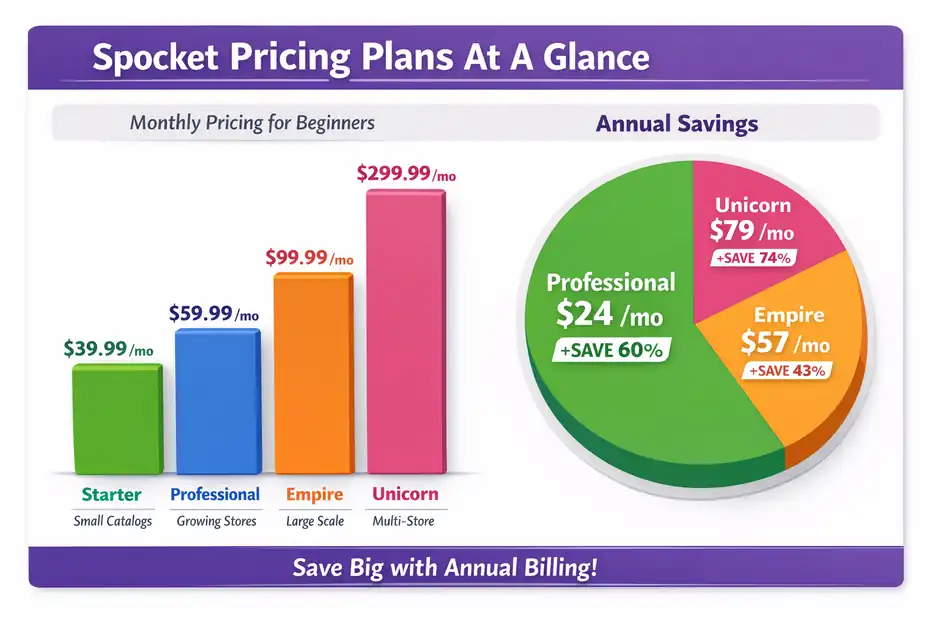
Spocket offers four paid plans: Starter, Professional, Empire, and Unicorn. It also offers monthly and annual billing, with the annual pricing heavily discounted versus month-to-month rates.
Monthly Plan Pricing For Beginners
Here is the current monthly pricing shown on Spocket’s official pricing page:
| Plan | Monthly Price | Best For |
|---|---|---|
| Starter | $39.99/month | Testing a small catalog |
| Professional | $59.99/month | Small stores ready to grow |
| Empire | $99.99/month | Serious scaling and large catalogs |
| Unicorn | $299.99/month | Large operations and multi-store workflows |
These are not tiny jumps, but they are not random either. The Starter-to-Professional jump is about access and flexibility. The Empire jump is about scale. Unicorn is positioned for much larger sellers who want very high limits and more operational room.
I suggest looking at Professional as the practical “real business” tier for many beginners. Not because Starter is bad, but because Starter is narrow by design. It works best when you already know your niche and you want a tight catalog.
Annual Plan Pricing And Savings
Spocket also pushes annual billing quite aggressively. On the official pricing page, annual pricing is listed at $24/month for Professional, $57/month for Empire, and $79/month for Unicorn, with savings amounts displayed on the page. The page also labels annual billing as “FREE 8 months off,” which is Spocket’s way of framing the larger yearly discount.
That discount is big enough to change the decision for some sellers. Professional, for example, drops from $59.99 monthly to $24/month when billed annually. That is a major difference in effective monthly cost.
The catch is simple: annual billing only makes sense if you are reasonably sure you will stay with the platform for the year. If you are still validating your niche, your suppliers, or your store concept, monthly pricing gives you more freedom even if the month-to-month number looks worse.
In my experience, annual discounts are great after validation, not before it. Beginners often do this backward.
Free Trial And Payment Methods
Spocket’s official pricing and help pages say the paid plans come with a 7-day free trial. The help center also says subscriptions and orders can be paid using credit cards and PayPal.
That trial matters because it gives you a short window to test your workflow. You can browse products, see whether suppliers fit your market, and decide whether the dashboard feels intuitive enough for your business.
My advice is to use the free trial like a serious audit, not a casual look around. Build a draft catalog. Compare shipping setups. Estimate margins. Try to think like a store owner, not just a shopper.
What You Get In Each Spocket Plan
Each Spocket plan builds on the previous one, but the practical differences are easier to understand when you look at what changes for a beginner’s day-to-day workflow.
Starter Plan: Best For Very Small Catalogs
Starter is priced at $39.99 per month and includes 25 unique products, 0% transaction fees, access to the large product catalog, unlimited orders, bulk checkout, Spocket Academy, and listing support for AliExpress, eBay, and Amazon according to the pricing page.
For a true beginner, Starter works when you want to keep things tight and simple. A one-product store, a highly focused niche store, or a very small test catalog can fit inside this plan.
Here is the limitation you need to respect: 25 unique products is not much. That sounds obvious, but many beginners underestimate how quickly they use those slots. A bedding niche can easily need separate variants for sheets, pillow covers, throws, and seasonal bundles. A beauty niche can burn through 25 products just by testing bundles and price points.
Starter is not a bad plan. It is a plan for discipline. If you know exactly what you want to sell, it can work. If you are still exploring, it can feel restrictive fast.
Professional Plan: The Sweet Spot For Most Beginners
Professional costs $59.99 per month on monthly billing and includes everything in Starter plus 250 unique products, 25 premium products, multiple store support, chat with suppliers, branded invoices, and VIP chat support.
I think this is the plan most beginners should look at first. It gives you enough product room to test properly without forcing you into enterprise-level spending. The jump from 25 to 250 unique products changes how you can build a store. You can test categories, create collections, rotate seasonal offers, and remove underperformers without feeling boxed in.
The premium product allowance also matters because product quality and presentation can shape your margins. Then there is branded invoicing, which is one of those features that seems small until you realize it can help your store look less generic to customers.
If you are serious enough to launch, optimize, and learn from real customer behavior, Professional is usually where the platform starts to feel comfortable rather than limiting.
Empire And Unicorn: Built For Scale, Not Curiosity
Empire is $99.99 per month and includes 10,000 unique products plus 10,000 premium products. Unicorn is $299.99 per month and raises those limits to 25,000 unique and 25,000 premium products. Both include the advanced features from lower plans.
These tiers are not beginner defaults. They are scaling tiers.
Empire starts to make sense when you run a large catalog, manage many collections, or need the breathing room to expand aggressively. Unicorn is positioned for even larger sellers and operations handling substantial product volume or more complex multi-store needs.
The pricing page also notes multiple store support, while clarifying that each store still needs its own subscription to access all features and VIP support.
That last detail is important. Some beginners assume “multiple store support” means one payment covers every store. The official page does not say that. In fact, it says a separate subscription is required for each store.
So yes, these plans are powerful. But they only make financial sense when your store volume justifies them.
How To Choose The Right Plan As A Beginner
Picking the right Spocket plan is less about status and more about matching your subscription to your selling style.
The best plan is usually the one that removes your next bottleneck without creating unnecessary cost.
Choose Based On Catalog Size, Not Optimism
Here is the cleanest way to decide:
- Starter: Choose this if you want 1 to 25 products and a tightly curated niche.
- Professional: Choose this if you want room to test, expand, and build real collections.
- Empire: Choose this if you already know you need a large catalog and plan to scale quickly.
- Unicorn: Choose this only if you are operating at a much bigger level.
I recommend that you estimate your catalog in real numbers, not vague intentions. Open a spreadsheet and list every product you expect to import in the next three months. Include bundles, alternates, and backup products. That exercise alone often makes the correct plan obvious.
Many beginners say, “I’ll stay lean,” then import 18 products in week one and feel stuck by week two. That is a frustrating place to be because you end up upgrading reactively instead of planning confidently.
Think About Branding And Supplier Communication Early
Professional and above include branded invoices, supplier chat, and VIP chat support. These can sound like “nice to have” items until you start dealing with delivery expectations, product issues, and customer perception.
Branded invoicing matters because it makes your store feel more like a real brand and less like a random reseller. Supplier chat matters because communication delays can hurt customer satisfaction when order questions come up. Better support matters because beginners often need answers fast when they are learning.
I would not buy a higher plan just for those features. But if you are already close on product limits, these extras can push Professional ahead pretty easily.
Use Margin Math Before You Commit
Spocket’s help center reminds sellers that shipping costs are not included in the listing price and that you need to account for base cost, shipping, and your desired margin when setting pricing.
That means your subscription fee should be part of your margin thinking too.
A simple beginner formula looks like this:
- Total Cost Per Sale: Product cost + shipping + transaction-related costs + ad cost estimate + share of subscription
- Target Price: Total cost per sale + desired profit margin
Imagine a product costs $12, shipping is $4, and your store-level overhead adds another $3 average cost per order. Your cost is already $19 before profit. That is why plan choice matters. If your subscription is too high for your current order volume, your margins get squeezed.
Monthly Vs Annual: Which One Makes More Sense?
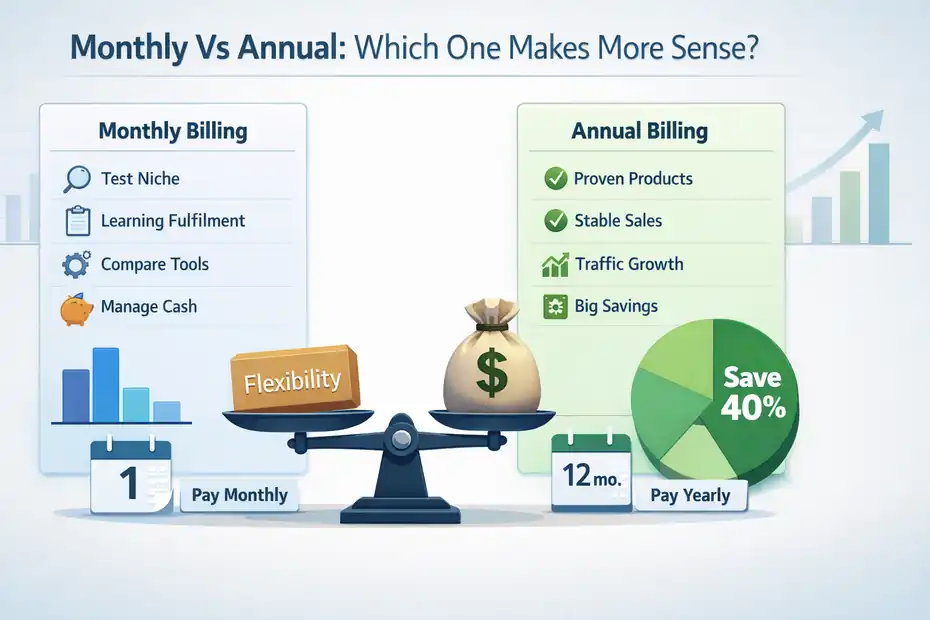
Spocket’s annual plans are dramatically cheaper on an effective monthly basis, but monthly billing gives beginners flexibility. The right answer depends on whether you are validating or scaling.
When Monthly Billing Is The Smarter Beginner Move
Monthly billing is usually the safer choice when you are still figuring things out. That includes cases where you are:
- Testing a niche: You are not yet sure the audience or offer will work.
- Learning fulfillment: You have not processed enough orders to trust your workflow.
- Comparing tools: You may still switch platforms or suppliers.
- Managing cash carefully: You need lower upfront commitment.
I believe monthly is the most honest beginner choice. It keeps pressure low and allows you to pivot without feeling trapped by a yearly payment. Yes, the effective monthly price is higher, but flexibility has value.
For many of us, the early stage is messy. Products change. branding changes. Even the whole niche can change. Monthly pricing gives you room to adapt.
When Annual Billing Starts Paying Off
Annual billing becomes attractive once your business has a few signs of stability. Maybe you have found products that convert. Maybe your refund rate is manageable. Maybe you have repeatable traffic from ads, organic search, creators, or email.
At that stage, Spocket’s annual discounts can reduce a meaningful operating expense. Professional dropping to $24/month billed annually is especially notable if that is the plan you already know you need. Empire at $57/month annually also becomes much easier to justify if you are scaling product volume.
My general rule is simple: validate with monthly, optimize with annual.
That way, you use the discount when it actually improves your economics instead of turning into a premature commitment.
Beginner Mistakes To Avoid With Spocket Pricing
A lot of frustration around Spocket pricing comes from mismatched expectations, not from the platform itself. Most problems start before the subscription is even purchased.
Mistake 1: Choosing The Cheapest Plan By Default
Starter looks attractive because it is the lowest monthly entry point. But cheaper is not always cheaper in practice. If you need to upgrade after a week because 25 unique products is too restrictive, you did not really save money. You just delayed the right decision.
This happens often with general stores and trend-driven stores. Beginners import aggressively, test quickly, and realize they needed Professional from day one.
The fix is to project your catalog before you subscribe. That five-minute planning step prevents a lot of regret.
Mistake 2: Ignoring Shipping In Your Profit Math
Spocket explicitly notes that shipping costs are not included in the listing price and should be considered alongside base price and desired margin.
That means you cannot look at a product cost and assume the margin is obvious. Shipping changes the equation, especially for bulky items, international delivery, or lower-ticket products.
A beginner might see a $9 product and list it at $24.99 thinking the margin looks great. Then shipping adds $6, ad costs eat another chunk, and the subscription overhead narrows the remaining profit. Suddenly the “winning product” is mediocre.
Mistake 3: Paying Annually Too Early
Big discounts can make annual plans feel like a no-brainer. But a discount only helps if the underlying tool choice is right for your business.
If you are still unclear about your store strategy, an annual subscription can lock you into a setup you might outgrow, abandon, or replace. I would be cautious here. A lower effective monthly price is not the same as lower risk.
Mistake 4: Misunderstanding Multi-Store Support
The pricing page says multiple store support is available, but it also states that each store requires a separate subscription to access all features and VIP support.
That is a small sentence with big budget implications. If you plan to run several stores, calculate that cost upfront. Do not assume one upgraded plan will cover all of them.
A Simple Plan Selection Framework For Beginners
If you are still unsure, this framework makes the decision easier. You do not need a perfect answer. You need a practical one.
The 3-Question Test
Ask yourself these three questions:
- How many products will I realistically import in the next 90 days? If the answer is above 25, Starter is probably too tight.
- Do I care about brand presentation and smoother supplier communication? If yes, Professional becomes more appealing.
- Am I validating or scaling? Validation usually favors monthly billing. Scaling often favors annual discounts.
These questions work because they cut through wishful thinking. They force you to tie price to workflow, brand goals, and business stage.
My Beginner Recommendations By Store Type
Here is the recommendation I would give most new sellers:
- One-product or tiny niche store: Start with Starter on monthly billing.
- Curated niche store with testing plans: Start with Professional on monthly billing.
- Growing store with proven traction: Move to Professional annual or Empire annual depending on catalog size.
- Large catalog or multi-brand operator: Consider Empire or Unicorn only after revenue justifies it.
I think this keeps you from underbuying and overbuying at the same time, which is harder than it sounds.
Final Verdict: Which Spocket Plan Should A Beginner Choose?
For most people searching spocket pricing plans explained for beginners, the real answer is this: Starter is fine for a very small and disciplined launch, but Professional is the plan that usually gives a beginner enough room to build a real store without hitting limits too quickly. Empire and Unicorn are scale plans, not default starting points.
If you are cautious, start monthly. Use the 7-day trial seriously. Count your planned products. Run your margin math with shipping included. Then choose the lowest plan that removes your next likely bottleneck, not just the cheapest one on the page.
That is the most beginner-friendly way to approach Spocket pricing. It keeps your costs grounded, your expectations realistic, and your store setup aligned with how you actually plan to sell.
FAQ
What is included in Spocket pricing plans for beginners?
Spocket pricing plans include product importing, supplier access, order fulfillment support, and product limits. Higher plans add premium products, branded invoicing, and supplier communication. Beginners typically start with basic product access and upgrade as their catalog and store needs grow.
Which Spocket plan is best for beginners starting out?
The Professional plan is usually the best starting point for beginners because it offers enough product capacity and flexibility for testing. Starter works for very small stores, but most beginners outgrow it quickly when they begin adding more products or expanding their catalog.
Does Spocket offer a free trial for new users?
Yes, Spocket offers a 7-day free trial that allows beginners to explore the platform, import products, and test workflows. This trial helps users evaluate whether the platform fits their store setup before committing to a paid subscription.
Is Spocket worth the price for dropshipping beginners?
Spocket can be worth the price if you value time-saving automation, supplier access, and product management tools. Beginners who actively test products and build a real store often benefit more compared to those running very small or experimental setups.
Should beginners choose monthly or annual Spocket pricing plans?
Beginners should usually start with monthly plans to stay flexible while testing their store. Annual plans offer significant discounts, but they are better suited for users who have validated their products and are confident in scaling their business long term.

I’m Juxhin, the voice behind The Justifiable.
I’ve spent 6+ years building blogs, managing affiliate campaigns, and testing the messy world of online business. Here, I cut the fluff and share the strategies that actually move the needle — so you can build income that’s sustainable, not speculative.
Related posts:
 Dropshipping Business Model Success: Tips for Long-Term Growth
 Dropshipping for Beginners: The Complete No-Fluff Guide
 Salehoo Dropshipping Reviews: Is It Worth Your Money Today?
 Is SaleHoo Worth It? Honest Breakdown for New Sellers
 AppScenic Pricing Explained: Real Costs
 AppScenic Pros And Cons For Dropshipping