
Table of Contents
Some links on The Justifiable are affiliate links, meaning we may earn a small commission at no extra cost to you. Read full disclaimer.
Bubble SaaS product development strategy works best when you treat no-code speed as a business advantage, not just a way to launch faster.
If you want to turn an idea into recurring revenue without wasting months on features nobody wants, you need a clear plan for validation, build scope, pricing, onboarding, and growth.
I have seen too many founders jump into Bubble excited about the builder itself, then get stuck because the product strategy was fuzzy.
Let me walk you through a practical path that helps you build smarter, launch leaner, and grow with less guesswork.
Define What Your SaaS Should Actually Solve
A strong Bubble SaaS product development strategy starts before you open the editor. You are not building pages, workflows, and databases yet.
You are deciding whether the problem is painful enough that someone will pay to solve it.
Understand The Real Problem Behind The Idea
Most SaaS ideas sound decent in one sentence. That is exactly why many of them fail. “A project management tool for freelancers” sounds fine, but it is too broad to win. “A client portal that helps freelance designers collect approvals, invoices, and file handoffs in one place” is much stronger because it targets a specific friction point.
Here is how I suggest thinking about it. Ask yourself what job the user is trying to get done, what slows them down today, and what costly workaround they currently accept. If the answer is vague, the opportunity is probably weak. If the answer sounds like, “I lose hours every week doing this manually,” then you are getting closer.
A good sign is when the problem already has ugly solutions. Maybe people are juggling Airtable, email, Stripe, Slack, and spreadsheets. That mess is frustrating, but it proves demand. In many cases, your Bubble app does not need to invent a new category. It just needs to make an existing workflow feel much simpler.
I believe founders often overvalue originality and undervalue clarity. You do not need the most revolutionary concept. You need a painful, frequent, expensive problem that a narrow audience already understands.
Pick A Narrow Market Before You Pick Features
One of the biggest mistakes in no-code SaaS is trying to build for “everyone who might need this.” Bubble makes it easy to imagine endless flexibility, which is useful later, but dangerous early on. The broader your audience, the less focused your messaging, onboarding, and feature priorities become.
Try this filter: choose a market where you can describe the user in one sentence. For example, “independent mortgage brokers who need a client intake workflow” or “boutique recruiting firms managing candidate pipelines.” That kind of specificity shapes everything else.
A narrow market helps you write better landing page copy because you can speak to a real day-to-day problem. It also helps you decide what data types and workflows matter in Bubble.
A recruiting app and a legal intake app may both use forms, stages, notes, and user permissions, but the logic and language are different enough that your MVP should not try to serve both.
In my experience, niche positioning usually improves conversions faster than adding more features. A product that feels made for one audience often outperforms a “flexible platform” that could theoretically fit many.
Validate Demand Before You Build Too Much
You do not need a giant research process, but you do need proof that people care. The easiest path is usually direct conversations. Talk to 10 to 20 potential users and look for repeated complaints, repeated language, and repeated urgency.
Pay attention to phrases like these:
- High Intent Signal: “We do this manually every week.”
- Budget Signal: “We already pay for two tools to handle parts of this.”
- Pain Signal: “This causes delays, mistakes, or lost revenue.”
- Switching Signal: “I would test something better if it saved me time.”
A simple pre-sell page can help too. Describe the problem, promise one clear outcome, and invite users to join a waitlist or book a demo. If you run traffic to it, even a small test can teach you something. A landing page that converts at 2% to 5% on cold traffic is not bad for an early concept, especially in B2B. Warm outreach can do much better.
Do not wait for perfect evidence. You just need enough confidence to build the smallest version that proves people will engage, stick, and eventually pay.
Turn The Idea Into A Strategic Product Plan
Once the problem is validated, your next move is not “build the app.”
It is deciding what the app must do first, what can wait, and what would distract you from revenue.
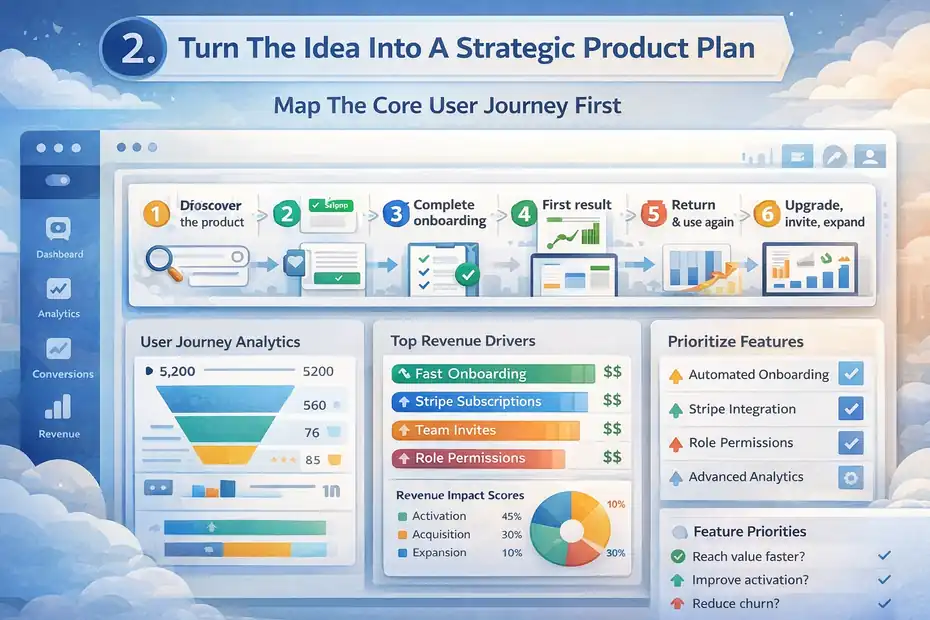
Map The Core User Journey First
Before touching Bubble, map the product as a user journey. This matters more than most founders realize. A SaaS product is not a pile of features. It is a sequence of moments that either moves a user toward value or loses them.
For most SaaS products, the journey looks something like this:
- Stage 1: Discover the product.
- Stage 2: Sign up or book a demo.
- Stage 3: Complete onboarding.
- Stage 4: Reach the first useful result.
- Stage 5: Return and use it again.
- Stage 6: Upgrade, invite teammates, or expand usage.
When you write it this way, feature priorities become easier. Anything that shortens time-to-value deserves serious attention. Anything that only looks impressive in a demo but does not help users reach a result can probably wait.
Imagine you are building a Bubble SaaS for appointment-based businesses. The key journey might be: create account, add services, connect calendar, publish booking page, receive first booking. That is the product. Not the reporting dashboard. Not ten custom themes. Not an AI assistant added because it feels modern.
I recommend sketching this journey on one page. It becomes your decision-making filter during the build.
Choose An MVP That Creates One Clear Outcome
An MVP is not just a smaller product. It is the simplest product that produces a meaningful transformation. That is an important difference. If users cannot get a concrete result, they will not care that the app was “lean.”
A smart MVP for Bubble usually includes:
- One Primary User Type: Keep roles simple unless multiple roles are essential.
- One Core Workflow: Build the action users came for.
- One Main Benefit: Save time, reduce errors, increase visibility, or generate revenue.
- Basic Account Logic: Signup, login, plan access, and permissions.
- Minimal Reporting: Enough feedback to show progress, not a giant analytics suite.
A common mistake is shipping a technically complete app with no emotional payoff. For example, users can create records, edit settings, and see a dashboard, but they never feel the product solved anything important. That kind of MVP is alive, but not valuable.
I suggest asking one brutal question: What must be true for a user to say, “This is already worth trying”? Build that first. Then remove everything that does not support that moment.
Prioritize Features By Revenue Impact
Founders often prioritize based on what feels easiest to build, what looks polished, or what competitors have. I think a better approach is to rank features by revenue impact.
Use a simple filter:
- Does this help users reach value faster?
- Does this improve conversion from visitor to signup?
- Does this improve activation after signup?
- Does this reduce churn or support team usage expansion?
- Does this unlock pricing power?
For example, in a Bubble SaaS product development strategy, automated onboarding steps may matter more than a sleek settings page. Role-based permissions may matter more than advanced visual customization. Stripe billing integration may matter more than a beautiful internal admin area.
This is especially important because Bubble lets you build a lot quickly. Speed is great, but it can fool you into thinking every possible workflow should be included now. It should not. The goal is not feature volume. The goal is a path to revenue.
Design Your Bubble App Around Simplicity And Speed
Now you can move into product structure. At this stage, strategy should guide the build.
Bubble gives you flexibility, but your setup needs to stay clean enough to scale without becoming fragile.
Structure The Database Around Real Usage
Database design in Bubble can either save you months or create hidden chaos. I have seen many apps get messy because the founder modeled the database around pages instead of business logic.
Start with the core objects in the system. For a typical SaaS, that may include users, organizations, subscriptions, projects, tasks, messages, files, or reports. Your data types should reflect how the product works in real life, not how the UI looks on day one.
A practical example: If your product serves teams, you may need both a User and a Workspace or Company data type. That lets you handle permissions, shared records, and billing more cleanly later. If you skip that and attach everything directly to the user, multi-user support becomes much harder.
Also think early about privacy rules. Bubble’s privacy system is powerful, but it requires intention. If users will store sensitive business data, access rules cannot be an afterthought. Good privacy structure improves security and reduces logic bugs.
My rule is simple: Every major data type should have a clear purpose, predictable relationships, and minimal redundancy. If the same value is copied everywhere because it feels convenient, it will usually become a maintenance problem later.
Build Workflows That Support The Core Value Fast
Workflows are where Bubble products either feel magical or clumsy. The best workflow design keeps the user moving with as little friction as possible.
Focus first on actions that matter most:
- Account Creation: Keep it light. Ask only for what you need.
- First Setup: Guide users through the minimum inputs required.
- Primary Action: Let them do the main thing quickly.
- Confirmation: Show progress or success immediately.
- Next Step: Tell them what to do next so momentum continues.
Let’s say you are building a CRM-style SaaS. A weak onboarding asks for team size, company details, pipeline preferences, and five optional settings before the user ever adds a lead.
A stronger onboarding gets them to import or create their first lead in under three minutes. That difference directly affects activation.
I recommend measuring “time to first value” from the start, even if you track it manually at first. If users need 20 minutes to get something useful done, your workflow probably needs simplification.
Keep The UI Useful Before You Make It Fancy
Bubble founders sometimes overinvest in visual polish before the product earns it. A clean interface matters, of course, but clarity matters more. Users usually forgive basic styling if the product helps them quickly. They do not forgive confusion.
Your interface should make three things obvious:
- What this page is for.
- What action matters most.
- What happens next.
That means fewer competing buttons, better empty states, and stronger guidance. Good empty states are underrated. Instead of a blank dashboard, show one sentence that explains the first action and one button that starts it.
I believe early SaaS UI should feel calm. Not empty, not cheap, just focused. Bubble gives you many layout options, reusable elements, and conditional states. Use those to reduce friction, not to decorate every corner.
A practical benchmark is this: If a new user cannot figure out the next action in five to ten seconds, something needs to be simplified.
Build The MVP That Can Reach Revenue Fast
At this point, your Bubble SaaS product development strategy should shift from planning to execution.
The key is building enough to test revenue, not enough to satisfy every future use case.
Include Only The Features That Prove Willingness To Pay
Your MVP should answer one business question clearly: will users pay for this outcome? That is why revenue-oriented scope is so important.
For many Bubble SaaS products, the revenue-driving foundation includes user authentication, account structure, the core workflow, billing setup, email notifications, and a basic support or contact path. What it usually does not include is deep customization, edge-case automation, or enterprise-level controls.
A useful test is to imagine a live demo. What would you show in ten minutes that makes someone say yes to a trial or paid setup? Build that. If it does not help close the sale, it is not first-priority.
Example: if your SaaS helps agencies deliver SEO reports to clients, the MVP may only need account setup, client creation, report templates, branded links, and monthly scheduling. You probably do not need white-labeled mobile apps, deep permissions, or AI commentary in version one.
In my experience, the cleanest path to first revenue is a surprisingly small product with one strong promise.
Add Billing Early Instead Of Treating It As A Later Step
Many founders delay billing because it feels awkward to charge for an early product. I understand that instinct, but waiting too long can blur the signal you need most. Even if you offer a pilot, discounted beta, or founder plan, your product should be structurally ready for payment.
For Bubble apps, that usually means planning for:
- Subscription Tiers: What changes by plan?
- Access Rules: What features or limits differ?
- Trial Logic: Is there a free trial, freemium tier, or demo flow?
- Upgrade Prompts: Where do users hit a natural paywall?
- Billing State Handling: What happens when payment fails or a subscription expires?
Stripe is commonly used here because it fits most SaaS billing models well, but the strategic point matters more than the tool. Your pricing logic should match the value metric. That might be users, projects, reports, records, bookings, or usage volume.
I suggest monetizing earlier than feels comfortable. You learn more from one paying user than from twenty polite free users.
Launch With Manual Support Where It Helps
One underrated advantage of Bubble is that you can launch a product before every process is automated. That is a strength, not a weakness. Early on, manual support often teaches you exactly what to automate later.
Maybe you manually import customer data for the first five clients. Maybe you help configure settings on onboarding calls. Maybe you generate a report partially behind the scenes. That is acceptable if it helps you learn what customers value and what breaks.
This approach is common in early SaaS. Many products begin as “software plus founder effort” before becoming fully self-serve. The important part is knowing which manual tasks are temporary and which signal a missing product capability.
I recommend documenting every repetitive support task during launch. When a task repeats three to five times, it becomes a strong candidate for productization.
Create A Pricing And Positioning Strategy That Supports Growth
A product can work technically and still struggle commercially.
Pricing and positioning are where many Bubble apps either gain momentum or stall out.
Price Based On Value, Not Build Effort
This is a big mindset shift. Your users do not care how fast Bubble let you build the app. They care what the app helps them achieve. So your pricing should reflect value, not development time.
If your product saves a recruiter five hours per week, helps a consultant close more clients, or reduces admin errors for a clinic, that value can be meaningful. Charging too little can actually hurt conversion because the product feels less serious or less critical.
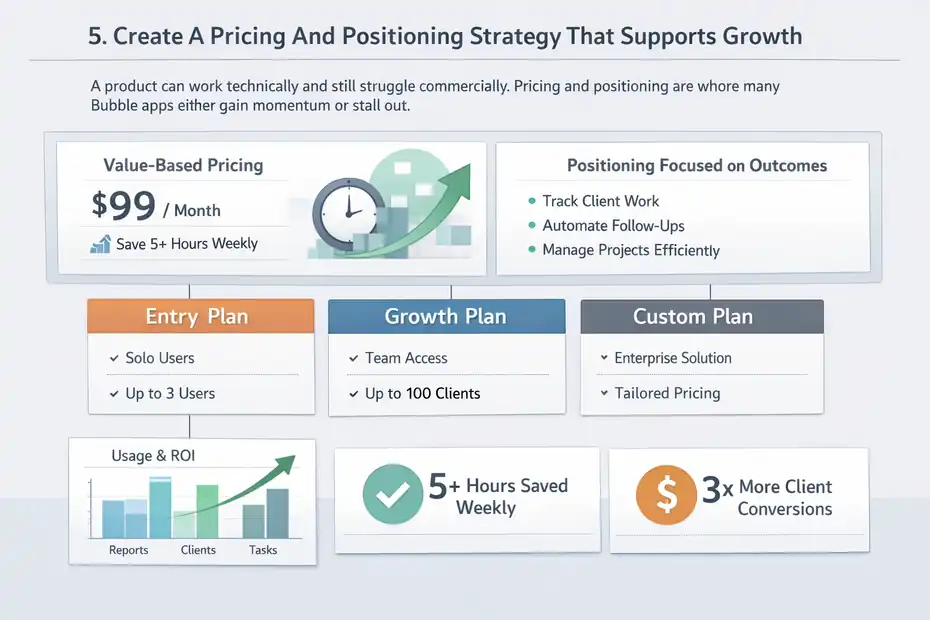
A simple pricing structure often works best at the beginning:
- Entry Plan: For solo users or light usage.
- Growth Plan: For teams or higher usage.
- Custom Plan: For larger buyers with special needs.
Tie plans to an understandable value metric. For example, “up to 3 team members,” “up to 100 active clients,” or “up to 1,000 reports per month.” Avoid confusing plan logic that forces users to calculate their fit.
From what I have seen, early-stage B2B SaaS often underprices itself by focusing on affordability instead of ROI. If your tool helps a business make or save even a few hundred dollars per month, a $49 to $199 monthly range may be completely reasonable depending on the niche.
Position The Product Around Outcomes, Not Features
Features matter once someone is comparing tools. Outcomes matter earlier. Your landing page, onboarding, and sales conversations should communicate what changes for the user after using the product.
Instead of saying:
- customizable dashboards
- multi-step workflows
- dynamic database structure
Say:
- track client work without messy spreadsheets
- automate follow-ups so leads stop slipping through
- give your team one place to manage handoffs and progress
That language is easier to understand and easier to buy into. It also helps with SEO because it reflects how users actually search. People rarely search for “dynamic no-code relational database interface.” They search for ways to reduce manual admin, manage bookings, organize leads, or automate delivery.
I recommend testing several positioning angles around the same product. Sometimes a small messaging change can improve demo bookings or signups dramatically without any build changes at all.
Offer A Simple Upgrade Path
Good SaaS pricing is not just about entry. It is about expansion. You want users to naturally grow into higher plans because their usage increases, their team grows, or their need becomes more advanced.
That means your plan design should encourage progression without feeling punishing. Useful upgrade triggers include more users, more automation volume, more client accounts, premium templates, or advanced reporting.
A realistic scenario: You launch a Bubble app for consultants with a $29 solo plan and a $99 team plan. At first, most customers start solo. Over time, the ones who add assistants, more clients, or more workflow complexity move upward. That is healthier than trying to force everyone into a high-ticket plan too early.
In my opinion, a smooth upgrade path is one of the most overlooked parts of product strategy because founders focus too heavily on the first sale and not enough on expansion revenue.
Launch In A Way That Generates Feedback And Sales
A launch should not be treated like a grand reveal. For most SaaS founders, especially on Bubble, launch is the beginning of real market learning.
Start With Controlled Traffic And Warm Outreach
The fastest early traction usually comes from warm channels, not broad paid acquisition. That can mean direct outreach, personal network referrals, niche communities, LinkedIn conversations, email lists, or partnerships.
Why this works: warm audiences forgive rough edges more easily and give better feedback. They also convert better because trust already exists. In an early-stage Bubble SaaS product development strategy, that matters more than trying to look massive on day one.
You do not need thousands of visitors to validate the product. You need the right people. Fifty targeted users are more useful than five thousand random clicks.
A practical launch flow might look like this:
- Publish a clear landing page.
- Record a short product walkthrough.
- Reach out to 30 to 50 ideal users directly.
- Offer demos, beta access, or a founding customer rate.
- Track objections and onboarding friction.
I suggest keeping outreach simple and specific. Mention the exact problem you solve, the audience fit, and the main outcome. Generic “check out my new app” messages tend to get ignored.
Measure Activation Before You Obsess Over Traffic
A lot of founders chase more traffic before the product is ready to convert or retain anyone. That creates noise. Focus first on activation, which means users reaching the first valuable result.
Useful early metrics include:
- Visitor To Signup Rate
- Signup To Activated User Rate
- Time To First Value
- Trial To Paid Conversion
- Week 1 Retention
- Support Tickets Per New User
If users sign up but do not finish onboarding, you probably have a workflow issue. If they activate but do not return, the recurring value may be weak. If they pay and quickly cancel, the promise may not match the experience.
For SaaS, activation and retention usually matter more than top-of-funnel volume at the beginning. Even modest improvements here can transform revenue potential. For example, moving activation from 20% to 40% effectively doubles the pool of users who have a chance to convert later.
Use Conversations To Improve The Product Faster
Analytics are helpful, but direct conversations are gold at this stage. Talk to users after signup, after onboarding, and after they stop using the product. Ask what they expected, where they got confused, and what nearly stopped them.
You will hear patterns surprisingly fast. Maybe the CTA was clear but setup felt too long. Maybe users wanted templates. Maybe they thought a feature worked differently. These are strategic clues, not just UX notes.
I like asking one simple question after a demo or first-use session: “What would need to happen for this to become a no-brainer for you?” The answer often reveals the missing element between interest and purchase.
In many cases, a few customer conversations lead to stronger product-market fit than weeks of internal brainstorming.
Optimize Retention, Conversion, And Product-Led Growth
Once users are entering the product, the next priority is helping them stay, pay, and refer others.
This is where your Bubble SaaS product development strategy starts acting like a real growth system.
Improve Onboarding Until Value Feels Obvious
Onboarding should remove uncertainty, not add it. The best onboarding feels like progress, not setup. Users should understand what to do, why it matters, and what they get next.
A solid onboarding flow usually includes:
- A Clear First Goal: One action that creates momentum.
- Contextual Guidance: Help shown at the exact moment it is needed.
- Progress Signals: Steps completed, data added, task finished.
- Fast Wins: A result they can see quickly.
- Follow-Up Prompts: Emails or in-app reminders that pull them back.
For Bubble apps, this often means simplifying forms, pre-filling examples, using conditional states to hide complexity, and showing sample data where helpful. A blank product is intimidating. A guided product is easier to trust.
I suggest rewriting onboarding every time you notice repeated confusion. Most products need several rounds before they feel smooth. That is normal.
Reduce Churn By Solving The Right Problems
Churn is rarely fixed with random feature additions. Usually, it improves when the product becomes more necessary, easier to use, or better aligned with the buyer’s workflow.
There are different churn types:
- Expectation Churn: The product promised one thing and delivered another.
- Activation Churn: Users never got to value.
- Workflow Churn: The product is useful but not integrated into daily habits.
- Pricing Churn: Value is too weak for the cost.
- Complexity Churn: The product feels too hard to maintain.
Each type needs a different response. If users say setup is hard, new features will not solve that. If users only log in once per month, weekly reminder emails may not help unless the product truly belongs in their workflow.
In my experience, the strongest anti-churn tactic is making the product part of something recurring: team collaboration, client delivery, reporting cycles, lead management, scheduling, or revenue tracking. The more operationally embedded the app becomes, the harder it is to replace.
Add Product-Led Growth Loops Carefully
Product-led growth sounds exciting, but it only works when sharing, inviting, or expanding usage feels natural. Do not force viral mechanics where they do not belong.
Effective growth loops in SaaS often include:
- Invites: Users bring teammates in.
- Client Sharing: End customers or stakeholders view outputs.
- Templates: Users duplicate and share setups.
- Branded Outputs: Reports, forms, portals, or pages expose the product.
- Usage Expansion: More data, more records, more workspaces.
A Bubble example: if your SaaS creates client-facing dashboards, every shared dashboard is also a distribution channel. If your SaaS handles internal workflows, team invites may be the more natural loop.
I recommend identifying one organic expansion path and building around that instead of chasing a vague growth model.
Scale The Product Without Breaking What Made It Work
Scaling is not just about more users. It is about keeping performance, clarity, and profitability strong as usage grows.
Strengthen Operations And Performance Early
Bubble can handle serious products, but scaling well requires discipline. As your user base grows, inefficient workflows, messy database searches, and weak privacy structures become more expensive.
A few practical priorities matter here:
- Review Heavy Workflows: Remove unnecessary actions and repeated searches.
- Clean Database Queries: Avoid bloated page loads and inefficient filtering.
- Use Reusable Elements Wisely: Keep interfaces consistent and easier to update.
- Monitor Bottlenecks: Watch where pages slow down or workflows fail.
- Document Logic: Future you will thank you.
This is where founders often feel the difference between “it works” and “it scales.” A product that feels fine with 20 users can feel frustrating at 2,000 if the technical foundation stayed sloppy.
I advise treating performance optimization as part of the product strategy, not just a technical cleanup task. Slow or unreliable apps reduce trust and lower retention.
Decide What To Automate, Delegate, Or Rebuild
As revenue grows, you will face choices about internal processes and platform structure. Some tasks should be automated in Bubble. Some should move to external systems. Some should be handled by people until the process stabilizes.
For example, early customer success might stay founder-led. Billing failure emails might be automated. Complex enterprise onboarding might require a manual setup checklist. There is no prize for automating everything too soon.
At some point, you may also consider whether parts of the app should be rebuilt or extended with custom code, APIs, or additional services. That decision should come from business need, not ego. If Bubble is supporting the product well, there is no reason to rush into a more complex stack just because it sounds more technical.
I believe good scaling decisions come from constraints you can measure: slower onboarding, support overload, workflow delays, or margin pressure.
Expand Strategically Instead Of Randomly
Once the product starts working, feature requests increase. This is exciting, but dangerous. You can easily drift away from the clear product that earned traction in the first place.
Use expansion filters:
- Does this request come from ideal customers?
- Will it improve retention, conversion, or expansion revenue?
- Does it strengthen the core product or pull it sideways?
- Can it support a higher-value plan or new segment?
- Will it increase complexity more than value?
Sometimes the best growth move is vertical expansion into a closely related audience. Other times it is deeper functionality for the same audience. For example, a Bubble SaaS for agencies might later add client portals, billing visibility, or internal team workflows.
That is strategic adjacency. Building a totally different tool for a new audience is usually riskier.
Common Mistakes That Hurt Bubble SaaS Growth
Even good products can stall because of a few repeated strategic mistakes. These are worth watching closely because they show up again and again.
Building Too Broad Too Early
This is probably the most common problem. Founders try to make the product flexible enough for every possible customer, then end up with weak messaging, bloated workflows, and unclear onboarding.
A broad product is harder to explain, harder to sell, and harder to optimize. A narrow product earns conviction faster. You can always expand later once you understand where traction is strongest.
If your homepage needs three paragraphs to explain who the product is for, that is a warning sign.
Confusing Activity With Validation
Just because people sign up, compliment the product, or request features does not mean you have real validation. The clearest signal is behavior: do they activate, return, and pay?
I have seen founders feel encouraged by busy dashboards and excited feedback, only to realize few users actually depended on the product. That is painful, but common.
Track actions tied to value, not vanity. Usage depth beats surface interest every time.
Letting The Builder Drive The Business
Bubble is fun to build in. That is part of the appeal. But the platform should serve the business strategy, not replace it. When founders get too caught up in workflows, plugins, and UI tweaks, they sometimes lose sight of positioning, pricing, activation, and retention.
Your goal is not to become great at adding features. Your goal is to create a product people keep paying for.
That sounds obvious, but I think many no-code founders need to hear it more often.
Your Practical Roadmap From Idea To Revenue
If you want a simple path forward, here is how I would approach a Bubble SaaS product development strategy from scratch. Keep it lean, commercial, and focused on learning fast.
Follow This Sequence In Order
You do not need a perfect business plan. You need a sensible progression:
- Validate The Problem: Talk to real users and confirm pain.
- Choose A Narrow Audience: Make the product feel specific.
- Map The User Journey: Define how users reach value.
- Scope The MVP: Include only what proves willingness to pay.
- Build The Core Product In Bubble: Focus on speed and clarity.
- Add Billing Logic Early: Even for beta or discounted plans.
- Launch To Targeted Users: Use outreach and guided onboarding.
- Measure Activation And Retention: Improve the weak points first.
- Refine Positioning And Pricing: Match outcomes and buyer value.
- Scale What Works: Deepen traction before expanding sideways.
That sequence sounds simple because it is supposed to. Most SaaS growth comes from doing basic things exceptionally well, not from chasing trendy tactics.
Treat Revenue As A Product Signal
Revenue is not just money. It is proof that your product solves something important enough to justify a budget. That is why monetization should not be treated as a distant milestone.
A small number of paying users can teach you:
- what the product is really worth
- who feels the problem most urgently
- which features actually influence buying decisions
- where onboarding needs to improve
- how much support customers expect
Those lessons are incredibly valuable. In many cases, they matter more than raw user count.
Stay Focused On The Outcome, Not The Platform
Bubble is the engine, not the promise. Your users are not buying “a Bubble app.” They are buying a better workflow, more revenue, fewer errors, faster delivery, or less admin stress.
That perspective helps you make better decisions at every stage. It keeps you grounded when building. It sharpens your messaging. It supports healthier pricing. And it stops you from getting distracted by features that look impressive but do not improve the customer outcome.
If I were building a SaaS on Bubble today, that is exactly how I would think about it: solve one painful problem for one clear audience, get them to value fast, charge earlier than feels comfortable, and improve the product based on real usage instead of assumptions.
That is how an idea becomes revenue.
FAQ
What is a bubble saas product development strategy?
A bubble saas product development strategy is a structured approach to building, launching, and scaling a SaaS product using Bubble. It focuses on validating demand, building a lean MVP, and optimizing for revenue and retention without relying on traditional coding.
How do you validate a SaaS idea before building in Bubble?
You validate a SaaS idea by talking to target users, identifying repeated pain points, and testing interest with a simple landing page or pre-sale. The goal is to confirm real demand before investing time into building the product.
What features should be included in a Bubble SaaS MVP?
A Bubble SaaS MVP should include only the core workflow that delivers value, basic user authentication, and simple billing logic. The focus is on helping users achieve a clear outcome quickly rather than offering many advanced or secondary features.
How can you monetize a Bubble SaaS product early?
You can monetize early by adding subscription plans, offering beta pricing, or charging for premium access from the start. Early monetization helps validate demand and provides real feedback on whether users see enough value to pay.
What are common mistakes in Bubble SaaS development?
Common mistakes include building too many features too early, targeting a broad audience, delaying monetization, and focusing more on design than user outcomes. These issues often lead to low retention and weak product-market fit.

I’m Juxhin, the voice behind The Justifiable.
I’ve spent 6+ years building blogs, managing affiliate campaigns, and testing the messy world of online business. Here, I cut the fluff and share the strategies that actually move the needle — so you can build income that’s sustainable, not speculative.
Related posts:
 Bubble App Builder Review: Can You Build Real Apps?
 Social Media Marketing for Small Business – Best Tips
 Methods for Marketing Affiliate Websites – Simple Ways
 Internet Marketing Ideas: Increase Your Marketing Efforts
 Monetizing a Website: Best Earning Money Practice
 How to Increase Social Media Followers