
Table of Contents
Some links on The Justifiable are affiliate links, meaning we may earn a small commission at no extra cost to you. Read full disclaimer.
Using an ecommerce CRM for higher repeat customer rates is less about collecting more customer data and more about acting on the right signals at the right moment
A good CRM should help you understand who bought, what they bought, when they may need something next, and what could stop them from returning.
In this guide, I’ll show you eight practical retention tactics that turn those signals into repeat purchases. We’ll cover the setup, segmentation, automation, service data, loyalty, win-back logic, measurement, and the mistakes that quietly weaken customer lifetime value.
Why Ecommerce CRM Changes Repeat Customer Economics
An ecommerce CRM becomes valuable when it helps you make better retention decisions, not when it simply stores more profiles. Before building automations, you need to define what the system should remember, decide, and improve.
What An Ecommerce CRM Really Does
A traditional CRM often centers on sales pipelines, contacts, and account history. Ecommerce works differently. Online stores can have thousands of customers, short sales cycles, product-level behavior, anonymous browsing, returns, service tickets, subscriptions, and repeat orders happening without a salesperson. Your CRM therefore needs to act more like a customer decision engine.
At minimum, it should connect identity with purchase history, product categories, order value, engagement, support history, consent status, and lifecycle stage. The useful part is not seeing those fields on a profile. The useful part is turning them into rules.
Imagine two people buy the same skincare serum. Customer A is a first-time buyer with one item. Customer B has ordered six times, usually reorders every six weeks, and currently has a delivery complaint open. Sending both customers the same “buy again” message ignores nearly everything you know.
I suggest thinking about CRM in three layers: memory, decision, action. Memory is the customer record. Decision is the logic that determines what should happen next. Action is the message, offer, service task, loyalty event, recommendation, or suppression rule created from that decision.
I believe the strongest ecommerce CRM is not the one with the most data. It is the one that helps you make fewer irrelevant decisions at scale.
Set A Retention Baseline Before You Automate
Before changing anything, capture a baseline for the customer behavior you want to improve. Otherwise, an automation can generate sales while still failing to increase true repeat purchasing.
Start with repeat customer rate: The percentage of customers in a defined period who have purchased more than once. Then add time to second purchase, purchase frequency, average order value, repeat revenue share, and customer lifetime value. For products with predictable consumption, also track the typical number of days between first and second orders.
Use cohorts rather than only storewide averages. A cohort groups customers by a shared starting point, such as the month of their first purchase. If 1,000 customers placed a first order in January and 220 placed a second order within 90 days, your 90-day second-purchase rate is 22%. If a later comparable cohort reaches 260 repeat buyers, you can see the improvement clearly.
The time window matters. Coffee, skincare, furniture, and occasion wear should not share the same expected repeat cycle. Define the window around how customers actually use the product.
Track these five numbers before launch:
- Second-purchase rate: How many first-time customers order again inside your chosen window.
- Median time to second order: How quickly repeat behavior happens.
- Repeat revenue share: How much revenue comes from existing customers.
- Purchase frequency: How often active customers order.
- Customer lifetime value: How much revenue or contribution margin a customer produces over time.
That baseline becomes the scoreboard for every tactic that follows.
Tactic 1: Build A Customer Profile You Can Actually Act On
The first tactic is foundational: Create a customer record that supports decisions. You do not need every possible field; you need reliable data that explains timing, value, intent, and friction.
Unify The Signals That Change Customer Decisions
Start by listing the events that would change what you say or do. Orders are obvious, but product viewed, category browsed, refund requested, subscription canceled, loyalty tier changed, review submitted, and support ticket opened can matter just as much.
Group CRM data into four buckets. Transactional data covers orders, products, discounts, returns, and spend. Behavioral data covers browsing, clicks, cart activity, and category interest. Relationship data covers loyalty, reviews, referrals, support, and subscriptions. Permission data covers email, SMS, and other channel consent.
Then create a minimum viable profile. For many stores, I would begin with customer ID, first order date, last order date, total orders, total spend, last product purchased, category purchased, discount usage, refund status, marketing consent, and last meaningful engagement. If your products have predictable usage, add an expected reorder date. If service strongly affects retention, add recent ticket status and issue type.
Next, create calculated fields such as lifecycle stage, days since last order, days beyond expected reorder date, VIP status, churn-risk band, and product affinity. These values turn raw history into something automation can use.
Here is the shortcut I recommend: Do not ask, “What data can we collect?” Ask, “What decision do we wish we could make?” If you want replenishment reminders, you need reorder timing. If you want to protect unhappy customers from promotions, you need unresolved support status.
Finally, audit duplicates, timestamps, consent mismatches, missing product IDs, and failed order syncs every month. Simple automation built on clean data usually beats sophisticated automation built on unreliable events.
Tactic 2: Segment Customers By Lifecycle And Buying Intent
Repeat purchases are usually driven more by lifecycle stage and product behavior than broad demographics. Segment customers according to what they have done, what they are likely to need next, and how valuable the relationship has become.
Build Segments Around The Second Purchase And RFM
The first-to-second purchase gap deserves its own CRM strategy because it is the point where a buyer begins becoming a repeat customer. Create at least four first-buyer segments: Order not yet delivered, delivered but still inside the normal usage window, approaching the expected second-purchase window, and past that window without reordering.
Each segment needs a different job. Before delivery, reduce uncertainty. After delivery, help the customer get value. Near the reorder window, make the next purchase easier. After the window passes, diagnose inactivity before increasing incentives.
Then add RFM. RFM stands for recency, frequency, and monetary value. In simple language, it asks how recently someone bought, how often they buy, and how much they spend. You do not need a complicated scoring model. Start with simple bands such as active, cooling, or lapsed for recency; one order, two to three, or four-plus for frequency; and standard, high value, or top tier for spend.
Layer product affinity only when it changes the action. A frequent running-sock buyer may need a different recommendation from a customer whose first purchase was a jacket. Likewise, “high value + recent + frequent” may enter VIP treatment while “high value + lapsed” deserves a more careful win-back path.
I suggest starting with 8–12 useful segments. If two segments receive exactly the same treatment, they probably do not need to be separate yet. Good segmentation makes decisions clearer; bad segmentation simply creates more folders.
Tactic 3: Engineer The Second Purchase Journey
A second purchase should not be left to chance. Your CRM can create a deliberate bridge from order confirmation to product success and then to the next relevant buying opportunity.
Protect Product Success Before Asking For Another Sale
One of the easiest retention mistakes is turning every post-purchase message into an upsell. Immediately after checkout, the customer’s main questions are usually: Did the order work, when will it arrive, and did I choose correctly?
Use the early post-purchase period to reduce anxiety and improve product success. Confirm the order, clarify delivery expectations, explain setup or usage, and prevent common mistakes. If the product has a learning curve, deliver guidance before frustration appears.
Then create a selling boundary. You might suppress promotional cross-sells until the order ships, delivery is confirmed, or a minimum number of days has passed. The right boundary depends on the product.
Imagine you sell a premium espresso grinder. An immediate offer for cleaning tablets might convert, but a setup guide explaining grind size, calibration, and first-use tips improves the customer’s experience first. Once they are using the grinder successfully, accessories become more relevant.
Map the product experience in days. Ask when delivery happens, when the customer first experiences value, when they may run out, when a complementary product becomes useful, and when dissatisfaction usually appears. Those milestones become triggers.
A simple second-purchase path might be:
- Order stage: Confirm purchase and set expectations.
- Delivery stage: Provide setup, usage, or care guidance.
- Value stage: Help the customer succeed with the product.
- Opportunity stage: Recommend the next logical product or reorder.
- Delay stage: If no purchase happens, change the message instead of repeating the offer.
I recommend optimizing this journey for time to second purchase and second-purchase rate, not just attributed email revenue.
Tactic 4: Trigger Replenishment And Cross-Sell By Customer Timing
Calendar campaigns are convenient for marketers, but customer demand rarely follows your calendar. Better retention comes from triggering offers around expected need and individual buying behavior.
Use Repurchase Windows And Next-Product Logic Together
Start with product-level order history. For repeat-purchased SKUs or categories, calculate the number of days between orders. The median is often a useful starting point because a few unusually long gaps can distort the average.
Suppose a moisturizer is typically reordered around day 48. That gives you a baseline, not a universal schedule. One customer may buy two units and reorder every 90 days. Another may reorder every 35. Once enough history exists, use the individual customer’s cadence. Until then, fall back to the product or category pattern.
Create an early reminder, a near-due reminder, and a late path. The early message can focus on convenience. The near-due message can make reordering effortless. The late message can ask whether needs changed rather than repeatedly shouting “buy again.”
Then connect replenishment with next-product logic. Map relationships between products: Starter to advanced, core item to accessory, routine step one to step two, or first flavor to variety pack. Exclude products the customer just bought, returned, already subscribes to, or has clearly moved beyond.
Imagine a buyer purchases a beginner watercolor set. Instead of promoting your overall bestseller, the CRM waits until delivery and then recommends replacement paper and better brushes based on the natural learning path.
I suggest building cross-sell logic from “what problem comes next?” rather than “what product do we want to sell next?”
That question makes personalization more useful and usually reduces the need to rely on discounts.
Tactic 5: Feed Support Signals Into Retention Logic
Customer service contains some of the strongest churn signals in your business. If support data stays isolated, marketing can keep pushing offers while the customer is still trying to solve a problem.
Treat Service Problems And Recovery As CRM Events
Turn important service moments into structured events your retention logic can understand. Useful examples include delivery delay, damaged item, sizing issue, billing problem, refund requested, replacement sent, negative sentiment, and unresolved ticket.
Not every ticket should stop marketing, but some should. A customer waiting on a missing package should not receive a cheerful “ready for your next order?” promotion. Create suppression rules for unresolved high-friction cases, then automatically restore eligibility after resolution.
I recommend defining three service severity levels. Low severity covers simple questions. Medium severity covers inconveniences requiring action. High severity covers financial loss, repeated failure, charge disputes, or strong dissatisfaction. Each level can have a different communication policy.
Then build recovery around issue type and customer history. A first-time buyer with a damaged item needs reassurance and a fast fix. A loyal customer with six orders and a shipping failure may deserve more proactive attention. A chronic returner who repeatedly exploits promotions needs different treatment.
Use a simple recovery sequence: Resolve the issue, confirm the fix worked, wait long enough for the customer to experience the resolution, then decide whether to request feedback, recommend another purchase, or return the customer to normal lifecycle messaging.
For example: “High-value customer + ticket resolved + no refund + no open issue for seven days” can trigger a service-recovery follow-up.
Measure the 60- or 90-day repeat purchase rate of recovered customers, not only satisfaction scores. That tells you whether support is protecting future revenue.
Tactic 6: Make Loyalty A Behavior System
Loyalty programs often weaken when they become permanent discount machines. A CRM-driven loyalty strategy should reward behaviors that strengthen the relationship and make future purchases more likely.
Reward Actions That Predict Durable Customer Value
Start by identifying actions your best customers tend to take. Purchases matter, but so can completing a profile, leaving a useful review, referring a qualified customer, joining a subscription, buying across several categories, or reaching a purchase-frequency milestone.
Then decide what deserves points, status, access, convenience, or recognition. Avoid rewarding low-value actions simply because they are easy to track. If customers can earn large rewards from behaviors that do not improve retention, the program becomes an expensive coupon engine.
I prefer experience benefits before pure discounts. Early access, member-only bundles, free shipping thresholds, priority support, surprise samples, product education, or exclusive restocks can create value without teaching customers to wait for a promo code.
Use the CRM to personalize loyalty progress. A customer who is 10% away from the next tier should see progress. Someone with unused rewards can receive a reminder near a natural reorder window. A newly promoted VIP should receive a different experience from a long-established VIP.
Define VIP status with recency, frequency, spend, and profitability where possible. Gross revenue can be misleading if a customer returns heavily or only buys with deep discounts. If your data supports it, include margin and return behavior.
The important principle is behavioral alignment: Your program should make the habits of high-value customers easier, more visible, and more rewarding for the people who are moving in that direction.
Tactic 7: Build Win-Back Flows Around Churn Risk
A win-back program should begin when a customer becomes meaningfully late, not simply when an arbitrary number of days passes. CRM data lets you define churn risk around real purchase cadence.
Define Risk By Category, Then Escalate Carefully
A customer who has not purchased in 60 days may be healthy or effectively churned depending on what you sell. Start with the normal gap between repeat orders by category. Then create stages such as approaching due, overdue, at risk, and lapsed.
For example, if a category usually repeats around every 45 days, you might treat day 38 as approaching due, day 50 as overdue, day 70 as at risk, and day 100 as lapsed. Those numbers are illustrative. Your own order history should determine the real thresholds.
Layer engagement on top. Someone who is overdue but has viewed products twice this week should not receive the same message as someone who has not opened, clicked, visited, or purchased in months. Also check whether the customer switched to another product or category before labeling them churned.
Do not start with your strongest discount. First remind the customer of value, convenience, product progress, or new relevance. Next test social proof, a recommendation, or a low-cost perk. Only later should you introduce a financial incentive for customers who remain inactive.
Build incentive rules around value and margin. A high-value customer may justify a stronger recovery investment. A low-margin customer may not. A habitual discount buyer should not automatically receive an even larger offer.
Whenever volume allows, keep a small holdout group. That helps you distinguish customers the win-back flow truly recovered from customers who would have returned anyway.
Tactic 8: Measure Cohorts, Holdouts, And Customer Lifetime Value
CRM programs can look successful because they touch many orders, but repeat-customer growth requires proof that behavior changed. The final tactic is building measurement around customer outcomes rather than channel activity.
Measure Incremental Repeat Behavior, Not Just Attributed Revenue
Your primary metric should usually be second-purchase rate or repeat purchase rate inside a defined window. Pair it with median time to second order, repeat revenue share, purchase frequency, average order value, and customer lifetime value. If margin data is available, add contribution margin per customer because revenue can hide excessive discounting.
Break results down by first-purchase cohort, acquisition source, first product, discount status, and lifecycle segment. This shows where retention is improving rather than hiding everything inside a storewide average.
Imagine a store increases its 90-day second-purchase rate from 20% to 24%. With 10,000 first-time buyers, that means 400 additional second-time customers. If their second orders average $70, that creates $28,000 in additional gross revenue before future purchases. The bigger question is whether those customers keep buying afterward.
Use holdouts for major programs when possible. If 1,000 at-risk customers enter a win-back flow, keep a comparable group from receiving it. If the treatment group produces 80 repurchases while 60 comparable customers return without the sequence, the incremental lift is much smaller than an attribution dashboard might suggest.
Test one strategic variable at a time: Timing, incentive, product recommendation logic, or message count. Start with customer decisions before creative details.
Your dashboard should answer four questions: Are more customers returning, are they returning sooner, are we preserving margin, and are later cohorts outperforming earlier ones? If it cannot, the dashboard is probably too focused on campaign activity.
Choosing An Ecommerce CRM Stack For Retention
Your technology stack should match the retention decisions you need to automate. A smaller store may need only a commerce platform plus lifecycle messaging, while a larger operation may separate marketing, service, loyalty, and subscriptions.
Match Each Tool To One Clear Retention Job
If your store runs on Shopify, treat the commerce platform as a core source of customer, order, and product data rather than assuming it must perform every retention function itself.
For customer segmentation and lifecycle messaging, Klaviyo and Omnisend are relevant ecommerce-focused options. If service data is central to retention, Gorgias can represent the support layer. LoyaltyLion fits stores that need a dedicated loyalty layer, while Recharge is relevant when subscriptions or recurring orders are part of the model.
Choose tools according to customer decisions you cannot execute reliably today.
| Platform | Best Fit In A Retention Stack | Core Job | Main Question To Ask |
|---|---|---|---|
| Shopify | Commerce data foundation | Orders, customers, products | Is data feeding downstream systems cleanly? |
| Klaviyo | Lifecycle retention marketing | Segmentation and automated messaging | Can we build behavior-based journeys efficiently? |
| Omnisend | Ecommerce marketing automation | Lifecycle email and related messaging | Does the workflow model fit our complexity? |
| Gorgias | Service-led retention | Support history and issue handling | Can service signals affect marketing eligibility? |
| LoyaltyLion | Loyalty-led retention | Rewards and customer tiers | Are rewards changing behavior, not just discounting? |
| Recharge | Subscription-led retention | Recurring purchase lifecycle | Do subscriptions need dedicated save logic? |
Start with three use cases: Second-purchase journey, replenishment or cross-sell, and win-back. Document the trigger, eligibility rule, exclusion rule, message goal, and success metric for each. Then test whether your current systems can execute them.
Add software only when there is a clear operational gap. More integrations create more places where customer IDs can mismatch, events can fail, and definitions can drift. In my experience, a lean stack with trusted data and five well-designed automations can outperform a complex stack with dozens of loosely managed flows.
Common Ecommerce CRM Mistakes That Lower Repeat Rates
Most retention problems are not caused by missing features. They come from weak timing, poor data, excessive discounting, and measuring activity instead of customer behavior.
Mistake 1: Sending More Campaigns Instead Of Better Triggers
When repeat revenue slows, increasing campaign frequency can produce a temporary sales bump, but it does not solve why customers are not returning.
Triggered journeys respond to customer state. A replenishment reminder arrives when a product may be running out. A service recovery flow waits until a complaint is resolved. A second-purchase journey adapts to what the customer bought first.
Campaigns still make sense for launches, seasonal moments, announcements, and broad promotions. The mistake is using them as a substitute for lifecycle logic.
Audit your calendar and ask what percentage of messages are scheduled because the marketing team chose a date versus triggered because the customer did something meaningful. If nearly everything is calendar-driven, your CRM is probably underused.
I suggest reducing noise before adding more automation. Suppress customers from general promotions when a more relevant lifecycle journey is active. The customer does not experience marketing, support, loyalty, and subscriptions as separate departments. They experience one brand, so your communication logic should behave like one system.
Mistake 2: Using Discounts Before Diagnosing The Problem
A discount can recover a purchase, but it cannot tell you why the customer hesitated. If you reach for incentives first, you may hide product, service, timing, or relevance problems.
Break non-repeaters into likely reasons. Some have not used the product yet. Some chose the wrong product. Some had a poor delivery experience. Some simply do not need another purchase. Some are price sensitive. Those conditions deserve different responses.
Use non-discount interventions when appropriate: Education, replenishment convenience, bundles, subscription options, product matching, loyalty progress, or a service check-in. Then reserve discounts for segments where price is likely to be a real barrier or where the economics justify recovery spending.
Track discount dependency as a customer attribute. If someone increasingly requires larger offers to purchase, their apparent lifetime value may be less attractive than revenue alone suggests.
A useful rule is simple: Every discount should have a hypothesis. “We are offering 10% because this lapsed segment historically responds after two non-incentive touches” is a strategy. “We send 10% after 60 days because the template suggested it” is not.
Mistake 3: Ignoring Identity, Consent, And Suppression Logic
One person can buy with two email addresses, check out as a guest, switch devices, subscribe to SMS later, or contact support from another address. If your CRM treats those interactions as unrelated people, segmentation becomes unreliable.
Define how profiles merge and which identifiers are trusted. Email can be useful, but customer IDs, phone numbers, account logins, and commerce-platform identifiers may also matter. Be cautious with automatic merging because incorrectly combining two people is worse than keeping a duplicate.
Consent needs equal attention. A customer relationship does not override channel permission. Store consent explicitly, honor opt-outs, and separate transactional communication from promotional eligibility according to the rules that apply to your market.
Build suppression rules as carefully as inclusion rules. Exclude recent purchasers from unnecessary win-back offers. Exclude unresolved high-severity support cases from cheerful promotions. Exclude subscribers from one-time replenishment reminders when recurring delivery already solves the need.
Good CRM logic often works by not sending something. Relevance improves when the system knows when silence is the better customer experience.
A 30-Day Ecommerce CRM Implementation Plan
You do not need to rebuild retention in one project. A focused month can create a reliable baseline, one high-impact lifecycle journey, and a measurement process you can improve over time.
Build The First Retention System In Four Weeks
Week 1: Establish the baseline. Choose your repeat-purchase window and calculate second-purchase rate, median time to second order, repeat revenue share, purchase frequency, and customer lifetime value. Identify the first products or categories with enough order volume to analyze. List the customer events you already capture and the gaps that block useful decisions.
Week 2: Clean and segment. Fix duplicate or missing identifiers where possible. Create lifecycle stages for first-time buyers, repeat buyers, VIPs, at-risk customers, and lapsed customers. Add product affinity only where it changes the action. Document consent and suppression rules before building promotional flows.
Week 3: Launch one second-purchase journey. Start with a high-volume first-purchase category. Build delivery-stage education, product-success content, a timed next-purchase opportunity, and an exit condition when the customer orders again. Keep the journey simple enough that you can understand every branch.
Week 4: Measure and iterate. Compare the eligible cohort with your baseline or a holdout group. Review repeat purchase rate, time to second order, margin, unsubscribes, and support feedback. Fix timing and segmentation before adding more messages.
Once this works, add replenishment, service recovery, loyalty progression, and win-back according to the biggest gap in your customer journey.
Final Takeaway: Use CRM To Make The Next Purchase More Logical
An ecommerce CRM for higher repeat customer rates works when it helps you recognize what each customer needs next and removes friction from that next step. The technology matters, but the retention logic matters more.
Build clean profiles. Segment by lifecycle and buying behavior. Protect the first product experience. Trigger replenishment around real usage. Feed service problems into marketing decisions. Reward behaviors that strengthen loyalty. Define churn by purchase cadence. Then measure repeat behavior with cohorts and holdouts instead of relying only on attributed revenue.
If you are deciding where to start, focus on the second purchase. Pick one high-volume first-order product, map what should happen between delivery and the next natural buying moment, and build that journey before expanding. One well-designed retention path can teach you more than dozens of generic automations and give you a repeatable system you can scale across the rest of the store.

I’m Juxhin, the voice behind The Justifiable.
I’ve spent 6+ years building blogs, managing affiliate campaigns, and testing the messy world of online business. Here, I cut the fluff and share the strategies that actually move the needle — so you can build income that’s sustainable, not speculative.
Related posts:
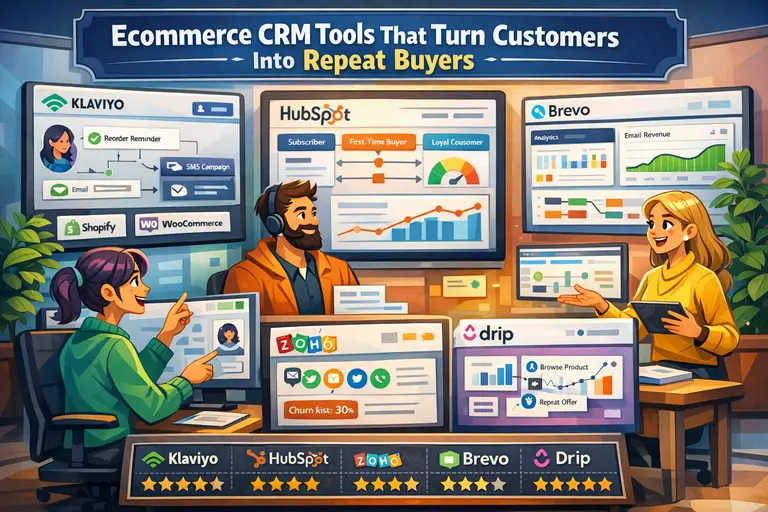 Ecommerce CRM Tools That Turn Customers Into Repeat Buyers
 Best Ecommerce CRM Software: 11 Top Platforms Compared for Smarter Growth
 How Ecommerce CRM Increases Sales: 9 Practical Ways Stores Earn More
 Which Ecommerce CRM Should I Choose? A Smart Buyer’s Guide for Online Stores
 Is Ecommerce CRM Worth It for Online Stores? The Revenue Truth Explained
 Ecommerce CRM for Growing Ecommerce Brands: 11 Features That Matter Most