
Table of Contents
Some links on The Justifiable are affiliate links, meaning we may earn a small commission at no extra cost to you. Read full disclaimer.
BrightLocal review for small business local seo is a useful question because most local businesses do not need another bloated SEO subscription. They need a tool that helps them rank in Google Business Profile, fix listings, manage reviews, and prove whether local SEO is actually driving calls, leads, and visits.
I have looked at BrightLocal’s current 2026 plans, core features, and review-focused data, and my take is pretty simple: for many small businesses, it can be worth paying for, but only if you use the right plan for the stage you are in.
What BrightLocal Is And Who It Is Really For
BrightLocal is a local SEO platform built around one job: helping businesses improve visibility in local search rather than trying to be an all-purpose SEO suite.
The company positions it around local rank tracking, audits, listings management, review management, and reporting, and says the platform is used daily by more than 10,000 marketers, agencies, and multi-location brands.
Why Small Businesses Even Consider BrightLocal
Most small businesses do not struggle because they lack “SEO data.” They struggle because local SEO work gets messy fast.
You need to know whether you rank in the map pack, whether your business details are consistent across directories, whether customers are leaving fresh reviews, and whether competitors are quietly outranking you in nearby neighborhoods.
BrightLocal is attractive because it bundles those local tasks into one place. Instead of buying one tool for rankings, another for listings, and a third for review monitoring, it tries to cover the core local workflow under one roof.
That matters more in 2026 than it did a few years ago because Google Business Profile signals, review freshness, and local prominence still influence visibility, and Google explicitly recommends complete, accurate business information, regular hours updates, photos, and review responses as part of improving local ranking.
A practical example: Imagine you run a plumbing business with one location. You do not need a giant enterprise SEO platform. You need to know where you rank for “emergency plumber near me,” whether your Google profile has gaps, whether Yelp and Apple Maps show the right phone number, and whether your recent reviews look healthy. That is the problem BrightLocal is built to solve.
The Best-Fit Business Types
In my experience, BrightLocal makes the most sense for businesses where local search directly affects revenue. That includes home services, dental clinics, law firms, med spas, local retail, restaurants, auto services, and any service-area business that depends on nearby searches and map visibility.
It is also a better fit when you already know local SEO matters. If your customers mostly come from referrals, repeat business, or marketplaces, you may not get enough value from the subscription
But if people discover you through Google Maps, review sites, or “near me” searches, the platform starts looking much more useful.
BrightLocal also has a nice middle ground for small operators and consultants. It is not just for agencies, even though it includes white-label reports and lead-gen features.
The main reason small businesses care is simpler: it turns scattered local SEO work into a repeatable routine.
How BrightLocal Works For Local SEO
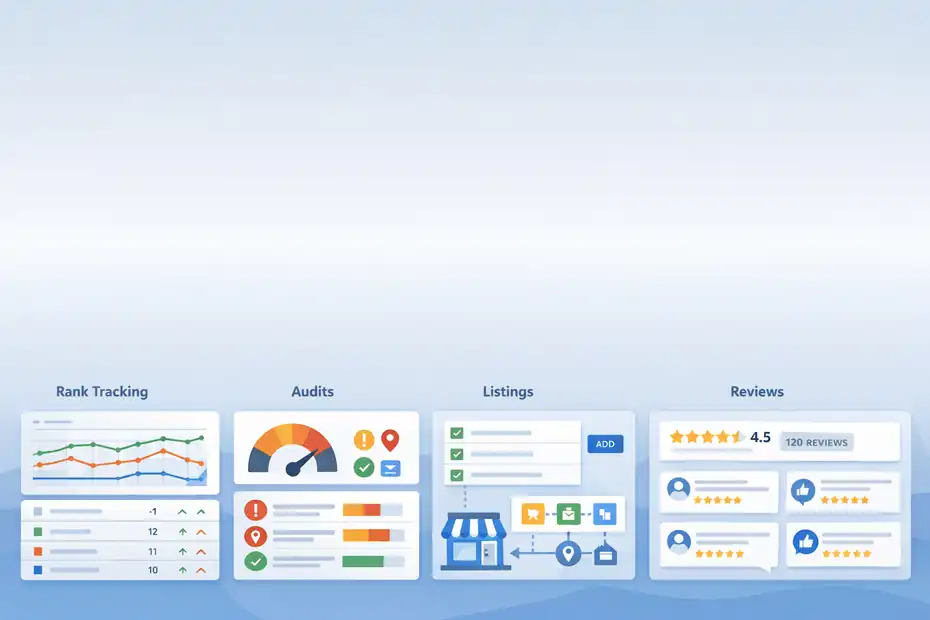
The easiest way to understand BrightLocal is to think of it as four systems working together: rankings, audits, listings, and reviews.
That combination is the main reason people pay for it instead of trying to piece together free tools.
Rank Tracking: The Feature Most Small Businesses Feel Immediately
BrightLocal includes Local Rank Tracker and Local Search Grid in all plans. The traditional rank tracker shows how you rank for local keywords, while the grid view maps ranking performance across a service area so you can see where you are strong and where visibility drops off.
BrightLocal says Local Search Grid is included in all plans and supports customizable grid sizes from 3×3 up to 15×15.
This matters because local rankings are not uniform. You might rank in the top three near your office but disappear five miles away. For a small business owner, that is incredibly useful. It turns “our SEO is not working” into something specific like “we rank well downtown but not in the northern suburbs.”
Here is where I think BrightLocal earns its keep. Many local businesses waste months judging SEO by gut feeling. A map-based ranking view gives you a visual answer fast.
It also helps you explain progress to partners or staff who do not care about keyword reports but absolutely understand green dots versus red ones on a map. That is one of the platform’s most practical strengths.
Audits: Good For Finding What To Fix First
BrightLocal’s audit stack includes Citation Tracker, GBP Audit, and Local Search Audit. On its platform pages, the company says it crawls more than 300 data points across local search, citations, and Google Business Profile to flag issues and highlight opportunities.
For a small business, this is useful because local SEO often fails on basics. Incorrect business details, incomplete categories, weak review signals, poor local landing pages, duplicate listings, and inconsistent citations all create drag.
Google’s own Business Profile guidance reinforces that accurate and complete information, updated hours, owner responses to reviews, and strong prominence signals can help local visibility.
I would not treat any audit score as a magic truth. No tool can fully understand your market, service mix, or offline brand strength. But I do think BrightLocal’s audits are valuable for prioritization.
They help you stop guessing and start fixing. For a business owner with limited time, that is often more important than having the “best” dashboard on paper.
Listings And Reviews: Where The Platform Becomes More Than A Tracker
BrightLocal’s listings management includes Active Sync, Citation Builder, and a GBP Post Scheduler. Citation Builder is a pay-as-you-go service that helps create listings, claim and update existing ones where possible, and remove harmful duplicates.
Review management in the Grow plan adds review monitoring, review generation campaigns, and review widgets for your site.
This is important because local SEO does not end with rankings. If your name, address, or phone number is inconsistent online, or if you have stale review profiles, your visibility and conversion rate both suffer.
BrightLocal’s own 2026 Local Consumer Review Survey found that 92% of consumers care about star ratings, 74% only care about reviews from the last three months, and 47% will not use a business with fewer than 20 reviews.
That tells you something simple: review management is not “nice to have” anymore. If BrightLocal helps you maintain review freshness and response habits, that can be worth real money for a local business.
BrightLocal Pricing In 2026 And What You Actually Get
This is where the review gets real, because a tool can be useful and still not be worth paying for.
BrightLocal currently offers Track, Manage, and Grow software plans, with pricing based on the number of active locations. Official pricing starts at $39 per month, with annual billing options discounted by around 25%.
For one location, search snippets from BrightLocal’s pricing page show Track at $39 monthly, Manage at $49 monthly, and Grow at $59 monthly. BrightLocal also offers a 14-day free trial with no card required.
What Each Plan Is Really Buying You
Here is the simplest way to think about the plans.
| Plan | Best For | What Stands Out | My Take |
|---|---|---|---|
| Track | Businesses that need visibility and diagnostics | Rank tracking, Local Search Grid, citation and GBP audits, competitor insights | Best starter option |
| Manage | Businesses that need active listings control | Everything in Track plus syncing business data and GBP post scheduling | Worth it if listings change often |
| Grow | Businesses that want review generation and response workflows | Everything in Manage plus review monitoring, review generation, review widgets | Best value if reviews drive revenue |
Pricing and feature structure are based on BrightLocal’s current official plan breakdown and support documentation.
My honest view: Track is probably the right entry point for most single-location businesses. If all you need is ranking visibility, audits, and a repeatable way to spot local SEO issues, it is usually enough. Manage makes sense when listings maintenance is a real operational problem. Grow becomes worthwhile when reviews are central to sales, trust, or lead conversion.
The Hidden Cost People Miss
The biggest mistake I see is assuming the subscription includes everything. It does not. Citation Builder is pay-as-you-go, and BrightLocal says submission campaigns or submission credits are purchased separately.
The platform also notes you can use Citation Builder without a monthly subscription through its free Simply Listings account. Search results and support pages indicate citation pricing starts around $3.20 per site, with bulk options from $2 per site.
That is not a deal-breaker, but it changes how you budget. If you are evaluating BrightLocal purely on monthly software cost, you may underestimate total spend. On the other hand, the pay-as-you-go model can be more sensible than paying permanently for citation work you only need a few times a year.
So, is BrightLocal expensive? I would say no for local SEO software, especially compared with heavier reputation or listings platforms. But it gets expensive if you subscribe without a plan for what work you will actually do each month.
Where BrightLocal Is Strong And Where It Feels Weak
No review is useful if it only repeats feature pages. The better question is where BrightLocal genuinely helps a small business and where it can still feel limited.
What BrightLocal Does Very Well
The first strength is focus. BrightLocal is not trying to win every SEO category. That usually helps the product. The platform is centered on local tasks, and the feature set reflects that: map-based ranking, GBP audits, citation tracking, listings management, and review workflows.
The second strength is usability for proving local SEO progress. I believe this matters more than many experts admit. A lot of small businesses cancel SEO because they do not understand what improved.
BrightLocal’s visual reporting, especially grid-based rank tracking, is easier to explain than a traditional SEO dashboard full of technical metrics.
The third strength is cost relative to scope. Starting at $39 per month with a no-card trial makes it easier for a small business to test whether the platform fits its workflow.
BrightLocal also highlights a 4.8 out of 5 average rating based on 1,300+ reviews across Google, G2, and Trustpilot, which at least suggests broad customer satisfaction, even if I never rely on vendor-owned testimonials alone.
Where BrightLocal Can Feel Limited
The biggest limitation is that BrightLocal is still a local SEO platform, not a full growth system. It will not replace your website platform, CRM, paid ads stack, or broad technical SEO toolkit.
If you expect one subscription to handle local SEO, organic content research, backlink outreach, and sales attribution in one place, you will feel boxed in.
The second limitation is geographic coverage. BrightLocal states its tools are configured for the USA, UK, Canada, and Australia. That is fine for many users, but it is important if your business operates elsewhere or across unsupported regions.
The third limitation is execution. The tool can show you what is wrong, but it cannot magically make your business more review-worthy, more trusted, or more relevant in your market.
You still need to respond to reviews, improve landing pages, tighten categories, and build processes around review requests and profile updates. In other words, BrightLocal is a very good system for local SEO operations, but it is not a substitute for local SEO judgment.
Is BrightLocal Worth Paying For Different Types Of Small Businesses?
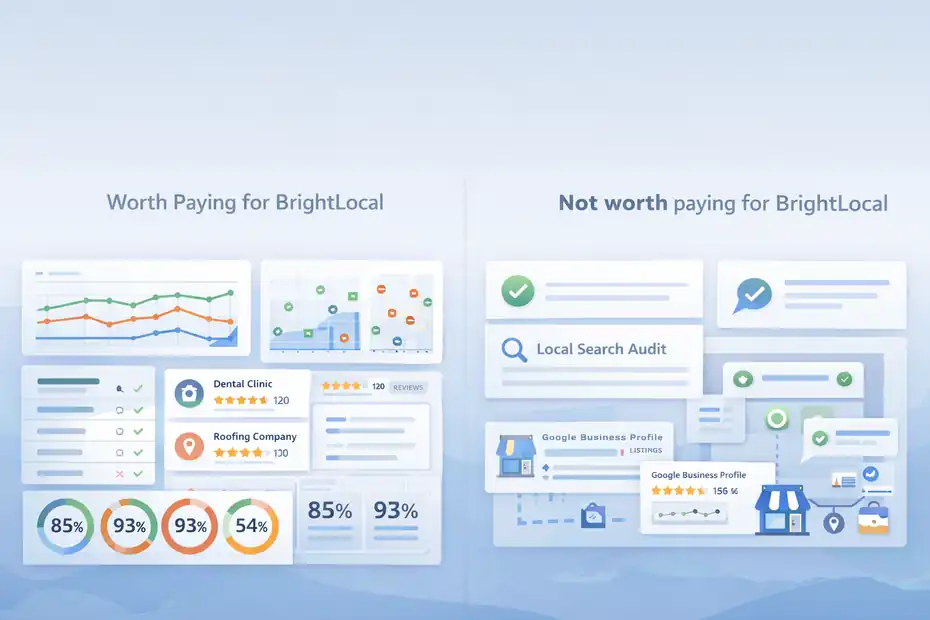
This is the section most people care about.
“Worth it” depends less on the tool and more on the kind of business you run, how often your local data changes, and whether local search brings in customers.
Yes, It Is Worth Paying For If Local Search Is A Revenue Channel
If customers regularly find you through Google Maps, branded searches, service-plus-city searches, or review platforms, BrightLocal can pay for itself pretty quickly.
BrightLocal’s 2026 consumer survey found that 85% of people are more likely to use a business after reading positive reviews, 93% have made a purchase after reading reviews, and 54% check a business website after reading positive reviews.
That means even modest improvements in map visibility, review freshness, and listing accuracy can affect real buying behavior. A dentist getting two extra new-patient bookings a month, or a roofer getting one extra qualified lead, can usually justify a $39 to $59 monthly spend without much drama.
I especially like BrightLocal for businesses with one to five locations that have enough marketing maturity to act on the data. If you will actually review audits, request reviews, update listings, and track local movement, the platform has a clear path to ROI.
Maybe Not Worth It If You Will Not Use The Workflow
I would skip BrightLocal if you know you are not going to log in after the first month. That sounds obvious, but it is the most common software failure pattern. Small businesses often buy tools to reduce uncertainty, not to run a process.
If your Google Business Profile is already well managed, your reviews come in steadily, your listings are stable, and local SEO is not a major lead source, a monthly subscription might be unnecessary. In that case, a short-term audit project or occasional citation cleanup could be smarter than recurring software.
This is also true if you are extremely early-stage. A brand-new local business often gets more mileage from fully setting up Google Business Profile, collecting its first 10 to 20 real reviews, fixing its website service pages, and tightening business details everywhere. BrightLocal can help with that, but it is not the first domino by itself.
My Verdict By Business Stage
Here is how I would call it:
- New local business: Useful, but not urgent unless you need a structured local SEO checklist immediately.
- Established single-location business: Usually worth it, especially on Track or Grow depending on review needs.
- Service-area business with competitors nearby: Strong fit because grid tracking reveals neighborhood-level blind spots.
- Multi-location small brand: Often worth it because consistency and reporting get messy fast.
- Owner who wants “done for me” results without doing the work: Probably not the right purchase unless you buy services too. BrightLocal’s managed local SEO services start at $799 per month.
How To Get The Most Value From BrightLocal
A good tool is only valuable if you use it in a disciplined way. The best BrightLocal setup is not complicated, but it should be intentional.
Start With One Core KPI Set
Do not open BrightLocal and try to fix everything. I suggest you start with four KPIs:
- Map visibility: Your average position and grid pattern for your most important local keywords.
- Review health: Total review count, recent review volume, response rate, and average rating.
- Listing consistency: Whether your NAP and core details match across key platforms.
- GBP completeness: Categories, hours, photos, posts, and missing profile elements.
This works because it mirrors what customers and Google both care about: relevance, trust, and consistency. Google says complete and accurate profile information, up-to-date hours, review responses, and overall prominence help businesses show better in local results.
BrightLocal’s audit and review features are useful because they map pretty closely to those fundamentals.
Use The Tool In Monthly Sprints, Not Random Check-Ins
The businesses that get value from BrightLocal usually build a rhythm around it.
- Week 1: Check rankings and grid movement.
- Week 2: Fix audit issues and update listings.
- Week 3: Request reviews from recent customers and respond to new ones.
- Week 4: Review results, save reports, and decide what to improve next month.
I like this approach because it prevents dashboard wandering. You are not paying for “insights.” You are paying for repeatable local SEO execution. That is a big difference.
Also, remember BrightLocal’s own review data: 74% of consumers only care about reviews written in the last three months, and 37% say owner responses matter when evaluating reviews. That makes recurring review activity part of the ROI story, not a side task.
Combine BrightLocal With Real Business Process Changes
This is where many subscriptions quietly fail. A tool alone cannot create better customer sentiment. You still need operational triggers.
For example, a med spa could ask for reviews 24 hours after an appointment, a locksmith could request them right after job completion, and a restaurant could prompt happy regulars via QR code after positive in-person feedback.
BrightLocal’s review generation features can support that process, but the process itself has to exist.
BrightLocal reports that 78% of consumers were asked to write a review in the last 12 months, and 65% wrote one after being asked. That is a strong reminder that review growth is often a process problem, not a software problem.
Final Verdict: Is BrightLocal Worth Paying For?
For most small businesses that rely on local visibility, I believe BrightLocal is worth paying for when you choose the plan that matches your actual workflow.
The platform’s pricing starts low enough to be accessible, the feature set is tightly aligned with real local SEO work, and the best tools inside it solve practical problems: where you rank, what is broken, where your listings are inconsistent, and whether your review profile is strong enough to convert searchers.
My plain-English verdict looks like this:
- Worth it on Track if you mainly need rank tracking, audits, and clearer local SEO priorities.
- Worth it on Manage if listings updates and profile syncing are recurring headaches.
- Worth it on Grow if reviews materially affect sales, trust, and lead flow.
- Not worth it if you want passive results without a real local SEO routine.
If I were advising a typical single-location small business today, I would start with the free trial, test Track first, and only move up if listings management or review generation are active needs. That keeps cost under control and lets the platform prove itself in your real market.
And honestly, that is the standard I think any small business software should meet: not “does it have features,” but “does it make your next local SEO action clearer and more profitable?” BrightLocal has a good case for yes.
FAQ
What is BrightLocal used for in small business local SEO?
BrightLocal is a local SEO tool that helps small businesses track rankings, audit listings, manage reviews, and improve Google Business Profile performance. It focuses on visibility in local search and map results, making it easier to identify issues and optimize for more calls, leads, and customers.
Is BrightLocal worth it for small businesses in 2026?
BrightLocal is worth it for small businesses that rely on local search for customers. If you actively manage reviews, track rankings, and fix listing issues, the platform can deliver strong ROI. However, it is less valuable if you do not plan to use it consistently.
How much does BrightLocal cost for one location?
BrightLocal pricing starts at around $39 per month for one location, with higher-tier plans offering listings management and review tools. Costs increase if you purchase citation-building services, which are priced separately and depend on the number of directories you choose.
Does BrightLocal help improve Google Business Profile rankings?
BrightLocal helps improve Google Business Profile rankings by identifying optimization gaps, tracking local keyword positions, and supporting review generation. While it does not directly change rankings, it provides the data and tools needed to improve visibility through consistent local SEO actions.
What are the main alternatives to BrightLocal?
Common alternatives to BrightLocal include tools like Moz Local, Whitespark, and Semrush local SEO features. These platforms offer similar capabilities such as listings management and rank tracking, but BrightLocal stands out for its focused local SEO tools and affordability for small businesses.

I’m Juxhin, the voice behind The Justifiable.
I’ve spent 6+ years building blogs, managing affiliate campaigns, and testing the messy world of online business. Here, I cut the fluff and share the strategies that actually move the needle — so you can build income that’s sustainable, not speculative.
Related posts:
 BrightLocal Review For Multi Location Businesses: Worth It Or Too Complex?
 BrightLocal Review For Google Business Profile Tracking: Better Insights?
 BrightLocal Honest Review For Freelancers: Smart Investment Or Waste?
 BrightLocal Review For Local SEO Agencies: Is It Worth The Cost?
 BrightLocal Reviews: Why Marketers Trust This SEO Tool
 BrightLocal Review For Local SEO Reporting: Save Hours Or Settle Less?