
Table of Contents
Some links on The Justifiable are affiliate links, meaning we may earn a small commission at no extra cost to you. Read full disclaimer.
A real squirrly vs yoast seo comparison matters because these plugins do not just organize settings. They shape how you plan content, optimize pages, handle technical SEO, and stay consistent long enough to grow traffic.
I’ve looked at both through the lens that actually matters to most site owners: not which one has the louder feature page, but which one helps you publish better pages, fix real SEO problems, and keep momentum.
If you are trying to choose between Squirrly and Yoast in 2026, this guide will help you match the tool to your site, budget, and growth style.
What This Squirrly Vs Yoast Seo Comparison Is Really Measuring
Before we get into features, we need to define “drives more traffic” the right way. Plugins do not create rankings by magic.
They influence traffic by making the right SEO actions easier, faster, and more consistent.
What “More Traffic” Actually Means In Practice
When people search for a squirrly vs yoast seo comparison, they usually want a winner. I get that. But in real SEO, traffic comes from a chain of outcomes: better content targeting, cleaner technical signals, stronger internal linking, better metadata, and a publishing workflow you can stick with for months.
Here is how I evaluate that:
- Traffic driver 1: Better content decisions. Can the plugin help you choose a keyword, align the page with intent, and optimize without turning the article into robotic sludge?
- Traffic driver 2: Better implementation. Can it handle titles, descriptions, schema, indexing controls, sitemaps, canonicals, redirects, and social metadata without creating friction?
- Traffic driver 3: Better consistency. Can you actually keep using it every week without burnout, confusion, or feature overload?
- Traffic driver 4: Better prioritization. Does it tell you what matters next, or does it just flood you with settings?
This is where the split starts. Yoast is built around a very mature, straightforward WordPress SEO workflow. Squirrly leans harder into guided SEO, AI, ranking priorities, and a broader platform model that also supports non-WordPress use through its Cloud App.
So the better question is not “Which plugin has more features?” It is “Which plugin gets you to execute the highest-value SEO tasks more often?”
The Core Difference In Philosophy
I think this is the part most reviews miss.
Yoast feels like a trusted editor and technical safety net. It gives you clear on-page checks, schema support, setup guidance, and a stable plugin ecosystem.
Yoast has been around since 2008, says it helps millions of websites, and its WordPress plugin reports 10+ million active installations with a 4.8-star rating.
Squirrly feels more like a guided SEO system. It pushes AI-based SEO goals, Focus Pages, keyword research, rank-oriented workflows, and a built-in 14-day bootcamp.
Its WordPress plugin reports 40,000+ active installs and a 4.6-star rating, while also promoting support for non-WordPress sites through its SaaS and Cloud App setup.
That means Yoast usually wins on familiarity, trust, and simplicity at scale. Squirrly often wins on hand-holding, guided prioritization, and “tell me what to fix next” behavior.
How Squirrly And Yoast Work Day To Day
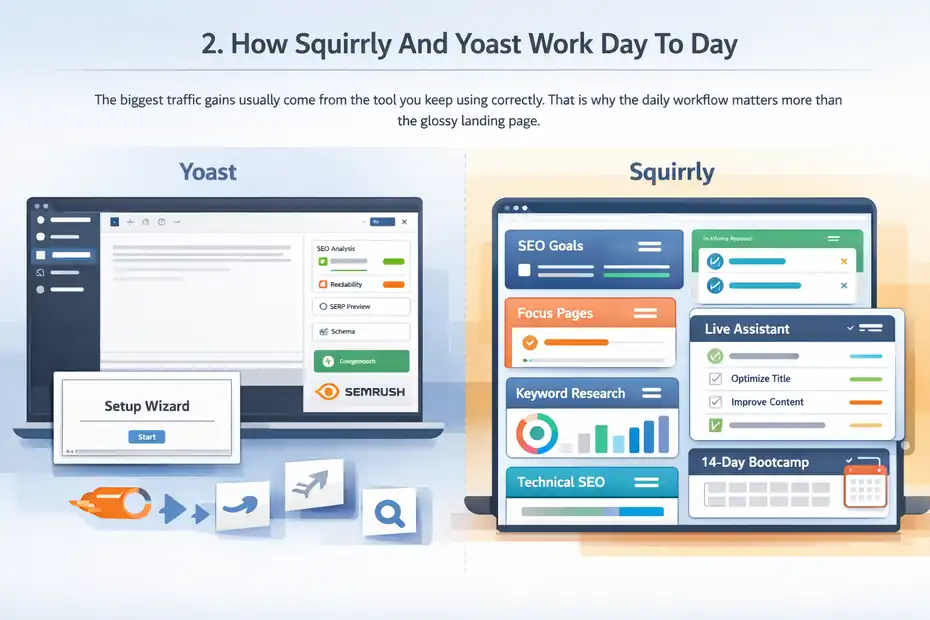
The biggest traffic gains usually come from the tool you keep using correctly. That is why the daily workflow matters more than the glossy landing page.
Yoast’s Workflow: Cleaner, Simpler, More Familiar
Yoast is very good at staying out of your way while still nudging you. For many WordPress users, that matters more than having 50 extra panels.
Inside the editor, Yoast focuses on content analysis, readability analysis, SERP previews, schema support, and clear optimization feedback.
The plugin also highlights that setup is quick, uses a configuration wizard, and supports import/export for migration from other SEO plugins. It also lists Semrush integration for keyword research directly in Yoast.
That combination creates a nice rhythm:
- Step 1: Configure the site correctly. The wizard reduces setup errors early.
- Step 2: Optimize while writing. You get feedback without leaving the page editor.
- Step 3: Improve structure gradually. Premium adds redirects and internal linking suggestions.
In my experience, Yoast works especially well for bloggers, publishers, and small teams that already know the basics of keyword targeting. It does not try to become your entire SEO operating system. It tries to make WordPress SEO feel manageable.
That restraint is one reason it stays popular. If you publish often and dislike dashboard chaos, Yoast can help you keep momentum.
Squirrly’s Workflow: More Guided, More Active, More Prescriptive
Squirrly takes a very different route. Instead of mainly scoring the page you are writing, it tries to guide your larger SEO process.
On its WordPress plugin page, Squirrly highlights AI-Powered SEO Goals, Focus Pages, real-time optimization through Live Assistant, keyword research, automatic technical SEO handling, and a built-in 14-Day SEO Bootcamp.
It also says the Live Assistant works with builders like Elementor, Gutenberg, and Divi, and mentions compatibility with WooCommerce, Multisite, WPML, and PHP 8+.
That changes how the product feels in use:
- Step 1: Choose a page or priority. Squirrly is more likely to tell you what deserves attention first.
- Step 2: Work inside a guided checklist. Focus Pages and goals push you toward action.
- Step 3: Track progress across more SEO dimensions. This feels closer to a lightweight SEO platform than a simple plugin.
I think Squirrly is strongest for users who do not just want an editor score. They want direction. They want the plugin to say, “Here is why this page is underperforming and here is what to fix next.”
The upside is momentum. The downside is that some users may find the ecosystem heavier than they need.
Setup, Learning Curve, And Ease Of Use
A plugin that confuses you will not drive more traffic. It will sit installed and half-configured while you procrastinate.
Yoast Is Usually Easier For First-Time WordPress Users
Yoast earns a lot of trust here. Its setup language is simple, the interface is mature, and the plugin explicitly promotes a step-by-step configuration wizard plus built-in migration tools.
That matters because most beginners are not really asking for “more features.” They are asking for fewer mistakes.
Imagine you run a local service site with 25 pages. You need:
- titles and meta descriptions
- XML sitemaps
- schema basics
- index/noindex controls
- clean social previews
- maybe redirects later
Yoast covers that path in a way that feels predictable. I would recommend it to someone who says, “I want solid SEO foundations without feeling like I joined a cockpit.”
Another underrated advantage is social proof. With 10+ million active installs and nearly 26,000 five-star reviews on WordPress.org, Yoast has simply been tested by more site types, more hosts, and more workflows than almost any other SEO plugin.
That does not automatically make it better for every person. But it does lower the “Am I about to break something?” anxiety.
Squirrly Is More Helpful For Users Who Want Direction, Not Just Settings
Squirrly is not as instantly familiar, but it may be more useful for people who want guided execution.
Its messaging revolves around AI-guided goals, Focus Pages, ranking support, and a bootcamp-style workflow. It also promotes broader functionality through a SaaS plus plugin configuration and says non-WordPress sites can use the Cloud App, though some features such as Focus Pages are not available outside WordPress.
That creates a different beginner experience.
Instead of simply asking, “Is this paragraph readable?” Squirrly is more likely to ask, “What page should rank next, what are you missing, and what sequence of actions gets you there?”
For many of us, that is genuinely helpful. Especially if SEO always feels vague.
The tradeoff is complexity. A beginner who only wants titles, sitemaps, and on-page checks might feel Squirrly is trying to do too much. But a beginner who wants a more coach-like system may actually learn faster with it.
Feature Comparison That Actually Affects Traffic
This is the section people usually jump to, so let me keep it practical. More boxes checked does not always equal more rankings.
Quick Comparison Table
| Area | Yoast SEO | Squirrly SEO | Traffic Impact |
|---|---|---|---|
| Core WordPress SEO | Strong | Strong | Both can cover fundamentals |
| Setup Wizard | Yes | Guided setup, broader workflow emphasis | Yoast easier for clean start |
| Real-Time Content Feedback | Yes | Yes, via Live Assistant | Tie, but style differs |
| Readability Analysis | Strong | Less central to product identity | Yoast stronger for editorial quality |
| AI-Guided SEO Goals | Limited compared with Squirrly’s guided system | Major part of product | Squirrly stronger for prioritization |
| Internal Linking | Premium suggestions | Automatic inner link features promoted | Depends on workflow |
| Redirect Management | Premium | Advanced redirections promoted in free comparisons | Useful for site maintenance |
| Non-WordPress Support | No, WordPress-first | Yes, via Cloud App | Squirrly wins here |
| Plugin Popularity | 10+ million installs | 40,000+ installs | Yoast wins on trust and ecosystem |
| Price Entry Point | Free, Premium $118.80/year | Free, Pro $9.99/month | Depends on billing preference |
Pricing and feature references above come from the vendors’ official pages and WordPress.org listings.
Which Features Matter Most For Organic Growth
Let me be blunt: a lot of feature comparisons waste your time.
The features that usually move traffic are these:
- Keyword targeting guidance: Helps you align a page with a realistic search term.
- Metadata control: Better title tags and meta descriptions improve click-through rate.
- Schema and technical cleanup: Helps search engines understand the page.
- Internal linking support: Improves crawl paths and topical relationships.
- Publishing consistency: The plugin keeps your workflow from falling apart.
Yoast is excellent when your SEO process is already defined and you mainly need a reliable WordPress layer. Squirrly is more appealing when your process is not defined and you want the software to push you into one.
That is why I would not say one universally drives more traffic. I would say:
- Yoast often drives more traffic for organized publishers who value simplicity.
- Squirrly often drives more traffic for overwhelmed site owners who need guided priorities.
That distinction sounds small, but it changes the buying decision completely.
Pricing, Value, And What You Actually Get

Price alone is not useful. What matters is whether the cost matches the level of help you need.
Yoast Pricing: Clear, Familiar, And Easier To Budget
Yoast SEO Premium is listed at $118.80 per year, billed annually, and includes premium features like optimization for up to five keywords, redirects, internal linking suggestions, AI suggestions for titles and descriptions, social previews, and 24/7 support.
Yoast also states that Premium now includes Local SEO, Video SEO, and News SEO plugins in the package.
That pricing is straightforward.
I like that because budgeting matters when you run multiple sites or client projects. You can compare annual cost quickly and decide whether the premium features save enough time to justify the spend.
For a solo blogger, the free version may be enough for quite a while. For a content-heavy site, Premium becomes more defensible because redirects, internal links, and workflow improvements can save real hours every month.
Squirrly Pricing: Lower Entry Monthly, Broader SaaS Logic
Squirrly’s pricing page shows a Free plan, Pro at $9.99 per month, Web Dev Kit at $51.20 per month, and Business at $71.99 per month.
The same page also notes that, thanks to its SaaS plus plugin setup, it can be used on WordPress and non-WordPress sites, and that support differs by plan.
This pricing structure tells you something important: Squirrly is thinking more like a broader SEO platform than a single-plugin upsell.
That can be a good deal if you want:
- guided SEO priorities
- keyword research built into the workflow
- broader account/site handling
- non-WordPress flexibility
- more of an operating system feel
But it can also be overkill if all you want is a solid WordPress SEO plugin.
I would frame it like this: Yoast usually wins on budget clarity. Squirrly can win on value if you actually use the extra guidance and platform-style features.
Which One Is Better For Different Types Of Websites
This is where the real answer lives. The best plugin depends on your site model.
Best Choice For Bloggers, Publishers, And Content Teams
For pure publishing workflows, I lean Yoast more often.
Why? Because content teams usually need a stable editing layer, readability checks, predictable SEO fields, schema support, and migration-friendly processes. Yoast is built for that environment and has the scale, maturity, and trust signals to prove it.
A realistic example:
You run a niche content site publishing 12 articles per month. Your team already has briefs, keywords, and an editorial process.
In that case, Yoast’s simpler workflow keeps friction low. Editors can optimize quickly without getting distracted by dashboards that pull them into broader strategy mode.
That matters because traffic growth on publishing sites often comes from volume plus consistency, not from spending 45 minutes inside a plugin panel every time.
Best Choice For Small Businesses, Service Sites, And DIY Operators
For a small business owner wearing five hats, I think Squirrly becomes more interesting.
A dentist, coach, lawyer, consultant, or local contractor may not need “just an SEO layer.” They may need a system that says:
- this page should rank first
- these issues matter most
- here is the next task
- here is how to improve this page’s visibility
That is where Focus Pages, AI-guided goals, and the more prescriptive workflow can be genuinely useful.
I have seen this pattern a lot: the person who says “I know I need SEO but I never know what to do next” usually benefits more from guided software than from cleaner settings screens.
Best Choice For Agencies And Multi-Site Setups
This one is more nuanced.
Yoast has the ecosystem familiarity and broad compatibility that agencies often appreciate. Squirrly, meanwhile, promotes agency-oriented plans like Web Dev Kit and Business, plus multi-site and broader account/site usage.
My view:
- Choose Yoast if your agency values standardization, client familiarity, and clean WordPress handoff.
- Choose Squirrly if your agency wants a more guided SEO process, broader dashboard logic, or support for non-WordPress workflows through the Cloud App.
Common Mistakes People Make When Choosing Between Them
This is the section I wish more comparison posts included, because people often pick the wrong plugin for the wrong reason.
Mistake 1: Choosing Based On Feature Quantity
I see this all the time. Someone compares 40 features to 55 features and assumes the plugin with more capabilities must drive more traffic.
Not true.
If you only use titles, descriptions, sitemaps, and basic on-page checks, the extra feature stack may not help you at all. In some cases, it can even reduce output by increasing friction.
A plugin drives traffic when it helps you ship better pages consistently. Not when it gives you more places to click.
Mistake 2: Expecting The Plugin To Replace SEO Strategy
Neither Squirrly nor Yoast can fix weak keyword choices, poor search intent match, thin content, or weak backlinks by themselves.
Even the smartest plugin cannot save an article that targets the wrong query.
That said, Squirrly does lean harder into prioritization and ranking guidance, which can help reduce strategic drift for newer users. Yoast is better viewed as a strong implementation tool paired with your own keyword strategy.
Mistake 3: Ignoring Workflow Fit
This is the big one.
- Pick Yoast if you want calm, proven, familiar workflow support.
- Pick Squirrly if you want more direction and active guidance.
When people ignore this and choose based on hype, they often switch again six months later. That migration costs time, introduces risk, and slows publishing momentum.
Which One Drives More Traffic In Real-World Use?
Now for the answer people actually want.
Yoast Usually Wins When Your Process Is Already Strong
If your content strategy is solid and your team already knows how to do keyword research, structure content, and publish on a schedule, Yoast often drives more traffic simply because it stays efficient.
Its core strengths support repeatable execution:
- easy setup
- familiar UI
- clear on-page guidance
- strong readability support
- mature plugin trust
- premium tools for redirects and internal links
For these users, less friction equals more output. More output, when paired with good targeting, often means more traffic.
I would especially trust Yoast on established blogs, editorial teams, and businesses that already have an SEO playbook.
Squirrly Usually Wins When You Need More Direction To Execute
If your biggest issue is not knowledge but consistency, Squirrly can be the better traffic driver.
Its strongest angle is helping users move from “I know SEO matters” to “I know exactly what to work on next.” Between AI SEO goals, Focus Pages, live guidance, keyword research, and bootcamp-style structure, it is trying to reduce decision fatigue.
That matters more than people think.
Imagine a solo founder with 30 important landing pages and zero time to study SEO deeply. A plugin that helps prioritize pages and actions may create faster gains than one that mainly perfects on-page scoring.
So my honest verdict is this:
- Yoast drives more traffic for disciplined content operations.
- Squirrly drives more traffic for users who need guided momentum and broader SEO direction.
My Final Verdict And Recommendation
This short section is the closest thing to a straight answer.
Choose Yoast If You Want Reliability, Simplicity, And Editorial Efficiency
I recommend Yoast when your goal is to keep WordPress SEO clean, stable, and easy to manage over the long term.
Choose it if you care most about:
- familiar WordPress experience
- faster onboarding
- massive install base and social proof
- strong readability analysis
- simple migration and setup
- clean Premium upgrades for redirects and internal linking
If I were running a content site with an existing process, this is probably where I’d start.
Choose Squirrly If You Want Guided SEO Execution And More Active Help
I recommend Squirrly when you want more than a plugin. You want something closer to a guided SEO system.
Choose it if you care most about:
- AI-guided SEO goals
- Focus Pages and page-level prioritization
- built-in SEO bootcamp structure
- SaaS plus plugin model
- support for non-WordPress sites through the Cloud App
- broader plan options for agencies or multi-site use
If you often feel stuck on what to do next, Squirrly may help you act faster.
Bottom Line
For most WordPress site owners, Yoast is still the safer general recommendation because it is easier to trust, easier to learn, and easier to keep using.
For DIY business owners, growth-minded operators, and people who benefit from active direction, Squirrly may produce better traffic outcomes because it is more prescriptive.
That is the real answer to the squirrly vs yoast seo comparison question.
- Not “Which plugin is objectively better?”
- But “Which plugin helps you do the right SEO work more consistently?”
And in SEO, consistency is usually the thing that wins.
FAQ
What is the main difference in a squirrly vs yoast seo comparison?
The main difference is that Yoast focuses on simplicity and on-page optimization, while Squirrly provides guided SEO workflows with AI-driven recommendations. Yoast helps you execute SEO efficiently, whereas Squirrly helps you decide what to do next, making it more strategic for beginners.
Which plugin drives more traffic, Squirrly or Yoast SEO?
Neither plugin directly drives traffic on its own. Yoast tends to perform better for structured content workflows, while Squirrly can generate better results for users who need guided SEO actions and prioritization. The better choice depends on how you manage content and SEO execution.
Is Squirrly SEO better for beginners than Yoast?
Squirrly can be better for beginners who want step-by-step guidance and clear SEO tasks. Its built-in goals and recommendations reduce confusion. Yoast is still beginner-friendly but assumes you already understand basic SEO concepts and prefer a simpler interface.
Does Yoast SEO have better features than Squirrly?
Yoast has strong core SEO features, especially for WordPress users, including readability analysis and technical SEO controls. Squirrly offers more advanced guidance tools like AI SEO goals and keyword planning, making it feel more like a complete SEO system rather than just a plugin.
Can you use Squirrly and Yoast SEO together?
Using both plugins together is not recommended because they can conflict with each other’s settings, such as meta tags and sitemaps. It is best to choose one plugin and fully commit to it to avoid technical issues and inconsistent SEO signals.

I’m Juxhin, the voice behind The Justifiable.
I’ve spent 6+ years building blogs, managing affiliate campaigns, and testing the messy world of online business. Here, I cut the fluff and share the strategies that actually move the needle — so you can build income that’s sustainable, not speculative.
Related posts:
 How Good Is My Website SEO? Find Out Instantly!
 Is Whitespark SEO the Missing Piece to Your Local Success?
 Squirrly SEO Pricing: What You Pay vs What You Get
 Squirrly Vs Rank Math Comparison: Which Wins For Rankings?
 What Is Content Marketing in SEO? The Key to More Leads
 Whitespark Alternative: 7 Powerful Local SEO Tools in 2025