
Table of Contents
Some links on The Justifiable are affiliate links, meaning we may earn a small commission at no extra cost to you. Read full disclaimer.
If you’ve been scanning listings for an ecommerce business for sale, you’ve probably noticed how wildly prices, profits, and potential can vary.
Some seem like pure goldmines—others, like glitter-covered traps. But how do you tell the difference between a business that’s ready to scale and one that’s quietly sinking?
In this guide, I’ll show you how to dig past the surface metrics and uncover the hidden gold buried in ecommerce business listings.
Understanding What Makes an Ecommerce Business Valuable
When you’re evaluating an ecommerce business for sale, the goal is to look past shiny sales numbers and uncover what’s really driving long-term value.
A business that looks impressive on paper can crumble if its foundations—revenue, traffic, customer loyalty, and margins—aren’t solid.
Assessing Core Revenue Drivers
Every ecommerce business has a few key products, channels, or customer groups that fuel its revenue. Your job is to find them.
Start by checking the sales concentration ratio: if more than 40% of sales come from a single product or customer segment, that’s a red flag for instability.
I usually suggest using the store’s platform analytics (like Shopify Analytics → Reports → Sales by Product) to spot these trends.
Next, dig into revenue sources:
- Are sales organic or driven by heavy ad spend?
- How much comes from repeat customers versus new ones?
- Is revenue seasonal or consistent year-round?
A healthy ecommerce business shows steady month-to-month revenue with diverse income sources—not a rollercoaster graph.
Evaluating Traffic Quality and Conversion Rates
Traffic numbers can be deceptive. Ten thousand visitors a month sounds great until you realize only 0.3% convert.
I like to cross-check data from Google Analytics (Acquisition → Channels → Source/Medium) and Shopify’s built-in metrics. Look for:
- Traffic origin: Are visitors coming from search, social, or paid campaigns?
- Bounce rate: If it’s over 60%, the traffic may not be relevant.
- Conversion rate: A solid ecommerce conversion rate sits between 2–4%.
If the site relies too heavily on paid ads, test how sustainable that traffic is by pausing campaigns for a few days—does revenue drop sharply? That tells you a lot about its real strength.
Analyzing Customer Retention and Repeat Purchases
Customer retention is the lifeblood of a valuable ecommerce business. A one-time buyer doesn’t build your brand; a loyal customer does.
Pull data from tools like Klaviyo or Shopify Customer Reports to find the repeat purchase rate (ideally 25–40% for established brands).
Pay attention to:
- Average order frequency per year.
- Time between purchases.
- Subscription or loyalty program performance.
If customers return willingly without constant discounts, that’s gold. It means the brand delivers genuine value, not just temporary hype.
Reviewing Profit Margins Beyond Surface Numbers
Don’t just look at gross revenue—it’s meaningless without context. Focus instead on net profit margin and contribution margin per order.
A healthy ecommerce business typically has a profit margin of 10–20%. Lower than that can still work if the business has strong growth potential or high retention rates.
Ask to see the full P&L (Profit & Loss) statement, including hidden expenses like shipping, fulfillment, software subscriptions, and ad costs.
I’ve seen plenty of stores claiming 25% margins that drop to 5% when all costs are accounted for. Always validate profit figures with bank statements and payment processor records.
Identifying Red Flags Before Buying an Ecommerce Business
Not all that glitters is Shopify gold. Before you buy, you need to know how to spot the warning signs that an ecommerce business might be riskier than it looks.
Spotting Inflated Revenue or Fabricated Metrics
Some sellers manipulate data to make their store appear more profitable. They might run flash sales or ad campaigns right before listing to spike short-term revenue.
To verify authenticity:
- Compare last six months’ sales trends instead of just 30-day data.
- Ask for Shopify or Stripe read-only access.
- Cross-check traffic data from Google Analytics.
If numbers don’t align across tools, or if refunds are unusually high, that’s a sign something’s off.
Recognizing Overdependence on Paid Ads or One Product
When 90% of traffic comes from Facebook Ads or one hero product, sustainability becomes a risk. If that product loses appeal or ad costs spike, revenue can collapse overnight.
Here’s what I do:
- Review ad spend versus return using Meta Ads Manager → Ads Reporting.
- Check diversification: Are there multiple channels (Google, Pinterest, SEO)?
- Identify the top three products by sales—if one dominates, that’s dependency.
An ecommerce business for sale should have multiple reliable revenue streams, not one golden goose.
Checking for Supplier and Fulfillment Vulnerabilities
Reliable supply chains make or break ecommerce operations. If the business relies on one overseas supplier with slow shipping or thin margins, you’re inheriting their risk.
Ask the seller:
- Do they have supplier contracts or purchase agreements?
- What are average lead times and failure rates?
- Are there backups if a supplier folds?
You can confirm supplier stability by placing a few test orders yourself and measuring fulfillment time and product quality. It’s a simple, revealing move.
Detecting Hidden Debt, Liabilities, or Legal Risks
Even profitable stores can carry invisible baggage—like outstanding tax obligations, trademark disputes, or customer data compliance issues (think GDPR).
Before closing, review:
- Business registration and tax filings.
- Any ongoing chargeback or PayPal dispute ratios.
- Trademark ownership for brand names and logos.
I recommend involving a legal advisor for due diligence here. It’s not the fun part, but it’s where many first-time buyers get burned.
Evaluating Growth Potential and Market Fit
A truly valuable ecommerce business isn’t just profitable—it’s scalable. You want to know if there’s room to grow and how much effort it will take.
Measuring Product-Market Alignment and Trends
You can tell when a business fits its market: the products solve a real problem and customer reviews prove it.
Start by:
- Reading reviews for recurring pain points or delight factors.
- Checking Google Trends for the main keywords—are they stable or rising?
- Evaluating niche saturation using tools like Exploding Topics or Jungle Scout.
A business in a rising trend niche (like sustainable home products or pet wellness) will typically command a higher valuation because growth comes naturally.
Analyzing SEO, Social Media, and Organic Reach
A strong organic foundation means lower marketing costs and higher sustainability. I usually begin with SEMrush to check domain authority, backlink quality, and ranking keywords.
Look for:
- At least 30% of traffic coming from organic search.
- Active social media engagement (not inflated followers).
- Consistent blog or content updates driving new visitors.
Organic traffic often signals that the brand has authority and genuine community trust—something money alone can’t buy.
Exploring Untapped Sales Channels and Expansion Opportunities
When analyzing an ecommerce business for sale, consider what the next level looks like. Many sellers haven’t explored marketplaces like Amazon, Walmart, or TikTok Shop.
Potential expansion paths include:
- Adding new platforms: eBay, Etsy, or niche marketplaces.
- Introducing wholesale or B2B options.
- Expanding into international shipping (starting with Canada, UK, or Australia).
I’ve seen brands double their valuation simply by launching in one additional region or adding a new ad channel.
Estimating Scalability Based on Infrastructure and Tools
Finally, evaluate the systems that run the business. Can it scale easily, or is it duct-taped together?
Check for:
- Automation tools (e.g., Zapier, Klaviyo, Gorgias for customer service).
- Scalable platforms (Shopify Plus, WooCommerce with reliable hosting).
- Inventory management software (like Skubana or Cin7).
A well-built backend means growth won’t break operations. If processes are manual or outdated, factor the cost of upgrading into your offer.
Analyzing Financials Like an Expert Buyer
Buying an ecommerce business for sale isn’t just about liking its brand or products—it’s about understanding its financial heartbeat.
When you can read and interpret the numbers like an expert buyer, you’ll see things most others miss.
Reading P&L Statements and Cash Flow the Right Way
A Profit and Loss (P&L) statement isn’t just a formality; it’s your truth serum. It tells the story of how money moves through the business—what comes in, what goes out, and what’s left.
Start by looking at revenue trends across at least 12 months. Consistent growth usually signals operational health, while wild spikes or sudden drops suggest volatility. Then review Cost of Goods Sold (COGS), operating expenses, and ad spend ratios.
To double-check accuracy, I recommend matching the P&L against bank statements and payment processor data (for example, Stripe → Reports → Payouts). You’ll want to ensure the numbers align.
Cash flow statements are equally vital. A business can show profits but still struggle if cash is tied up in inventory or delayed payments. Positive cash flow month-to-month is a better indicator of health than one-off high-profit months.
If you’re serious, use a simple visualization—like a line graph comparing monthly cash inflows vs. outflows—to see patterns of stability or stress.
Understanding Inventory Turnover and Seasonal Trends
Inventory turnover shows how efficiently a business moves products. The formula is straightforward: Cost of Goods Sold ÷ Average Inventory. A higher ratio means faster sales and healthier cash flow.
For ecommerce, I suggest looking for an inventory turnover rate between 4–8 times per year. Anything lower might indicate overstocking or slow-moving products.
To spot seasonal trends, compare monthly sales data over two to three years. You can do this easily inside Shopify Analytics → Reports → Sales Over Time. If sales peak only during holidays, ensure your financial model accounts for off-season slowdowns.
Example scenario: A dropshipping store selling beach accessories may show high summer profits but minimal off-season sales. Without year-round demand or supplementary products, that can create financial gaps.
Evaluating Subscription Revenue and Lifetime Value (LTV)
Subscription revenue is a golden metric in ecommerce—it brings predictability. If the business offers subscriptions, check monthly recurring revenue (MRR) and churn rate (the percentage of customers who cancel each month).
The higher the MRR and lower the churn, the more stable the business. For context, a 5% monthly churn rate means you’re losing 60% of subscribers annually—a big red flag.
Next, calculate Customer Lifetime Value (LTV) using this simple formula:
LTV = Average Order Value × Purchase Frequency × Gross Margin.
A business with an LTV at least three times higher than its Customer Acquisition Cost (CAC) is in a strong position. If LTV barely exceeds CAC, profitability will be tough to maintain.
Confirming EBITDA and Adjusted Owner’s Income
EBITDA—Earnings Before Interest, Taxes, Depreciation, and Amortization—helps you gauge the true operating profit. But for smaller ecommerce businesses, it’s equally important to look at Seller’s Discretionary Earnings (SDE) or Adjusted Owner’s Income.
SDE includes the owner’s salary and personal expenses that wouldn’t continue under new ownership. For example, if the seller runs ads through a personal account or includes non-business expenses, those should be added back to reflect true profitability.
A quick sanity check: The asking price of the ecommerce business for sale should typically be 2.5–3.5× its annual SDE, depending on growth potential and risk. If it’s priced higher, it needs strong justification—like proprietary tech or exclusive supplier rights.
Using Data Tools to Verify Business Health
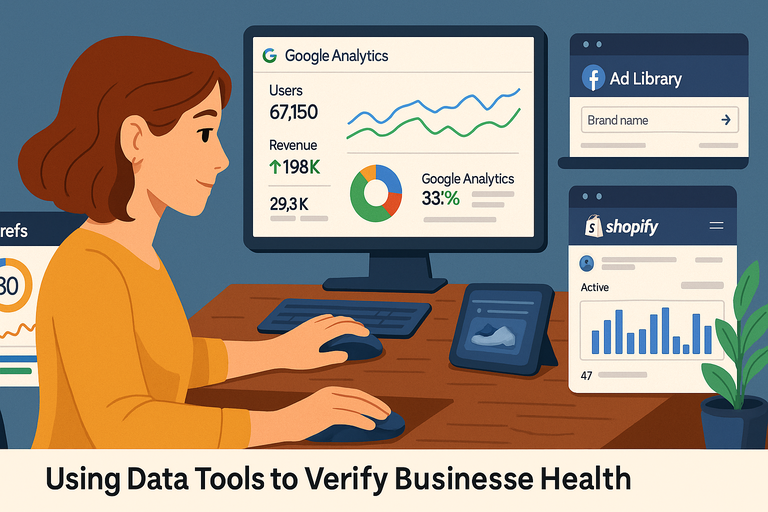
Numbers don’t lie—but they can be manipulated. That’s where data tools come in.
Using the right platforms can help you verify the real story behind an ecommerce business for sale before you make an offer.
Leveraging Google Analytics and Shopify Data Insights
Google Analytics is your first line of truth. Always request read-only access from the seller. Look under Acquisition → Channels to see where traffic originates, and Behavior → Site Content to identify which pages or products drive engagement.
Pay attention to:
- Traffic sources (organic vs. paid)
- Conversion rates by device type
- Geographic distribution of customers
In Shopify, navigate to Reports → Finances → Sales by Channel to confirm revenue sources. If Google Analytics and Shopify numbers don’t align, dig deeper.
I once evaluated a store that showed $40K in “sales” on Shopify—but only $28K tracked in Analytics. Turns out, test orders and returns weren’t being excluded.
Using Ahrefs or SEMrush to Assess Organic Potential
Organic visibility often reveals long-term sustainability. In Ahrefs or SEMrush, plug in the site’s domain and look for:
- Domain Rating (DR): Above 40 is a good sign for niche ecommerce sites.
- Organic Traffic Trend: Steady growth beats sudden spikes.
- Top Keywords: Do they rank for purchase-intent terms like “buy,” “best,” or “discount”?
If traffic collapsed after a Google algorithm update, that’s a warning sign. A stable SEO footprint means less dependency on ads and a more defensible business.
Employing Facebook Ad Library for Marketing Transparency
The Facebook Ad Library lets you peek behind the curtain. Type the brand name into the Ad Library search bar to see active and past ads.
You’re looking for:
- Consistent creative testing (not random one-off ads).
- Ads running for more than 60 days—indicating profitable campaigns.
- Frequency of new campaigns (too frequent resets can signal low-performing ads).
I like this step because it reveals whether the business has a replicable ad strategy or just a lucky viral hit.
Tracking Brand Sentiment Through Review and Social Tools
Brand reputation is the quiet metric that reveals customer trust. Use Trustpilot, Yotpo, or Google Reviews to gauge sentiment. If you spot patterns of complaints (like shipping delays or poor support), they’ll likely carry over to you post-acquisition.
Social listening tools like Brand24 or Mention can also highlight brand mentions and sentiment over time. Look for consistent engagement and genuine community discussion—not spammy comments or fake reviews.
Healthy sentiment usually means loyal customers, smoother operations, and lower refund rates.
Negotiation Strategies to Secure the Best Deal
Negotiation isn’t about squeezing the seller—it’s about structuring a deal that protects both sides. The smartest ecommerce buyers blend financial analysis with empathy and timing.
Knowing When and How to Negotiate Valuation
Start negotiations after your due diligence phase. Once you’ve verified data inconsistencies or potential risks, you can use those findings to justify a revised offer.
If the asking price seems high, reference benchmarks: Most ecommerce businesses sell for 2.5–3× annual profits. If it’s higher, it must show unique value like brand equity or proprietary IP.
A calm, data-backed negotiation works far better than emotional bargaining. I usually start with a simple statement: “Based on what I’ve found in the numbers, I believe a fair valuation is X because of Y.” That approach keeps the tone professional and cooperative.
Structuring Earn-Outs or Performance-Based Payments
Earn-outs are powerful tools to de-risk your purchase. They let you pay part of the price upfront and the rest only if the business hits agreed targets.
For example:
- 70% paid at closing.
- 30% paid over 12 months if revenue or profit goals are met.
This setup keeps the seller invested in a smooth transition. If they’re confident in their numbers, they’ll usually agree.
Requesting Due Diligence Period Extensions
If you uncover new information or discrepancies during the due diligence process, don’t rush. Request an extension to verify all claims properly.
Explain it clearly: “I just want to make sure both of us feel confident before moving forward.” Most sellers appreciate the transparency—it’s better than backing out later.
Remember: The due diligence phase isn’t about mistrust; it’s about clarity.
Working with Brokers and Legal Experts Effectively
A professional ecommerce broker or M&A attorney can be worth every penny. They help interpret contracts, ensure assets transfer cleanly, and catch hidden clauses that could hurt you later.
Before hiring, ask about their ecommerce-specific experience. Someone familiar with digital assets (Shopify, Amazon FBA, SaaS) will spot issues traditional brokers might miss.
When finalizing, make sure your Asset Purchase Agreement (APA) covers:
- Domain and brand transfer
- Email list ownership
- Supplier contracts
- Ad account access
A good legal partner helps you close the deal smoothly, without surprises waiting in the fine print.
Transitioning Smoothly After the Purchase
Buying an ecommerce business for sale is only half the battle. The real test begins once you take the reins.
Transitioning ownership smoothly ensures customers stay loyal, the brand remains stable, and operations don’t skip a beat.
Creating an Onboarding Plan with the Seller
The best transitions start with collaboration, not a clean break. I always suggest negotiating an onboarding period—usually 30 to 90 days—where the seller helps you understand day-to-day systems.
Ask for access to:
- Supplier contacts and fulfillment workflows
- Advertising account structures (Facebook Ads Manager, Google Ads, etc.)
- CRM or email automation tools (like Freshsales or Omnisend)
Set up weekly check-ins during this period. Use a shared document or task tracker to record key processes, login transfers, and performance data. Think of it as your business “handover manual.”
If possible, request video walkthroughs—like a quick screen-share tutorial showing how inventory is managed or how campaigns are launched. These become priceless reference materials later.
Maintaining Customer Trust During Ownership Change
Customers can be surprisingly sensitive to ownership changes, especially if communication feels abrupt. I recommend crafting a simple email or announcement post that reassures them.
Something like: “We’re excited to continue the great products and service you’ve come to love, with even more improvements coming soon.”
To maintain trust:
- Keep branding, tone, and product quality consistent for at least 60 days.
- Monitor customer support closely. A sudden dip in response quality damages credibility fast.
- Keep the seller’s customer service scripts for a few months to preserve brand voice.
In my experience, transparency builds trust faster than a total rebrand ever could.
Retaining Key Staff or Freelancers Post-Acquisition
Behind every successful ecommerce store is a small army of people who know the inner workings—the virtual assistants, ad managers, and content writers. Losing them right after acquisition can cause chaos.
Before closing the deal, ask the seller which team members are essential and whether they’re open to staying on. Offer small retention bonuses or flexible working terms to encourage loyalty.
If the store uses freelancers, connect directly through platforms like Upwork or Slack to maintain continuity. Their insight into ad performance or customer patterns often saves you weeks of guesswork.
Implementing Quick Wins to Boost Revenue Early
Once operations are stable, look for quick, low-risk improvements to generate early returns.
Here are a few I recommend:
- Email automation: Set up post-purchase and abandoned cart flows if they’re missing. These often lift revenue by 10–20% instantly.
- Upsells and bundles: Use Shopify apps like ReConvert or Zipify to offer product bundles. It’s one of the easiest profit-boosting moves.
- Product page optimization: Improve images, descriptions, and add reviews to increase conversion rates.
These small, immediate wins create cash flow and confidence while you plan long-term improvements.
Common Mistakes Buyers Make When Acquiring Ecommerce Businesses

Even experienced entrepreneurs slip up when emotions or assumptions cloud logic. Knowing the common traps can save you from expensive lessons.
Falling for Vanity Metrics or Trend Hype
Many listings flaunt “high traffic” or “fast growth,” but these can be smoke and mirrors. A store can double its traffic with ads while profits shrink.
Always ask: What’s driving the growth? If it’s a viral product or TikTok trend, consider how sustainable that demand really is. For example, fidget spinners looked amazing in 2017—but most buyers who jumped in late ended up with warehouses full of dead stock.
Stick to data that measures profitability, not popularity.
Skipping Due Diligence or Rushing the Process
Eagerness is dangerous when real money’s at stake. I’ve seen buyers skip due diligence out of excitement, only to uncover major supplier or refund issues after purchase.
Due diligence should cover:
- Financial statements (P&L, cash flow)
- Traffic verification (Google Analytics access)
- Supplier reliability and fulfillment times
If something feels off, slow down. Deals that are truly solid can withstand scrutiny.
Underestimating Post-Acquisition Workload
Running an ecommerce business isn’t passive income—it’s active management. Between inventory, customer support, and ad optimization, the daily work can surprise new owners.
Before buying, map out how many hours per week current operations require. If it’s 40+ hours and you plan to “automate everything,” you’ll need to budget for staff or VA support.
Buying a business doesn’t buy you time; it buys you responsibility.
Ignoring Brand Reputation or Customer Reviews
No amount of revenue offsets a toxic reputation. Always research how customers feel about the brand before purchasing.
Check:
- Trustpilot or Google Reviews for recurring complaints.
- Social media comments for sentiment trends.
- Refund and chargeback rates from payment processors.
If the brand has frequent delivery issues or low ratings, that negative perception will follow you. Fixing reputation damage costs far more than most buyers expect.
How to Build Long-Term Value After Purchase
The real payoff comes from what you do after the acquisition. Building long-term value transforms your ecommerce business for sale into a growing, lasting asset.
Refining Product Lines and Upsell Strategies
Once you’ve stabilized operations, start pruning underperforming SKUs. Focus on products that consistently drive profit and customer satisfaction.
Then, introduce smart upsells. For example, if you sell skincare products, offer a “Complete Routine Bundle” or auto-refill subscriptions. Apps like Bold Subscriptions or Recharge make this seamless.
A simplified catalog with strong cross-sells usually improves both margins and customer experience.
Improving Automation and Operational Efficiency
Efficiency creates scalability. Automating repetitive tasks frees time for strategy.
I recommend integrating:
- Zapier for connecting apps (like automating “new order → notify supplier”).
- ShipStation for centralized shipping and tracking.
- Gorgias for customer support automation with macros and templates.
Streamlining reduces errors and gives you real-time visibility into performance metrics.
Expanding into New Regions or Niches
Growth often hides just beyond your current borders. Expanding internationally or entering new micro-niches can dramatically increase your reach.
Use Shopify Markets to test international shipping or multi-currency pricing. Alternatively, identify related niches that align with your brand identity.
For instance, a store selling yoga mats could branch into eco-friendly workout apparel—same audience, different category.
Reinforcing Brand Loyalty and Customer Lifetime Value
Loyal customers spend more, forgive mistakes, and become your best advertisers. Invest in keeping them.
Ways to strengthen loyalty:
- Implement a simple rewards program (Smile.io or LoyaltyLion).
- Personalize post-purchase emails.
- Use surveys to gather feedback and show customers you’re listening.
A business with high repeat purchase rates is worth significantly more when resold later.
Pro Tip: The Mindset That Finds Hidden Gold
Buying an ecommerce business for sale isn’t just a transaction—it’s a hunt for overlooked value. Success often comes down to mindset.
Thinking Like a Miner, Not a Shopper
A shopper looks for beauty; a miner looks for potential. The miner knows the gold is under dirt and patience reveals it.
When analyzing a business, focus less on polish and more on promise. A site with outdated design but solid recurring revenue might be your hidden gem.
Focusing on Systems and Longevity, Not Flashy Numbers
The strongest ecommerce businesses are system-driven. Flashy revenue spikes mean nothing if they depend on luck or ads.
Look for repeatable systems: automated fulfillment, strong SEO rankings, and documented processes. Those are the veins of real gold.
Knowing When to Walk Away or When to Dig Deeper
If something feels off—missing data, vague answers, unrealistic claims—it’s okay to walk away. The right deal will make sense logically, not just emotionally.
But sometimes digging deeper uncovers hidden opportunity. I once evaluated a brand that seemed stagnant, but after discovering it ranked #1 for niche keywords with poor conversion rates, I realized it only needed better UX. That small fix tripled profits within months.
Turning Modest Businesses into Scalable Assets
You don’t need to buy perfection. You need to buy potential. Small, steady stores with solid customer bases can scale beautifully with the right tweaks.
When you approach each ecommerce business for sale with a builder’s mindset, you stop chasing hype and start uncovering lasting value. The “hidden gold” isn’t the business itself—it’s your ability to refine it.

I’m Juxhin, the voice behind The Justifiable.
I’ve spent 6+ years building blogs, managing affiliate campaigns, and testing the messy world of online business. Here, I cut the fluff and share the strategies that actually move the needle — so you can build income that’s sustainable, not speculative.