
Table of Contents
Some links on The Justifiable are affiliate links, meaning we may earn a small commission at no extra cost to you. Read full disclaimer.
Jungle Scout Extension review for product validation is one of those searches people make right before paying for another Amazon tool and hoping it finally gives them a straight answer.
I get it. Product validation is where most seller mistakes get expensive fast, and the Jungle Scout Extension promises to reduce that risk with sales estimates, historical data, opportunity scoring, and on-page Amazon insights.
The real question is not whether the extension looks impressive.
It is whether the data is reliable enough to help you decide what to sell, what to avoid, and where it can still mislead you if you trust it too much.
What The Jungle Scout Extension Is Actually Designed To Do
The Jungle Scout Extension is not meant to run your whole Amazon business by itself.
It is built to help you validate product ideas while you browse Amazon product pages and search result pages, so you can judge demand, competition, pricing, and sales potential without constantly switching tabs.
It Turns Amazon Pages Into A Research Dashboard
When you install the extension on Chrome or Firefox, it overlays product research data directly onto Amazon.
That includes monthly sales estimates, historical sales and pricing trends, profit projections, product opportunity scoring, listing quality indicators, and ASIN-level competitor snapshots.
On search pages, it can surface data across multiple listings at once. On product pages, it gives you a tighter detail view so you can inspect one ASIN more carefully.
That sounds simple, but in practice it matters a lot. Product validation falls apart when your process is too slow. If you have to jump between spreadsheets, calculators, search results, and separate research tools just to decide whether a garlic press niche is viable, you end up making lazy decisions.
This extension speeds up the “first pass” stage, which is where you eliminate obvious bad ideas before you waste time modeling margins or contacting suppliers.
I think this is one of the extension’s biggest strengths. It shortens the gap between seeing a product and assessing whether it deserves more attention. That is especially helpful if you are still learning what a healthy niche looks like.
You can scan price bands, review counts, estimated sales, and trend lines without leaving the Amazon page in front of you.
The Core Validation Promise Is Speed Plus Context
Jungle Scout positions the extension around idea validation, sales forecasting, and opportunity scoring.
The company says its AccuSales algorithm analyzes more than 1 billion data points daily and uses inputs like orders, shipments, best seller rank, inventory, pricing, categories, and subcategories to refine sales estimates.
That tells you what the tool is trying to do: turn Amazon’s partial public signals into a practical estimate sellers can act on.
In plain English, you are buying direction, not certainty. The extension is trying to answer three questions quickly: Is there enough demand here, is the competition beatable, and does the market leave room for profit?
Those are exactly the right questions for product validation. But they are not questions any extension can answer perfectly, because Amazon does not publish every number sellers want.
That is why a fair review should not ask, “Is Jungle Scout exact?” It should ask, “Is Jungle Scout directionally accurate enough to help me avoid bad inventory bets and identify promising niches faster than manual research?” In my view, that is the right lens for judging it.
How Product Validation Works Inside The Extension
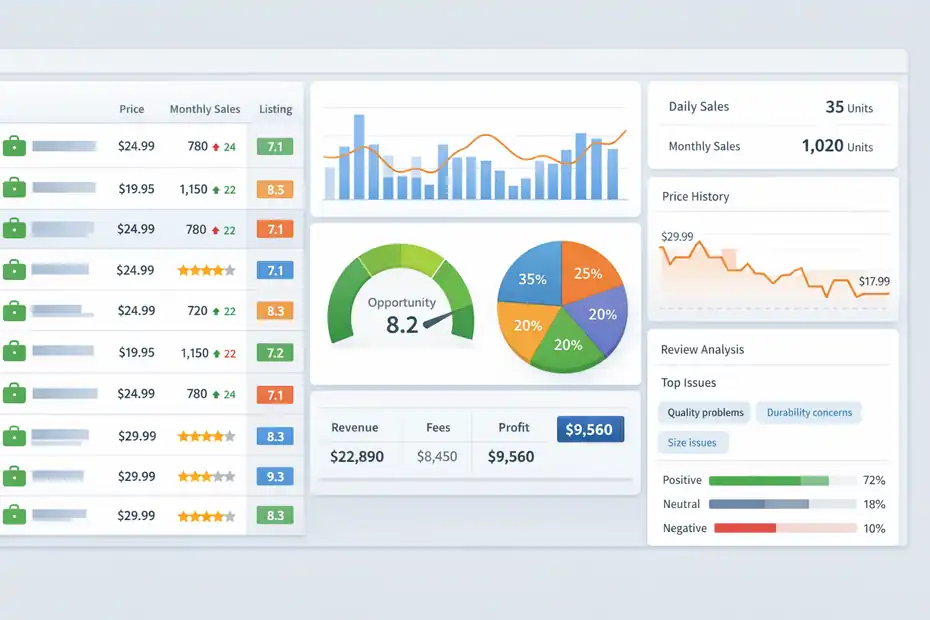
To review the extension properly, you need to understand the validation workflow it supports. Product validation is not one number. It is a chain of checks that helps you decide whether a product is worth sourcing, branding, and launching.
The Jungle Scout Extension supports that chain fairly well when you use the features in the right order.
Start With Search Page Validation, Not Emotional Product Picking
A lot of beginners open Amazon, type a product idea they personally like, and then try to justify it. That is backwards. The extension works better when you begin on a broad search results page and let the market tell you whether the niche is healthy.
Search page overlays can show brand, price, monthly sales, rating, and listing quality metrics across multiple listings. That gives you a quick market snapshot instead of a single-listing obsession.
Here is the better sequence. First, search a broad keyword like “lunch bag for adults” rather than a hyper-specific listing. Second, scan whether the top listings cluster around a profitable price point.
Third, look at sales concentration. If one dominant brand appears to absorb most of the sales, your entry path is harder.
Fourth, compare review counts with estimated sales. If several listings have healthy sales despite modest review volume, that can signal a less locked-up niche.
This is where the extension earns its keep. You can reject weak niches quickly. Imagine you spot 40 first-page listings, but estimated monthly sales are mostly thin, reviews are heavy, and price compression is obvious.
That is not a product you want to “figure out later.” The extension helps you kill those ideas early, which is one of the most profitable habits in Amazon selling.
Then Use Product Page Validation To Check The Details
Once a niche survives the search page test, the product page view becomes more useful. Jungle Scout’s product overlay gives you current and historical data directly on the page, including daily sales, monthly sales, price history, and BSR history.
The historical layer matters because product validation should never rely on a single month. A product can look strong in a screenshot and still be seasonal, discount-driven, or declining.
This is where I suggest slowing down. A product with strong estimated monthly sales but erratic price history can be dangerous. If the category keeps dropping from $29.99 to $17.99 during promo periods, your margin assumptions may be fantasy.
Likewise, if BSR trends spike during holidays and flatten the rest of the year, you need to understand whether you are validating a year-round product or a seasonal one.
The newer AI Review Analysis feature also adds useful validation context. It summarizes sentiment themes from reviews so you can spot recurring complaints and possible product improvement angles.
That does not replace reading reviews yourself, but it can speed up the “why do customers hate this?” phase and help you identify positioning opportunities.
Is Jungle Scout Extension Accurate Enough For Real Product Validation?
This is the heart of the review. My honest answer is yes, for most sellers it is accurate enough for product validation, but only if you understand what “accurate enough” means.
It is a decision-support tool, not a direct feed from Amazon’s private sales ledger.
What Accuracy Means In Amazon Research
Jungle Scout says its estimates are built from algorithmic modeling that incorporates orders, shipments, BSR, inventory, pricing, categories, and subcategories, and that those models are continually updated at the category level.
The extension page also states that the tool uses real-time data and an AccuSales model pulling from over 1 billion data points daily. That gives the company a credible technical basis for estimates, at least on paper.
But even with a strong model, accuracy in Amazon research is never literal. No mainstream tool can promise exact monthly unit sales for every ASIN in every marketplace at every moment.
Markets move, promotions distort demand, stockouts interrupt ranking behavior, and Amazon itself changes how signals behave. So the standard should be whether the estimates are directionally reliable enough to support filtering and prioritization.
From what I have seen across seller reviews and competing write-ups, that is where Jungle Scout generally performs well. Even independent comparison content that favors no single winner usually lands on the same basic point: these tools are estimates, not ground truth, but can still be useful when used comparatively across niches rather than as exact accounting numbers.
Where The Extension Feels Reliable In Practice
The extension is usually strongest when you use it for pattern recognition. For example, comparing 20 similar products on page one and seeing whether demand appears spread across multiple sellers is the kind of job it handles well.
Reading price history, sales trend direction, and review-level weakness is another area where it adds genuine value. Opportunity Score can also help with quick triage, since it blends demand, competition, and listing quality into one shorthand metric.
I would trust Jungle Scout more for relative judgments than absolute ones. Relative judgment means saying, “Niche A looks healthier than niche B,” or, “This product cluster has stronger demand and weaker review barriers than that one.”
Absolute judgment means saying, “This ASIN will definitely sell 734 units next month.” The first use is smart. The second is where people get hurt.
That distinction is important. Sellers who complain that any product tool is “inaccurate” often expect exact numbers in a marketplace where exact numbers are largely hidden.
Sellers who use the extension as a compass rather than a crystal ball usually get much more value from it.
Where Accuracy Breaks Down
The biggest blind spots are the ones you would expect. Trending products can move faster than historical models. Flash discounts, coupons, Prime events, and inventory issues can distort signals. Some categories are noisier than others.
And if a listing’s performance depends on off-Amazon traffic, bundles, or aggressive ad spend, the extension may show the result without fully showing the cause.
That means you should not validate a product on extension data alone if you are about to place a large first order. Use it to narrow the field. Then pressure-test your best ideas with margin modeling, review analysis, seasonality checks, and small-batch sourcing logic.
The extension helps you make better decisions, but it does not remove the need for judgment.
The Best Features For Product Validation
Not every feature matters equally if your goal is product validation. Some are nice to have.
Others are the real reason to install the extension in the first place.
Sales Estimates And Historical Trends Do Most Of The Heavy Lifting
If I had to name the most valuable validation feature, it would be the combination of monthly sales estimates plus historical charts. Jungle Scout can show BSR, price, daily sales, and monthly sales history inside the extension.
That lets you see whether demand is steady, rising, volatile, or obviously seasonal.
This matters because a product can look amazing in a static search result and still be a trap. Imagine a listing doing strong volume in December because it is giftable, then sliding badly from February to August.
If you validate only on the current month, you can confuse temporary momentum with stable demand. Historical charts do not solve every problem, but they reduce that risk a lot.
I also like that historical pricing sits next to sales context. Sellers often get hypnotized by volume and forget margin pressure. A niche with solid sales but unstable pricing can be much uglier than a niche with slightly lower demand and healthier price discipline. In product validation, boring and stable usually beats exciting and chaotic.
Opportunity Score Is Useful, But Only As A Shortcut
Jungle Scout’s Opportunity Score is designed to summarize demand, competition, and listing quality into one metric. That is helpful for fast filtering, especially if you are reviewing a lot of ideas and need a quick “look closer” or “skip it” signal.
Still, I would not build a business around a score. Composite metrics are useful because they compress complexity, but that is also their weakness. They hide the underlying reasons.
A decent score may come from demand that looks strong but is actually concentrated in one listing. A weak score may ignore a product improvement angle you can clearly see in the reviews.
My suggestion is simple: Use Opportunity Score to sort, not to decide. If a niche scores well, open it up and inspect review counts, listing quality, differentiation angles, and pricing behavior yourself. If it scores poorly, do the same before you toss it out completely. Shortcuts are helpful, but they should not do your thinking for you.
AI Review Analysis Can Expose Gaps Faster
The AI Review Analysis feature is one of the more practical additions for product validation because it surfaces common positive and negative review themes and suggests product improvements.
For a seller trying to find a realistic entry angle, that is useful. You are not just asking, “Does this niche sell?” You are asking, “Can I make something better enough to compete?”
For example, if repeated complaints mention weak zippers, poor insulation, or bad handle design, that is not just noise. It can become your differentiation strategy. Product validation gets much stronger when you combine demand signals with a clear “why customers would choose mine” hypothesis.
The extension helps you move from raw niche scanning into product improvement thinking faster than manual review scraping would.
Pricing, Plans, And Whether The Extension Is Worth Paying For

A review about accuracy still needs to answer the money question. A tool can be good and still not be worth it for your stage.
Jungle Scout’s current Catalyst plan structure gives the extension across its seller plans, but the value changes depending on how serious your research needs are.
What The Current Pricing Looks Like
According to Jungle Scout’s support and pricing materials, the Starter plan is $49 per month or $348 annually and includes full access to the browser extension, Academy access, and limited usage across several research tools.
Growth Accelerator is $79 per month or $588 annually and expands limits substantially, while Brand Owner + Competitive Intelligence is listed in the support article at $149 per month or $1,548 annually, with far higher tracking and research limits plus CI access.
Jungle Scout’s public pricing page also notes a 7-day money-back guarantee for standard Catalyst plans and says Starter includes one user, while Growth Accelerator and Brand Owner allow additional seats at extra cost.
For someone focused only on product validation, Starter is the most relevant entry point. That is because it already gives extension access, which is the core feature under review. You do not need the highest-tier plan just to judge demand and competition while browsing Amazon.
That said, I think Growth Accelerator becomes more appealing once you are validating products every week instead of casually exploring. The higher limits, broader research access, and connected seller features make more sense when research becomes operational rather than occasional.
Is It Worth It For Beginners?
For true beginners, the answer depends on whether you are serious or still just curious. If you are only watching YouTube videos and vaguely thinking about Amazon someday, $49 a month will probably feel premature. You can learn basic validation logic before paying for premium software.
But if you are actively narrowing product ideas, I think the extension can justify itself quickly by helping you avoid one bad order. That sounds dramatic, but bad validation decisions are expensive. A weak product choice can cost you far more than a few months of software.
In that sense, the extension is less about “saving time” and more about buying better judgment faster.
User feedback points in a similar direction. G2 review summaries praise ease of use, strong features, and support, while also noting that pricing can be a barrier for smaller businesses.
Trustpilot shows a 4.5 score with roughly 4,000 reviews on the page opened, but the reviews also include complaints around billing, data mismatch, and access issues. That feels realistic to me. The tool is broadly well regarded, but not magic, and not friction-free.
The Biggest Mistakes People Make When Using It For Validation
A tool review is only useful if it tells you how people misuse the tool. In many cases, what looks like “bad data” is actually bad interpretation.
Mistake One: Treating Estimates Like Guaranteed Sales
This is the most common mistake by far. Sellers see an estimated monthly sales number and turn it into a sourcing decision without context. They forget that the number is modeled, not guaranteed, and that category behavior can shift.
A better approach is to treat estimated sales as one part of a validation stack. Pair it with review velocity, historical trend shape, pricing consistency, first-page competition, and obvious differentiation opportunities.
If all of those line up, the estimate becomes much more useful. If they conflict, trust the conflict. That friction is usually telling you something important.
I recommend asking one simple question every time: “If this estimate is 20 to 30 percent off, does the product still make sense?” If the answer is no, your idea is probably too fragile.
Mistake Two: Validating A Single Listing Instead Of A Market
Product validation is about a niche, not your favorite ASIN. The extension works best when you compare multiple listings and look for market structure. Are sales spread across several competitors? Are review barriers moderate or brutal? Is the price ceiling attractive enough for your cost structure?
When you validate one listing in isolation, you can miss important realities. Maybe that listing has unusual brand authority, outside traffic, or mature ad support. Maybe the rest of the market is much weaker. Maybe the listing you admire is the exception, not the rule.
The extension gives you the ability to compare quickly, but you still have to use it that way.
Mistake Three: Ignoring Review-Based Differentiation
Some sellers only care about demand and competition count. That is not enough. You also need a believable reason customers would choose your version. Jungle Scout’s review analysis features can help you identify recurring complaints, which often become product improvement angles.
Imagine a crowded niche where most listings complain about poor stitching or awkward sizing. That niche might still be viable if customer frustration is obvious and solvable.
On the other hand, a niche with clean sentiment and polished listings may look attractive on the surface but leave you very little room to stand out. Good validation always includes the “why would mine win?” question.
How To Use Jungle Scout Extension The Right Way Before You Buy Inventory
This is the workflow I would actually recommend if your goal is smart product validation. It is practical, conservative, and much better than trusting one flashy metric.
A Simple Validation Process That Makes The Tool More Accurate
Step 1: Start on a broad keyword search page and scan the first page with the extension open. Look for a healthy price range, signs that sales are not concentrated in one dominant listing, and a mix of review counts that suggests newer entrants can still compete.
Step 2: Open the best-looking ASINs one by one and inspect their historical BSR, price, daily sales, and monthly sales charts. Eliminate products that look heavily seasonal, discount dependent, or unstable in ways that could crush margin.
Step 3: Use review analysis to find recurring complaints. Your goal is not just to find a niche that sells. Your goal is to find a niche where a better version could reasonably win.
Step 4: Cross-check your economics outside the extension. Build a rough landed-cost model, include Amazon fees, estimate ad pressure conservatively, and ask whether the product still works if sales come in lower than expected. The extension can help you find ideas. It cannot protect you from weak unit economics.
The Verdict: Accurate Or Not?
My verdict is that Jungle Scout Extension is accurate enough for product validation when used like a research framework, not like a guarantee machine. It is especially strong for fast niche screening, comparative analysis, historical context, and identifying review-driven product improvement opportunities.
It is weaker when users expect exact sales truth, ignore market-wide comparisons, or skip the margin and differentiation work that still has to happen outside any browser extension.
So, is it accurate? Not perfectly. No Amazon research tool is. Is it useful enough to improve your product decisions and reduce bad bets? Yes, absolutely, and for many sellers that is the standard that matters.
If you use the extension to compare markets, verify trends, inspect customer complaints, and stress-test your assumptions, it can be a very practical product validation tool. If you use it as a shortcut to avoid thinking, it will disappoint you.
FAQ
Is Jungle Scout Extension accurate for product validation?
Jungle Scout Extension is generally accurate for product validation when used for directional insights rather than exact numbers. It provides reliable estimates for comparing niches, spotting demand trends, and evaluating competition, but results should always be combined with manual research and profit analysis before making final sourcing decisions.
How does Jungle Scout Extension estimate Amazon sales?
Jungle Scout Extension estimates Amazon sales using algorithmic models based on factors like Best Seller Rank, pricing, inventory levels, and category trends. It processes large datasets to predict monthly sales, but since Amazon does not reveal exact numbers, these estimates should be treated as informed approximations.
Can beginners rely on Jungle Scout Extension for product research?
Beginners can rely on Jungle Scout Extension as a starting point for product research because it simplifies data analysis and highlights demand and competition quickly. However, it should not replace learning core validation skills like understanding margins, customer needs, and differentiation strategies for long-term success.
What are the limitations of Jungle Scout Extension for validation?
The main limitations include reliance on estimated data, sensitivity to seasonal trends, and inability to fully reflect external factors like advertising or off-Amazon traffic. It may also mislead users who depend on a single metric instead of analyzing the broader market context and product viability.
Is Jungle Scout Extension worth it for product validation?
Jungle Scout Extension is worth it for product validation if you are actively researching products and want faster, data-driven decisions. It helps eliminate weak ideas quickly and identify promising niches, making it valuable for serious sellers, but less essential for those still exploring casually.

I’m Juxhin, the voice behind The Justifiable.
I’ve spent 6+ years building blogs, managing affiliate campaigns, and testing the messy world of online business. Here, I cut the fluff and share the strategies that actually move the needle — so you can build income that’s sustainable, not speculative.
Related posts:
 Helium 10 Review for Amazon Sellers: Honest Results
 The Power of Zik Analytics for Amazon Seller Growth
 Helium 10 Trial: Maximize Your Amazon Profits Fast!
 Helium 10 Pricing & Plans – Compare & Choose Wisely
 Viral Launch Amazon Success: Boost Rankings & Revenue!
 How to Make Money Dropshipping: 7 Secrets to a $10K/Month