
Table of Contents
Some links on The Justifiable are affiliate links, meaning we may earn a small commission at no extra cost to you. Read full disclaimer.
Jungle Scout review for small Amazon brands usually comes down to one practical question: will this tool actually help you grow, or will it just become another monthly subscription you barely use?
I think that is the right lens. Small brands do not need more dashboards. You need clearer product decisions, better keyword targeting, tighter inventory planning, and fewer expensive mistakes.
In this guide, I’ll break down where Jungle Scout genuinely helps, where it feels oversized, and whether it is the right fit for a lean Amazon business trying to scale without wasting cash or time.
What Jungle Scout Actually Is For Small Amazon Brands
If you are researching this software, you are probably not looking for a flashy feature list.
You want to know whether Jungle Scout helps a small Amazon brand make smarter decisions faster.
What The Platform Is Really Designed To Do
Jungle Scout’s current seller-focused platform is Catalyst, which the company positions for new and growing sellers.
On its own pricing and product pages, Jungle Scout says Catalyst is built to help sellers discover products, find keywords, optimize listings, automate review requests, and scale product-level decisions rather than manage enterprise-level category intelligence.
It also separates Catalyst from Cobalt, which is aimed at brands doing more than $5 million on Amazon and needing broader market and advertising intelligence.
That matters because many small brand owners buy Amazon software that was really made for larger teams. In my experience, that is where tool fatigue starts. You pay for complexity you do not need, then you stop logging in after three weeks.
For a small Amazon brand, the real use case is simpler. You need help with four things: product validation, keyword research, listing improvement, and operational visibility.
Jungle Scout does cover those areas reasonably well, especially if you are still building your first few ASINs or trying to grow a tight catalog without hiring analysts.
So the product is not magic. It is decision support. If you treat it like that, it makes more sense.
Who Will Get The Most Value From It
Jungle Scout makes the most sense for sellers who are still close to the ground. That includes private label beginners, small brand owners with one to ten core products, and teams that still do product research and listing work themselves.
A good example is a small home organization brand with three SKUs doing $20,000 to $80,000 a month. That kind of seller often needs better keyword targeting, more confidence in expansion ideas, and a more organized way to watch competitors without spending enterprise software money.
It is less compelling for two groups. First, resellers or arbitrage sellers who do not need deep brand-building workflows. Second, larger Amazon-first brands that need category-level benchmarking, share-of-voice analysis, or more advanced ad and market intelligence.
Jungle Scout itself says those broader needs are better served by Cobalt rather than Catalyst.
I believe this is the first important filter. Jungle Scout is not “best for every Amazon seller.” It is most useful when you are a small brand trying to reduce uncertainty in everyday Amazon decisions.
Why This Question Matters More In 2026
The pressure on small brands is real. Amazon says independent sellers now account for more than 60% of sales in its store, and in the U.S. they averaged more than $290,000 in annual sales in 2024, with more than 55,000 sellers crossing $1 million.
That tells you two things at once: the opportunity is still huge, and the competition is not getting softer.
At the same time, cost pressure has not gone away. Amazon’s U.S. selling plan still carries the professional subscription fee, and Amazon has also published 2026 FBA fee updates, including a fuel and logistics-related surcharge beginning April 17, 2026.
That is why tool ROI matters more now. A small brand cannot afford software that only feels useful. It has to help you avoid bad inventory bets, weak launches, and low-converting listings.
The Core Features That Matter Most
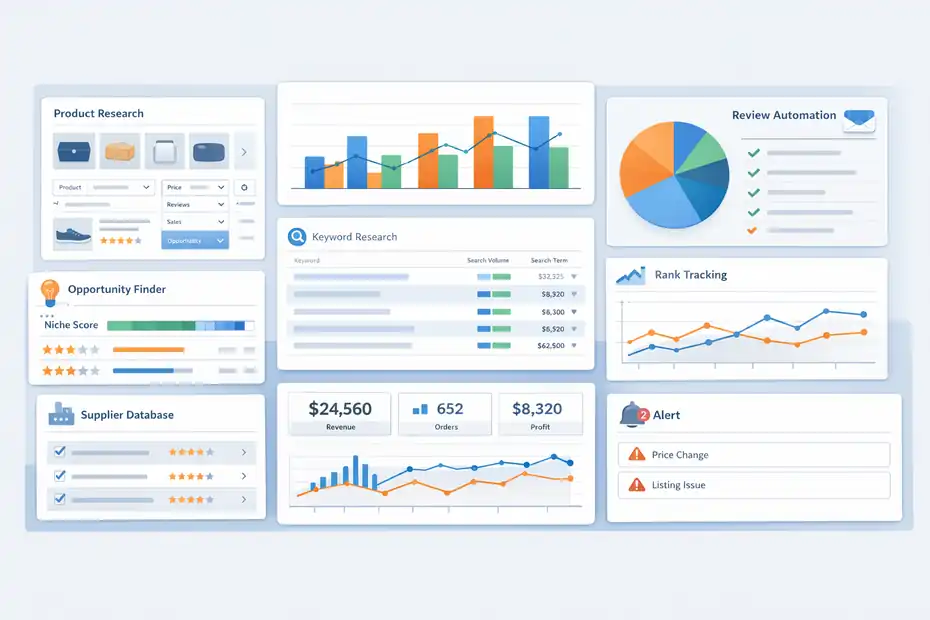
Not every feature deserves equal attention. For small brands, a few tools do most of the heavy lifting.
Product Research And Opportunity Discovery
This is still one of Jungle Scout’s strongest use cases. The platform includes Product Database, Product Tracker, Opportunity Finder, and the browser extension, all built around identifying demand, competition, and sales patterns
Jungle Scout says these tools are included at different access levels across plans, with broader access on Growth Accelerator and Brand Owner tiers.
In plain English, this means you can pressure-test product ideas before you sink money into samples, freight, and a launch. That is valuable because most small brands do not fail from a lack of hustle. They fail from backing the wrong SKU.
Here is how I think this works best in practice:
- Step 1: Start with a narrow niche, not a giant category.
- Step 2: Check whether top listings are dominated by entrenched brands with massive review counts.
- Step 3: Look for steady demand instead of one-month hype.
- Step 4: Compare price bands and margin room, not just sales volume.
Imagine you sell kitchen storage products and want to launch a drawer organizer. Jungle Scout can help you see whether the niche is filled with low-priced commodity sellers or whether there is room for a more premium, branded angle.
That is a better question than “Does this keyword get traffic?”
Keyword Research, Listing Support, And Ranking Visibility
Jungle Scout’s Keyword Scout, Rank Tracker, and Listing Builder are the features that usually matter most after the product itself is chosen.
Jungle Scout says Keyword Scout helps identify high-converting terms and reverse-search competitor ASINs, while Rank Tracker monitors keyword rank history and Listing Builder supports keyword-driven listing creation.
For a small brand, this matters because Amazon SEO is not really about stuffing phrases into bullets. It is about matching search intent with a listing that actually converts.
I usually recommend using these features in this order:
- Research first: Find the primary buying keywords and supporting long-tail phrases.
- Prioritize next: Separate high-volume terms from high-intent terms.
- Build last: Use those terms to shape title, bullets, images, and backend fields.
The big win here is focus. Many small brands target too many keywords at once. They chase broad phrases where they have no chance to rank and ignore lower-volume keywords that actually bring ready-to-buy shoppers.
A small pet accessories brand, for example, might obsess over “dog bowl” when a better path is “elevated slow feeder dog bowl for small dogs.” Lower traffic, yes. Better conversion and less competition, often yes too.
Review Automation, Inventory, And Daily Management
Jungle Scout’s Growth Accelerator tier includes review automation, inventory management, alerts, supplier database access, supplier tracking, and sales analytics tools. The company also states that review automation is a Catalyst feature, not a Cobalt one.
These are not the flashy features, but for small brands they can be the sticky ones. Why? Because they connect directly to workflow.
A few examples:
- Review Automation: Helps you consistently send Amazon-compliant review requests instead of doing it manually.
- Inventory Manager: Helps estimate reorder timing so you are not constantly guessing.
- Alerts: Useful when price changes, listing edits, hijackers, or Buy Box issues appear.
- Supplier Tools: Helpful if you are juggling quote comparisons and reorder organization.
This is where Jungle Scout starts feeling more like an operating system than a research tool. I would not say every seller will use every feature. Most will not.
But when a small brand is moving from one hero SKU to a real catalog, these functions become more valuable.
Pricing, Plans, And Whether The Cost Makes Sense
The hardest part of any Jungle Scout review for small Amazon brands is not features. It is whether the subscription pays for itself.
Current Plans And What Small Brands Need To Know
Jungle Scout’s published seller plans show three main tiers in its 2024 pricing article: Starter at $49 per month or $348 billed annually, Growth Accelerator at $79 per month or $588 billed annually, and Brand Owner + Competitive Intelligence at $399 per month or $3,588 billed annually.
Its current pricing page also says annual billing can save up to $360 and that Catalyst is aimed at sellers doing $0 to $5 million in annual Amazon revenue.
Here is my honest take:
- Starter: Fine for early validation, but restrictive for a real brand.
- Growth Accelerator: The plan most small Amazon brands should look at first.
- Brand Owner + CI: Usually overkill unless your team is larger and you actively need competitive intelligence.
The price gap matters because software creep is real. A small brand might already be paying for Amazon itself, design help, PPC tools, email systems, bookkeeping, and freight-related apps.
Another $79 a month is manageable if it replaces guesswork. Another $399 a month is a very different decision.
When Jungle Scout Is Worth Paying For
I think Jungle Scout earns its cost when one of these is true.
- Case 1: You are choosing your next product and want to avoid a bad launch.
- Case 2: You have traffic but weak rankings and need keyword direction.
- Case 3: You are running multiple tasks manually and losing time every week.
- Case 4: You do not yet have a repeatable product research process.
A simple ROI example helps. Suppose Growth Accelerator costs $79 monthly. If the platform helps you improve one listing enough to lift conversion by even a small amount, or helps you avoid ordering 500 units of a poor product idea, the software can pay for itself very quickly.
That said, I do not think the value shows up automatically. If you log in twice a month and never use the research or optimization tools deeply, the subscription will feel expensive fast.
When It Starts Feeling Too Expensive
This is the part many reviews avoid. Jungle Scout can absolutely feel overpriced for a small brand in three situations.
First, you already know your niche extremely well and are not adding products anytime soon. In that case, the research advantage shrinks.
Second, your business bottleneck is not research or listing work. It might be cash flow, creative quality, inventory constraints, or poor margins. Software does not fix those.
Third, you are trying to replace judgment with dashboards. I have seen sellers stare at data but still avoid making a decision. That is not a Jungle Scout problem. That is a founder confidence problem.
So yes, it can be worth it. But only when it supports action.
Step-By-Step: How Small Brands Should Actually Use Jungle Scout
This is where most of the real value lives. A tool is only useful if you can turn it into a workflow.
Step 1: Validate Expansion Ideas Before Spending Money
Start with product discovery, not sourcing. Use Jungle Scout to narrow ideas based on demand, pricing, review competition, and seasonality trends. The goal is not to find a “perfect product.” The goal is to eliminate obviously bad bets early.
A practical workflow looks like this:
- Step 1: Build a list of adjacent products that match your current brand.
- Step 2: Use keyword and product research tools to compare demand patterns.
- Step 3: Remove ideas with brutal review barriers or poor price-to-margin room.
- Step 4: Track finalists for a few weeks instead of deciding in one afternoon.
I suggest thinking in adjacency, not randomness. If you already sell reusable kitchen containers, a lid organizer or pantry label system makes more sense than jumping into pet supplies just because search volume looks good.
That sounds obvious, but many small brands chase “opportunity” instead of brand coherence. Jungle Scout helps more when your idea already makes strategic sense.
Step 2: Build Listings Around Buyer Language
After product validation, move into keyword research and listing structure. Use your main keywords to shape the listing, but do not write for the algorithm alone. Write for the shopper who is comparing you against six other options.
Here is the sequence I recommend:
- Primary term: Put the clearest, most relevant phrase in the title naturally.
- Support terms: Use bullets and description to capture use cases, material, size, or problem-solving language.
- Image alignment: Make sure images visually answer the same intent your keywords imply.
- Rank tracking: Watch whether your important terms move after changes.
For example, if your keyword research shows buyers care about “stackable,” “BPA-free,” and “leakproof,” those ideas should not live only in backend fields. They should be visible in the listing experience itself.
This is where many small brands underperform. They collect keyword data, then write generic copy that could fit any product. Jungle Scout gives you the data. You still need to translate it into sharp positioning.
Step 3: Use Operations Features To Protect Growth
Once products are live, shift your attention from launch mode to maintenance mode. This is where review automation, alerts, and inventory planning become useful.
A simple weekly operating rhythm might look like this:
- Monday: Check rank movement and listing changes.
- Wednesday: Review reorder timing and velocity trends.
- Friday: Scan alerts, competitor shifts, and review request performance.
It does not have to be complicated. In fact, I think simplicity is the point. A small brand wins by building repeatable habits, not giant reporting systems.
This also helps emotionally. When you know where to look each week, Amazon feels less chaotic. That alone is worth something.
Where Jungle Scout Helps You Scale And Where It Does Not
A fair review should cover both the upside and the limits.
What It Can Genuinely Improve
Jungle Scout can improve speed, confidence, and structure. For a small brand, those three things matter a lot.
The platform can help you:
- Find product opportunities faster
- Benchmark basic competitor data
- Build listings from clearer keyword inputs
- Track ranking movement
- Organize supplier and reorder workflows
- Automate some repetitive review-request work
Those are meaningful gains. Jungle Scout also says Catalyst users can track up to 200 ASINs, while Cobalt goes much deeper for enterprise brands. That reinforces the idea that Catalyst is built for small to mid-sized operations, not giant catalogs.
I believe the biggest scaling benefit is reducing messy decision-making. Instead of “I think this niche looks promising,” you move toward “The demand, price band, and competition suggest this is worth testing.”
For founder-led brands, that is huge.
What It Will Not Fix For You
This is important: Jungle Scout will not fix a weak product, a bland brand, bad images, poor margins, or sloppy fulfillment.
It also will not magically create product-market fit. If your product is undifferentiated and your listing looks like everyone else’s, keyword tools alone will not save you.
Some sellers also expect software to solve advertising inefficiency. Jungle Scout can support decisions, but if your creative, offer, or price is off, the underlying economics still break.
I say this because small brands often buy tools during stressful growth plateaus. The temptation is to believe the next dashboard will unlock the business. Usually, the real answer is sharper positioning plus better execution.
The Most Common Misuse I See
The most common misuse is buying Jungle Scout too early and too passively.
Too early means before you have enough clarity on your brand, customer, and economics. Passive means logging in, skimming a few numbers, and then doing nothing with them.
A better approach is intentional use. Give the software a job. Maybe that job is helping you choose one new SKU this quarter. Maybe it is rebuilding three weak listings. Maybe it is tightening reorder timing for your best seller.
If you cannot define the job, the subscription will probably feel vague.
Common Mistakes Small Brands Make With Jungle Scout
You can absolutely get decent software and still get poor results. Usually the problem is how the tool gets used.
Mistake 1: Chasing Volume Instead Of Profitability
A lot of sellers see a big keyword and get excited. But traffic without margin is not growth. It is stress.
You should evaluate products and keywords in context:
- Demand: Is there enough search and purchase activity?
- Competition: Are top sellers beatable?
- Price: Is there room for healthy contribution margin?
- Brand fit: Does it belong in your catalog?
I suggest being suspicious of niches that look too obvious. If everyone sees the same opportunity, the window may already be closing.
Mistake 2: Treating Estimates Like Guaranteed Truth
Jungle Scout uses estimated data, and like every Amazon research platform, it is trying to model a marketplace Amazon does not fully expose. The company says its sales estimates are generated through a proprietary algorithm using multiple signals and machine learning. That is useful, but it is still directional intelligence, not divine certainty.
The smart way to use the data is triangulation. Look for patterns, not single-number certainty. If three signals point the same direction, confidence rises. If they conflict, slow down.
That mindset will save you from overcommitting to a product because one estimate looked exciting.
Mistake 3: Buying A Bigger Plan Than You Need
This happens all the time. Founders assume the most expensive plan is the serious one, so they upgrade before they have a serious use case.
For many small brands, Growth Accelerator is the sweet spot because it unlocks the seller-focused tools that actually influence daily execution. The higher-tier Brand Owner option can make sense later, but only when competitive intelligence and extra users are truly relevant.
My rule is simple: upgrade when a feature solves a real bottleneck, not when it sounds impressive.
Final Verdict: Scale Or Stall?
This final section is the real answer to the title question. Small brands do not need a maybe. They need a decision.
My Honest Verdict For Most Small Amazon Brands
Jungle Scout is a solid scaling tool for small Amazon brands, but only when you are actively building, optimizing, or expanding. If you are in motion, it can help you move faster and make fewer expensive mistakes. If you are not in motion, it can become shelfware.
I would not call it perfect. Some sellers will want deeper ad capabilities, broader market intelligence, or a more specialized workflow in certain areas.
But for the core needs of a small Amazon brand, Jungle Scout covers the fundamentals well: product research, keyword discovery, listing support, rank tracking, review automation, and operational visibility.
So my answer is this: For the right small brand, it helps you scale. For the wrong use case, it helps you stall more expensively.
Who Should Buy It Right Now
You should seriously consider Jungle Scout if:
- You are launching or validating new products
- You are rebuilding weak listings
- You want a more organized Amazon operating workflow
- You need research support more than enterprise analytics
- You will actually use the tools weekly
That last point matters most. A tool only compounds when your habits do.
Who Should Probably Skip It
You should probably skip it, pause it, or delay it if:
- You only have one stable SKU and no near-term expansion plan
- Your biggest problem is cash flow or margin, not research
- You are not ready to act on the data
- You mainly need advanced enterprise insights rather than seller tools
If that is you, I would save the money and fix the more urgent business issue first.
The Bottom Line
If you want my plain-English conclusion, here it is: Jungle Scout is not a shortcut to winning on Amazon, but it is a very useful system for reducing guesswork. For small brands trying to scale carefully, that is often exactly what you need.
And honestly, that is enough. On Amazon, avoiding one bad decision can be more profitable than finding one brilliant idea.
FAQ
Is Jungle Scout worth it for small Amazon brands?
Jungle Scout is worth it for small Amazon brands when you actively use it for product research, keyword optimization, and listing improvements. It helps reduce guesswork and avoid costly mistakes. However, if you are not launching new products or optimizing listings regularly, the value becomes limited.
What does Jungle Scout do for Amazon sellers?
Jungle Scout helps Amazon sellers find profitable product opportunities, discover high-converting keywords, track rankings, and manage inventory. It provides data-driven insights that support better decisions across product research, listing optimization, and daily operations, especially for small brands scaling their product catalog.
Which Jungle Scout plan is best for small brands?
The Growth Accelerator plan is usually the best choice for small Amazon brands. It includes essential tools like keyword research, product tracking, review automation, and inventory management. Lower plans can feel restrictive, while higher-tier plans may offer features that small businesses do not yet need.
Can Jungle Scout help increase Amazon sales?
Jungle Scout can help increase Amazon sales by improving product selection, keyword targeting, and listing optimization. When used consistently, it helps sellers identify better opportunities and refine their listings to match buyer intent, which can lead to higher visibility, better conversion rates, and more consistent revenue growth.
What are the limitations of Jungle Scout for small sellers?
Jungle Scout does not fix poor product quality, weak branding, or low profit margins. It relies on estimated data, not exact figures, so decisions still require judgment. Small sellers may also find it unnecessary if they are not expanding their product line or actively optimizing their listings.

I’m Juxhin, the voice behind The Justifiable.
I’ve spent 6+ years building blogs, managing affiliate campaigns, and testing the messy world of online business. Here, I cut the fluff and share the strategies that actually move the needle — so you can build income that’s sustainable, not speculative.
Related posts:
 Amazon Ecommerce Guide: How to Start and Grow Fast
 Jungle Scout Review For Private Label Beginners: Real Profit Insights
 How to Make Money Dropshipping: 7 Secrets to a $10K/Month
 How to Use Jungle Scout Amazon for Product Sourcing
 Dropshipping Marketing Strategies That Actually Drive Sales
 Dropshipping Platforms Ranked: Speed, Fees, and Control