
Table of Contents
Some links on The Justifiable are affiliate links, meaning we may earn a small commission at no extra cost to you. Read full disclaimer.
A good quillbot ai writing tool review should answer one thing clearly: will this tool actually make your writing better, or just rewrite it faster.
I’ve spent a lot of time testing tools in this category, and Quillbot stands out because it does not try to be everything at once. It focuses heavily on paraphrasing, cleanup, clarity, and workflow support, while also adding extras like grammar checking, AI detection, translation, and citations.
The catch is that those strengths help some writers a lot more than others.
What QuillBot Is And Who It Is Really For
QuillBot is best understood as a rewriting and polishing tool first, and a broader AI writing assistant second.
That distinction matters, because many people buy it expecting a full content engine when its real strength is refining text you already have.
What QuillBot Actually Does
When you land on QuillBot today, you are not just getting a paraphraser. The platform’s main suite includes a paraphraser, grammar checker, summarizer, translator, citation generator, plagiarism checker, AI detector, AI humanizer, AI chat, and AI text generator. It also offers browser and app-based workflows so you can use it without constantly copying and pasting between tabs.
That sounds broad, but in practice, QuillBot still shines most when you already have text and want to improve how it reads. I would not treat it as your main idea-generation machine. I would treat it as a draft improver. If your daily work involves rewriting awkward sentences, tightening emails, making notes sound more professional, or simplifying technical copy, it feels genuinely useful.
This is why QuillBot tends to appeal to students, marketers, freelance writers, researchers, and non-native English speakers. QuillBot itself says Premium is aimed at students, content creators, and professionals, and its public product pages lean heavily on clarity, fluency, multilingual support, and productivity rather than “one-click article creation.”
I think that positioning is actually a good sign. Tools that promise to do every writing task usually do most of them badly. QuillBot feels more honest about where it helps most.
Who Will Get The Most Value From It
If you write from scratch and care deeply about your own voice, QuillBot can be helpful, but only if you use it selectively. The sweet spot is not “write everything for me.” The sweet spot is “help me say this better without wasting 20 minutes on one paragraph.” That is a meaningful difference.
Imagine you are a student finishing a literature essay. Your argument is fine, but several sentences are repetitive and clunky. QuillBot can help you vary wording, fix grammar, and shorten bulky passages. Now imagine you are an SEO writer trying to publish a 2,500-word article from a blank page.
QuillBot can support your editing process, but it is not the strongest tool if your main need is original long-form generation. That is where expectations often go wrong.
In my experience, QuillBot is most worth it for three groups. First, writers who constantly revise existing copy. Second, users who work across languages, since QuillBot’s translator supports 52 languages and several writing surfaces support multilingual workflows. Third, budget-conscious users who want more than a grammar checker but do not want enterprise-level writing software costs.
If that sounds like you, QuillBot deserves a serious look. If not, it may feel narrower than the marketing suggests.
How QuillBot Works In Real Use
The easiest way to judge QuillBot is not by its feature list. It is by what happens when you put messy writing into it and try to improve something specific, like clarity, tone, or conciseness.
That is where the tool either earns its price or becomes another browser tab you stop opening.
The Core Workflow Behind The Tool
QuillBot’s everyday workflow is simple: paste or type text, choose the kind of help you need, review the suggestions, and then edit the output instead of accepting it blindly.
On the Chrome extension page, QuillBot describes the experience as in-page editing with grammar fixes, paraphrasing, sentence rewriting, tone suggestions, and text generation without leaving the page.
That workflow matters because it reduces friction. A lot of writing tools technically work, but they are annoying enough that you stop using them. QuillBot’s browser extension and app ecosystem aim to solve that by keeping the tool close to where you already write.
The company also offers Windows, Safari, and mobile options, and highlights usage across apps like Word, Outlook, Slack, and browser-based text fields.
Here is the practical loop I recommend:
- Step 1: Draft your idea in your own words first.
- Step 2: Use the paraphraser only on sections that feel repetitive, vague, or too stiff.
- Step 3: Run the grammar checker after the rewriting pass, not before.
- Step 4: Read the final version out loud so you can catch robotic phrasing.
- Step 5: Keep any sentence that sounds more like you than the AI suggestion.
That last step is important. QuillBot is good at cleanup, but your judgment is still the final editor.
Where QuillBot Performs Well And Where It Feels Weak
The strongest public feedback pattern around QuillBot is pretty consistent. G2’s review summary says users commonly praise ease of use, fast paraphrasing, clarity improvement, grammar help, and multiple rephrasing options. At the same time, some users point out that the free version is limited, and the pros-and-cons section also surfaces complaints around inaccuracy and context.
That lines up with what I would expect from this kind of tool. Sentence-level rewriting is usually easier for AI than preserving subtle intent across an entire long draft. QuillBot tends to do better on local edits than on high-stakes voice-sensitive writing.
For example, it is useful for simplifying a dense paragraph, but less dependable when a sentence has humor, strong nuance, or a very personal tone.
I also think the tool’s “AI humanizer” positioning should be treated carefully. QuillBot publicly offers that feature, but “humanizing” should not be mistaken for magically producing excellent prose. A sentence can become less stiff without becoming better. Good writing still needs judgment, structure, and context.
So here is the honest version: QuillBot is strong at cleanup, speed, and rewrite assistance. It is weaker when you expect deep originality, exact brand voice control, or perfect context-aware editing on the first pass.
Setting Up QuillBot The Smart Way
A lot of disappointing tool reviews come from bad setup, not bad software. If you use QuillBot like a magic button, you will probably think it is overhyped.
If you use it with a simple workflow, it becomes much more useful.
Best First Setup For Students, Bloggers, And Professionals
If you are new to QuillBot, start with the tools that affect your daily writing most often. For most people, that means the paraphraser, grammar checker, and browser extension first. Those are the features most closely tied to the platform’s core value proposition and the ones that reduce time spent polishing text.
A simple beginner setup looks like this:
- For students: Use paraphrasing for sentence clarity, summarizer for reading notes, and citation tools for formatting support.
- For bloggers: Use paraphrasing for trimming repetition, grammar checking for final cleanup, and the extension for editing inside publishing workflows.
- For professionals: Use the extension for emails and documents, then rely on grammar and tone suggestions for faster client-facing writing.
If you already live inside Google Docs, browser-based workflows matter more than standalone editors. QuillBot’s extension is built around that kind of in-context use, which is honestly where the convenience starts to justify the subscription for frequent writers.
My suggestion is to avoid turning on everything at once mentally. Pick one real writing pain point. Maybe it is awkward emails. Maybe it is repetitive blog intros. Maybe it is turning lecture notes into cleaner study materials. Let QuillBot solve that first.
A Step-By-Step Workflow That Produces Better Output
Here is the workflow I recommend if you want QuillBot to improve your writing instead of flattening it.
- Step 1: Write the rough version without editing. This preserves your intent and voice.
- Step 2: Drop only one paragraph at a time into the paraphraser. Smaller chunks usually keep meaning intact better than huge blocks.
- Step 3: Compare the original and rewritten versions side by side. Keep only the changes that improve clarity or rhythm.
- Step 4: Run grammar suggestions after you finalize meaning. This stops you from cleaning sentences you might delete anyway.
- Step 5: Use summarizer or translator only when the task calls for it, not by default.
- Step 6: Do one human pass for tone, examples, and specificity.
That final human pass is where most people either win or lose. QuillBot can remove friction, but it cannot tell whether your example is persuasive, whether your sentence sounds confident, or whether your message fits the reader emotionally.
A realistic example: If you are writing a freelance pitch, QuillBot can help make your wording cleaner and more concise. But only you know whether the email sounds warm, credible, and specific enough to get a reply. That is why the best results come from collaboration, not automation.
Features, Pricing, And Value For Money
This is the section most people care about, because even a useful tool can feel overpriced if the free plan already solves your main problem. QuillBot’s value depends heavily on how often you write and which features you actually use.
What You Get On Free Vs Premium
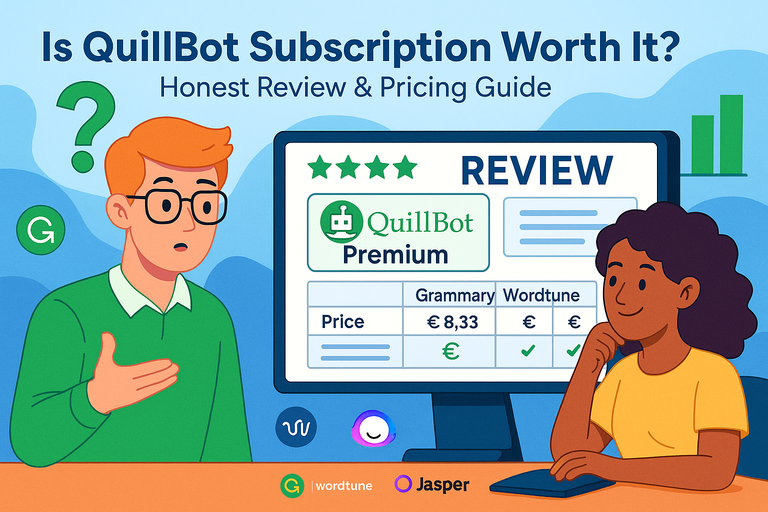
QuillBot’s current premium pricing page shows three main paid options: $19.95 monthly, $39.95 billed quarterly, and $99.95 billed annually, which works out to $8.33 per month on the annual plan.
The Premium page also highlights benefits like unlimited paraphrasing, unlimited modes, advanced grammar recommendations, unlimited AI detector access, custom summaries, and plagiarism prevention. Student pricing is also advertised from $6.25 per month on the annual plan for eligible users.
The free experience still includes meaningful access. QuillBot’s Chrome Web Store listing says the free plan includes grammar checking, basic corrections, limited paraphrasing access, core writing suggestions, and multilingual writing support, while Premium expands paraphrasing, style modes, tone insights, and sentence-level help.
Here is the simplest way to think about it:
| Plan/Tool | Current Positioning | Best For |
|---|---|---|
| QuillBot Free | Basic corrections, limited paraphrasing, core suggestions, multilingual support. | Casual users, occasional students, light editing |
| QuillBot Premium Monthly | $19.95/month. | Short-term projects or testing before annual commitment |
| QuillBot Premium Annual | $99.95/year, about $8.33/month. | Frequent writers who will use it weekly |
| QuillBot Student Offer | Starting from $6.25/month on annual student pricing. | Eligible students who want better value |
For many people, the annual plan is the only version that feels truly competitive on price. Monthly pricing is not terrible, but it is much harder to justify unless you are using it constantly.
Is QuillBot Actually Worth Paying For
I believe QuillBot is worth paying for when you use it as a repeated productivity tool, not as a one-off novelty. The premium value comes from removing repeated friction: rewriting dozens of awkward sentences per week, cleaning professional writing faster, and avoiding constant tab switching through its extension workflow.
The strongest value argument is relative pricing. Grammarly currently lists Pro at $30 monthly or $12 per month when billed annually, while QuillBot’s annual premium rate is lower at $8.33 per month. Grammarly also positions itself as a broader communication product, while QuillBot stays more tightly focused on rewriting and polish.
So which is better value? It depends on your workflow.
- QuillBot is better value if: You care most about paraphrasing, rewriting, and affordable premium access.
- Grammarly is better value if: You want a more expansive writing and communication layer across many tasks and are willing to pay more.
QuillBot also claims to be trusted by over 35 million writers worldwide, which tells you it is no tiny niche tool. That does not prove quality by itself, but it does suggest the platform has reached enough scale to invest in a broad tool ecosystem.
The Biggest Pros, Cons, And Mistakes To Watch For
No review is useful if it only praises the tool. QuillBot has clear strengths, but it also has very predictable failure points. Knowing those in advance can save you money and frustration.
Where QuillBot Feels Genuinely Helpful
The first major advantage is speed. QuillBot helps reduce the time between “this sentence is awkward” and “this now reads clearly.” That is not glamorous, but it is valuable. A lot of writing work is not about inspiration. It is about polishing.
The second advantage is accessibility. The product is available on web, browser, Windows, Safari, and mobile surfaces, and the company puts a lot of emphasis on working where you already write. That practical convenience is easy to underestimate until you are editing across email, docs, and forms every day.
The third advantage is multilingual usefulness. QuillBot’s translator supports 52 languages, and its writing products also highlight multilingual support in common writing environments. For bilingual or multilingual users, that can make the tool feel more flexible than a grammar checker built mostly around English-only workflows.
Finally, QuillBot’s product mix is unusually practical for students and knowledge workers. Citation tools, summaries, plagiarism checks, grammar support, and paraphrasing all live under one account. That kind of bundle can be genuinely efficient when your day includes reading, rewriting, and formatting rather than just drafting from scratch.
The Downsides Most Reviews Underplay
The biggest downside is that QuillBot can make average writing look cleaner without making it much smarter. That sounds harsh, but it matters. A sentence can become shorter, smoother, and still be forgettable. This is why I do not recommend using QuillBot as a substitute for structure, expertise, or original thinking.
Another weakness is limitation by context. Public user feedback on G2 includes mentions of inaccuracy and contextual understanding issues. That is normal for AI-assisted rewriting tools, but it becomes a real problem when you are working on persuasive, emotional, or technical content where small wording changes can alter meaning.
There is also the free-plan ceiling. Many users like QuillBot, but some clearly feel that the most useful experience sits behind Premium. If you only write occasionally, the free plan may be enough. If you need regular high-volume rewriting, you will likely feel those limits quickly.
The most common user mistake is letting the tool rewrite too much at once. When people dump large chunks of content into a paraphraser and accept the output without review, they often end up with flatter, less human writing. I suggest using it surgically. Paragraph by paragraph usually beats full-document rewriting.
How To Get Better Results With QuillBot
A tool review should not stop at “good” or “bad.” The more useful question is how to make the tool perform better for your specific work. QuillBot improves a lot when you use it with a deliberate editing system.
Practical Optimization Tips For Daily Writing
Here are the habits I would use to get more value from QuillBot:
- Tip 1: Start with your own structure. Let QuillBot improve wording, not invent your argument.
- Tip 2: Use it late in the process for polish, not early for direction.
- Tip 3: Rewrite only the weak spots. Do not “AI-wash” strong paragraphs just because you can.
- Tip 4: Keep examples, opinions, and specifics in your own voice.
- Tip 5: Read every changed paragraph out loud before publishing.
That last one sounds simple, but it catches a lot. AI-assisted rewrites often look fine silently and sound strange out loud. Reading out loud exposes rhythm problems, stiff phrasing, and places where the meaning drifted.
I also recommend building a mini feedback loop. Save three before-and-after examples from your own work. Look at what QuillBot consistently improves and what it consistently damages. Some writers notice it helps with trimming fluff. Others notice it weakens personality. Once you know the pattern, you can use it much more efficiently.
Advanced Use Cases For Content, Academic, And Business Work
For content teams, QuillBot is best used as an editing layer. For example, you might draft a blog post manually, use QuillBot to tighten repetitive sections, and then do a final brand-voice pass yourself. That works far better than asking the tool to produce a full article and hoping it sounds expert.
For academic work, I would use QuillBot for clarity and citation support, not for replacing actual understanding. The citation generator, summarizer, and paraphrasing tools are useful helpers, but you still need to verify meaning and source integrity yourself. That is especially true when you are simplifying dense material.
For business communication, the value is speed plus polish. Imagine you send 30 client emails a week. Saving even three minutes per email means 90 minutes back every week. That kind of time recovery is where a paid writing assistant starts to justify itself financially. That is not an official QuillBot metric, just a realistic workflow example based on how these tools are typically used.
My bigger point is this: QuillBot pays off fastest in repeated micro-edits. It is less impressive as a “do everything” AI layer and more impressive as a friction-reduction tool you touch all day.
QuillBot Alternatives And Final Verdict
A fair review needs context. QuillBot is good, but “worth it” only makes sense when you compare it to what else you could use instead or whether you even need a paid tool at all.
When QuillBot Is Better Than The Alternatives
QuillBot makes the most sense when paraphrasing and rewriting are your core needs. Compared with Grammarly, it offers a lower annual entry price and a more rewrite-centric value proposition. Grammarly, by contrast, leans harder into broader communication assistance and cross-workflow productivity.
That means QuillBot is usually the better fit if you say things like:
- “I already know what I want to say, but I want it to sound cleaner.”
- “I rewrite a lot of academic or marketing text.”
- “I want premium features without paying top-tier monthly prices.”
It is also appealing if you want a bundle that includes rewriting, grammar, citations, AI detection, and translation in one account. Not everyone needs that mix, but students and solo writers often do.
If your top priority is advanced original drafting, strong team governance, or a more expansive communication platform, QuillBot may feel narrower than some alternatives. That is not a flaw so much as a product identity.
My Honest Verdict: Worth It, But Only For The Right User
Here is my honest conclusion for this quillbot ai writing tool review: QuillBot is not overhyped, but it is frequently misused. The tool is genuinely helpful when you need faster rewriting, cleaner phrasing, and practical editing support across daily writing tasks. It becomes disappointing when you expect it to replace skill, strategy, or original thought.
I would call it worth it for students, freelancers, bloggers, multilingual users, and professionals who spend a lot of time revising text. I would not call it essential for people who only write occasionally or who mainly want a long-form content generator. For those users, the free plan may be enough, or another tool category may be a better fit.
So, is Quillbot worth it or overhyped? My answer is simple: worth it when you use it as a writing improver, overhyped when you expect it to be your writer. That single mindset shift is the difference between feeling impressed and feeling let down.

I’m Juxhin, the voice behind The Justifiable.
I’ve spent 6+ years building blogs, managing affiliate campaigns, and testing the messy world of online business. Here, I cut the fluff and share the strategies that actually move the needle — so you can build income that’s sustainable, not speculative.
Related posts:
 Paraphrasing Tool Quillbot AI Tested on 5 Topics
 The QuillBot Review: Is This AI Writing Tool Worth It?
 How Many Words Can Quillbot Paraphrase
 Paraphrasing Tool Quillbot Reviewed on 10 Texts
 Is QuillBot Subscription Worth It? Honest Review & Pricing Guide
 QuillBot Grammar Checker Paraphrase Tool Review