Table of Contents
Some links on The Justifiable are affiliate links, meaning we may earn a small commission at no extra cost to you. Read full disclaimer.
If you’re searching for semrush vs ahrefs which is better for seo, you’re probably not looking for another vague “it depends” answer. You want to know which one will actually help you rank faster, research smarter, and waste less money.
I’ve looked at both through the lens that matters most in 2026: day-to-day SEO work, reporting, technical fixes, content planning, and how well each platform supports modern search, including AI visibility.
The honest answer is that both are strong, but they are not equally strong for the same type of user.
What Actually Separates Semrush And Ahrefs Today?
Both platforms cover the core SEO stack: keyword research, competitor analysis, backlink data, rank tracking, and technical audits. The real difference is in how they package those workflows, how broad the platform is beyond SEO, and which kind of user feels productive faster.
Semrush positions itself as a broader growth platform spanning SEO, AI visibility, PPC, social, and reporting, while Ahrefs stays more tightly centered on search, content, links, analytics, and AI/search visibility workflows.
Why This Comparison Matters More In 2026
SEO software is no longer just about ten blue links. Semrush now markets itself around visibility across AI search, SEO, PPC, social, and more, while Ahrefs has expanded into AI visibility tracking with Brand Radar and also highlights web analytics and LLM visibility in reporting.
That matters because a tool that felt “SEO-only” a couple of years ago may now influence how you measure citations, mentions, and search demand beyond classic rankings.
From what I’ve seen, this changes buying decisions in a big way. If your job includes reporting to clients, monitoring competitors, checking paid search overlap, and tying SEO into wider marketing performance, Semrush starts to look stronger.
If your job is mostly finding search opportunities, dissecting competitors, and building an SEO system with less clutter, Ahrefs often feels cleaner.
The Fast Answer Before We Go Deeper
I believe the simplest honest summary looks like this:
- Semrush is usually better for agencies, in-house teams, and marketers who want an all-in-one growth platform with stronger reporting, broader toolkit coverage, and more built-in workflow options.
- Ahrefs is usually better for SEO specialists, content teams, and lean operators who care most about search-focused research, backlink investigation, intuitive competitor analysis, and a lower-cost entry path.
That is the headline. The rest of this guide is about when that headline is right, when it is wrong, and how to choose without regretting the subscription three weeks later.
Pricing And Value: Which Tool Gives You More For The Money?
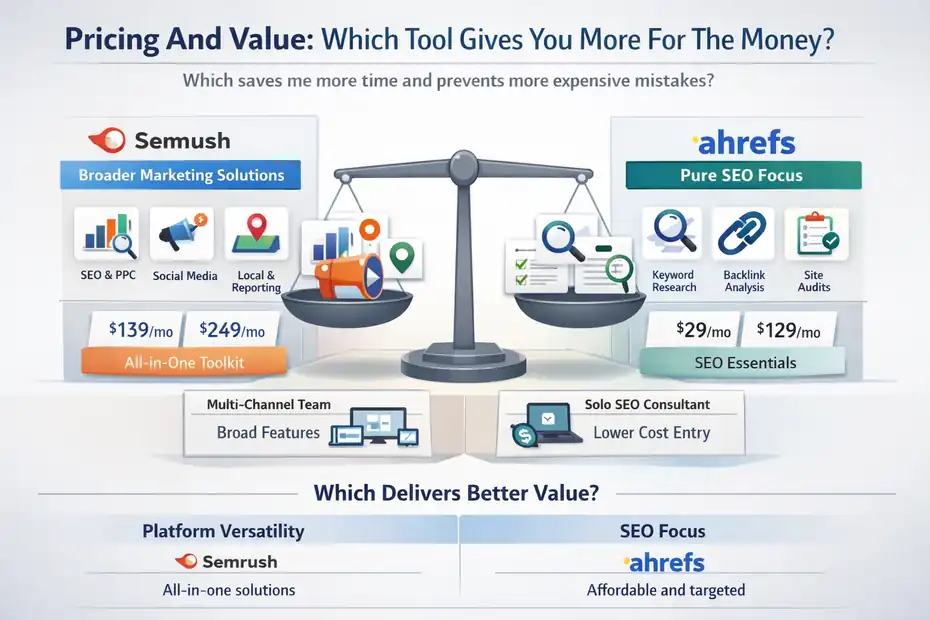
Pricing is where a lot of people make the wrong decision, because they compare plan cost without comparing what kind of work the tool is meant to replace.
The better question is not “Which is cheaper?” but “Which saves me more time and prevents more expensive mistakes?”
Semrush Pricing: Better For Broader Marketing Teams
Semrush’s SEO Toolkit pricing is listed at $139.95 per month for the entry tier, $249.95 per month for the mid-tier, and $499.95 per month for the top tier.
Its broader platform also includes add-ons and separate toolkits for things like local, advertising, social, and AI visibility, which can make Semrush feel expensive if you only need pure SEO, but more cost-effective if you would otherwise pay for multiple point solutions.
In practical terms, this means Semrush often makes more sense when one subscription supports several jobs inside a business. Imagine you run a mid-sized e-commerce brand.
Your SEO lead needs keyword and audit data, your paid search manager wants ad intelligence, your content team needs topic planning, and your leadership team wants polished reports. In that kind of setup, Semrush can consolidate enough workflows that the higher price starts to feel justified.
The catch is obvious. If you are a solo consultant doing mostly audits, content planning, and link research, you may end up paying for capability you rarely use.
Ahrefs Pricing: Stronger Entry Point For Pure SEO Users
Ahrefs currently offers a $29 Starter plan, then Lite at $129 per month, Standard at $249 per month, Advanced at $449 per month, and Enterprise at $1,490 per month, according to Ahrefs’ current pricing and 2026 plan guidance.
Ahrefs also offers Ahrefs Webmaster Tools with free access to Web Analytics, Site Audit, and Site Explorer for verified websites.
That lower-cost entry path is a real advantage. I suggest paying attention to it if you are a freelancer, niche-site builder, editor, startup founder, or someone who only needs one serious SEO platform. Ahrefs makes it easier to get into a professional workflow without immediately committing to a heavier all-in-one stack.
There is also a psychological benefit here. A smaller plan can force cleaner execution. Instead of bouncing around six toolkits, you stay focused on search data, pages, links, topics, and rankings.
Which Delivers Better Value?
Here is my honest take: Semrush usually wins on platform value, while Ahrefs often wins on SEO value.
| Use Case | Better Value Pick | Why |
|---|---|---|
| Solo blogger or affiliate site | Ahrefs | Lower entry cost, focused SEO workflows, less platform bloat |
| Freelancer doing audits and content strategy | Ahrefs | Easier to justify financially if PPC and social are not part of the service |
| Small business marketing team | Semrush | Broader feature set can replace multiple subscriptions |
| Agency serving SEO plus reporting and competitor intelligence | Semrush | Stronger reporting and wider toolkit coverage |
| In-house SEO specialist focused mainly on organic growth | Ahrefs | Cleaner day-to-day search workflow |
| Multi-channel growth team | Semrush | SEO, PPC, social, and AI visibility are closer together |
If money is tight, Ahrefs is usually the safer first purchase. If time, reporting, and cross-channel complexity are the bigger pain points, Semrush often pays for itself faster.
Keyword Research: Which Tool Helps You Find Better Opportunities?
Keyword research is where both tools are genuinely strong. The difference is less about whether either platform can produce keyword ideas and more about how they help you turn those ideas into a real plan.
Semrush Is Better For Large-Scale Keyword Mapping
Semrush says its database contains 27.9 billion keywords across 142 geographic databases, and its Keyword Magic Tool is built to organize related terms into topic-based groups while showing metrics such as search volume, intent, keyword difficulty, and CPC.
This is one of the biggest reasons people stick with Semrush. It is very good at taking a broad topic and helping you expand it into a working keyword universe. If you are planning an entire site architecture, content hub, or category expansion, the grouping and filtering flow is genuinely useful.
Imagine you run a B2B SaaS site in project management. In Semrush, you can start with a seed topic, break that into commercial, informational, and comparative intent buckets, then prioritize by difficulty, CPC, and topic relevance.
That makes it easier to brief writers, build internal link clusters, and map pages to funnel stages.
I recommend Semrush here when your problem is scale. You are not just trying to find a few good keywords. You are trying to build a complete roadmap.
Ahrefs Is Better For Traffic-First Keyword Decisions
Ahrefs’ Keywords Explorer says it taps 28.7 billion topics, and Ahrefs continues to frame keyword research around practical opportunity selection rather than just raw list building.
The platform also emphasizes metrics that help users think beyond one query and toward the broader traffic potential of a topic.
This is where Ahrefs often feels more like an SEO operator’s tool.
In my experience, Ahrefs tends to encourage a stronger page-level mindset: what topic is worth targeting, what already ranks, how much traffic the page could realistically earn, and what competing pages are doing to deserve that visibility.
That sounds subtle, but it changes decisions. A beginner often chases keywords. A better strategist chases pages and topics. Ahrefs nudges you toward the second habit.
So if you publish fewer, better pages and care deeply about choosing the right battles, Ahrefs often feels sharper.
Which Is Better For Content Planning?
For editorial planning, I’d put it this way:
- Choose Semrush if you need breadth, clustering, filtering, and large-scale keyword mapping.
- Choose Ahrefs if you want a more search-operator-friendly workflow for judging topic value and competitor page potential.
Neither choice is wrong. The right one depends on whether you are building an entire content machine or making sharper bets on fewer pages.
Backlink Analysis And Competitive Research: Where Ahrefs Still Feels Especially Strong
This is usually the section people care about most, because Ahrefs built much of its reputation on backlinks and competitive SEO intelligence.
Semrush is not weak here at all, but the two tools do feel different in use.
Ahrefs Is Usually The More Natural Tool For Link-Led SEO Work
Ahrefs remains highly centered on Site Explorer-style investigation. Its documentation and free tools continue to foreground metrics like Domain Rating and linking domains, and its overall product language still feels built around understanding why pages rank and who links to them.
That focus matters in practice. When you are reverse-engineering a competitor, Ahrefs often feels direct. You jump from domain to page to link source to ranking keyword with very little friction. For link builders, digital PR teams, and SEOs who spend hours in competitive research, that flow is a big advantage.
I would not call this a pure “data quality” verdict, because both companies publish strong database claims and most buyers cannot independently validate freshness across every niche. I would call it a workflow verdict. Ahrefs often feels like the faster tool when the task is, “Show me why this page outranks mine.”
Semrush Is Stronger When You Need Links In A Wider SEO Context
Semrush says its database includes 43 trillion backlinks and 808 million domains, and its backlink reporting ties into a broader platform that also includes technical audit, keyword research, position tracking, and reporting.
That matters because many teams do not analyze links in isolation. They want to compare link growth with rankings, keyword targets, site issues, and performance reporting in one environment. Semrush is very good at making backlink analysis part of a bigger diagnostic process.
A realistic example: If a client loses rankings, an agency using Semrush can move from position changes to technical warnings to keyword shifts to backlinks to custom reporting without switching platforms. That is not glamorous, but it is incredibly practical.
My Verdict On Backlinks And Competitor Research
If backlink analysis is the heart of your SEO work, I would still lean Ahrefs.
If backlinks are one part of a broader SEO and marketing workflow, I would lean Semrush.
That distinction is more useful than saying one is universally “better.” Most people do not need the most romantic link index story. They need the tool that fits their actual weekly tasks.
Technical SEO And Site Audits: Which One Helps You Fix More, Faster?
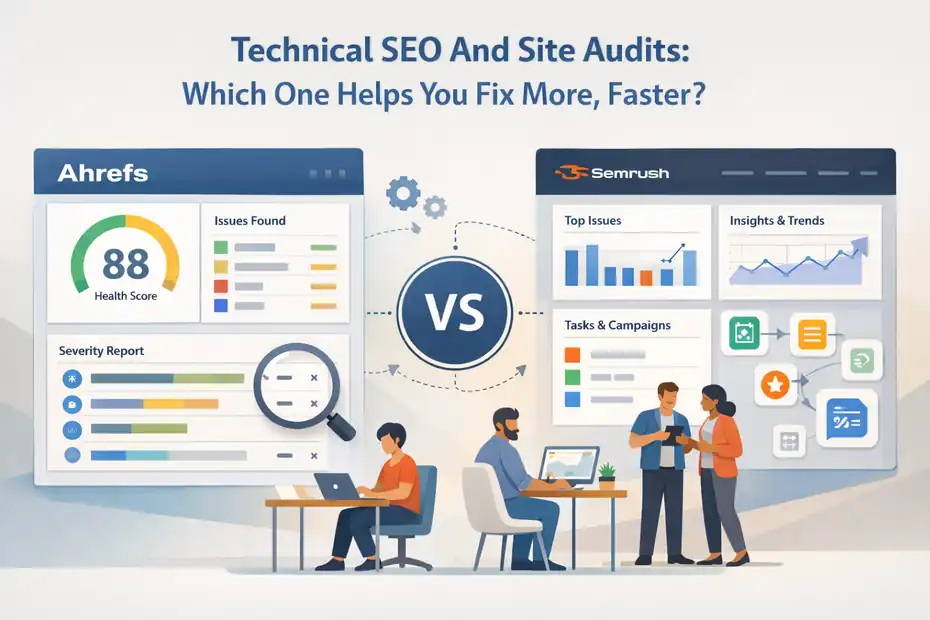
Technical audits are often oversimplified in tool comparisons. The question is not just how many issues a crawler finds.
The question is whether the tool helps you prioritize the right fixes and turn them into action.
Ahrefs Offers A Strong, Focused Audit Experience
Ahrefs says its Site Audit can find 170+ common technical and on-page SEO issues, and it presents a Health Score plus issue monitoring for verified sites through Ahrefs Webmaster Tools.
That makes Ahrefs especially attractive for site owners who want a straightforward technical workflow without a lot of noise. You crawl the site, review severity, inspect recurring problems, and work through the fixes. For many users, that is enough.
I especially like this style for lean teams. If you are the person writing content, checking rankings, and coordinating developers all in the same week, an audit tool that stays readable is a gift.
The limitation is that Ahrefs can feel narrower if you want broader cross-tool task orchestration around those fixes.
Semrush Gives You More Operational Context Around Audits
Semrush says Site Audit checks for 140+ issues, prioritizes them by severity, and now includes dedicated widgets tied to AI-driven visibility in its Site Audit overview. Semrush also describes the crawler as a central health-analysis workflow within the larger SEO toolkit.
This is a good example of why “more issues found” is not the whole story. Even though Ahrefs lists a higher number of common issues, Semrush can be more useful for teams that need prioritization, reporting, campaign tracking, and connections to other search workflows. The richer operating environment is part of the value.
Let me put it simply. Ahrefs often feels like a clean technical scanner. Semrush often feels like a technical scanner plugged into a management system.
Which Tool Is Better For Technical SEO?
I suggest using this rule:
- Pick Ahrefs if you want an accessible audit workflow for your own sites or a small portfolio.
- Pick Semrush if you need more workflow management, stakeholder reporting, and broader context around technical problems.
For advanced SEOs, either tool can surface meaningful issues. The better platform is the one that makes those issues easier to prioritize, communicate, and fix.
Rank Tracking, Reporting, And Daily Workflow: Semrush Usually Pulls Ahead
This is one of the most underappreciated reasons people choose Semrush and stay with it. Pure SEO research is only part of the job.
The rest is tracking progress, proving results, and avoiding messy reporting work.
Semrush Is Better For Granular Rank Tracking And Reporting
Semrush states that Position Tracking monitors rankings daily and supports tracking by device and location down to ZIP code, with support that includes Google, Bing, Baidu, ChatGPT Search, and Google AI Mode.
Semrush also highlights custom dashboards and recurring PDF reports that can blend data from Semrush with Google Search Console and GA4.
That is a strong package for agencies and in-house teams. You are not just watching positions. You are building a reporting habit. You can segment by market, device, and competitor set, then present movement in a way that clients or leadership can understand.
In real life, this matters more than many buyers expect. Fancy link reports do not pay the bills. Clear evidence of progress does.
Ahrefs Rank Tracking Is Good, But Usually Less Central To The Buying Decision
Ahrefs’ Rank Tracker supports desktop and mobile tracking across 190+ locations, competitor comparison, and newer visibility monitoring tied to AI search performance. It is capable and modern, especially with recent Rank Tracker improvements.
Still, I rarely hear people say they bought Ahrefs mainly because its reporting and tracking layer was more compelling than Semrush. More often, they buy Ahrefs for research, competitive analysis, and focus, then use rank tracking as part of the package.
That does not make Ahrefs weak. It just means Semrush tends to feel more operations-ready for teams that live in status reports, client calls, and weekly performance reviews.
Which One Feels Better Every Day?
For solo work, Ahrefs often feels calmer.
For client work and team operations, Semrush often feels more complete.
I think that is the fairest way to say it. One is not more “professional” than the other. They are professional in different ways.
AI Search, Visibility Tracking, And Modern SEO: Both Are Adapting Fast
In 2026, ignoring AI visibility is a mistake.
You do not need to panic about it, but you do need tooling that helps you see how your brand and content appear beyond traditional rankings.
Ahrefs Has Moved Aggressively Into AI Visibility
Ahrefs’ Brand Radar maps brand visibility across six AI platforms and also across channels that influence AI visibility, including SEO, YouTube, Reddit, and TikTok. Ahrefs says the product can analyze hundreds of millions of search-backed prompts, with additional custom prompt packages available.
That is a meaningful shift. Ahrefs is no longer just “the backlink tool.” It is clearly trying to give SEOs a way to understand how brands surface in AI answers and adjacent discovery environments.
For content strategists and brand teams, this could become one of Ahrefs’ most interesting advantages, especially if you care about topical coverage and mention frequency across multiple surfaces, not just Google rankings.
Semrush Also Treats AI Visibility As A Core Product Direction
Semrush now promotes AI visibility as part of its broader platform, and its AI Visibility Toolkit is designed to track brand visibility, competitors, prompts, and optimization opportunities in AI-driven search.
Semrush has also introduced AI-related views inside Site Audit and broader brand-performance pages tied to AI platforms like ChatGPT.
This fits Semrush’s larger pattern. Rather than creating a narrow AI-only tool identity, Semrush is trying to place AI visibility inside an existing multi-channel performance stack. For some businesses, that is exactly what they need.
If your leadership team already wants one dashboard story that covers SEO, AI search, traffic signals, and market visibility, Semrush may be easier to operationalize.
Which Is Better For AI-Era SEO?
This one is still moving, so I would avoid overconfident claims. But here is my best current judgment:
- Ahrefs feels especially interesting for AI/search visibility research and brand discovery analysis.
- Semrush feels stronger if you want AI visibility embedded into a broader marketing and reporting system.
In other words, Ahrefs feels a bit more exploratory here. Semrush feels a bit more operational.
Which Tool Is Better For Different Types Of Users?
This is the section that usually decides the purchase. Features matter, but fit matters more.
Best Choice For Bloggers, Niche Site Owners, And Freelancers
I’d usually recommend Ahrefs first for bloggers, affiliate publishers, and freelancers who mainly need keyword research, competitor analysis, link investigation, site audits, and a lower-cost starting point.
The free Webmaster Tools access for verified sites also makes the ecosystem easier to grow into.
The reason is simple. These users usually win by making smarter content bets, finding weaknesses in competing pages, and keeping their workflow tight. Ahrefs supports that style really well.
Best Choice For Agencies And In-House Marketing Teams
I’d usually recommend Semrush for agencies and in-house teams that need broader workflows: rank tracking, polished reporting, keyword mapping, backlink analysis, site audits, and visibility across related channels or stakeholders.
Semrush’s reporting and its wider toolkit footprint make it easier to run as a central operating system.
If you manage clients, present to executives, or coordinate across SEO, paid, social, and content, that breadth matters. It saves switching costs and reduces reporting chaos.
Best Choice For E-Commerce, Local, And Multi-Channel Brands
For e-commerce and local businesses, Semrush often has the edge because the broader environment matters more. Semrush offers dedicated Local plans and emphasizes keyword, traffic, reporting, and visibility workflows that connect to wider marketing strategy.
Ahrefs can still absolutely work for these businesses, especially if organic search is the core channel. But if your marketing decisions are rarely “SEO only,” Semrush tends to fit more naturally.
Common Mistakes People Make When Choosing Between Them
Most bad software purchases come from choosing based on reputation instead of workflow. I’ve seen this happen a lot.
Mistake 1: Buying The Tool Your Favorite SEO Expert Likes
Some experts love Ahrefs because they live in competitive research all day. Others love Semrush because they run agencies and need reporting discipline. Neither preference automatically applies to you.
A better approach is to list your top five weekly SEO tasks. If most of them are research-heavy, Ahrefs may fit better. If most of them involve tracking, presenting, collaborating, and managing broader campaigns, Semrush may fit better.
Mistake 2: Comparing Raw Feature Lists Instead Of Speed To Insight
A long feature list can be misleading. What matters is how quickly the tool gets you to the next useful action.
For example, an audit report is not valuable because it contains 150 issues. It is valuable because it helps you identify the 8 issues worth fixing this week. A keyword tool is not valuable because it returns 20,000 suggestions. It is valuable because it helps you choose the right 12 pages to build next.
That is why I keep coming back to this: Semrush is often broader, and Ahrefs is often sharper.
Mistake 3: Ignoring Free Or Lower-Risk Entry Paths
Ahrefs’ Starter plan and Webmaster Tools lower the risk of adoption for smaller operators, while Semrush’s broader ecosystem makes more sense when you know you need a larger operating platform.
If you are early-stage, do not overbuy. The best SEO platform is the one you will actually use every week.
Final Verdict: Semrush Vs Ahrefs Which Is Better For SEO?
Here is my final answer.
Semrush is better for SEO today if you want a broader platform that combines research, audits, rank tracking, reporting, AI visibility, and adjacent marketing workflows in one place. For agencies, in-house teams, e-commerce brands, and anyone managing multiple stakeholders, it is often the more practical business decision.
Ahrefs is better for SEO today if you want a cleaner, more search-focused platform that shines in keyword research, competitive analysis, backlink investigation, and focused day-to-day organic growth work.
For bloggers, freelancers, publishers, and SEO specialists, it is often the tool that feels easier to trust and easier to use consistently.
So if you want my plain-English recommendation:
- Pick Semrush if you need an SEO operating system.
- Pick Ahrefs if you need an SEO research weapon.
That is the clearest way I know to answer semrush vs ahrefs which is better for seo in 2026. Neither platform is objectively perfect. But one of them is usually a much better match for the way you actually work.
FAQ
What is the main difference between Semrush and Ahrefs?
The main difference between Semrush and Ahrefs is their focus. Semrush offers a broader all-in-one marketing platform with SEO, PPC, and reporting tools, while Ahrefs focuses more on search data, backlinks, and competitor analysis. Your choice depends on whether you need a full marketing system or a dedicated SEO research tool.
Is Semrush better than Ahrefs for beginners?
Semrush is often better for beginners who want guided workflows, structured reports, and an all-in-one dashboard. It helps simplify complex SEO tasks with built-in recommendations. However, Ahrefs can still work well if you prefer a cleaner interface and are focused mainly on learning keyword research and competitor analysis.
Which tool is better for keyword research, Semrush or Ahrefs?
Both tools are excellent, but Semrush is better for large-scale keyword planning and grouping, while Ahrefs is stronger for evaluating keyword difficulty and traffic potential. If you are building a full content strategy, Semrush helps with structure, while Ahrefs helps you choose high-impact topics more precisely.
Is Ahrefs better than Semrush for backlinks?
Ahrefs is generally considered better for backlink analysis because of its intuitive interface and strong link-focused workflow. It makes it easier to analyze competitor links and understand ranking factors. Semrush is still powerful but is designed to integrate backlinks into a broader SEO and marketing strategy.
Which is better for SEO in 2026, Semrush or Ahrefs?
In 2026, Semrush is better for teams needing a complete SEO and marketing platform, including reporting and AI visibility tracking. Ahrefs is better for individuals or specialists focused on keyword research, backlinks, and competitor insights. The best choice depends on your workflow, budget, and SEO goals.

I’m Juxhin, the voice behind The Justifiable.
I’ve spent 6+ years building blogs, managing affiliate campaigns, and testing the messy world of online business. Here, I cut the fluff and share the strategies that actually move the needle — so you can build income that’s sustainable, not speculative.