
Table of Contents
Some links on The Justifiable are affiliate links, meaning we may earn a small commission at no extra cost to you. Read full disclaimer.
If you’re looking for a real squirrly ai seo assistant review, you’re probably trying to answer one practical question: will this tool actually help your site rank, or will it just give you more colorful SEO tasks to ignore?
I’ve gone through what Squirrly is promising, how its pricing is positioned, and where the tool seems genuinely useful versus where the marketing gets a little louder than the results.
For the right WordPress user, it can be surprisingly helpful. For the wrong one, it may feel like paying for hand-holding you did not need.
What Squirrly AI SEO Assistant Actually Is
Squirrly positions itself as more than a normal SEO plugin. Instead of acting like a settings panel, it tries to behave like a guided SEO workflow inside your site.
Squirrly Tries To Be A Guided SEO System, Not Just A Plugin
Most WordPress SEO tools help you fill in titles, meta descriptions, schema settings, and sitemaps. Squirrly does that too, but its bigger pitch is guidance. The platform says it gives you a daily SEO roadmap, AI-assisted recommendations, page-specific tasks through Focus Pages, keyword research, audits, and rank tracking in one system. It also claims support for both WordPress and non-WordPress sites through its cloud app.
That matters because many site owners do not fail at SEO due to missing one technical setting. They fail because they do random things for three weeks, get bored, and stop. Squirrly clearly built its product around that problem. In plain English, it is trying to turn SEO into a checklist habit instead of a one-time setup.
I think this is the strongest part of the product idea. A lot of SEO tools assume you already know what to do with a keyword report or a crawl issue. Squirrly assumes you probably do not, and tries to bridge that gap.
That does not automatically mean better rankings. It means the tool is designed for execution support, not just diagnostics.
The AI Angle Is Real, But It Is Not Magic
Squirrly says it uses multiple types of AI, including what it calls Ranking Vision AI, keyword research AI, and ASK AI. The company also says Focus Pages is powered by its own AI system rather than generic LLM-only logic. In practice, that means the “AI SEO assistant” experience is less about writing your article for you and more about prioritizing pages, surfacing tasks, and helping you improve optimization signals over time.
That distinction is important. If you came here hoping for a full AI content engine like a writer plus strategist plus editor in one click, Squirrly is not really that. It leans more toward workflow intelligence than content generation.
From what I’ve seen, that is actually a good thing. Pure AI writing features often sound exciting, but they can tempt people into publishing generic content faster. Squirrly’s better use case is helping you tighten page targeting, on-page relevance, and follow-through.
So yes, the AI layer seems legitimate in the sense that it powers recommendations and prioritization. No, it is not some mystical ranking button.
Who Squirrly Is Best For
Not every SEO tool is meant for every site owner. Squirrly becomes much easier to judge once you match it to the right type of user.
It Makes The Most Sense For Beginners, Busy Owners, And Small Teams
Squirrly’s homepage and pricing pages repeatedly aim at non-experts, bloggers, business owners, content creators, and agencies that want clearer direction. The free plan is described as best for newbies, bloggers, and solo operators, while the broader product pitch emphasizes helping users who “don’t speak Google” but still want rankings.
That positioning feels accurate.
Imagine you run a local service business, publish one or two blog posts a month, and keep hearing that you need keyword research, internal links, audits, schema, rank tracking, and page updates. That list gets overwhelming fast. A tool that narrows your attention to “these are your most important pages, and here are the next actions” can save real mental energy.
I would also put small editorial teams in this category. If nobody on the team is a dedicated SEO specialist, Squirrly may create useful process discipline.
The key phrase here is process discipline. That is what you are paying for as much as the feature list.
It Is Less Compelling For Experienced SEOs And Data-Heavy Teams
If you already know how to run content audits, map keywords to search intent, build internal linking systems, and interpret ranking movement, Squirrly may feel overly guided. Its strength is instruction. For advanced users, too much instruction can start to feel like friction.
This is where tools like Semrush and Ahrefs often make more sense. They are usually better fits when you want deeper datasets, broader competitor intelligence, and more control over your analysis workflow rather than a step-by-step coach. Squirrly itself even frames comparisons against larger SEO suites and claims users often compare it with those platforms.
I would be careful, though, not to compare them as if they are identical products. Squirrly is trying to simplify and operationalize SEO. Semrush and Ahrefs are more like larger research environments.
So if you are the kind of user who wants maximum data freedom, Squirrly may feel a bit boxed-in. If you want help taking consistent action, that same structure may be the reason you like it.
Core Features That Matter In Real Use
A review should not just repeat the feature list. The better question is whether the features solve actual bottlenecks.
Focus Pages And Daily SEO Goals Are The Real Hook
The standout concept inside Squirrly is Focus Pages. The company describes it as a way to concentrate on the pages you most want to rank, with page-specific tasks and a continuous improvement loop built around better content, structure, internal linking, and optimization signals. Its broader “daily SEO roadmap” message reinforces the same idea: do the next best SEO actions instead of guessing.
This is smarter than it sounds.
A lot of site owners spread effort across too many URLs. They tweak a homepage today, rewrite a blog intro tomorrow, and install schema next week, but never fully improve the pages that could actually generate traffic or leads. Squirrly’s Focus Pages model tries to stop that behavior.
Here is the practical advantage:
- Clear priority: You know which pages deserve attention first.
- Task sequencing: You are less likely to skip foundational improvements.
- Momentum: Progress feels visible, which makes follow-through easier.
I believe this is where Squirrly earns its place. Not because Focus Pages is revolutionary technology on its own, but because it addresses one of the most common SEO failures: inconsistent execution.
Live Assistant, Audits, And Automation Fill In The Gaps
Squirrly also offers a real-time SEO Live Assistant, audit features, keyword research, rank tracking on higher plans, automation settings, schema-related features, redirects, sitemaps, local SEO, and integrations with things like WooCommerce, Google Search Console, and Google Analytics-related workflows. The company also highlights compatibility with multilingual and field-management setups like WPML, Polylang, TranslatePress, Gutenberg, and ACF.
The Live Assistant looks especially useful for writers who want feedback while editing instead of after publishing. According to Squirrly, it checks issues like introduction strength, keyword repetition, length, and over-optimization in real time.
The automation side is also worth noting. Squirrly says its automation can apply SEO patterns across common post types and even re-optimize large stores quickly, including WooCommerce catalogs.
That said, features only matter if you use them. Many all-in-one SEO platforms look amazing on paper and end up half-configured in real life. Squirrly’s advantage is that several of these features feed into one guided workflow instead of living as disconnected modules.
Pricing, Value, And What You Actually Get
Pricing is where reviews get honest. A tool can be useful and still not be worth the money for your situation.
Squirrly’s Entry Pricing Is Fair, But Usage Limits Matter
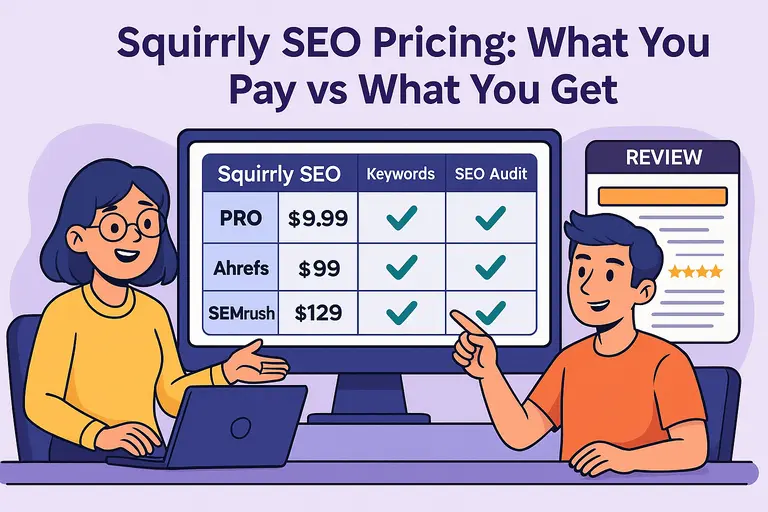
Squirrly’s pricing page shows a free plan, a PRO plan at $9.99 per month, a Web Dev Kit plan at $51.20 per month, and a Business plan at $71.99 per month. The free tier is limited, with one site, one Focus Page, five AI keyword researches per month, and one audit page per month. PRO increases capacity and supports five sites, while higher tiers expand site limits and advanced capabilities.
Here is the quick view:
| Plan | Price | Best Fit | Notable Limit/Angle |
|---|---|---|---|
| Free | $0/month | Testing the workflow | Very limited usage |
| PRO | $9.99/month | Solo site owners | 5 sites, reasonable entry point |
| Web Dev Kit | $51.20/month | Freelancers or technical users | 10 sites, broader usage |
| Business | $71.99/month | Agencies or serious operators | 7 sites, premium capabilities |
Source data comes from Squirrly’s official pricing page.
For a solo blogger or small business, the PRO plan is where the tool starts to become realistically usable. The free plan is more of a product demo than a full SEO operating system.
My view is simple: the entry pricing is reasonable if the workflow gets you to publish and improve pages more consistently. If you are paying and still ignoring the recommendations, even $9.99 becomes wasted money.
The Value Question Depends On Whether You Need Guidance Or Raw Power
Squirrly’s pricing can look cheap when compared with major SEO suites, but that does not automatically make it a bargain. It is only a bargain if guided execution is what you lack.
For example, a site owner who knows exactly how to plan clusters, analyze SERPs, run technical audits, and prioritize content updates may not get much extra value from Squirrly’s coaching layer. In that case, even a lower price can be a poor fit.
But if you regularly say things like, “I know SEO matters, but I’m never sure what to do next,” then Squirrly’s value proposition gets stronger fast.
I suggest thinking about it this way:
- If your biggest problem is knowledge overload, Squirrly helps.
- If your biggest problem is lack of data depth, another tool may help more.
- If your biggest problem is consistency, Squirrly may be one of the better WordPress-friendly options.
That is why I would not call it cheap or expensive in a vacuum. It is either efficient structure or unnecessary scaffolding, depending on your working style.
Real-World Pros And Cons
This is where the review gets more useful. A tool can be technically good and still annoy the wrong user.
What Squirrly Seems To Do Well
The strongest outside signals line up with Squirrly’s core pitch. Capterra lists Squirrly SEO at 4.7 out of 5 from 168 reviews, and review snippets praise its user-friendly interface, real-time analysis, keyword research, and ease of integration. Squirrly’s own awards page also cites ratings across review platforms, including 4.6 out of 5 based on 528 reviews and 4.7 out of 5 scores on additional platforms, though those are vendor-curated summaries and should be read with that context in mind.
Based on the product setup and those reviews, the main advantages look like this:
- Strong beginner usability: The platform clearly tries to explain what to do next.
- Good workflow design: Focus Pages and guided tasks solve decision fatigue.
- Broad feature coverage: It combines optimization, audits, keyword research, and tracking in one place.
- WordPress-friendly implementation: It is built around practical site-owner behavior, not just SEO theory.
In my experience, usability is underrated in SEO software. A more “powerful” platform is not actually better if it sits unused after week one.
Where The Tool Can Feel Overhyped Or Frustrating
The biggest downside is also tied to its main strength. Because Squirrly is so guidance-heavy, some users will feel that the assistant layer oversimplifies SEO or pushes generalized advice that does not perfectly fit every page.
That is not just speculation. One verified Capterra review praised the product overall but said the predefined suggestions were not always a perfect fit for unique content or SEO needs, limiting customization. Another review liked the product but called out cost as a weak point.
I think that is fair criticism.
No SEO assistant, AI-powered or not, can fully understand your audience, your conversion model, and your editorial intent the way a strong strategist can. So if you treat every recommendation as law, you may over-optimize blandly.
There is also the usual all-in-one tool risk: feature abundance can create a false sense of progress. Checking boxes is not the same as earning links, building authority, or publishing genuinely better content.
So yes, there is some real substance here. But yes, the marketing can make it sound more universal than it is.
How Squirrly Compares To Other SEO Options
A review becomes more believable when the product is placed in context, not treated like the only option on earth.
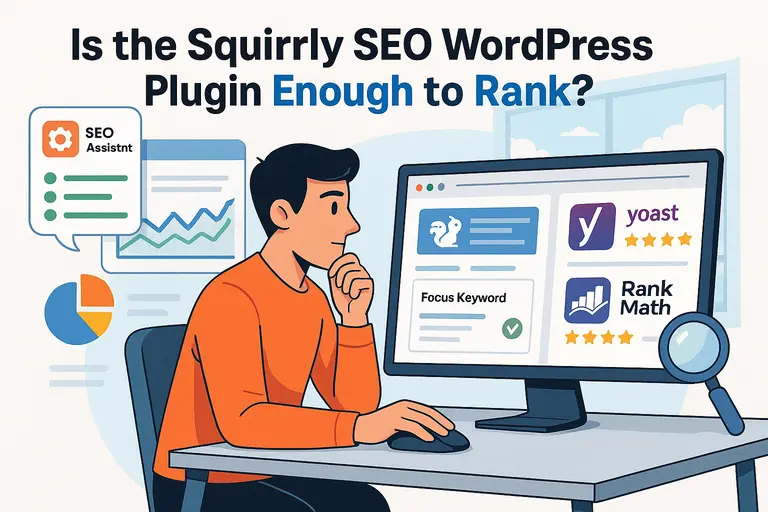
Versus Rank Math And Yoast, Squirrly Feels More Like A Coach
Compared with Rank Math and Yoast SEO, Squirrly’s clearest difference is that it pushes an SEO workflow, not just on-page settings and analysis scores. Squirrly itself argues that other plugins behave more like configuration panels, while it focuses on ranking roadmaps and ongoing page improvement.
That is marketing language, but the underlying point is valid.
If you mainly want a reliable SEO plugin for titles, metadata, schema basics, XML sitemaps, and page-level optimization hints, Yoast or Rank Math may be simpler and more familiar. If you want more proactive direction built into the experience, Squirrly becomes more interesting.
Here is the cleanest way I’d frame it:
| Tool | Best For | Main Strength | Main Weakness |
|---|---|---|---|
| Squirrly | Beginners who need direction | Guided SEO workflow | Can feel prescriptive |
| Yoast SEO | Simplicity and familiarity | Easy core SEO setup | Less strategic guidance |
| Rank Math | Feature-heavy value seekers | Lots of built-in capability | Can feel crowded to some users |
This comparison is partly an inference based on each product’s positioning and feature emphasis, not a claim that one tool always outperforms another in rankings.
Versus Semrush Or Ahrefs, It Plays A Different Game
I do not think Squirrly is best judged as a direct replacement for enterprise-style SEO suites. Even Squirrly’s own site invites those comparisons, but in practical use, these products serve different working styles.
Semrush and Ahrefs are stronger when you need broader market data, backlink analysis, competitor monitoring, content research at scale, and deeper reporting across many domains. Squirrly is stronger when you want a guided SEO layer embedded closer to the publishing workflow.
Imagine two users:
- A consultant managing audits, backlink gaps, and competitor reporting for multiple clients.
- A business owner trying to improve five priority pages without hiring an SEO lead.
The first user is probably happier in Semrush or Ahrefs. The second might get more actual work done with Squirrly.
That is why I do not see Squirrly as a gimmick. I see it as a specialized form of SEO product design. Its success depends less on how many features it lists and more on whether you need a coach, a dashboard, or a data warehouse.
Setup Experience, Learning Curve, And Daily Use
This is the part people often skip when writing reviews, but it is where buyer regret usually starts.
The Learning Curve Looks Easier Than Traditional SEO Platforms
Squirrly repeatedly markets itself to people who are not full-time SEO professionals, and that shows in the way the product is framed. The language is less “build advanced SEO architecture from scratch” and more “follow these next steps to improve your page.” The free plan description, the daily roadmap positioning, and the live writing assistant all point in that direction.
That usually means faster onboarding for non-experts.
I think this is one of the least appreciated reasons some users will prefer Squirrly over more established names. When a tool reduces the mental tax of SEO, you are more likely to keep using it. And regular usage matters more than theoretical power for most small sites.
A realistic onboarding path might look like this:
- Connect the site and complete baseline settings.
- Choose the pages that matter most.
- Use Focus Pages to prioritize work.
- Improve content with the Live Assistant.
- Review audits and rank changes over time.
That is a manageable system for a solo operator. It is not glamorous, but it is practical.
Daily Usage Depends On Whether You Like Structured Workflows
Some people thrive when software tells them what to do next. Others hate it.
Squirrly is clearly designed for the first group. Its methodology leans into recurring tasks, visible progress, and structured page improvement. The company explicitly says many sites fail because they optimize randomly, stop after setup, fail to track progress, and do not improve pages over time. Its Focus Pages methodology is built to counter those habits.
I agree with that diagnosis more than I agree with most SEO marketing claims.
Where I would be cautious is this: If you already have a content calendar, a page optimization SOP, and a reporting system, Squirrly’s structure may overlap with your existing process instead of improving it.
But for many business owners, “structured daily workflow” is exactly what has been missing. In that scenario, Squirrly’s daily use case makes sense and may produce more benefit than a technically stronger tool that you rarely open.
Common Mistakes Users Will Make With Squirrly
Even a good tool gets blamed when it is used badly. This section matters because most disappointment comes from misuse, not from the software failing outright.
Mistake 1: Treating Recommendations Like Absolute Truth
The easiest way to misuse Squirrly is to follow every suggestion too literally. SEO assistants can help you notice weak introductions, poor targeting, thin optimization, or missing structure. They cannot fully understand nuance, conversion psychology, or why your audience may prefer a page that breaks “best practices.”
This matters because one of the outside criticisms of Squirrly is that some predefined suggestions do not perfectly fit unique content needs.
Here is how I’d use the tool more intelligently:
- Use it for diagnosis, not dictatorship.
- Accept recommendations that improve clarity and relevance.
- Ignore anything that makes the page sound robotic or less helpful.
A review like this has to be honest: SEO software often nudges people toward formulaic pages. Squirrly is helpful when it sharpens your page. It becomes a problem when it starts flattening your voice or your offer.
Mistake 2: Expecting The Tool To Replace Strategy
Squirrly can help you execute SEO. It cannot pick the right business model, create a differentiated content angle, or build your authority for you.
That sounds obvious, but it is the trap behind almost every “AI SEO” purchase. People buy the tool hoping it will turn average ideas into rankings through optimization alone. Usually, it will not.
Imagine you publish a page targeting a competitive keyword with weak expertise, no original examples, and no clear reason to rank. Squirrly may help you optimize that page better. But a better-optimized weak page is still a weak page.
I recommend using Squirrly for these jobs:
- Prioritizing the right pages
- Improving existing on-page relevance
- Reducing SEO guesswork
- Keeping execution consistent
I would not rely on it alone for content strategy, authority building, or market positioning. That is where human judgment still does the heavy lifting.
Final Verdict: Smart Rankings Or Gimmick?
Squirrly AI SEO Assistant is not a gimmick, but it is also not a miracle.
My Honest Take On Whether It Is Worth It
I think Squirrly is a legitimate SEO tool with a genuinely useful angle: it helps non-experts and time-starved site owners turn SEO into a repeatable workflow. Its best features are not flashy AI copy tricks. They are prioritization, guided page improvement, and reducing the friction that causes most people to abandon SEO halfway through.
Official product pages highlight that daily roadmap, Focus Pages workflow, live assistant, automation, and broad feature coverage, while third-party review data suggests users generally rate the product positively.
That said, I would not call it the best choice for everyone.
Buy it if you want structure, coaching, and a WordPress-centered SEO system that pushes you to keep improving important pages.
Skip it if you already have a mature SEO process, want deeper data exploration, or dislike guided software that tells you what to do next.
So, smart rankings or gimmick? My answer is this: smart for the right user, gimmicky only when it is bought with the wrong expectations.

I’m Juxhin, the voice behind The Justifiable.
I’ve spent 6+ years building blogs, managing affiliate campaigns, and testing the messy world of online business. Here, I cut the fluff and share the strategies that actually move the needle — so you can build income that’s sustainable, not speculative.
Related posts:
 Squirrly SEO Review: Real Results or Smart Marketing?
 Squirrly Seo Plugin Review: Hidden Ranking Power Secrets
 Squirrly SEO – The Ultimate WordPress SEO Plugin for Boosting Your Website’s Rankings
 Is the Squirrly SEO WordPress Plugin Enough to Rank?
 Squirrly SEO Pricing: What You Pay vs What You Get
 Squirrly Seo Score Not Improving Fix Real Ranking Recovery