
Table of Contents
Some links on The Justifiable are affiliate links, meaning we may earn a small commission at no extra cost to you. Read full disclaimer.
TikTok ecommerce is one of those things that looks simple from the outside—short videos, lots of views, and somehow real sales happening behind the scenes.
This guide is for brands, ecommerce store owners, creators selling products, and marketers who want to understand how TikTok actually turns attention into revenue.
The core question this answers is: how do brands move people from watching TikToks to confidently buying products—without relying on hype alone?
I’ll break it down step by step, focusing on the real mechanics, tools, and strategies that make TikTok ecommerce work in practice.
What TikTok Ecommerce Really Means for Brands Today
TikTok ecommerce isn’t just “selling on social media.” It’s a shift in how people discover products, build trust, and decide to buy—often without ever leaving the app.
How TikTok Ecommerce Differs From Traditional Social Selling
Traditional social selling usually looks like this: build followers → post promos → send people to a product page → hope they convert. TikTok flips that model completely.
Here’s the real difference in practice:
- Discovery first, brand second: On TikTok, people see products before they know or care about the brand. The algorithm doesn’t care if you’re new.
- Content beats reputation: A no-name store with the right video can outperform a well-known brand with polished ads.
- Demand is created, not captured: TikTok doesn’t wait for existing intent like Google Search does—it manufactures intent through storytelling.
In my experience, this is why so many Shopify brands struggle at first. They try to “advertise” instead of letting the product live inside content.
Quick comparison for clarity:
| Channel | How Products Are Found | Buying Mindset |
| From followed accounts | Browsing | |
| Facebook Ads | Targeted interruptions | Skeptical |
| Google Search | Intent-based queries | Ready to buy |
| TikTok Ecommerce | Algorithmic discovery | Curious → convinced |
TikTok ecommerce works because it meets people before they’re shopping—and nudges them there naturally.
Why Entertainment-First Content Drives Purchase Intent
People don’t open TikTok to shop. They open it to be entertained, distracted, or inspired—and that’s exactly why it works for ecommerce.
Entertainment lowers resistance. When someone laughs, relates, or thinks “that’s so me,” they stop guarding themselves against ads.
What actually converts isn’t the product—it’s the moment around the product.
High-performing TikTok ecommerce videos usually lean on:
- Relatability: “If you’ve ever struggled with ___, this might help.”
- Pattern interrupts: Unexpected hooks in the first 2 seconds.
- Micro-stories: Problem → frustration → product reveal → relief.
I’ve seen simple videos—shot on a phone, no branding, no captions—outperform studio ads because they felt human. TikTok rewards that.
Important mindset shift: You’re not selling a product. You’re selling a feeling of discovery.
The Role of Native Commerce Inside the TikTok App
Native commerce is where TikTok ecommerce becomes dangerous—in a good way.
TikTok doesn’t just show products anymore. It lets people buy without leaving.
Native ecommerce tools include:
- TikTok Shop product tags: Tap-to-view product cards inside videos.
- In-app checkout: No browser redirects, fewer drop-offs.
- Live shopping: Real-time demos with instant purchasing.
Every removed step increases conversion. TikTok knows this.
From what I’ve seen, brands using native checkout often see:
- Lower cart abandonment
- Higher impulse purchases
- Better attribution data inside TikTok
This is TikTok quietly becoming a marketplace, not just a platform.
How TikTok’s Algorithm Fuels Ecommerce Product Discovery
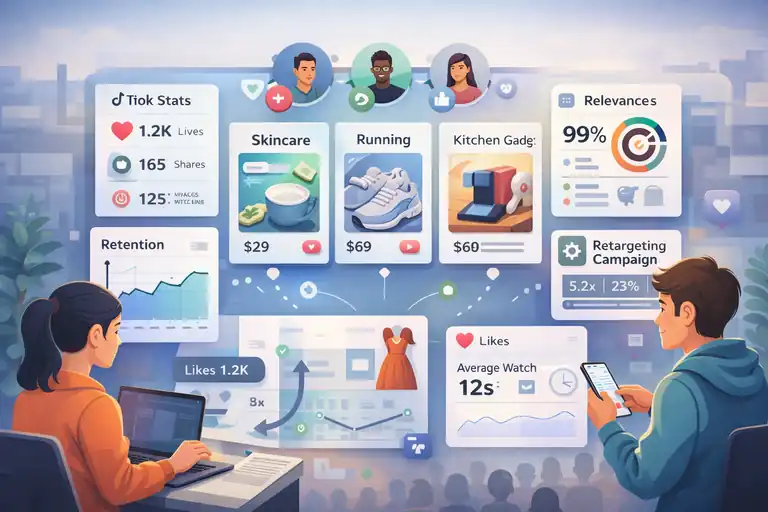
TikTok’s algorithm is the real sales engine behind TikTok ecommerce. If you understand how it thinks, you stop guessing—and start engineering reach.
Interest-Based Distribution Versus Follower-Based Reach
Most platforms show content to your audience. TikTok shows content to the right audience.
What that means practically:
- You don’t need followers to sell.
- Each video is judged independently.
- A single product video can explode overnight.
TikTok tests your video with small interest clusters. If it performs, it expands. If it doesn’t, it dies quietly—no penalty.
Signals TikTok watches early:
- Did people stop scrolling?
- Did they watch past the hook?
- Did they rewatch or share?
Followers barely matter at this stage.
This is why TikTok ecommerce is perfect for new brands. You’re not buried under established players.
Why Watch Time Matters More Than Likes for Sales
Likes feel good, but watch time pays the bills.
TikTok heavily prioritizes:
- Average watch duration
- Completion rate
- Rewatches
A video with 5,000 views and high watch time can outperform one with 100,000 views and low retention—especially for ecommerce.
Why this impacts sales:
- Longer watch time = deeper product understanding
- Deeper understanding = higher purchase confidence
I always tell brands: Optimize for retention, not vanity metrics.
Simple retention tactics that work:
- Delay the product reveal by 3–5 seconds.
- Tease the outcome before explaining the product.
- Use on-screen text to reset attention mid-video.
How Product Videos Get Pushed to Buyer-Ready Audiences
TikTok doesn’t just learn what people like—it learns what they buy.
Over time, the platform builds buyer profiles based on:
- Product views
- Clicks on product tags
- Completed purchases
- Saved shopping-related videos
Your product videos get matched with users who’ve shown similar buying behavior—even if they’ve never heard of your category.
This is where TikTok ecommerce feels unfair (in your favor):
- A skincare video reaches skincare buyers.
- A kitchen gadget hits people who already bought gadgets.
- A problem-solving product finds frustrated users automatically.
The more your content aligns with a clear use case, the faster TikTok connects it to buyers.
My honest advice: Don’t chase trends blindly. Chase buyer intent signals inside your niche. That’s how views turn into sales—consistently.
TikTok Shop Explained: Native Selling Inside the Platform
TikTok Shop is where TikTok ecommerce stops being theoretical and starts producing real orders.
Instead of sending users to an external store, TikTok lets brands sell directly inside the app, removing friction at the exact moment interest peaks.
How TikTok Shop Works for Brands and Sellers
At its core, TikTok Shop is an integrated storefront that connects your products to videos, lives, and creator content.
Here’s the simplified flow:
- Seller onboarding: Brands register as TikTok Shop sellers and connect a business account.
- Product sync: Products are uploaded manually or synced from platforms like Shopify.
- Content activation: Products are tagged inside organic videos, ads, and live streams.
What makes this powerful is distribution. TikTok doesn’t just host your store—it actively pushes product-tagged content to users most likely to buy.
From what I’ve seen, brands that treat TikTok Shop like a content channel—not a catalog—win faster.
Product Listings, In-App Checkout, and Order Flow
TikTok Shop removes several classic ecommerce friction points in one move.
Product listings include:
- Price, variants, and images
- Short product descriptions
- Reviews pulled from TikTok activity
In-app checkout means:
- No external browser
- Stored payment methods
- Fewer abandoned carts
Order flow looks like this:
- User taps a product tag in a video
- Product page opens inside TikTok
- Checkout completes without leaving the app
- Seller fulfills via their connected platform
Why this matters for conversion: Every extra click usually drops conversion rates by 10–20%. TikTok compresses the funnel into seconds.
Fees, Eligibility Requirements, and Regional Availability
TikTok Shop isn’t free—but it’s competitive.
Typical fee structure (varies by region):
- Referral/transaction fees: ~2–8%
- Optional affiliate commissions
- Shipping handled by seller or TikTok logistics partners
Eligibility basics:
- Business or creator account
- Verified identity and tax info
- Compliance with product policies
Regional rollout (as of now):
- Widely available in the US, UK, and parts of Southeast Asia
- Expanding rapidly into EU markets
My honest take: Even with fees, TikTok Shop often outperforms sending traffic to a standalone store—especially for impulse-driven products.
Content Formats That Convert Views Into Ecommerce Sales
TikTok ecommerce doesn’t convert because of ads—it converts because of formats. Certain video styles consistently lower skepticism and increase buying confidence.
Short-Form Product Demos That Reduce Buyer Friction
Short-form demos work because they answer objections visually.
High-converting demo traits:
- Show the problem within 2 seconds
- Demonstrate the solution clearly
- End with a soft CTA, not a hard sell
What works better than features:
- Before/after moments
- Side-by-side comparisons
- “I didn’t believe this until…” framing
I’ve watched 15-second demos outperform polished landing pages because people see the result instantly.
Creator-Style Videos Brands Use to Build Trust
Creator-style content doesn’t feel like advertising—and that’s the point.
Key elements:
- Handheld camera
- Casual language
- Imperfect delivery
Instead of saying “Our product is amazing,” these videos say:
- “Here’s how I actually use this.”
- “This fixed a problem I didn’t expect.”
- “I was skeptical, but…”
Trust multiplier: TikTok users trust creators more than brands. Mimicking that tone dramatically improves ecommerce performance.
Live Shopping Streams and Real-Time Purchase Triggers
Live shopping is TikTok ecommerce on fast-forward.
Why it works:
- Real-time Q&A removes doubt
- Scarcity triggers action
- Social proof builds instantly
Common live tactics that convert:
- Limited-time discounts
- Bundle-only offers
- Live-only bonus items
Even small brands see spikes during lives because urgency collapses decision time.
Influencer and Affiliate Models Powering TikTok Ecommerce
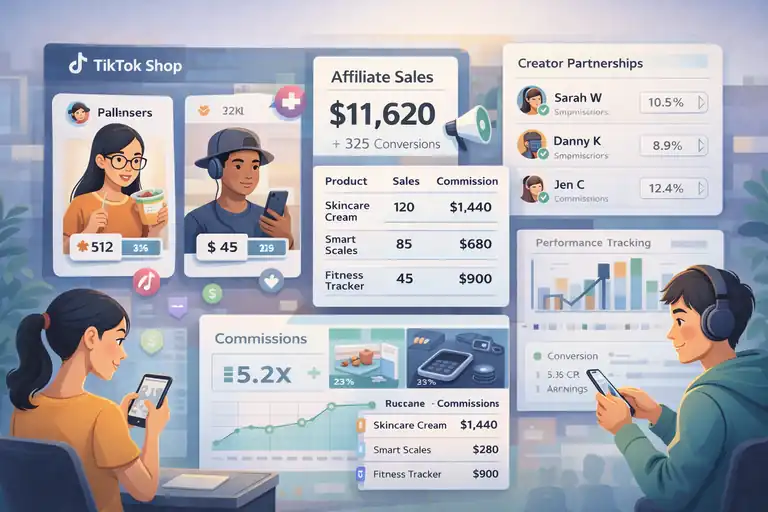
Influencers aren’t just awareness tools anymore—they’re distribution partners inside TikTok ecommerce.
How TikTok Affiliate Links Drive Scalable Sales
TikTok’s affiliate system lets creators earn commissions by tagging your product.
How it works:
- You set a commission rate
- Creators choose products to promote
- Sales are tracked automatically
Why this scales fast:
- No upfront cost
- Creators test content for you
- Winning videos can be boosted as ads
I’ve seen brands generate hundreds of UGC-style videos in weeks—without filming anything themselves.
Choosing Creators Based on Conversion, Not Followers
Follower count is a vanity metric. Conversion is the real KPI.
Better creator selection criteria:
- Past product tagging history
- Comment quality (questions = buying intent)
- Video watch time consistency
A creator with 8,000 followers who understands persuasion can outperform a 500K account chasing trends.
Managing Creator Partnerships Inside TikTok Shop
TikTok Shop includes built-in tools to manage creators efficiently.
What you can control:
- Commission rates by product
- Creator approval settings
- Performance tracking per video
Smart brands do this:
- Identify top-performing creators
- Increase commission for winners
- Repurpose their content into ads
My rule of thumb: If a creator video sells organically, it’s already validated. Scale it.
Integrating TikTok Ecommerce With Shopify and Platforms
Once TikTok ecommerce starts driving interest, integration is what turns chaos into a system. This is where brands stop guessing and start tracking, fulfilling, and scaling with confidence.
Connecting TikTok With Shopify Product Catalogs
If you’re using Shopify, this is the cleanest TikTok ecommerce setup available right now.
How the integration actually works:
- Install the TikTok app from the Shopify App Store
- Sync your product catalog automatically
- Enable product tagging for videos, ads, and TikTok Shop
Why this matters: You avoid duplicate listings, pricing mismatches, and inventory errors.
In practice, this saves hours every week. I’ve seen brands break campaigns simply because a product went out of stock without syncing.
Quick win: Only sync best-selling or test products first. Flooding TikTok with your entire catalog usually hurts performance.
Tracking Orders, Inventory, and Fulfillment Workflows
TikTok ecommerce can feel messy unless fulfillment is airtight.
Order flow options:
- Fulfill orders directly inside Shopify
- Use TikTok’s logistics partners (region-dependent)
- Route orders to 3PL services automatically
Inventory syncing benefits:
- Prevents overselling
- Updates stock levels in real time
- Avoids canceled orders that kill account trust
What I recommend: Centralize everything in Shopify, even if sales originate on TikTok. One source of truth keeps scaling sane.
Using TikTok Pixel for Ecommerce Conversion Data
The TikTok Pixel is a small tracking script that tells TikTok what users do after clicking.
What it tracks:
- Product views
- Add-to-cart actions
- Purchases and revenue
Why it’s critical for scaling:
- Feeds TikTok’s algorithm real buyer data
- Improves ad targeting over time
- Enables accurate ROAS tracking
Pro setup tip: Verify events inside TikTok Events Manager and prioritize Purchase and Add to Cart. Without this, you’re flying blind.
Paid TikTok Ads That Support Organic Ecommerce Sales
Paid ads don’t replace organic TikTok ecommerce—they amplify what’s already working. The smartest brands use ads as gasoline, not a match.
Spark Ads and Boosting High-Converting Organic Videos
Spark Ads let you turn existing organic posts into ads while keeping their engagement.
Why Spark Ads outperform cold ads:
- Social proof stays visible
- Content feels native
- Performance data already exists
My favorite workflow:
- Post organically
- Identify top-performing videos
- Boost only proven winners
This reduces risk and speeds up learning.
Retargeting Viewers Who Show Purchase Intent
Retargeting is where TikTok ecommerce gets efficient.
High-intent audiences include:
- 75% video viewers
- Product page viewers
- Add-to-cart users
What to show them:
- Testimonials
- FAQs answered on camera
- Objection-handling content
Think of retargeting as reassurance, not persuasion.
Scaling Winning Products With Conversion-Focused Ads
Once a product converts organically and via Spark Ads, scaling becomes mathematical.
Scaling signals to watch:
- Stable CPA over 3–5 days
- Consistent watch time above 50%
- Positive comment sentiment
Scaling methods that work:
- Duplicate winning ads into new ad sets
- Test new hooks with the same product
- Expand audiences slowly
Hard truth: If a product can’t sell organically on TikTok, ads usually won’t save it.
Trust Signals That Turn TikTok Viewers Into Buyers
Trust is the currency of TikTok ecommerce. Without it, views are just noise.
Social Proof Through Comments, Duets, and Reviews
TikTok comments are a hidden conversion engine.
Strong trust signals include:
- Questions about shipping or pricing
- Users tagging friends
- Creators dueting your product
Smart brands do this:
- Pin positive comments
- Reply with video responses
- Turn FAQs into new content
Each interaction compounds credibility.
User-Generated Content as an Ecommerce Conversion Tool
User-generated content (UGC) is content created by real customers or creators.
Why UGC converts better:
- Feels unbiased
- Shows real-world usage
- Matches TikTok’s native style
How to encourage UGC:
- Offer affiliate commissions
- Send free products to small creators
- Feature customer videos on your profile
I’ve seen UGC outperform brand ads by 3x in conversion rate.
Reducing Skepticism With Authentic On-Camera Proof
Skepticism is natural. Your job is to remove it.
On-camera proof that works:
- Live demonstrations
- Side-by-side comparisons
- Honest pros and cons
What builds trust fastest: Showing imperfections. Acknowledging limitations often increases credibility more than hype.
My honest advice: If you wouldn’t believe your own ad, your audience won’t either.
Common TikTok Ecommerce Mistakes Brands Must Avoid
Most TikTok ecommerce failures don’t happen because the product is bad—they happen because brands apply old marketing logic to a platform that rewards authenticity, speed, and feedback loops.
Overproduced Ads That Kill Authentic Engagement
Polished doesn’t mean persuasive on TikTok.
What overproduced ads usually signal:
- “This is an ad, skip it.”
- Brand-first messaging instead of user-first problems
- Zero emotional connection in the first 2 seconds
What works better:
- Natural lighting
- Handheld phone footage
- Real people speaking casually
I’ve personally paused high-budget ads because raw creator-style clips were converting better at half the cost.
Reality check: If it looks like a commercial, TikTok treats it like one.
Sending Traffic Off-App Too Early in the Funnel
One of the biggest TikTok ecommerce mistakes is forcing users to leave TikTok before trust is built.
Why off-app traffic hurts conversion:
- Page load delays break momentum
- Users switch mental contexts
- Drop-off skyrockets on mobile
Better approach:
- Use TikTok Shop or in-app product pages
- Answer objections inside content first
- Retarget before pushing external checkout
Rule I follow: Keep users in TikTok until they want to buy.
Ignoring Post-Purchase Content and Retention
Most brands stop posting once the sale happens. That’s expensive.
Post-purchase content drives:
- Repeat purchases
- UGC creation
- Word-of-mouth growth
Simple retention ideas:
- “How to use it” videos
- Setup or unboxing clips
- Comment replies from new buyers
Retention costs less than acquisition. TikTok makes it visible.
How Brands Measure TikTok Ecommerce Success Properly
TikTok ecommerce success isn’t about going viral—it’s about building repeatable revenue signals.
Metrics That Matter Beyond Views and Follower Growth
Views are attention. Revenue is success.
Metrics that actually matter:
- Conversion rate (views → sales)
- Cost per acquisition (CPA)
- Average order value (AOV)
- Revenue per video
Healthy benchmarks I’ve seen:
- 1–3% conversion from video views
- 30–50% average watch time
- Positive comment-to-view ratio
Followers help later. Early on, they’re optional.
Attribution Challenges in TikTok Ecommerce Funnels
TikTok doesn’t exist in a vacuum.
Common attribution issues:
- Users watch, don’t click, then buy later
- Cross-device behavior hides conversions
- Platform reporting mismatches Shopify data
How brands reduce confusion:
- Use TikTok Pixel + Shopify tracking together
- Compare blended ROAS, not platform-only ROAS
- Look at revenue lift during content spikes
From what I’ve seen, TikTok’s influence is often undercounted—not overcounted.
Optimizing Content Based on Revenue, Not Virality
Virality without revenue is just noise.
Better optimization questions:
- Which videos drive purchases, not likes?
- What hooks attract buyers, not scrollers?
- Which comments correlate with sales?
Smart move: Tag videos internally as awareness, consideration, or conversion. Optimize each differently.
Scaling TikTok Ecommerce From First Sale to Consistency
The jump from “first sale” to “consistent sales” is where TikTok ecommerce becomes a real business channel.
Systemizing Content Creation for Product Testing
Guessing kills momentum. Systems create leverage.
A simple testing system:
- 3 hooks per product
- 2 video formats per hook
- 1 clear problem per video
That’s six data points in days, not weeks.
What I’ve learned: Volume beats perfection every time on TikTok.
Expanding Winning Products Into Multiple Creatives
When something works, don’t celebrate—replicate.
Ways to expand winning creatives:
- New hooks with the same footage
- Different creators, same script
- Problem-focused vs outcome-focused angles
One product can support dozens of creatives without feeling repetitive.
Building Long-Term Brand Equity on TikTok Ecommerce
Short-term sales are great. Long-term trust is better.
Brand equity on TikTok comes from:
- Consistent posting cadence
- Transparent communication
- Showing the people behind the brand
My long-term belief: The brands that win TikTok ecommerce aren’t the loudest—they’re the most human.
FAQ
What Is TikTok Ecommerce?
TikTok ecommerce is the process of selling products directly through TikTok using short-form videos, live streams, and native tools like TikTok Shop. Brands turn product-focused content into sales by letting users discover, evaluate, and buy without leaving the app.
How Do Brands Turn TikTok Views Into Sales?
Brands convert views into sales by creating entertaining, problem-solving videos that trigger product discovery, then using product tags, TikTok Shop, and retargeting ads to remove buying friction. High watch time and native checkout are the biggest conversion drivers.
Does TikTok Ecommerce Work Without a Large Following?
Yes. TikTok ecommerce does not rely on follower count. The algorithm distributes content based on user interest and behavior, allowing new brands to generate sales from a single high-performing video.

I’m Juxhin, the voice behind The Justifiable.
I’ve spent 6+ years building blogs, managing affiliate campaigns, and testing the messy world of online business. Here, I cut the fluff and share the strategies that actually move the needle — so you can build income that’s sustainable, not speculative.
Related posts:
 Ecommerce Store Guide: 7 Negative Pitfalls to Avoid
 Affordable Ecommerce Email Marketing Agency Services
 Ecommerce Marketing Guide: Turn Traffic Into Sales
 Social Commerce Strategies to Turn Engagement Into Sales
 Ecommerce CRM Tools That Turn Customers Into Repeat Buyers
 Ecommerce SEO Strategy That Drives Buyers, Not Just Rankings