Table of Contents
Some links on The Justifiable are affiliate links, meaning we may earn a small commission at no extra cost to you. Read full disclaimer.
When I first started writing online, I remember searching endlessly for the best blogs to make money—the kind that could teach me how to turn my words into income without feeling like guesswork.
The truth is, there are thousands of blogs out there, but only a few genuinely help new content creators understand where to start, what to focus on, and how to actually make money from their content.
Whether you’re blogging for passion or profit, finding the right mentors and examples can change everything. Below, I’ve outlined the best blogs that truly empower beginners to grow, monetize, and master the art of online content creation.
Smart Passive Income: Proven Blogging Strategies That Work
Smart Passive Income (SPI) is one of those blogs that feels like having a patient mentor guiding you through every stage of online growth.
Created by Pat Flynn, it’s a goldmine for anyone who wants to build long-term revenue from their content without feeling overwhelmed.
Understanding How Smart Passive Income Builds Long-Term Revenue
What makes SPI stand out is its honest approach to passive income. Pat doesn’t promise overnight success; instead, he focuses on sustainable growth. The main principle here is creating assets once that pay off repeatedly.
He teaches readers to build systems—like evergreen content, online courses, and affiliate partnerships—that keep generating income even when you’re not actively working.
For example, instead of chasing trending blog posts, Pat suggests focusing on pillar content: high-value guides that continue to attract visitors for years.
The SPI podcast also dives deep into real stories from successful creators, showing how they’ve turned consistent effort into recurring income. I’ve personally found his long-term view refreshing—it’s more about freedom than hustle.
Step-By-Step Guides for Affiliate Marketing Beginners
If you’re new to affiliate marketing, SPI offers detailed roadmaps that make the process feel achievable.
Here’s how Pat breaks it down:
- Start with trust. Don’t recommend anything you wouldn’t use yourself.
- Choose affiliate programs that match your audience’s real needs.
- Create content that naturally integrates products—tutorials, reviews, or personal experiences.
- Use transparency to your advantage; disclose partnerships clearly.
One of Pat’s most memorable lines is that “affiliate income is just a byproduct of helping people.” This mindset shift is what separates ethical marketers from pushy ones.
Lessons From Pat Flynn on Building Trust and Authority
Pat Flynn’s biggest lesson? Be human first.
Instead of hiding behind polished marketing, he openly shares his wins and failures. This vulnerability builds authenticity, something that resonates deeply with new bloggers.
Readers trust him because he never claims perfection—he shares experiments, even the ones that flop.
From what I’ve seen, adopting his “teach everything you learn” philosophy can rapidly grow authority. The more openly you share your process, the faster people begin to see you as an expert worth listening to.
How to Turn Blog Traffic Into Sustainable Income Streams
Traffic by itself doesn’t pay the bills—but Smart Passive Income teaches you how to convert it.
The key lies in diversification:
- Affiliate marketing for product-based income.
- Digital courses and memberships for predictable revenue.
- Podcasting and email funnels to nurture long-term followers.
Pat also emphasizes email list ownership. Social media may fluctuate, but your email subscribers remain your most loyal audience—and that’s where consistent revenue begins.
ProBlogger: Expert Advice for Making Money from Blogging
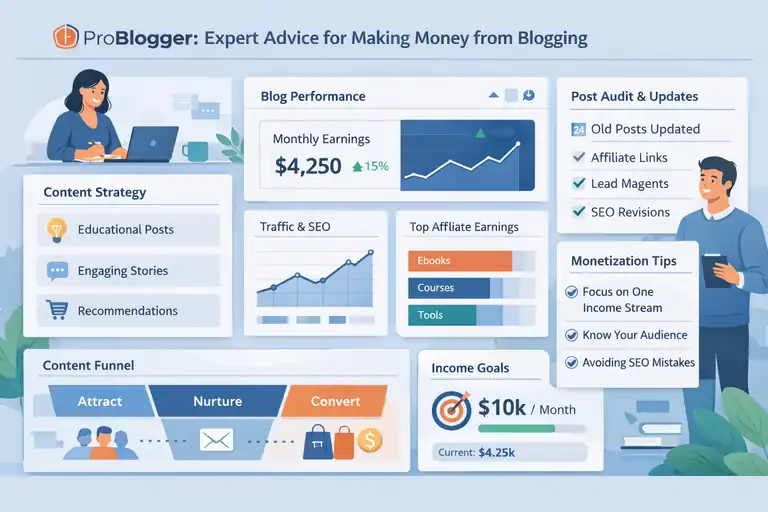
ProBlogger, founded by Darren Rowse, is like a masterclass in professional blogging. It bridges the gap between writing for passion and writing for profit—perfect for creators ready to take things seriously.
Actionable Blogging Tips That Help You Monetize Faster
Darren doesn’t sugarcoat it—making money blogging takes time, but his strategies speed up the process.
Some of his most effective tips include:
- Posting consistently to build reader habits.
- Treating each blog post like a mini marketing campaign.
- Creating series-based content that keeps readers coming back.
He also teaches how to audit old posts for monetization potential—something most beginners overlook. Updating older content with affiliate links or lead magnets can double your earnings without writing anything new.
Building a Content Strategy That Attracts Paying Readers
What I love about ProBlogger is its practical focus on content strategy. Darren suggests starting by identifying your reader transformation: what problem are you helping them solve?
Once you know that, every piece of content should guide them toward a paid solution—whether it’s an ebook, course, or affiliate product. This creates a natural journey from value to purchase, instead of random sales pitches.
A simple content strategy formula from ProBlogger looks like this:
- Start with educational posts.
- Nurture with relatable stories.
- Sell through helpful recommendations.
Common Monetization Mistakes New Bloggers Should Avoid
Darren’s been blogging since 2002, and he’s seen every rookie mistake in the book.
His top three warnings:
- Ignoring your audience’s intent. Don’t write what you want—write what they need.
- Chasing too many income streams at once. Focus on one monetization method before expanding.
- Neglecting SEO. Without search traffic, even the best content goes unseen.
He often says, “Traffic without strategy is like water in your hands—it slips away fast.” I’ve found that painfully true.
Turning Your Writing Into a Profitable Online Business
At its core, ProBlogger encourages creators to think like entrepreneurs. That means treating your blog like a real business—with systems, branding, and measurable goals.
Darren advises setting income goals early and tracking what works. For instance, one of his posts about creating ebooks shows how a single product can earn thousands with consistent promotion.
His lesson? Don’t wait until your blog feels “ready” to monetize—start testing early and refine along the way.
Neil Patel Blog: Data-Driven Marketing and SEO Growth
Neil Patel’s blog is the powerhouse for anyone who wants to turn data into dollars. It’s where content creators learn not just to write—but to rank, convert, and scale intelligently.
How Neil Patel Uses SEO to Drive Blog Revenue
Neil’s entire philosophy centers on optimization. Every blog post is designed to attract traffic, convert visitors, and feed business goals.
He teaches how to identify high-intent keywords—the ones people search right before making a purchase—and build content around them. His in-depth tutorials on technical SEO (like site speed, backlinks, and user experience) are beginner-friendly but powerful.
I’ve applied some of his SEO frameworks myself, like using topic clusters, and saw consistent organic traffic within months. It’s all about building authority through helpful, keyword-rich content that Google loves.
Keyword Research Tactics That Boost Earnings
Neil’s keyword research process is what separates hobby bloggers from professionals.
Here’s the simplified version:
- Use free tools like Ubersuggest to find high-volume, low-competition keywords.
- Prioritize commercial intent—keywords tied to buying behavior.
- Build content silos: groups of related articles that link to one another.
He often says, “Don’t just chase clicks—chase conversions.” That means writing with a goal, not just to fill space.
Scaling Blog Traffic with Content Marketing Frameworks
Neil Patel doesn’t stop at SEO. He dives into frameworks for scaling content sustainably.
A few standout strategies include:
- Updating top-performing posts quarterly to maintain rankings.
- Repurposing blog content into YouTube videos or LinkedIn posts.
- Building funnels that guide readers from awareness to purchase.
In his view, growth isn’t just about more posts—it’s about smarter use of existing content.
Monetization Insights from Real SEO Experiments
What I find fascinating about Neil’s blog is how transparent he is about experiments. He shares metrics—what worked, what tanked, and why.
He’s shown, for example, how improving page load speed by just one second increased conversions by 7%. Small optimizations lead to real money when scaled across hundreds of pages.
His biggest takeaway: traffic is meaningless unless you know what to do with it. Every blog should be built to convert—whether that’s through affiliate links, email signups, or product sales.
Pro tip: If you’re a new content creator, start by studying how these three experts—Pat Flynn, Darren Rowse, and Neil Patel—align authenticity, strategy, and data. Combine their principles: Pat’s trust-based approach, Darren’s structured monetization, and Neil’s SEO mastery. That’s the formula for turning a blog into a lasting income engine.
Adam Enfroy Blog: From Zero to Full-Time Blogger
Adam Enfroy’s blog is like the blueprint for turning blogging into a real business.
What I love about his approach is how straightforward he makes it—no hype, no fluff—just the systems and mindset needed to go from zero to full-time income online.
The Business Mindset Behind Successful Blogging
Adam approaches blogging like an entrepreneur, not just a writer. He often says that treating your blog as a business from day one changes everything—from how you spend your time to the way you measure success.
Instead of obsessing over daily page views, he focuses on ROI (return on investment). That means asking: How does this post generate leads, affiliate revenue, or authority?
One of his most valuable lessons is that a blog isn’t a diary—it’s a digital asset. Each post should have a purpose, like building email subscribers or ranking for monetizable keywords. Thinking this way early helps creators avoid burnout and grow strategically.
Step-by-Step Blueprint to Earn with Affiliate Marketing
Adam’s affiliate strategy is refreshingly practical, especially for beginners. He built a six-figure income by mastering SEO-driven affiliate content, and he shares the entire process transparently.
Here’s the basic structure he teaches:
- Pick a profitable niche: Choose one with proven affiliate programs (like software, tools, or online courses).
- Do keyword research: Target terms that signal intent—phrases like “best,” “review,” or “comparison.”
- Create value-first content: Write tutorials or guides that genuinely help readers make informed choices.
- Track and optimize: Measure click-through rates and conversions to refine what works.
I’ve used his method for smaller projects, and it really does simplify the learning curve. It’s less about chasing viral posts and more about building consistent revenue assets.
Why Adam Enfroy Treats Blogging Like a Startup
Adam’s unique angle is seeing blogging as a scalable startup. He applies business systems—delegation, automation, and data tracking—to what’s traditionally a one-person job.
He often says, “Think like a CEO, not a freelancer.”
That means:
- Outsourcing repetitive tasks (like formatting or editing) to save time.
- Using analytics tools to make decisions instead of guesses.
- Building partnerships with other creators to expand reach.
I believe this mindset is what helped him grow faster than most bloggers. Instead of writing more, he builds smarter.
Scaling Content Creation Without Losing Quality
As traffic grows, it’s easy to sacrifice quality for quantity. Adam’s system prevents that. He teaches how to scale through content teams and standardized templates.
He documents everything—from content briefs to SEO checklists—so anyone on his team can produce consistent results. Even if you’re solo right now, you can apply the same principle by creating repeatable processes for your posts.
A great starting point is building a content calendar that prioritizes evergreen topics. This ensures you’re investing time into posts that stay relevant (and profitable) for years.
Blogging Wizard: Simplified Tools and Growth Tactics
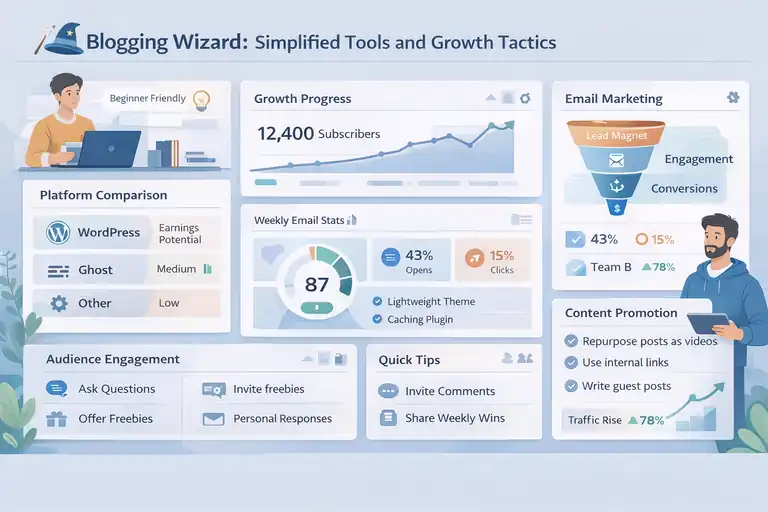
Blogging Wizard, created by Adam Connell, is a treasure for creators who want to grow without tech overwhelm.
It’s packed with practical tools, strategies, and how-tos that help you make real progress without expensive software or steep learning curves.
Choosing the Right Blogging Platform to Earn More
One of the first challenges new bloggers face is picking a platform. Blogging Wizard breaks it down in plain language, comparing WordPress, Ghost, and other tools based on earning potential.
The takeaway? Own your platform. Self-hosted WordPress is the top choice because it gives you control over monetization—whether through ads, affiliate links, or digital products.
Adam also stresses the importance of site speed and security for revenue growth. For example, using lightweight themes and caching plugins can improve SEO rankings, leading to more traffic and higher earnings.
How to Build and Grow an Engaged Audience
Growing an audience isn’t about luck—it’s about connection. Blogging Wizard teaches you to build relationships through helpful content and consistent communication.
Some of the simplest tactics work best:
- Ask questions in your posts to invite comments.
- Create lead magnets like checklists or templates.
- Reply personally to early subscribers and commenters.
From my experience, genuine engagement often beats large, passive audiences. When people feel seen, they stay—and eventually buy.
Effective Email Marketing Strategies for Beginners
Blogging Wizard simplifies email marketing, especially for beginners. Adam recommends starting with one easy tool like Brevo (formerly Sendinblue) or Kit (formerly ConvertKit).
He suggests sending simple, conversational newsletters that educate or inspire. No need for fancy designs—just clarity and value.
A few beginner-friendly email ideas:
- Share weekly “quick wins” from your latest post.
- Offer exclusive freebies to subscribers.
- Create a short welcome sequence that introduces your brand story.
The focus is to nurture readers into fans—because fans convert.
Content Promotion Tips That Actually Drive Income
Even great content won’t earn money if no one sees it. Blogging Wizard teaches smart, low-cost promotion strategies that actually move the needle.
A few examples include:
- Repurposing blog posts into short-form videos for TikTok or Reels.
- Using internal links to guide readers toward monetized posts.
- Writing guest posts on niche sites to earn backlinks and authority.
I’ve found that combining these with SEO gives your blog both immediate and long-term exposure.
Create and Go: Blogging for Passive Income
Create and Go, founded by Alex and Lauren, is a blog built for people who want to make money online while living life on their own terms. Their teaching style is honest, beginner-friendly, and focused on realistic income growth, not hype.
Realistic Ways to Make Money Blogging in Your First Year
What I appreciate about Create and Go is that they don’t sugarcoat the first year—it’s tough. But they show how to make that time count.
Their method focuses on three practical income streams:
- Affiliate marketing: Promoting products you genuinely use.
- Ad revenue: Using platforms like Mediavine or Raptive once your traffic grows.
- Digital products: Selling ebooks, templates, or courses.
Even hitting a few hundred dollars per month is possible with focus and consistency. Their advice helps you build realistic expectations and sustainable systems.
Creating Digital Products That Sell While You Sleep
Alex and Lauren are masters of passive income through digital products. They emphasize solving specific problems—like “how to meal plan on a budget” or “how to grow on Pinterest”—rather than broad topics.
Their process includes:
- Surveying your audience to find their biggest struggles.
- Building a simple product (like a guide or mini-course).
- Launching with email and blog-based promotions.
The beauty of digital products is that once created, they can sell indefinitely with minimal maintenance.
Pinterest Traffic Secrets for New Bloggers
Pinterest is one of Create and Go’s secret weapons. They built most of their early traffic through it, and their approach is still relevant today.
They teach beginners how to:
- Create branded, eye-catching pins using Canva.
- Schedule posts with Tailwind for consistent visibility.
- Write SEO-optimized pin descriptions with targeted keywords.
Pinterest might not get as much hype as it once did, but it’s still a goldmine for bloggers in lifestyle, food, and personal development niches.
Turning Blogging Into a Full-Time Career Path
Create and Go’s story—from corporate burnout to full-time bloggers—shows what’s possible when you stay committed.
They encourage treating your blog as a journey of growth. The first year might be about learning; the second, about scaling. By year three, many of their students are earning stable, passive income.
Their biggest advice? Don’t wait for perfect. Publish, test, adjust, and keep going. Blogging rewards persistence more than perfection.
HubSpot Blog: Content Marketing That Converts
HubSpot’s blog is where marketing meets monetization. It doesn’t just teach you how to attract readers—it shows you how to turn them into paying customers.
Every post feels like a mini course in strategy, filled with actionable insights and real data.
Learning the Foundations of Blog Monetization Through Marketing
HubSpot believes that making money from blogging starts with understanding the buyer’s journey. That means aligning your content with what your readers need at each stage—awareness, consideration, and decision.
In simple terms:
- Awareness content attracts traffic (think “how-to” guides).
- Consideration content builds trust (like comparisons or tutorials).
- Decision content drives conversions (product demos, case studies, or offers).
By mapping your posts to these stages, you ensure your blog isn’t just read—it’s remembered and acted upon.
I’ve personally found this framework powerful when building content funnels that actually convert visitors into customers.
Using Analytics to Identify High-Earning Blog Topics
One of HubSpot’s strongest lessons is to rely on data, not guesses. Their analytics dashboard helps you see which posts generate leads or revenue, not just clicks.
Here’s what to track:
- Conversion rate: Which topics lead to email signups or purchases.
- Time on page: Longer engagement often signals buying interest.
- Traffic source: SEO traffic usually converts better than social traffic.
When you focus on metrics that matter, you can double down on profitable topics instead of writing endless posts that don’t move the needle.
How to Turn Blog Posts Into Lead-Generating Assets
HubSpot’s marketing system shines here. They teach how to turn any post into a lead magnet by adding strategic CTAs (calls to action) and content upgrades.
For example, if you wrote a post on “how to start a podcast,” you could offer a free checklist in exchange for an email signup. Over time, this builds a list of warm leads ready for your offers.
Their principle is simple: every post should either educate or convert. When done right, your blog becomes a quiet but consistent sales engine.
Repurposing Blog Content for Multiple Income Streams
HubSpot is a masterclass in repurposing. They constantly reuse blog posts across different platforms—videos, social media, and email campaigns—to reach wider audiences.
You can follow their model by:
- Turning tutorials into YouTube videos.
- Creating mini-ebooks from popular post series.
- Sharing blog excerpts as LinkedIn articles.
This multiplies your income potential without creating from scratch every time. I like to think of it as getting compound interest on your content.
The She Approach: Monetization for Creative Entrepreneurs
Ana, the creator behind The She Approach, brings a personal and empowering voice to monetization.
She’s proof that creativity and business can go hand in hand—and that you don’t need a massive audience to earn well.
Strategies for Selling Digital Products as a Blogger
Ana focuses on selling digital products like ebooks, templates, and printables. Her golden rule: start simple.
She suggests beginning with a low-cost product that solves one clear problem—like a “blog content planner” or “Instagram caption toolkit.” This helps you test the market without heavy investment.
What’s smart about her approach is the emphasis on feedback. She encourages creators to involve their audience in the process by asking what they’d actually buy. This turns product creation into a collaboration, not a gamble.
Building Email Funnels That Generate Sales Automatically
Email funnels are Ana’s secret weapon for passive income. She uses simple, automated sequences to warm up subscribers before making an offer.
Her formula looks like this:
- Deliver free value (a checklist, guide, or template).
- Send educational emails that build trust.
- Introduce a low-cost product that feels like a natural next step.
I’ve seen this work beautifully—it’s like guiding a friend from “curious” to “confident buyer.”
How to Use Blog Content to Grow a Personal Brand
Ana teaches that your blog is more than a platform—it’s your portfolio. She shows how to use storytelling and consistent messaging to make your brand memorable.
A few ways she suggests doing this:
- Use personal anecdotes to build relatability.
- Stick to one tone and color scheme across all content.
- Align blog topics with your mission and expertise.
Your blog should make readers say, “I trust her—I want to learn from her.” That trust is what turns followers into buyers.
Creating an Income Diversification Plan for Stability
Ana emphasizes not relying on one income stream. Blogs can dip in traffic, affiliate programs can close—but multiple streams create safety.
She encourages combining:
- Digital products
- Affiliate partnerships
- Sponsored collaborations
- Services or coaching
It’s like having a table with four legs—if one wobbles, the rest keep you steady. I’ve applied this mindset myself, and it’s a game-changer for financial stability.
Making Sense of Cents: Real Financial Freedom from Blogging
Michelle Schroeder-Gardner’s blog, Making Sense of Cents, is the definition of turning content into true financial freedom.
She started blogging about paying off debt and built it into a million-dollar business—all from home.
Lessons on Balancing Content Creation and Monetization
Michelle’s biggest lesson is to balance authenticity with strategy. She writes about personal finance from her real-life experiences, which makes her content relatable and trustworthy.
Her rule of thumb: help first, sell later. When you genuinely care about your reader’s progress, monetization becomes a natural result.
She also stresses having clear boundaries—set time for writing, marketing, and resting. Burnout kills creativity faster than anything.
How Michelle Schroeder-Gardner Earned Six Figures Blogging
Her success wasn’t overnight. Michelle built her income mainly from affiliate marketing and digital courses.
Her core approach:
- Focus on evergreen finance topics (budgeting, saving, side hustles).
- Use SEO to attract consistent organic traffic.
- Integrate affiliate links naturally within value-rich posts.
One of her best examples is her post on “how to start a blog,” which generates thousands monthly through affiliate links. It’s proof that transparency and helpfulness can be incredibly profitable.
Actionable Tips to Build Passive Income Through Blogging
Michelle’s approach to passive income is refreshingly practical. She focuses on:
- Creating evergreen content that stays relevant over time.
- Building email lists to promote affiliate offers automatically.
- Investing in automation tools to save time.
She often says, “Work hard once, and let it pay you forever.” That’s passive income in a nutshell.
Managing Time and Motivation as a Solo Creator
As a solo blogger, Michelle’s advice on time management hits home. She recommends working in focused blocks, setting weekly priorities, and celebrating small wins.
Her philosophy: progress beats perfection. Even one high-quality post per week adds up over time. I think her grounded approach keeps new creators realistic—and motivated to keep going.
Authority Hacker: Building a Profitable Authority Blog
Authority Hacker, created by Gael Breton and Mark Webster, is like a business school for bloggers. Their content is data-driven, transparent, and built around building blogs that last—not ones that burn out.
What Makes an Authority Site Different from a Typical Blog
An authority site focuses on becoming the go-to resource in one niche. Unlike casual blogs, authority sites are built strategically—with SEO, branding, and monetization in mind from the start.
Gael and Mark teach how to create topical depth—meaning you cover every angle of a topic so Google sees you as an expert.
They also stress building trust with readers through transparency and useful tools, not clickbait. That’s what separates long-term authority sites from one-hit blogs.
Step-by-Step Breakdown of Affiliate Site Monetization
Authority Hacker’s monetization process is one of the most structured in the industry.
Their steps:
- Research a niche with high affiliate potential.
- Build SEO-driven content clusters.
- Use data to identify high-converting keywords.
- Create comparison articles that rank and convert.
Their Authority Site System (TASS) course goes deeper, but even their free blog content is enough to start seeing results.
SEO and Content Systems That Generate Ongoing Revenue
Their philosophy is to build systems, not chaos. They automate SEO reporting, backlink outreach, and even content briefs.
It’s about consistency: publishing predictable, high-quality content regularly. This builds domain authority over time, which keeps earnings stable.
They often cite that a single well-ranked article can earn $1,000+ per month—if optimized and updated consistently. That’s the kind of predictability every creator dreams of.
Building Scalable Systems for Long-Term Growth
What makes Authority Hacker’s approach sustainable is their obsession with scaling smartly.
They teach outsourcing content writing, building internal teams, and creating workflows so you’re not chained to your desk.
It’s not about working more, it’s about working better. If you ever feel overwhelmed running your blog solo, their methods can show you how to regain time while increasing profit.
Pro tip: If you’re searching for the best blogs to make money, these four—HubSpot, The She Approach, Making Sense of Cents, and Authority Hacker—cover every stage of growth. From marketing and branding to passive income and scaling, they prove that blogging isn’t luck; it’s strategy, structure, and staying consistent.
FAQ
What are the best blogs to make money for new content creators?
Some of the best blogs to make money include Smart Passive Income, ProBlogger, Neil Patel, Adam Enfroy, and Create and Go. They offer proven tips on monetization, SEO, and affiliate marketing.
How can new bloggers start making money from their blog?
New bloggers can start earning by focusing on affiliate marketing, sponsored content, digital products, and email marketing while building consistent traffic through SEO.
Which blog is best for learning affiliate marketing?
Smart Passive Income by Pat Flynn is one of the best blogs to make money through affiliate marketing, offering step-by-step tutorials and real-world strategies for beginners.

I’m Juxhin, the voice behind The Justifiable.
I’ve spent 6+ years building blogs, managing affiliate campaigns, and testing the messy world of online business. Here, I cut the fluff and share the strategies that actually move the needle — so you can build income that’s sustainable, not speculative.