
Table of Contents
Some links on The Justifiable are affiliate links, meaning we may earn a small commission at no extra cost to you. Read full disclaimer.
I’ve seen the doba company come up a lot in dropshipping discussions, usually framed as an “easy” way to start selling without inventory, and that curiosity is probably what brought you here too.
This review is for aspiring dropshippers, ecommerce beginners, and online sellers who are trying to decide whether Doba is actually worth their money or just another overhyped platform.
The core question I’ll answer is simple: is Doba a legitimate dropshipping solution you can build a business on, or does it fall short once you look past the marketing?
Is Doba Company Legit For Online Dropshipping Businesses?
Before you worry about features or pricing, the first thing that matters is trust.
When people ask whether the doba company is legit, they’re really asking if it’s safe to build a real business on—or if it’s going to create problems down the road.
How Doba Company Operates As A Dropshipping Middleman
Doba company doesn’t manufacture or ship products itself. It operates as a middleman platform that connects you to thousands of third-party suppliers through one dashboard.
How the model works in plain English:
- You pay Doba a monthly subscription.
- You choose products from Doba’s catalog.
- When you get a sale, Doba forwards the order to the supplier.
- The supplier ships the product to your customer.
In my experience, this setup lowers the barrier to entry. You don’t need supplier outreach, contracts, or inventory management. But the trade-off is control. Because you’re not dealing with suppliers directly, margins, branding, and shipping speed are often out of your hands.
This model is legitimate, but it’s fundamentally different from supplier-direct dropshipping, where you negotiate pricing and terms yourself.
Business Verification, Supplier Vetting, And Trust Signals
One reason Doba company has lasted this long is that it does real supplier screening. Not perfectly, but enough to avoid the worst-case scenarios.
Key trust indicators worth noting:
- U.S.-based company with over 20 years in operation
- Suppliers must meet basic business verification requirements
- Many suppliers are domestic wholesalers, not overseas marketplaces
Doba claims to work with thousands of pre-vetted suppliers, which helps reduce outright scams. That said, vetting doesn’t mean “high quality.” It usually means the supplier is legitimate, not that their products or fulfillment are exceptional.
From what I’ve seen, this is acceptable for beginners—but experienced sellers often outgrow it quickly.
Common Legitimacy Concerns New Users Should Know
Most complaints about the doba company aren’t about fraud. They’re about expectations not matching reality.
The most common concerns I hear:
- Product prices are often higher than AliExpress or direct suppliers
- Shipping times vary widely between suppliers
- Limited ability to customize packaging or branding
- Refunds and returns depend heavily on the supplier, not Doba
These issues don’t make Doba illegitimate, but they do make it risky if you promise fast shipping or premium branding.
I always tell people: if your store’s value proposition depends on speed or uniqueness, Doba may feel restrictive.
Who Doba Company Is Best Suited For Realistically
I believe the doba company works best for a very specific type of seller.
Doba is a reasonable fit if you are:
- New to dropshipping and want minimal setup friction
- Testing product ideas before committing to direct suppliers
- Running a general store without strong branding requirements
- Selling primarily to U.S. customers with standard expectations
Doba is a poor fit if you are:
- Focused on long-term brand building
- Competing on price in aggressive niches
- Scaling paid ads where margins matter
- Needing consistent 2–5 day shipping
Think of Doba as training wheels. Legit, functional, and useful—but not something most people ride forever.
Doba Company Features That Matter For Daily Store Operations
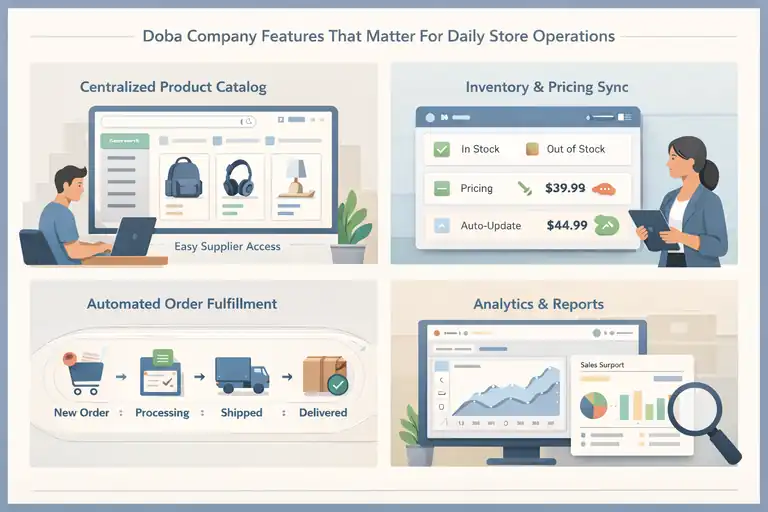
Features matter less on paper and more in day-to-day use. This section looks at how Doba company actually performs when you’re running a store, not just browsing a demo.
Centralized Product Catalog And Supplier Access Model
Doba’s biggest strength is its centralized catalog. Instead of juggling multiple supplier accounts, everything lives in one dashboard.
What this helps with:
- Faster product sourcing
- Easier category browsing
- No supplier outreach or approval delays
The downside is depth. You’re choosing from what Doba makes available, not the entire market. In my experience, the catalog is broad but not deep. You’ll find plenty of “okay” products, fewer standout winners.
This is great for speed, less great for differentiation.
Inventory Sync, Pricing Updates, And Data Accuracy
Doba company does automated inventory syncing, which is critical for avoiding overselling.
How it works in practice:
- Supplier stock levels update automatically
- Price changes are pushed to your store
- Out-of-stock items can be paused
This is one area where Doba performs solidly. It reduces manual work and prevents some common beginner mistakes. That said, sync speed depends on the supplier. I’ve seen delays of several hours, which can matter during sales spikes.
If you’re running ads, I recommend padding inventory rules or limiting daily order volume.
Order Routing, Automation, And Fulfillment Workflow
Order automation is where Doba saves the most time.
Typical fulfillment flow:
- Customer orders from your store
- Order appears in Doba dashboard
- You approve and pay for the order
- Supplier ships directly to customer
It’s not fully hands-off, but it’s streamlined. You still need to review orders, especially early on. I actually prefer this—it gives you a chance to catch pricing errors or shipping mismatches before they become customer complaints.
For beginners, this balance between automation and control is a plus.
Analytics, Reporting, And Product Research Capabilities
This is where Doba feels dated compared to newer tools.
What you get:
- Basic sales reports
- Order tracking status
- Limited product performance data
What’s missing:
- Trend analysis
- Demand forecasting
- Competitor insights
I don’t rely on Doba for product research. I treat it as a fulfillment layer, not a strategy tool. Most successful sellers I know pair it with external research tools or marketplace data.
If you expect built-in “winning product” insights, you’ll be disappointed. If you expect basic operational visibility, it gets the job done.
Doba Company Pricing Plans And Real Cost Breakdown
Pricing is where most people either commit to Doba or quietly back away.
On the surface, the doba company looks straightforward, but once you factor in limits, upsells, and margins, the real cost becomes clearer.
Subscription Tiers And What Each Plan Actually Unlocks
Doba currently offers four main plans: Limited, Basic, Standard, and Enterprise. Each tier mainly controls scale, not quality.
- Limited ($29.99/month): Best for testing, not selling. You get one store integration, very low product limits, and capped inventory access. I see this as a sandbox, not a business plan.
- Basic ($59.99/month): This is where things become usable. More listings, better inventory capacity, and access to product research tools. Still tight if you plan to test aggressively.
- Standard ($149.99/month): This is Doba’s “real business” tier. Higher product downloads, API access, auto-listing, and more integrations. Most sellers who stick with Doba long-term end up here.
- Enterprise ($299.99/month): Built for volume sellers managing many stores. If you’re not already doing serious order volume, this tier usually doesn’t make sense.
From what I’ve seen, pricing isn’t about features—it’s about how many chances you get to experiment.
Hidden Costs That Impact Long-Term Profitability
This is where people get surprised. The subscription is only part of the cost.
- Product pricing markups: Doba suppliers often bake margins into product costs. That eats into ad profitability fast.
- Shipping fees vary by supplier: You don’t get flat-rate shipping. Some products look profitable until checkout.
- Returns and restocking policies: Returns are supplier-dependent, which means you may eat losses to keep customers happy.
- Scaling requires plan upgrades: You’ll outgrow lower tiers quickly if testing multiple niches.
I’ve seen sellers spend $150/month on Doba and still struggle to clear $10 profit per order.
Comparing Doba Company Costs To Supplier-Direct Models
This is the comparison that matters.
| Model | Monthly Cost | Margins | Control | Time Investment |
| Doba Company | $30–$300 | Lower | Limited | Low |
| Supplier-Direct | $0–$50 | Higher | High | Medium |
| AliExpress-Based | $0 | Medium | Medium | High |
Doba trades margin for convenience. If your time is more valuable than your profit per sale, that trade can make sense early on.
Pricing Red Flags That Affect Scaling Potential
A few things I always flag when evaluating Doba pricing:
- You pay more as you test more
- Margins don’t improve with volume
- No supplier negotiation leverage
- Ad scaling exposes thin profits fast
In my opinion, Doba pricing works best for validation, not aggressive scaling.
Doba Company Supplier Quality And Product Selection
Supplier quality is where Doba feels both safe and limiting at the same time. You won’t run into scams, but you also won’t find many hidden gems.
Type Of Suppliers Available Inside The Doba Marketplace
Doba primarily works with U.S.-based wholesalers and distributors. That’s a plus for trust and shipping consistency.
- Domestic wholesalers with existing fulfillment systems
- Branded distributors reselling known products
- Private suppliers offering generic items
What you won’t find much of are small, flexible suppliers willing to customize or negotiate.
Product Niches Where Doba Company Performs Best
Doba performs best in practical, evergreen categories.
- Home and kitchen
- Office and business supplies
- Pet products
- Tools and hardware
These niches work because customers prioritize availability over branding. Trend-driven niches usually underperform here.
Quality Control Limitations And Brand Consistency Issues
Here’s the honest truth: Doba doesn’t control quality. Suppliers do.
- Product photos vary wildly
- Packaging is inconsistent
- Branding is usually generic or absent
If you’re building a brand-first store, this becomes a problem fast. I’ve seen sellers receive products that look fine individually but destroy brand trust over time.
Shipping Speed, Packaging, And Customer Experience Risks
Shipping speed is better than overseas marketplaces, but still inconsistent.
- Most U.S. suppliers ship in 3–7 business days
- Tracking delays happen
- Packaging is supplier-standard, not customer-friendly
This means your customer experience depends more on the supplier than your store. That’s manageable early on, but risky at scale.
Doba Company Integrations With Ecommerce Platforms
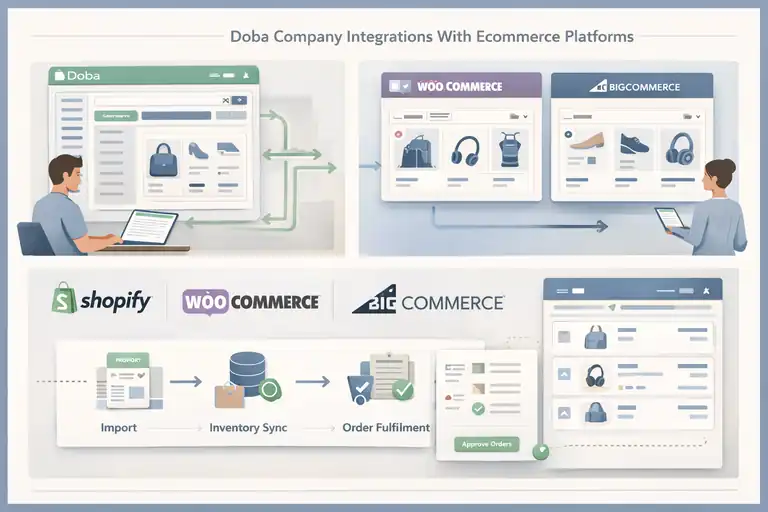
Integrations are where theory meets reality. Doba company promises “plug-and-play” connections, but what really matters is how much work you still end up doing once the store is live.
Shopify Integration Depth And Automation Limitations
Shopify is Doba’s strongest integration, and if you’re using Doba at all, this is the platform I’d recommend pairing it with.
The integration allows you to:
- Import products with one-click listings
- Sync inventory and pricing changes
- Push orders into the Doba dashboard for fulfillment
That sounds fully automated, but in practice it’s semi-automated. Orders still require review and payment approval inside Doba.
I actually see this as a mixed blessing. On one hand, it slows things down. On the other, it prevents accidental losses when supplier prices change overnight.
Where Shopify users get frustrated is customization. Product descriptions, variants, and images often need cleanup after import. If you care about conversion rate optimization, you’ll still be editing listings manually.
My takeaway: solid integration, but not hands-off ecommerce.
Compatibility With WooCommerce, BigCommerce, And Others
Doba supports WooCommerce, BigCommerce, Wix, and a few other platforms, but these integrations are noticeably thinner.
Common limitations include:
- Fewer automation rules
- Slower inventory syncing
- More manual CSV-style product handling
WooCommerce users especially feel this. Because WooCommerce is more flexible by nature, Doba’s structured system can feel restrictive. You can make it work, but expect more setup time and troubleshooting.
If you’re not already locked into another platform, Shopify remains the least painful option with Doba company.
Manual Work Required Despite Platform Integrations
This is the part most reviews gloss over. Even with integrations enabled, Doba does not eliminate manual work.
You’ll still need to:
- Review product pricing before publishing
- Check shipping costs per supplier
- Approve and pay for orders
- Handle customer service yourself
I’ve seen new sellers assume integrations mean “set it and forget it.” That mindset usually leads to thin margins and angry customers. Doba works best when you treat it like an assistant, not an autopilot.
How Integration Gaps Affect Store Efficiency
Integration gaps don’t just cost time. They cost momentum.
When order volume increases, small inefficiencies compound:
- Slower order approval creates fulfillment delays
- Inventory sync lag causes overselling
- Manual edits slow down product testing
For low-volume stores, this is manageable. For scaling stores, it becomes a bottleneck. This is one of the main reasons experienced sellers eventually move away from Doba company.
Doba Company Pros, Cons, And Final Verdict
After using and observing Doba in real stores, the verdict is nuanced. It’s not bad. It’s just very specific in who it serves well.
Clear Advantages That Still Attract New Sellers
There are real reasons people start with Doba.
The biggest advantages:
- Legitimate, vetted suppliers
- No supplier outreach or negotiation
- Centralized dashboard for products and orders
- Faster shipping than overseas marketplaces
For beginners, this removes a lot of early friction. I genuinely think Doba lowers the emotional barrier to starting dropshipping, which matters more than people admit.
Deal-Breaking Disadvantages Experienced Sellers Notice
As soon as you focus on margins and branding, cracks appear.
The most common deal-breakers:
- Higher product costs limit ad scalability
- No direct supplier relationships
- Limited branding and packaging control
- Subscription cost adds pressure early
In my experience, sellers don’t quit Doba because it’s broken. They leave because they outgrow it.
Comparison To Alternative Dropshipping Platforms
Here’s a simple perspective comparison:
| Platform Type | Ease Of Use | Margins | Branding Control | Best For |
| Doba Company | High | Low | Low | Beginners |
| Supplier-Direct | Medium | High | High | Scaling brands |
| AliExpress-Based | Low | Medium | Medium | Trend testing |
Doba optimizes for simplicity, not profitability.
Final Recommendation Based On Real-World Use Cases
If you’re just starting and want a structured, low-risk way to learn dropshipping, Doba company is a legitimate option. I’d use it to validate niches, understand fulfillment, and build confidence.
If your goal is long-term scaling, strong branding, or aggressive paid ads, I wouldn’t stay long. Use Doba as a stepping stone, not a destination.
My honest advice: Start with Doba if it helps you take action. Just don’t build your entire future on it.
FAQ
Is Doba company legit or a scam?
Doba company is a legitimate dropshipping platform that has been operating for over 20 years. It works as a middleman connecting sellers with verified suppliers, not a scam, but it comes with trade-offs in pricing and control.
Is Doba company worth it for beginners?
Yes, Doba company can be worth it for beginners who want an easy way to start dropshipping without finding suppliers themselves. It’s best for learning the process and testing products, not for long-term scaling.
Why do sellers stop using Doba company?
Most sellers leave Doba company because of higher product costs, limited branding control, and thin margins. As stores grow, many switch to direct suppliers for better pricing and flexibility.

I’m Juxhin, the voice behind The Justifiable.
I’ve spent 6+ years building blogs, managing affiliate campaigns, and testing the messy world of online business. Here, I cut the fluff and share the strategies that actually move the needle — so you can build income that’s sustainable, not speculative.
Related posts:
 The Ecommerce Business Boom: 4 Reasons Why Now Is the Time to Start
 CartFlows Plugin: Simplify Your Sales Funnels Like a Pro
 Best Platform to Sell Online for Fast Growth and Low Fees
 SaleHoo Review: Is It Legit or a Scam? My Honest Take
 Doba Review: Honest Pros, Cons, and Real Costs
 Is Freelancer Worth It: Make Good Money