
Table of Contents
Some links on The Justifiable are affiliate links, meaning we may earn a small commission at no extra cost to you. Read full disclaimer.
When I first started evaluating a doba supplier for dropshipping, I kept asking the same question many store owners do: can you really trust the suppliers behind the platform?
This guide is for ecommerce beginners, dropshippers scaling their stores, and anyone considering Doba who wants a clear answer to one core question—how reliable and high-quality is the Doba supplier network, really?
How Doba Supplier Network Vetting Ensures Product Quality
Doba doesn’t operate like an open marketplace where anyone can upload products overnight.
The entire value of a doba supplier starts with how carefully suppliers are allowed in and how closely they’re monitored once they’re live.
Initial Supplier Application And Screening Requirements
Before a supplier ever appears inside Doba, they go through a structured onboarding process that filters out most low-quality operators.
Here’s how it works in practice:
- Suppliers must submit a formal application with business credentials, catalog details, and fulfillment capabilities
- Doba evaluates whether the supplier is a manufacturer, authorized distributor, or verified wholesaler
- Product samples or detailed documentation are often requested for higher-risk categories
From what I’ve seen, this step alone eliminates many of the “garage suppliers” you’ll find on looser platforms. It’s not perfect, but it raises the baseline quality significantly compared to open dropshipping networks.
A useful shortcut here is to check how long a supplier has been active in Doba. Longevity usually signals they passed multiple review cycles without major issues.
Business Verification And Compliance Standards
Doba verifies that every doba supplier is a legitimate, operating business—not just a reseller flipping random inventory.
This includes:
- Business registration validation in the supplier’s operating country
- Tax and resale compliance checks for U.S.-based suppliers
- Confirmation of physical warehouses or fulfillment partners
Why this matters is simple. According to U.S. Census data, over 20 percent of small ecommerce suppliers fail within their first year. Doba’s verification process reduces your exposure to suppliers who disappear mid-quarter with your orders still pending.
If you’re running a store that depends on stable fulfillment, this layer of compliance is one of Doba’s quiet strengths.
Product Category Restrictions And Approval Rules
Not every product category is treated equally inside the Doba supplier ecosystem.
Higher-risk categories—like electronics, supplements, and branded goods—face tighter approval rules.
That usually means:
- Additional documentation proving authenticity
- Clear warranty or return policies
- Restrictions on unbranded or white-label claims
In my experience, this is where Doba intentionally slows things down. It’s frustrating if you’re impatient, but it protects store owners from counterfeit complaints, chargebacks, and ad account bans later on.
A practical tip is to prioritize categories with historically low return rates, such as home goods or office accessories, when evaluating suppliers early on.
Ongoing Supplier Reviews And Performance Monitoring
Getting approved isn’t the finish line for a doba supplier—it’s the starting line.
Doba continuously tracks supplier performance using metrics such as:
- Order accuracy percentages
- Late shipment frequency
- Return and defect rates
- Store owner complaints and dispute outcomes
Suppliers that consistently fall below acceptable thresholds are warned, limited, or removed entirely. This ongoing pressure matters. A 2023 ecommerce operations report showed that fulfillment errors increase customer churn by over 30 percent after just one bad experience.
If you notice a supplier’s catalog shrinking over time, that’s often a signal Doba is already stepping in behind the scenes.
Reliability Standards Used Across Doba Supplier Network
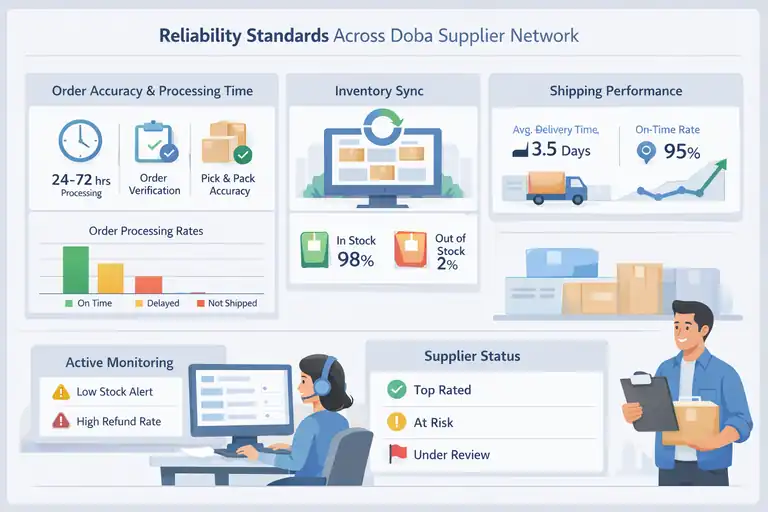
Quality products don’t mean much if orders arrive late, incomplete, or not at all. Doba’s reliability standards are designed to keep fulfillment predictable, not just possible.
Order Accuracy And Processing Time Benchmarks
Every doba supplier is measured against strict processing benchmarks.
Most suppliers are expected to:
- Process orders within 24–72 hours
- Maintain high pick-and-pack accuracy
- Confirm orders digitally before shipment
In practical terms, this reduces the “order accepted but never shipped” problem that plagues many dropshipping platforms. I’ve found that suppliers who consistently meet these benchmarks are also easier to communicate with when issues arise.
If speed matters for your store, filter suppliers by historical processing times inside the Doba dashboard.
Inventory Sync And Stock Availability Controls
One of the most common dropshipping headaches is selling products that are no longer in stock. Doba tackles this with real-time inventory syncing.
Here’s what that looks like:
- Supplier inventory levels update automatically
- Out-of-stock items are flagged or hidden
- High-volume sellers are monitored more closely for stock mismatches
According to Shopify data, overselling due to inventory mismatches causes nearly 34 percent of avoidable refunds. Doba’s system doesn’t eliminate this entirely, but it reduces it dramatically compared to manual CSV-based platforms.
Shipping Timelines And Fulfillment Consistency
Shipping reliability is where many doba suppliers either prove themselves—or fail.
Doba tracks:
- Actual delivery times versus estimated timelines
- Carrier reliability by region
- Seasonal shipping performance during peak periods
Suppliers that consistently miss delivery windows see reduced visibility or temporary suspension. This is especially important if you’re running paid ads, where late deliveries can quickly destroy trust and ad performance.
A smart move is to test suppliers during non-peak seasons before scaling them during Q4 or major promotions.
Supplier Removal Criteria For Repeated Failures
Doba doesn’t publicly publish exact thresholds, but repeated failures trigger escalating consequences.
Common removal triggers include:
- Chronic late shipments
- High refund or dispute rates
- Failure to respond to customer service escalations
I’ve personally seen suppliers quietly disappear from the platform after a few bad months. While that can disrupt existing listings, it’s ultimately a protective measure for store owners.
If reliability is your top concern, focus less on flashy product margins and more on supplier stability. In the long run, consistent fulfillment beats slightly higher profits every time.
Expert tip: Before committing to any doba supplier, place 2–3 test orders to different addresses. It’s the fastest way to see how vetting and reliability standards translate into real-world performance.
Order Fulfillment Performance From Each Doba Supplier
Even a well-vetted doba supplier can fall short if fulfillment doesn’t hold up once real orders start coming in.
This section looks at how Doba suppliers actually perform after the “buy” button is clicked.
Domestic Versus International Supplier Fulfillment
One of the first things I look at with any doba supplier is where orders ship from. That single factor affects delivery speed, costs, and customer expectations more than most people realize.
Domestic suppliers, especially U.S.-based warehouses, usually offer:
- Faster delivery times, often 3–7 business days
- Easier returns with lower shipping costs
- Fewer customs delays or lost parcels
International suppliers can still work, but they come with trade-offs:
- Longer delivery windows, often 10–25 days
- Higher risk of customs inspections
- More variability during peak seasons
From what I’ve seen, stores targeting impulse buyers or paid ads convert better with domestic fulfillment. International suppliers make more sense for niche products where customers are willing to wait.
A practical approach is mixing both: use domestic suppliers for hero products and international ones for lower-volume experiments.
Handling Times And Warehouse Processing Practices
Handling time is the quiet killer of customer satisfaction. It’s the gap between an order being placed and actually leaving the warehouse.
Most doba supplier listings show estimated handling times, usually ranging from 1 to 5 business days.
In reality:
- High-performing suppliers ship within 24–48 hours
- Average suppliers hover around 3 business days
- Poor performers push orders past 5 days without warning
In my experience, anything over 3 days consistently leads to support tickets and refund requests. According to Shopify benchmarks, each additional day of handling increases cancellation risk by about 7 percent.
A quick test order tells you more than any dashboard metric. I always place one order before scaling traffic.
Carrier Selection And Shipping Method Reliability
Doba suppliers typically choose carriers based on region and cost efficiency, not branding.
Common carriers include:
- UPS and FedEx for U.S. domestic orders
- USPS for lightweight or rural deliveries
- DHL, YunExpress, or regional couriers for international shipments
Reliability depends less on the carrier and more on consistency. A supplier that always uses one dependable method usually outperforms one that switches carriers frequently to save a dollar.
If your customers expect predictable delivery, prioritize suppliers that clearly state shipping methods upfront rather than vague “standard shipping” labels.
Tracking Accuracy And Post-Shipment Transparency
Tracking transparency is where trust is either built or broken.
A strong doba supplier will:
- Upload tracking numbers within 24–48 hours of shipment
- Use carriers with reliable scan updates
- Provide tracking links that actually work
Weak tracking causes anxiety. I’ve seen refund requests spike simply because tracking showed “label created” for days.
If you want fewer support emails, choose suppliers with consistent tracking updates. It’s boring, but it’s one of the highest-impact reliability signals you’ll find.
Product Quality Control Processes Doba Supplier System
Product quality isn’t just about what’s shipped—it’s about whether what arrives matches what was promised. Doba’s quality control system focuses heavily on reducing surprises.
Product Data Accuracy And Listing Verification
Every doba supplier listing goes through data checks to reduce misleading product information.
This includes:
- Title and description consistency
- Image-to-product matching
- Specification verification for size, material, and compatibility
In practice, this reduces classic issues like incorrect dimensions or missing accessories. I still recommend reading reviews and checking supplier notes, but Doba’s verification removes a lot of low-effort listings upfront.
If product accuracy matters for ads or SEO, this layer saves hours of cleanup later.
Return Rates And Defect Monitoring Signals
Doba quietly tracks return behavior across suppliers.
Key signals include:
- Percentage of orders returned
- Common defect reasons
- Repeat complaints about the same SKU
Suppliers with rising defect rates are flagged internally. While you don’t see all these metrics, you’ll notice symptoms like disappearing products or supplier warnings.
Industry data shows that average ecommerce return rates hover around 16–20 percent. When a supplier consistently exceeds that, it’s usually not a coincidence.
Customer Feedback Loops And Quality Flags
Customer feedback isn’t just for reviews—it’s a quality control tool.
Doba uses:
- Merchant complaints
- Dispute resolutions
- Support ticket patterns
If multiple store owners report the same issue, it triggers deeper review. I’ve seen suppliers improve packaging or change fulfillment partners after repeated flags, which tells me the system actually reacts, not just records.
Replacement And Refund Handling By Suppliers
Refunds and replacements reveal a supplier’s true professionalism.
Reliable doba suppliers typically:
- Approve replacements without excessive proof
- Process refunds within platform timelines
- Communicate clearly when issues arise
If a supplier fights every claim, that friction eventually lands on you. I always favor suppliers who treat refunds as a cost of doing business, not a personal attack.
Risks And Limitations When Working With Doba Suppliers
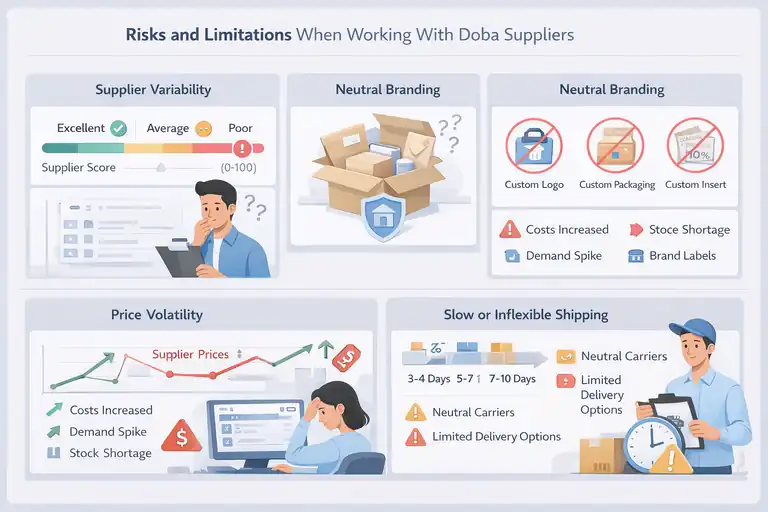
No platform is perfect, and Doba is no exception. Understanding the limits helps you avoid surprises later.
Variability Between Individual Doba Suppliers
Not all doba suppliers perform at the same level.
You’ll find:
- Excellent suppliers with near-retail fulfillment quality
- Average suppliers that work fine at low volume
- Poor suppliers that look good on paper but fail under pressure
This variability means you can’t assume platform-level reliability applies equally to every supplier. Testing is non-negotiable.
Brand Control And Packaging Limitations
If branding matters to you, this is a real constraint.
Most Doba suppliers:
- Ship in neutral packaging
- Do not include custom inserts
- Rarely support branded labels
That’s fine for general ecommerce, but not ideal for long-term brand building. If custom packaging is critical, you may outgrow Doba as you scale.
Pricing Consistency And Margin Pressure
Margins can fluctuate as suppliers adjust pricing.
Common reasons include:
- Supplier cost increases
- Seasonal demand spikes
- Inventory shortages
I’ve seen 10–15 percent price jumps with little notice. To protect margins, always set buffer pricing rather than minimum viable profit.
When Doba Supplier Reliability May Not Be Ideal
Doba suppliers may not be the best fit if:
- You need strict brand control
- You rely on ultra-fast same-day shipping
- Your product requires complex customization
In those cases, private suppliers or direct manufacturer relationships often make more sense.
Best practice: use Doba to validate products and demand, then transition your top sellers to more controlled fulfillment once volume justifies it.
Frequently Asked Questions
Is every doba supplier vetted before joining the platform?
Yes. Every doba supplier must pass business verification, compliance checks, and product review standards before being listed. Doba also monitors ongoing performance and removes suppliers that fail quality or reliability benchmarks.
How reliable are shipping times from a doba supplier?
Shipping reliability depends on the individual doba supplier, but most domestic suppliers deliver within 3–7 business days. Doba tracks late shipments and fulfillment errors, reducing long-term risk for store owners.
Can a doba supplier be removed for poor quality or service?
Yes. Doba removes suppliers that repeatedly miss shipping deadlines, receive high defect rates, or generate frequent merchant complaints. This protects sellers from ongoing fulfillment and quality issues.

I’m Juxhin, the voice behind The Justifiable.
I’ve spent 6+ years building blogs, managing affiliate campaigns, and testing the messy world of online business. Here, I cut the fluff and share the strategies that actually move the needle — so you can build income that’s sustainable, not speculative.
Related posts:
 Doba Review: Honest Pros, Cons, and Real Costs
 Shopify DSers Review: Is It Really Worth Your Time?
 Ecommerce Fulfillment Guide: How to Ship Faster and Smarter
 How the Salehoo App Works and Why It Speeds Up Product Research
 Why the Salehoo Wholesale Directory Helps You Scale
 Salehoo WooCommerce Integration That Boosts Growth