
Table of Contents
Some links on The Justifiable are affiliate links, meaning we may earn a small commission at no extra cost to you. Read full disclaimer.
When people first look into doba suppliers, the big question usually isn’t about features or pricing—it’s whether they can actually support a store long term without headaches.
This article is for store owners, dropshippers, and ecommerce founders who are considering Doba as a core supplier network and want a clear, honest answer.
We’re answering one specific question here: are Doba suppliers reliable enough to build and sustain a long-term ecommerce business?
How Reliable Are Doba Suppliers for Long-Term Stores?
If you’re thinking long term, reliability isn’t about whether an order ships today—it’s about whether the same system still works six months or two years from now.
This section looks at how doba suppliers hold up once the honeymoon phase is over and real operational pressure kicks in.
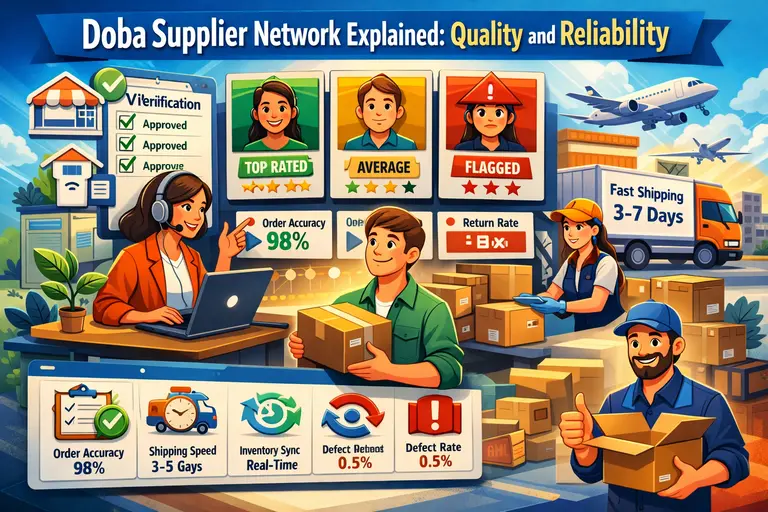
Supplier Vetting Standards Inside the Doba Marketplace
One thing I’ll give Doba credit for is that it doesn’t operate like a completely open directory. Suppliers go through an approval process before they’re listed, which filters out some low-quality vendors you’d find on looser platforms.
Here’s how that plays out in practice:
- Doba suppliers are typically U.S.-based or have U.S. fulfillment centers, which reduces shipping uncertainty.
- Most suppliers are established wholesalers rather than individuals flipping products.
- Doba removes inactive or underperforming suppliers over time, though this can happen quietly.
That said, vetting doesn’t mean ongoing enforcement. From what I’ve seen, initial approval is stronger than long-term monitoring. A supplier that was reliable in month one can slowly slip on inventory accuracy or response times later.
This is why I never recommend assuming all doba suppliers are equal just because they’re on the platform.
My advice: Treat Doba’s vetting as a starting filter, not a guarantee. You still need your own internal scorecard for suppliers you rely on heavily.
Consistency Of Inventory Across Doba Suppliers
Inventory consistency is where many long-term stores feel friction with doba suppliers. Because Doba aggregates multiple independent vendors, stock levels can change fast—sometimes faster than the platform updates.
Common patterns store owners run into:
- Inventory shows “available” but goes out of stock after the order is placed.
- Seasonal products disappear without notice.
- High-demand SKUs fluctuate weekly.
This isn’t unique to Doba, but it’s more noticeable because you don’t control the supplier relationship directly. If you’re running ads or ranking organically for a product, even a 24–48 hour stock mismatch can create refunds and support tickets.
What works better long term:
- Favor suppliers with deeper catalogs and higher inventory counts.
- Avoid “single-SKU dependence” on one doba supplier.
- Build buffer logic in your store, such as longer processing times or stock thresholds.
Consistency improves when you narrow your supplier list instead of constantly testing new ones.
Product Quality Control And Brand Consistency Issues
Product quality with doba suppliers is usually acceptable—but not uniform. That distinction matters a lot for long-term brands.
In my experience:
- Commodity items like home goods and office supplies are usually consistent.
- Apparel, supplements, and electronics accessories vary more.
- Branding elements like packaging and inserts are rarely consistent across suppliers.
Because you’re not private labeling, you’re inheriting the supplier’s quality standards. That’s fine for general stores, but it becomes limiting if you’re trying to build trust and repeat customers.
A simple way to reduce risk:
- Order samples from every supplier you plan to scale with.
- Reorder samples every few months to check for silent quality changes.
- Avoid mixing similar products from different doba suppliers on the same product page.
Long-term reliability improves when expectations are realistic and monitored continuously.
Communication Reliability Between Sellers And Suppliers
Communication is one of the most underrated factors in supplier reliability. With doba suppliers, communication is mediated through the platform, which is both helpful and limiting.
The upside:
- Centralized messaging keeps everything documented.
- Doba support can step in if a supplier goes unresponsive.
The downside:
- You’re rarely speaking directly to decision-makers.
- Response times vary widely between suppliers.
- Urgent issues don’t always move fast enough for customer-facing problems.
From what I’ve seen, suppliers that respond within 24 hours early on tend to stay responsive. If communication feels slow during testing, it usually doesn’t improve later.
My rule: if a supplier can’t clearly answer pre-sale questions, they won’t magically improve during fulfillment issues.
Order Fulfillment Performance Of Doba Suppliers Over Time
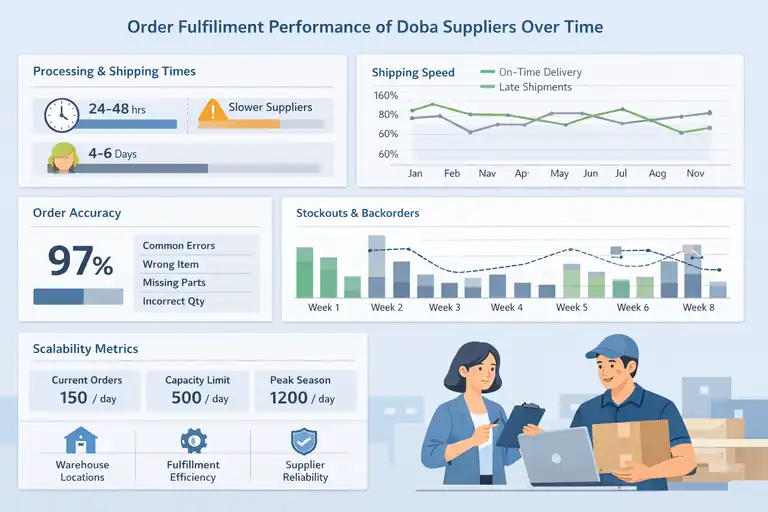
Order fulfillment is where long-term reliability becomes measurable.
Shipping speed, accuracy, and scalability all show whether doba suppliers can support growth—or quietly cap it.
Average Processing And Shipping Times From Doba Suppliers
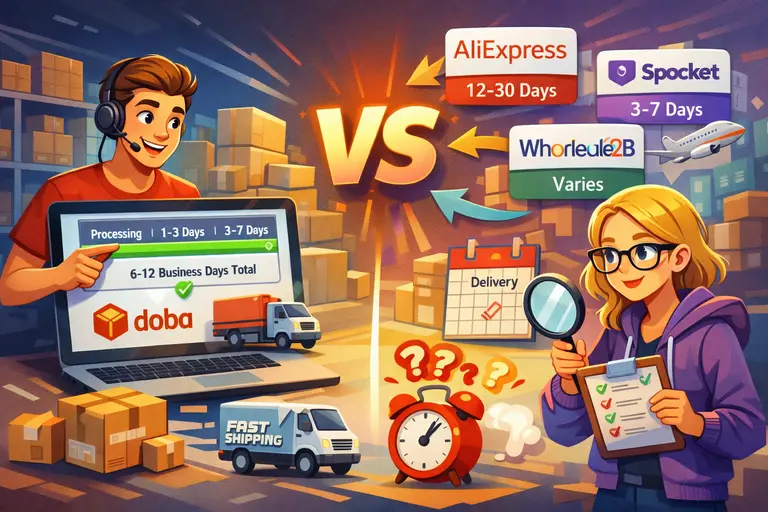
Most doba suppliers list processing times between 1–3 business days, with shipping times ranging from 3–7 days domestically. In reality, performance clusters into two groups.
What I typically see:
- Strong suppliers process within 24–48 hours consistently.
- Weaker suppliers stretch processing to 4–6 days during busy periods.
- Shipping speed depends heavily on carrier choice, not just location.
This matters long term because customers anchor expectations fast. Once your store promises “fast shipping,” any deviation shows up in reviews and chargebacks.
If speed matters to your brand:
- Filter for suppliers with warehouses closest to your core audience.
- Track real delivery times, not advertised ones.
- Remove suppliers that miss SLAs more than twice in a month.
Consistency beats raw speed every time.
Order Accuracy Rates And Common Fulfillment Errors
Order accuracy among doba suppliers is generally solid, but not perfect. Industry-wide, dropshipping accuracy averages remember around 96–98%, and Doba suppliers fall within that range.
The most common errors:
- Wrong color or variation shipped.
- Missing accessories or parts.
- Incorrect quantity in multi-pack orders.
These issues aren’t catastrophic, but they compound at scale. A 2% error rate at 50 orders a day becomes a customer support workload very fast.
What helps:
- Avoid complex product variations early.
- Add clear SKU mapping inside your store backend.
- Monitor return reasons weekly to spot patterns.
Suppliers with stable SKUs tend to stay accurate over time.
Handling Backorders And Stockouts In Long-Term Stores
Backorders are where long-term stores either adapt or burn out. With doba suppliers, stockouts happen because inventory data isn’t always real-time.
Practical strategies I’ve seen work:
- Use inventory buffers instead of “sell until zero.”
- Automatically pause ads when stock dips below a threshold.
- Build email flows to handle delayed orders proactively.
The stores that survive don’t avoid stockouts—they manage customer expectations better when they happen. Silence is what kills trust, not delays.
Scalability Of Doba Suppliers As Order Volume Grows
Scaling is the real test of supplier reliability. A supplier that handles 5 orders a day may struggle at 50.
With doba suppliers:
- Larger wholesalers scale better than niche vendors.
- Smaller suppliers often outsource fulfillment, creating bottlenecks.
- Holiday seasons expose weaknesses fast.
If you plan to grow:
- Ask suppliers about daily order capacity early.
- Watch performance during promotions or spikes.
- Never scale a single product without a backup supplier option.
In my experience, Doba works best as a growth-stage solution—not the final destination.
It’s reliable enough to build momentum, validate products, and generate cash flow, but long-term success depends on how strategically you manage supplier relationships inside the platform.
Pricing Stability And Margin Risks With Doba Suppliers
Pricing is where a lot of long-term stores quietly lose profitability. On the surface, doba suppliers look predictable.
Over time, though, small pricing shifts and competitive pressure can eat away at margins if you’re not watching closely.
Wholesale Price Fluctuations From Doba Suppliers
Doba suppliers do not lock pricing long term. Wholesale prices can change with little warning, especially in categories tied to shipping costs, fuel prices, or seasonal demand.
What I’ve personally seen happen:
- A product that costs $18 wholesale quietly moves to $20 within a few months.
- Shipping surcharges get added without clear announcements.
- Suppliers adjust pricing during peak seasons to manage demand.
This matters because most stores don’t reprice daily. If you’re running ads or ranking organically, even a $2 cost increase can flip a profitable product into a loss.
How to protect yourself:
- Track landed cost weekly, not just product cost.
- Build minimum margin rules before scaling ads.
- Avoid thin-margin products unless volume is extremely predictable.
Pricing drift is normal. Ignoring it is what causes damage.
Impact Of Marketplace Competition On Profit Margins
One overlooked issue with doba suppliers is that you’re rarely the only seller offering the same product. The marketplace nature creates invisible competition pressure.
Here’s what that looks like in real life:
- Multiple stores list identical products with identical photos.
- Race-to-the-bottom pricing happens fast on Google Shopping.
- Customers price-check more aggressively when products feel generic.
This doesn’t mean Doba can’t be profitable, but it does mean margins are fragile without differentiation.
Ways store owners compensate:
- Bundle products instead of selling single items.
- Add content, warranties, or fast-shipping guarantees.
- Focus on niche audiences instead of broad keywords.
If you rely only on price, doba suppliers become much harder to sustain long term.
Long-Term Cost Predictability For Store Owners
Predictability is what allows planning. With doba suppliers, cost predictability is moderate, not strong.
Costs you can usually forecast:
- Platform subscription fees.
- Base wholesale pricing trends.
- Standard shipping ranges.
Costs that tend to surprise people:
- Supplier-driven shipping changes.
- Packaging or handling fees.
- Occasional fulfillment surcharges during peak demand.
From what I’ve seen, stores that survive long term build a pricing buffer. They don’t aim for maximum margin. They aim for margin stability.
If your pricing only works when everything stays perfect, it won’t last.
Comparing Doba Supplier Pricing To Direct Supplier Deals
When you compare doba suppliers to direct supplier relationships, the trade-off becomes clear.
Here’s a simple comparison:
| Aspect | Doba Suppliers | Direct Suppliers |
| Upfront effort | Low | High |
| Wholesale pricing | Medium | Lower |
| Price control | Limited | Strong |
| Negotiation ability | Minimal | High |
| Long-term margins | Moderate | Strong |
Doba pricing is essentially the convenience premium. You pay slightly higher costs to avoid negotiation, contracts, and logistics setup.
For many stores, that trade-off is worth it early on. Long term, it often becomes the reason owners look elsewhere.
Platform Dependence Risks When Using Doba Suppliers
Any platform dependency comes with trade-offs. Doba makes sourcing easier, but it also creates structural risks that matter more the longer you stay.
Supplier Exclusivity And Lack Of Direct Relationships
With doba suppliers, you’re not building direct supplier relationships. You’re renting access to them.
That means:
- No exclusive pricing.
- No custom packaging or branding.
- No priority during high-volume periods.
If a supplier prioritizes another retailer, there’s little you can do. You don’t have leverage because the relationship belongs to the platform, not you.
For short-term testing, this is fine. For long-term brands, it’s limiting.
Risks Of Supplier Removal Or Product Discontinuation
Suppliers can disappear from Doba. Products can be discontinued. When that happens, stores are often caught off guard.
Real scenarios I’ve seen:
- A top-selling product vanishes overnight.
- A supplier leaves the platform after contract changes.
- Inventory sync breaks and listings auto-disable.
If that product drives a large percentage of revenue, recovery isn’t instant.
Best practices that reduce risk:
- Never let one product exceed 30–40% of revenue.
- Always have backup SKUs or alternative suppliers.
- Regularly export product data and supplier info.
Platform stability matters, but redundancy matters more.
Data Ownership And Control Over Customer Experience
Doba handles fulfillment, but the customer experience still lands on you. That split creates friction.
Limitations store owners feel:
- Limited control over packaging and inserts.
- No ability to customize post-purchase experience.
- Delayed issue resolution when suppliers are slow.
You own the brand, but not the fulfillment process. Over time, that mismatch can strain customer trust if issues repeat.
This is usually the moment when store owners start thinking about private fulfillment.
Limitations Of Relying On Aggregated Supplier Networks
Aggregated networks like Doba are designed for access, not optimization.
Strengths:
- Fast setup.
- Low technical overhead.
- Wide product selection.
Limitations:
- Little supplier loyalty.
- No operational customization.
- Hard ceilings on differentiation.
These limits aren’t fatal. They just mean Doba has a role, not a monopoly, in a long-term strategy.
Comparing Doba Suppliers To Alternatives For Long-Term Growth
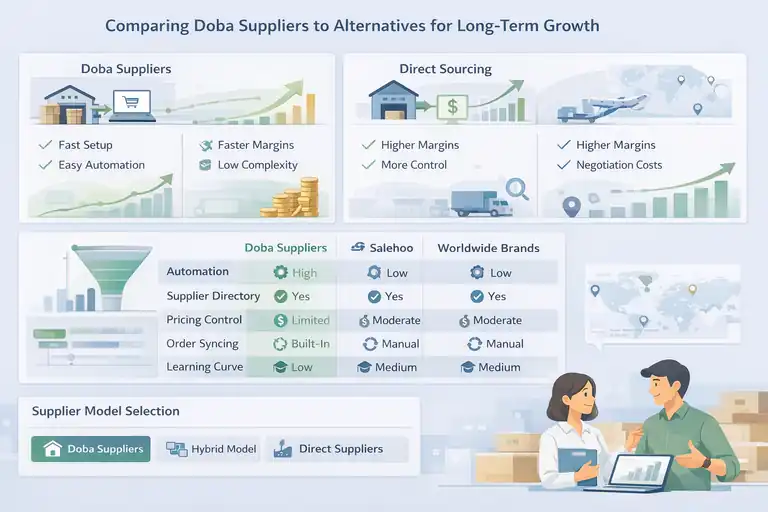
At some point, most store owners ask the same question: stay, hybrid, or move on? This section breaks that decision down honestly.
Doba Suppliers Vs Direct Sourcing From Manufacturers
Direct sourcing usually means working with manufacturers overseas or domestic wholesalers without a middle platform.
Key differences:
- Lower per-unit costs.
- Higher setup complexity.
- More negotiation and logistics responsibility.
Doba suppliers win on speed and simplicity. Direct sourcing wins on margins and control.
In my experience, many stores start with Doba, validate products, then transition bestsellers to direct suppliers.
Doba Suppliers Compared To SaleHoo And Worldwide Brands
Doba, SaleHoo, and Worldwide Brands solve similar problems differently.
Quick comparison:
| Feature | Doba | SaleHoo | Worldwide Brands |
| Automation | High | Low | Low |
| Supplier directory | Yes | Yes | Yes |
| Order syncing | Built-in | Manual | Manual |
| Pricing control | Limited | Moderate | Moderate |
| Learning curve | Low | Medium | Medium |
Doba is more operationally friendly. The others offer more supplier transparency but require more work.
When Doba Makes Sense Versus Private Supplier Agreements
Doba makes the most sense when:
- You’re validating products.
- You want speed over control.
- You’re managing multiple SKUs without complexity.
Private agreements make more sense when:
- You’ve proven consistent demand.
- Margins matter more than speed.
- Brand experience becomes a priority.
There’s no shame in evolving. Staying static is the real risk.
Choosing The Right Supplier Model For Store Longevity
Long-term stores rarely rely on one model forever. They adapt.
What I usually recommend:
- Start with doba suppliers for momentum.
- Identify top-performing products.
- Transition winners to direct or private suppliers.
Doba isn’t unreliable. It’s just not designed to be everything forever. Used intentionally, it can be a powerful stepping stone instead of a hidden bottleneck.
FAQ
Are Doba suppliers reliable enough for long-term ecommerce stores?
Yes, doba suppliers can be reliable for long-term stores if you actively manage them. Reliability depends on selecting consistent suppliers, monitoring inventory and pricing changes, and not relying on a single product or vendor for the majority of revenue.
What are the biggest risks of using Doba suppliers long term?
The main risks are pricing changes, inventory inconsistencies, and limited control over supplier relationships. Because doba suppliers operate inside a marketplace, you don’t get exclusivity or guaranteed long-term pricing stability.
When should a store move beyond Doba suppliers?
Most stores outgrow doba suppliers once they scale consistently and margins become a priority. If a product sells steadily and customer experience matters more than speed of setup, moving to direct or private supplier agreements usually makes more sense.

I’m Juxhin, the voice behind The Justifiable.
I’ve spent 6+ years building blogs, managing affiliate campaigns, and testing the messy world of online business. Here, I cut the fluff and share the strategies that actually move the needle — so you can build income that’s sustainable, not speculative.
Related posts:
 The Best SaleHoo Shopify Suppliers for Dropshipping
 Salehoo Directory Review: Is It the Best Supplier Database?
 Doba Supplier Network Explained: Quality and Reliability
 Why the Salehoo Wholesale Directory Helps You Scale
 Can You Make Money With SaleHoo? Full Earning Guide
 How Fast Is Doba Shipping for Real Orders?