
Table of Contents
Some links on The Justifiable are affiliate links, meaning we may earn a small commission at no extra cost to you. Read full disclaimer.
If you’re researching digital marketing affiliate programs right now, you’re probably looking for reliable partners that actually pay well and won’t waste your time.
I’ve been in that same spot, scrolling through endless lists that never tell you which programs are worth joining today.
So in this guide, I put together a clear, updated list of the 15 best programs you can join immediately—without dealing with outdated networks or discontinued platforms.
1. HubSpot: High-Converting Digital Marketing Affiliate Program
HubSpot is one of the easiest digital marketing affiliate programs to promote because people already search for its tools daily.
I’ve found that when someone is ready to invest in a CRM or marketing automation, they often compare HubSpot first.
HubSpot CRM And Marketing Tools Overview
If you’re new to HubSpot, the platform basically gives businesses everything they need to manage customers: CRM, email marketing, live chat, ticketing, automation workflows, and even a full content management system.
When I recommend HubSpot to beginners, I usually start with the free CRM because it removes friction.
Key tools worth highlighting:
- CRM Dashboard: Lets users track contacts, deals, and communication. (UI path: Contacts → Contacts List → Create Contact.)
- Marketing Hub: Email scheduling, forms, landing pages, and automation.
- Sales Hub: Pipeline management and follow-up tools.
- Service Hub: Customer support ticketing.
One thing I like is how HubSpot removes technical setup barriers. Someone can create a contact record or send an email in minutes.
That simplicity is a huge conversion driver from an affiliate standpoint because users progress quickly from free to paid tiers when they outgrow the basics.
Commission Structure And Payout Expectations
HubSpot’s affiliate system is straightforward, but it’s powerful once you understand how the tiers work. You can earn up to $1,000 per referred customer depending on the product level they choose. The payouts happen either:
- As a one-time flat commission, or
- As a recurring percentage, depending on the plan they pick.
The reason this program converts well is simple: HubSpot sells itself. Once users see automation workflows or the email drag-and-drop builder, the value becomes obvious.
In my experience, leads entering with the intent to grow a business have the highest upgrade rate. If someone wants automation, sequences, or advanced reporting, they almost always choose a paid plan.
Best Audiences To Promote HubSpot Effectively
HubSpot works best for people who need structure but don’t want to hire developers or patch different tools together.
I typically target:
- Small business owners overwhelmed by spreadsheets
- Freelancers wanting a simple sales pipeline
- Early-stage startups looking for scalable CRM
- Marketers who need automation without complexity
A practical example: I once explained HubSpot to a local business owner who kept losing track of leads. When they saw visual deal stages, everything clicked.
Within two weeks, they upgraded because they wanted email automation. That kind of jump is common with the right audience.
Proven Content Angles That Drive HubSpot Conversions
The best-performing content tends to answer a problem rather than pitch a tool.
Here are angles that consistently work for me:
- “How To Organize Leads Without Paying for Complex Software.” This naturally introduces the free CRM.
- “Beginner Automation Workflows That Save 5+ Hours Per Week.” When you show the workflow builder UI (Automation → Workflows → Create Workflow), people instantly understand the value.
- “HubSpot vs [Competitor]: Which One Scales Better for Small Teams?” Comparison articles convert extremely well because users reading them are closer to buying.
When you walk through a real example—like sending an automated follow-up when a form is submitted—your conversions increase because readers can visualize using the tool themselves.
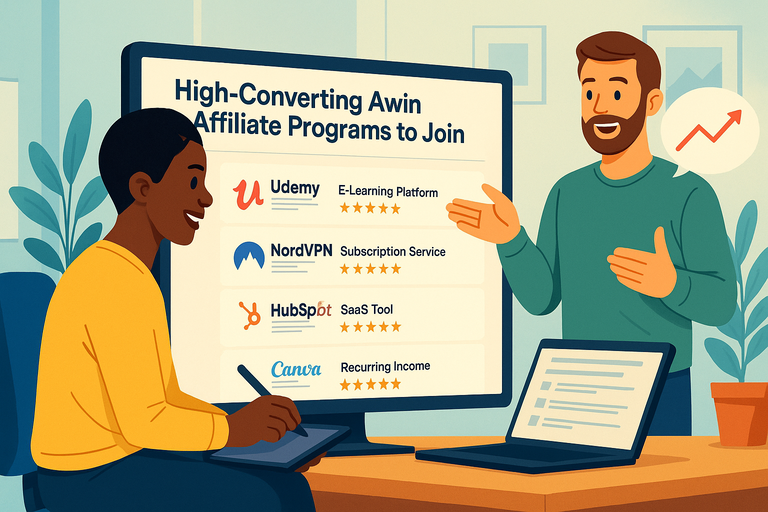
2. Awin: Versatile Network With Thousands Of Marketing Offers
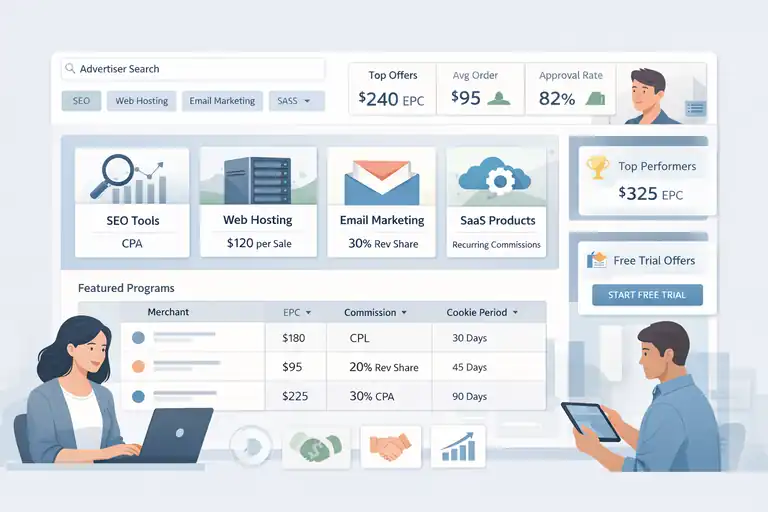
Awin replaced the now-discontinued ShareASale, so if you’re looking for up-to-date digital marketing affiliate programs, this is where many top merchants live now.
I personally use Awin when I want to diversify beyond software into services, tools, and niche digital products.
How Awin’s Marketplace Supports Digital Marketing Niches
Awin is broad, but that’s actually its strength. You can promote marketing tools, e-commerce services, SaaS products, and even creator-focused tools.
Inside the dashboard (UI path: Advertisers → Search), you’ll find categories such as:
- SEO tools
- Web hosting services
- Email marketing platforms
- Analytics software
What I appreciate most is the transparency. Awin shows EPC (earnings per click), average order value, and approval rates before you join a program. That alone saves me a lot of guesswork and prevents me from promoting low-converting offers.
Commission Models And Offer Types You Can Promote
Awin supports classic affiliate structures like:
- CPL (Cost per Lead)
- CPA (Cost per Acquisition)
- Revenue share
For digital marketing niches, CPA and revenue share tend to pay best. For instance, SaaS companies often pay recurring commissions, while service providers lean toward flat payouts.
One detail I always check is the program’s validation period. Some merchants take 30 days; others take 90. That matters when forecasting your income, especially if you’re scaling blog traffic.
Why Awin Works Well For Bloggers And Niche Creators
Awin approves blogs faster than many networks, especially if you already have content published. Their affiliate tracking links are easy to create, and they offer a handy Chrome extension called “Awin Publisher MasterTag” that simplifies link generation.
If you create niche content—SEO, branding, automation, B2B workflows—you’ll find products that fit without stretching your content strategy.
That alignment matters more than most people realize. When the product genuinely solves the reader’s problem, conversion rates jump.
Tips For Finding High-Earning Awin Merchant Programs
Here’s what I personally look for when choosing Awin partners:
- High EPC: This usually signals strong merchant conversion rates.
- Short cookie windows with high payouts or long cookie windows with recurring payouts—both can be lucrative in different ways.
- Programs with strong brand recognition: People convert faster when they already trust the name.
- Products with free trials: Trial-first products often convert best.
A simple but effective strategy is filtering merchants by “Top Performers” inside the dashboard. I’ve found several hidden gems this way—tools with small audiences but extremely high conversion rates.
3. Semrush: Leading SEO Platform With Strong Affiliate Earnings
Semrush remains one of the highest-earning digital marketing affiliate programs for SEO-focused audiences.
It also has one of the strongest brand reputations, which makes conversions much easier.
Core Features Affiliates Should Highlight
The challenge with Semrush is that it offers so many tools that people get overwhelmed. I try to simplify it by focusing on the features most beginners actually use:
- Keyword Magic Tool: Helps users find keywords with search volume, difficulty, and intent.
- Site Audit: Diagnoses technical issues like indexing problems and broken links.
- Position Tracking: Tracks rankings daily.
- Backlink Analytics: Shows who links to your competitors.
A trick that works well: Show a screenshot-style walkthrough. For example, “To find keyword opportunities, go to Keyword Research → Keyword Magic Tool, type your seed keyword, then sort by KD% under 30.” It makes your content more actionable and credible.
Semrush Affiliate Commission And Cookie Duration
The Semrush affiliate program (formerly called BeRush) offers one of the best payout structures in the SEO world:
- $200+ per sale
- Generous trial payouts
- Long cookie windows
Because SEO tools have strong buying intent, readers evaluating Semrush are often already close to paying. I’ve seen affiliate conversions from people who clicked my link weeks earlier—thanks to the long cookie duration.
Effective Content Formats For Promoting Semrush
Semrush converts especially well in search-based content. Here are formats that have consistently worked for me:
- Keyword research tutorials that demonstrate the UI
- Competitor analysis walkthroughs
- SEO tool comparison posts
- Ranking recovery checklists that naturally introduce Semrush audits
A quick scenario: When someone searches “how to analyze competitors,” they’re already thinking about buying software. If your tutorial shows a real Semrush dashboard, that reader often becomes a trial user.
How To Position Semrush For SEO Beginners And Agencies
One technique that improves conversions is framing Semrush differently for beginners vs. agencies. Beginners want simplicity and guidance. Agencies want scalability and reporting.
For beginners, I emphasize:
- Prebuilt templates
- Simple keyword filters
- Automated audits
For agencies, I highlight:
- White-label reporting
- Multi-project dashboards
- Historical keyword data
If you address both groups clearly, you’ll capture more buying intent.
4. Systeme.io: All-In-One Marketing Platform With Recurring Payouts
Systeme.io is one of my favorite tools to recommend because it’s beginner-friendly and the recurring affiliate payouts add up quickly.
If you write for solopreneurs or course creators, this one converts well.
Platform Features That Increase Affiliate Conversions
Systeme.io gives users landing pages, funnels, email marketing, automations, membership sites, and course hosting—all inside one login.
Here’s the UI path I often reference because it helps beginners: Funnels → Create → Choose Funnel Goal → Pick a Template.
What makes the platform attractive for your readers is:
- Fast setup
- No design headaches
- Low learning curve
- Everything under one tool instead of paying for five separate subscriptions
I’ve seen readers move from “just exploring funnels” to “launching their first product” entirely inside Systeme.io, which naturally leads to upgrades.
Commission Breakdown For Funnel Builders And Marketers
Systeme.io’s commission structure is simple:
- 60% on every sale
- Recurring monthly commissions
- Affiliate commissions on both tools and courses sold through the marketplace
Recurring commissions are where Systeme.io really shines. Even if you only bring in a few active users each month, the income stacks over time. I’ve seen people build predictable four-figure income streams simply by creating solid how-to content around funnels.
Strategies To Create High-Intent Systeme.io Content
If you want conversions, you must show the platform in action. People don’t buy funnels—they buy outcomes.
Some content ideas that consistently perform:
- Tutorials showing funnel setups
- Email automation walkthroughs
- Sales page templates explained
- Step-by-step guides for launching digital products
One personal insight: When I show how to build a simple lead funnel in under 10 minutes, conversion rates spike. People love seeing speed and simplicity.
Audiences Most Likely To Purchase Through Your Link
Systeme.io resonates strongly with audiences who value simplicity and affordability.
I usually target:
- New creators launching digital products
- Coaches who need simple sales funnels
- Solopreneurs replacing expensive tools
- Beginners wanting automation without complexity
If someone complains that software feels too overwhelming, Systeme.io is the solution they’re hoping for. That emotional alignment makes the affiliate promotion feel natural.
5. Kit: Creator-Focused Email Marketing Platform Affiliate Program
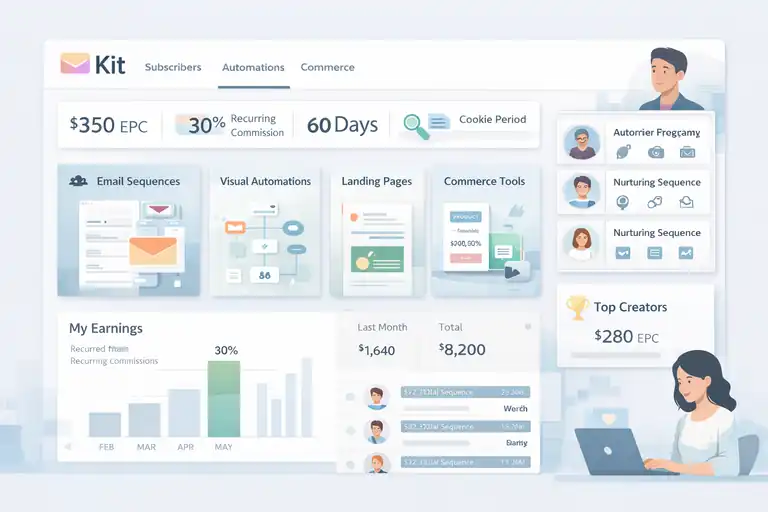
Kit (formerly ConvertKit) is one of the most trusted email platforms for creators, and it still has one of the most reliable affiliate programs I’ve ever used.
Because creators value simplicity and automation, Kit is an easy recommendation.
Kit Features That Appeal To Creators And Small Businesses
Kit stands out because it doesn’t try to be everything. Instead, it focuses on helping creators grow their audience and send better emails.
Key features worth highlighting:
- Email sequences: Automated series for nurturing subscribers.
- Visual automations: Drag-and-drop workflows that show how subscribers move through funnels.
- Landing pages: Simple templates for lead magnets.
- Commerce tools: Sell digital products without needing a separate platform.
One UI path I always mention: Automations → Create Automation → Choose Trigger (e.g., “Joins Form”). It immediately shows beginners how simple email automation can be.
Affiliate Payments, Recurring Rates, And Cookie Details
Kit pays 30% recurring commissions, which adds up quickly as your referred creators grow their lists. The recurring model is ideal because creators rarely switch email tools once they’re fully set up.
The cookie window is long enough to capture warm leads who explore multiple email tools before deciding.
In my experience, Kit conversions often happen after users try the visual automation builder—once they see how intuitive it feels, the choice becomes easy.
How To Position Kit Against Other Email Software
When promoting Kit, I stay away from overly technical comparisons. Instead, I frame it through the lens of simplicity and creator workflows.
Here’s what resonates with readers:
- Tools like Brevo or GetResponse have more features, but they can feel overwhelming for creators.
- Kit removes friction by focusing on email sequences, tagging, and automation paths that creatives actually use.
- The platform is perfect for people who want to write more and troubleshoot less.
One insight from experience: When creators see how tagging works (Subscribers → Select Subscriber → Add Tag), it instantly clicks why segmentation matters.
Best Promotional Angles For Creator-Focused Audiences
Creator audiences respond to emotional clarity more than technical specs.
These angles convert very well:
- “How To Build Your First Email Funnel in Under 15 Minutes.”
- “The Simplest Email Setup for Selling Your First Digital Product.”
- “Why Most Creators Fail at Email—and How Kit Fixes It.”
A practical scenario: When I teach creators to set up a “Welcome + Lead Magnet Delivery + Soft Pitch” sequence, the simplicity lowers their resistance. And once they experience an automated funnel working for them, upgrading to a paid Kit plan feels natural.
6. Brevo: CRM And Email Automation Platform With Global Reach
Brevo is one of the easiest digital marketing affiliate programs to promote because the platform works well for both beginners and growing businesses.
I like recommending it when someone wants affordable automation without the usual complexity.
Key Brevo Tools Affiliates Should Emphasize
When I walk someone through Brevo, I usually start with the email builder because it’s friendly and fast. From there, it’s easier to show how automation and CRM connect behind the scenes.
Key tools to highlight:
- Email Campaign Builder: Lets users design emails through a drag-and-drop editor. (UI path: Campaigns → Email → Create Campaign.)
- Automation Workflows: Helps users set triggers such as “Contact Submits a Form.” Workflows show the flow visually, which helps beginners understand automation without fear.
- Brevo CRM: Tracks contact details, activity, and sales pipelines.
- Transactional Email: Ideal for order confirmations and password resets if your audience includes e-commerce users.
From what I’ve seen, Brevo hits a sweet spot: simple enough for non-technical users but still strong enough for freelancers and small teams that need structured communication.
Commission Structure And Ideal Audience Types
Brevo offers performance-based affiliate earning opportunities, but the real upside comes from promoting their paid plans, because users tend to stick around once they set up automations.
Ideal audiences include:
- People switching from overly complex email tools
- Small business owners needing automation on a budget
- Creators and coaches wanting clean segmentation
- E-commerce sellers needing transactional email
One pattern I’ve noticed is that Brevo works best for users who want clarity. If someone feels overwhelmed by other email tools, Brevo’s interface usually feels like a breath of fresh air.
Content Approaches That Convert Well For Brevo
Brevo converts best when you walk someone through an automation scenario rather than simply describing features.
Proven content formats:
- Beginner automation tutorials: Example: “Automation → Create Workflow → Welcome Message.”
- Brevo vs. Competitor comparisons: Especially against tools that feel complicated or expensive.
- List-building tutorials: People love seeing how to create forms and segment contacts.
- Email templates breakdowns: Showing how to duplicate a high-performing layout adds credibility.
A personal tip: When I show how to create a welcome sequence in under five minutes, conversions jump noticeably. People want speed and clarity more than anything.
Differentiating Brevo From Other Email Services In Promotions
A lot of email platforms try to be everything. Brevo stays focused on powerful automation and easy workflows without overpowering the user.
Angles that help you stand out:
- Brevo’s pricing is predictable, which matters for beginners watching their budget.
- The CRM is built-in rather than being a tacked-on feature.
- Transactional email gives Brevo an edge if your audience includes e-commerce sellers.
When promoting Brevo, I often say something like: “If you want an email tool that doesn’t require a learning curve, Brevo is a safe choice.” People appreciate honesty more than hype.
7. ClickFunnels: Funnel-Building Software With Recurring Payouts
ClickFunnels is widely known, but what surprises people is how well it still converts.
If your audience wants quick funnel setup without coding, ClickFunnels remains one of the easiest products to promote.
Overview Of Funnel Tools And Affiliate Opportunity
ClickFunnels is designed to help people sell online without needing a developer. That’s the heart of its affiliate appeal: speed and simplicity.
Key tools worth highlighting:
- Funnel Builder: Drag-and-drop steps for leads, sales pages, checkout, and upsells.
- Follow-Up Funnels: Automation sequences tied to funnel behavior.
- Templates: Pre-designed pages for webinars, challenges, and product launches.
- ClickFunnels Marketplace: Users can buy or share funnels, which often inspires upgrades.
When I teach beginners, I show them how to create a two-step funnel using the path Funnels → Create Funnel → Choose Goal. That alone can sell the platform.
Understanding The ClickFunnels Commission Model
ClickFunnels pays recurring commissions, which is a huge draw.
Affiliate earnings typically include:
- Monthly recurring commissions for active users
- High-ticket earnings for courses and events
- A long-standing reputation for generous payouts
A detail I appreciate is how ClickFunnels nurtures leads with training videos. If someone signs up through your link, the ecosystem does most of the selling afterward.
Content Strategies That Drive High-Intent Clicks
ClickFunnels works extremely well in practical, tutorial-driven content. People considering funnel software want to see real examples.
What converts best:
- Step-by-step funnel builds: Show how to add a page step and connect an email action.
- Webinar funnels: These attract buyers with strong purchase intent.
- Lead magnet funnel guides: Quick wins encourage trial signups.
- Comparison content: Example: ClickFunnels vs. Systeme.io for beginners.
Whenever I show someone how to create an upsell page in under three minutes, the reaction is always the same: “Wait, that’s it?” That moment often turns them into a trial user.
Positioning ClickFunnels For Coaches, Course Creators, And SMBs
The easiest way to sell ClickFunnels is to frame it as a sales system, not just a funnel builder. Coaches and creators especially resonate with this because they rely heavily on lead nurturing.
Positioning angles that work:
- Coaches want conversion-focused templates and simple workflows.
- SMBs want predictable customer journeys.
- Course creators want upsells, downsells, and follow-up emails.
I’ve seen coaches double their leads simply by fixing the “dead end” problem—adding an upsell or follow-up sequence that ClickFunnels makes easy to implement.
8. Leadpages: Landing Page Platform With Consistent Payouts
Leadpages is great if your readers want fast, high-converting landing pages without touching code. It’s one of those tools where people “get it” the moment they build their first page.
Why Leadpages Resonates With Digital Marketers
Leadpages focuses on one thing: helping people publish high-converting landing pages quickly.
What makes it appealing:
- Clean drag-and-drop editor
- High-quality templates
- Built-in conversion optimization tools like A/B testing
- Simple integrations with email and CRM platforms
One personal observation: Most beginners hate design work. Leadpages solves that instantly, which is why it converts consistently well.
Affiliate Commission Details And Link Tools
Leadpages offers solid affiliate payouts and gives you a dashboard with easy link management.
Affiliate perks include:
- Recurring commission opportunities
- Affiliate resources and prebuilt creatives
- Simple link tracking inside your dashboard
Leadpages customers tend to stay long term, which means your recurring payouts can feel surprisingly stable compared to higher-churn tools.
Effective Leadpages Comparison And Review Content
Comparison content performs really well because landing page builders differ widely.
High-performing formats:
- Leadpages vs. ClickFunnels for landing pages
- Leadpages vs. WordPress page builders
- Template walkthroughs with screenshots
- Speed vs. design flexibility breakdowns
When I show readers how to duplicate a page (UI path: Landing Pages → Actions → Duplicate), they appreciate the time-saving aspect. Little shortcuts build trust.
Best Use Cases To Highlight In Your Promotions
Leadpages shines when the user needs something simple and fast.
Best-fit scenarios:
- Running paid ads to a clean landing page
- Promoting webinars or workshops
- Building opt-in pages for lead magnets
- Creating quick validation pages for offers
These use cases show readers exactly how Leadpages removes friction, which is usually the deciding factor in landing page tools.
9. GetResponse: Email, Funnel, And Automation Suite Affiliate Program
GetResponse is a “do a little of everything” platform, which means you can promote it to a wide range of audiences. What I like most is the balance between affordability and features.
Key Tools That Attract Small Business Users
GetResponse offers email marketing, automation, landing pages, funnels, and even webinars.
Features worth highlighting:
- Autofunnel (now simply called Funnels): Lets users create full funnels with pages, emails, and checkout.
- Email visual builder: Users can drag blocks to design campaigns.
- Webinar hosting: A big differentiator for creators.
- List segmentation: Helps businesses target the right people.
When teaching beginners, I usually show them how to create an email campaign with the UI path: Email Marketing → Create Newsletter. The simplicity reduces friction immediately.
Affiliate Program Payout Options And Terms
GetResponse offers two strong affiliate options:
- Recurring commissions
- One-time bounties
If you want predictable income, the recurring option is my favorite. Small businesses often stay with GetResponse long term because once they automate campaigns, switching platforms feels painful.
A quick tip: Look for users who want to host webinars. They convert at higher rates because competitors usually charge more for that feature.
Practical Content Types That Convert Best
GetResponse converts well when your content helps people imagine replacing multiple tools with one platform.
Best content types:
- Funnel-building tutorials
- Webinar setup guides
- Automation walkthroughs
- Email list-building strategies
A simple scenario: If someone wants to sell an online workshop, you can show them how GetResponse handles pages, emails, registration, and reminders all in one flow. That type of convenience sells itself.
Positioning GetResponse For Non-Techy Audiences
GetResponse feels less intimidating than many all-in-one platforms. That’s your biggest angle.
Positioning ideas:
- Emphasize beginner-friendly UI
- Highlight simple tutorial paths like Funnels → Create Funnel
- Show how templates remove design headaches
- Compare it with more complex platforms
When someone is overwhelmed, the reassurance that GetResponse is approachable can make all the difference.
10. ConvertBox: On-Site Conversion Tool With High EPC Potential
ConvertBox is an under-the-radar tool, but it pays incredibly well because high-intent audiences love on-site engagement tools. If you target bloggers or SaaS-focused readers, this one can surprise you.
Lead Capture Features That Improve Conversions
ConvertBox helps websites capture leads through targeted pop-ups, slide-ins, and embedded CTAs.
Key features that matter for conversions:
- Behavior-based targeting: Show messages only when visitors scroll, click, or intend to exit.
- Personalized messaging: Tailor CTAs based on user location or URL.
- A/B testing: Simple testing to optimize opt-ins.
- Segmentation: Assign tags directly to email platforms.
One trick I use: Show how easy it is to create a new message using the path Dashboard → Create ConvertBox → Choose Type. People love tools that don’t require coding.
One-Time Payment Affiliate Structure Explained
ConvertBox is unique because it’s sold as a lifetime license.
Affiliate advantages:
- High EPC because users love one-time payments
- No ongoing subscription stress for the customer
- Strong buyer intent among marketers
The lifetime model often removes purchase hesitation. When readers realize they’ll avoid ongoing fees, they convert faster compared to traditional SaaS tools.
Best Use Cases For Bloggers And SaaS Reviewers
ConvertBox shines with audiences who care about conversions.
Best-fit user types:
- Bloggers capturing email leads
- SaaS creators guiding users to trials
- Course creators promoting lead magnets
- Niche sites needing segmented offers
A real scenario: I once showed a blogger how to trigger a slide-in offer when a reader scrolled 60 percent down a post. Their opt-in rate increased by nearly 40 percent in a week.
Effective Tutorial And Demo Content Topics
ConvertBox converts exceptionally well when you demonstrate live targeting examples.
High-converting content ideas:
- Segmenting offers based on referral URL
- Exit-intent pop-up setups
- Personalized CTAs for returning visitors
- A/B test walkthroughs showing results
Short, actionable demos help people picture the tool on their own website, and once they imagine the results, buying becomes an easy decision.
11. VWO: A/B Testing And Optimization Platform For Enterprises
VWO is one of the strongest digital marketing affiliate programs for teams that take experimentation seriously.
I like recommending it when someone needs A/B testing that scales without using discontinued tools like Google Optimize, which is no longer available.
Core Optimization Features Affiliates Should Showcase
VWO has a lot of advanced capabilities, but you don’t need to overwhelm your reader. I usually highlight the features that businesses actually use daily.
Key features worth promoting:
- A/B Testing: Lets teams test a variation (like a new CTA button) and measure performance.
- Heatmaps: Shows where users click, move, or drop off. (UI path: Analyze → Heatmaps.)
- Full-Funnel Tracking: Helps teams see how changes affect deeper conversion steps.
- Deploy Without Code: The visual editor allows non-developers to launch tests.
When businesses realize they can test headlines or layouts without developer delays, the value becomes instantly clear. That’s often the moment they decide to trial VWO.
Commission Structure And Enterprise Conversion Tips
VWO offers payouts aligned with enterprise-level pricing, which means individual conversions can be worth significantly more than typical SaaS referrals.
Tips for converting enterprise leads:
- Emphasize ROI: Many companies see 20–40 percent conversion lifts simply by running structured tests.
- Focus on risk reduction: Testing reduces expensive redesign mistakes.
- Highlight no-code experimentation: Teams want speed.
- Use real scenarios: For example, testing two hero headlines and discovering one improves demo bookings by 18 percent.
Enterprise buyers respond to clarity, proof, and predictable improvement. Once they understand that VWO cuts uncertainty, they’re more open to high-ticket decisions.
Use Cases For Agencies And Growth Teams
If your audience includes agencies or internal growth teams, VWO becomes a natural fit.
Relevant use cases:
- Agencies managing multiple clients and needing centralized reporting
- Growth teams running experiments on checkout flows
- SaaS companies testing onboarding variations
- E-commerce brands optimizing product pages or cart steps
A scenario I’ve seen: An agency tested a new product description layout for an e-commerce client. The variation lifted add-to-cart actions by 12 percent in seven days. That kind of quick win hooks decision-makers.
How To Build Trust When Promoting Technical Tools Like VWO
VWO can feel intimidating to beginners, so trust-building matters.
What works well:
- Explain concepts in plain language (e.g., “A/B testing is simply showing two versions and seeing which wins”).
- Use simple UI paths like: Testing → A/B Test → Create Test.
- Show small, quick experiments before advanced ones.
- Emphasize support resources and templates.
When readers feel the tool is “learnable,” their hesitation disappears. The goal is to help them imagine running their first test without feeling overwhelmed.
12. Optimizely: Feature-Rich Experimentation Platform With Big Payouts
Optimizely is ideal for data-driven teams that live inside experiments. It’s a powerful tool, and its enterprise-level pricing means affiliate payouts can be substantial.
Product Capabilities That Appeal To Data-Driven Teams
Optimizely’s strength is its depth. It doesn’t just run tests; it powers experimentation across entire product ecosystems.
Highlight these features:
- Multi-Page Experiments: Easily test across funnels.
- Feature Flags: Turn features on or off without redeploying code.
- Personalization Engine: Deliver content variations to different audience segments.
- Robust Stats Engine: Teams trust the data because it uses long-tested statistical models.
A small example that resonates: “Want to test a new checkout design without risking revenue? Feature flags let you roll it out to only 10 percent of users first.”
Commission And Sales Cycle Expectations
Optimizely sits in the enterprise tier, so conversions usually involve a longer sales cycle. But when a referral closes, payouts tend to be significantly higher than typical SaaS commissions.
What helps affiliates succeed:
- Warm up leads with case study-style explanations
- Focus on risk reduction
- Position Optimizely as a long-term testing infrastructure, not a one-off tool
- Target teams already expressing interest in CRO or experimentation frameworks
Most enterprise teams simply need reassurance that the investment aligns with their growth goals.
Best Content Types For High-Ticket Software Promotion
Content for Optimizely should speak to decision-makers, not beginners.
High-converting formats include:
- CRO strategy explainers
- Feature flag implementation tutorials
- A/B testing maturity models
- ROI-focused content comparing experimentation platforms
A scenario that works well: explaining how a SaaS company used flagging to safely introduce a new onboarding flow and reduced churn by 9 percent. Enterprises care deeply about these outcomes.
How To Prepare Audiences For Optimizely’s Pricing And Value
One challenge is that users may assume Optimizely is “too expensive.” Preparing them early makes conversions smoother.
How to set expectations:
- Frame pricing as an investment in reduced churn and increased conversions.
- Explain that experimentation platforms often pay for themselves with one successful test.
- Show examples of simple tests that yield surprising lifts.
- Present Optimizely as infrastructure rather than optional tooling.
If someone sees experimentation as revenue protection, price becomes an easier conversation.
13. Teachable: Popular Course Platform With Solid Affiliate Terms
Teachable is ideal for creators who want a simple way to host and sell courses without wrestling with technology. I often recommend it to newcomers because the learning curve is gentle.
Key Selling Features For Course Creators
Teachable focuses on creator ease, which is why it converts well.
Top features to highlight:
- Course Builder: Drag-and-drop setup for lessons. (UI path: Courses → New Course → Curriculum.)
- Sales Pages: Customizable templates without code.
- Built-In Checkout: Reduces friction for buyers.
- Affiliate Management: Creators can recruit their own affiliates.
One detail readers appreciate is how quickly they can launch a minimum viable course. Even a simple three-lesson draft builds confidence fast.
Commissions And Cookie Lifespan Simplified
Teachable’s affiliate program offers recurring commissions on paid plans.
What makes it appealing:
- Long cookie duration
- Strong upgrade paths
- Stable recurring income
- High retention rates among creators
When someone publishes their first course, switching platforms becomes unlikely. The emotional investment in building their curriculum makes your affiliate earnings surprisingly consistent.
Effective Teachable Tutorials And Review Ideas
Practical tutorials always outperform generic platform reviews.
Content ideas that convert well:
- First-course setup guides
- Teachable vs. Kajabi comparisons
- Pricing breakdowns that show entry-level affordability
- Templates for course outlines or sales pages
A scenario that works: walking readers through uploading a lesson video inside Curriculum → Add Lecture. Seeing how easy it is removes hesitation instantly.
Target Audiences Most Likely To Convert
Teachable appeals strongly to:
- First-time creators
- Coaches launching workshops
- Bloggers expanding into courses
- Niche educators building small but profitable audiences
Readers who already trust you for learning advice convert especially well because they associate your guidance with educational clarity.
14. Fiverr Affiliates: Marketplace With Wide Appeal And Flexible Payouts
Fiverr is one of the easiest digital marketing affiliate programs to get started with because nearly every business owner needs freelancers at some point. The range of services makes it beginner-friendly.
Types Of Services Best To Promote For Maximum Earnings
Certain Fiverr services naturally convert better than others.
High-performing categories:
- Logo and branding design
- Website fixes and small development tasks
- SEO audits
- Social media content creation
- Video editing
These solve immediate pain points, so users convert quickly. I often build lists like “10 small tasks to outsource this month” because readers love practical help.
How Fiverr CPA And Dynamic CPA Models Work
Fiverr’s affiliate structure is flexible.
Two main models:
- CPA: A one-time payout based on the buyer’s first purchase.
- Dynamic CPA: Earnings depend on the chosen category, sometimes paying significantly more.
A tip from experience: Users buying high-value services (like website redesigns) often produce the best payouts. Always highlight value-focused service tiers to increase earnings.
Content Formats That Drive High Volume Clicks
Volume matters with Fiverr, and broad topics work extremely well.
Effective formats:
- “Best Fiverr gigs for small business owners”
- “Tasks you should outsource instead of DIYing”
- Tutorials showing how to hire freelancers efficiently
- Comparisons between Fiverr and Upwork
Because Fiverr attracts both beginners and advanced users, general problem-solving content consistently generates clicks.
Strategies For Long-Term SEO Traffic Growth
Fiverr content benefits from evergreen search behavior.
Strategies that work long term:
- Create category-specific guides (e.g., Fiverr for YouTube editing).
- Update gig examples every few months.
- Use real success scenarios like: “I hired a Fiverr designer for $25 and here’s the before/after.”
- Target keywords like “best freelance services” or “hire freelancers online.”
These small tweaks build authority while also capturing consistent organic demand.
15. Canva Pro: Visual Design Tool With Massive Search Demand
Canva Pro is one of those tools that practically sells itself. The search demand is huge, and readers love seeing simple design workflows.
Canva Pro Features That Make Affiliate Promotion Easier
Canva Pro includes the upgraded tools people want most once they outgrow the free plan.
Features worth highlighting:
- Brand Kit: Centralizes fonts, colors, and logos.
- Magic Resize: Instantly repurposes designs for different platforms.
- Unlimited folders: Helps keep projects organized.
- Premium templates and assets: Reduces design time dramatically.
One UI tip that impresses readers: showing how to use Resize → Copy & Resize to generate 5–10 formats instantly.
Commission Structure And Trial Conversion Tips
Canva Pro offers recurring affiliate income, and conversions spike when you focus on workflow improvements rather than features.
Trial conversion strategies:
- Show a before/after workflow comparison
- Demonstrate how Magic Resize reduces hours of manual design
- Highlight team features for businesses
- Create tutorials showing how to build social content bundles
People don’t upgrade for features—they upgrade for saved time.
Content Ideas That Perform Best On Search And Social
Canva Pro thrives on visual content, so your strategy should match that energy.
Best content formats:
- Social media template tutorials
- Branding kit setup guides
- Canva Pro vs. free version comparisons
- Design challenges or “design this in 5 minutes” style videos
These formats attract creators, small businesses, and marketers all at once.
Tailoring Canva Pro Promotions For Different Niches
The secret to promoting Canva Pro well is customizing the angle for each niche segment.
Examples:
- For bloggers: Emphasize pin design templates and quick repurposing.
- For coaches: Highlight presentation templates and workbook layouts.
- For e-commerce sellers: Explain product photo editing and background remover.
- For social media managers: Show scheduling workflows inside Canva.
Helping readers see their own use case reflected in the tool often leads to instant upgrades.
Frequently Asked Questions
What are the best digital marketing affiliate programs for beginners?
The best digital marketing affiliate programs for beginners are tools with strong brand trust, simple onboarding, and recurring commissions, such as email marketing, SEO, and funnel-building platforms.
How much can you earn from digital marketing affiliate programs?
Earnings vary widely, but digital marketing affiliate programs can generate anywhere from a few hundred dollars per month to five figures, depending on traffic quality, niche fit, and commission structure.
Are digital marketing affiliate programs worth joining in 2026?
Yes. Digital marketing affiliate programs remain highly profitable because businesses continuously invest in software, tools, and services to grow online, creating long-term recurring income opportunities.

I’m Juxhin, the voice behind The Justifiable.
I’ve spent 6+ years building blogs, managing affiliate campaigns, and testing the messy world of online business. Here, I cut the fluff and share the strategies that actually move the needle — so you can build income that’s sustainable, not speculative.
Related posts:
 Proven Ways to Make Money Online Through Affiliate Marketing
 How to Use ShareASale Affiliate Program Without Any Hassle
 How to Find the Best Affiliate Products to Sell for Maximum Profit
 ClickMagick ClickBank Integration – Track, Optimize & Profit!
 High-Converting Awin Affiliate Programs to Join
 10 Digital Marketing Affiliate Marketing Hacks That Work