Table of Contents
Some links on The Justifiable are affiliate links, meaning we may earn a small commission at no extra cost to you. Read full disclaimer.
If you’ve ever wondered how to turn a simple website into a profitable website affiliate marketing machine, you’re not alone. Many people start with a dream of earning passive income online but get stuck figuring out how all the moving parts fit together.
Where do you start? How do you choose the right niche, build trust, and actually make money from affiliate links?
In this guide, I’ll walk you through every step—from setting up your site to optimizing it for conversions—so you can build your own high-performing affiliate website from scratch.
Choose a Profitable Niche That Converts
Finding the right niche is where your website affiliate marketing journey truly begins. A niche determines your audience, content strategy, and income potential.
Choosing wrong means wasted effort; choosing right means building a business that grows almost on autopilot.
Identify Gaps in Underserved Markets
One of the biggest mistakes I see beginners make is picking a niche that’s too broad. Instead, look for small but profitable pockets that others are overlooking.
Here’s how I like to find these hidden gems:
- Browse Reddit and Quora: See what people are constantly asking about that lacks good answers. For example, I once found a profitable niche around “eco-friendly pet care” by noticing a Reddit thread with thousands of comments but very few affiliate sites.
- Check Amazon Subcategories: Scroll through sub-niches where products have high ratings but few review sites ranking on Google.
- Look for gaps in content coverage: Use Google’s “People Also Ask” section. If you find a recurring question no one has addressed in depth, that’s an opportunity.
The goal is to find a niche where people are searching actively but where competition is still beatable.
Use Data Tools to Validate Niche Profitability
Passion is great, but data decides whether your niche will actually pay the bills. I always verify my ideas using a few core tools:
- SEMrush: Look for keyword volumes between 1,000–10,000/month with manageable competition. If most sites ranking are forums or low-authority blogs, that’s a good sign.
- Google Trends: Shows whether interest is stable or declining. You want a steady or upward trend, not a fad that’s dying.
- Amazon Best Sellers + Affiliate Payout Rates: A niche with 3–10% commission and mid to high-ticket products ($100–$500) is ideal.
Example: “Home office ergonomics” shows consistent 5-year growth and offers multiple affiliate products like chairs, standing desks, and monitor mounts—all within solid commission brackets.
Focus on Evergreen vs. Trending Niches
Evergreen niches—like health, personal finance, and tech—are always in demand, while trending niches (like NFTs or smart home gadgets) can spike fast but fade just as quickly.
I suggest a hybrid approach:
- Choose an evergreen foundation (e.g., home fitness).
- Layer in a trending micro-niche (e.g., AI-powered fitness trackers).
This way, you gain consistent traffic while staying relevant. It’s like planting trees that bear fruit year-round while experimenting with seasonal crops.
Assess Competitor Strategies and Weaknesses
Before locking in your niche, analyze your competitors—not to copy them, but to outperform them.
Here’s my go-to method:
- Spy on their content using tools like SimilarWeb. Look for their top-performing pages and backlink sources.
- Evaluate quality gaps: Are their reviews generic? Is their design outdated? Are they missing video or comparison tables?
- Read user comments: Sometimes, readers directly tell you what’s missing.
By identifying where competitors fall short, you can immediately position your site as more trustworthy and user-focused.
Build a High-Performance Affiliate Website
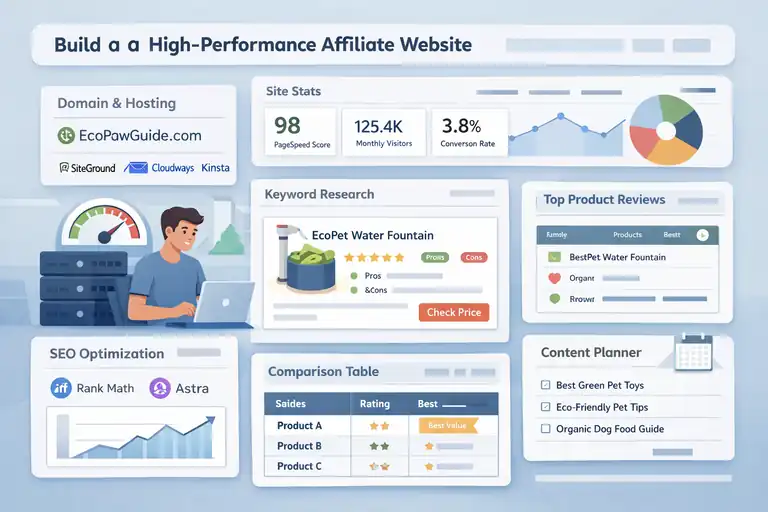
Once you’ve chosen your niche, it’s time to build a foundation that can handle growth. A fast, trustworthy, and conversion-ready site is your affiliate machine’s engine.
Pick the Right Domain Name and Hosting
Your domain should be short, memorable, and niche-relevant. If your niche is “eco pet care,” something like EcoPawGuide.com works far better than BestPetsReviewsOnlineNow.com.
For hosting, prioritize speed and uptime.
From experience, I recommend:
- Hostgator for beginners who want simplicity.
- Hostinger for advanced users needing scalability.
- WPengine if you expect high traffic and want managed WordPress hosting.
Even small speed gains—say, a 1-second improvement—can increase conversions by up to 7%.
Use a CMS That Supports Scalable Growth
A CMS (content management system) like WordPress remains the best choice for affiliate websites. It’s flexible, SEO-friendly, and easy to scale.
For beginners, start with:
- GeneratePress or Astra themes for speed.
- Elementor for easy design control.
- Rank Math for optimizing your pages.
Tip: Keep plugins minimal—only install what improves site performance or conversions.
Design for Speed, SEO, and User Experience
Think of your site as a digital storefront. If it loads slowly or feels confusing, visitors will leave.
Here’s what I prioritize:
- Core Web Vitals: Use PageSpeed Insights to keep your score above 85.
- Mobile-first design: Over 60% of affiliate traffic comes from phones.
- Readable typography and visual cues: Highlight CTAs (calls-to-action) with whitespace and contrast.
Remember, SEO isn’t just about keywords—it’s about usability. Google rewards websites that people stay on and engage with.
Create Conversion-Focused Page Layouts
Each page should guide users toward a clear action—whether that’s reading a review, clicking an affiliate link, or subscribing.
Try this proven layout for review posts:
- Intro paragraph: Explain what you’ll cover.
- Quick summary box: Include rating, pros/cons, and price.
- Detailed review: Discuss performance, pros, and cons.
- Affiliate CTA: Add a well-placed “Check Price” button.
A clean layout combined with trust-building visuals (badges, testimonials, product photos) can easily double your click-through rate.
Create Content That Attracts and Converts
Now that your foundation is set, it’s time to produce content that drives sales. In affiliate marketing, your words do the selling—so they must be honest, useful, and optimized.
Write Product Reviews That Build Trust
Readers can smell fake reviews from a mile away. Always write as if you’ve actually tested the product.
Structure your reviews like this:
- Intro: What problem does the product solve?
- Personal experience: Describe what you liked or didn’t.
- Comparison: Mention similar products and why you prefer this one.
- Verdict: Recommend who should buy it—and who shouldn’t.
Example: “I tested three ergonomic keyboards, but only the Logitech K860 reduced wrist strain noticeably after a week.” That kind of firsthand insight builds credibility fast.
Use Comparison and “Best Of” Posts Strategically
These posts—like Best Noise-Canceling Headphones for Home Offices—rank well because they cover multiple products and satisfy buyer intent.
When creating them:
- Compare top 5–10 products with clear pros and cons.
- Include tables summarizing key features and affiliate links.
- Add short verdicts like “Best for Beginners” or “Best Budget Option.”
Pro tip: Update these posts quarterly. Google rewards freshness, and affiliate networks often change commission structures or availability.
Optimize for Buyer Intent Keywords
Instead of chasing “headphones,” target terms like “best headphones for home office 2025.” These indicate that people are ready to buy.
Tools to find buyer intent keywords:
- Ahrefs Keyword Explorer: Filter by words like “best,” “review,” or “vs.”
- Google Autosuggest: Shows what real users are typing.
- AnswerThePublic: Great for identifying question-based search intent.
Example keyword progression:
- Informational: “What are ergonomic chairs?”
- Buyer intent: “Best ergonomic chairs under $200.”
You want the second type.
Blend Storytelling with Practical Product Value
Facts tell, but stories sell. I often share small anecdotes, like how a standing desk improved my back pain, then connect it to the product’s features.
Try this simple structure:
- Problem: “I was getting back pain after long workdays.”
- Solution: “I tried the FlexiSpot desk, and it changed my posture.”
- Outcome: “Now I can work 8 hours without strain.”
Readers connect emotionally, and that connection drives conversions.
Master SEO For Long-Term Traffic Growth
You can build the best affiliate website in the world, but without steady traffic, it’s like shouting into an empty room. SEO is what keeps your website affiliate marketing engine running month after month.
It’s not about hacks—it’s about building authority the right way so Google and your readers both trust you.
Research Low-Competition Affiliate Keywords
Finding the right keywords is like choosing the best battleground—you want traffic potential, but not a war you can’t win.
Here’s what I usually do:
- Start with buyer intent terms: Look for phrases like best [product] for [use], [product] review, or [product A] vs [product B]. These show clear purchasing intent.
- Use keyword tools smartly: In Ubersuggest, filter for keywords with a KD (Keyword Difficulty) score under 30 and monthly volume above 500.
- Spy on small competitors: If sites with low domain authority (DA 20–40) are ranking, it’s a sign you can too.
For example, instead of “best cameras,” target something like best vlogging cameras under $500. It’s more specific, easier to rank for, and has better conversion intent.
Pro tip: Don’t ignore long-tail keywords—they bring smaller but highly targeted traffic that converts better.
Build Topic Clusters For Authority And Relevance
Search engines now favor depth over volume. Building topic clusters helps you prove expertise.
Here’s how I structure them:
- Start with a pillar post – For example, “Complete Guide to Ergonomic Office Setup.”
- Create supporting posts – Write smaller articles like “Best Ergonomic Chairs for Small Desks” or “Top Standing Desk Accessories.”
- Link them together – Interlink all subtopics to the pillar page using descriptive anchor text.
This structure tells Google, “I’m not just writing one article—I’m an expert on this entire subject.” It also improves dwell time since users naturally browse related posts.
If you’re visual like me, think of a hub-and-spoke model: one main hub (pillar post) connected to smaller spokes (supporting posts).
Optimize On-Page SEO Elements Effectively
On-page SEO isn’t about stuffing keywords—it’s about making your content easy for both humans and algorithms to understand.
I follow a simple checklist:
- Title tag: Use your focus keyword naturally, and keep it under 60 characters. Example: “Best Standing Desks for Small Home Offices (2026 Guide).”
- Meta description: Add a benefit-driven summary that entices clicks.
- Headings (H2/H3): Use semantic keywords, not just repetitions.
- Alt text: Describe images meaningfully (e.g., “adjustable standing desk for home office”).
- URL structure: Keep it short and clean—no unnecessary words.
Don’t forget schema markup (using a plugin like Rank Math). It helps your posts appear with review stars or FAQs on Google, boosting your CTR instantly.
Leverage Internal Linking To Boost Conversions
Internal linking is the quiet powerhouse of SEO. It spreads link authority, keeps visitors on your site longer, and gently nudges them toward affiliate content.
Here’s how I approach it:
- Link every new post to at least two older ones.
- Use natural anchor text like “check out my detailed review of the FlexiSpot E7 desk.”
- Prioritize linking to high-converting pages like product reviews and comparison guides.
- Avoid overdoing it—3–5 internal links per 1,000 words is a good balance.
Over time, this builds a web of relevance that Google loves and visitors actually enjoy navigating.
Implement Smart Affiliate Link Strategies
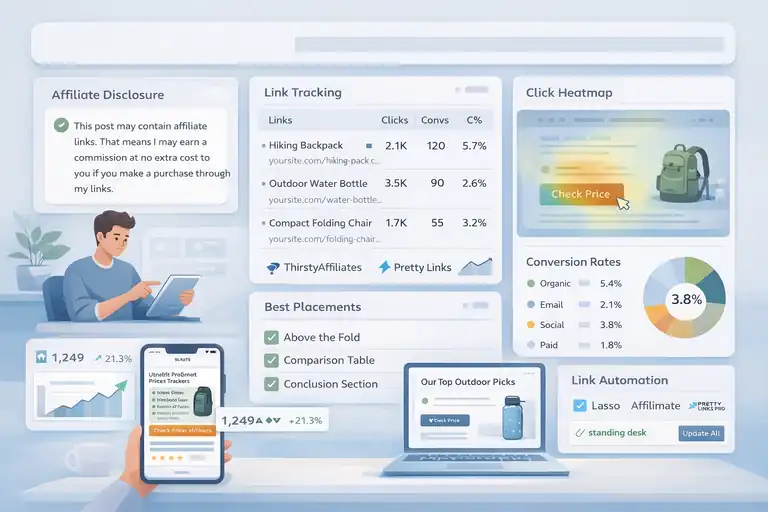
Affiliate links are your revenue engine, but they must be used wisely.
It’s not just about inserting them—it’s about doing it transparently, ethically, and strategically for maximum clicks and trust.
Use Affiliate Disclosure The Right Way
Transparency is non-negotiable. The FTC requires affiliate disclosures, but done right, they can also build trust.
I place a short, friendly disclosure at the top of affiliate posts:
“This post may contain affiliate links. That means I may earn a small commission at no extra cost to you if you make a purchase through my links.”
You can also add a smaller note under CTA buttons or in your footer. Keep it simple and conversational—no one likes legal jargon.
Track Links And Analyze Click Behavior
If you don’t track your links, you’re flying blind. Understanding which links drive clicks and conversions lets you double down on what works.
Here’s what I use:
- ThirstyAffiliates or Pretty Links: These plugins cloak long URLs and track performance.
- Google Analytics + UTM tags: Add custom tags to see which pages or buttons drive the most affiliate traffic.
- Heatmaps (like Hotjar): Show where users actually click or stop scrolling.
By analyzing this data, you can tweak placements and call-to-action (CTA) designs to lift conversions by 20–40%.
Optimize Placement For Maximum Conversions
Not all link placements are equal. I’ve tested dozens of layouts, and these consistently perform best:
- Above the fold: Add one contextual affiliate link early for impatient readers.
- Within comparison tables: Readers love direct “Buy Now” buttons beside features.
- In conclusion sections: Perfect spot to reinforce trust after delivering value.
Avoid overloading your content with links—it feels spammy. Instead, place 3–5 per post with strong intent signals.
Automate Link Management With Tools
Manually managing hundreds of affiliate links can get messy. Automation tools save hours and prevent broken links (which kill commissions).
My go-to stack:
- Lasso: Beautiful product boxes with performance tracking.
- Affilimate: Aggregates data from multiple affiliate programs.
- Pretty Links Pro: Automatically replaces keywords with affiliate links across posts.
Example: You can set it to automatically convert the word “standing desk” into a link every time it appears—no manual edits needed.
Automation keeps your affiliate ecosystem healthy and scalable as your content library grows.
Build And Grow An Engaged Audience
Traffic without engagement is like filling a leaky bucket. A loyal, returning audience not only converts better but also amplifies your reach through word-of-mouth and shares.
Use Email Marketing To Nurture Trust
Your email list is your most valuable asset—it’s traffic you own.
Here’s my basic system:
- Offer a useful freebie like a “7-Day Affiliate Starter Guide.”
- Use a simple opt-in form with tools like Aweber or Mailerlite.
- Send value-packed emails (tips, mini-guides, or product deals).
Keep it personal. Write like you’re talking to one friend, not a crowd. Over time, these subscribers become your biggest fans and repeat buyers.
Engage Readers Through Authentic Storytelling
Stories connect deeper than sales pitches ever could. Share real moments—your first affiliate commission, a product that surprised you, or even a mistake you learned from.
Example: I once promoted a gadget I hadn’t fully tested. It backfired when readers complained. I shared that openly, and oddly, it built more trust than any successful post.
That’s the power of honesty—it makes people stick around.
Leverage Social Media To Expand Reach
Don’t rely solely on Google. Use social channels to amplify your message and drive consistent traffic.
- Pinterest: Great for evergreen content like “how-to” guides and product lists.
- YouTube: Perfect for unboxing or review videos. Even short clips can link back to your site.
- Twitter/X and LinkedIn: Ideal for quick insights or sharing behind-the-scenes tips.
Focus on 1–2 platforms where your audience already hangs out instead of trying to be everywhere.
Build A Community Around Your Brand
An engaged community is your long-term safety net against algorithm changes.
Ways to build one:
- Create a private Facebook group or Discord server for your niche.
- Host live Q&A sessions about new products or affiliate tips.
- Encourage user-generated content—ask readers to share their results or photos.
When your readers feel part of something bigger, they naturally promote your content and trust your recommendations more.
Pro Tip: Always prioritize value over volume. A smaller, loyal audience that trusts your recommendations will outperform a large, passive one every time. If your website affiliate marketing strategy builds relationships first, the revenue follows naturally.
Drive Consistent Traffic Through Multiple Channels
If your website affiliate marketing strategy relies on one traffic source, you’re building on shaky ground.
Consistent traffic comes from diversification—mixing organic reach, paid visibility, partnerships, and smart content distribution.
Use Organic Search And SEO As The Core Channel
Organic search should be your foundation. It brings free, qualified traffic month after month once you rank well.
Here’s my simple formula for sustainable SEO growth:
- Publish long-form, evergreen content: Aim for 1,500–2,500 words that answer everything a reader might ask about the topic.
- Use internal links strategically: Link newer posts to your top-performing evergreen ones to boost ranking power.
- Optimize for snippets: Add clear, structured answers (bullet lists or numbered steps) to capture “featured snippet” positions on Google.
Example: For a post like “Best Travel Backpacks for Digital Nomads,” include a concise comparison table at the top and an FAQ section at the bottom. Google loves this structure, and readers stay longer.
Remember—SEO rewards patience. It can take 3–6 months to see consistent traffic growth, but once it kicks in, it’s your most stable source.
Supplement Traffic With Paid Ads Strategically
Paid traffic can give you a jumpstart, especially for testing product-market fit or new affiliate offers.
The trick is to spend smart, not big.
- Use retargeting ads: Show ads to visitors who read your reviews but didn’t click. Tools like Meta Ads Manager or Google Ads make this simple.
- Boost proven content: Promote only articles already showing conversions or high engagement.
- Test multiple creatives: Run 3–5 ad versions at small budgets ($5–10/day) to find what performs best before scaling.
Think of paid ads as fuel—you pour it in when you need a push, but your SEO engine should keep the car moving long-term.
Partner With Influencers And Other Creators
Affiliate marketing thrives on credibility, and partnerships can multiply your reach fast.
Here’s what’s worked best for me:
- Micro-influencers (5K–50K followers): They often have more engaged audiences than large creators.
- Co-create content: Write guest posts, record joint YouTube reviews, or host live Q&A sessions together.
- Affiliate swaps: Promote each other’s content or products to tap into new but aligned audiences.
Example: A fitness affiliate site partnering with a YouTube trainer can easily double exposure overnight while boosting trust through shared authority.
Repurpose Content For Maximum Visibility
One post can become five pieces of content if you repurpose it wisely.
Here’s a quick example:
- Turn a long-form article into a short YouTube explainer.
- Slice that video into 30-second TikToks or Reels.
- Convert key tips into carousel posts for LinkedIn or Instagram.
- Transform quotes into Pinterest pins or email snippets.
Repurposing saves time and keeps your message consistent across platforms. The goal isn’t to create more content—it’s to squeeze more value out of what’s already working.
Monetize Beyond Affiliate Links
Affiliate links are powerful, but relying on them alone limits your earning potential.
Diversifying your income streams strengthens your business and protects you against commission changes or network closures.
Add Complementary Digital Products
Digital products—like templates, eBooks, or Notion planners—are easy to create and scale.
Here’s how to find ideas:
- Look at your most popular content. What recurring problems do readers face?
- Package your expertise into something practical—a “Content Planning Template for Affiliates” or “Affiliate SEO Checklist.”
- Use tools like Gumroad or Podia to sell them directly from your site.
Even a $19 digital product can bring in steady income when promoted across your blog and email list.
Offer Consulting Or Coaching Services
If you’ve built success in your niche, there’s demand for your guidance.
You can start small by offering 1:1 coaching calls or group workshops on Zoom. For example:
- “Affiliate Website Audit & Strategy Session”
- “How to Choose a Profitable Niche (1-Hour Workshop)”
This not only diversifies income but also positions you as an expert, attracting more loyal readers.
Build And Sell Your Own Online Course
Once your audience trusts you, teaching becomes a natural next step.
Here’s how to get started:
- Outline a clear transformation (e.g., “Build Your First Affiliate Website in 30 Days”).
- Record short, digestible lessons using Loom or OBS Studio.
- Host your course on Teachable, Thinkific, or Podia.
Courses scale beautifully because they combine authority, automation, and community—all while deepening your brand impact.
Integrate Display Ads Without Hurting UX
Display ads can provide passive income if implemented carefully. The key is balance—you want to earn from impressions without frustrating readers.
A few tips that have worked for me:
- Use Ezoic or Mediavine for smarter ad placements that optimize revenue per visitor.
- Limit ad density to maintain page speed.
- Avoid intrusive pop-ups or auto-play videos.
Display ads shouldn’t feel like noise. When done right, they quietly add an extra revenue layer without disrupting conversions.
Analyze, Optimize, And Scale Your Affiliate Site
You can’t grow what you don’t measure. Scaling your affiliate website comes down to knowing what works, improving what doesn’t, and doubling down on proven winners.
Use Analytics To Identify Top-Performing Pages
Data reveals the truth—always. I check performance weekly using:
- Google Analytics (GA4): Track traffic, engagement, and conversion behavior.
- Google Search Console: Identify which queries bring impressions but low CTR (click-through rate).
- Affiliate dashboards: See which posts or links drive the most sales.
If one article brings in 70% of your affiliate revenue, create supporting posts, internal links, and content upgrades around that topic.
A/B Test Calls-To-Action And Content Formats
Sometimes, a small change in button color or text can increase clicks by 20%.
Test one variable at a time:
- CTA wording: “Check Price” vs. “See Today’s Deal.”
- Button placement: Above or below comparison tables.
- Content type: Text-only reviews vs. video reviews.
Tools like VWO make A/B testing easy, even for beginners. Over time, you’ll find what your audience naturally responds to.
Optimize For Conversion Rate And Retention
It’s not just about getting traffic—it’s about keeping visitors engaged and converting.
I focus on:
- Fast loading speed: Every second delay can reduce conversions by 7%.
- Clear navigation: Readers should find product pages within two clicks.
- Trust elements: Add testimonials, review badges, or user photos to build confidence.
Think of your website as a conversation: the smoother it flows, the more likely visitors are to buy.
Expand To Related Niches For Growth
Once your main niche is stable, expanding into adjacent areas helps scale revenue.
Example: If your affiliate site is about home fitness, branching into “nutrition for fitness” or “home gym tech” keeps your audience overlap high.
This kind of lateral expansion allows you to reuse authority, backlinks, and brand trust—making growth faster and cheaper.
Maintain And Future-Proof Your Affiliate Business
The digital world changes fast. To keep your website affiliate marketing business relevant, you need to stay proactive—not reactive.
Keep Content Fresh And Up-To-Date
Outdated posts can quietly kill rankings. Schedule a quarterly content refresh:
- Update product links and prices.
- Add new competitors or 2025 updates.
- Replace old stats and screenshots.
Even adding 100–200 words of new insights can signal freshness to Google and bump your rankings back up
Monitor Algorithm Updates And Adapt
Google’s algorithm updates can feel like earthquakes. Instead of panicking, focus on user value:
- Write genuinely helpful content.
- Maintain E-E-A-T (Experience, Expertise, Authoritativeness, Trust).
- Diversify traffic so you’re not 100% dependent on search.
The best defense against SEO volatility is real brand building.
Diversify Income Streams To Reduce Risk
Never let one affiliate program or traffic source hold your business hostage.
Here’s my “3×3 rule”:
- At least 3 income streams (affiliate, digital products, ads).
- From 3 major partners (Amazon, niche-specific programs, your own offers).
This spreads risk so even if one network changes commission rates, your business remains stable.
Build Long-Term Brand Equity Around Your Site
In the end, you’re not just building an affiliate site—you’re building a brand.
That means:
- Creating consistent branding (colors, tone, and voice).
- Building recognition through email, social, and partnerships.
- Sharing your personal story to stand out from faceless review sites.
When readers associate your name with trust, they’ll follow your recommendations automatically. That’s the ultimate goal of any affiliate business: long-term loyalty that turns clicks into community.
Pro Tip: The most successful affiliate sites aren’t just optimized—they’re human. Keep showing up authentically, experiment constantly, and let trust compound over time. That’s how your website affiliate marketing machine evolves into a sustainable, future-proof business.
FAQ
How do I start website affiliate marketing from scratch?
Start by choosing a profitable niche, building a WordPress website, and joining affiliate programs like Amazon Associates or ShareASale. Then, publish SEO-optimized content that promotes products relevant to your audience.
How long does it take to make money with website affiliate marketing?
Most beginners start seeing results in 3–6 months with consistent content, SEO, and audience building. It depends on your niche, traffic, and product selection.
What tools do I need for a website affiliate marketing setup?
Use tools like WordPress for your site, Ahrefs for keyword research, ConvertKit for email marketing, and Lasso for managing affiliate links.

I’m Juxhin, the voice behind The Justifiable.
I’ve spent 6+ years building blogs, managing affiliate campaigns, and testing the messy world of online business. Here, I cut the fluff and share the strategies that actually move the needle — so you can build income that’s sustainable, not speculative.