
Table of Contents
Some links on The Justifiable are affiliate links, meaning we may earn a small commission at no extra cost to you. Read full disclaimer.
ClickMagick affiliate tracking software review is a search phrase people usually type when they are tired of guessing which clicks actually make money. I get it. In 2026, tracking is not just about counting visits anymore.
It is about filtering junk traffic, connecting clicks to conversions, sending cleaner signals back to ad platforms, and making faster decisions without drowning in dashboards.
This review breaks down what ClickMagick does well, where it feels limited, how much it costs, and whether it is a smart buy for affiliates, media buyers, small brands, and agencies right now.
What ClickMagick Is Really Built To Do
ClickMagick is not a page builder, CRM, or all-in-one marketing suite. It is a tracking and attribution platform designed to show you what happened between the click and the conversion, then help you optimize around that data.
What Problem It Solves For Affiliates
If you promote affiliate offers, the biggest headache is usually not traffic. It is blind traffic. You can buy clicks from Meta, Google, native, YouTube, solo ads, or influencer shoutouts and still have no clean answer to a basic question: which source, ad, page, or audience segment is actually producing profitable conversions?
ClickMagick is built to answer that with link tracking, attribution, postback support, reporting, and optimization tools focused on paid traffic and direct-response campaigns.
What makes that relevant in 2026 is the broader tracking environment. Bot traffic has become a real operational problem, not a niche annoyance
Imperva’s 2025 Bad Bot Report says bad bots now account for 37% of all internet traffic, while automated traffic overall has surpassed human activity at 51% of web traffic. That matters because if your tracker cannot separate fake or low-quality clicks from real visitors, your “optimization” can get worse as you spend more.
My view is simple: ClickMagick is most useful when every click has a cost. If you are running paid traffic, tracking errors become expensive fast. If you are only doing basic content affiliate marketing with a handful of blog links, the software can still help, but you may not squeeze enough value from it to justify a paid plan. That is the first filter I would use before even looking at features.
Who Should Buy It And Who Probably Should Not
ClickMagick’s own plan descriptions tell you a lot about its ideal user. The Starter plan is framed for small campaigns and newer advertisers, while Standard and Pro clearly target optimization, scaling, more team members, more tracked visitors, and more ad accounts.
The product pages also lean hard into ad tracking, attribution, fraud protection, and conversion feedback loops for platforms like Google and Facebook.
That means the best-fit users are usually one of these three groups. First, affiliate marketers who run paid traffic and need reliable postback tracking across networks. Second, e-commerce or lead-gen advertisers who want first-party tracking and better conversion signals.
Third, agencies or small teams that need a shared source of truth across campaigns without paying enterprise-level attribution prices.
The weaker fit is someone who wants a complete growth stack in one tool. ClickMagick gives you tracking, reporting, split testing, Smart Links, API access, and optimization help, but it is not trying to replace your email platform, landing page builder, affiliate network software, or customer database.
If that is what you want, you may feel like it is “missing features” when in reality it is just more focused than broad. Personally, I think that focus is a strength, but only if you buy it for the right job.
The 2026 Positioning In Plain English
A lot of tracking tools now promise better attribution, server-side data, cleaner event matching, and cookieless resilience. ClickMagick’s 2026 positioning is basically this: accurate tracking, first-party data, better feedback to ad platforms, strong anti-fraud protection, and simpler pricing than some premium attribution competitors.
On its own site, the company highlights TrueTracking, Audience Optimization, advanced attribution, cross-device tracking, offline sales tracking, and ClickShield as the core pillars.
That positioning feels credible because the company is not pretending to be everything. It is selling decision clarity. The language is a little marketing-heavy in places, but the feature set lines up with what performance marketers actually care about: real-time stats, split tests that are based on cleaner data, conversion uploads, bot filtering, and implementation paths for affiliate networks through server-to-server postbacks.
So if you want the shortest possible summary of this section, here it is: ClickMagick is a specialized tracking and optimization tool for marketers who need cleaner attribution than basic analytics can provide. That is a strong place to be in 2026.
The Features That Actually Matter In Daily Use
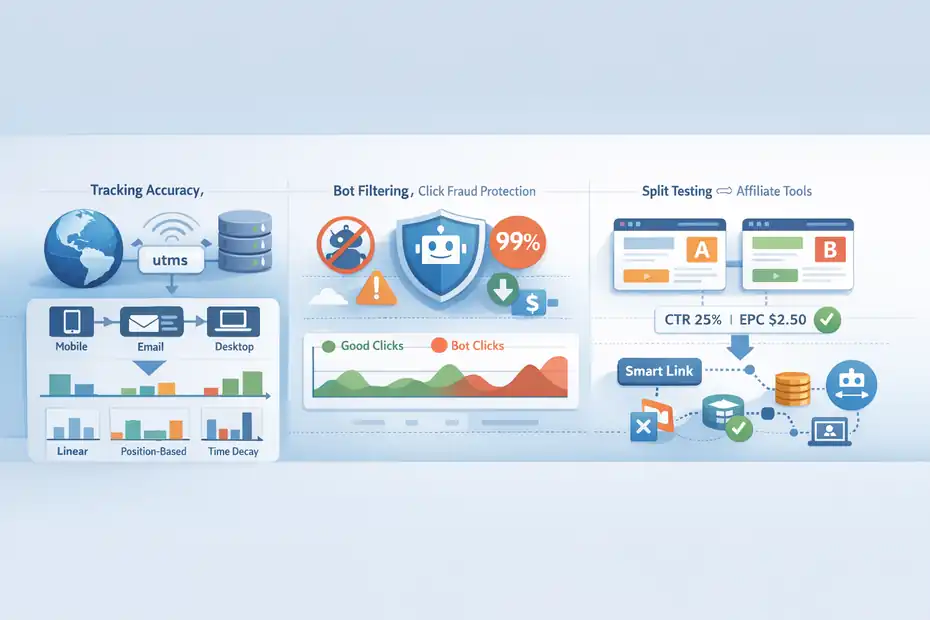
The feature list is long, but not every feature carries the same weight. The real value comes from a handful of capabilities that directly affect ROI, data quality, and speed of optimization.
Tracking Accuracy, First-Party Data, And Attribution
ClickMagick leans heavily on what it calls TrueTracking, along with UTMs, server-side tracking, and first-party data. On the product page, it claims these pieces work together to improve conversion attribution accuracy and give ad platforms better signals. It also offers advanced attribution models beyond last-click, including linear, position-based, and time-decay views.
In practical terms, this matters when a buyer does not convert in one clean session. Maybe they click from mobile, return on desktop, browse an email, and purchase later. ClickMagick says it supports cross-device tracking and can map the customer journey more accurately than standard platform-side reporting alone.
That is a meaningful advantage for affiliates and advertisers working with longer funnels, webinars, lead magnets, or upsell sequences.
I would not frame this as magic. No platform sees everything perfectly, especially in a privacy-first environment. But I do think ClickMagick is strongest when you compare it against basic last-click reporting inside an ad platform.
If your current process is “Meta says one thing, Google says another, and affiliate network stats say something else,” then the jump in clarity can feel dramatic. That is where a specialized tracker earns its keep.
Bot Filtering, Click Fraud Protection, And Traffic Quality
This is one of the most compelling reasons to use ClickMagick. The FAQs and product pages put serious emphasis on bot filtering and ClickShield fraud protection, including blacklist syncing for ad platforms and protection against repeated wasteful clicks from bots, competitors, or habitual ad clickers.
The company says ClickMagick filters out 99% of bot and fake clicks, and says ClickShield can reduce wasted PPC spend by preventing repeat offenders from seeing your ads.
Even if you treat vendor claims cautiously, the underlying problem is very real. With bad bots now representing 37% of all internet traffic according to Imperva, traffic quality is no longer a side metric. It is a budget protection issue.
For affiliates buying traffic on thin margins, removing garbage data can be as valuable as improving conversion rate because it changes both your reporting accuracy and your scaling decisions.
This is also where ClickMagick feels more performance-marketer-friendly than a standard analytics setup. Google Analytics can tell you plenty about sessions and events, but it is not built around paid click quality control in the same direct-response way.
ClickMagick is. That focus shows up in how the product talks about bots, repeated paid clicks, and traffic filtering as operational levers, not just dashboard trivia.
Split Testing, Smart Links, And Affiliate-Friendly Extras
ClickMagick includes easy split testing, Smart Links, short links, and affiliate tools. The product page says you can test headlines, pages, and funnel steps without code-heavy workarounds, and it specifically notes integrations with 100+ affiliate networks through server-to-server postback tracking.
That affiliate angle matters more than it might seem. Many “attribution” tools are really built for brands first and affiliates second. ClickMagick feels like it still understands the day-to-day workflow of affiliate promotion: rotating links, tracking external offers, using postbacks for cleaner conversion reporting, and creating short links that are easier to deploy in ads, emails, and social placements.
A realistic example helps here. Imagine you are testing two presell pages before the same affiliate offer. One page gets a better click-through rate, but the other produces higher earnings per click after the offer conversion comes back through postback. A weak tracker may tempt you to choose the wrong winner.
ClickMagick’s value is that it tries to keep that decision tied to cleaner downstream data, not just front-end vanity numbers. That is exactly the kind of detail that separates hobby affiliates from serious buyers.
Setup Experience And How Hard It Really Is
Most tracking tools sound great until implementation starts. This is the point where many people quit, blame the software, and go back to messy spreadsheets and ad-platform reports.
Getting Started Without Feeling Overwhelmed
ClickMagick includes a step-by-step setup wizard on its plans page, and the Standard plan includes a one-on-one onboarding call. The company also offers a 14-day free trial and says you can upgrade, downgrade, or cancel easily.
That tells me the company understands that setup friction is one of the biggest barriers to adoption.
For a beginner, the easiest first win is usually simple link tracking. You create tracked links, send paid traffic to a page or affiliate offer, and start reading click and conversion data before diving into more advanced attribution models.
That gives you immediate value without forcing a full-stack implementation on day one. In my experience, this is the right way to approach tools like ClickMagick: get one clean traffic path working first, then expand.
The software becomes more powerful when you add custom domains, first-party tracking, conversion events, and postbacks, but you do not need every advanced feature live in the first hour. That is important because some reviews make trackers sound intimidating.
ClickMagick is not “easy” in the same way a simple URL shortener is easy, but it does appear intentionally designed to get new users from zero to useful faster than enterprise-grade tools often do.
Postback Tracking, Pixels, And Conversion Setup
For affiliate marketers, postback tracking is the feature that usually matters most. ClickMagick says it integrates with 100+ affiliate networks through server-to-server postbacks, which is typically more reliable than relying only on browser-side pixels.
That matters because browser restrictions, blockers, and privacy changes can break or undercount client-side tracking.
A simple implementation flow looks like this: Create the tracking link in ClickMagick, pass the click ID through your traffic source and landing page flow, place the ClickMagick tracking code if needed on owned pages, and configure the affiliate network or platform to send conversion data back through postback when a lead or sale happens. Once that loop is working, your reports become much more useful because conversion outcomes connect back to the original click source.
This is also where many tracking mistakes happen. One wrong parameter, one missing token, or one mismatch in the postback URL and your stats become incomplete. So the software is only half the equation. The other half is disciplined implementation.
I do not see this as a weakness of ClickMagick specifically. It is just the truth of tracking software in general. Still, if you are not comfortable with IDs, tokens, pixels, and postbacks, expect a learning curve.
First-Party Domains, Cross-Device Tracking, And Offline Sales
Where ClickMagick becomes more interesting in 2026 is beyond basic affiliate link tracking. The product page highlights first-party tracking domains, cross-device tracking, and even phone or offline sales tracking.
That combination is useful for businesses with hybrid funnels, call-heavy lead generation, or higher-ticket offers where the sale may not happen in the same browser session.
Let me make that concrete. Imagine you run ads for a service business. A prospect clicks from Instagram on a phone, opts in, gets nurtured, and later closes by phone after talking to sales. Many tools struggle to attribute that cleanly without expensive add-ons or messy manual processes.
ClickMagick specifically says it can track offline conversions back to the original ad or promotion and then send that first-party conversion data back to ad platforms. That is a serious capability for a tool priced below many premium attribution suites.
I would still test this carefully in your own funnel before making big promises to yourself or clients. But from a feature standpoint, ClickMagick offers more implementation depth than many people expect when they first hear the brand name. It is not just a link cloaker. It has moved well beyond that lane.
Reporting, Optimization, And Day-To-Day Decision Making
Tracking tools live or die by one thing: do they help you make better decisions faster? Raw data is not the goal. Better allocation is the goal.
Reports That Help You Cut Losers Faster
ClickMagick emphasizes real-time stats and reports, visitor profiles, funnel-level visibility, and the ability to see what happened at the click and conversion level. It also highlights complete visitor profiles so you can view a user’s history across ads, site behavior, and responses before purchase.
For performance marketers, that is not just interesting data. It changes how fast you can act. If one ad set has a higher front-end click-through rate but worse conversion value after the funnel, you want to know that today, not at the end of the week.
If one traffic source produces lots of opt-ins but poor-quality leads, you want that visible before you scale it.
ClickMagick’s reporting approach seems built around those direct-response decisions rather than top-level marketing summaries.
That said, reporting value depends on data hygiene. Garbage in, garbage out still applies. If your tags are inconsistent, postbacks are missing, or campaign names are sloppy, no software can rescue that completely. My recommendation is to treat setup standards as part of the tool itself.
The best ClickMagick users are usually the ones who keep naming conventions and conversion logic disciplined from the start.
Audience Optimization And Ad Platform Feedback Loops
One of the stronger product angles is Audience Optimization, which sends actual conversion data back to ad platforms in real time. ClickMagick argues that ad platforms often misattribute 20% to 50% of conversions and that cleaner feedback improves optimization. It also says first-party data helps produce better event match scores.
This matters because modern ad platforms are heavily algorithmic. If the platform is optimizing around incomplete or noisy signals, your campaign can drift toward the wrong audience, wrong placements, or wrong creatives.
So the value of a tracker is not only internal visibility. It is also external signal quality. Better feedback can improve how the platform spends your money.
I think this is one of the biggest reasons ClickMagick remains relevant in 2026. The market has shifted from simple click reporting toward signal management. The companies that win are not always the ones with the prettiest dashboard.
They are the ones that help you feed cleaner outcomes back into Meta, Google, and other platforms. ClickMagick clearly understands that shift.
ClickMagick Insights And Morning Magick
ClickMagick now includes Insights and Morning Magick, which the company describes as daily and weekly performance analysis that tells you what to scale, pause, or fix. The pricing page shows AI Insights capacity by plan, while the dedicated Insights page says the feature highlights important shifts and can replace hours of manual stats checking.
I like this direction because one of the hidden costs of tracking software is the time it demands. Many marketers buy a tracker, then barely use the data because pulling insights takes too much effort. A layer that surfaces anomalies, changes, and likely actions can make the software more valuable even if the underlying data engine stays the same.
Would I buy ClickMagick only for Insights? No. I would buy it for tracking, attribution, and traffic-quality control first. But as a bonus layer, Insights makes the platform feel more aligned with how real marketers work now: less dashboard archaeology, more guided action. That is a smart update for 2026.
Pricing, Plans, And Whether The Cost Makes Sense
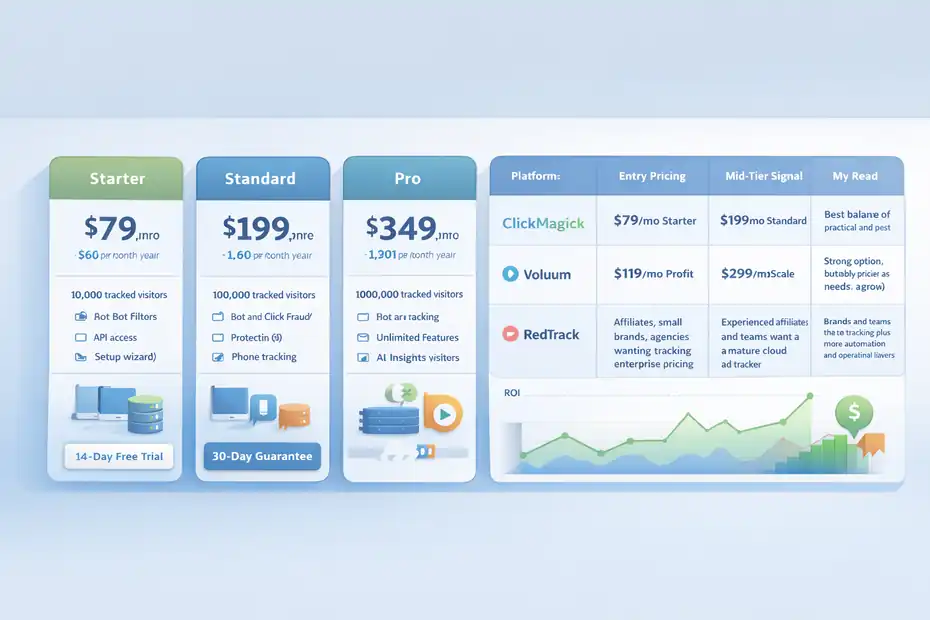
Pricing is where a lot of software reviews become fluffy. Let’s keep this simple and practical. Does ClickMagick cost enough to hurt, and does it deliver enough to justify that cost?
Current ClickMagick Pricing For 2026
ClickMagick’s public pricing page shows three main plans. Starter is $79 per month or $66 per month billed yearly, with 10,000 tracked visitors, one user, one website or e-commerce store, one ad account per platform, six months of data retention, basic bot filtering, API and Zapier access, and the setup wizard.
Standard is $199 per month or $166 per month billed yearly, with 100,000 tracked visitors, extra team members, one-year data retention, onboarding, bot and click fraud protection, advanced attribution, phone and offline sales tracking, and unlimited affiliate campaigns.
Pro is $349 per month or $291 per month billed yearly, with 1,000,000 tracked visitors, unlimited team members, unlimited ad accounts, and more AI Insights capacity.
The company also offers a 14-day free trial, says you can cancel in a couple of clicks, and states a 30-day money-back guarantee in its trial policy. That lowers the risk a bit for people who want hands-on validation before committing.
My take: the Starter plan is affordable for a serious solo marketer, but not cheap enough for pure beginners who are not yet buying traffic consistently. Standard is where the value really starts to show if you are actively optimizing paid campaigns. That is also the plan where ClickMagick begins to look strong against pricier alternatives.
Comparison Table: ClickMagick Vs Other Tracking Platforms
For context, here is a simple pricing-and-positioning snapshot based on public pricing pages and product descriptions.
| Platform | Entry Pricing | Mid-Tier Signal | Best Fit | My Read |
|---|---|---|---|---|
| ClickMagick | $79/mo Starter | $199/mo Standard | Affiliates, small brands, agencies wanting strong tracking without enterprise pricing | Best balance of practical depth and cost for many direct-response marketers. |
| Voluum | $119/mo Profit | $299/mo Scale | Experienced affiliates and teams that want a mature cloud ad tracker | Strong option, but notably pricier as needs grow. |
| RedTrack | Pricing page emphasizes tiered plans and broader tracking, automation, and ads management; page shows plan pricing blocks starting around $200/month in one section | Higher operational focus | Brands and teams that want tracking plus more automation and operational layers | Powerful, but usually a different buyer profile than budget-conscious solo affiliates. |
This is where ClickMagick has a real advantage. Its Standard tier at $199 per month lands in a sweet spot: advanced attribution, fraud protection, offline tracking, onboarding, and unlimited affiliate campaigns without immediately forcing you into mid-enterprise pricing.
That does not make it “the best” for everyone, but it does make it one of the better value plays for performance marketers who need serious tracking without agency-software sticker shock.
What Return On Investment Would Justify The Spend
The easiest ROI case is wasted ad spend. If ClickShield and bot filtering prevent even a modest amount of fake, repeated, or low-value clicks, the software can pay for itself quickly for PPC users. ClickMagick itself makes that argument directly in the FAQ, especially for Google and Bing advertisers.
The second ROI case is optimization quality. A better decision about which page, traffic source, or campaign to scale can easily outweigh the monthly subscription if you are spending real money already. And the third ROI case is time.
Features like Insights, cleaner reports, and more centralized attribution can reduce the hours you spend trying to reconcile conflicting numbers.
If you are spending under a few hundred dollars a month on traffic, I would be more cautious. At that stage, improving your offer, creative, or page speed may matter more than adding a tracker.
But once traffic spend becomes meaningful, ClickMagick starts looking less like a cost and more like insurance plus leverage.
The Downsides, Limitations, And Common Mistakes
No honest ClickMagick affiliate tracking software review should pretend the tool is perfect. The product is strong, but it comes with trade-offs.
It Is Still A Tracking Tool, Which Means A Learning Curve
The biggest downside is simple: tracking software requires precision. Postbacks, tokens, event mapping, custom domains, and attribution settings can be confusing if you are new to performance marketing.
ClickMagick does appear to invest in onboarding, setup guidance, API docs, and support, but there is no way around the fact that accurate tracking needs accurate implementation.
This is why some users bounce off trackers too early. They expect plug-and-play simplicity, but the value only appears after the plumbing is connected properly. If you are not willing to spend some time learning setup basics, you may underuse the software and blame the platform for what is really an implementation gap.
I do not say that to defend the tool blindly. It is a real buying consideration. If you want instant simplicity, ClickMagick may feel heavier than you expected. If you want control and deeper visibility, that same complexity starts to feel justified.
Some Marketers Will Outgrow It Or Need A Different Stack
Another limitation is strategic fit. ClickMagick is focused, which is good, but some organizations need a broader operational layer around tracking, attribution, data warehousing, or ad automation.
Platforms like RedTrack and some higher-end tools lean more toward unified operations and larger-scale infrastructure. Voluum also remains a strong specialist competitor for serious affiliates.
That does not mean ClickMagick is weak. It means buyer context matters. A solo affiliate running offers across several traffic sources may find ClickMagick ideal. A bigger in-house growth team with more complex data requirements might want something else.
The wrong move is treating every tracker as interchangeable. They are not. Their philosophy and target user matter a lot.
Common Mistakes People Make After Buying
The most common mistake is tracking too much, too soon. People wire up ten campaigns, five event types, three traffic sources, and two offer paths on day one. Then when the data looks messy, they do not know what broke.
A better approach is staged implementation: one traffic source, one funnel, one conversion goal, then expand.
The second mistake is using the reports without tightening naming conventions. If campaign names, link structures, and source tags are inconsistent, your tracker becomes harder to trust.
The third mistake is ignoring traffic quality metrics and only looking at raw clicks. In 2026, that is dangerous. With bot pressure rising, you need to care about filtered clicks and fraud protection, not just volume.
The last mistake is not using the data to take action. I have seen marketers obsess over perfect dashboards and still fail to pause bad campaigns quickly. The whole point of ClickMagick is faster, cleaner decisions. If it becomes another dashboard you admire but do not use, the software is not the problem.
Final Verdict: Is ClickMagick Worth It In 2026?
If you want a simple verdict, here it is: yes, ClickMagick is worth serious consideration in 2026, especially for affiliates and performance marketers who buy traffic, care about attribution accuracy, and need cleaner data without jumping straight to very expensive enterprise tools.
Best For These Types Of Buyers
I would put ClickMagick near the top of the shortlist for three groups. First, solo or small-team affiliates who need reliable postback tracking, split testing, Smart Links, and traffic-quality control. Second, service businesses or lead-gen advertisers who want call and offline conversion visibility without overbuilding their stack.
Third, agencies that want shared tracking discipline and more credible reporting at a lower cost than many premium alternatives.
The software’s strongest selling points are not flashy. They are practical: better attribution, better fraud filtering, better optimization signals, and a feature set that maps closely to how direct-response marketers actually work.
That is why I think the tool has held up well even as the market has shifted toward AI insights, first-party data, and signal quality.
When I Would Personally Choose Something Else
I would look elsewhere if your business needs a much broader operational platform than tracking alone, or if your traffic volume and team complexity justify a system designed more for large-scale infrastructure and ad operations.
I would also hesitate if you are still too early in the game to know what you would actually measure. In that case, simpler analytics plus tighter offer testing may be the smarter first step.
But for the person who searched for a clickmagick affiliate tracking software review because they are spending money, want to stop guessing, and need a tracker that can grow with them, I think ClickMagick makes a strong case.
Not because it is perfect, and not because every claim on any software sales page should be taken at face value, but because the product-market fit is clear. It solves an expensive problem, and in 2026 that problem is only getting bigger.
FAQ
What is ClickMagick and how does it work for affiliate tracking?
ClickMagick is a tracking platform that helps affiliates monitor clicks, conversions, and traffic sources in real time. It uses tracking links, pixels, and postbacks to connect user actions to specific campaigns, giving you clearer insight into which ads and offers generate real revenue.
Is ClickMagick accurate for tracking affiliate conversions?
ClickMagick is considered highly accurate when set up correctly, especially with server-to-server postback tracking. It reduces reliance on browser cookies and improves attribution by capturing first-party data, which helps minimize data loss caused by ad blockers or privacy restrictions in modern browsers.
How much does ClickMagick cost in 2026?
ClickMagick pricing starts at $79 per month for the Starter plan and goes up to $349 per month for the Pro plan. Each tier increases tracked visitors, data retention, and advanced features like fraud protection, offline tracking, and AI-powered insights.
Who should use ClickMagick affiliate tracking software?
ClickMagick is best suited for affiliate marketers, media buyers, and businesses running paid traffic campaigns. It is especially valuable for users who need accurate attribution, bot filtering, and optimization tools to improve return on ad spend and scale campaigns effectively.
Is ClickMagick worth it for beginners?
ClickMagick can be worth it for beginners who are already spending money on traffic and want better tracking. However, it may feel complex at first. If you are not yet running paid campaigns, simpler tools may be enough until you need deeper tracking and optimization.

I’m Juxhin, the voice behind The Justifiable.
I’ve spent 6+ years building blogs, managing affiliate campaigns, and testing the messy world of online business. Here, I cut the fluff and share the strategies that actually move the needle — so you can build income that’s sustainable, not speculative.
Related posts:
 ClickMagick Link Tracking Review: Boost Conversions Fast
 Best Way to Make Money Online
 How To Create Passive Income Online: 10 Best Ways
 How RedTrack API Transforms Affiliate Tracking
 15 Must-Have Affiliate Marketing Tools to Grow Faster
 Is SurveyMonkey Worth It For Affiliate Marketing: Hidden Potential