
Table of Contents
Some links on The Justifiable are affiliate links, meaning we may earn a small commission at no extra cost to you. Read full disclaimer.
When I first heard about affiliate marketing, I remember thinking, “Wait, you can earn money by simply recommending products?”
That curiosity sent me down a rabbit hole that changed how I viewed online income forever. So, if you’re wondering affiliate marketing what is it and how it actually works, you’re in the right place.
Let’s break down what affiliate marketing really means, how the process flows, and what tools and strategies can help you succeed.
Understanding Affiliate Marketing: What It Really Means
Affiliate marketing is one of those business models that looks simple on the surface but has a fascinating structure beneath it.
In essence, it’s a partnership where one person (the affiliate) earns a commission for promoting another company’s product or service.
But beyond that, it’s an ecosystem built on trust, strategy, and value exchange.
How Affiliate Marketing Creates a Win-Win System
Affiliate marketing thrives because everyone benefits. It’s not a one-sided sales pitch — it’s a performance-based relationship where each participant wins:
- The Merchant (or Brand) gets exposure and sales without paying upfront for advertising.
- The Affiliate (that’s you) earns a commission for every sale, lead, or click generated through your unique link.
- The Consumer gains useful product recommendations and insights from someone they trust, often saving time and confusion.
For example, if you promote a hosting service like Hostinger on your blog, you only get paid when someone actually signs up through your referral link. This creates accountability — merchants pay for results, and affiliates earn for impact.
I like to think of it as the modern word-of-mouth economy. Instead of casually recommending a tool to a friend, you’re recommending it online, with the added advantage of tracking links and data-driven commissions.
The Roles of Merchants, Affiliates, and Consumers
Affiliate marketing works like a relay race with three essential players:
- Merchant or Advertiser: The company that owns the product or service — for instance, Awin (which replaced ShareASale) connects merchants to affiliates in multiple niches.
- Affiliate or Publisher: The marketer or creator promoting products — bloggers, YouTubers, or social media influencers are typical examples.
- Consumer: The person who clicks on the link and makes a purchase.
Here’s a simple way to visualize it:
You → Promote a product → Consumer → Buys it → Merchant → Pays you a commission.
It’s that straightforward — but the success depends on trust, content quality, and how well your recommendations align with your audience’s needs.
Why Affiliate Marketing Became a Core Online Business Model
Affiliate marketing became the backbone of online income for one simple reason — scalability. It allows creators, bloggers, and entrepreneurs to generate passive income without holding inventory or dealing with customer service.
A few reasons it took off:
- Low barriers to entry: Anyone can start, even with a small blog or YouTube channel.
- Performance-based rewards: You only get paid for actual conversions, so businesses love it.
- Infinite scalability: The same piece of content can earn commissions for months or years.
In my experience, affiliate marketing also changed the advertising game — from interruption-based ads to trust-based recommendations.
Today, platforms like FlexOffers, PartnerStack, and Impact make it possible to connect affiliates with reputable global brands in just a few clicks.
How Affiliate Marketing Works Step by Step
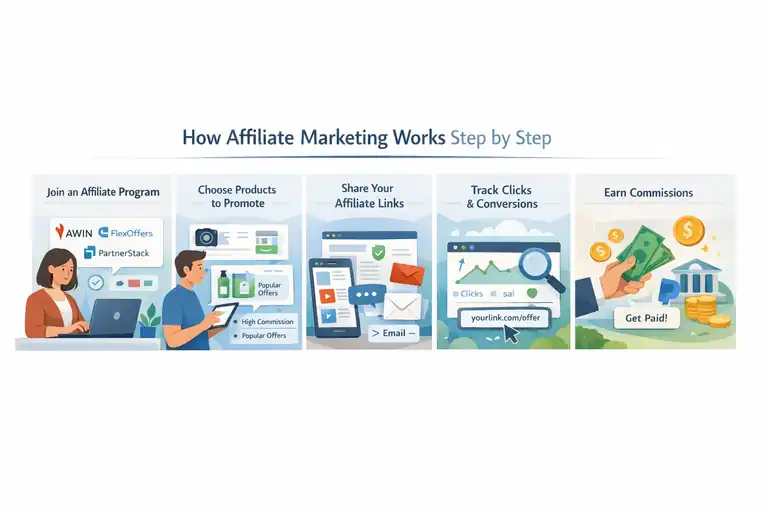
Let me break down exactly how affiliate marketing works — step by step. Each stage matters because it builds the foundation for consistent, measurable results.
Step 1: Joining an Affiliate Program
Your journey starts by signing up for an affiliate program. Think of it like joining a partnership club where you get your own unique referral link.
You can find opportunities on trusted networks like:
- Awin: Global affiliate network hosting major brand programs.
- FlexOffers: Massive database of affiliate campaigns across multiple niches.
- PartnerStack: Great for SaaS and software-related partnerships.
Each platform provides a dashboard where you can browse offers, view commission rates, and track conversions.
A quick tip: Always choose programs that match your niche and audience interest. Promoting skincare on a tech blog won’t convert — relevance wins every time.
Step 2: Choosing Products or Services to Promote
Once accepted into a program, the next step is choosing what to promote. This part is both strategic and creative.
Ask yourself:
- Does this product genuinely solve a problem for my audience?
- Would I personally use or recommend it?
- Does it offer fair commissions and long cookie durations (the time period a click can still earn you money)?
For example, if your niche is blogging, tools like Rank Math, Surfer SEO, or AIOSEO make excellent affiliate options — they’re relevant, trusted, and essential for your readers.
In my opinion, it’s better to promote fewer, high-quality products with authentic recommendations than dozens of low-quality ones just for commissions.
Step 3: Sharing Unique Tracking Links Across Channels
When you join a program, you’ll receive a unique affiliate link — a special URL that tracks clicks and sales back to you.
Here’s how affiliates share their links:
- In blog posts or tutorials (“How to Start a Blog with Hostgator”)
- Inside YouTube video descriptions
- Through newsletters or email sequences using tools like Aweber
- On social media platforms like Pinterest, TikTok, or Instagram
Most affiliates use link management tools like ThirstyAffiliates or PrettyLinks to create short, clean URLs (e.g., yourblog.com/go/hostinger). It looks more professional and easier to remember.
Just make sure to add a disclosure that you may earn a commission — transparency builds trust.
Step 4: How Clicks, Cookies, and Conversions Are Tracked
Here’s where the magic happens — tracking. When someone clicks your affiliate link, a cookie (a small digital file) is stored in their browser.
- If they make a purchase within the cookie’s time frame (often 30–90 days), you get credit for the sale.
- If they buy later from another device or after the cookie expires, you might miss the commission — so timing and relevance matter.
Advanced tools like ClickMagick or Voluum help you monitor every click, analyze conversion rates, and optimize campaigns.
This transparency is what makes affiliate marketing sustainable — every sale is traceable, measurable, and fair.
Step 5: Earning Commissions and Getting Paid
Once your links start converting, the best part kicks in — earnings.
Every network has its own payout schedule:
- Awin and Impact pay monthly after a validation period.
- MyLead offers flexible withdrawal methods once you meet a minimum threshold.
- FlexOffers provides regular payouts depending on partner terms.
Payments are usually made via PayPal, direct deposit, or bank transfer. Some advanced affiliates even reinvest part of their commissions into paid ads or SEO tools like Semrush or Sitechecker to scale results faster.
Over time, these small commissions compound into real, recurring income — that’s the beauty of affiliate marketing.
The Most Popular Types of Affiliate Programs
Affiliate programs come in several models, and understanding these helps you choose one that fits your goals, traffic source, and audience type.
Let’s go through the most common ones and what makes each unique.
Pay-Per-Sale vs. Pay-Per-Lead vs. Pay-Per-Click Explained
There are three main affiliate commission structures. Each pays you differently based on the user action generated through your link.
- Pay-Per-Sale (PPS): This is the classic and most common structure. You earn a percentage of each sale you help generate. For example, if you promote a Shopify plan and someone signs up through your link, you might earn a fixed $58 per sale.
- Pay-Per-Lead (PPL): Instead of a sale, you earn when a visitor takes a qualifying action—like submitting a form, downloading a trial, or signing up for a newsletter. MyLead and Fireads are excellent networks for this model since they focus on CPL (cost per lead) offers.
- Pay-Per-Click (PPC): Rare but simple. You’re paid for sending traffic (clicks) to the advertiser’s website, even if no purchase happens. These are best suited for high-traffic blogs or ad-heavy niches.
If you’re just starting out, PPS models tend to be more sustainable long-term because they align income with genuine results. But PPL can work well in niches where users are hesitant to buy immediately, such as finance or software trials.
How Recurring Affiliate Programs Work
Recurring programs are where affiliate marketing starts to feel like true passive income. Instead of getting paid once per sale, you continue earning as long as the customer stays subscribed.
Here’s how it usually works:
- A customer signs up for a subscription-based product (like Mailerlite for email marketing or Getresponse).
- You earn a commission each billing cycle (monthly or annually).
- Your income compounds over time as your referred customers renew.
Many software and SaaS-focused networks like PartnerStack specialize in recurring commissions. I’ve personally seen affiliates earn steady monthly payouts years after publishing a single review article or tutorial.
This model rewards patience and quality content. Instead of chasing one-time sales, you’re building a long-term revenue stream that can scale quietly in the background.
The Difference Between High-Ticket and Low-Ticket Programs
The main difference lies in how much you earn per conversion and how difficult it is to convert a user.
- High-ticket programs: Pay $200–$1,000+ per sale but require more trust and effort to close. Examples include premium hosting providers or online courses.
- Low-ticket programs: Pay smaller commissions (like $10–$50) but convert easily due to lower pricing or impulse buys—perfect for beginners or lifestyle blogs.
To put it simply:
- High-ticket = fewer conversions, higher payouts.
- Low-ticket = more conversions, smaller payouts.
I’ve found that the best approach is a hybrid strategy. Mix high-ticket tools (like WP Engine hosting) with low-ticket ones (like Moosend email tools) to balance income consistency and scalability.
Proven Affiliate Marketing Strategies That Actually Work
Affiliate marketing isn’t about dropping links everywhere and hoping for clicks. The real success comes from using strategies that connect trust with conversion.
Creating Valuable Content That Converts Readers to Buyers
Content is your most powerful conversion tool. The key is to write with intent — not just to rank, but to solve problems.
Try this 3-step approach:
- Identify what your audience struggles with (e.g., “How to start an email list from scratch”).
- Create genuinely useful content like tutorials, reviews, or comparisons.
- Naturally integrate affiliate links where the solution fits.
For example, if you write a tutorial on “Setting up your first email campaign,” you might demonstrate Brevo’s automation dashboard, then include your affiliate link with a gentle callout like, “I personally use Brevo because it makes email workflows simpler.”
Using SEO and Blogs to Drive Long-Term Traffic
Search engine optimization (SEO) is what keeps your affiliate content working 24/7. Once you rank, it’s like owning digital real estate that brings in daily traffic.
Here’s what I recommend:
- Use keyword tools like Semrush or Surfer SEO to find phrases with buyer intent.
- Optimize on-page elements like titles, headings, and internal links (try Internal Link Juicer for WordPress).
- Keep content fresh — update old articles every few months to maintain rankings.
The beauty of SEO-driven affiliate marketing is sustainability. Even one well-optimized article can bring in sales years after you publish it.
Leveraging Social Media and YouTube for Product Promotion
Social platforms can accelerate affiliate earnings if used strategically. The trick is to teach first, sell second.
- YouTube: Create tutorials or reviews showing real product demos. Example: “Testing Awin’s affiliate dashboard for beginners.”
- Instagram/TikTok: Use short-form content to highlight quick wins or tips.
- Pinterest: Great for visual niches like travel, recipes, or home decor with embedded affiliate links.
Each platform has its own rhythm. From my experience, short, authentic videos that show real results (not polished ads) perform best.
Building Email Lists and Automated Funnels for Passive Income
If you’ve ever wondered how top affiliates make money while they sleep, it’s through email automation.
Tools like Kit and Brevo make it easy to:
- Capture leads using opt-in forms or landing pages (try OptinMonster or Leadpages).
- Create drip sequences that deliver helpful tips and soft promotions.
- Segment your list to promote the right offers to the right audience.
For example, a simple funnel could look like this:
Blog post → Free email checklist → Email series → Affiliate recommendation → Recurring sales.
The beauty? You only build it once — it runs on autopilot from there.
How to Use Paid Ads Without Losing Profit
Paid ads can supercharge affiliate marketing, but only if you know your numbers.
Start small. Use tracking tools like ClickMagick or Voluum to monitor cost-per-click and ROI. Then:
- Test different creatives and landing pages.
- Track conversions daily.
- Scale only campaigns with consistent profit margins.
Platforms like Google Ads and Facebook Ads can work beautifully for high-ticket products or webinar funnels, but only after you’ve validated your organic strategy first.
My golden rule: Never spend more than you can afford to lose on a test campaign. Paid traffic works best when used as fuel for already-proven content.
Best Affiliate Marketing Platforms to Start With
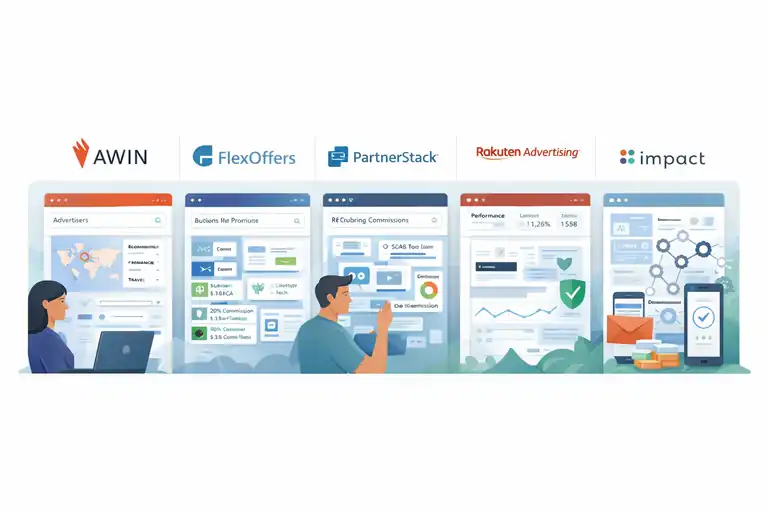
Choosing the right affiliate platform can make or break your success. The best networks offer trustworthy merchants, fair payouts, and transparent tracking.
Awin – The Global Network Replacing ShareASale
Awin is one of the most respected affiliate networks, hosting thousands of global brands across every niche. It officially replaced ShareASale, which is now discontinued.
You’ll find offers for ecommerce, finance, SaaS, and travel. The interface is simple — once logged in, click “Advertisers,” filter by category, and apply to relevant programs.
I like Awin because of its reliability — strong tracking, clear terms, and steady payouts make it ideal for both beginners and professionals.
FlexOffers and PartnerStack – Ideal for Broad and SaaS Niches
FlexOffers and PartnerStack complement each other perfectly.
- FlexOffers has one of the largest affiliate libraries online, covering lifestyle, business, and tech.
- PartnerStack specializes in SaaS companies, offering recurring commissions for tools like automation, CRMs, and analytics.
If your audience includes entrepreneurs or online creators, PartnerStack is gold. Its dashboard even lets you track renewals and subscription activity in real time.
Rakuten Advertising and Impact – Trusted for Enterprise-Level Brands
Rakuten Advertising and Impact are where big brands live. These platforms cater to established affiliates and professional marketers managing multiple campaigns.
Impact, in particular, is known for:
- Real-time reporting and attribution modeling.
- Excellent fraud protection.
- Deep API integrations for advanced analytics.
If you’re aiming to work with well-known names like Adobe or Lenovo, these are your go-to networks.
MyLead and Fireads – Great Options for CPA and CPL Offers
Both MyLead and Fireads focus on CPA (cost per action) and CPL (cost per lead) campaigns — meaning you get paid when users complete specific actions like filling out forms or downloading apps.
They’re perfect if your traffic comes from social ads, mobile apps, or incentive-based campaigns. I’ve used MyLead personally for testing niche offers because of its easy approval and quick payouts.
A tip: Always read the campaign rules. Some CPA offers restrict certain traffic sources or require country-specific targeting.
Essential Tools to Manage and Track Your Affiliate Links
Once you start adding affiliate links to your content, it becomes clear how messy things can get—especially if you’re promoting multiple products. That’s where link management and tracking tools come in.
These tools keep your affiliate links clean, organized, and measurable so you always know what’s working (and what’s not).
ThirstyAffiliates and PrettyLinks – Simplify Link Management and Cloaking
Both ThirstyAffiliates and PrettyLinks are WordPress plugins designed to make your affiliate links more professional and easier to manage. They also help with something called link cloaking, which means turning long, ugly affiliate URLs into short, branded ones.
Here’s how they differ and when to use each:
- ThirstyAffiliates is built specifically for affiliate marketers. You can group links by category, add “nofollow” tags automatically, and even insert links directly from the WordPress editor. I personally like its auto-linking feature—it automatically links keywords in your content to your affiliate URLs without you manually editing each post.
- PrettyLinks focuses more on creating clean, trackable links. You can shorten something like https://example.com/product?id=12345 to yourblog.com/go/product. It also provides click tracking and redirect types (301, 302, 307).
A quick tip: Keep a consistent folder structure like /go/ or /tools/ for all your affiliate links. It’s easier to remember and looks clean to your readers.
ClickMagick and Voluum – Advanced Tracking and Conversion Analytics
When your affiliate marketing grows, basic link tracking won’t cut it. You’ll want to know which links, traffic sources, and devices are generating sales. That’s where ClickMagick and Voluum come in.
- ClickMagick is great for beginners who want simplicity with power. It tracks every click, helps detect fake traffic, and shows conversion data in an easy-to-read dashboard. You can even create A/B split tests right inside the platform to compare landing pages.
- Voluum, on the other hand, is more advanced. It’s designed for affiliates running paid ads. It lets you track campaigns across multiple channels (Facebook, Google Ads, native ads) and analyze ROI with deep analytics.
If you’re serious about scaling, Voluum’s AI-based optimization automatically routes traffic to your best-performing offers. It’s not cheap, but I’ve found it pays for itself once your campaigns reach consistent volume.
AffiliateWP and Tapfiliate – Build and Manage Your Own Affiliate Programs
If you ever decide to create your own product or course, tools like AffiliateWP and Tapfiliate let you build and manage your own affiliate program.
- AffiliateWP integrates seamlessly with WordPress and WooCommerce. You can track referrals, create custom commission rules, and invite affiliates from your dashboard. For example, if you sell digital products through Podia or Sellfy, connecting AffiliateWP can automate referral tracking.
- Tapfiliate is cloud-based and perfect for SaaS, ecommerce, or online courses. It lets you customize affiliate dashboards, set recurring commissions, and connect to CRMs like HubSpot or Brevo for better communication.
Running your own program means you control commissions, relationships, and branding—turning affiliates into long-term partners instead of one-off promoters.
Common Mistakes Beginners Make in Affiliate Marketing
Everyone makes mistakes when starting out, but knowing what to avoid early can save you months of frustration.
Let’s go over the most common ones I see from new affiliates—and how to fix them.
Promoting Too Many Products Without a Niche Focus
The biggest rookie mistake? Trying to promote everything.
Affiliate marketing works best when your content feels focused and trustworthy. When you promote too many unrelated products, it confuses your audience and weakens your authority.
Instead, stick to one niche and go deep. For example, if your blog is about digital tools, focus on a few core categories—like SEO tools (Rank Math, Semrush), hosting (Hostinger), or email platforms (Brevo).
I’ve learned that being “the go-to person” in one area earns far more trust—and conversions—than being “the person who promotes everything.”
Ignoring the Importance of Audience Trust
Trust is the currency of affiliate marketing. If people don’t believe your recommendations are genuine, no link will convert.
Be transparent by disclosing your affiliate relationships (for example: “I may earn a small commission if you purchase through my link—at no extra cost to you”).
Share real experiences. Screenshots, short demos, or your honest opinions go a long way. I often say: Don’t sell products—share stories that prove they work.
Neglecting SEO and Long-Term Content Strategy
Affiliate success rarely happens overnight. The best traffic is organic traffic—visitors who find your content through search engines.
Many beginners skip SEO, hoping for fast wins. But if you build your site with long-term keywords using tools like Surfer SEO or Semrush, you’ll create a steady stream of readers who come ready to buy.
A simple SEO habit that pays off:
- Update your posts every 3–6 months.
- Add internal links to newer content (use Internal Link Juicer).
- Refresh stats and product details regularly.
That’s how you keep old articles earning commissions for years.
Overlooking Analytics and Conversion Tracking
If you’re not tracking what works, you’re flying blind.
Many beginners rely on “gut feeling” instead of data. But affiliate marketing is math-driven—clicks, conversions, and ROI matter.
Use ClickMagick, Voluum, or your affiliate dashboard to see which links convert.
Then:
- Double down on your top-performing pages.
- Improve underperforming links (change CTAs, update visuals).
- Test, measure, and tweak—every small change adds up.
I’ve seen affiliates double their income simply by improving the layout of their most-visited posts after checking analytics.
How to Choose the Right Niche and Offers
Choosing your niche is the foundation of affiliate marketing success. Pick wrong, and you’ll constantly chase results. Pick right, and you’ll build a business that grows naturally over time.
Why Passion and Demand Must Align for Long-Term Success
Here’s the truth: Passion alone doesn’t pay the bills, but neither does chasing trends you don’t care about. The sweet spot is where your interests meet market demand.
Ask yourself:
- Can I write or talk about this topic for the next year?
- Are people actively searching for solutions in this space?
- Are there affiliate products with good commissions in this niche?
For example, if you’re passionate about personal finance, you’ll find thousands of search queries monthly for budgeting tools, apps, and courses—plus solid affiliate programs through Awin or Impact.
That combination—interest and demand—is what keeps you motivated and profitable long term.
Using Tools Like Semrush and Surfer SEO to Validate Niche Potential
You don’t have to guess whether a niche is viable. Tools like Semrush and Surfer SEO make it easy to check.
Here’s how I usually do it:
- Open Semrush, type your niche idea (like “DIY home decor”), and check monthly search volume and competition.
- Use Surfer SEO to analyze top-ranking pages. It shows how much content, keywords, and backlinks they have.
- Look for a balance—enough demand, but not too much competition.
This data-driven approach saves you from investing time in niches that look good on paper but have zero growth potential.
Evaluating Commissions, Cookie Durations, and Payout Schedules
Before committing to an affiliate program, take a closer look at how it pays.
Here’s what I usually check:
- Commission Rate: Higher isn’t always better. A 10% recurring commission on a $50 monthly tool often beats a one-time $100 payout.
- Cookie Duration: The longer, the better. A 90-day cookie means if your reader buys anytime within three months, you still get credit.
- Payout Schedule: Look for consistent payment cycles (monthly or bi-weekly). Networks like Awin and FlexOffers are known for reliability.
As a general rule, aim for programs that balance fair commissions with solid reputation. Don’t chase flashy rates from unknown networks—you want to get paid on time, every time.
Building a Simple Affiliate Funnel for Consistent Sales
Think of an affiliate funnel like a guided path that leads your audience from curiosity to trust, and finally to purchase.
Instead of scattering your links everywhere, a funnel helps you focus on the user journey — step by step — so your efforts actually turn into commissions.
Step-by-Step Funnel Example Using Leadpages and WPFunnels
Let me walk you through a simple example you can build using Leadpages and WPFunnels.
- Start with a Lead Magnet: Offer something genuinely helpful for free — a short guide, checklist, or mini email course. For instance, if you’re promoting email marketing tools, you could create a “5-Day Email Setup Plan.”
- Create a Landing Page (Leadpages): Use Leadpages to design a simple page that collects emails. The interface is drag-and-drop, so you can add your form by clicking “Add Widget > Form.” Connect it to your email tool like Kit or Brevo (more on this soon).
- Set Up an Automated Funnel (WPFunnels): Inside WordPress, install WPFunnels. Create your funnel by choosing a template like “Lead Magnet to Offer.” Add two pages:
- Opt-in page (collects the lead).
- Bridge page (introduces your affiliate offer).
- Example: After someone downloads your checklist, the bridge page thanks them and introduces a related product — say, Awin’s affiliate dashboard tutorial — with your affiliate link.
- Follow Up with an Email Sequence: Once they sign up, the goal is to nurture them through automation (the next section explains how).
This setup turns casual visitors into leads, then gently into buyers. It’s predictable, repeatable, and scalable.
How Email Automation with Kit or Brevo Can Nurture Leads
Once you capture leads, automation turns interest into income. Tools like Kit (formerly ConvertKit) and Brevo (formerly Sendinblue) make this part almost effortless.
Here’s how I usually structure a simple email sequence:
- Day 1: Deliver the lead magnet and share a quick personal story about how the product helped you.
- Day 2: Send educational content — a tip, tool, or checklist that adds value.
- Day 3: Introduce your affiliate offer. Include your link naturally, like, “If you want to try the same platform I use, here’s the link.”
- Day 5: Send a reminder or success story. People need gentle nudges to act.
In Kit, you can set this up by going to “Automations > Create New > Visual Automation.” Then drag and drop your email sequence. Brevo offers a similar “Workflow” builder where you can trigger actions based on email opens or link clicks.
A funnel without follow-up is like meeting a potential client and never calling back. Automation keeps your audience engaged long after they’ve left your website.
Integrating Analytics Tools Like MonsterInsights for Optimization
A good affiliate funnel isn’t just about setup — it’s about continuous improvement. That’s where MonsterInsights comes in.
It connects your WordPress site directly to Google Analytics and shows data inside your dashboard.
You’ll see:
- Which blog posts or pages bring in the most traffic.
- Which affiliate links get the most clicks.
- How users move through your funnel.
I recommend enabling the Publisher Reports module inside MonsterInsights. It helps identify your top-performing outbound links, so you know which affiliate products deserve more focus or updates.
Optimization is a quiet superpower in affiliate marketing. Even a small improvement — say, a 5% increase in link click-through rate — can double your income over time.
Getting Started: A Beginner’s Roadmap to First Commission
If you’re new to affiliate marketing, this section is your action plan. No fluff, no jargon — just clear, practical steps to make your first sale faster.
Setting Up a Blog or Website with Hostinger or WP Engine
The foundation of affiliate marketing is having your own platform — a website or blog. It’s your digital home, your base of trust.
For beginners, I suggest starting with Hostinger or WP Engine.
- Hostinger is affordable, fast, and beginner-friendly. You can install WordPress in one click from your dashboard.
- WP Engine is built for performance. It’s a managed WordPress host that handles speed, security, and backups automatically.
Once installed, choose a lightweight theme (like Astra or GeneratePress) and install essential plugins — SEO (Rank Math), caching (WP Rocket), and link management (PrettyLinks).
Your goal here isn’t perfection — it’s progress. Launch your site, even if it’s simple. You can refine later.
Joining Your First Affiliate Network and Selecting Products
Next, sign up for one or two affiliate networks to find offers relevant to your niche.
Good starting options include:
- Awin – versatile global network replacing ShareASale.
- FlexOffers – huge variety of categories and brands.
- PartnerStack – great for SaaS and recurring commissions.
When choosing products:
- Make sure you’d actually use them. Authenticity matters.
- Check commission rates and cookie durations.
- Look for quality landing pages — a bad checkout experience can kill conversions.
Start small with 2–3 products you believe in, and learn how each network’s dashboard tracks sales and payouts.
Creating Content That Targets Buyer Intent Keywords
The secret to affiliate sales lies in intent. You don’t just want readers — you want readers ready to buy.
Focus on buyer keywords like:
- “Best [product type] for beginners”
- “[Tool name] vs [competitor] comparison”
- “Is [product] worth it?”
Use Semrush or Surfer SEO to find these search terms. Then craft content that answers questions and recommends your affiliate products naturally.
For example: a post titled “Best Email Tools for Bloggers” could explain why Brevo is beginner-friendly and Kit is ideal for creators — with affiliate links added organically.
The golden rule: teach first, sell later.
Tracking Results and Refining Your Strategy for Growth
Once your content and links are live, tracking becomes your best friend.
Tools like ClickMagick or Voluum help you see exactly where sales come from — whether it’s blog posts, social media, or emails. Combine that with MonsterInsights to track user behavior on your site.
Every month, review your:
- Top-performing pages.
- CTR (click-through rate) for affiliate links.
- Conversion rates per traffic source.
Then refine. Update old posts, test new CTAs, or shift focus to higher-converting topics. Growth in affiliate marketing is about iteration, not perfection.
Final Expert Tips for Sustainable Affiliate Income
Affiliate marketing is a long game. It’s not about quick wins — it’s about building a brand that earns while you sleep. Here are some personal lessons I’ve learned that will help you build something lasting.
Focus on Building Authority, Not Just Sales
People buy from those they trust. Instead of pushing links, focus on becoming a reliable source of insight.
Publish honest reviews, show screenshots of your results, and give both pros and cons. When your audience sees you as an educator — not a salesperson — your conversion rates rise naturally.
Diversify Traffic Sources for Long-Term Stability
Relying solely on one platform (like Google or YouTube) is risky. Algorithms change overnight.
To stay stable:
- Use SEO for consistent, organic traffic.
- Grow an email list with Kit or Brevo so you own your audience.
- Repurpose content across YouTube, Pinterest, and Medium.
Diversifying ensures that if one traffic source slows, another keeps your income steady.
Treat Affiliate Marketing Like a Business, Not a Side Hustle
Even if you’re just starting out, treat this like a real business. Track income, plan content calendars, and reinvest in tools that save you time.
Use WPFunnels to automate campaigns, ClickMagick for data insights, and Surfer SEO to optimize your content. The more structure you build, the faster your affiliate income stabilizes.
Keep Learning — The Best Affiliates Always Stay Updated
Affiliate marketing changes constantly — new tools, algorithms, and trends appear every year.
Follow reliable blogs, listen to podcasts, and keep testing new methods. I like to spend an hour each week reviewing analytics and experimenting with one new idea — whether it’s a different funnel layout or testing AI content tools.
The truth is, consistent learning is your real edge. The affiliates who keep adapting are the ones who stay profitable long term.
Pro Tip: Treat every click like a conversation, not a transaction. When you genuinely help your audience make informed choices, your affiliate income becomes not just consistent — but sustainable.
FAQ
What is affiliate marketing and how does it work?
Affiliate marketing is a performance-based strategy where you earn a commission by promoting another company’s products or services. You share a unique tracking link, and when someone makes a purchase through it, you get paid.
How do beginners start with affiliate marketing?
Beginners start by choosing a niche, joining an affiliate program, and promoting products through a blog, social media, or email. Tools like Awin and PartnerStack help find and track affiliate offers.
Can you make money from affiliate marketing?
Yes, you can earn passive income through affiliate marketing by driving consistent traffic and conversions. The key is creating valuable content that builds trust and solves real problems for your audience.

I’m Juxhin, the voice behind The Justifiable.
I’ve spent 6+ years building blogs, managing affiliate campaigns, and testing the messy world of online business. Here, I cut the fluff and share the strategies that actually move the needle — so you can build income that’s sustainable, not speculative.
Related posts:
 Where To Promote Affiliate Links For Free
 How Do People Make Money Blogging
 10 Proven Strategies for Creating Passive Income Streams
 How to Get Into Affiliate Online Marketing in 5 Easy Steps!
 How to Find the Best Affiliate Products to Sell for Maximum Profit
 15 Must-Have Affiliate Marketing Tools to Grow Faster