
Table of Contents
Some links on The Justifiable are affiliate links, meaning we may earn a small commission at no extra cost to you. Read full disclaimer.
An omnisend vs klaviyo comparison matters more than most email tool reviews because these two platforms can shape how much revenue your store actually pulls from email, SMS, and retention.
If you are trying to choose once and avoid an expensive migration later, this is the decision worth slowing down for.
I have looked at the current product positioning, pricing structure, and feature sets, and my honest take is simple: both can drive strong sales, but they do it in very different ways.
The better platform is usually the one that matches your store’s stage, team size, and data complexity.
What Omnisend And Klaviyo Actually Are
Both platforms help ecommerce brands send campaigns, automate flows, segment customers, and track revenue from retention marketing.
The big difference is not whether they can send emails. It is how deeply they are built around data, channels, and complexity.
Omnisend In Plain English
Omnisend is an ecommerce-focused email and SMS platform that keeps a lot of useful retention tools in one place. Its current positioning leans heavily into simplicity, omnichannel automation, and a strong out-of-the-box setup for online stores.
Omnisend says all plans include all features, plus support, templates, pre-built workflows, forms, reports, list cleaning, A/B testing, and more than 160 integrations. That matters because many brands do not fail from lack of features. They fail because the team never gets the system fully launched.
In practice, Omnisend feels like a platform built for speed. You connect Shopify or another store, sync products and customer events, turn on key automations, and start selling without needing a data team.
It also combines email, SMS, and web push, which is useful for stores that want one workflow builder instead of several disconnected tools.
Omnisend highlights real-time behavioral segmentation, lifecycle stages, and AI-assisted segment creation, but it still presents those features in a way that feels approachable for lean teams.
My opinion: If you run a small or mid-sized store and want to move fast, Omnisend is often easier to operationalize. That can turn into more sales simply because your abandoned cart, welcome, browse abandonment, and post-purchase flows go live earlier and stay maintained longer.
Klaviyo In Plain English
Klaviyo is also built for ecommerce, but it pushes harder on data depth, predictive analytics, AI, and broader customer orchestration. Its platform messaging now goes beyond email and SMS into a wider B2C CRM direction, with analytics, service, and more advanced data-driven personalization layers.
Klaviyo also emphasizes real-time segments, predictive insights, omnichannel messaging, mobile messaging credits, and AI-assisted campaign creation.
This is where Klaviyo gets powerful. If your team is comfortable building granular segments, managing profile quality, using predictive data, and optimizing attribution across multiple touchpoints, Klaviyo gives you more room to get sophisticated.
That can produce excellent revenue lift for larger or more mature brands, especially when lifecycle marketing is treated like a real profit center rather than a newsletter side project.
Klaviyo’s benchmarks are also based on a very large customer base, with the company citing data from more than 183,000 customers in its 2026 email and SMS benchmark resources.
My honest read: Klaviyo is often the better “scale complexity” platform, but not always the better “get profitable fast” platform.
The Biggest Difference: Simplicity Vs Depth
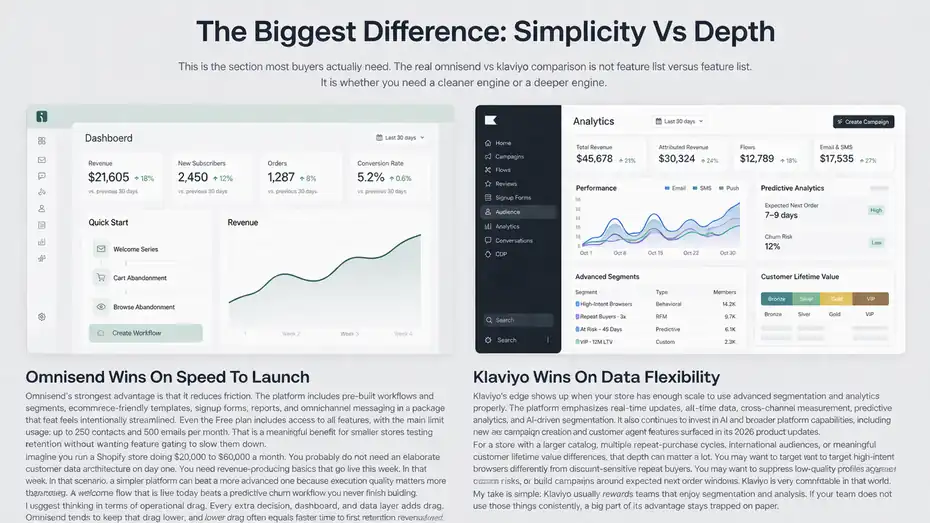
This is the section most buyers actually need. The real omnisend vs klaviyo comparison is not feature list versus feature list. It is whether you need a cleaner engine or a deeper engine.
Omnisend Wins On Speed To Launch
Omnisend’s strongest advantage is that it reduces friction. The platform includes pre-built workflows and segments, ecommerce-friendly templates, signup forms, reports, and omnichannel messaging in a package that feels intentionally streamlined.
Even the Free plan includes access to all features, with the main limit being usage: up to 250 contacts and 500 emails per month. That is a meaningful benefit for smaller stores testing retention without wanting feature gating to slow them down.
Imagine you run a Shopify store doing $20,000 to $60,000 a month. You probably do not need an elaborate customer data architecture on day one. You need revenue-producing basics that go live this week.
In that scenario, a simpler platform can beat a more advanced one because execution quality matters more than theoretical capability. A welcome flow that is live today beats a predictive churn workflow you never finish building.
I suggest thinking in terms of operational drag. Every extra decision, dashboard, and data layer adds drag. Omnisend tends to keep that drag lower, and lower drag often equals faster time to first retention revenue.
Klaviyo Wins On Data Flexibility
Klaviyo’s edge shows up when your store has enough scale to use advanced segmentation and analytics properly. The platform emphasizes real-time updates, all-time data, cross-channel measurement, predictive analytics, and AI-driven segmentation.
It also continues to invest in AI and broader platform capabilities, including new campaign creation and customer agent features surfaced in its 2026 product updates.
For a store with a larger catalog, multiple repeat-purchase cycles, international audiences, or meaningful customer lifetime value differences, that depth can matter a lot. You may want to target high-intent browsers differently from discount-sensitive repeat buyers.
You may want to suppress low-quality profiles aggressively, model churn risk, or build campaigns around expected next order windows. Klaviyo is very comfortable in that world.
My take is simple: Klaviyo usually rewards teams that enjoy segmentation and analysis. If your team does not use those things consistently, a big part of its advantage stays trapped on paper.
Pricing: Which One Is Actually More Cost Effective
Pricing is where a lot of buyers get emotional, and honestly, for good reason. A platform can be “better” in theory and still be the wrong choice if pricing grows faster than your retention revenue.
Omnisend Pricing Is Easier To Predict
Omnisend’s current pricing page shows a Free plan at $0 with 250 contacts and 500 emails per month, and its Standard and Pro tiers are positioned around ecommerce sending volume.
Omnisend’s help documentation says Pro starts at $59 per month and includes unlimited emails, push notifications, and monthly SMS credits equal to the plan price.
The pricing page also notes that all plans include all features, which is unusually generous compared with many SaaS tools that reserve core capabilities for higher tiers.
That structure tends to feel friendlier to growing brands. You are not constantly wondering whether one extra automation split or one more form feature lives behind another paywall. Omnisend also highlights free migration and onboarding support on higher plans, which can reduce switching costs.
I like predictable pricing because it lowers fear-based decision making. When a team is scared to grow its list because the bill might jump unexpectedly, marketing gets weird.
Klaviyo Pricing Requires More Active Management
Klaviyo’s free plan currently includes up to 250 profiles, 500 emails per month, 150 mobile message credits, Customer Hub, built-in reporting, and email support.
Once you move beyond free, Klaviyo pricing scales with profiles and channel usage, and its billing documentation explains that certain plans auto-upgrade when profile thresholds are crossed.
Klaviyo’s help content also gives an example of a $100 monthly plan for 5,000 profiles and 50,000 emails, and a $140 monthly plan for 6,500 profiles and 65,000 emails.
That does not make Klaviyo overpriced by default. But it does mean list hygiene becomes a finance issue, not just a deliverability issue. If you keep too many inactive profiles, your cost can rise before your revenue does. For disciplined operators, that is manageable.
For messy teams, it gets expensive quickly.
Here is the practical rule I recommend:
| Store Situation | Better Pricing Fit |
|---|---|
| Small store, lean team, wants all core features early | Omnisend |
| Mid-sized store using email + SMS but wanting predictable spend | Omnisend |
| Larger store with strong segmentation discipline | Klaviyo can justify its cost |
| Brand with poor list hygiene and lots of inactive profiles | Omnisend is usually safer |
The key is not sticker price alone. It is cost per useful outcome.
Features That Directly Impact Sales
Both tools can drive revenue, but they tend to win through different paths. One wins through speed and simplicity. The other wins through data precision and expansion room.
Automation And Flow Building
Omnisend gives you pre-built workflows, automation splits, segmentation, forms, SMS, web push, and product-based personalization in a unified ecommerce setup. It is designed to help stores activate high-value automations without much friction.
That is great for core flows like welcome, cart abandonment, browse abandonment, order confirmation, cross-sell, and win-back.
Klaviyo also handles those flows well, but it shines when you want more nuanced decision logic and richer audience modeling.
If you want flows triggered by predictive metrics, lifecycle movement, or deeper behavioral combinations, Klaviyo is often the stronger environment. Its positioning around analytics and AI reinforces that direction.
For many stores, though, the sales winner is the tool that helps you launch these flows properly:
- Welcome series with offer timing that does not train coupon abuse
- Cart flow with product reminder and social proof
- Browse flow for high-intent non-cart visitors
- Post-purchase flow that drives second order speed
- Win-back flow that filters out low-value reactivation waste
I believe most stores underestimate how much money lives in just those five flows.
Segmentation And Personalization
Omnisend’s segmentation has become stronger than many people assume. The platform supports dynamic segments using orders, tags, engagement, location, profile data, and real-time browsing or purchase behavior, and it also now highlights AI-assisted segment creation and lifecycle stage-based grouping.
Klaviyo still has the stronger reputation for advanced segmentation, and that reputation is earned. Its segment engine is built around real-time updates, all-time data, cross-channel measurement, and AI support. If your strategy relies on slicing audiences very precisely, Klaviyo gives you more room to experiment and optimize.
A realistic example helps here. Let’s say you sell skincare:
- In Omnisend, you can quickly build segments for first-time buyers, repeat buyers, subscribers who viewed but did not purchase, and VIPs.
- In Klaviyo, you are more likely to build layered audiences around expected replenishment windows, predicted lifetime value, churn risk, and channel preference.
Both can make money. Klaviyo gives you more strategic depth. Omnisend gets more brands to the starting line.
SMS, Push, And Omnichannel Revenue
Omnisend has a strong omnichannel argument because email, SMS, and web push are native parts of the ecommerce workflow experience. The platform positions web push as a built-in channel, and its Pro plan includes SMS credits equal to plan value.
Omnisend also supports global SMS pricing and two-way SMS capabilities in its SMS materials.
Klaviyo’s omnichannel push is broader in another way. Its feature pages reference email, SMS, push, and mobile messaging, and its broader platform direction now extends into service and CRM-style capabilities.
Klaviyo also emphasizes compliance safeguards, quiet hours, and predictive SMS use cases.
If your main goal is to coordinate email and SMS simply, Omnisend is very appealing. If your goal is to orchestrate more nuanced customer communication across a growing data stack, Klaviyo feels more expandable.
Which Platform Is Easier For Different Types Of Stores
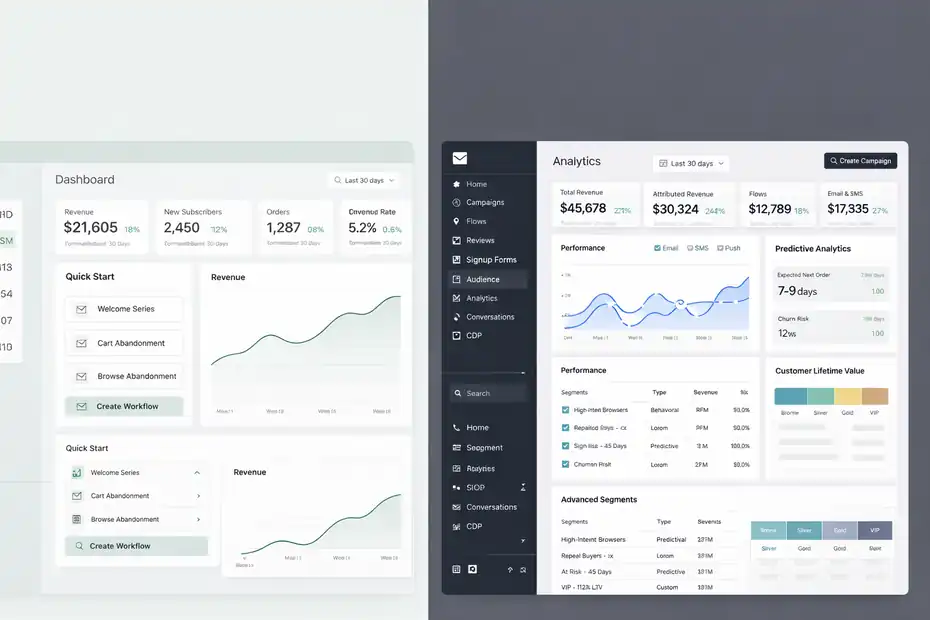
This is where I think many reviews become too generic. “Best” depends on what kind of store you actually run, not which vendor has the longer feature page.
Best For Small And Growing Ecommerce Stores
Omnisend is usually the easier recommendation for smaller stores, founder-led brands, and lean ecommerce teams. The reason is not that small brands do not deserve advanced tools. It is that simpler systems are more likely to get used well.
Omnisend’s all-features-included approach, ecommerce workflows, accessible segmentation, templates, and support model reduce the odds of buying more platform than you can realistically operate.
If I were advising a store under roughly low-to-mid six figures in monthly revenue, I would seriously consider Omnisend first. At that stage, the gains often come from disciplined execution, faster campaign cadence, cleaner forms, better popups, and strong automations. You do not always need predictive everything.
You need the basics to work really well.
Best For Mature Brands And Data-Heavy Teams
Klaviyo makes more sense when your retention program is already a strategic growth channel.
If your team looks at cohorts, suppresses inactive profiles regularly, models lifecycle transitions, and treats segmentation as a competitive advantage, Klaviyo gives you more headroom.
The platform’s analytics, AI, segmentation, and profile-centric billing model line up better with a brand that actively manages customer data as an asset.
A good fit might be a brand with:
- Large product catalog complexity
- Strong repeat purchase behavior
- Multiple regions or channel mixes
- A retention marketer or agency that lives in the platform daily
- A tolerance for more active list and cost management
In that setup, Klaviyo can absolutely drive more sales because the team can unlock its extra depth.
Common Mistakes That Hurt Sales No Matter Which Tool You Choose
The tool matters, but bad setup decisions matter more.
I have seen stores blame the platform when the real problem was weak strategy, poor segmentation, or lazy offer design.
Choosing Based On Brand Hype Instead Of Workflow Fit
Klaviyo has stronger “advanced marketer” brand gravity. Omnisend has stronger “practical ecommerce operator” appeal. Neither identity should make the decision for you. A platform only drives sales when it fits your team’s operating style.
- Mistake 1: Picking Klaviyo because it feels more premium, then using only basic newsletters.
- Mistake 2: Picking Omnisend for simplicity, then later needing complex predictive segmentation you cannot fully replace with process.
- Mistake 3: Underestimating migration cost, training time, and the hidden revenue dip that can happen during transition.
I suggest mapping your first 90 days before choosing. List the flows, campaigns, channels, reporting views, and segments you will actually use. The better platform is the one your team can execute well, not the one with the most impressive demo.
Ignoring List Quality And Deliverability
This is especially important with Klaviyo’s profile-based pricing pressure, but it matters in Omnisend too. Keeping inactive contacts forever can hurt deliverability, inflate costs, and dilute performance readouts.
Klaviyo’s billing docs explicitly explain profile-driven auto-upgrades, which means inactive data can become a direct budget issue.
A simple rule works for both tools: Clean aggressively, segment engagement, and let reporting guide suppression. Revenue usually improves when your list gets healthier because your sends become more relevant and inbox placement gets stronger.
How To Decide Which One Will Drive More Sales For You
The honest answer is not universal. For some stores, Omnisend will drive more sales because it gets the right automations launched faster and keeps costs cleaner.
For others, Klaviyo will drive more sales because it enables smarter segmentation, better data use, and more advanced lifecycle orchestration.
Choose Omnisend If You Want Faster Revenue Activation
Choose Omnisend when your priority is getting profitable retention systems live quickly. Its free plan includes all features with usage limits, its ecommerce orientation is obvious, and its channel mix of email, SMS, and web push gives smaller teams a lot without much operational sprawl.
Omnisend also claims more than 150,000 brands and highlights ROI messaging around strong return per dollar spent, though I would always treat vendor ROI claims as directional rather than guaranteed.
I would lean Omnisend if this sounds like you:
- You want to launch fast
- You prefer predictable value
- You do not have a dedicated retention analyst
- You want email, SMS, and push in one simpler workflow environment
- You care a lot about ease of setup and support
Choose Klaviyo If You Want Higher Strategic Ceiling
Choose Klaviyo when your retention program is mature enough to use advanced data well. The platform’s real-time segments, predictive capabilities, analytics direction, AI features, and broader B2C CRM positioning give it a higher strategic ceiling for sophisticated brands.
Its benchmark resources are also extensive, with data drawn from more than 183,000 customers, which can help teams set realistic performance targets.
I would lean Klaviyo if this sounds like you:
- You already segment deeply
- You actively manage profile quality
- You want predictive and analytics-led optimization
- You have enough revenue scale to justify complexity
- You have a marketer or agency who will fully use the platform
Final Verdict: Which Drives More Sales
Here is my honest conclusion from this omnisend vs klaviyo comparison: Omnisend usually drives more sales for smaller and mid-sized stores that need execution speed, lower friction, and strong ecommerce automation out of the box.
Klaviyo usually drives more sales for mature brands with stronger data discipline, advanced segmentation habits, and the internal capacity to turn extra complexity into measurable profit.
If you forced me to simplify it even more, I would say this:
- Omnisend is the better choice for getting retention revenue moving quickly.
- Klaviyo is the better choice for squeezing more value from a sophisticated customer data strategy.
That may sound less dramatic than a one-word winner, but it is the answer that will save you money and probably make you more of it. The best platform is not the one with the loudest reputation. It is the one your team will actually use well enough to turn subscribers into repeat customers.
FAQ
What is the main difference in an omnisend vs klaviyo comparison?
The main difference is simplicity versus depth. Omnisend focuses on fast setup and ease of use for ecommerce stores, while Klaviyo offers more advanced segmentation, analytics, and data-driven marketing capabilities for brands that want deeper customer insights and long-term optimization.
Which platform drives more sales, Omnisend or Klaviyo?
It depends on your business stage. Omnisend often drives more sales for smaller stores due to faster execution, while Klaviyo can generate higher long-term revenue for larger brands that fully use its advanced segmentation and predictive analytics features.
Is Omnisend cheaper than Klaviyo?
Omnisend is generally more predictable and cost-effective, especially for growing stores. Klaviyo pricing scales with contact profiles and usage, which can become expensive if list management is not handled properly, making Omnisend a safer option for budget-conscious teams.
Is Klaviyo better for advanced email marketing?
Yes, Klaviyo is better suited for advanced email marketing strategies. It provides deeper segmentation, predictive analytics, and more flexible data modeling, making it ideal for experienced marketers who want to build highly targeted and optimized campaigns.
Who should choose Omnisend over Klaviyo?
Omnisend is best for small to mid-sized ecommerce businesses that want a simple, all-in-one solution with email, SMS, and automation. It works well for teams that prioritize ease of use, faster setup, and consistent execution over advanced data complexity.

I’m Juxhin, the voice behind The Justifiable.
I’ve spent 6+ years building blogs, managing affiliate campaigns, and testing the messy world of online business. Here, I cut the fluff and share the strategies that actually move the needle — so you can build income that’s sustainable, not speculative.
Related posts:
 The Ultimate Guide to Using Templates for Email Marketing
 Top 10 Email Service Providers: Powerful Tools for Businesses
 Boost Sales with Automated Email Marketing: 10 Proven Strategies
 Aweber Sign Up Walkthrough: Get Started Fast & Free
 How Omnisend WooCommerce Integration Performs
 Omnisend Vs MailerLite Ecommerce Comparison: Best Value