
Table of Contents
Some links on The Justifiable are affiliate links, meaning we may earn a small commission at no extra cost to you. Read full disclaimer.
Omnisend vs MailerLite ecommerce comparison is a smart question to ask before you lock yourself into an email platform that shapes your store’s retention, automation, and repeat revenue.
I’ve looked at both from the angle that matters most to store owners: how well they handle ecommerce data, automation, pricing, and day-to-day usability.
The short version is simple: Omnisend usually gives better value for serious ecommerce brands, while MailerLite often gives better value for smaller stores that want low costs and a simpler setup.
The right choice depends less on hype and more on how your store actually sells.
What This Comparison Is Really About
This is not just a feature checklist. For most online stores, the real question is which platform helps you turn customer data into more revenue without creating unnecessary complexity.
What Ecommerce Brands Usually Need From An Email Platform
If you run an online store, you do not just need newsletters. You need product-aware automation, subscriber segmentation, popups or forms, purchase tracking, and revenue reporting that connects marketing activity to actual orders.
Omnisend is built around that ecommerce use case, with native store integrations, multichannel automation, and workflows for abandoned cart, post-purchase, and welcome flows.
MailerLite supports ecommerce too, but its broader identity is still closer to an affordable email marketing platform that also added ecommerce capabilities.
In my experience, this difference matters most after the first few months. At the beginning, both tools can send campaigns and collect subscribers. But once you want smarter automations based on cart events, purchase history, product behavior, or SMS follow-up, the platform architecture starts to matter more than the headline monthly price.
A simple way to think about it is this: MailerLite is often the better “email-first” budget option, while Omnisend is usually the better “store-first” lifecycle marketing option. That does not make one universally better. It makes them better for different stages of ecommerce maturity.
Who This Comparison Will Help Most
This guide is especially useful if you are in one of these situations:
- You run a Shopify, WooCommerce, BigCommerce, or PrestaShop store and want to improve abandoned cart and post-purchase revenue.
- You are migrating from a basic newsletter setup to real ecommerce automation.
- You want to know whether the cheaper plan actually stays cheaper once your list grows.
- You care about best value, not just lowest cost.
Imagine you are running a store doing 300 to 800 orders a month. At that point, you usually need more than broadcasts. You need flows that recover carts, recommend products, segment buyers, and keep campaigns tied to store behavior.
That is where this comparison becomes useful, because “best value” depends on how much revenue the platform can help recover and retain, not just what it costs on day one.
Quick Verdict: Which Platform Gives Better Value?

The short answer is that Omnisend gives better value for stores that want ecommerce depth, while MailerLite gives better value for stores that want simplicity and low starting costs.
Best Value Winner For Most Ecommerce Stores: Omnisend
Omnisend has a stronger ecommerce-specific product shape. Its platform is built around online selling, not just email sending.
The company positions the platform for Shopify, WooCommerce, and other ecommerce brands, and highlights automated workflows, segmentation by shopping behavior, and multichannel messaging across email, SMS, and push notifications.
Omnisend also says its paid plans start at $16 per month, while its Pro tier starts at $59 and includes unlimited emails plus SMS credits equal to the monthly plan price.
That matters because a lot of ecommerce value is operational. If your store can recover abandoned carts, trigger post-purchase messages, and layer SMS into those flows without stacking extra tools, the platform becomes more cost-efficient over time.
Omnisend also offers 24/7 live chat and email support for all customers, including free users, which is unusually strong if you are a smaller team without in-house lifecycle marketing help.
I believe Omnisend is the better pick for most stores that already know email is a revenue channel, not just a communication channel. You may pay more than MailerLite at the low end, but you are usually paying for deeper ecommerce execution.
Best Budget Value For Smaller Stores: MailerLite
MailerLite’s value story is different. Its pricing is much easier on early-stage businesses. The Growing Business plan starts at $10 per month, and the platform leans hard into simplicity, accessible design, landing pages, and general email marketing usability.
MailerLite also supports ecommerce integrations and abandoned cart workflows for connected stores such as Shopify, WooCommerce, BigCommerce, and PrestaShop.
For many stores, especially newer ones, that is enough. If you mainly want popups, newsletters, a welcome series, basic segmentation, and one or two cart flows, MailerLite can absolutely do the job.
The tradeoff is that it feels less ecommerce-native than Omnisend, and support access is more limited by plan level. MailerLite says email or chat support is available on paid plans, and 24/7 live chat is tied to the Advanced plan.
So if your store is small, your margins are tight, and you want the cheapest reliable path to email marketing with some ecommerce functionality, MailerLite may be the better value today. The question is whether it will still be the better value six months from now.
Feature Comparison That Actually Matters For Ecommerce
A comparison table helps, but it only becomes useful when the rows reflect how stores make money.
| Category | Omnisend | MailerLite | Best For |
|---|---|---|---|
| Entry Pricing | Free plan, paid from $16/month | Free plan, Growing Business from $10/month | MailerLite for lower starting cost |
| Ecommerce Focus | Built specifically for ecommerce brands | General email platform with ecommerce features | Omnisend |
| Core Channels | Email, SMS, push | Primarily email; ecommerce email automations supported | Omnisend |
| Native Ecommerce Integrations | Shopify, WooCommerce, BigCommerce | Shopify, WooCommerce, BigCommerce, PrestaShop | Tie, depending on stack |
| Abandoned Cart | Native ecommerce workflows with email, SMS, push options | Abandoned cart workflow supported for connected stores | Omnisend for depth |
| Support | 24/7 chat and email for all plans | Paid plans for support; 24/7 live chat on Advanced | Omnisend |
| Simplicity | Strong, but more ecommerce-oriented | Very beginner-friendly | MailerLite |
| Best Fit | Growth-focused ecommerce stores | Lean-budget stores and simpler setups | Depends on stage |
Data based on current platform and support pages.
Automation Depth And Revenue Potential
Automation is where the real separation starts. Omnisend supports workflows for welcome, abandoned cart, and post-purchase messaging, and its help documentation shows that product abandonment can include email, SMS, and push notification blocks.
It also documents SMS automation use cases like shipping updates, order confirmations, and abandoned cart reminders.
MailerLite supports abandoned cart automation and ecommerce triggers for connected stores, and its documentation shows a practical workflow builder for cart recovery.
That is useful and real. Still, the structure feels more like “email automation with ecommerce triggers” than a fully ecommerce-native multichannel engine.
If your goal is to squeeze more revenue out of customer journeys, Omnisend has the advantage.
A basic example: A customer browses a product, adds it to cart, leaves, then returns later. With Omnisend, you have a more natural path to combine product-driven email with SMS or push in the same automation logic. That usually makes more sense for stores with frequent promotions, repeat buyers, or larger catalogs.
Ease Of Use For Small Teams
MailerLite deserves real credit here. Its value is not just price. It is also clarity. The product is designed to feel lightweight, approachable, and easy to learn. The main site emphasizes ease of use, automation, landing pages, and simple workflows.
For a solo founder, tiny team, or side business, that can be a huge advantage because execution speed matters more than having every possible ecommerce feature.
Omnisend is also user-friendly, but the product assumes you are thinking more like a store operator. You will see more ecommerce context, more automation logic tied to shopping behavior, and more multichannel thinking. That is powerful, but it can also feel like more moving parts if your store is still very early.
I suggest thinking about your team’s actual capacity. If nobody on your team has time to build sophisticated flows, a simpler platform can be the better value even if it is less powerful on paper.
Pricing: Cheap Vs Cost-Effective Is Not The Same Thing
This is the section most people focus on first, but I think it works better when you ask two separate questions: what costs less now, and what saves or earns more later?
Omnisend Pricing In Practice
Omnisend’s current pricing page says paid plans start at $16 per month, while the Pro plan starts at $59 per month. The support article for 2026 pricing notes that Pro includes unlimited emails and SMS credits matching the monthly plan cost.
Omnisend’s free plan allows use of all features with limited sends, according to its pricing page.
That pricing model makes sense for stores that want to move quickly into automation. You are not buying a stripped-down ecommerce layer and then bolting on separate messaging tools later. For brands that already know SMS matters, or that want more complete lifecycle campaigns, Omnisend can be cheaper than stitching together multiple apps and support gaps.
A realistic scenario: a Shopify store with 2,500 contacts might look at the sticker price and think MailerLite is the obvious deal. But if Omnisend helps recover even a few extra carts each month through stronger ecommerce workflows, the cost difference may disappear fast. That is why I usually separate “budget choice” from “best value choice.”
MailerLite Pricing In Practice
MailerLite’s pricing page says the Growing Business plan starts at $10 per month. Its positioning is straightforward: affordable entry, clean feature set, and scalable email marketing for businesses that want solid functionality without paying premium rates too early.
For early ecommerce brands, this can be genuinely attractive. Maybe you only have 400 subscribers, send one campaign per week, and run a welcome automation plus one abandoned cart flow.
In that setup, paying as little as possible is sensible. MailerLite also gives you websites and landing pages, which can matter if your broader marketing stack is still lean.
Where people get tripped up is assuming the cheapest starting plan always stays the cheapest overall solution. Once you want more advanced support, deeper automation, or stronger ecommerce lifecycle execution, the cost equation changes.
That does not mean MailerLite becomes bad value. It means its best value zone is earlier and simpler.
Integrations And Store Compatibility
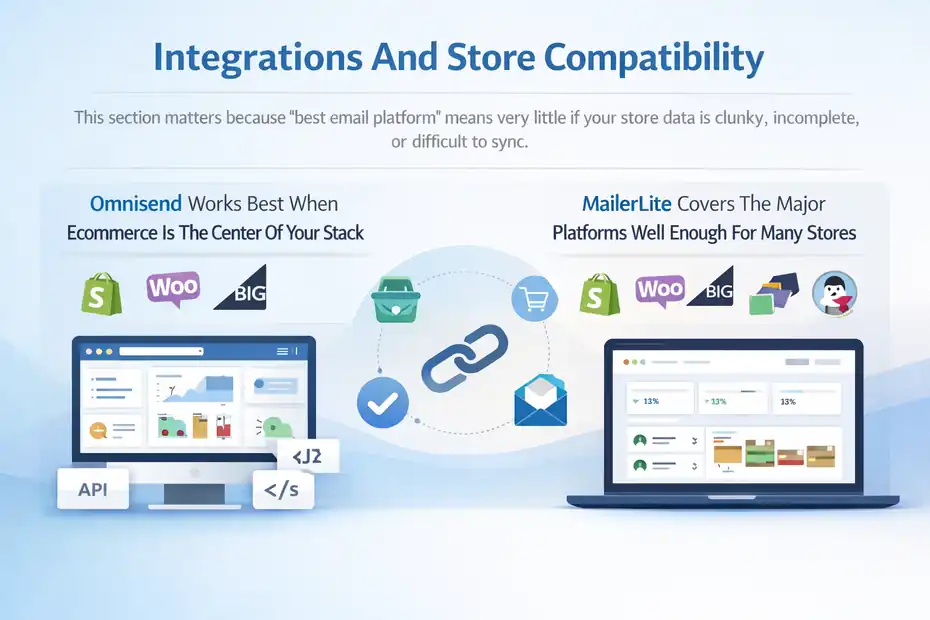
This section matters because “best email platform” means very little if your store data is clunky, incomplete, or difficult to sync.
Omnisend Works Best When Ecommerce Is The Center Of Your Stack
Omnisend’s documentation highlights native integrations for Shopify, WooCommerce, and BigCommerce, with custom platform options available through API and JavaScript setup. Its support content also covers headless commerce scenarios, which tells me the company is thinking beyond the most basic store setups.
That matters because strong ecommerce email depends on event quality. You need reliable sync for product views, cart activity, purchases, customer properties, and on-site forms.
Omnisend’s embedded form guidance also notes automatic front-end integration for Shopify, BigCommerce, and WooCommerce once the app is installed, which reduces setup friction for the most common ecommerce stacks.
If you are on one of the major store platforms and want your email system to feel tightly connected to your store, Omnisend has the stronger “native commerce” feel.
MailerLite Covers The Major Platforms Well Enough For Many Stores
MailerLite supports Shopify, WooCommerce, BigCommerce, and PrestaShop integrations, and its docs show practical ecommerce actions like syncing customers, importing products into campaigns, tracking purchases, and triggering abandoned cart flows. It also advertises 130+ integrations across its broader ecosystem.
That is more than enough for a lot of businesses. If your store runs on a mainstream platform and you mostly need standard ecommerce email functionality, MailerLite is capable. The limitation is not that it cannot connect. It is that the overall experience may feel less purpose-built for aggressive ecommerce lifecycle marketing than Omnisend’s environment.
So I would frame it this way: MailerLite is compatible enough for many stores, while Omnisend is strategically better aligned for stores that expect email and retention to become a major growth lever.
Support, Reliability, And Day-To-Day Operations
Support is easy to ignore until you are migrating data, fixing sync issues, or debugging a broken automation at the worst possible time.
Omnisend Has The Stronger Support Promise
Omnisend says it offers 24/7 live chat and email support for all customers, including those on the free plan. For lean ecommerce teams, that is a major operational advantage. If your cart sync breaks before a weekend promotion, you do not want to discover that support is paywalled behind a higher tier.
Shopify app feedback summaries also consistently mention strong support, ease of use, and effective automation. I would not treat app reviews as perfect truth, but they are useful for spotting recurring themes in real merchant experience.
In practical terms, support quality affects ROI. Faster troubleshooting means less lost revenue from broken forms, missed sends, or poorly configured automations.
MailerLite Support Is More Plan-Dependent
MailerLite’s support pages say email or chat access is available on paid plans, while 24/7 live chat is available on the Advanced plan. That is not unusual in SaaS, but it does change the value equation for ecommerce users who may need hands-on help during setup or growth stages.
I do not think this automatically makes MailerLite a poor choice. Many businesses will rarely need support once things are configured properly. But if you are comparing best value instead of cheapest software, support should count as part of the product, not an optional extra.
For newer store owners, I usually see this pattern: they underestimate how often they need help during migration, domain authentication, automation setup, and event troubleshooting. That is one reason Omnisend often feels like the safer ecommerce bet.
Which Platform Fits Different Types Of Ecommerce Businesses?
The best comparison is not “Which tool is better?” It is “Which tool fits my store right now?”
Choose Omnisend If You Want A True Ecommerce Retention Engine
Omnisend is the stronger fit if your store is already serious about retention marketing. That usually means you care about more than newsletters and discount blasts. You want flows tied to buyer intent, cart behavior, and lifecycle stages.
Choose Omnisend when these points sound like you:
- You want email plus SMS in one platform.
- You rely on Shopify, WooCommerce, or BigCommerce and want native ecommerce depth.
- You plan to build welcome, abandoned cart, browse or product abandonment, and post-purchase automations.
- You want 24/7 support without upgrading just to ask for help.
I recommend Omnisend for stores doing consistent order volume, brands with repeat-purchase potential, and teams that see retention as a growth channel rather than a side task.
Choose MailerLite If You Want Simplicity And Lower Upfront Cost
MailerLite is the smarter pick when cash efficiency matters more than ecommerce depth. It works especially well for businesses that sell online but do not yet need a heavy lifecycle marketing setup.
Choose MailerLite when these points sound like you:
- You want the lowest practical monthly cost to get started.
- You mainly need campaigns, signup forms, landing pages, and a few core automations.
- Your ecommerce setup is simple and your list is still relatively small.
- You prioritize a clean UI and easy learning curve over multichannel depth.
I believe MailerLite is excellent for early-stage brands, content-led stores, and businesses where ecommerce is important but not yet sophisticated.
Common Mistakes People Make When Comparing These Two
A lot of bad software decisions happen because people compare the wrong things.
Mistake 1: Comparing Newsletter Features Instead Of Store Revenue Features
This is the biggest one. People look at templates, drag-and-drop editors, and campaign sending, then assume the platforms are basically the same. They are not. For ecommerce, the more important comparison is around store events, product-aware automation, cart recovery, segmentation quality, and multichannel execution.
A platform can look cheaper and still become more expensive if it limits your recovery and repeat-purchase programs. That is why I always tell store owners to compare revenue workflows first and generic email features second.
Mistake 2: Ignoring Support Until Migration Starts
Migration is where hidden friction shows up. You may need help with domain setup, contact sync, store permissions, popup display issues, or automation triggers. Omnisend’s all-plan 24/7 support is a real edge here, while MailerLite’s hands-on support depends more on your plan.
If your team is technical and patient, that may not matter much. But for most small ecommerce teams, smoother support reduces stress and risk during the most fragile phase of adoption.
Mistake 3: Buying For Today Only
A store with 300 subscribers and one product can survive on almost any decent platform. The better question is what you will need when you have 5,000 subscribers, more SKUs, seasonal promotions, and customer segments that behave differently.
From what I’ve seen, brands outgrow shallow ecommerce setups faster than they expect. That is why Omnisend often wins the long-term value argument, even when MailerLite wins the short-term budget argument.
How I Would Decide Between Them In Real Life
This is the part I think helps most: what I would actually do if I were choosing for a real store.
Scenario 1: Small Store, Tight Budget, Simple Funnel
Let’s say you run a niche Shopify store with 20 to 50 orders a month. You want a popup, welcome series, weekly campaigns, and one abandoned cart email. You do not care about SMS yet. You mostly want something easy and affordable.
In that case, I would lean toward MailerLite. The lower starting price and simpler environment are probably the better value. You can get the basics live quickly and avoid overpaying for features you will not use immediately.
Scenario 2: Growing Store That Wants More Lifecycle Revenue
Now imagine your store is doing steady sales, maybe 300 or more orders a month, and you want retention to become a reliable revenue stream. You want a proper welcome flow, abandoned cart recovery, post-purchase messaging, and maybe SMS follow-up later.
Here, I would choose Omnisend. It is simply better aligned with ecommerce growth. The deeper commerce logic, multichannel automation, and stronger support setup make it easier to build a serious retention program without outgrowing the platform too quickly.
Scenario 3: Content Brand With Some Ecommerce On The Side
If your business is part newsletter, part creator brand, part digital or physical product business, MailerLite can still be the smarter fit. Its broader creator-friendly and small-business-friendly setup may feel more natural than an ecommerce-first platform.
That is why there is no universal winner. There is only the better fit for the business model you actually run.
Final Verdict: Best Value Depends On Your Store Stage, But Omnisend Wins For Most Ecommerce Use Cases
If I had to give one direct answer to the focus keyword, it would be this: in an omnisend vs mailerlite ecommerce comparison, Omnisend offers the best value for most dedicated ecommerce businesses, while MailerLite offers the best value for smaller stores that need a cheaper and simpler setup.
Omnisend wins when ecommerce is central to your business. It is more commerce-native, stronger for multichannel lifecycle marketing, and better positioned for stores that care about cart recovery, segmentation, and retention revenue. Its support model also adds real value for small teams.
MailerLite wins when cost, simplicity, and speed are the priority. It is a good platform, especially for early-stage stores or businesses that want general email marketing with enough ecommerce functionality to cover the basics.
My honest recommendation is simple. If your store is already committed to ecommerce growth, choose Omnisend. If you are still proving the business model and want to keep software spend low, choose MailerLite. That is the cleanest way to think about best value without getting distracted by surface-level feature lists.
FAQ
What is the main difference between Omnisend and MailerLite for ecommerce?
The main difference is that Omnisend is built specifically for ecommerce, offering advanced automation and multichannel marketing, while MailerLite is a general email marketing platform with ecommerce features. Omnisend focuses more on revenue-driven workflows like cart recovery and product-based automation.
Which is better for beginners, Omnisend or MailerLite?
MailerLite is usually better for beginners because it has a simpler interface and lower starting cost. It is easier to set up basic campaigns and automations. Omnisend, while still user-friendly, includes more ecommerce-focused features that may feel overwhelming for new users.
Is Omnisend worth the higher price compared to MailerLite?
Omnisend can be worth the higher price if your store relies on ecommerce automation and lifecycle marketing. Its ability to recover abandoned carts, send SMS, and track revenue often leads to higher returns, making it more cost-effective for growing online stores.
Does MailerLite support ecommerce automation like abandoned cart emails?
Yes, MailerLite supports ecommerce automation, including abandoned cart emails and purchase tracking. However, its automation is more email-focused and less advanced compared to Omnisend’s multichannel workflows that include SMS and deeper ecommerce triggers.
Which platform is best value for ecommerce stores overall?
For most ecommerce stores, Omnisend offers better long-term value due to its ecommerce-first features and automation depth. MailerLite provides better short-term value for small or budget-conscious stores that need simple email marketing with basic ecommerce functionality.

I’m Juxhin, the voice behind The Justifiable.
I’ve spent 6+ years building blogs, managing affiliate campaigns, and testing the messy world of online business. Here, I cut the fluff and share the strategies that actually move the needle — so you can build income that’s sustainable, not speculative.
Related posts:
 Is It Hard To Migrate From Klaviyo: The Truth No One Tells You
 Best Alternatives To GetResponse For Ecommerce Stores That Convert
 What is Getresponse: A Brief Introduction
 How Do I Create An Email Newsletter And What Should It Include?
 How to Advertise Your Business: Utilizing Email Marketing Strategies
 Top 10 Email Service Providers: Powerful Tools for Businesses