
Table of Contents
Some links on The Justifiable are affiliate links, meaning we may earn a small commission at no extra cost to you. Read full disclaimer.
Appscenic vs Spocket comparison gets tricky fast because both tools promise the same end result: faster product sourcing, automated order flow, and fewer dropshipping headaches.
But once you look closer, they are built a little differently, priced differently, and aimed at slightly different types of store owners. If you are trying to choose one without wasting months on the wrong setup, this guide will help you do that.
I’ll walk you through features, pricing, integrations, automation, profit math, and the real trade-offs so you can pick the platform that fits your store now and still makes sense later.
What AppScenic And Spocket Actually Do
Both platforms sit between your store and your suppliers, but they do not emphasize the exact same strengths.
Understanding that early saves you from choosing based on homepage promises instead of daily workflow.
The Core Idea Behind Each Platform
AppScenic is built around automated dropshipping operations with verified suppliers, 24/7 stock and price sync, automatic ordering, tracking imports, and a smart wallet payment system. Its site also leans hard into AI-assisted ecommerce workflows and automation depth.
Spocket is also an automation-first dropshipping platform, but its positioning is a bit more marketplace-driven. It promotes access to US and EU suppliers, a very large product catalog, automatic fulfillment, product importing, and support for channels like AliExpress, Amazon, and eBay depending on plan level.
Here is the simplest way I’d put it. AppScenic feels like a tighter operational system. Spocket feels like a broader sourcing marketplace with automation layered on top.
That difference matters because one seller may care more about workflow control, while another mainly wants more catalog options and marketplace flexibility.
Who Each Tool Seems To Be Built For
AppScenic looks strongest for store owners who care about supplier vetting, multi-step automation, and a more controlled catalog environment.
The company says its suppliers are verified and that it focuses on domestic suppliers across regions like the USA, EU, UK, Canada, and Australia. It also says more than 80,000 retailers have tried the platform.
Spocket looks strongest for sellers who want a large product catalog, access to US and EU suppliers, beginner-friendly onboarding, and broader channel options as they grow.
On its pricing page and homepage, it advertises a 100M+ catalog, unlimited orders, and multi-store support, though some higher-end features scale by plan.
In real life, that often translates like this:
- AppScenic: Better fit for sellers who want a more curated, automation-heavy system and are willing to pay more for that structure.
- Spocket: Better fit for sellers who want broader catalog reach, lower entry pricing, and room to test product ideas before committing deeply.
Pricing And Cost Structure Comparison
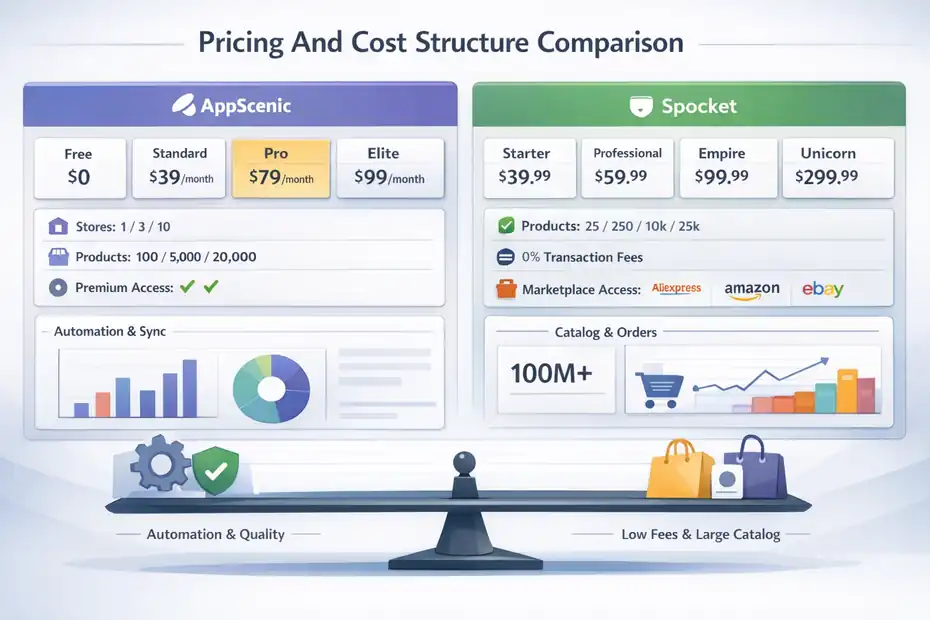
Pricing is where many people make the wrong decision because they only compare the monthly fee. That is not enough.
You need to look at product limits, store limits, premium access, and whether hidden operational friction will cost you more later.
AppScenic Pricing In Plain English
AppScenic currently shows a Free plan at $0 per month for browsing the catalog, then three paid plans: Standard at $39 per month, Pro at $79 per month, and Elite at $99 per month. The Standard plan includes 1 connected store and 100 pushed products.
Pro includes 3 connected stores and 5,000 pushed products. Elite includes 10 connected stores and 20,000 pushed products. Premium products are not included on Standard but are included on Pro and Elite.
That pricing tells me AppScenic is not trying to win on “cheapest beginner tool.” It is trying to win on functionality and scaling room. If you only need a handful of products to test one niche, $39 can feel high. But if you already know you want serious automation and supplier syncing, the math looks more reasonable.
A realistic scenario: Imagine you run a niche pet accessories store and plan to push 80 products, not 800. Standard could be enough. But if you are building a general store with frequent product testing, that 100-product cap can become restrictive very quickly.
Spocket Pricing In Plain English
Spocket currently shows Starter at $39.99 per month, Professional at $59.99 per month, Empire at $99.99 per month, and Unicorn at $299.99 per month on monthly billing.
The Starter plan includes 25 unique products, 0% transaction fee, the 100M+ catalog, unlimited orders, bulk checkout, premium products, supplier chat, branded invoices, and marketplace-related features shown on the page such as AliExpress, Amazon, and eBay dropshipping.
Professional increases limits to 250 unique products and 25 premium products. Empire rises to 10,000 unique products and 10,000 premium products. Unicorn goes to 25,000 unique and premium products.
The biggest pricing advantage Spocket advertises is 0% transaction fees across its plans. That matters because some dropshipping platforms quietly erode margin with order-based fees.
My read is simple: Spocket gives you a gentler entry path if you are okay with product limits and a more marketplace-style setup. It feels easier to justify for early testing.
Which One Is Better Value?
Pure monthly pricing is close at the entry level: AppScenic Standard is $39 and Spocket Starter is $39.99. But the value equation changes based on what you need. AppScenic gives 100 pushed products on Standard, while Spocket Starter shows 25 unique products.
Spocket, however, advertises 0% transaction fees and a much larger catalog footprint. AppScenic leans harder into automated sync and verified suppliers.
So the better value depends on your business model:
- Choose AppScenic for value if you care more about deeper automation, supplier vetting, and higher immediate product capacity.
- Choose Spocket for value if you care more about lower-friction testing, catalog breadth, and fee transparency.
I believe too many store owners compare these tools like software subscriptions when they should compare them like supply-chain systems. The real cost is not only the monthly charge. It is bad products, delayed syncs, product limits, and wasted testing cycles.
Product Catalog And Supplier Quality
Catalog size sounds exciting, but catalog quality usually matters more. A smaller, cleaner catalog can beat a massive one if your customers receive products on time and ask for refunds less often.
AppScenic’s Supplier Approach
AppScenic says it offers more than 1 million products and emphasizes verified domestic suppliers. It repeatedly highlights that suppliers are vetted before approval and that automation covers pricing, stock sync, ordering, and tracking updates.
That supplier-vetting angle is important. In dropshipping, “more suppliers” is not always better. Sometimes it just means more ways for your store to break. A curated network can reduce risk if the vetting is strong and the sync quality is reliable.
From a strategic angle, AppScenic makes more sense when your brand depends on consistency. Think home decor, pet goods, wellness accessories, or giftable products where presentation and delivery matter as much as product price.
Spocket’s Supplier Approach
Spocket heavily promotes US and EU suppliers and positions itself as a platform for faster shipping and curated winning products. It also advertises a 100M+ product catalog and broader marketplace capabilities.
That catalog scale can be useful for testing. If you are running a trend-led store, seasonal collection strategy, or broad general store, having more inventory ideas can help you move faster. The trade-off is that bigger catalogs usually require stricter filtering on your side.
This is where many beginners get hurt. They assume a big catalog means easy profit. In practice, a huge catalog means you need a tighter product selection process. Otherwise, you end up with random items, weak merchandising, and a store that feels like a flea market.
Which Platform Wins On Product Sourcing?
I’d frame it this way:
- AppScenic wins on curation mindset: verified suppliers, automation depth, and a more controlled supplier environment.
- Spocket wins on sourcing breadth: larger catalog claims, more testing flexibility, and broader marketplace appeal.
If you are building a brand, AppScenic has the stronger pitch. If you are still searching for product-market fit, Spocket has the stronger exploration advantage.
Automation, Syncing, And Daily Workflow
This is the section I think matters most, because once your store starts getting orders, pretty product pages stop being the issue. Operations become the issue.
Where AppScenic Feels Stronger
AppScenic clearly emphasizes 24/7 stock and price sync, automatic ordering, tracking-number imports, and automated supplier payments through its smart wallet. That is a meaningful operational stack.
Those features matter most when your order volume starts to grow. For example, if you are processing 20 to 40 orders per day, even small sync delays can create overselling, refund requests, and support tickets. Instant or near-real-time sync becomes a margin-protection feature, not just a convenience feature.
I also like that AppScenic frames automation around the whole workflow rather than only “import products fast.” That tells me the product is trying to reduce operational drag after the sale, not just help you launch faster.
Where Spocket Feels Stronger
Spocket also offers automatic fulfillment, order tracking, bulk checkout, and an easier product import flow. It repeatedly positions itself as beginner-friendly and emphasizes one-click import plus automated order management.
That kind of workflow is often enough for newer sellers. If you are not doing heavy order volume yet, simplicity can matter more than advanced payment automation. A clean import-to-order flow is a legitimate advantage when you are still learning merchandising, ad testing, and customer support basics.
Spocket’s broader marketplace support can also help if you plan to sell in multiple ecosystems later. That is not relevant for every store, but for some operators it becomes a real growth lever.
Which One Is Easier To Run Long Term?
My honest opinion: AppScenic appears better set up for sellers who want operations to feel tighter over time, while Spocket appears easier for sellers who want to get moving faster and test more broadly.
If your business goal is “launch quickly and validate a niche,” Spocket has the easier story.
If your business goal is “build a reliable system that I won’t outgrow in six months,” AppScenic has the stronger operational story.
Integrations And Store Compatibility
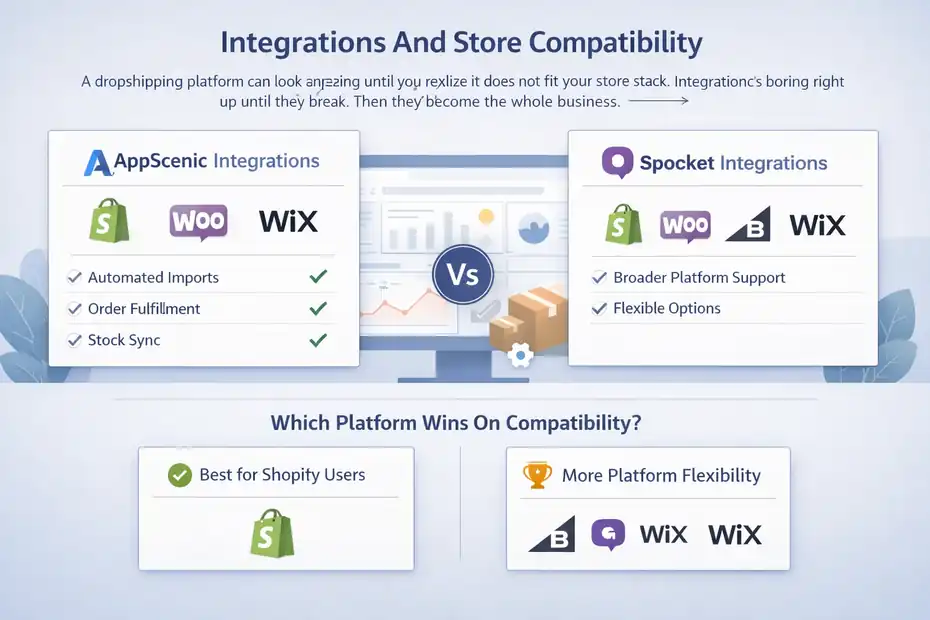
A dropshipping platform can look amazing until you realize it does not fit your store stack.
Integrations are boring right up until they break.Then they become the whole business.
AppScenic Integrations
AppScenic officially highlights integrations with Shopify, WooCommerce, and Wix, and its integrations page says it automates product imports, order payments and fulfillment, price and stock sync, tracking numbers, and translations.
Its individual integration pages for Shopify, WooCommerce, and Wix all lean into full automation.
That is a solid fit for many independent store owners because Shopify, WooCommerce, and Wix cover a big slice of the market. If you are on one of those platforms, AppScenic looks straightforward.
Spocket Integrations
Spocket’s integrations page says it integrates with platforms including Shopify, WooCommerce, BigCommerce, and Wix. Its help center also provides connection guides for Shopify, WooCommerce, and BigCommerce.
That wider integration footprint gives Spocket an edge if you are not locked into Shopify or WooCommerce. It also suggests a slightly broader approach to platform compatibility.
Which Platform Wins On Compatibility?
Spocket gets the nod here because its official integration footprint appears broader, especially with BigCommerce support clearly documented.
AppScenic still covers the big three for many small and mid-sized sellers, but Spocket gives you more platform flexibility on paper.
If you are already on Shopify, this is less decisive. If you are still choosing your commerce stack, Spocket is more flexible.
Beginner Setup And Learning Curve
A lot of comparison posts skip this, but they should not. The best platform for an experienced operator is not always the best one for a first-time store owner.
Starting With AppScenic
AppScenic shows a simple getting-started flow: create an account, connect your store, and import products. The free browsing plan and trial make it possible to explore before paying for a full setup.
Still, I would not call AppScenic the most forgiving option for true beginners. Its product structure, automation depth, and plan logic make more sense once you already understand margins, supplier selection, and product syncing.
That is not a flaw. It just means the platform feels more “business system” than “toy sandbox.”
Starting With Spocket
Spocket explicitly says it is beginner-friendly and positions its flow as sign up, connect your store, browse products, and start selling. Its help center also makes store connection steps easy to follow.
That messaging lines up with the product design angle. A newer seller can usually understand the appeal immediately: browse products, import them, automate fulfillment, and keep moving.
Which One Is Easier For A New Seller?
Spocket wins for beginner friendliness. AppScenic wins for sellers who already know what operational control they want.
If this is your first store, I’d usually suggest starting with the platform that reduces decision fatigue. In many cases, that will be Spocket. If this is your second or third store and you are tired of messy workflows, AppScenic becomes much more attractive.
Common Mistakes People Make When Choosing Between Them
This is where a lot of wasted money happens. Most bad software decisions are actually bad strategy decisions wearing a software hat.
Mistake 1: Choosing Based Only On Monthly Price
A $20 to $40 difference means nothing if one platform helps you avoid overselling, refund requests, or support chaos. I have seen sellers obsess over subscription cost while leaking hundreds in poor product selection and customer complaints.
AppScenic’s higher product allowances and automation features may justify the price for some stores, while Spocket’s lower-tier flexibility may be more efficient for lean testing.
Mistake 2: Confusing Catalog Size With Product Opportunity
Spocket’s 100M+ catalog sounds huge, but huge does not mean profitable. You still need angle, offer, positioning, landing-page clarity, and delivery reliability.
AppScenic’s more curated supplier story can actually be an advantage if you want fewer, better product options.
Mistake 3: Ignoring Your Store Type
A niche, brand-focused store and a rapid product-testing general store should not choose software the same way. If you ignore that, you will either overpay for features you do not use or underbuy and hit operational ceilings early.
My rule of thumb:
- Brand-first niche store: lean toward AppScenic.
- Test-heavy or broader catalog store: lean toward Spocket.
That is not universal, but it is a smart starting point.
Which Platform Is Better For Different Business Scenarios
You do not need a universal winner. You need the right winner for your business model. That is a healthier way to make this decision.
Best For A New Solo Store Owner
Spocket is easier to recommend for a new solo founder who wants quick setup, simple imports, and an accessible starting point. Its beginner-friendly messaging, 7-day trial, lower-tier entry plan, and broad catalog make it easier to test your first few offers without feeling boxed in by a more system-heavy platform.
Imagine you are launching a skincare accessories store with 12 to 20 SKUs. You care more about speed and experimentation than deep workflow sophistication. Spocket is probably enough.
Best For A Brand-Focused Store
AppScenic is stronger for stores that care about supplier verification, brand consistency, and automation depth. If you are building a cleaner niche brand and want fewer supply-chain surprises, AppScenic’s positioning makes more sense.
Imagine you are building a modern home office store with higher average order value. You want tighter product selection, cleaner customer experience, and fewer fulfillment headaches. AppScenic feels better aligned.
Best For Scaling Operations
For scaling, the answer depends on what kind of scaling you mean.
If you mean scaling catalog breadth, channel reach, and product testing volume, Spocket has a strong case because of its huge catalog claims, multi-store support, and broader marketplace-oriented features.
If you mean scaling process reliability, order automation, and operational control, AppScenic has the stronger case because of its sync, auto-ordering, tracking automation, and smart payment system.
Final Verdict: AppScenic Vs Spocket Comparison Which Wins?
The honest answer is that neither platform wins for everyone.
AppScenic wins if you want deeper automation, a more curated supplier environment, and a setup that feels better suited to building a tighter long-term operation. Its paid plans are more expensive, but the operational value can justify that for serious niche stores and scaling brands.
Spocket wins if you want easier onboarding, broader catalog access, more platform flexibility, and a lower-friction way to test products and offers. It is especially appealing for beginners and for sellers who want to move fast without overcommitting to a more structured system too early.
If you want my personal recommendation, here it is:
- Choose AppScenic if your priority is control, automation depth, and supplier quality.
- Choose Spocket if your priority is speed, catalog access, and beginner-friendly testing.
For many people, the real winner is not the “better” platform. It is the one that matches your current stage without trapping your next stage.
And that is the comparison that actually matters.
FAQ
What is the main difference between AppScenic and Spocket?
The main difference in an appscenic vs spocket comparison is that AppScenic focuses on automation and verified suppliers, while Spocket emphasizes a larger product catalog and beginner-friendly setup. AppScenic is better for operational control, while Spocket is ideal for fast product testing and easier onboarding.
Which is better for beginners, AppScenic or Spocket?
In most cases, Spocket is better for beginners because it offers a simpler setup process, a large catalog for testing products, and an intuitive interface. AppScenic can feel more advanced, making it better suited for users who already understand dropshipping workflows and automation.
Does AppScenic or Spocket offer better product quality?
AppScenic tends to offer more consistent product quality due to its focus on verified suppliers and curated listings. Spocket also provides quality products, especially from US and EU suppliers, but its larger catalog means you need to filter carefully to maintain consistency.
Which platform is more affordable, AppScenic or Spocket?
Spocket is generally more flexible for beginners with lower entry barriers and no transaction fees. AppScenic may appear more expensive upfront, but its automation features and higher product limits can provide better value for scaling businesses over time.
Can you use AppScenic or Spocket for scaling a dropshipping business?
Yes, both platforms support scaling, but they do so differently. AppScenic is better for scaling operations with automation and supplier control, while Spocket is better for scaling product testing and expanding into multiple sales channels.

I’m Juxhin, the voice behind The Justifiable.
I’ve spent 6+ years building blogs, managing affiliate campaigns, and testing the messy world of online business. Here, I cut the fluff and share the strategies that actually move the needle — so you can build income that’s sustainable, not speculative.
Related posts:
 AppScenic Dropshipping Review: Hidden Truths
 Sell The Trend Review: Is It the Best Dropshipping Tool?
 Shopify DSers Review: Is It Really Worth Your Time?
 AppScenic Pros And Cons For Dropshipping
 Spocket Review Honest Pros And Cons: Worth It Or Not?
 Can You Make Money With Spocket Or Is It Overhyped?