
Table of Contents
Some links on The Justifiable are affiliate links, meaning we may earn a small commission at no extra cost to you. Read full disclaimer.
If you are trying to decide whether Spocket vs Zendrop which is better for your store, the honest answer is that each platform wins in a different kind of dropshipping business.
Spocket leans hard into US and EU supplier access, curated products, and a more “premium catalog” feel, while Zendrop pushes automation, branding, coaching, and a bigger all-in-one scaling pitch.
I’ve looked at the current official pricing, shipping, and feature pages for both, and the best choice really comes down to what you sell, how fast you want to move, and how much control you want over branding and fulfillment.
What Spocket And Zendrop Actually Do
Both tools solve the same core problem: they help you run a dropshipping store without stocking inventory yourself.
The difference is in how they approach suppliers, fulfillment, and store growth.
Spocket Focuses On Curated US And EU Supplier Access
Spocket is built around product sourcing and order management, with a strong pitch around US and EU suppliers, faster local shipping, premium products, and store integrations.
On its public site, it also highlights one-click product importing, tracking, multiple store support, branded invoicing, and marketplace options like Amazon and eBay dropshipping on supported plans.
What that means in plain English is simple: Spocket is usually trying to help you sell products that feel less like “generic random imports” and more like locally sourced or at least better-positioned catalog items. That matters if your brand angle is quality, faster delivery, or a cleaner customer experience.
In my experience, this kind of positioning often works better for stores selling home goods, lifestyle accessories, beauty tools, pet items, and giftable products where buyers care about trust and delivery speed. This positioning is supported by Spocket’s own emphasis on premium products, supplier chat, and US/EU sourcing.
There is one thing I would keep in mind, though: Spocket is still a marketplace layer between you and suppliers. So even if the catalog feels more curated, your actual experience can still vary by supplier responsiveness, stock reliability, and shipping consistency.
Public Shopify reviews for Spocket show both positive comments about shipping and sourcing and negative comments about billing, supplier responsiveness, and sync issues, which tells me supplier-level execution still matters a lot.
Zendrop Focuses On Automation, Branding, And Faster Scaling
Zendrop positions itself more aggressively as an all-in-one dropshipping platform for launching and scaling.
Its official site and pricing pages emphasize automated fulfillment, 1M+ products, AI features, print-on-demand, private product listings, custom branding, coaching calls, and academy resources. It also claims more than 3,000,000 sellers on its homepage.
That matters because Zendrop is not just selling “find a product and import it.” It is selling the idea of an operating system for beginner-to-growth-stage dropshippers.
If you are the kind of seller who wants product discovery help, automation, branding upgrades, and educational support in the same ecosystem, Zendrop is clearly built to appeal to you.
Its help center also documents private labeling and custom packaging options, which fits that more brand-oriented positioning.
From what I’ve seen, Zendrop tends to make more sense for sellers who want to test faster, automate more of the routine work, and move toward a brand feel without building a private supply chain from scratch.
Public Shopify app data also shows Zendrop with a higher rating and a much larger review count than Spocket on the Shopify App Store partner pages, which is not everything, but it is a useful signal when judging market traction.
The Quick Verdict: Which One Is Better?
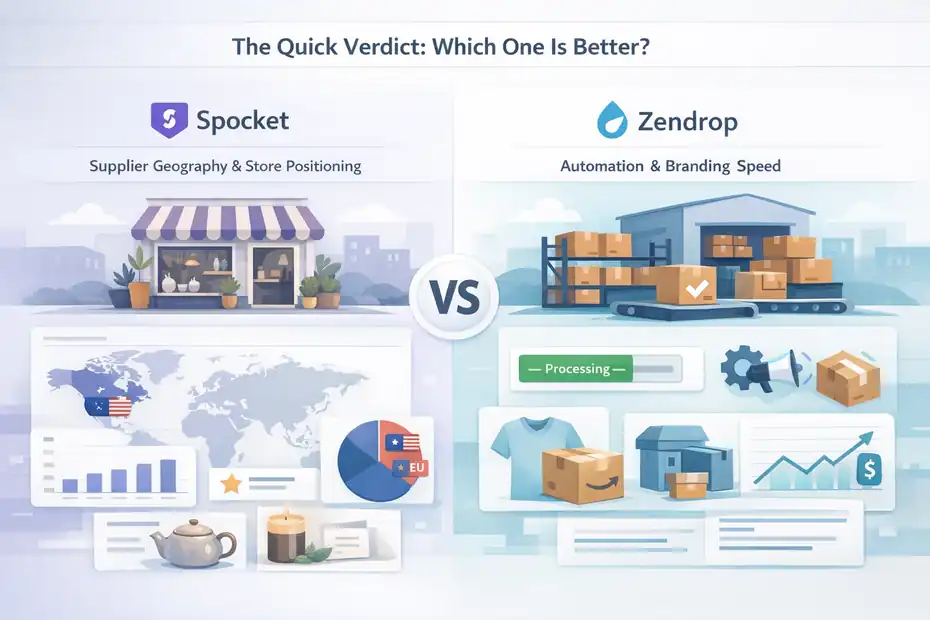
There is no universal winner.
The better platform depends on what kind of store you are building, what your margins look like, and how important shipping geography is to your customers.
Choose Spocket If You Care Most About Supplier Geography And Store Positioning
I would lean toward Spocket if your whole offer depends on products sourced from US and EU suppliers, or at least on the customer perception of faster, more trustworthy shipping from those regions.
Spocket’s public site repeatedly leans on US and EU sourcing, premium products, and curated supplier access, and that makes it a stronger fit for stores where brand trust is tightly connected to where products come from.
Imagine you are building a Shopify store for kitchen accessories or boutique home decor. In that case, your customers are less likely to tolerate vague shipping timelines or obviously commodity-style product pages.
Spocket helps more when your brand message is something like “carefully selected products with faster delivery” instead of “low-cost viral items tested at speed.” That difference is subtle, but it affects everything from your ad angle to your refund rate. The platform’s premium product and branded invoice features support that kind of positioning.
I also think Spocket can make sense if you want a slightly narrower catalog with less noise. A smaller, more curated pool can be helpful when you are trying to build a cohesive catalog instead of chasing every trending item.
The tradeoff is that a more curated marketplace is not always the best environment for ultra-fast product testing at scale.
Choose Zendrop If You Care Most About Automation, Branding, And Operational Speed
I would lean toward Zendrop if you want to launch quickly, test products more aggressively, automate fulfillment, and grow into branding features without stitching together too many separate systems.
Zendrop’s pricing page clearly highlights automated fulfillment, custom branding, private product listings, print-on-demand, and coaching support, while its help center confirms custom packaging and private labeling options.
That makes Zendrop stronger for the seller who wants one platform to handle sourcing, order flow, fulfillment automation, and some brand-building upgrades later.
I especially like this structure for beginner and intermediate sellers who are not just asking, “Where do I get products?” but also, “How do I stop my backend from becoming chaos once orders start coming in?” Zendrop’s platform story is more complete in that sense.
There is another practical advantage: Zendrop publishes concrete help-center guidance around standard processing and international shipping expectations. It says processing is usually 1–3 days, sometimes up to 5, and that global shipping averages 10–15 days.
That is useful because it gives you something more operationally specific than generic marketing language when planning customer communication.
Pricing: Which Platform Gives Better Value?
Pricing is where many comparisons go wrong. The cheapest plan is not always the best value.
The better question is whether the features you need show up early enough in the plan structure.
Spocket Pricing Is More Traditional, But Gets Expensive As You Scale
Spocket’s official pricing page currently shows Starter at $39.99 per month, Professional at $59.99 per month, Empire at $99.99 per month, and Unicorn at $299.99 per month on monthly pricing, with lower annual equivalents shown elsewhere on the same page.
The page also mentions a 7-day trial in plan cards, but its FAQ mentions a 14-day free trial, so there is some inconsistency on the same pricing page that you should verify before subscribing.
What I notice here is that Spocket becomes meaningfully more expensive once you need broader catalog access and higher product limits.
Starter shows 25 unique products, Professional shows 250 unique products and 25 premium products, Empire shows 10,000 unique and premium products, and Unicorn goes to 25,000 unique and premium products.
That tells me Spocket’s value curve is not really designed around “I need the cheapest possible way to test a lot of products.” It is more suited to sellers who want curated access and are comfortable paying for scale.
If your business model depends on wide product testing, Spocket’s structure can feel restrictive early on. But if you are building a tighter, more selective store, that may not hurt you much. I believe this is one of the biggest hidden decision points in the whole Spocket vs Zendrop debate.
Zendrop Starts Cheaper And Looks Better For Beginners
Zendrop’s official pricing page currently shows a Free plan, a Pro plan at $49 per month, and a Plus plan at $79 per month, alongside annual prices.
The Free plan includes access to 1M+ products, 24/7 support, unlimited orders, and other listed features, while paid tiers add more growth-oriented capabilities such as automated fulfillment, custom branding, print-on-demand, and private product listings.
For beginners, that matters a lot. A free starting point lowers risk, especially when you are still validating your niche, testing product pages, or figuring out whether your traffic strategy can actually convert.
In plain terms, Zendrop gives you more room to experiment before your software stack starts eating your margin. That is often the smarter move for a first-time store owner.
I do want to be fair here: low entry cost is only helpful if the workflow stays reliable once orders come in. But on pure pricing structure, Zendrop looks more beginner-friendly than Spocket right now. If you are bootstrapping, Zendrop usually wins the value conversation unless Spocket’s US/EU supplier angle is the single thing your store cannot live without.
Product Selection And Supplier Quality
This is where a lot of store owners get emotional, because the product catalog ends up shaping the whole brand.=
The right question is not “Which has more products?” but “Which gives me better products for my business model?”
Spocket Is Better For Curated Catalogs And A More Premium Feel
Spocket promotes a 100M+ product catalog, premium products, curated suppliers, and strong US/EU sourcing. On paper, that sounds broad, but the practical advantage is not just size. It is the positioning of the marketplace. Spocket is clearly trying to feel more curated than a raw bulk-import sourcing environment.
That tends to help if you want cleaner brand consistency. For example, a minimalist wellness shop or modern pet accessories brand usually benefits more from a tighter catalog than from a chaotic “everything store” experience.
When your catalog looks intentionally selected, your product pages usually convert better because the store feels more trustworthy. I believe this is one of Spocket’s biggest strengths, even if it is not always captured in simple feature checklists.
The tradeoff is that curated usually also means less flexibility for wild experimentation. If your growth style is “test 30 products fast and kill losers quickly,” Spocket may feel slower or more expensive relative to the freedom you want.
Product quality and catalog curation can absolutely improve brand perception, but they do not always maximize testing speed.
Zendrop Is Better For Breadth, Testing, And Finding Winning Products Faster
Zendrop’s official pricing page says even the free plan includes access to 1M+ products, while paid plans highlight “Top Winning Products,” product requests, US products, and private listings. Its homepage also leans heavily into product discovery, profitability, and speed.
That tells me Zendrop is better optimized for sellers who want product breadth and a more active testing workflow. If you are running TikTok-style creative testing, fast product-page iteration, or frequent offer swaps, a bigger catalog with product-request support is valuable.
You are not just buying access to items. You are buying optionality.
A realistic scenario here is a one-product store operator who tests three adjacent offers every month. Zendrop makes more sense in that setup because the platform feels built for product motion, not just product curation.
I would still tell you to vet product detail pages carefully, because a large catalog is only useful if you filter aggressively. But if your strategy depends on speed and volume, Zendrop has the edge.
Shipping Times And Fulfillment Reliability
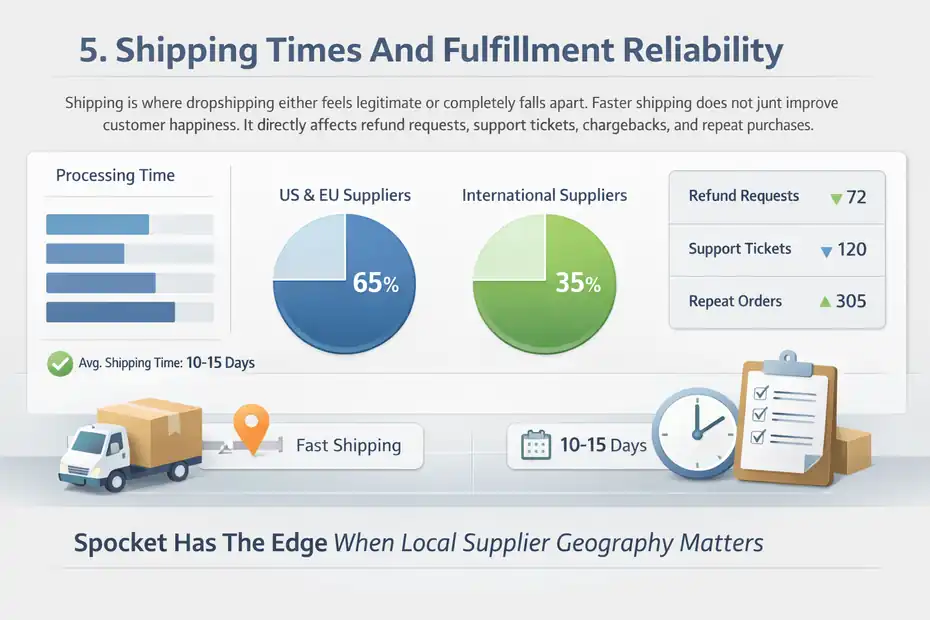
Shipping is where dropshipping either feels legitimate or completely falls apart. Faster shipping does not just improve customer happiness.
It directly affects refund requests, support tickets, chargebacks, and repeat purchases.
Spocket Has The Edge When Local Supplier Geography Matters
Spocket’s strongest public differentiation is still its US and EU supplier base. That does not automatically guarantee fast shipping on every product, but it improves your odds of shorter delivery windows for customers in those regions compared with purely overseas-first sourcing. Spocket’s site repeatedly emphasizes this supplier geography as a key benefit.
This matters more than many beginners realize. A store selling impulse-buy gadgets might survive with longer delivery expectations if the price is low enough. But a store selling gift items, home accessories, or customer-sensitive products usually suffers when shipping feels vague or slow.
In those categories, supplier geography is a conversion lever, not just an operations detail. Spocket gives you a stronger foundation for that kind of promise.
The catch is that Spocket is not publishing one simple universal shipping SLA on the pages I reviewed, because supplier-level delivery depends on the item and source. So I would not choose Spocket assuming every listing will ship quickly.
I would choose it because it gives you access to a supplier mix that can support a faster-delivery strategy if you curate carefully.
Zendrop Is More Transparent About Its Fulfillment Timelines
Zendrop’s help center is more specific about shipping and processing. It says standard processing is usually 1–3 days, sometimes up to 5 days, and that global shipping averages 10–15 days for international orders. That kind of clarity is helpful when setting shipping notices, support templates, and customer expectations.
I like this because transparency is underrated in dropshipping. Even if 10–15 days is not “Amazon fast,” it is a workable promise when you communicate it clearly before purchase.
Customer frustration often comes less from the raw delay and more from surprise. Zendrop gives you more concrete information to build your customer messaging around.
So here is my honest take: Spocket is better if you want to lean into local-supplier positioning and potentially faster regional fulfillment, while Zendrop is better if you want a more documented, automation-oriented fulfillment process you can explain clearly to buyers. That is a small distinction, but it matters in practice.
Branding, Custom Packaging, And Long-Term Store Building
A lot of stores never get past the “random product reseller” stage because they do not invest in brand signals early enough. This is where Zendrop starts to look stronger.
Zendrop Is Better For Private Labeling And Packaging Upgrades
Zendrop’s help center explicitly lists custom packaging and private labeling options, including branded boxes, logo printing, and products labeled with your brand. Its pricing and marketing pages also mention custom branding and private product listings.
That is a big deal if you are trying to move from simple arbitrage into a real branded e-commerce business. Branded packaging does not just look nice. It raises perceived value, supports repeat purchases, and makes your business feel intentional.
If two stores sell similar products, the one that feels like a brand usually wins more often on trust alone. Zendrop is clearly set up for that progression.
I would especially recommend Zendrop here for sellers who already know they want to build a store that can eventually become its own asset. Private labeling and packaging are not mandatory on day one, but it helps when the path is already built into your platform. Otherwise, retooling later becomes messy.
Spocket Covers Basic Brand Presentation, But Not As Deeply
Spocket does offer branded invoices across its paid plans, which is useful and definitely better than sending completely generic order documentation. It also includes supplier chat and premium product access, which can support a more polished customer experience.
Still, if I compare the two side by side on branding depth, Zendrop feels more intentionally built for custom packaging and private label progression. Spocket helps you present your store better, but Zendrop appears to give you more visible infrastructure for turning a dropshipping setup into a brand-led business.
That distinction matters if you are thinking six to twelve months ahead instead of just trying to get your first sale.
So if your long-term goal is “build a branded store I can scale or even sell later,” I would give Zendrop the branding win. If your goal is “sell curated products with a cleaner buying experience now,” Spocket can still do the job well.
Ease Of Use, Automation, And Day-To-Day Workflow
What kills momentum in dropshipping is not usually product sourcing. It is backend friction. If every order becomes a manual task, growth gets painful fast.
Zendrop Has A Stronger Automation Story
Zendrop’s paid plans explicitly include automated fulfillment, and its broader messaging leans heavily into operational ease, scaling, and all-in-one workflow support. That is exactly what you want if your store starts getting consistent daily orders and you do not want fulfillment to become a part-time job.
I think this is where Zendrop becomes easier to justify as your order volume rises. Automation is not sexy, but it protects your time and reduces the chance of fulfillment mistakes.
For many stores, the best software investment is not the one that adds more products. It is the one that removes repetitive work. Zendrop’s positioning is very strong on that front.
Its training ecosystem also helps here. Weekly coaching calls and Zendrop Academy are not mission-critical features for advanced operators, but for newer sellers they can shorten the learning curve.
Sometimes that matters more than a feature chart because the real bottleneck is not software access. It is decision quality.
Spocket Is Straightforward, But More Catalog-Centric Than System-Centric
Spocket is not difficult to use. Its site highlights one-click imports, tracking, automatic fulfillment, supplier chat, and support resources. Public reviews also mention its interface being intuitive.
The difference is that Spocket feels more centered on sourcing and supplier access, while Zendrop feels more centered on operational workflow and store growth. That does not mean Spocket is weak. It just means the center of gravity is different.
If your main headache is finding better products with better regional sourcing, Spocket solves the right problem. If your main headache is streamlining order flow and building a brandable machine, Zendrop solves the right problem.
I suggest thinking about your current bottleneck before choosing. Most people compare platforms like they are picking a “best app.” In reality, you are choosing which business problem you need solved first.
Common Mistakes People Make When Comparing Spocket And Zendrop
This is the part most comparison posts skip, and honestly, it is where the expensive mistakes happen. The wrong platform is often the result of the wrong buying logic.
Mistake 1: Choosing Based Only On Monthly Price
A lot of people see a cheaper entry plan and assume it is the better deal. That is only true if the platform still works for your store once you get traction.
Zendrop’s lower barrier to entry is a real advantage, but Spocket may still be more profitable for a store that depends on better regional supplier positioning and higher perceived product quality.
The smarter way to compare is this: ask which platform gives you the shortest path to your actual business model. If you are building a premium-feeling lifestyle store, a slightly higher software bill may be worth it if it improves conversion rate and reduces customer complaints.
If you are testing broad offers fast, flexible access matters more.
In other words, software cost should be compared against likely business outcome, not just against itself. That is the adult way to do e-commerce math.
Mistake 2: Ignoring Shipping Expectations And Brand Fit
Another mistake is choosing a platform because a YouTube review said it was “best overall.” That is useless unless the reviewer has your exact business model. A general store running aggressive paid-social testing has very different needs from a niche brand trying to earn trust and repeat purchases.
If your audience expects local-feeling delivery and a polished brand experience, Spocket may be the better fit even if Zendrop has more flashy features. If your audience is more price-sensitive and you are optimizing for product testing speed, Zendrop often makes more sense.
This is why I believe “best platform” is the wrong question. “Best platform for my promise to customers” is the right one.
That single shift in thinking can save you months of rebuilding later.
Final Recommendation: Which One Should You Pick?
Here is the simple version. If you want the cleaner answer without the fluff, this is it.
Pick Spocket If Your Store Wins On Trust, Curation, And Regional Sourcing
Go with Spocket if you want to build a more curated store, care a lot about US/EU supplier access, and want your catalog to feel more premium from the start. It is the stronger fit for stores that rely on cleaner positioning, faster local-feeling shipping potential, and a more selective product mix.
Spocket also includes helpful features like branded invoices, supplier chat, premium products, and marketplace support on its plans.
I would especially consider Spocket for niches like home decor, boutique accessories, beauty tools, pet products, and gift items where trust and presentation matter more than aggressive test volume. If that is your lane, Spocket may produce a better customer experience even if it costs more.
Pick Zendrop If You Want The Better All-Around Growth Platform
Go with Zendrop if you want lower-risk entry pricing, stronger automation, clearer fulfillment workflows, branding upgrades, and an easier path from beginner seller to scaled operator. Its published features around automated fulfillment, custom branding, private listings, private labeling, print-on-demand, and coaching make it the better all-around choice for most new and growing dropshippers.
If you forced me to pick one platform for the average beginner in 2026, I would choose Zendrop. The reason is not hype. It is simply that Zendrop gives more flexibility early, looks better for operational automation, and creates a stronger bridge toward branding later. But if your brand angle depends on curated US/EU sourcing, Spocket can still absolutely be the smarter call.
So, spocket vs zendrop which is better? For most beginners, Zendrop is better overall. For curated, premium-feeling stores built around US/EU supplier positioning, Spocket is better. That is the honest answer.
Quick Comparison Snapshot
This last section gives you a fast reference if you are still stuck between the two.
| Area | Spocket | Zendrop |
|---|---|---|
| Best For | Curated stores, US/EU supplier positioning | Beginners, automation, scaling, branding |
| Entry Pricing | Paid plans start at $39.99/month on current monthly page | Free plan available; paid plans shown from $49/month |
| Supplier Angle | Strong US/EU emphasis | Broad catalog with US products and product requests |
| Automation | Solid, but less central to positioning | Strong automation-first positioning |
| Branding | Branded invoices | Custom branding, private labeling, custom packaging |
| Shipping Strength | Better fit for regional/local-feeling positioning | More transparent published processing and shipping guidance |
| Ideal User | Niche brand with curated products | Seller testing, growing, and systemizing fast |
The table above reflects the current official pages I reviewed, and I would still encourage checking the live plan pages before subscribing because pricing pages can change and Spocket’s current trial messaging appears inconsistent between sections of its own site.
My final opinion is simple: Zendrop is the safer default recommendation, while Spocket is the better specialist choice. When a platform is better for a narrower but very real use case, that does not make it worse. It just means you need to match the tool to the store you actually want to build.
FAQ
What is the main difference between Spocket and Zendrop?
The main difference is that Spocket focuses on US and EU suppliers with a curated product catalog, while Zendrop emphasizes automation, product variety, and branding features. Spocket is better for premium positioning, while Zendrop is better for scaling and testing products quickly.
Is Zendrop better than Spocket for beginners?
Zendrop is generally better for beginners because it offers a free plan, automated fulfillment, and built-in training resources. It allows new sellers to test products with lower risk and less upfront cost compared to Spocket’s paid entry plans.
Does Spocket have faster shipping than Zendrop?
Spocket can offer faster shipping when using US or EU suppliers, especially for customers in those regions. Zendrop typically provides global shipping that averages around 10–15 days, making it reliable but not always as fast as local supplier options.
Which platform is better for branding, Spocket or Zendrop?
Zendrop is better for branding because it includes features like custom packaging, private labeling, and branded products. Spocket offers branded invoices, but it does not provide the same level of brand customization as Zendrop.
Which is more profitable, Spocket or Zendrop?
Profitability depends on your business model. Spocket may offer higher perceived value with curated products, while Zendrop allows faster testing and scaling. Zendrop is often more profitable for beginners, while Spocket works better for niche, premium-focused stores.

I’m Juxhin, the voice behind The Justifiable.
I’ve spent 6+ years building blogs, managing affiliate campaigns, and testing the messy world of online business. Here, I cut the fluff and share the strategies that actually move the needle — so you can build income that’s sustainable, not speculative.
Related posts:
 Spocket Review Honest Pros And Cons: Worth It Or Not?
 Can You Make Money With Spocket Or Is It Overhyped?
 The Best Way to Dropship Without Wasting Money
 How to Become a Dropshipper With No Experience
 Dropshipping How to Start: Your Complete Beginner’s Guide
 Salehoo Products List That Helps You Find Winning Items Fast